
Reviewed · POMPEII & VESUVIUS TOURS
Pompeii: Skip-the-Line Guided Tour with Expert Archaeologist
Pompeii makes ancient life feel startlingly close. This archaeologist-led tour gives you the context needed to understand the ruins, not just a march past old stones. I like the small-group format, which makes it easier to hear, ask questions, and keep pace with the guide. I also like the focus on ordinary life, from bakeries and shops to public baths and houses.
The three-hour option reaches farther than the shorter Pompeii Express route and may include newer excavation areas. The main drawback is the physical effort: Pompeii is huge, hot, uneven, and short on shade. At $70 per person, the price is fair if you want expert interpretation and a smoother entry, but less appealing if you prefer wandering alone or plan to spend a full day exploring every corner.
The best guides bring the buried city back to life. Past tours have featured archaeologists such as Ilaria, Anna, Brunella, Enzo, Sonia, and Iliana, all praised for clear explanations, humor, and enthusiasm. One family even found that their children stayed interested for all three hours, which is no small achievement at an enormous archaeological park.
In This Review
- Key points to know before booking
- Why Pompeii is better with a guide
- Meeting at Via Villa dei Misteri, 1
- Walking Pompeii’s preserved streets
- The Forum, temples, and public life
- Shops, bakeries, baths, and homes
- Brothels, cemeteries, and the human cost
- New excavations and Pompeii’s unfinished story
- City walls and views toward Naples
- How good is the $70 value?
- Which Pompeii option should you choose?
- Practical details that make the day easier
- Should you book this Pompeii tour?
- FAQ
- Where does the Pompeii tour meet?
- How early should I arrive?
- How long does the tour last?
- What is included in the price?
- Is hotel pickup included?
- Is the tour conducted in English?
- Can I choose a private tour?
- What should I bring?
- Can wheelchair users or people with mobility impairments join?
- Can the tour include a brothel or new excavation area?
Key points to know before booking

- An archaeologist leads the walk: You get more than basic dates and names. The guide explains what buildings were for, how people lived, and how excavations continue today.
- The three-hour route covers more ground: Choose the Complete Pompeii option if you want the Forum, temples, shops, baths, homes, casts, city walls, and possible newer digs.
- The Express option lasts about two hours: It focuses on major sights such as the Forum, temples, and shops.
- Pompeii is physically demanding: Expect uneven streets, heat, dust, and very little shade. Comfortable shoes, water, a hat, and sun protection matter.
- Skip-the-line entry saves useful time: Your ticket is reserved in advance, so you avoid the regular entry line at the park gate.
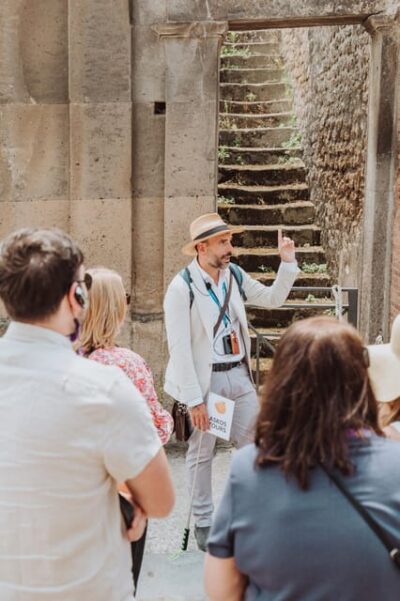
- The meeting point needs care: Meet at the entrance on Via Villa dei Misteri, 1, across from the Hortus Pompei restaurant. Look for the guide holding a green Walks sign.
Why Pompeii is better with a guide

Pompeii is not a tidy museum. It is a sprawling city with streets, public buildings, private homes, businesses, walls, cemeteries, and half-excavated areas. Without explanation, you can easily walk past a bakery, temple, or residence without understanding what you are seeing.
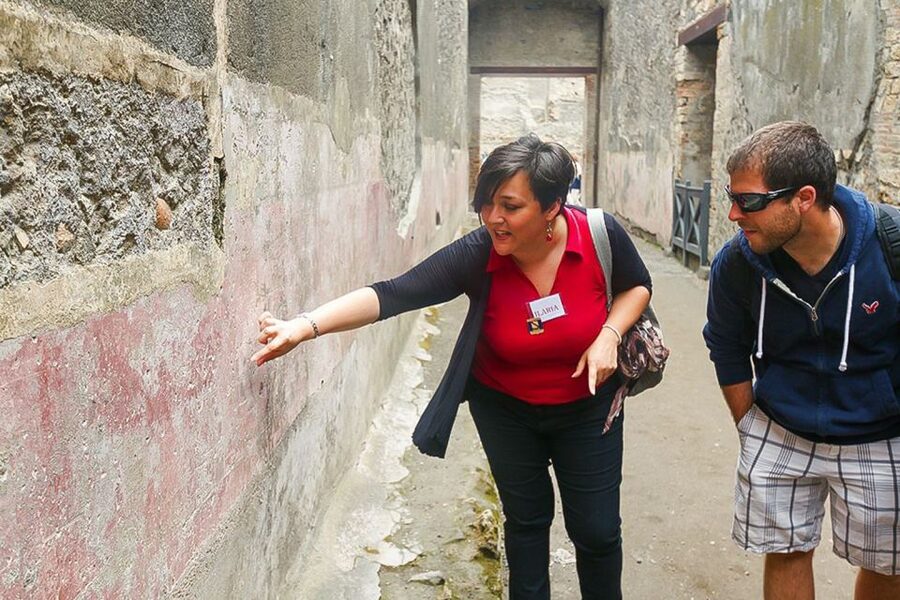
That is where this tour earns its keep. An archaeologist can point out the small details that make the site human. You may notice a counter in a shop, a bakery where food remains almost intact, or the layout of a house that reveals how social life worked. The guide connects these pieces to daily routines in the Roman world.
I especially like that the tour is not limited to Pompeii’s postcard sights. The Forum and temples matter, but the shops, baths, bakery, cemetery, and homes tell you how the city functioned. You get a better sense of Pompeii as a living town rather than only a disaster site.
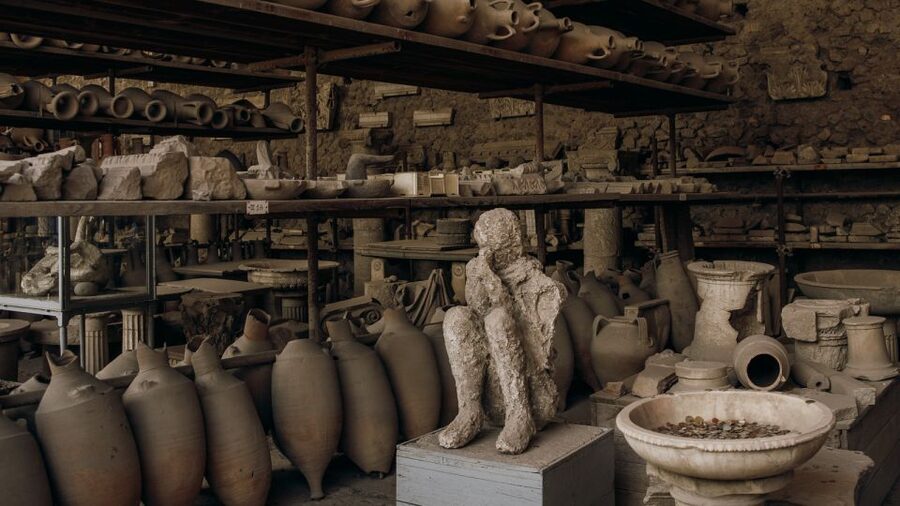
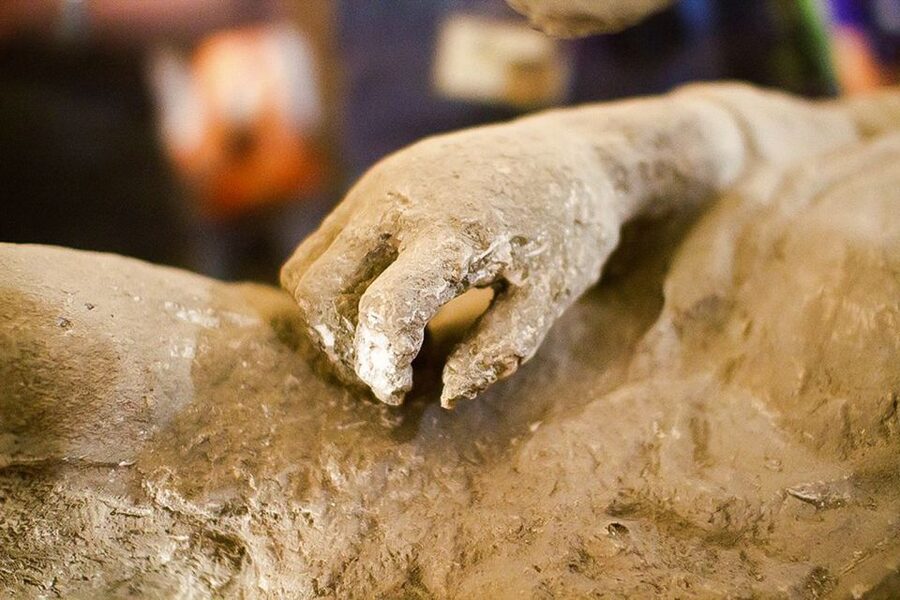
The guide also explains the eruption of Mount Vesuvius in 79 AD and the city’s tragic end. The plaster casts are among the most emotional parts of the visit. They show people caught during the eruption, and the experience can feel heavy. A good guide handles this material with care, giving historical context without turning suffering into spectacle.
More Pompeii and Vesuvius trips:
- Pompeii: Entry Ticket and Guided Tour with an Archaeologist
★ 4.8 · 19,459 reviews - Pompeii: Entry Ticket with Optional Audio Guide
★ 4.2 · 12,360 reviews - Pompeii: Small Group Tour with an Archaeologist
★ 4.8 · 12,264 reviews
Meeting at Via Villa dei Misteri, 1
You meet at the entrance gate to Pompeii Archaeological Park, across from the Hortus Pompei restaurant. Arrive 15 minutes early and look for the green Walks sign.
This is one place where you should pay close attention to the exact directions. One past participant found the digital map pin confusing, and another suggested that the meeting and end points could be explained more clearly. The practical fix is simple: use the stated entrance address and identify the restaurant as your landmark. Do not rely only on a generic map pin.
The tour returns to the same entrance area after roughly two or three hours. Hotel transportation is not included, so you must arrange your own way to Pompeii. If you are coming from Naples or another town in Campania, allow extra time for the journey and for finding the correct gate.
Walking Pompeii’s preserved streets
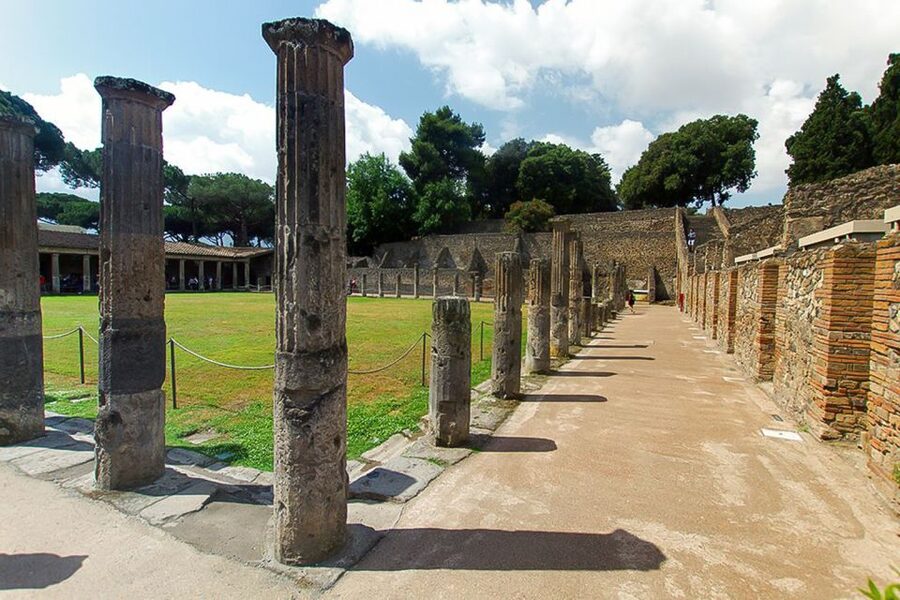
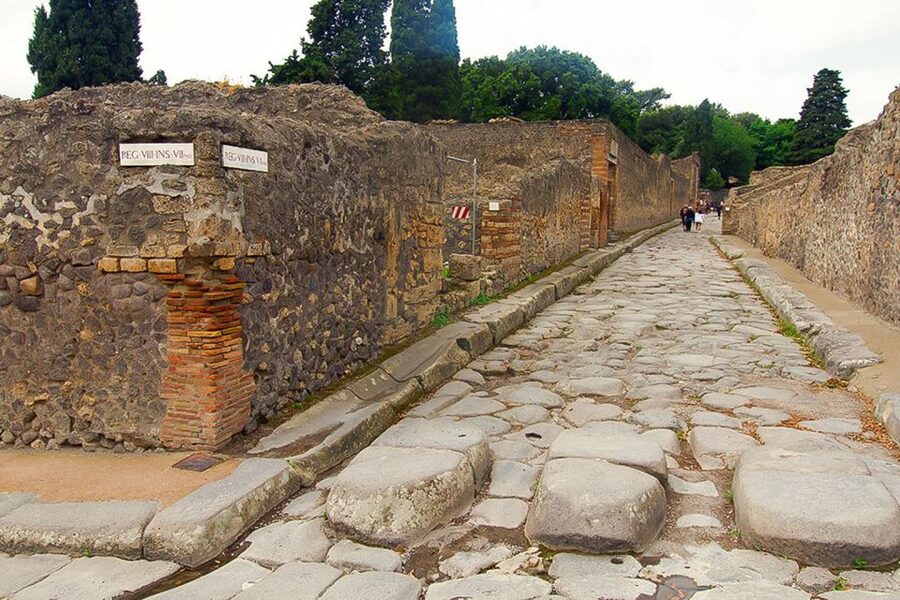
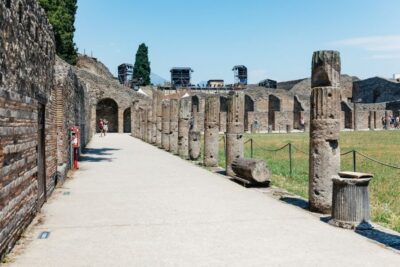
Once inside, you begin walking through the ancient city. The streets are one of Pompeii’s great strengths. Their paving stones, building fronts, sidewalks, and crossing points make the Roman town feel unusually readable.
The route requires a moderate walking pace. The surface is not a smooth modern path, and the park is large enough that three hours can feel tiring even for fit walkers. Several people who enjoyed the tour also noted the heat. In summer, the combination of bright sun and stone can wear you down quickly.
Wear sturdy, closed-toe shoes. High heels are not allowed, and baby strollers are not suitable for this walk. Bring water, a hat, and sunscreen. A visitor who took the tour in July recommended a UV umbrella because shade is limited. That is useful advice, especially for afternoon departures.
The guide usually uses a headset when needed. This is more important than it sounds. Pompeii can be noisy, and a headset means you do not have to crowd around the guide to hear. It also lets you look at the building while listening instead of constantly watching the guide’s face.
The Forum, temples, and public life
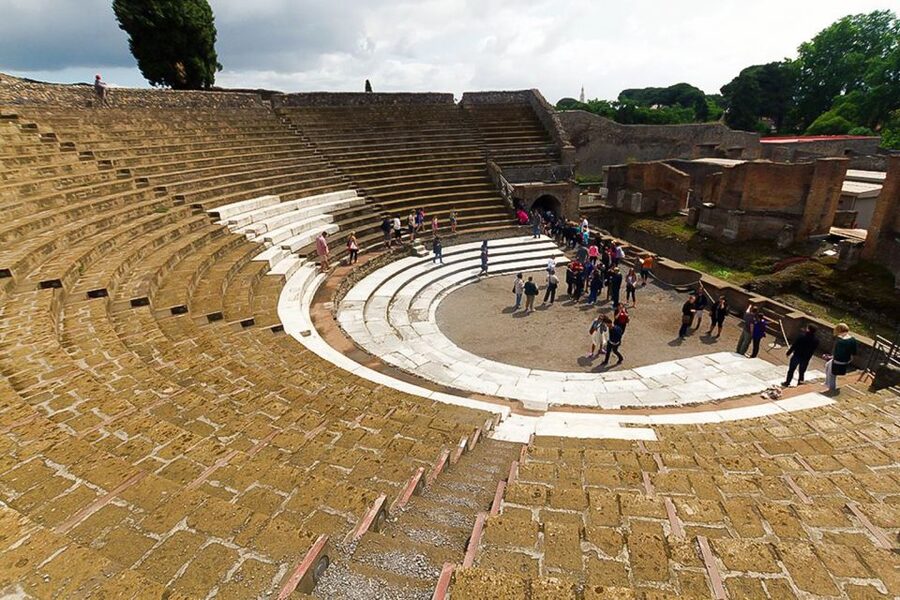
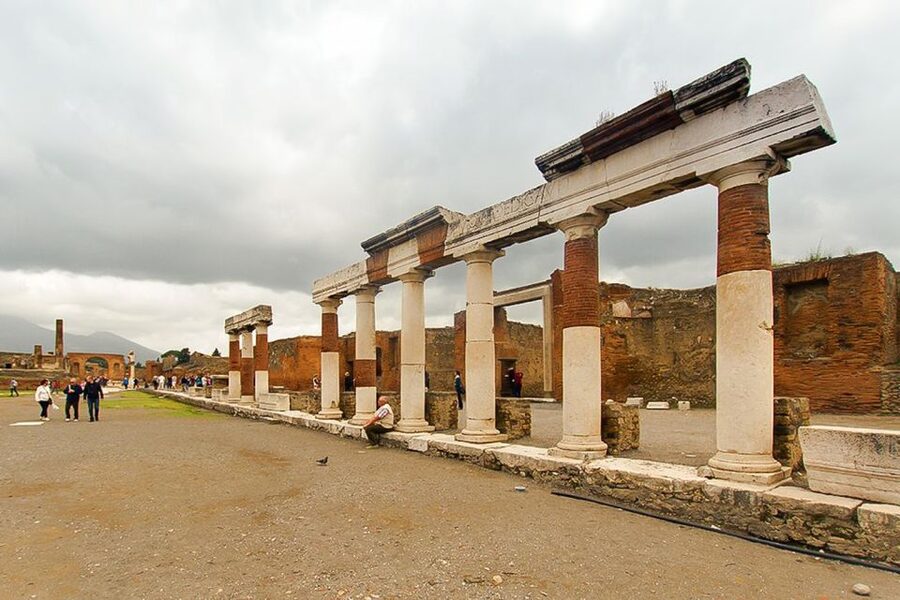
The Roman Forum provides the broad civic picture. This was the center of public life, surrounded by important religious and administrative buildings. Here, the guide can help you picture Pompeii as a functioning city with politics, worship, trade, and public gatherings.
The Temple of Apollo adds an older religious layer to the route. Rather than simply naming the temple, the archaeologist explains how sacred buildings fit into the city and how the surrounding spaces were used.
These major sights are especially helpful early in the tour because they give you a map in your head. After that, shops and houses make more sense. You begin to understand how the public center connected with the streets and neighborhoods around it.
The Express option concentrates on this central material. If your time is tight, the two-hour route gives you a solid introduction to the Forum, temples, and shops. It is a sensible choice for a short stop, though you will not get the same reach as the three-hour Complete Pompeii option.
A few more Pompeii bookings to compare
- Pompeii Small Group Tour with an Archaeologist
★ 5.0 · 6,593 reviews - Pompeii: Skip-the-Line Entrance Ticket with Audio Guide
★ 4.0 · 2,509 reviews - Naples: Pompeii and Mt. Vesuvius with Lunch and Wine Tasting
★ 4.5 · 2,454 reviews - Pompeii: Archaeological Park Tour with Ticket on request
★ 4.5 · 2,283 reviews
Shops, bakeries, baths, and homes
The strongest part of the longer tour is the attention to everyday life. Pompeii’s shops and houses reveal a city that was practical, social, and busy long before the eruption.
The ancient bakery is a memorable stop. The remains of food are still almost intact, giving the place a direct connection to daily work and eating. The guide can make sense of the equipment and explain what the bakery tells us about the city’s businesses.
You also visit an ancient supermarket, at least in the modern shorthand used to describe one of the commercial sites. This kind of stop helps you picture shopping as a routine part of city life rather than an abstract historical idea.
The public baths show another side of Roman society. They were not simply places to wash. They were part of public life and give you a way to think about how people spent time, met others, and used shared facilities.
The villas and houses add a more personal view. Rooms, courtyards, decorative features, and household arrangements can reveal differences in wealth and social status. The archaeologist’s job is to point out what you might otherwise overlook, including details that are not dramatic but are vital to understanding how the city worked.
Brothels, cemeteries, and the human cost
The tour may include one of Pompeii’s old brothels if it is appropriate for the group. That qualification matters for families, school-age children, and anyone who would rather focus on public buildings and homes. If included, the guide can explain the site as part of the city’s social and commercial life.
The old cemetery offers a quieter change of tone. Located outside the main urban area, it helps explain how Pompeii’s streets and boundaries were organized. It also reminds you that the city was not just a collection of homes and businesses. It had the full range of institutions and spaces you would expect in a real town.
The plaster casts are emotionally powerful. They show the final moments of people caught by the eruption, and they can be difficult to view. I appreciate that the tour places them within the larger story of the eruption and preservation rather than presenting them as a quick shock.
This is one part of the visit where your guide’s manner matters greatly. The strongest guides described in past tours, including Anna, Ilaria, and Enzo, combined serious subject matter with clear storytelling and a respectful tone.
New excavations and Pompeii’s unfinished story
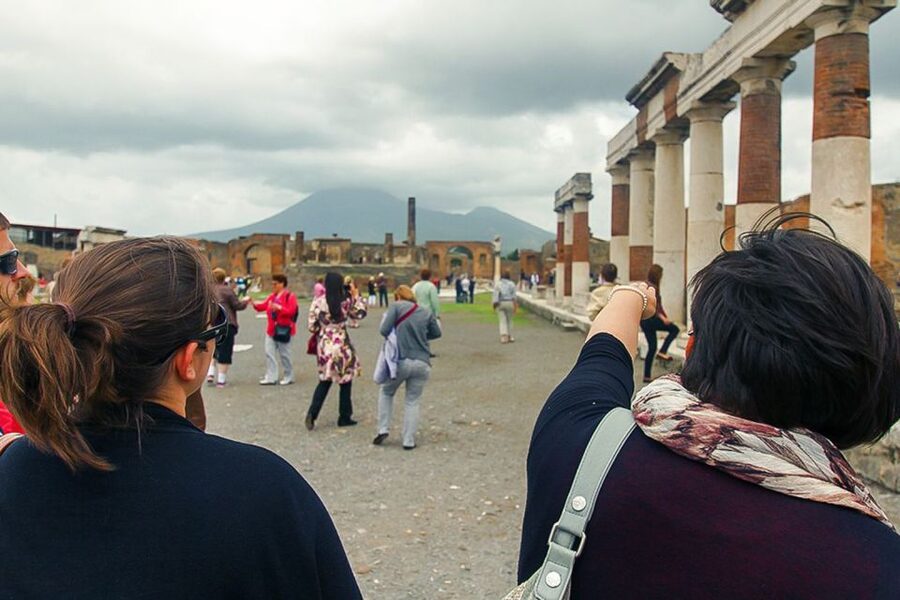
About one third of Pompeii remains uncovered. That fact changes the way you look at the park. You are not visiting a finished historical display. Archaeologists are still excavating, recording, and preserving the site.
The longer tour may take you toward newer discoveries, depending on current access and excavation work. One visitor specifically praised being taken to a newly opened archaeological dig. The route can change as new areas open or preservation work alters what is accessible.
This flexibility is a real advantage of an archaeologist-led visit. A fixed audio guide can explain only what it was programmed to cover. A professional guide can point out current work and explain why some areas are protected, closed, or still being studied.
You should not expect every departure to follow exactly the same path. That is part of the nature of Pompeii. The site is active, and access can shift. If your main goal is to see as much as possible, choose the longer option and understand that the precise route may adapt.
City walls and views toward Naples
The walk along the old city walls adds a wider view of Pompeii and the surrounding area. From here, you may get panoramic views toward Naples, helping you understand the city’s position beneath Mount Vesuvius.
This is also a useful pause after several hours among narrow streets and stone buildings. The view gives you a sense of scale and shows how the ancient city relates to the modern region around it.
Do not expect a leisurely lookout visit. The tour is still a walking circuit, and the walls form part of a larger route. Still, this final perspective helps tie together the city, volcano, coast, and distant urban area.
How good is the $70 value?
At $70 per person, this is not the cheapest way to enter Pompeii. The value comes from three things: a reserved skip-the-line ticket, an official Pompeii guide, and expert interpretation from someone trained in archaeology.
The ticket alone does not explain why a building matters. Pompeii rewards context because many of its most interesting details are easy to miss. If you would otherwise wander for two or three hours without knowing what you are looking at, the guide can make the admission fee work much harder.
The small-group setup also matters. You should have room to ask questions and should not have to fight through a large crowd to hear. Past groups praised guides for keeping different ages involved, answering children’s questions, and making the tour feel personal.
The price is less convincing if you already have strong archaeological knowledge or want to spend the entire day exploring independently. The guided route ends after two or three hours, and one past participant wished the tour lasted longer. You can explore on your own afterward, but plan your schedule accordingly.
Which Pompeii option should you choose?
Choose the three-hour Complete Pompeii option if Pompeii is a major reason for your visit. You get more time for houses, baths, shops, the bakery, cemetery, plaster casts, city walls, and possible excavation areas.
Choose Pompeii Express if you have a tight schedule or want a shorter introduction. It concentrates on the Forum, temples, and shops, making it easier to fit into a busy day.
A private or small-group format is available. A private tour may suit families or groups that want more control over questions and pace, while a small group should offer a good balance of cost and personal attention.
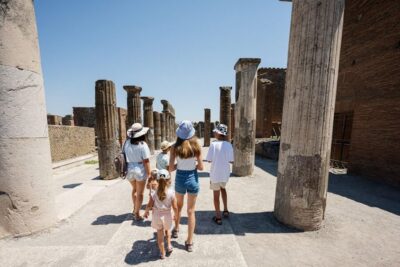
This tour suits adults, families with older children, and anyone who wants the site explained in plain language. Children can enjoy it when the guide keeps the stories lively. Past guides such as Sonia and Iliana were praised for answering children’s questions and holding their attention for the full three hours.
It is not suitable for wheelchair users, people with mobility impairments, or strollers. You should be able to walk at a moderate pace without difficulty. Even if you have no formal mobility limitation, consider the heat, uneven streets, and distance before booking.
Practical details that make the day easier
The tour is offered in English and lasts two to three hours, depending on the option you select. Full names for all participants must be supplied at booking and must match their passports or identification documents, with no name changes allowed.
Bring a passport or ID card, including one for each child. Wear comfortable closed-toe shoes, carry plenty of water, and protect yourself from the sun. There is limited shade, and the park has few facilities during the route. One past participant found only one toilet stop and one food and drink point, with long queues at the latter.
You can cancel up to 24 hours before the start for a full refund, and the reserve now, pay later choice keeps payment flexible. Check the available start times before booking, especially if you are coordinating trains, meals, or a visit to Mount Vesuvius.
Should you book this Pompeii tour?
Book it if you want Pompeii to make sense. The archaeologist guides are the main reason to choose this experience, and names such as Ilaria, Anna, Brunella, Enzo, Sonia, and Iliana have been associated with lively, clear tours that work for both adults and children.
The three-hour version is the better buy for a first visit. Pompeii is too large and too layered for a quick glance, and the longer route gives you a fuller look at daily life, public buildings, emotional remains, and current excavation work.
Skip it if you need a fully accessible route, dislike guided pacing, or want to spend the whole day choosing your own streets. For most first-time visitors, though, the expert guide turns a massive archaeological park into a place you can actually read.
FAQ
Where does the Pompeii tour meet?
It meets at the Entrance Gate for Pompeii Archaeological Park on Via Villa dei Misteri, 1, across from the Hortus Pompei restaurant. Look for a guide holding a green Walks sign.
How early should I arrive?
Arrive 15 minutes before the scheduled start time.
How long does the tour last?
The experience lasts two to three hours. The Complete Pompeii option takes about three hours, while Pompeii Express takes about two hours.
What is included in the price?
The tour includes a pre-reserved skip-the-line Pompeii ticket, an official Pompeii tour guide, and headsets when needed.
Is hotel pickup included?
No. Hotel pickup and drop-off are not included.
Is the tour conducted in English?
Yes. The live tour guide language is English.
Can I choose a private tour?
Yes. Private and small-group options are available.
What should I bring?
Bring a passport or ID card, comfortable shoes, and identification for children. Water, sun protection, and a hat are also practical choices for the hot, exposed site.
Can wheelchair users or people with mobility impairments join?
No. The tour is not suitable for wheelchair users, people with mobility impairments, or strollers. You should be able to walk at a moderate pace without difficulty.
Can the tour include a brothel or new excavation area?
The route may include an old brothel when appropriate for the group. The longer option may also visit newer excavation areas, but the itinerary can change as excavation and preservation work continue.
Recently added around Pompeii
- Pompeii Ruins Private Tour with Optional Skip-the-Line Entry★ 4.9 · 732 reviews
- Pompeii 3hours Villa of Mysteries tour with an Archaeologist★ 4.8 · 486 reviews
- Pompeii: Group Tour with an Archeologist Guide★ 4.4 · 490 reviews
- Pompeii: Exclusive Tour with Archaeologist and Entry Tickets★ 4.9 · 634 reviews
- Pompeii: Skip-the-Line Tickets and Tour with Archaeologist★ 4.9 · 467 reviews
- Pompeii: Small-Group Tour of Pompeii and Herculaneum★ 4.8 · 867 reviews
- Pompeii: Skip-the-line-Ticket and Guided Tour★ 4.6 · 1,152 reviews
- Pompeii: Skip-the-Line Entry & Audioguide★ 3.8 · 225 reviews
Pompeii & Vesuvius Tours, compared.
Entry Ticket and Guided Tour with an Archaeologist
Read our review →


Pompeii Small Group Tour with an Archaeologist
Read our review →
Pompeii, Amalfi Coast and Positano Day Trip from Rome
Read our review →Browse the lists this tour appears in