

Reviewed · POMPEII & VESUVIUS TOURS
Pompeii Small Group Tour with an Archaeologist
Pompeii rewards a guide. This two-hour walk gives you direct entry with a licensed archaeologist, then leads you through the Forum, plaster casts, ancient homes, baths, and theaters without leaving you to decode a huge map alone. I especially like the human stories about Pompeii’s residents and the chance to see important buildings in a sensible order. The main catch is the group size, which can reach 20 people, and the uneven streets can make the pace harder for anyone with mobility problems.
The price, about $35.67 per person, is reasonable for a guided visit that includes the Pompeii Express entrance ticket. Guides such as Alessandra, Paolo, Teresa, Amedeo, Vincenzo, and Rafaela have earned praise for clear explanations, humor, and a gift for making ancient rooms feel connected to real people. You should still allow extra time after the tour if you want to explore beyond the main route.
In This Review
- Key things to know before you book
- Meeting the guide at Porta Marina Superiore
- The Basilica and Forum: Pompeii’s public center
- The Forum granaries and Pompeii’s human tragedy
- House of Menander and the details of Roman home life
- Stabian Baths: ancient bathing with a social purpose
- The Lupanar and Pompeii’s less polished side
- House of the Faun and two Pompeian theaters
- Why the archaeologist matters at Pompeii
- Is two hours enough for Pompeii?
- Price, group size, and overall value
- Who should book this Pompeii walk?
- Should you book it?
- FAQ
- How much does the Pompeii Small Group Tour with an Archaeologist cost?
- How long does the tour last?
- Where does the tour start?
- Where does the tour end?
- Is transportation included?
- Is the entrance ticket included?
- How large can the group be?
- Are headsets provided?
- Is the tour suitable for people with mobility problems?
- Can I cancel for a refund?
- Are children allowed on the tour?
- Can I bring a dog?
Key things to know before you book
- The route covers Pompeii’s major sights: You see the Basilica, Forum, Forum granaries, House of Menander, Stabian Baths, Lupanar, House of the Faun, Odeon, and Teatro Grande.
- The guide is the real value: An archaeological background helps explain frescoes, buildings, roads, casts, and daily life rather than simply naming each ruin.
- The tour ends inside Pompeii: You can continue exploring on your own after the guided portion, but pay attention to directions for the exits.
- Expect old Roman streets underfoot: The site has uneven paving, steps, ramps, and some short steep climbs.
- The group may include up to 20 people: Headsets are supplied for groups of 16 or more, though one complaint described a delay when the equipment did not work properly.
- Plan for sun and walking: Comfortable shoes, sunscreen, sunglasses, and a small bottle of water are essential, especially in summer.
Meeting the guide at Porta Marina Superiore
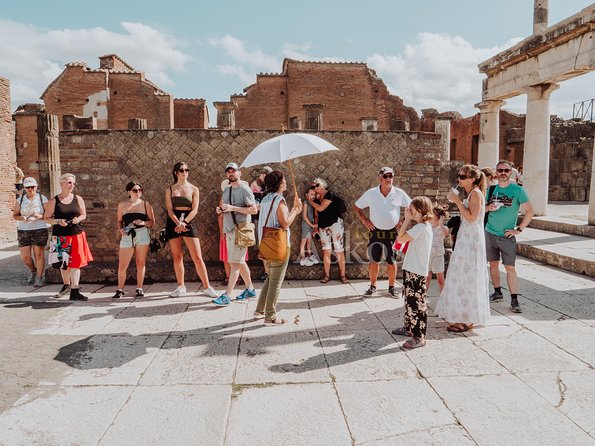
Your starting point is the Porta Marina Superiore entrance, at Via Villa dei Misteri 2. Look for the guide holding an Askos Tours sign. This detail matters because Pompeii has more than one entrance, and arriving at the wrong gate can turn a calm start into a frantic walk.
The tour includes the Pompeii Express entrance ticket, so you do not need to arrange a separate admission ticket for the guided visit. The operator describes the entry as skip-the-line, a useful benefit at a major archaeological site where queues can build.
Arrive on time. Pompeii is large, phone reception can be unreliable inside the ruins, and a guide cannot easily go back for a late arrival while leading a group. One late-arrival dispute ended with the group receiving entrance tickets but missing the guided portion. The practical lesson is simple: treat the meeting time as firm.
The tour runs in rain or shine. It takes about two hours, though the pace and exact time spent at each stop can vary. The group limit is 20 people per guide. That is small enough for a personal feel compared with a large coach tour, but not so small that you can expect constant one-on-one attention.
More Pompeii and Vesuvius trips:
- Pompeii: Entry Ticket and Guided Tour with an Archaeologist
★ 4.8 · 19,459 reviews - Pompeii: Entry Ticket with Optional Audio Guide
★ 4.2 · 12,360 reviews - Pompeii: Small Group Tour with an Archaeologist
★ 4.8 · 12,264 reviews
The Basilica and Forum: Pompeii’s public center
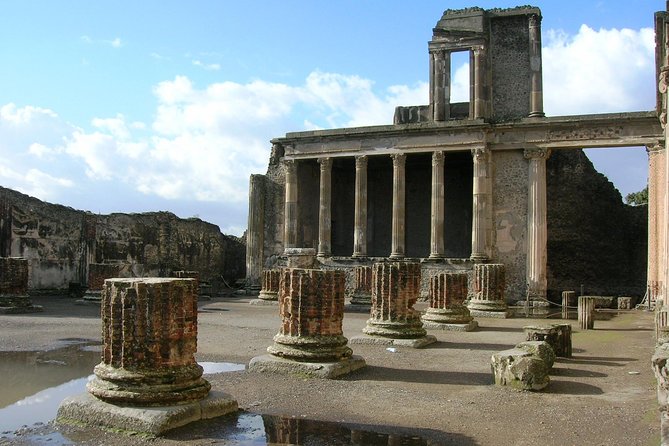
The first stop is the Basilica, an open portico that sheltered merchants and supported business and civic activity. It is a good place to begin because your guide can explain how Pompeii worked as a city, not just as a collection of attractive walls.
From there, you move to the Forum, the ancient city’s main square. This broad public space brought together commerce, politics, religion, and ordinary errands. Standing here helps you grasp Pompeii’s scale and organization before the route moves into houses, baths, and side streets.
A guide adds real value in these open spaces. Without context, columns and foundations can blur together. With an archaeologist explaining their function, you can begin to picture the forum as a working part of town rather than a silent field of ruins.
The scheduled stops are fairly short, about 10 to 15 minutes each. That keeps the group moving, but it also means you should not expect a long lecture on every building. Each guide chooses certain points for fuller explanation. Alessandra, for example, has been praised for bringing in current excavation work and questions about Pompeii’s preservation.
The Forum granaries and Pompeii’s human tragedy
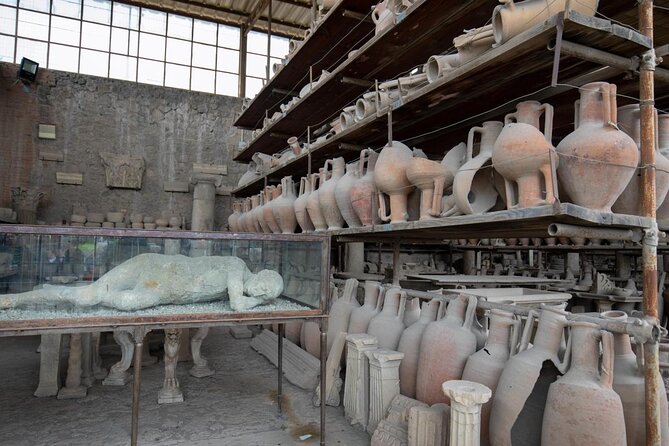
The granaries of the Forum hold marble tables, fountain basins, architectural pieces, and plaster casts of people caught in the eruption. You may also see casts of a dog and a tree.
This is one of the most emotional parts of the route. The casts are not decorative curiosities. They offer a direct, unsettling connection to the people and animals who died when the eruption destroyed Pompeii. A good guide handles this section with care, explaining what the casts represent while keeping the focus on human lives.
The stop is listed at about 15 minutes, enough to pause and listen without allowing the entire tour to become fixed in one room. One unhappy experience described a long stationary talk near the beginning, made worse by a delay with the headsets. That seems to have been an exception rather than the usual pattern, but it is worth knowing that equipment or crowd issues can affect the flow.
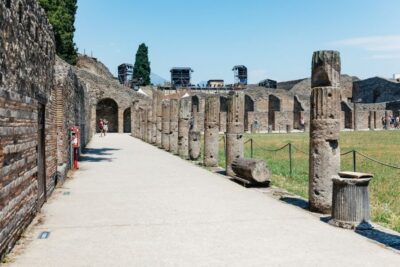
After the granaries, you walk along one of Pompeii’s original paved streets. These roads are part of the experience, not just a way between buildings. Their uneven surfaces and raised stones help you understand how people moved around the city, but they also explain why sturdy shoes matter.
House of Menander and the details of Roman home life
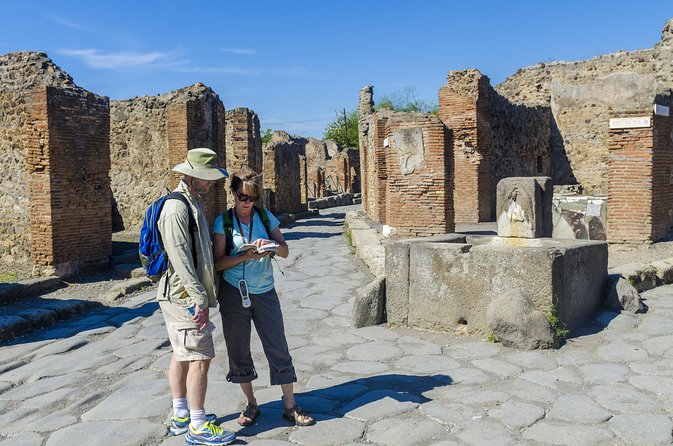
The House of Menander is one of Pompeii’s finest private residences, known for its architecture, decoration, and contents. Here the tour shifts from public life to domestic space.
Frescoes, mosaics, courtyards, and room layouts give your guide a chance to explain how a wealthy Roman household was arranged. The value of this stop is not just visual. A house reveals status, taste, work, family structure, and the way indoor and outdoor spaces were used.
Do not expect every room to be open or perfectly preserved. Pompeii’s condition can vary from building to building, and access may depend on conservation work. Still, the House of Menander offers enough material for a useful explanation of how a substantial home operated.
This is also where a guide can help you notice small details you might otherwise pass. Several people have singled out the guides’ ability to point out features that standard guidebooks do not explain well. That is exactly the advantage of walking with an archaeology specialist.
A few more Pompeii bookings to compare
- Pompeii: Skip-the-Line Entrance Ticket with Audio Guide
★ 4.0 · 2,509 reviews - Naples: Pompeii and Mt. Vesuvius with Lunch and Wine Tasting
★ 4.5 · 2,454 reviews - Pompeii: Archaeological Park Tour with Ticket on request
★ 4.5 · 2,283 reviews - Discover the Ancient Ruins of Pompeii: Day Trip from Rome
★ 3.5 · 2,247 reviews
Stabian Baths: ancient bathing with a social purpose
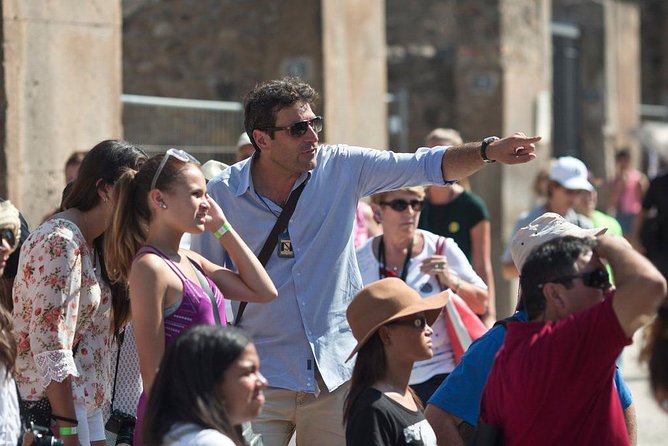
The Stabian Baths occupy a large area between the Brothel Lane, the Holconius crossroads, and Via Stabiana. They are described as Pompeii’s oldest thermal complex.
The baths were not simply places to wash. They were part of the city’s social life and public routine. Your guide can help you read the sequence of rooms and understand how the complex functioned, including the role of heated spaces and bathing areas.
The ruins are especially useful because they show Roman engineering in a practical setting. You see how a public facility was planned, supplied, and fitted into the street network. The stop also gives the tour a change of rhythm after the decorated rooms of the House of Menander.
As with the rest of the route, the ground can be rough. You will encounter steps, ramps, and mild climbs. The operator does not recommend this walk for people with mobility issues or impairments, and mobility scooters are not allowed. If you need a more manageable route, ask the company about a suitable private tour before booking.
The Lupanar and Pompeii’s less polished side
The Lupanar is Pompeii’s most famous brothel ruin. It is a brief but memorable stop, and the small rooms and surviving wall paintings offer a glimpse of a side of Roman life that public monuments often leave out.
Your guide can place the building in the wider social world of Pompeii rather than treating it as a quick novelty. That context is important. The Lupanar helps show that the city was made up of ordinary needs and private choices as well as temples, official buildings, and wealthy homes.
This stop can draw a crowd, and the rooms are not spacious. You may need patience as the group gathers around key details. A 20-person maximum is manageable, but it is still larger than a private family tour.
House of the Faun and two Pompeian theaters

The House of the Faun was one of the largest and most impressive private residences in Pompeii. Its size gives you another look at the wealth gap within the city and the ambition of its leading households.
The route then includes a short look at the Teatro Piccolo, also called the Odeon. This smaller theater provides a useful contrast with the final stop, Teatro Grande, the city’s most important and largest theater.
Teatro Grande is a strong ending because it brings public entertainment into the story. After seeing markets, homes, baths, and a brothel, you finish in a space designed for crowds and performance. It rounds out the picture of Pompeii as a complete city with work, worship, household life, leisure, and public events.
The theater stop is listed at about 10 minutes. That is enough for an overview, but not a full study of every architectural feature. If theater architecture is your main interest, you may want to spend extra time here after the guided walk.
Why the archaeologist matters at Pompeii
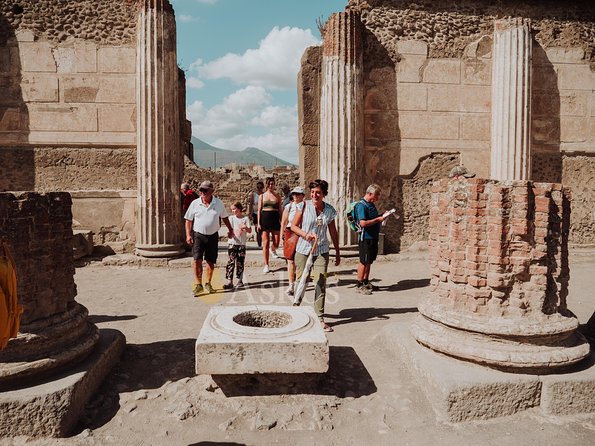
Pompeii is enormous and easy to underestimate. A map can show you where buildings are, but it cannot always explain why a basilica mattered, how a bath complex worked, or what a plaster cast asks you to remember.
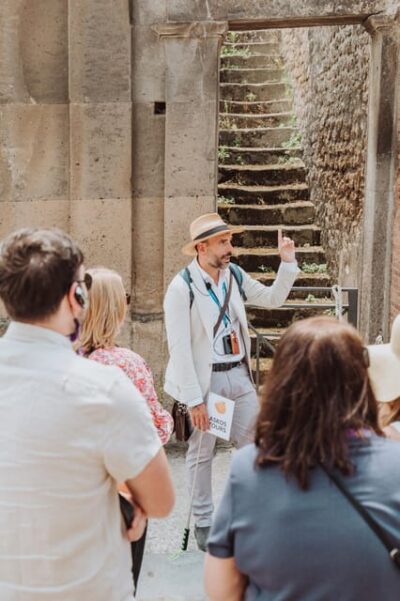
The strongest part of this tour is the human scale. Guides such as Paolo have been praised for connecting archaeology with preservation and education. Teresa is described as a clear storyteller who adjusted the pace to the group. Vincenzo brought regional knowledge and humor, while Alessandra has been praised for making the site engaging for adults and teenagers alike.
That variety is worth keeping in mind. You are booking an archaeological guide rather than a specific named person, so the style may differ. Some guides may spend more time on architecture, others on daily life, excavations, or the eruption. The consistent benefit is having someone interpret the remains as you walk.
The 4.8 rating from 6,593 reviews, with 96 percent recommending the experience, suggests a strong record. It does not guarantee a perfect start every time. One poor experience involved a late departure, faulty headsets, and too much time spent standing still. Still, the repeated praise for clear explanations, humor, pacing, and enthusiasm points to the tour’s main strength.
Is two hours enough for Pompeii?
Two hours is enough for a useful introduction, not enough to see all of Pompeii. The route gives you a well-chosen sample of public buildings, private houses, baths, theaters, a brothel, and the casts.
I like this length for a first visit or a day when you are combining Pompeii with other sights. You get a clear framework without spending half a day listening to a lecture. Families with teenagers have found the mix of buildings and stories effective, especially when the guide uses humor and direct explanations.
You should plan extra time if Pompeii is a major reason for your visit. Several people stayed inside the ruins after the guided portion and continued independently. Your guide may point out additional places worth seeing, but listen carefully to instructions about the exits because the tour finishes inside the archaeological park.
Do not schedule a tight onward connection immediately after the tour. The advertised duration is approximately two hours, and large sites rarely operate like a railway timetable. Give yourself breathing room for the walk out and for any extra exploring.
Price, group size, and overall value
At $35.67 per person, this is a good-value option if you want interpretation without paying for a private tour. The price includes the Pompeii Express entrance ticket, guidance for the full tour, and a licensed guide with an archaeological background.
The value is highest for first-time visitors. You are paying to save time choosing a route, to understand what you are seeing, and to avoid wandering past important buildings without context. Pompeii’s size makes that help worthwhile.
A maximum of 20 people is the tradeoff. You receive a small-group format, but the group may still bunch up inside narrow rooms or wait while everyone views a mosaic or fresco. Headsets are provided when the group reaches 16 or more. They should make the guide easier to hear, though technical problems are possible.
Food, drinks, and transportation are not included. You need to arrange your own way to the entrance and carry your own water. The tour is available all year and operates in rain or shine, so check the forecast and dress for the conditions.
Who should book this Pompeii walk?
I would choose this tour if you are visiting Pompeii for the first time, want the main sights explained, or prefer a planned route to independent wandering. It also suits families, since several guides have been praised for keeping younger people interested.
It is a good fit if you enjoy history but do not want an academic lecture. The best guides combine archaeology with stories about the people who lived here, making the ruins easier to understand and remember.
I would think twice if you dislike group touring, need a slow pace, or have difficulty with uneven ground. The site includes steps, ramps, paved streets, and short steep climbs. A private option may be better for mobility needs, and an independent visit may suit you if you want to linger for a long time at just one house or theater.
Wear sturdy walking shoes, a hat, sunglasses, and sunscreen. Bring a small bottle of water. Children must stay with an adult, and anyone under 18 should bring an identification card or passport.
Should you book it?
Book this tour if you want Pompeii to make sense, not simply to see a long series of ruins. For roughly $36, you get admission, a structured route, and an archaeologist who can connect public squares, private homes, baths, theaters, and the eruption’s victims.
The smart plan is to take the two-hour guided walk early in your visit, then remain inside and explore at your own pace. Arrive early at Porta Marina Superiore, wear proper shoes, and keep your schedule flexible. If you do that, this tour offers a practical and memorable introduction to one of Italy’s most powerful archaeological sites.
FAQ
How much does the Pompeii Small Group Tour with an Archaeologist cost?
The listed price is $35.67 per person. The Pompeii Express entrance ticket and guided assistance are included.
How long does the tour last?
The tour lasts approximately two hours.
Where does the tour start?
It starts at Porta Marina Superiore, located at Via Villa dei Misteri 2, 80045 Pompei, Italy. The guide holds an Askos Tours sign.
Where does the tour end?
The tour ends inside the Pompeii archaeological ruins.
Is transportation included?
No. Transportation, food, and drinks are not included.
Is the entrance ticket included?
Yes. The Pompeii Express entrance ticket is included.
How large can the group be?
The maximum is 20 people per guide.
Are headsets provided?
Headsets are provided for groups of 16 or more.
Is the tour suitable for people with mobility problems?
The tour is not recommended for people with mobility issues or impairments because of steps, ramps, uneven ground, and short steep climbs. Mobility scooters are not allowed.
Can I cancel for a refund?
You can cancel at least 24 hours before the start time for a full refund. Cancellations or changes made within 24 hours are not refunded or accepted.
Are children allowed on the tour?
Yes. Children must be accompanied by an adult. Travelers under 18 should bring an identification card or passport.
Can I bring a dog?
Only dogs weighing no more than 10 kilograms and no taller than 40 centimeters are permitted. They must remain on a leash, be carried inside buildings, and their waste must be collected. Service animals are allowed.
Recently added around Pompeii
- Pompeii Ruins Private Tour with Optional Skip-the-Line Entry★ 4.9 · 732 reviews
- Pompeii 3hours Villa of Mysteries tour with an Archaeologist★ 4.8 · 486 reviews
- Pompeii: Group Tour with an Archeologist Guide★ 4.4 · 490 reviews
- Pompeii: Exclusive Tour with Archaeologist and Entry Tickets★ 4.9 · 634 reviews
- Pompeii: Skip-the-Line Tickets and Tour with Archaeologist★ 4.9 · 467 reviews
- Pompeii: Small-Group Tour of Pompeii and Herculaneum★ 4.8 · 867 reviews
- Pompeii: Skip-the-Line Guided Tour with Expert Archaeologist★ 4.8 · 196 reviews
- Pompeii: Skip-the-line-Ticket and Guided Tour★ 4.6 · 1,152 reviews
Pompeii & Vesuvius Tours, compared.
Entry Ticket and Guided Tour with an Archaeologist
Read our review →



Pompeii, Amalfi Coast and Positano Day Trip from Rome
Read our review →
Pompeii and Mount Vesuvius Day Trip from Rome with Pizza Lunch
Read our review →Browse the lists this tour appears in