
Reviewed · POMPEII & VESUVIUS TOURS
Pompeii: Small Group Tour with an Archaeologist
Pompeii rewards a careful introduction. This tour makes the enormous archaeological park easier to read, with an archaeologist guiding you through the Forum, theaters, homes, and baths rather than leaving you to decode piles of ancient stone alone. I especially like the practical route through major sights and the chance to keep exploring after the guided portion. The main drawback is time: two hours gives you a strong start, but Pompeii is so large that you will still need several more hours for a fuller visit.
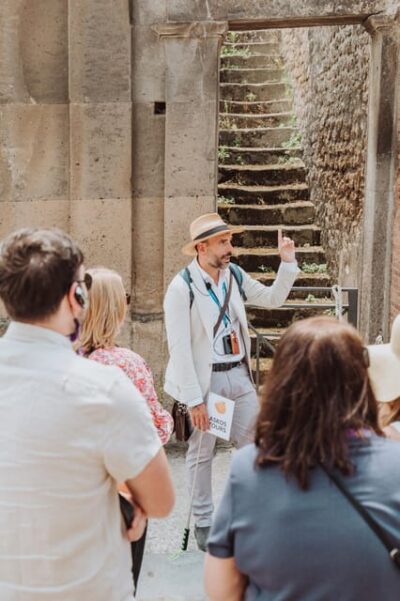
I also like the human details. Guides point out wheel ruts, handprints near fountains, shop entrances, household decorations, and the surviving plaster casts. Guides such as Roxanne, Alessandra, Paolo, Nicoletta, Teresa, and Mario have been praised for making the site lively without turning the tour into a dry lecture. If you want Villa of the Mysteries, choose the three-hour option, since it adds one of Pompeii’s most remarkable rooms of frescoes.
The tour costs about $40 per person and includes the Pompeii Express entry ticket. That is good value if you want context and a planned route, especially on a first visit. You do need to accept uneven paving, ramps, steps, and a slight uphill climb, so this is not a good choice for wheelchair users or people with significant mobility limits.
In This Review
- Key points to know before booking
- Why a guided start helps at Pompeii
- Entering through Porta Marina Superiore
- The Forum, Apollo, and Jupiter
- Homes, baths, and the daily life of Pompeii
- The Lupanar and Pompeii’s adult side
- The Great Theater and a memorable change of scale
- The House of the Mysteries and the three-hour choice
- Frescoes, mosaics, graffiti, and plaster casts
- What the $40 price gets you
- Choosing the best time and length
- Who should book this Pompeii tour?
- Final verdict: a smart first three hours in Pompeii
- FAQ
- How long is the Pompeii archaeologist tour?
- Does the tour include Pompeii admission?
- Can I explore Pompeii alone after the tour?
- Is the Villa of the Mysteries included in every option?
- Is transportation included?
- What languages are available?
- Is a private tour available?
- What should I bring?
- Is the tour suitable for wheelchair users?
- Can I bring luggage or a large bag?
Key points to know before booking
- The two-hour route covers Pompeii’s essential sights: You visit the Forum, temples, Basilica, baths, homes, brothel, and theater with an archaeologist.
- The three-hour option adds Villa of the Mysteries: Its preserved frescoes are a major reason to spend the extra hour.
- You can stay inside after the tour: The guide gives suggestions for continuing on your own, which is valuable at a site this large.
- Guides bring out small details: Look for cart tracks, fountain handprints, shop entrances, graffiti, mosaics, and painted walls.
- Meeting points vary: Your booked option determines where you meet, with several locations around Pompeii.
- Plan your timing carefully: A late afternoon tour can leave little time for independent exploring before the park closes.
Why a guided start helps at Pompeii
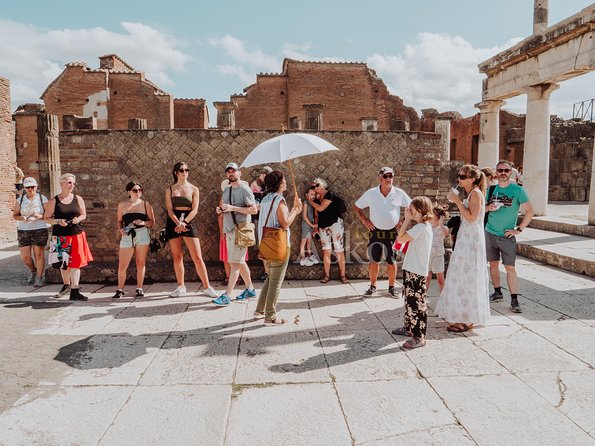
Pompeii is not a compact ruin with one clear path. It is an ancient city preserved by volcanic ash after Mount Vesuvius erupted in AD 79. Streets, homes, public buildings, shops, temples, and theaters spread across a broad area, and it can take about half an hour to walk from one side to the other.
I find a guide especially useful here because the most interesting evidence is often easy to miss. A high curb may reveal how people entered a shop. A worn groove in the paving may show where carts passed. A small wall painting can tell you more about daily life than another grand column.
The archaeologist guides also provide a sense of scale. Pompeii was not simply a collection of villas for wealthy Romans. It was a working city with bakeries, public baths, businesses, legal spaces, religious buildings, restaurants, theaters, and private homes. The tour connects those pieces so you can picture how the city functioned.
The strongest praise has gone to guides who mix facts with stories and humor. Roxanne was singled out for her warmth and easy manner. Alessandra was praised for being interactive and for giving useful suggestions after the tour. Paolo, Teresa, Anna, Nicoletta, Mario, and others have also been described as passionate, clear, and skilled at answering questions.
Guide quality can vary, as it does on any multi-guide activity. One person found a strong accent made parts of the commentary harder to follow, though the guide checked that everyone understood. The overall pattern is very positive, but if clear language matters to you, check the available language and tour type before booking.
More Pompeii and Vesuvius trips:
- Pompeii: Entry Ticket and Guided Tour with an Archaeologist
★ 4.8 · 19,459 reviews - Pompeii: Skip-the-Line Entrance Ticket with Audio Guide
★ 4.0 · 2,509 reviews - Naples: Pompeii and Mt. Vesuvius with Lunch and Wine Tasting
★ 4.5 · 2,454 reviews
Entering through Porta Marina Superiore
The tour generally begins at Porta Marina Superiore, one of the ancient city’s seven gates. This entrance gives the visit a useful sense of arrival. You are not dropped into a random house or isolated ruin. You enter through one of the original gateways and begin walking into the city itself.
The exact meeting point can vary. Listed meeting locations include several points along Via Villa dei Misteri, the Hortus Pompei restaurant and garden bar, and Via Roma 101. Read your booking details carefully, and arrive early enough to confirm your name with the staff. One person had a problem when staff failed to mark the arrival properly, and the group moved on without them. That issue was eventually sorted out, but it is a good reminder to make sure your check-in is complete.
The included Pompeii Express ticket lets you skip the ticket line. It does not include transportation, food, drinks, or personal expenses. If you arrive with a large bag, you may need the free cloakroom next to Porta Marina Superiore, subject to availability. Large bags and luggage are not allowed through the site.
The Forum, Apollo, and Jupiter
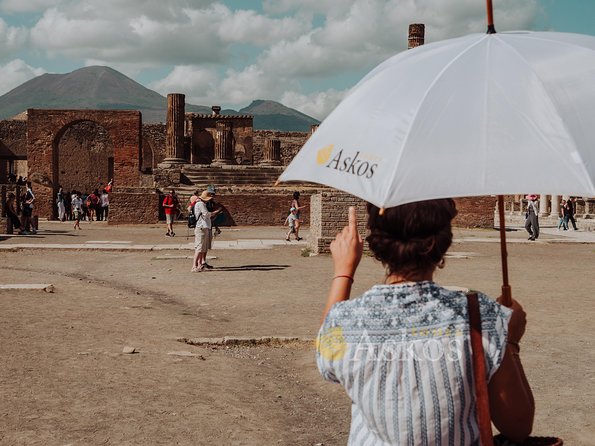
The Forum was Pompeii’s public heart. It was the place for civic business, religious activity, meetings, and public display. From here, you can also see Mount Vesuvius above the ruins, a view that gives the ancient disaster an immediate presence.
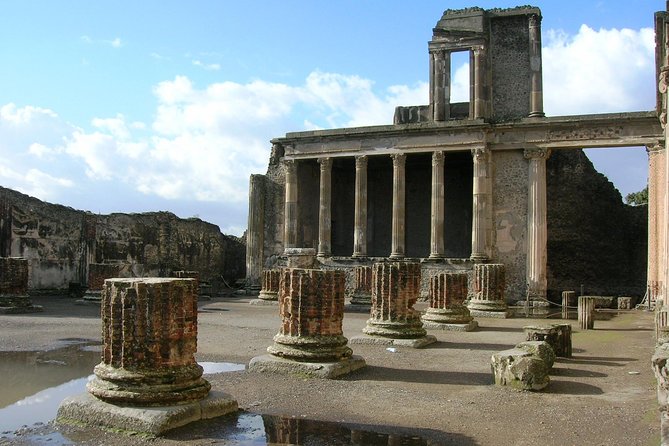
The Temple of Apollo helps explain Pompeii’s religious life. The Temple of Jupiter, at the northern end of the Forum, gives the area a grand civic focus. Your guide can help you separate the religious buildings from the political and commercial spaces, which may otherwise blur together when you are looking at broken walls and columns.
The Basilica was the city’s center for legal and business matters. It is one of the stops where a good explanation matters more than a quick photograph. Without context, the building can feel like another open rectangle. With a guide, you start to see how power, trade, law, and public life were arranged around the Forum.
This portion of the route can be busy, particularly around the best-known monuments. Guides have been praised for shifting the order slightly to avoid thick crowds and direct sunlight. The itinerary may change because of congestion or temporary closures, so do not expect every stop to follow a fixed sequence.
Homes, baths, and the daily life of Pompeii
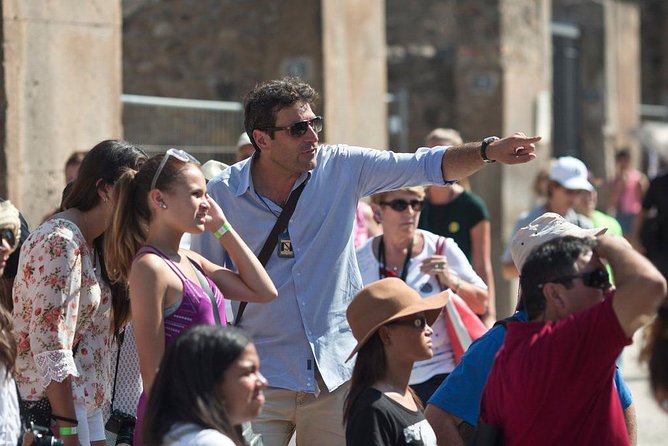
The House of Menander offers a look at an elegant private residence, while the House of the Faun shows the scale and wealth possible in Pompeii’s largest homes. The House of the Vettii is another highlight, with preserved rooms, wall paintings, and signs of elite domestic life.
I like this part of the tour because the guide can point out the difference between a private residence and a commercial space. Small architectural clues, including entrance arrangements and street-facing features, help you understand how people lived and worked in the same neighborhood.
The Forum Baths show how public bathing was woven into Roman life. These were not just places to wash. They were social spaces, and their surviving rooms reveal the planning required for heating, changing, and moving through the complex.
You will also see a bakery and other working areas. These less glamorous buildings help balance the grand houses. Pompeii becomes more believable when you see where bread was made, where people shopped, and how ordinary streets were laid out.
The paving is uneven, and some routes include steps, ramps, inclines, and declines. You should wear sturdy shoes and expect plenty of walking. One guide kept the group out of direct sun when possible, a thoughtful touch in hot weather, but shade cannot be guaranteed throughout the site.
A few more Pompei Campania bookings to compare
- Pompeii: Skip-the-line-Ticket and Guided Tour
★ 4.6 · 1,152 reviews - Pompeii: Small-Group Tour of Pompeii and Herculaneum
★ 4.8 · 867 reviews - Pompeii: Guided Tour with Skip-the-Line Entry
★ 4.9 · 812 reviews - Pompeii: Skip-the-Line Entry Ticket with Digital Guide App
★ 4.1 · 770 reviews
The Lupanar and Pompeii’s adult side
The Lupanar, commonly identified as Pompeii’s brothel, is one of the most talked-about stops. It contains small stone beds and preserved erotic frescoes. The name and the building’s function give your guide a chance to explain a less polished side of Roman society.
This stop includes adult themes. A guide can discuss the frescoes and graffiti with historical context, but parents should decide if the material suits their children. One family found that its ten-year-old was largely unaware of the adult meaning, though the setting is not designed as a children’s attraction.
The Lupanar can also be crowded because many tours include it. If you want time to look closely, stay near your guide and listen for explanations before moving through the narrow rooms. It is a memorable stop, but not necessarily the place where you will linger longest.
The Great Theater and a memorable change of scale

The Large Theater is one of the tour’s strongest visual moments. Walking into the seating area helps you understand that Pompeii was a city of public entertainment, not only temples and private houses.
This is also where the city’s scale becomes clear. You have walked through streets and rooms, and then suddenly you are looking at a large performance space built for a crowd. Several people have especially liked the theater because it provided a clear wow moment during the route.
The tour may also include the theater area and other public buildings in a slightly different order depending on crowd levels. That flexibility is useful, though it means your experience may not match the exact sequence shown when you book.
The House of the Mysteries and the three-hour choice
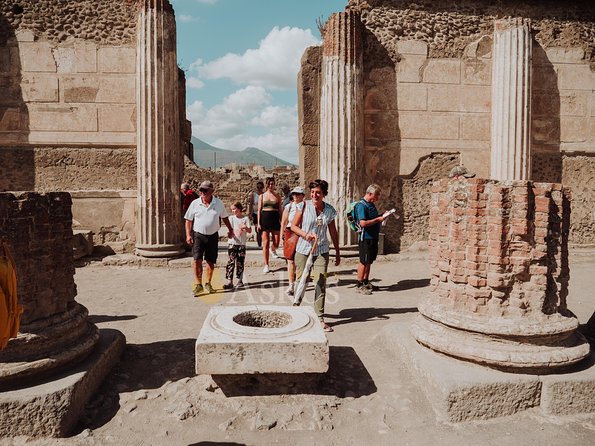
The three-hour tour adds the Villa of the Mysteries, located beyond the central group of highlights. This is the clearest reason to select the longer option.
The villa is known for its remarkable frescoes, which cover a room with scenes whose meaning has prompted long study and debate. You do not need to know every theory to appreciate the paintings. Their color, scale, and preservation make the room one of Pompeii’s most powerful interiors.
A guide such as Mario has been praised for explaining the frescoes with energy and detail, while other guides have used the extra time to connect the villa to the rest of the city. The walk to the villa adds distance, but it also takes you away from some of the most concentrated crowds.
I would choose three hours if you have a strong interest in Roman art, domestic life, or archaeology. The two-hour route works well if you want orientation before exploring alone, or if your day includes Herculaneum, Vesuvius, Naples, or another Campania sight.
Frescoes, mosaics, graffiti, and plaster casts
Pompeii’s art is not confined to a museum display. You see frescoes and mosaics in their original architectural setting, which changes how they feel. A painted wall in a dining room tells you something about taste, status, and the way rooms were used.
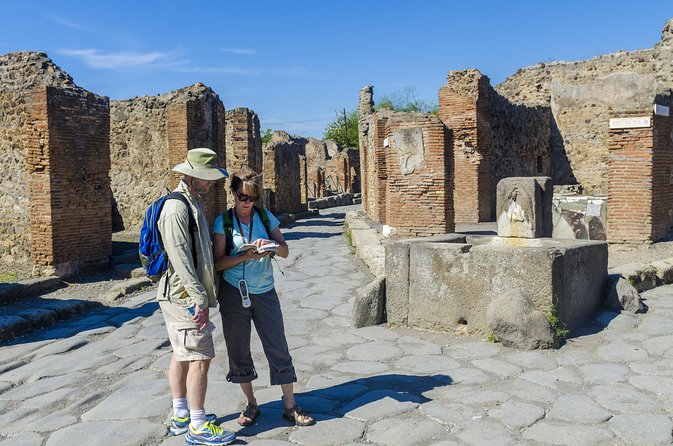
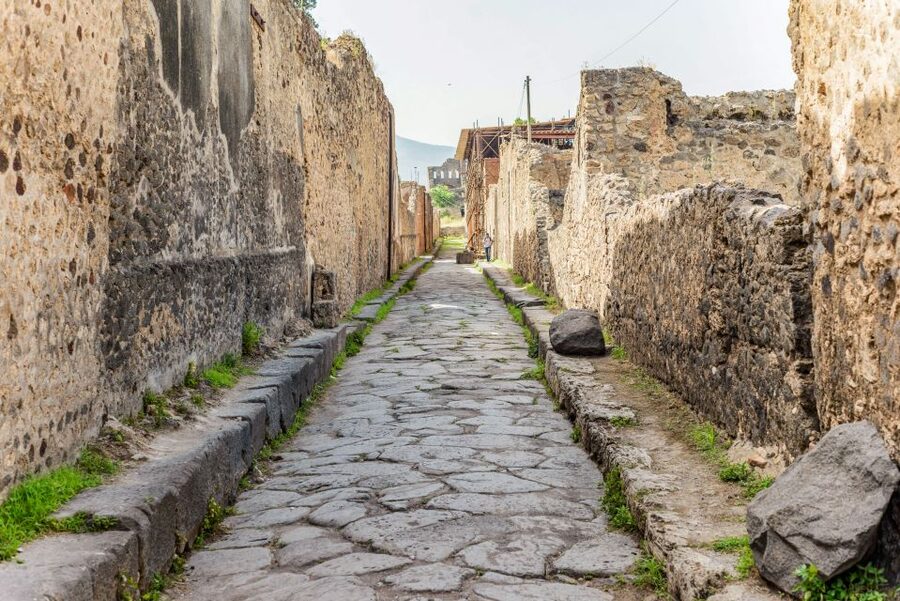
The guide helps you spot details you might walk past. Look for decorative patterns, household images, inscriptions, and graffiti. One guide drew attention to handprints near fountains and cart tracks in the streets, small traces that make the ancient city feel occupied rather than staged.
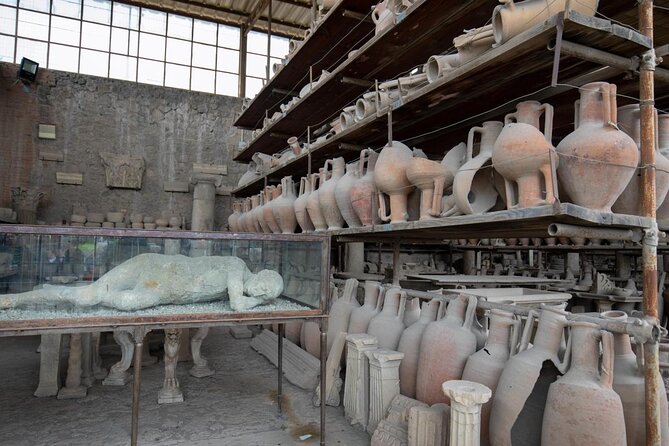
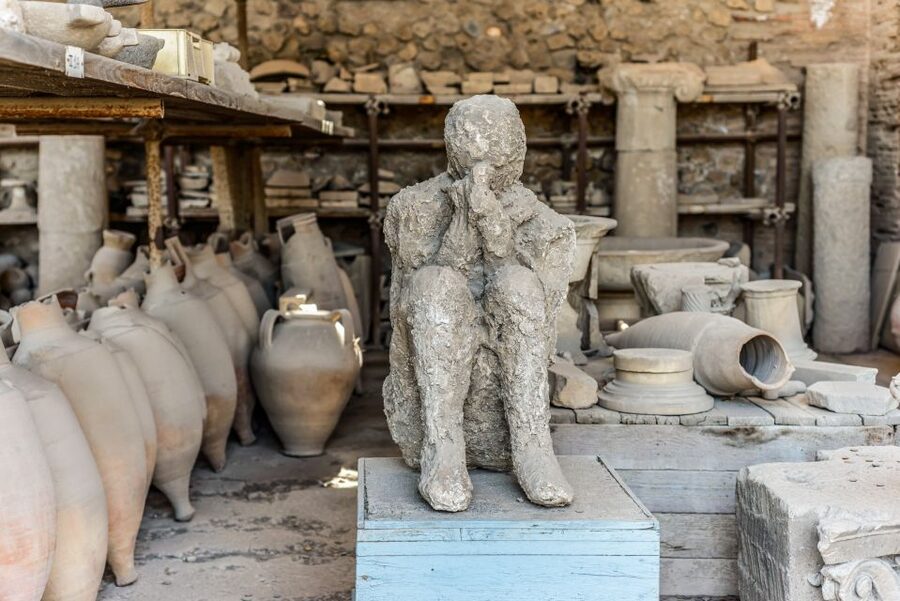
The plaster casts are more difficult to predict. The material says you may see casts of people caught during the eruption, but a recent note explains that the casts are no longer located inside dwellings. Three are displayed in sealed glass cases. Conditions can change, so do not build your entire visit around seeing a specific cast in a specific house.
That adjustment does not lessen the importance of the site, but it does make it wise to listen to current guidance on the day. Temporary closures and crowd controls can also affect access to individual buildings.
What the $40 price gets you
At about $40 per person, this is a fair price for a guided introduction to Pompeii. Your ticket is included, and you receive two or three hours with an archaeologist. That matters because the entry fee alone does not explain the city, direct you around closed areas, or tell you why a plain-looking building matters.
The value is highest for first-time visitors. If you already know Pompeii well, prefer quiet independent study, or plan to spend the entire day with a guidebook, you may not need this format. For most people, though, a short guided route prevents the first hours from becoming a tiring walk through disconnected ruins.
The private option costs more than the shared experience, though the exact supplement is not provided here. Choose it if your group wants to ask many questions or move at its own pace. The small shared group is the better value for most couples and families.
Headsets are available for groups of 16 or more. Smaller groups may not need them, but audibility can still depend on where you are standing and how crowded the area is. If you are sensitive to background noise, stay close to the guide.
Choosing the best time and length
A morning tour gives you more of the day afterward. This is useful because Pompeii is far too large for a quick exit after the guided walk. You can use the guide’s suggestions to visit additional houses or sections at your own speed.
Midmorning can also work well. One person found that crowds had thinned after noon, while another appreciated a guide who avoided busy areas. Conditions vary by date, but a guide who can adjust the route is a real advantage.
Be careful with late afternoon departures. A two-hour tour beginning at 2 p.m. may finish around 4 p.m., leaving only about an hour before the park closes at 5 p.m. Some buildings may close before the official site closing time, so you will have less freedom afterward.
If your schedule allows, I would pick the earliest practical start, especially for the three-hour route. You get the guided explanation while your energy is good and preserve more time for independent wandering.
Who should book this Pompeii tour?
I would recommend it to first-time visitors, families with older children, couples who want history explained in plain language, and anyone who prefers seeing the main sights before choosing where to spend extra time.
It is also a good match if you care about archaeology but do not want a university lecture. The best guides combine technical knowledge with stories about residents, businesses, buildings, and the eruption. Several people wished they had more time with their guide, which is a good sign that the commentary feels useful rather than padded.
You should think twice if you need step-free access or have trouble with uneven ground. Wheelchair users and people with mobility impairments are specifically advised against booking. Mobility scooters are not allowed, and large bags cannot enter.
Dogs over 10 kilograms are not allowed on the site, and children must be accompanied by an adult. Smoking is also prohibited. Bring a passport or identity card, though a copy is accepted.
Final verdict: a smart first three hours in Pompeii
I would book this tour if you want Pompeii to feel like a city rather than a field of ruins. The archaeologist guides are the main reason to go, and the strongest examples, including Roxanne, Alessandra, Paolo, Teresa, Nicoletta, Anna, and Mario, have helped people connect grand monuments with ordinary life.
Choose two hours for a focused introduction, then use the remaining day to explore on your own. Choose three hours if the Villa of the Mysteries and its frescoes are high on your list. At $40, the ticket, direction, and historical context make this a strong buy for a first visit, provided you plan around the walking and avoid a late start.
FAQ
How long is the Pompeii archaeologist tour?
You can choose a two-hour or three-hour guided tour. The three-hour option includes a visit to the Villa of the Mysteries.
Does the tour include Pompeii admission?
Yes. The Pompeii Express entry ticket is included.
Can I explore Pompeii alone after the tour?
Yes. You are free to remain inside the archaeological site and continue exploring after the guided portion. Your guide also gives suggestions for what to see next.
Is the Villa of the Mysteries included in every option?
No. It is included with the three-hour tour, not the standard two-hour route.
Is transportation included?
No. Transportation to and from Pompeii is not included.
What languages are available?
Guided tours may be offered in English, Italian, French, Spanish, German, and Portuguese. Shared and private options do not always offer the same languages, so check the selected option carefully.
Is a private tour available?
Yes. You can choose a private group option instead of joining a shared small group.
What should I bring?
Bring your passport or identity card. A copy is accepted.
Is the tour suitable for wheelchair users?
No. The tour is not suitable for wheelchair users or people with mobility impairments because of uneven surfaces, steps, ramps, and a slight steep climb.
Can I bring luggage or a large bag?
No. Luggage and large bags are not allowed. A free cloakroom is located next to Porta Marina Superiore, subject to availability.
Recently added around Pompei Campania
- Pompeii 3hours Villa of Mysteries tour with an Archaeologist★ 4.8 · 486 reviews
- Pompeii: Small-Group Tour of Pompeii and Herculaneum★ 4.8 · 867 reviews
- Pompeii: Skip-the-line-Ticket and Guided Tour★ 4.6 · 1,152 reviews
- Pompeii: Skip-the-Line Entry & Audioguide★ 3.8 · 225 reviews
- Pompeii: Guided Tour with Skip-the-Line Entry★ 4.9 · 812 reviews
- Pompeii: Afternoon to Sunset Guided Tour with Ticket★ 4.9 · 484 reviews
- Pompeii: Tour with Archaeologist Guide & Skip-the-Line Entry★ 4.5 · 478 reviews
- Pompeii: Skip-the-Line Entry Ticket with Digital Guide App★ 4.1 · 770 reviews
Pompeii & Vesuvius Tours, compared.
Entry Ticket and Guided Tour with an Archaeologist
Read our review →


Pompeii Small Group Tour with an Archaeologist
Read our review →
Pompeii, Amalfi Coast and Positano Day Trip from Rome
Read our review →
Pompeii and Mount Vesuvius Day Trip from Rome with Pizza Lunch
Read our review →Browse the lists this tour appears in