

Reviewed · POMPEII & VESUVIUS TOURS
Pompeii: Skip-the-Line Entrance Ticket with Audio Guide
Pompeii rewards patient wandering. This self-guided visit gives you skip-the-line entry, a map, and an audio guide so you can explore the huge archaeological site at your own speed. I especially like the freedom to linger over a fresco or move quickly past a less interesting street. I also like that the ticket office is just above the Pompeii Scavi train station, making the arrival simple once you know where to go.
The main drawback is that this is not a fully guided tour, and Pompeii is enormous. The audio guide can be hard to match with the ruins, especially if you are tired or unsure where you are on the map. You also need to collect the ticket in person, bring your own headphones, and prepare for strong sun with very little shade.
In This Review
- Key points before you book
- Collecting your ticket at Pompeii Scavi
- What skip-the-line really saves
- Using the audio guide and map
- Pompeii’s amphitheater and public spaces
- Houses, banquets, and ordinary Roman life
- Frescoes frozen in place
- The casts and the human cost
- Heat, water, and the seven-hour question
- Getting there from Naples
- Who will get the most from this ticket?
- Should you book the Pompeii audio-guide ticket?
- FAQ
- Where do I exchange the Pompeii ticket voucher?
- Is the ticket valid for the entire day?
- Is the audio guide available in English?
- Do I need to bring headphones?
- Can children enter for free?
- Can I cancel the booking?
Key points before you book

- The ticket office is above the Pompeii Scavi station: Exchange your voucher at the provider’s office on the first floor, then walk a very short distance to the entrance.
- The map matters: Pompeii is large and maze-like, so keep it with you even if you normally avoid guided tools.
- Bring headphones: A headset is not included. Several people used the supplied phone with their own wired earphones.
- Arrive early for cooler conditions: Around 9 a.m. can mean fewer people and less heat, though the ticket office may not open until after 9.
- The audio guide gives you control: You can choose which areas to see and spend as long as you like at important houses, theaters, and frescoes.
- A paid guide upgrade may be offered: Some people added a two-hour guided visit for about €10 per person, then continued alone afterward.
Collecting your ticket at Pompeii Scavi

Your visit begins at the activity provider’s office on the first floor of the Circumvesuviana train station at Via Villa dei Misteri 1. Look for the Pompeii Scavi station, not the modern town station. The collection office is almost beside the archaeological entrance, which is one of the best practical features of this arrangement.
You exchange your voucher there for your entry ticket, map, and audio guide. The office is close enough that you do not need to cross town or search for a distant meeting point. Still, allow a little extra time. The office may not be ready to issue tickets before 9 a.m., and the process is not electronic, so you cannot simply walk straight from the train platform into the ruins.
The entrance and collection point can feel crowded, especially when trains arrive. One useful detail is that arriving a few minutes late has not always caused a problem, with the ticket office allowing entry later than the precise time selected. I would not depend on that during a busy day, but it makes the ticket less rigid than some timed attractions.
If parking helps your plans, free parking may be available at Osteria Nonna Cherubina on Via Andolfi 46, if the restaurant is open and spaces are available. Treat this as a possibility, not a guaranteed parking arrangement.
More Pompeii and Vesuvius trips:
- Pompeii: Entry Ticket and Guided Tour with an Archaeologist
★ 4.8 · 19,459 reviews - Pompeii: Small Group Tour with an Archaeologist
★ 4.8 · 12,264 reviews - Naples: Pompeii and Mt. Vesuvius with Lunch and Wine Tasting
★ 4.5 · 2,454 reviews
What skip-the-line really saves
The main benefit here is avoiding the ordinary ticket-office queue. That matters most during the busiest hours, when Pompeii fills with independent visitors, school groups, and organized tours. Early in the morning, the regular line may not be very long, but skipping it still removes one piece of uncertainty from your day.
You should know that skip-the-line does not mean walking through every part of the entrance without waiting. There may still be a short queue for security or admission, particularly when many people arrive at once. The ticket saves time at the ticket office, not every possible pause at the gate.
At about $39.97 per person, this is a convenience purchase rather than the absolute cheapest way to enter Pompeii. Its value comes from combining admission, the audio guide, and the map in one arrangement. If you are visiting during a packed summer morning or have a train connection afterward, that convenience can be worth the extra cost.
For European Community visitors aged 18 to 24, an identification document can reduce admission to €2. Children from 0 to 17 enter free according to the supplied conditions. That makes this particular package less attractive for families with children or eligible young adults, so check the current booking options before paying the adult price.
Using the audio guide and map

The audio guide is available in English, French, German, Italian, and Spanish. The map is just as important as the commentary. Pompeii is not a compact museum with a simple loop, and you can easily spend hours walking streets that lead you away from the sights you most want to see.
The audio guide lets you choose your own order. You can stop for photographs, skip an area, or return to a house that caught your eye. That works well if you dislike being hurried by a group. It is also useful for a second visit, when you may want to seek out parts of the site you missed the first time.
There is a practical snag. The guide is not always easy to connect with the exact building in front of you. If you do not know how the numbered points relate to the map, you may spend more time figuring out the system than listening. A few people barely used the guide for this reason.
Bring your own headphones. The headset is not included, and one supplied phone was used with an auxiliary cable and personal earphones. Wired headphones are the safest choice based on the available instructions. You may need to leave an identity document while borrowing the device, so ask the office exactly what it requires before handing anything over.
If you prefer stories delivered in a clear order, a live guide may suit you better. An optional upgrade to a roughly two-hour guided tour has been available for about €10 per person at the meeting point. Guides including Alfonso, Alfonso-Marie, Astrid, and Julià received especially warm praise for their energy, explanations, and ability to point out details that are easy to miss. The guided option is separate from this audio-guide booking, and group sizes can vary.
Pompeii’s amphitheater and public spaces
Once inside, begin with the big public buildings if you want a strong sense of Pompeii’s scale. The Roman amphitheater is one of the major sights, and it helps you picture the city as a working Roman community rather than only a disaster site.
The small theater offers a different mood. Its more intimate scale makes it easier to imagine music, performances, and gatherings. The public gym shows another side of daily life, where exercise and social contact were part of the city’s routine.
These places are valuable because they give structure to the visit. Private houses can blur together after several hours, but theaters, athletic areas, and the amphitheater show how Pompeii functioned as a city. Use the map to mark each one, then give yourself time to wander into nearby streets instead of rushing from highlight to highlight.
A few more Pompei Campania bookings to compare
- Pompeii: Skip-the-line-Ticket and Guided Tour
★ 4.6 · 1,152 reviews - Pompeii: Small-Group Tour of Pompeii and Herculaneum
★ 4.8 · 867 reviews - Pompeii: Guided Tour with Skip-the-Line Entry
★ 4.9 · 812 reviews - Pompeii: Skip-the-Line Entry Ticket with Digital Guide App
★ 4.1 · 770 reviews
Houses, banquets, and ordinary Roman life

Pompeii is most affecting when you move beyond the famous catastrophe. The ruins preserve places where people lived, cooked, met friends, and held banquets. The audio commentary can help you connect walls and courtyards with ordinary routines that are not obvious from the stones alone.
Look closely at the layout of the homes. Rooms, open spaces, decorative surfaces, and dining areas tell you more when you pause and imagine how the spaces worked together. You are not simply looking at old buildings. You are seeing the remains of a city where social rank, family life, work, and entertainment were built into the design of the home.
The site rewards curiosity, but it can also tire you out. Some streets and buildings may be closed or difficult to reach on a particular day, and it is unlikely that you will see everything in one visit. Several hours can pass quickly, and a longer stay may still leave large parts unexplored.
Frescoes frozen in place
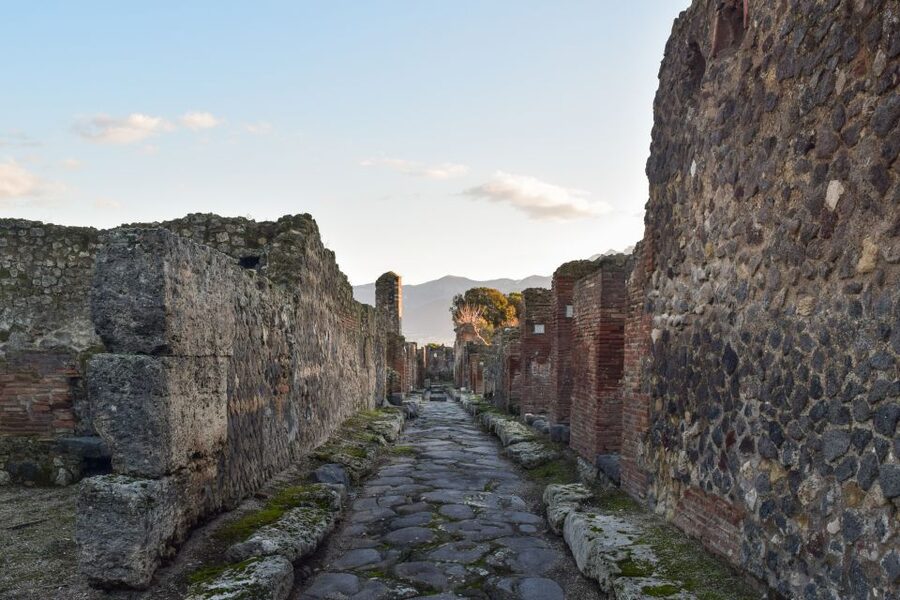
The frescoes are among Pompeii’s strongest reasons to visit. Their color and detail make the ancient city feel close, while the surrounding ruins remind you how abruptly life ended.
Do not rush through decorated rooms. The audio guide can provide context, but your own eyes will often notice small figures, borders, household scenes, and decorative patterns that deserve a quiet look. This is where the self-guided format works well. You can wait for a clearer view instead of moving along with a group.
Some rooms may be crowded, and the route through the site can change. Keep your map handy and accept that you may not reach every famous house. Pompeii is better treated as a large city to sample thoughtfully than as a checklist to conquer.
The casts and the human cost
The casts of Pompeii’s residents and animals are among the most moving parts of the visit. They bring the eruption out of the realm of dates and architecture and show the personal cost of the disaster.
You may see casts connected with citizens and pets. These are difficult to look at, but they are essential to understanding why Pompeii is more than a collection of Roman ruins. The best approach is to slow down, listen to the explanation, and give yourself a little quiet time before moving on.
The audio guide can provide useful background here, although a live guide may explain the evidence in a more connected way. If you choose the self-guided visit, use the commentary as a starting point and let the site itself set the pace.
Heat, water, and the seven-hour question
Pompeii is exposed. There is little shade, and the combination of stone streets, walking, and southern Italian sun can wear you down. Bring plenty of water, use sunscreen, and wear shoes that can handle uneven ancient paving.
There is only one café on the site according to the supplied information, so do not assume refreshments will be available whenever you need them. Food and drinks are not included in the ticket. Plan your break rather than waiting until you are exhausted.
You can finish in a few hours, but some people spend three and a half hours or much longer exploring. One person spent about seven hours at the site. I would plan at least half a day if Pompeii is important to you, with permission to leave earlier if the heat or crowds become too much.
This is also why the self-guided format has real value. You can stop outside, rest, skip distant sections, and return to the map when your energy improves. A coach excursion may feel tidier, but this ticket gives you more control over the day.
Getting there from Naples
The Circumvesuviana train makes Pompeii accessible from Naples, and the station beside the ruins is a major advantage. The train can be very crowded, so leave enough time for a busy journey and for finding the collection office after you arrive.
The meeting point is particularly convenient for independent plans. You are not tied to a large coach schedule, and the activity ends back at the same general meeting point. That makes it easier to continue around Pompeii afterward or return to the station.
The simple arrival is not completely foolproof. Make sure you have the correct Pompeii station and look for the provider’s office above the train station before joining the entrance line. The exchange point can be confusing if you expect the voucher to work directly at the gate.
Who will get the most from this ticket?
I would choose this option if you want independence, need to manage your own timing, or prefer listening privately rather than following a guide. It is also a good fit for a second visit, when you already know the main route and want to explore less familiar corners.
Families may appreciate the freedom to stop and move on without holding a group together. But check the child and young adult pricing carefully, since free entry for children and the €2 rate for eligible European Community visitors aged 18 to 24 can change the value calculation.
If this is your first visit and you are fascinated by Roman daily life, a live guide may be better. Pompeii is so large that a good guide can connect the amphitheater, houses, frescoes, and casts into one clear story. The audio guide works, but it asks more of you. You need to read the map, locate the right point, and decide how to organize the day.
Should you book the Pompeii audio-guide ticket?
Book it if you want a flexible day, an easy meeting point, and a way to avoid the main ticket-office line. The map and audio guide are useful additions, especially if you arrive early, bring headphones, and accept that Pompeii takes effort to navigate.
I would hesitate if you expect a polished guided tour from start to finish. In that case, ask about the optional live-guide upgrade at the office, which has sometimes been available for about €10 more per person. For everyone else, this is a practical way to experience one of Italy’s most powerful archaeological sites without being rushed.
Free cancellation up to 24 hours before the activity and reserve-now, pay-later terms also make it easier to fit into an uncertain itinerary. Just bring your passport or ID, headphones, sunscreen, water, and a small bag. Large luggage is not allowed.
FAQ
Where do I exchange the Pompeii ticket voucher?
Exchange it at the activity provider’s office on the first floor of the Circumvesuviana train station at Via Villa dei Misteri 1 in Pompeii. The office is close to the archaeological entrance.
Is the ticket valid for the entire day?
The activity has a duration of one day. Check availability for the starting times when booking.
Is the audio guide available in English?
Yes. The audio guide is offered in English, French, German, Italian, and Spanish.
Do I need to bring headphones?
Yes. Headphones are not included, so bring your own. The instructions specifically recommend bringing headphones.
Can children enter for free?
Children aged 0 to 17 go free according to the supplied conditions. European Community visitors aged 18 to 24 with identification pay €2.
Can I cancel the booking?
Yes. You can cancel up to 24 hours in advance for a full refund. Reserve-now, pay-later booking is also available.
Recently added around Pompei Campania
- Pompeii 3hours Villa of Mysteries tour with an Archaeologist★ 4.8 · 486 reviews
- Pompeii: Small-Group Tour of Pompeii and Herculaneum★ 4.8 · 867 reviews
- Pompeii: Skip-the-Line Entry & Audioguide★ 3.8 · 225 reviews
- Pompeii: Skip-the-line-Ticket and Guided Tour★ 4.6 · 1,152 reviews
- Pompeii: Guided Tour with Skip-the-Line Entry★ 4.9 · 812 reviews
- Pompeii: Afternoon to Sunset Guided Tour with Ticket★ 4.9 · 484 reviews
- Pompeii: Tour with Archaeologist Guide & Skip-the-Line Entry★ 4.5 · 478 reviews
- Pompeii: Skip-the-Line Entry Ticket with Digital Guide App★ 4.1 · 770 reviews
Pompeii & Vesuvius Tours, compared.

Entry Ticket and Guided Tour with an Archaeologist
Read our review →



Pompeii Small Group Tour with an Archaeologist
Read our review →
Pompeii, Amalfi Coast and Positano Day Trip from Rome
Read our review →Browse the lists this tour appears in