
Reviewed · POMPEII & VESUVIUS TOURS
Skip the Line Guided Tour of Pompeii led by an Archaeologist
Pompeii rewards a little expert help. I like the archaeologist guide, who turns worn stones, painted walls, and ancient streets into a picture of daily Roman life. I also like the skip-the-line entry and small group, though two hours is only enough for the main sights, not the whole enormous site.
The meeting point is Piazza Esedra, a practical start near public transportation. Guides such as Lello, Italo, Clelia, and Ana have earned especially warm praise for clear explanations, humor, and a friendly pace. You will walk over uneven ancient roads, often in the sun, so comfortable shoes and a moderate level of fitness matter.
In This Review
- Key points to know before booking
- Why a Pompeii guide is worth paying for
- Meeting at Piazza Esedra and entering the park
- Walking Via dell’Abbondanza
- Reading the Forum as Pompeii’s public center
- Seeing the Stabian Baths
- Entering the Lupanar
- What the archaeologist guide adds
- Group size, pace, and physical effort
- Is $95.53 a fair price?
- Who should book this Pompeii experience?
- Should you book it?
- FAQ
- How long does the Pompeii guided tour last?
- Where does the tour begin?
- Where does the tour finish?
- Are skip-the-line tickets included?
- Can I use the tour confirmation to enter Pompeii alone?
- How large is the group?
- What should I wear?
- What happens if I cancel?
Key points to know before booking
- A guide makes the ruins readable: You get context for streets, frescoes, baths, shops, and public buildings that are easy to pass without noticing.
- The tour lasts about two hours: It focuses on Pompeii’s major sights rather than trying to cover every open building.
- Groups are capped at 15 people: Some sessions may be much smaller, and audio devices help you hear the guide.
- Skip-the-line entry saves precious time: You enter with the guide rather than waiting through a long ticket queue.
- The walking is real work: Original paving stones, heat, and the size of the site can make the outing tiring, even in good shoes.
- Your booking confirmation is not a stand-alone ticket: You must join the guide, bring matching identification, and arrive on time.
Why a Pompeii guide is worth paying for
Pompeii is not a small archaeological exhibit. It is a buried Roman city with streets, homes, public buildings, businesses, religious spaces, and entertainment venues spread across a large area. You can walk in alone, but the site does not always explain itself.
A guide supplies the missing links. A painted wall becomes part of a home rather than just a pretty fragment. A raised stone in the street makes more sense when you learn how people moved through the city. A public building tells you something about Roman habits, status, hygiene, or commerce.
That is the main value here. At $95.53 per person, this is not the cheapest way to enter Pompeii. You are paying for admission, a professional archaeologist guide, and a focused route through the major areas. If you would otherwise spend hours reading signs and checking a map, the cost can make sense.
The strongest praise goes to the guides themselves. Lello is repeatedly described as warm, funny, and full of precise detail. Italo is praised for a relaxed manner and for helping people continue exploring after the formal tour ended. Clelia is noted for fitting a great deal into the two-hour time limit without making the visit feel overloaded.
The quality of your individual session depends on the guide assigned that day. Still, the pattern is clear: this experience works best because the person leading it treats Pompeii as a place where people lived, worked, argued, bathed, ate, and worshiped, not simply as a collection of ruins.
More Pompeii and Vesuvius trips:
- Pompeii: Entry Ticket and Guided Tour with an Archaeologist
★ 4.8 · 19,459 reviews - Pompeii: Entry Ticket with Optional Audio Guide
★ 4.2 · 12,360 reviews - Pompeii: Small Group Tour with an Archaeologist
★ 4.8 · 12,264 reviews
Meeting at Piazza Esedra and entering the park
The tour begins at Piazza Esedra in Pompei, Italy. The location is near public transportation, and the activity ends back at the same meeting point. There is no private transportation included, so you need to arrange your own way to the square.
Build in a generous arrival cushion. The area’s roads can be slow, and one late arrival missed the tour by only a few minutes after a short car journey turned into a much longer trip. This is especially important if you are coming by car or connecting from another town.
Bring the identification used for the reservation. IDs are mandatory for entry, and the names on the booking must match the names on those documents. This is an easy rule to overlook, but it can affect whether you get inside.
The skip-the-line benefit is practical rather than glamorous. Pompeii can attract long queues, and losing a large part of a short visit before you even enter is frustrating. Here, your confirmation is used with the guide for the guided entry. It is not a ticket you can use independently if you arrive at another time.
Walking Via dell’Abbondanza
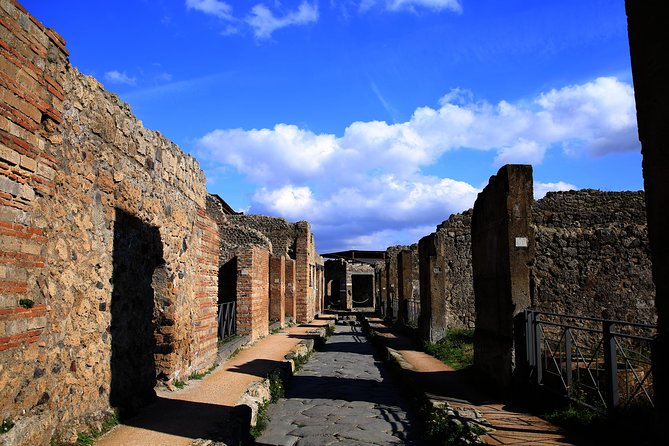
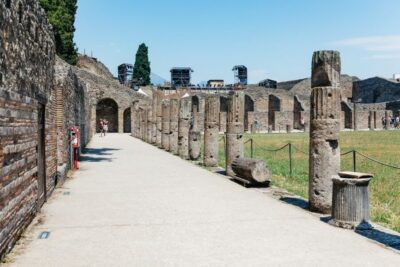
Via dell’Abbondanza is one of Pompeii’s main streets and gives you an immediate sense of the city’s scale. This is not a single monument that you inspect and leave. It is a route through the old urban fabric, with buildings and traces of everyday activity along the way.
The guide helps you read the street as a working part of town. You may notice details you would otherwise walk past, including the arrangement of buildings, the uneven paving, and signs of how people moved through the city. The point is not just to photograph the road. It is to understand what a main street meant in Roman Pompeii.
This section also sets the walking rhythm. You will spend much of the tour on foot over original ancient surfaces. Even visitors who enjoy history should expect sore feet if the day is hot. Wear sturdy, comfortable shoes, and do not treat this as a gentle stroll through a museum.
The route is generally well paced. One guide was praised for giving plenty of information without rushing, while another managed to keep a family with teenagers engaged. A five-year-old was also kept interested during one session, though the heat and long walking can still be difficult for younger children.
Reading the Forum as Pompeii’s public center
The Forum is the heart of the visit for many people. The route through the main streets ends here, giving you a larger view of how Pompeii functioned as a city. Markets and civic spaces gathered around this central area, and the guide explains how people used it in Roman times.
This is where the site’s separate pieces begin to connect. The street you have just walked becomes a route toward public life. Buildings around the square are no longer isolated walls. They form part of the political, commercial, and social center of Pompeii.
A particularly useful feature is the chance to get your bearings. One guide left a group near the Forum after the formal tour and explained the site’s grid system, allowing them to continue independently with the map. That is a smart way to handle a two-hour tour. You get a guided introduction, then a clearer plan for exploring beyond the official route.
The drawback is that a short visit cannot give every corner of the Forum the attention it deserves. You will get the main interpretation, not a long academic lecture at each building. For most people, that is the right trade-off. The Forum can otherwise become a blur of columns, paving, and names.
A few more Pompeii bookings to compare
- Pompeii Small Group Tour with an Archaeologist
★ 5.0 · 6,593 reviews - Pompeii: Skip-the-Line Entrance Ticket with Audio Guide
★ 4.0 · 2,509 reviews - Naples: Pompeii and Mt. Vesuvius with Lunch and Wine Tasting
★ 4.5 · 2,454 reviews - Pompeii: Archaeological Park Tour with Ticket on request
★ 4.5 · 2,283 reviews
Seeing the Stabian Baths
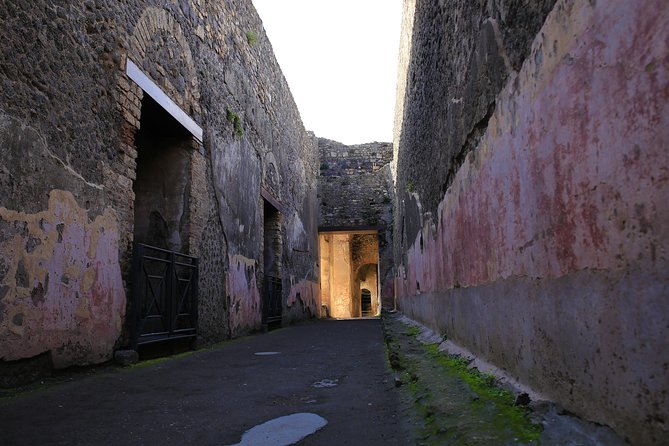
The Stabian Baths show a different side of Pompeii. The Forum gives you public and civic life, while the baths point toward routine, social habits, and Roman ideas about cleanliness and leisure.
A guide can explain why the baths matter beyond their surviving walls. You are not simply looking at an old thermal complex. You are learning how shared facilities fit into the rhythm of urban life and how architecture served practical needs.
The twenty-minute itinerary segments should be understood as approximate portions of the route, not as six isolated appointments. Your guide may spend more or less time at a particular place depending on access, crowd levels, and the group’s questions.
That flexibility helps. A good guide can avoid getting trapped behind a large group and keep the pace comfortable. The route may still feel quick if you want to study every room or photograph every detail. If you are an archaeology specialist or a repeat visitor, treat this as a focused overview rather than a complete research visit.
Entering the Lupanar
The Lupanar is one of Pompeii’s most famous stops. Its erotic frescoes attract attention, but the guide’s interpretation is what gives the building value. You can learn how to look at the images within the setting of Roman commercial and social life rather than treating them as a simple curiosity.
This stop may not suit every family in the same way. Children must be accompanied by an adult, and parents should decide if the subject matter is appropriate for their children. The tour is not presented as a sensational visit, but the erotic paintings are an explicit part of the site.
The Lupanar can also be crowded. A small group helps your guide position the visit and keep the explanation audible. Still, expect the possibility of other groups nearby. The tour’s maximum of 15 people is small by Pompeii standards, but it does not mean you will have the building to yourself.
What the archaeologist guide adds
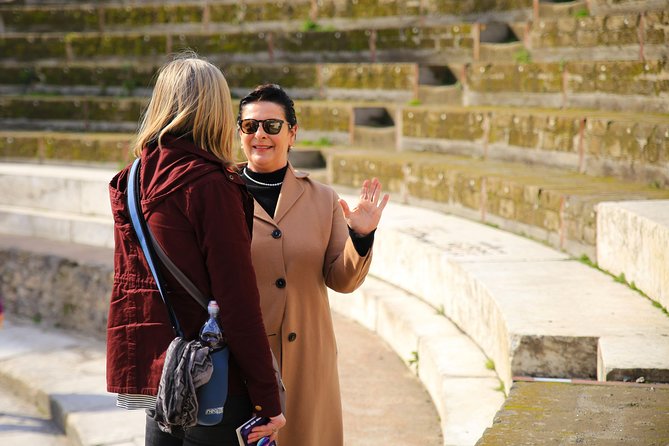
The title promises an archaeologist, and that is the central selling point. The best guides on this experience make Pompeii’s residents feel present through stories about geography, culture, homes, work, and daily routine.
Lello receives the most enthusiastic praise, especially for combining exact information with charm and humor. People describe him as patient, engaging, and unusually good at making complex subjects easy to follow. He also seems comfortable speaking to mixed groups, from adults with a strong interest in ancient history to families with teenagers.
Italo is praised for his relaxed style and for noticing small details that are easy to miss alone. His approach also appears useful after the two-hour route, since he helped explain how to navigate the remaining streets. Clelia is noted for delivering a great deal of information in a short time, while Ana is praised for being prompt, kind, funny, and clear.
You cannot guarantee a particular guide unless the operator confirms it. You can ask, but plan on receiving a strong professional guide rather than booking solely around one name.
The audio equipment is another practical benefit. Earbuds are handed out so everyone can hear while walking. That matters in a ruin-filled site where people naturally spread out, and it prevents you from having to stay pressed against the guide.
Group size, pace, and physical effort
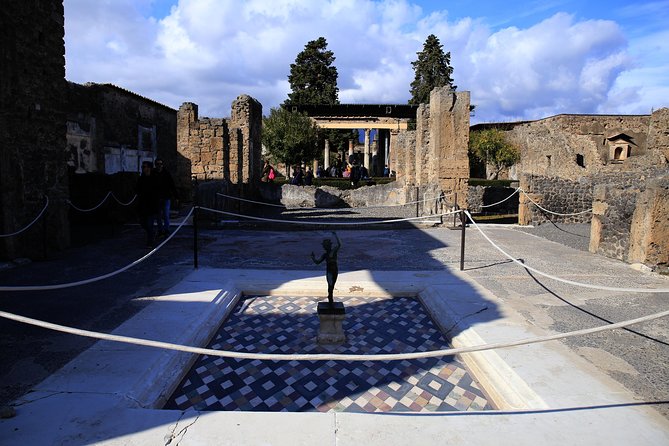
The group can include up to 15 people. That is small enough for questions and personal attention, while still keeping the price below a private tour. Some sessions may be much smaller, including groups of seven or only a few couples.
A small group also helps with movement. Large tour parties can clog narrow passages and make it hard to hear. With fewer people, your guide can keep the route moving and avoid some of the congestion created by bigger groups.
The pace is active but not described as a race. You will cover several major areas in two hours, so there is plenty of walking and regular stops for explanation. One person found the route long and hot even in sneakers, while others found the timing just right.
Plan around the weather. A noon start can be hot, though it may have fewer people at certain times. The tour information does not promise shade or special access for mobility needs, so anyone concerned about heat, uneven ground, or stamina should consider those limits before booking.
Children are welcome with an accompanying adult. The experience can work well for older children and teenagers if they enjoy stories and can manage the walking. Very young children may find the combination of heat, ancient paving, and two hours of standing tiring.
Is $95.53 a fair price?
The price is easiest to judge by comparing it with the kind of visit you want. If you want a quick, well-organized introduction with admission and an archaeologist guide, $95.53 can be fair. You avoid a long entry wait, follow a route through major highlights, and gain explanations that are difficult to reproduce with a map alone.
If you already know Pompeii well or want a full day to explore at your own speed, the value is less obvious. Two hours will not cover the entire archaeological park, and you may want to pay for entry and continue on your own afterward.
I see the tour as a time-saving orientation. It is especially useful for a first visit, a tight schedule, or anyone who prefers understanding a site rather than simply wandering through it. The fact that the guide may leave you near the Forum with enough direction to continue exploring adds flexibility.
There are group discounts, and the activity is offered in English with a mobile ticket. Free cancellation is available up to 24 hours before the start time. Cancellations or changes within 24 hours are not refunded or accepted, and a minimum group size is required for the tour to operate.
Who should book this Pompeii experience?
I would choose this tour if you are visiting Pompeii for the first time and want the major story in a manageable period. It is also a good match if you enjoy history but do not want a dry, formal lecture.
Families with older children and teenagers may appreciate the guides’ humor and interaction. The route is not passive, but the Lupanar’s erotic frescoes and the amount of walking deserve a quick family discussion before you go.
This is less suitable if you need a slow, fully accessible route, dislike walking on uneven surfaces, or want to inspect every house and fresco at length. It may also frustrate repeat visitors who already understand the site and prefer a self-guided day.
The 4.9 rating from 703 reviews and recommendation by 99 percent of customers fit the experience’s strongest qualities: excellent guides, clear storytelling, small groups, useful audio devices, and efficient entry. The main caution is not guide quality. It is the fixed two-hour limit and the physical demand of Pompeii itself.
Should you book it?
Book this tour if you want Pompeii to make sense quickly. The archaeologist guide is the real value, and the combination of skip-the-line entry, a group capped at 15, and a focused route removes much of the confusion from a first visit.
Arrive early, bring matching ID, wear serious walking shoes, and expect heat. If possible, leave time afterward to explore beyond the guided route, especially around the Forum and the wider street grid.
Skip it only if you want a full-day independent visit, already know Pompeii well, or need a slower pace. For most first-time visitors, this is a strong way to meet Pompeii through its people and daily life, not just its famous ruins.
FAQ
How long does the Pompeii guided tour last?
The tour lasts approximately two hours.
Where does the tour begin?
It begins at Piazza Esedra, 80045 Pompei NA, Italy.
Where does the tour finish?
The activity ends back at the meeting point.
Are skip-the-line tickets included?
Yes. Skip-the-line admission is included, with no long wait promised when entering with the guide.
Can I use the tour confirmation to enter Pompeii alone?
No. The confirmation is for the guided tour and can only be used with the guide. It is not a stand-alone ticket to the ruins.
How large is the group?
The maximum group size is 15 people. Some sessions may be smaller.
What should I wear?
Wear comfortable shoes because the route uses original ancient streets. Smart casual clothing is requested.
What happens if I cancel?
You can cancel for a full refund up to 24 hours before the local start time. Cancellations or changes made less than 24 hours before the start are not refunded or accepted.
Recently added around Pompeii
- From Pompeii: Bus Transfer to Vesuvius with Park Entry Fee★ 4.2 · 700 reviews
- Pompeii Skip-the-line Tour with Archaeologist Guide★ 5.0 · 559 reviews
- Visit in Pompeii – Pompeii Private Tour with Ada★ 5.0 · 436 reviews
- Ancient Pompeii Private Tour: Skip the Line & Kid-Friendly Option★ 5.0 · 167 reviews
- Pompeii Private Tour with an Archaeologist and Skip The Line★ 5.0 · 391 reviews
- Pompeii Private Tour with an Archaeologist and Skip The Line – 3 hours★ 5.0 · 564 reviews
- Sharing Tour of Pompeii★ 5.0 · 487 reviews
- Private Day Tour to Vesuvius, Herculaneum & Pompeii with Pick Up★ 5.0 · 279 reviews
Pompeii & Vesuvius Tours, compared.
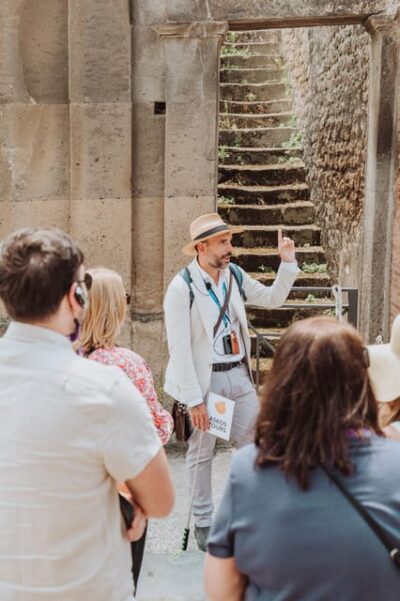
Entry Ticket and Guided Tour with an Archaeologist
Read our review →


Pompeii Small Group Tour with an Archaeologist
Read our review →
Pompeii, Amalfi Coast and Positano Day Trip from Rome
Read our review →Browse the lists this tour appears in