
Reviewed · POMPEII & VESUVIUS TOURS
Pompeii Skip-the-line Tour with Archaeologist Guide
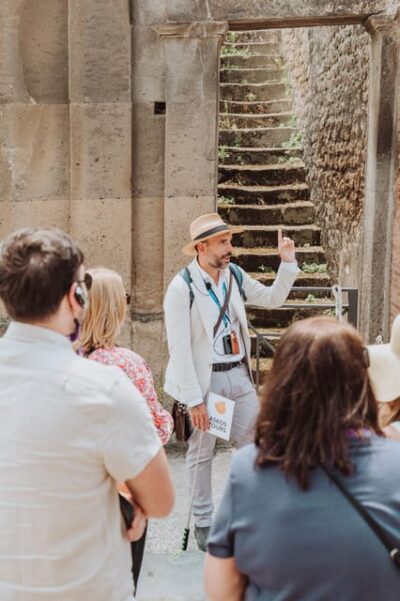
Pompeii tells its story in broken stone. This two-hour walking tour makes the vast Roman site easier to understand, pairing the main ruins with an archaeologist guide who can explain what you are seeing. I like the small maximum group of 16 and the way guides such as Lello, Italo, Cela, and Leonardo bring personal field experience to the visit. I also like that admission is included and the tour gets you past the entry line.
The main drawback is time. Pompeii is enormous, and two hours gives you a strong introduction rather than a complete visit. You will walk on uneven ancient streets in full sun, so comfortable shoes, water, and a hat matter. At $71.35 per person, this costs more than wandering alone, but the price can be worthwhile if you want the ruins to make sense rather than look like a giant field of old walls.
In This Review
- Key points to know before booking
- Why an archaeologist changes the Pompeii visit
- Getting to the Pompeii meeting point
- Entering the archaeological park without wasting time
- The theaters and the first look at public life
- Baths, shops, bars, and the practical Roman city
- The forum, where religion and government met
- Houses, the Gymnasium, and gladiator life
- The Lupanare and Pompeii’s less polished story
- What the two-hour pace feels like
- Price and value at $71.35
- Who will get the most from this tour
- Practical tips for a better Pompeii visit
- Should you book it?
- FAQ
- How long does the Pompeii tour last?
- What is included in the price?
- How do I reach the meeting point?
- Is this a ticket I can use to enter Pompeii alone?
- How large is the group?
- Can I cancel for a refund?
Key points to know before booking
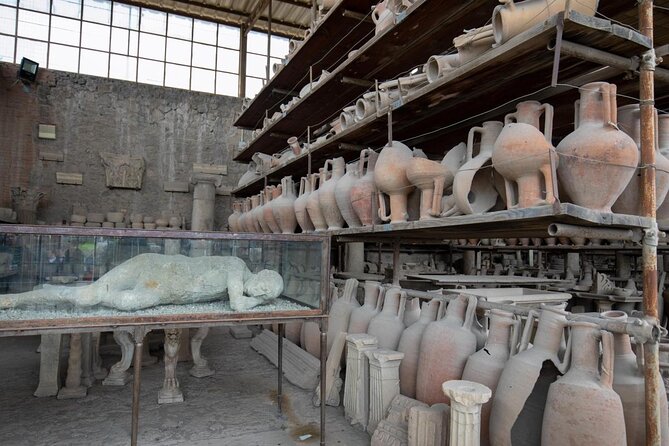
- Archaeologist-led interpretation: Guides explain small details that are easy to miss, from wagon ruts to building functions and excavation work.
- Two hours at the main highlights: Expect the forum, theaters, baths, shops, gladiator barracks, House of Menander, Gymnasium, and Lupanare, with the exact route shaped by site conditions.
- Small group limit: The group can include up to 16 people, a more manageable size than a large coach tour.
- Easy rail access: From Naples or Sorrento, take the Circumvesuviana train to Pompei Scavi, then make your own way to the meeting point.
- Skip-the-line entry: Your confirmation is used with the guide for the tour. It is not a stand-alone ticket for entering the ruins alone.
- Book ahead: The tour is often reserved about 42 days in advance, so popular times may fill early.
Why an archaeologist changes the Pompeii visit
Pompeii can be confusing without help. You walk past a wall, a doorway, or a paved courtyard, but the original purpose may not be clear. Was it a home, a shop, a temple, a bath, or part of a civic building? A good guide turns those fragments into a readable city.
That is the central strength here. Guides are not simply pointing toward famous ruins and reciting dates. They explain how Roman life worked, how people moved through the city, and how the eruption of Mount Vesuvius in AD 79 preserved so much of it.
The strongest praise goes to Lello, who is described as witty, energetic, and deeply familiar with the site. His direct archaeological experience adds useful detail, including links to people still working on the excavations. Italo receives similar praise for his clear English, thoughtful pacing, and ability to avoid the worst crowds. Cela is singled out for making the tour work well for a family with children and older teenagers.
You may be assigned a different guide, but the pattern is clear: the value rests heavily on the person leading the walk. Raphael Tours & Events uses several guides, including Lello, Italo, Cela, and Leonardo. Each is described as friendly, expressive, and able to answer questions.
More Pompeii and Vesuvius trips:
- Pompeii: Entry Ticket and Guided Tour with an Archaeologist
★ 4.8 · 19,459 reviews - Pompeii: Entry Ticket with Optional Audio Guide
★ 4.2 · 12,360 reviews - Pompeii: Small Group Tour with an Archaeologist
★ 4.8 · 12,264 reviews
Getting to the Pompeii meeting point
You arrange your own transportation. The simplest route from Naples or Sorrento is the Circumvesuviana train to Pompei Scavi station. The meeting point is at Hotel Vittoria on Piazza Esedra in Pompei, close to the archaeological area.
This is useful for independent visitors because you do not need a private car or hotel transfer. It also means you must allow enough time to find the meeting point and arrive before the scheduled start. If you are late or miss the tour, there is no refund.
The tour ends back at the meeting point. That makes it easy to continue exploring Pompeii on your own afterward, provided you have enough time and the site permits your continued access under the conditions of your admission.
At booking, include your mobile number with the country code. That gives the operator a way to contact you in case of an emergency or a change.
Entering the archaeological park without wasting time
The skip-the-line feature is valuable at Pompeii, especially when the entrance is busy. Instead of spending part of your limited visit waiting, you meet the guide and enter as part of the scheduled tour.
There is an important detail here: this is not a free-standing admission ticket. The confirmation is a guided-tour confirmation that you use with the guide. Do not treat it as a ticket you can redeem and then explore alone from the start.
Once inside, expect a walking tour over original Roman streets. These surfaces are not smooth modern sidewalks. The stones can be uneven, and the ground may include lava rock, so sturdy shoes are more useful than fashionable sandals.
Some groups receive ear sets, which can make it easier to follow the guide while standing in open spaces or near other groups. The stated maximum is 16 people. That is still a group, but it is small enough for questions and eye contact, particularly compared with tours that place 25 or more people around one guide.
The theaters and the first look at public life
The route includes Pompeii’s small theaters, where ancient audiences watched comedy and tragedy. These buildings help you picture the city as a place of entertainment, not simply a settlement frozen by disaster.
A guide can point out how the theater space worked and connect it to other public buildings nearby. Without that context, the curved seating and worn stone may look like another attractive ruin. With explanation, you begin to see the daily rhythm of Pompeii: performances, public gatherings, business, politics, and social life.
The theaters are also a good early stop because they show the range of the city. Pompeii was not one grand monument. It was a working town with public spaces, private houses, food businesses, religious buildings, and civic offices packed into a walkable urban area.
The tradeoff is that a two-hour tour cannot linger everywhere. If theater architecture is your main interest, you may want more time after the guided portion.
A few more Pompeii bookings to compare
- Pompeii Small Group Tour with an Archaeologist
★ 5.0 · 6,593 reviews - Pompeii: Skip-the-Line Entrance Ticket with Audio Guide
★ 4.0 · 2,509 reviews - Naples: Pompeii and Mt. Vesuvius with Lunch and Wine Tasting
★ 4.5 · 2,454 reviews - Pompeii: Archaeological Park Tour with Ticket on request
★ 4.5 · 2,283 reviews
Baths, shops, bars, and the practical Roman city
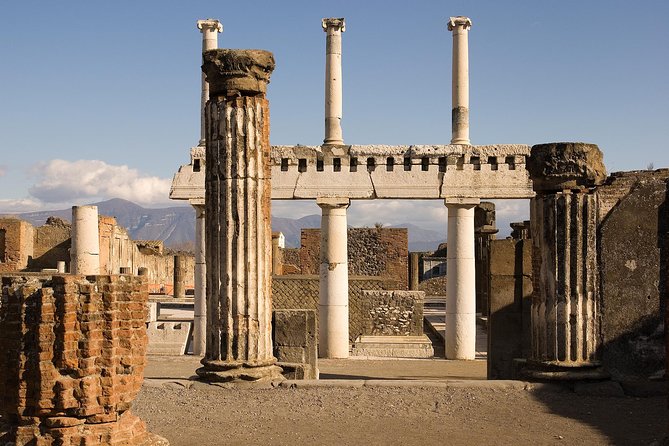
The thermal bathhouse is one of the most revealing parts of the walk. Roman baths were not only places to wash. They were linked to exercise, conversation, and everyday social life. A guide helps you understand how the rooms fit together and why the baths mattered to ordinary residents.
The tour also visits remains of local businesses, including restaurants, bars, and shops selling food and clothing. These details are especially helpful because they pull Pompeii away from the usual image of temples and statues. You see evidence of errands, meals, trade, and routine work.
This is where an archaeologist guide earns the fee. A worn counter or opening in a wall might not look important on its own. The guide can explain what it may have been used for and how it fits into the street around it.
The city’s ancient cobblestones still show ruts left by wagon wheels. Those marks are small, but they are among the most memorable details because they show repeated movement across the street over many years. Wear on the pavement can say as much about Pompeii as a large monument.
The forum, where religion and government met
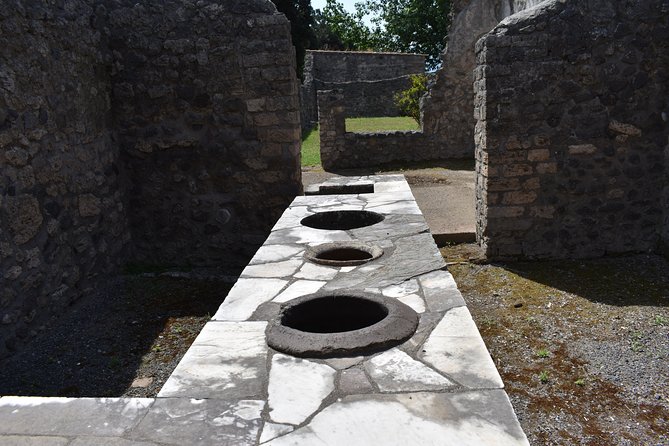
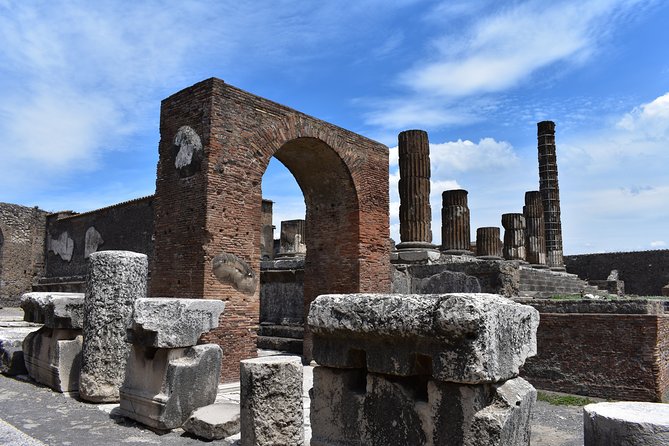
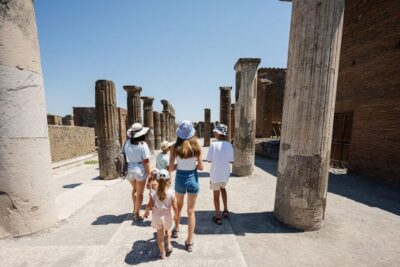
The forum was the civic heart of Pompeii. Here, temples, public buildings, priests, and politicians shared the same urban stage. It is one of the essential stops, but it can also be hard to read without guidance because much of the site survives as columns, foundations, and partial walls.
Your guide explains how Roman religion and public administration overlapped. The forum was not merely an open plaza for looking at ruins. It was a place where government, commerce, ceremony, and religious practice came together.
I would pay close attention here, even if you have already seen photographs of Pompeii. The guide’s explanation gives the open space a purpose and helps you understand how the surrounding buildings related to one another.
The forum can be exposed to the sun, with little shade. That makes a hat and water practical, especially during summer departures. The 5 p.m. tour lasts two hours, which may offer gentler light and cooler conditions, but you should still expect a full walking visit.
Houses, the Gymnasium, and gladiator life
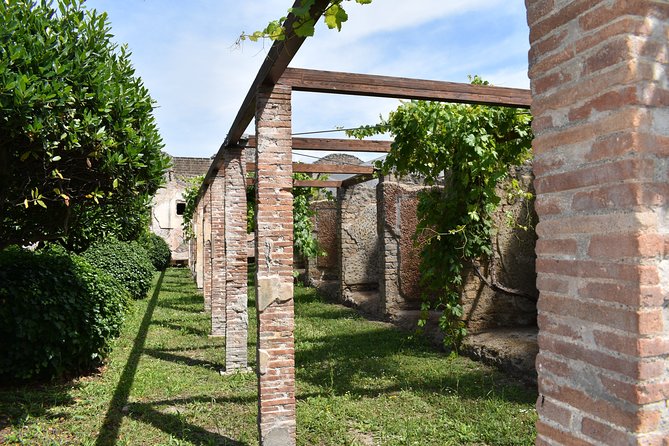
The itinerary includes the House of Menander and the Gymnasium, along with other important remains. These places add private and educational dimensions to the public buildings.
The House of Menander helps show how wealthier domestic spaces were arranged and decorated. The Gymnasium gives a sense of organized physical activity and education in the ancient city. You are not just seeing isolated rooms. You are comparing home life, exercise, public duties, and entertainment.
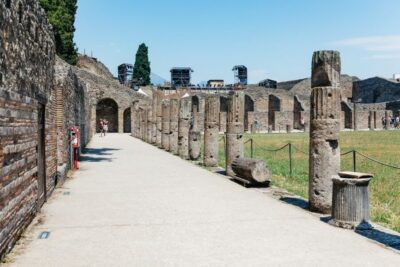
The tour also includes the barracks where Roman gladiators trained and lived. That stop links Pompeii to the Roman taste for public spectacle, while offering a more human view of the people who took part in it.
Because access and site conditions can affect the exact route, the guide may spend more or less time at particular buildings. The stated plan is to cover the highlights, not every open house and street.
The Lupanare and Pompeii’s less polished story
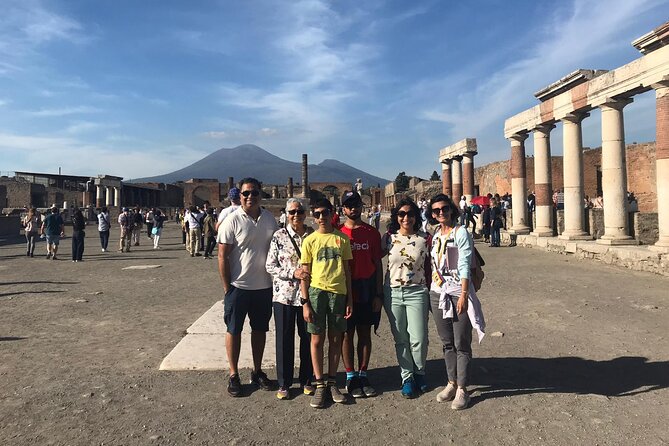
The rebuilt Lupanare, or brothel, is one of Pompeii’s most popular stops. Its presence can make the visit feel more real because it shows a side of Roman life that formal monuments often hide.
A guide provides needed context here. The building is easy to treat as a novelty, but its rooms and surviving features fit into a wider picture of commerce and social habits. The goal is not simply to point out the famous attraction, but to place it among the homes, shops, baths, temples, and streets of the city.
Families can still take this tour, but parents may want to decide how much explanation is suitable for younger children. The guides are praised for keeping children and teenagers involved, and one family with children aged 9, 12, and 14 found the storytelling held their attention.
What the two-hour pace feels like
Two hours passes quickly at Pompeii. Guides such as Lello and Italo are praised for keeping the walk engaging without letting the group lose its way. A well-paced route helps you see major highlights while staying ahead of some of the heavier crowds.
The pace is not a slow, private examination of every room. You will walk steadily, stop for explanations, ask questions, and move on. That suits you if this is your first Pompeii visit or if your Italy schedule allows only half a day.
The size of Pompeii is the main limitation. One guide specifically encouraged continuing after the main tour because there is much more to see. If you have a full day, treat the guided walk as an orientation, then spend extra time on areas that interest you most.
For a short visit, the structure is a major benefit. You do not spend your first hour wondering which direction to take or trying to identify a bathhouse from a private home.
Price and value at $71.35
At $71.35 per person, this is not the cheapest way into Pompeii. You are paying for admission, a local guide, a skip-the-line arrangement, and the chance to ask questions in a group capped at 16.
I see the value most clearly if you have limited time, care about ancient history, or want help understanding what remains. A self-guided visit costs less, but it puts the burden on you to plan a route and interpret ruins that can be difficult to identify.
The price is also easier to justify for families and first-time visitors. Children may lose interest when faced with rows of walls and paving stones. A guide who uses humor, questions, and stories can give those stones a purpose.
For a repeat visitor who has already studied Pompeii, the price may be harder to defend unless you specifically want archaeological interpretation. The tour is an introduction, not an exhaustive study of the entire park.
Who will get the most from this tour
I would choose this experience if you want:
- A clear first look at Pompeii without planning the route yourself
- An archaeologist guide rather than a basic audio-style introduction
- A smaller group instead of a large tour with 25 or more people
- A focused visit during a half-day in the Naples or Sorrento area
- Help engaging children or teenagers with the site
- A guided explanation of the eruption and Roman daily life
You may prefer exploring independently if you want to spend hours photographing one house, follow your own research, or move at a very slow pace. You should also think twice if uneven ground and extended walking are difficult for you, although the information provided says most people can participate and service animals are allowed.
The experience is offered in English. It requires good weather, and if poor weather cancels the tour, you are offered another date or a full refund. If the minimum number of participants is not reached, the operator offers another date or experience, or a full refund.
Practical tips for a better Pompeii visit
Arrive early. The tour does not provide hotel or port pickup, and late arrivals are not refunded.
Wear shoes with firm soles. You will walk over ancient streets and lava rock, not polished pavement. A hat is useful in summer, and water is a sensible addition even though food is not included.
Keep your expectations realistic. You will see major highlights such as the forum, theater, baths, shops, gladiator barracks, House of Menander, Gymnasium, and Lupanare, but Pompeii is too large for two hours to cover everything.
Listen for small observations. The wagon-wheel ruts, business counters, bath layouts, and building connections may be more meaningful than the most famous photo stop. These are the details that help you picture people living ordinary lives before the eruption.
Should you book it?
Book this tour if you want Pompeii explained by an archaeologist and need a well-organized introduction in about two hours. The small group, included admission, skip-the-line entry, and strong guide reports make it a sensible choice for first-time visitors, families, and anyone with limited time.
I would not book it expecting a full-day exploration. Pompeii is far too large for that. Instead, use the tour to understand the city’s main story, then stay on afterward if your schedule and access allow.
At $71.35, the tour earns its price through interpretation, not luxury. If you want the ancient streets, baths, forum, theaters, and homes to mean something, that is a fair trade.
FAQ
How long does the Pompeii tour last?
The tour lasts approximately two hours. The 5 p.m. departure also lasts two hours.
What is included in the price?
Admission tickets and a local guide are included. Food and hotel or port pickup and drop-off are not included.
How do I reach the meeting point?
You make your own way to Hotel Vittoria at Piazza Esedra in Pompei. From Naples or Sorrento, the Circumvesuviana train to Pompei Scavi station is described as an easy option.
Is this a ticket I can use to enter Pompeii alone?
No. The confirmation is for the guided tour and must be used with the guide. It is not a stand-alone ticket for independent entry.
How large is the group?
The tour has a maximum of 16 participants.
Can I cancel for a refund?
You can cancel at least 24 hours before the experience start time for a full refund. Cancellations or changes made less than 24 hours before the start are not refunded or accepted.
Recently added around Pompeii
- From Pompeii: Bus Transfer to Vesuvius with Park Entry Fee★ 4.2 · 700 reviews
- Skip the Line Guided Tour of Pompeii led by an Archaeologist★ 5.0 · 703 reviews
- Visit in Pompeii – Pompeii Private Tour with Ada★ 5.0 · 436 reviews
- Ancient Pompeii Private Tour: Skip the Line & Kid-Friendly Option★ 5.0 · 167 reviews
- Pompeii Private Tour with an Archaeologist and Skip The Line★ 5.0 · 391 reviews
- Private Day Tour to Vesuvius, Herculaneum & Pompeii with Pick Up★ 5.0 · 279 reviews
- Pompeii Private Tour with an Archaeologist and Skip The Line – 3 hours★ 5.0 · 564 reviews
- Sharing Tour of Pompeii★ 5.0 · 487 reviews
Pompeii & Vesuvius Tours, compared.
Entry Ticket and Guided Tour with an Archaeologist
Read our review →


Pompeii Small Group Tour with an Archaeologist
Read our review →
Pompeii, Amalfi Coast and Positano Day Trip from Rome
Read our review →Browse the lists this tour appears in