
Reviewed · POMPEII & VESUVIUS TOURS
Ancient Pompeii Private Tour: Skip the Line & Kid-Friendly Option
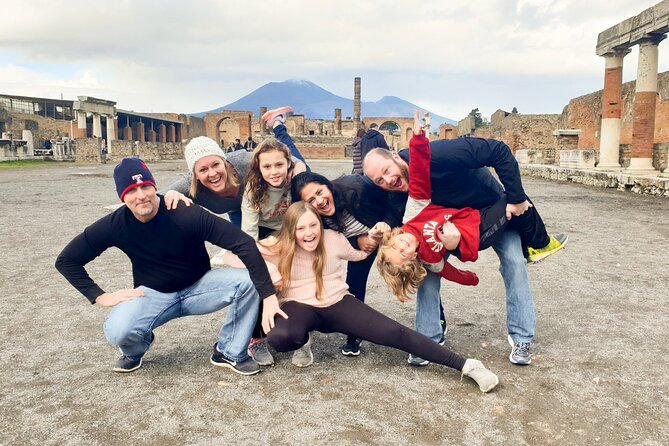
Pompeii rewards you with every dusty step. This private walking tour brings the buried Roman city into focus with a guide who explains daily life, not just dates and ruins. I especially like the private format, which lets you ask questions and adjust the pace, and the family option, with games, stickers, and a child-sized map. The main caution is pricing: the tour page gives mixed information about admission fees, so confirm whether your $165.05 price includes the actual Pompeii ticket.
A two-hour visit can cover the major sights, but Pompeii is vast and exposed to the sun. You will walk on ancient basalt streets, cross uneven ground, and spend much of the time outdoors. Book early if you want a particular time, since this experience is often reserved well ahead, and request a morning start if you want to avoid the worst heat.
In This Review
- Key points to know before you book
- Why a private Pompeii guide helps
- Starting at Porta Marina and entering the ancient city
- The Forum, where Pompeii handled public life
- Via dell’Abbondanza and the details of daily life
- The Forum Baths and Roman bathing culture
- The Temple of Apollo and Pompeii’s older roots
- The Basilica and the machinery of public business
- House of the Vettii, Pompeii’s great private residence
- Teatro Grande and the city’s entertainment
- The Antiquarium and the plaster casts
- The Pompeii family option for children ages 6 to 11
- Timing, walking, and summer heat
- What the $165.05 price means
- Who should book this Pompeii tour?
- FAQ
- How long does the Ancient Pompeii Private Tour last?
- Is the tour private?
- Are Pompeii admission tickets included?
- Where does the tour begin?
- Is there a family version for children?
- What sights are included?
- Do pick-up and drop-off come with the tour?
- What should I wear?
- Should you book it?
Key points to know before you book
- Private guide for your group only: You get direct attention and can ask for particular houses, temples, or streets.
- Fast-track ticket access: The guide can use a quicker ticket line, though admission-cost details should be confirmed before booking.
- Strong choice for families: Children ages 6 to 11 can receive a Pompeii4kids kit with a map, stickers, activities, and an activity book.
- Major sights in a short route: The Forum, Via dell’Abbondanza, Forum Baths, Temple of Apollo, House of the Vettii, theater, and Antiquarium all feature in the plan.
- Guides make the difference: Francesca, Anna, Natalia, Fabrizio, Viviana, Sabrina, Giuseppe, Alfredo, and others receive praise for clear explanations and warm work with children.
- Expect real walking: Good shoes, moderate fitness, water, and sun protection will make this much easier.
Why a private Pompeii guide helps
Pompeii is not a single monument. It is a whole Roman town, with streets, homes, shops, temples, public buildings, baths, and theaters spread across a large archaeological park. Without context, you can look at a wall painting or a row of stones and miss the human story behind it.
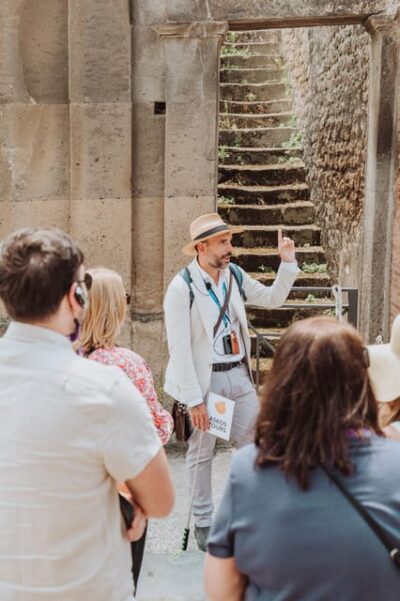
A private guide gives you a thread to follow. You learn how the Forum functioned, why the streets had stepping-stones, how Roman baths were arranged, and what the shops reveal about ordinary life. You can also ask for more time at a favorite site or tell the guide if your children need a shorter explanation.
That flexibility is useful for families. A guide can turn a bakery, bathhouse, or theater into a story instead of another old building. Francesca, Anna, Natalia, Viviana, Sabrina, and Fabrizio are repeatedly praised for keeping children involved while still giving adults serious historical detail.
The private setup also avoids the common problem of trying to keep up with a large group. That said, one account describes a guide moving too quickly for people with mobility issues. If anyone in your party has difficulty walking, say so at the start and ask for a slower route.
More Pompeii and Vesuvius trips:
- Pompeii: Entry Ticket and Guided Tour with an Archaeologist
★ 4.8 · 19,459 reviews - Pompeii: Entry Ticket with Optional Audio Guide
★ 4.2 · 12,360 reviews - Pompeii: Small Group Tour with an Archaeologist
★ 4.8 · 12,264 reviews
Starting at Porta Marina and entering the ancient city
The meeting point is at Via Villa dei Misteri, 2, near the Pompeii archaeological site. You meet your Blue Badge guide there, then begin the walking tour inside the park.
The route introduces the eruption of Mount Vesuvius in AD 79, when ash and volcanic material covered Pompeii. The disaster was terrible, but the burial also preserved streets, buildings, wall paintings, mosaics, shops, and objects that offer an unusually close look at Roman city life.
One early point of interest is the city wall and Porta Marina, once an important entrance connected with the harbor area. It helps you picture Pompeii as a working town with movement, trade, and visitors, rather than as the quiet ruin you see today.
Your guide may tailor the order based on crowds, weather, and your interests. Natalia, for example, is praised for meeting a family on time, using the children’s map at the right moments, and choosing a route that held attention without making the outing feel too long.
The Forum, where Pompeii handled public life
The Forum was Pompeii’s main political, religious, and commercial center. It is a large rectangular plaza, about 157 by 38 meters, and chariots were kept out of this pedestrian space.
This is one of the most important stops because it gives you the city’s basic layout. From here, your guide can explain how public decisions were made, where religious ceremonies took place, and how commerce and civic life shared the same center.
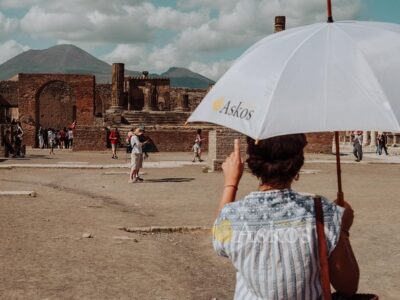
The open plaza can feel hot, especially around midday. There is little reason to linger in the sun without a clear explanation, so the guide’s commentary matters. A good guide helps you read the surrounding temples and public buildings instead of simply pointing at them.
Via dell’Abbondanza and the details of daily life
Via dell’Abbondanza is Pompeii’s longest and most important street. It ran from the Forum toward the Sarno Gate and served as a major commercial and social route.
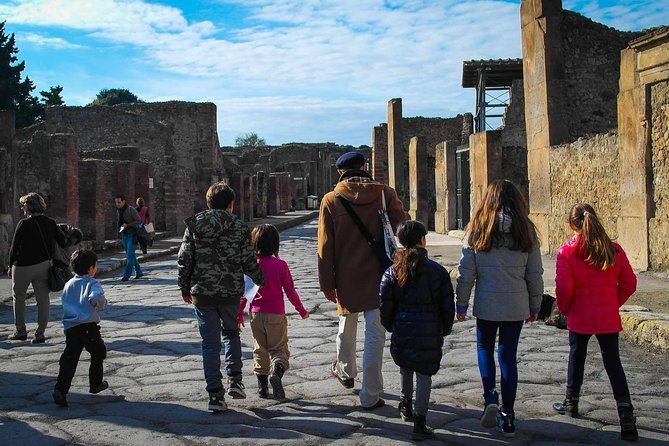
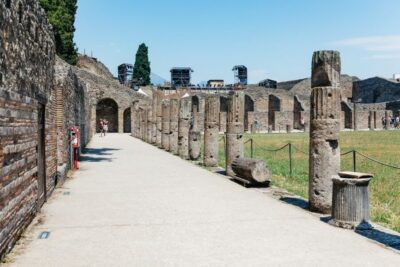
Walking here is one of the tour’s most revealing moments. You see the basalt paving, shop fronts, drainage arrangements, and stepping-stones placed across the street. These raised stones allowed pedestrians to cross when rainwater, waste, or flooding made the road unpleasant.
This is also where the city begins to feel practical and familiar. Roman Pompeii had shops, food outlets, traffic rules, public facilities, and homes packed along busy streets. The guide’s job is to connect those physical details with the people who used them.
The route includes a Roman fast-food counter, with large storage jars still built into the serving area. It is an excellent stop for children because the basic idea is easy to understand: ancient people bought prepared food much as people do today.
A few more Pompeii bookings to compare
- Pompeii Small Group Tour with an Archaeologist
★ 5.0 · 6,593 reviews - Pompeii: Skip-the-Line Entrance Ticket with Audio Guide
★ 4.0 · 2,509 reviews - Naples: Pompeii and Mt. Vesuvius with Lunch and Wine Tasting
★ 4.5 · 2,454 reviews - Pompeii: Archaeological Park Tour with Ticket on request
★ 4.5 · 2,283 reviews
The Forum Baths and Roman bathing culture
The Forum Baths were built around 80 BC and were still operating when Vesuvius erupted. They are among the best-preserved public bath complexes in Pompeii.
You can follow the traditional sequence:
- The Apodyterium, or changing room
- The Frigidarium, or cold room
- The Tepidarium, or warm room
- The Calidarium, or hot room
The rooms feature barrel-vaulted ceilings, stucco decoration, and terracotta telamones, which are sculpted figures used as architectural supports. This stop helps you understand that Roman baths were not just places to wash. They were part of public life and leisure.
The baths are also a good example of why a guide adds value. The rooms are compact, and their purpose may not be obvious at first glance. With an explanation, the heating system and sequence become much easier to picture.
The Temple of Apollo and Pompeii’s older roots
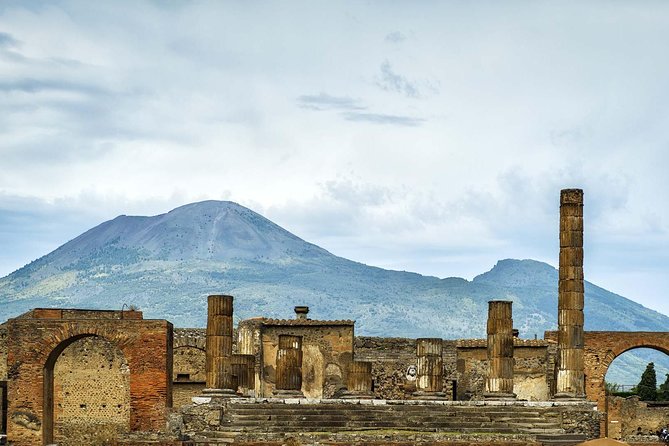
The Temple of Apollo dates back to the 6th century BC, making it one of Pompeii’s oldest religious sites. Its design blends Greek and Italic influences.
The temple sits on a raised podium, reached by a broad staircase, and its portico once had 48 columns. Bronze replicas of Apollo as an archer and Diana can be seen here, while the original Hellenistic bronzes are held at the National Archaeological Museum in Naples.
This is a short stop, but it gives useful background. Pompeii was not created all at once as a standard Roman town. Its religious and architectural traditions developed over centuries, before and during Roman control.
The Basilica and the machinery of public business
The Basilica occupies the southwestern corner of the Forum and dates to the 2nd century BC. It was Pompeii’s most imposing public building and one of the oldest examples of its type in the Roman world.
The word basilica may sound familiar from later Christian architecture, but here it refers to a civic building. It was used for legal and commercial business, not originally as a church.
The surviving space is largely architectural, so this is another place where interpretation matters. Your guide can help you imagine the columns, roof, officials, merchants, and legal activity that once filled the building.
House of the Vettii, Pompeii’s great private residence
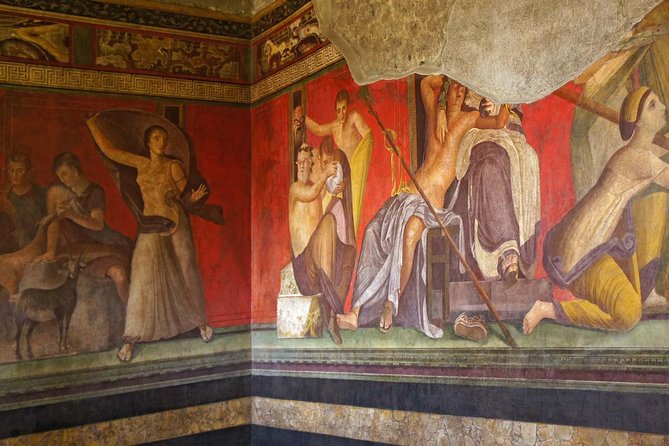
The House of the Vettii is often called Pompeii’s Sistine Chapel because of its wall paintings. After a 20-year restoration, it reopened in 2023 and offers one of the clearest looks at elite domestic life in the city.
The house belonged to Aulus Vettius Conviva and Aulus Vettius Restitutus, two former slaves who became wealthy wine merchants. Their home was designed to display their success, with decorative rooms and impressive artwork.
This stop adds social depth to the tour. Pompeii was not a city where everyone lived the same way. The house lets you compare private luxury with the shops, public baths, and working streets you have already seen.
The planned visit lasts about 20 minutes, making it one of the longer stops. If you care about Roman art, interior design, or social class, this is one of the tour’s strongest sections.
Teatro Grande and the city’s entertainment
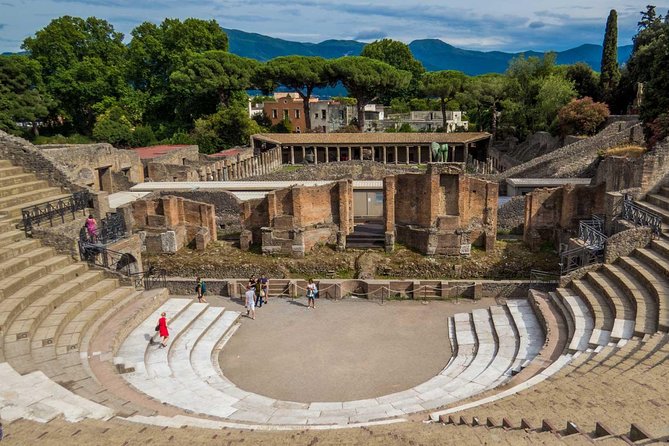
The Teatro Grande is one of the oldest surviving masonry theaters in the world. It was first built in the 2nd century BC and carved into a natural lava hillside.
The theater shows the shift from Greek-style design to Roman use. It also reminds you that Pompeii’s residents did not spend all their time working, shopping, or praying. Plays and public performances were part of city life.
For children, the theater can be an easy place to ask practical questions. Where did the audience sit? How did actors perform? What did a Roman afternoon at the theater feel like? A guide who welcomes those questions can keep younger visitors interested.
The Antiquarium and the plaster casts
The Antiquarium is Pompeii’s climate-controlled museum. It houses delicate finds from the archaeological park, including wall paintings, mosaics, and other objects that need more protection than the open ruins can provide.
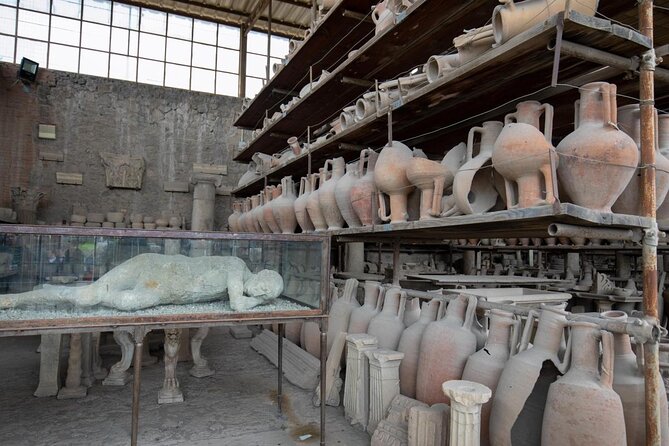
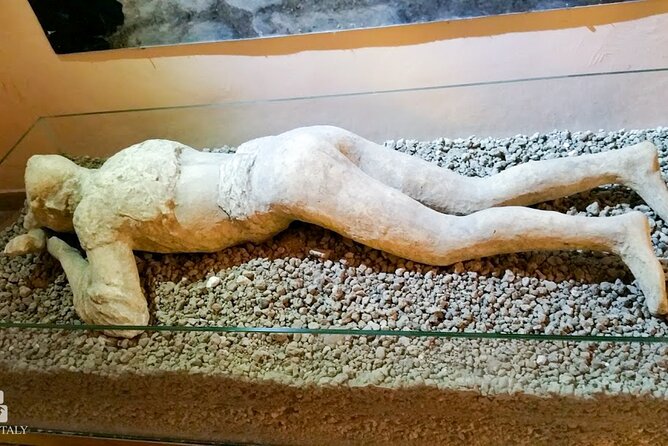
The museum also displays plaster casts of eruption victims, including small children. These are among Pompeii’s most moving remains. They show the final positions of people caught by the volcanic disaster, turning an ancient catastrophe into something personal and immediate.
This stop can be emotionally difficult, especially for young children. The family guide can explain the casts in an age-appropriate way, but parents should decide how much detail their children need.
The museum is also a welcome break from the outdoor heat. After walking through sunlit streets and open plazas, the cooler indoor setting gives you a chance to pause.
The Pompeii family option for children ages 6 to 11
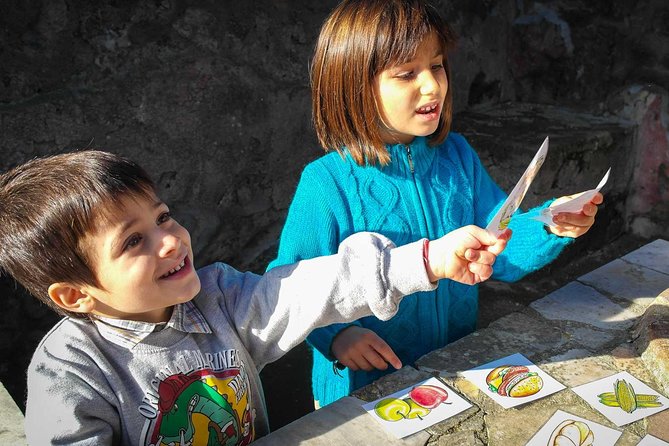
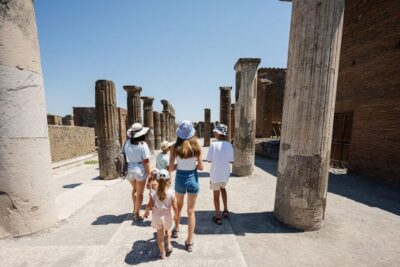
The family tour is not simply an adult tour with a few jokes added. It includes a Pompeii4kids kit with a special map, stickers, activities, games, and an activity book. The guide adjusts the route and explanations for younger minds.
The sticker map is especially practical. Children can place figures such as a gladiator, actor, slave, or politician near the building connected with that role. That simple task gives them something to do while helping them remember what each place was used for.
Short quizzes and puzzles also keep the pace moving. Families with children ages 5 to 11 describe the format as successful even during hot conditions, and one family with children ages 3, 7, and 9 found that the children stayed engaged throughout. The listed recommendation is ages 6 to 11, so ask about suitability if your youngest child is outside that range.
Adults do not lose out. The guide still explains the city’s politics, architecture, religion, art, and daily routines. Fabrizio, Francesca, Sabrina, Viviana, Anna, and Natalia are all praised for balancing child-focused activities with worthwhile information for parents and older children.
Timing, walking, and summer heat
The advertised duration is about two hours. That is enough for a focused introduction to the main sights, but Pompeii is large, and you will not see every open building in that time.
Some parties have spent more than the scheduled time with their guide, but you should not count on an extended visit. If you want a longer tour, confirm the duration before booking.
Start early if you can. A family visiting at 11 a.m. found the heat increasingly difficult by the end, even though the guide managed the conditions well. Morning also gives your guide a better chance of avoiding the thickest crowds.
Wear sturdy walking shoes. The ancient paving is uneven, and the site requires repeated walking across open streets and stone surfaces. Bring water, especially in warm weather, and expect a moderate level of physical activity.
Pick-up and drop-off are not included. You make your own way to Via Villa dei Misteri, 2, near public transportation, and the tour ends back at the same meeting point.
What the $165.05 price means
At $165.05 per person, this is not a budget visit. The value depends heavily on your group size and on what is included in the final ticket price.
For a small family or group, the private format can make sense. You are paying for a dedicated guide, a flexible pace, the chance to ask unlimited questions during the walk, and a family kit if you choose that option. A private guide can also save time by directing you toward the key sights rather than leaving you to navigate a huge archaeological park alone.
The fast-track access is useful, but read the admission wording carefully. One part of the information says admission is included, while another says admission fees are not included and that the guide can buy tickets quickly at the site. I would ask for a clear all-in price before paying so there are no surprises at the entrance.
The experience has a 4.9 rating from 167 ratings, with 98 percent recommending it. The strongest praise focuses on the guides’ historical command, patience, humor, and ability to work with children. That is encouraging because Pompeii is exactly the sort of place where guide quality can make or break the visit.
Free cancellation is available up to 24 hours before the start time. Changes or cancellations inside that window are not accepted for a refund.
Who should book this Pompeii tour?
I would choose this tour for a family that wants Pompeii to feel understandable rather than overwhelming. The games and map are useful for children, while the private format gives parents room to ask serious questions.
It also suits couples, friends, solo visitors, and history-minded groups who want the major sights explained in a compact visit. The guides are frequently praised for careful crowd management. Nandor and Natalia, in particular, are described as choosing routes that avoided the worst congestion.
I would hesitate if you want a slow, unstructured day exploring every corner of Pompeii. Two hours is a highlights tour, not a complete archaeological study. I would also compare the price with a regular group option if you are a couple on a tight budget.
FAQ
How long does the Ancient Pompeii Private Tour last?
The advertised duration is approximately two hours. Some visits have lasted longer, but you should plan around the stated two-hour schedule.
Is the tour private?
Yes. Only your group participates, so you receive the guide’s direct attention and can request a flexible pace or particular sights.
Are Pompeii admission tickets included?
The information provided is inconsistent. One section lists the admission fee as included, while another says admission fees are not included and that the guide can buy tickets through a fast-track line. Confirm the final ticket arrangement and total cost before booking.
Where does the tour begin?
The meeting point is Via Villa dei Misteri, 2, 80045 Pompei, Italy. The tour ends back at the same meeting point.
Is there a family version for children?
Yes. The family option is recommended for children ages 6 to 11 and includes a Pompeii4kids kit with a map, stickers, activities, and an activity book.
What sights are included?
The route includes the Archaeological Park of Pompeii, the Forum, Via dell’Abbondanza, the Forum Baths, Temple of Apollo, Basilica, House of the Vettii, Teatro Grande, and the Antiquarium.
Do pick-up and drop-off come with the tour?
No. Pick-up and drop-off are not included. You must reach the meeting point yourself.
What should I wear?
Good walking shoes are recommended, and you should be prepared for moderate physical activity. Much of the tour takes place outdoors on ancient stone streets, so water and sun protection are sensible additions.
Should you book it?
Book this Pompeii tour if you want a focused route, a private guide, and a better chance of keeping children interested. The family kit is more than a small bonus, and the guides receive especially strong praise for making the ruins understandable, funny, and human.
Before booking, get the admission-fee question settled in writing. Then choose an early start, wear proper shoes, and tell the guide about mobility needs or special interests. For a first visit to Pompeii, that combination of personal attention, crowd awareness, and clear storytelling makes the $165.05 price easier to justify, particularly for a family or small group.
Recently added around Pompeii
- From Pompeii: Bus Transfer to Vesuvius with Park Entry Fee★ 4.2 · 700 reviews
- Pompeii Skip-the-line Tour with Archaeologist Guide★ 5.0 · 559 reviews
- Skip the Line Guided Tour of Pompeii led by an Archaeologist★ 5.0 · 703 reviews
- Visit in Pompeii – Pompeii Private Tour with Ada★ 5.0 · 436 reviews
- Pompeii Private Tour with an Archaeologist and Skip The Line★ 5.0 · 391 reviews
- Private Day Tour to Vesuvius, Herculaneum & Pompeii with Pick Up★ 5.0 · 279 reviews
- Pompeii Private Tour with an Archaeologist and Skip The Line – 3 hours★ 5.0 · 564 reviews
- Sharing Tour of Pompeii★ 5.0 · 487 reviews
Pompeii & Vesuvius Tours, compared.
Entry Ticket and Guided Tour with an Archaeologist
Read our review →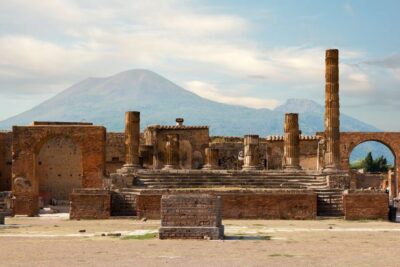

Pompeii Small Group Tour with an Archaeologist
Read our review →
Pompeii, Amalfi Coast and Positano Day Trip from Rome
Read our review →Browse the lists this tour appears in