

Reviewed · POMPEII & VESUVIUS TOURS
Pompeii Private Tour with an Archaeologist Guide
Pompeii makes more sense with a human voice. This private tour pairs an archaeologist guide with a focused walk through the ruins, so you can ask questions instead of guessing what each broken wall once meant. I especially like the personal pace and the chance to see major sights such as the Forum, Stabian Baths, House of the Faun, and Lupanar without being folded into a large group.
I also like how the route brings daily life into the story. The Thermopolium shows Pompeii’s version of fast food, while the homes, baths, theaters, and shops reveal how ordinary people used the city. The main drawback is simple: the two-hour tour is short for a site this large, and the Pompeii entrance ticket costs extra.
In This Review
- Key points to know before you book
- Why a private archaeologist changes Pompeii
- Meeting at Porta Marina Superiore
- The first ten minutes: getting oriented inside the archaeological park
- House of the Vettii and the Lupanar
- The Thermopolium: Pompeii’s everyday fast food
- Teatro Grande and the theaters
- House of the Faun and the Stabian Baths
- Via dell’Abbondanza and the Forum Baths
- Macellum, House of Menander, and the Forum granaries
- The Forum: ending with Pompeii’s civic center
- How the two-hour pace feels
- Value, group size, and who should book
- Should you book this Pompeii tour?
- FAQ
- Where does the Pompeii private tour begin?
- How do I find the guide?
- How long does the tour last?
- Is the Pompeii entrance ticket included?
- Is transportation included?
- Is this a group tour?
- What language is offered?
- What should I wear?
- Can people with service animals join?
- What is the cancellation policy?
Key points to know before you book
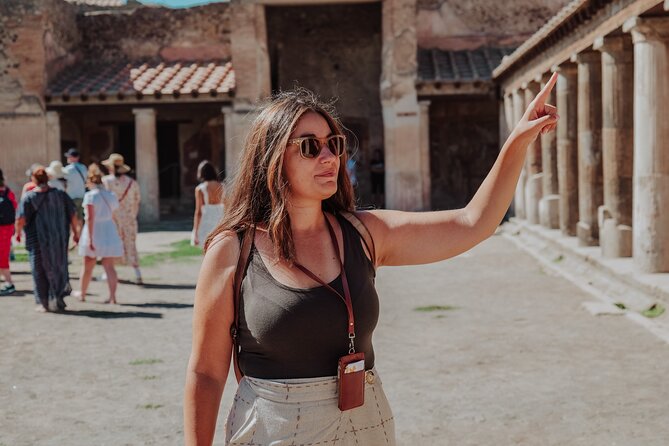
- An archaeologist leads the walk: You get explanations about buildings, excavation, and Roman life rather than only a list of dates.
- It is private for your group: You can ask questions, slow down, or focus on subjects that interest you.
- The route covers major Pompeii sights: Expect the House of the Vettii, Lupanar, Thermopolium, theaters, baths, Via dell’Abbondanza, and Forum.
- Entrance is not included: You pay separately for admission to the archaeological park. One recent booking reported paying about 20 euros per person.
- Two hours gives you an orientation, not the whole city: You will see important areas, but extra time afterward is worthwhile.
- Wear closed shoes: Pompeii’s ancient paving and uneven surfaces can be hard on feet, especially in flip-flops.
Why a private archaeologist changes Pompeii
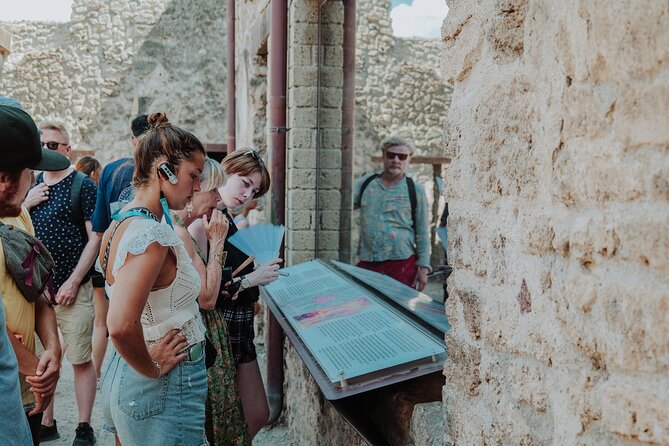
Pompeii is not a tidy museum with one clear path. It is a huge ancient city, and its streets can leave you wondering where to look first. A guide helps turn scattered stones, faded paintings, and roofless rooms into a picture of daily life.
This tour is especially useful because the guide is described as an archaeologist. That background can add useful caution to the storytelling. Some details about Pompeii remain uncertain, and a good guide can separate what is known from what is inferred.
The private format matters just as much. You are not waiting for a group of strangers to catch up, and the guide can adjust the pace to your party. One family found that their guide kept children interested. Another group with a broken foot took things slowly, stopped to rest, and avoided crowded spots.
Guides named in particularly strong comments include Rossana, Mena, Jolanda, Paolo, Vito, Rossella, Silvia, Michele, Antonella, Julia, Sarah, and Laura. The common thread is not a single personality or script. It is enthusiasm, clear explanations, and a visible respect for Pompeii.
More Pompeii and Vesuvius trips:
- Pompeii: Entry Ticket and Guided Tour with an Archaeologist
★ 4.8 · 19,459 reviews - Pompeii: Entry Ticket with Optional Audio Guide
★ 4.2 · 12,360 reviews - Pompeii: Small Group Tour with an Archaeologist
★ 4.8 · 12,264 reviews
Meeting at Porta Marina Superiore
The meeting point is at the main entrance called Porta Marina Superiore. The tour information also gives Via Villa dei Misteri, 1, 80045 Pompei as the start and end address, so check your confirmation carefully and allow time to reach the entrance.
Your guide is supposed to hold a sign with Askos Tours at the top. That is a useful detail in a busy arrival area. The tour ends at the ruins, and the guide can help explain how to reach your accommodation or the nearest train station.
Transportation is not included. You need to make your own way to Pompeii and to the entrance. The site is near public transportation, but this experience is designed as a walking tour once you arrive.
Plan for the separate admission charge. The tour price is $178.45 per person, while the Pompeii entrance ticket is not included. The final value depends heavily on group size. For one or two people, the private format costs more than joining a shared group. For a family or small group, the personal attention and group pricing may make better sense.
The first ten minutes: getting oriented inside the archaeological park
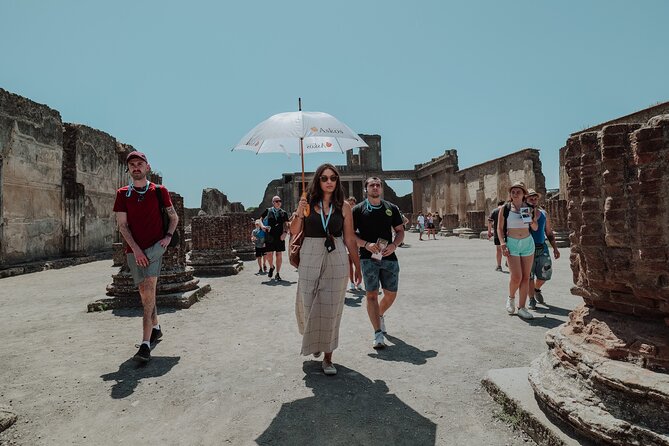
The opening stop is listed as the Archaeological Park of Pompeii. This is not really a sightseeing stop so much as the point where you meet the guide, enter the setting, and get your bearings.
That short orientation is useful. Pompeii can feel confusing at first, with several major streets and neighborhoods spread across the site. Your guide sets the direction and gives you a framework for what you are about to see.
If this is your first visit, listen closely during this opening section. The value of the rest of the tour depends on knowing how the pieces fit together.
House of the Vettii and the Lupanar
The House of the Vettii is one of the route’s key domestic stops. Here you see how an upper-class Pompeian home was arranged and decorated. One guide used the house to explain social life and the role of successful business people, including women who held economic power.
The house is valuable because it makes Pompeii personal. A forum can feel grand and distant, but a private home brings you into rooms where people ate, entertained, worked, and displayed their status.
Next comes the Lupanar, one of Pompeii’s most recognizable sites. The guide can help you understand why this small building matters within the city’s wider social and commercial life. It is also a good place to ask direct questions, since the private setting lets you discuss sensitive subjects without feeling rushed.
These stops can attract attention, so the guide’s ability to choose the best moment and explain what you are seeing is helpful. The route does not promise an empty site, but a private guide can help you spend your time more wisely.
A few more Pompeii bookings to compare
- Pompeii Small Group Tour with an Archaeologist
★ 5.0 · 6,593 reviews - Pompeii: Skip-the-Line Entrance Ticket with Audio Guide
★ 4.0 · 2,509 reviews - Naples: Pompeii and Mt. Vesuvius with Lunch and Wine Tasting
★ 4.5 · 2,454 reviews - Pompeii: Archaeological Park Tour with Ticket on request
★ 4.5 · 2,283 reviews
The Thermopolium: Pompeii’s everyday fast food
The House and Thermopolium of Vetutius Placidus offers one of the most memorable glimpses of ordinary life. The thermopolium was a food counter, a Roman answer to grabbing something ready-made rather than cooking at home.
This is the kind of stop that gives the tour its human scale. You are not only looking at temples and public buildings. You are seeing how people ate, bought food, and moved through their day.
A guide can point out details that are easy to miss, then connect the building to modern habits. Several guides were praised for showing how some parts of society have changed less than we expect. That comparison works best here, where the ancient city feels unexpectedly familiar.
Teatro Grande and the theaters
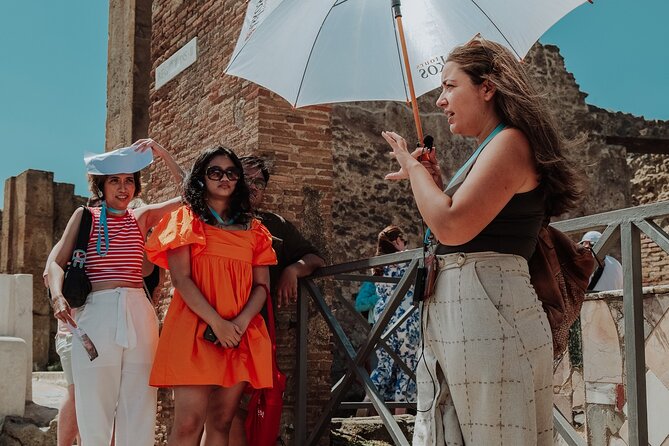
The Teatro Grande receives about five minutes in the listed route. That is brief, but it gives you a look at Pompeii’s public entertainment spaces and the city’s appetite for performances.
The short stop also hints at the main limitation of this tour. You are moving through a large site on a tight schedule. If theater architecture is a major interest, you will likely want to return later or spend extra time after the guided portion.
Still, the guide’s explanation can help you understand the theater as part of public life rather than as an isolated ruin. The smaller time allocation keeps the tour moving toward the many other major sites.
House of the Faun and the Stabian Baths
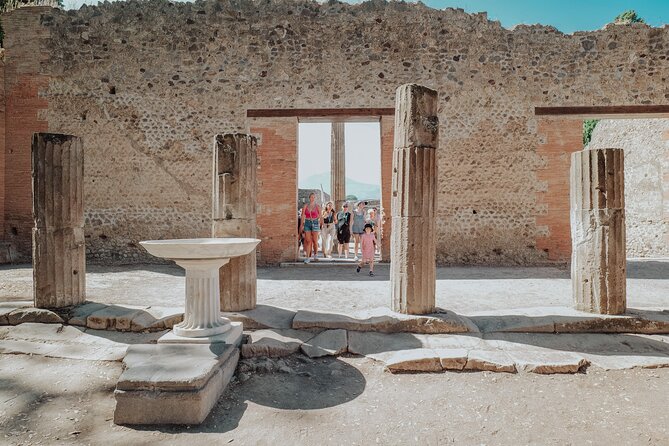
The House of the Faun is one of Pompeii’s famous residences. Its size and decoration show the wealth that some families enjoyed before the eruption. This is a place where an archaeologist guide can help you read the layout, materials, and decorative program instead of simply taking photographs and moving on.
The Stabian Baths provide a different view of city life. Public baths were places for washing, exercise, conversation, and social contact. The remains help you picture the infrastructure behind Roman comfort, including the design of bathing rooms and the effort needed to heat and supply them.
Together, these stops balance private luxury with shared public life. You see how the wealthy lived, then how a much broader part of the population used public facilities.
Via dell’Abbondanza and the Forum Baths
Walking along Via dell’Abbondanza gives you the street-level experience Pompeii is famous for. This was a major road through the city, lined with buildings and signs of daily business.
The road itself is a reminder to wear proper shoes. Ancient paving can be uneven, and the ruins may be tiring in hot weather. Closed shoes are strongly advised, and flip-flops are a poor choice here.
The Forum Baths continue the look at practical Roman life. They also help explain how public buildings were distributed around the central part of town. Your guide can tie the baths to the larger civic pattern, which is harder to see when you explore alone.
Several people found that their guides chose quieter routes or avoided the heaviest crowds when possible. That is a real benefit in Pompeii, where a narrow street or small house can feel very different when you are not standing behind a large group.
Macellum, House of Menander, and the Forum granaries
The Macellum was a market building in the central area. It gives you another view of commerce and food supply, and it pairs well with the earlier Thermopolium. One shows a prepared-food counter at street level. The other helps you think about the wider market system.
The House of Menander returns to private life. Its rooms and decoration offer another chance to compare homes and social status. You may find this stop especially useful if you enjoy seeing how archaeologists reconstruct family life from architecture.
The Granaries of the Forum are now used to display or store archaeological material, and the stop adds a reminder that Pompeii is still an active archaeological site. The city is not simply a finished ruin frozen in time. Preservation and excavation continue to shape what you can see.
The route gives each of these locations roughly five to ten minutes. That is enough for a clear explanation and a few questions, but not enough for an extended study of every room.
The Forum: ending with Pompeii’s civic center
The tour finishes at the Forum, the main public center of Pompeii. This is the place where politics, religion, commerce, and public ceremony came together.
Ending here makes sense. After seeing homes, shops, baths, theaters, and streets, you arrive at the space that tied the city together. A guide can help you identify the major buildings and explain how the Forum functioned within Roman society.
This is also the point where you may realize how much more there is to see. One person felt that two hours with a guide followed by one hour alone was still not enough. That is a fair warning. The tour is a strong first pass, not a full-day archaeological study.
If you have extra time, stay after the guide leaves and revisit places that interested you. Your guide can suggest additional areas and help you make a plan for the rest of the day.
How the two-hour pace feels
The pace is brisk but not frantic. Most stops receive ten minutes, with shorter visits at the theaters, Macellum, and Forum granaries. That structure lets you cover many important locations without spending the entire tour in one house.
I would choose this duration if you have only half a day in Pompeii or if you want a clear introduction before exploring alone. It is also useful on a hot or rainy day, when wandering without a plan can become tiring.
If you love archaeology, ancient architecture, or photography, consider treating the guided tour as the first part of a longer visit. The guide gives you context and direction. Your own time afterward gives you room to linger.
The weather does not necessarily ruin the experience. A guide has helped people enjoy the site in rain, and some found the wet ruins atmospheric. Still, wear shoes that can handle slippery or uneven surfaces, and be ready for limited shelter.
Value, group size, and who should book
At $178.45 per person, this is not a budget walk for a solo visitor. The separate entrance fee makes the total cost higher, and you should include that when comparing options.
The price becomes easier to justify when your group wants personal attention. Families can ask questions suited to children, history fans can focus on archaeology, and anyone with mobility concerns can request a slower pace. The private format also avoids the stop-and-start rhythm of a large shared group.
I would recommend it most strongly for:
- First-time visitors who want the main sights explained
- Families with children or teenagers
- Small groups with limited time
- People who prefer questions and conversation over a set lecture
- Anyone worried about missing important buildings in a very large site
You may not need it if you have already visited Pompeii, enjoy reading signs and maps on your own, or plan to spend several full days exploring. In that case, the private guide may feel costly for an orientation you could create yourself.
The tour is offered in English. Confirmation arrives at booking, service animals are allowed, and most people can participate. The experience is private, with only your group taking part.
Should you book this Pompeii tour?
Book it if you want Pompeii to feel like a lived-in city rather than a field of ruins. The archaeologist background, private format, and well-chosen route give you a strong introduction to homes, shops, baths, streets, theaters, and civic buildings.
I would book it for a half-day visit, then keep extra time for wandering. I would not book it expecting to see every corner of Pompeii in two hours. The entrance ticket is extra, and the price requires a group large enough to share the cost comfortably.
Free cancellation is available up to 24 hours before the start time. Double-check the meeting point and admission details before you go, wear closed shoes, and arrive ready to walk.
FAQ
Where does the Pompeii private tour begin?
The meeting point is at Pompeii’s main entrance, Porta Marina Superiore. The stated address is Via Villa dei Misteri, 1, 80045 Pompei, Italy.
How do I find the guide?
The guide will hold a sign with Askos Tours written at the top.
How long does the tour last?
The guided experience lasts approximately two hours.
Is the Pompeii entrance ticket included?
No. The Pompeii entrance ticket is not included in the tour price. One recent visit reported paying about 20 euros per person for admission.
Is transportation included?
No. You must arrange your own transportation to and from Pompeii.
Is this a group tour?
No. It is a private activity, so only your group participates.
What language is offered?
The tour is offered in English.
What should I wear?
Closed shoes are recommended. The uneven ruins can be difficult to walk through in flip-flops or other open footwear.
Can people with service animals join?
Yes. Service animals are allowed.
What is the cancellation policy?
You can cancel up to 24 hours before the start time for a full refund. Cancellations or changes made less than 24 hours before the experience are not accepted for a refund.
Recently added around Pompeii
- From Pompeii: Bus Transfer to Vesuvius with Park Entry Fee★ 4.2 · 700 reviews
- Pompeii Skip-the-line Tour with Archaeologist Guide★ 5.0 · 559 reviews
- Skip the Line Guided Tour of Pompeii led by an Archaeologist★ 5.0 · 703 reviews
- Visit in Pompeii – Pompeii Private Tour with Ada★ 5.0 · 436 reviews
- Ancient Pompeii Private Tour: Skip the Line & Kid-Friendly Option★ 5.0 · 167 reviews
- Pompeii Private Tour with an Archaeologist and Skip The Line★ 5.0 · 391 reviews
- Private Day Tour to Vesuvius, Herculaneum & Pompeii with Pick Up★ 5.0 · 279 reviews
- Pompeii Private Tour with an Archaeologist and Skip The Line – 3 hours★ 5.0 · 564 reviews
Pompeii & Vesuvius Tours, compared.
Entry Ticket and Guided Tour with an Archaeologist
Read our review →


Pompeii Small Group Tour with an Archaeologist
Read our review →
Pompeii, Amalfi Coast and Positano Day Trip from Rome
Read our review →Browse the lists this tour appears in