

Reviewed · POMPEII & VESUVIUS TOURS
PompeiI Exclusive Tour with your Archaeologist in a Small Group
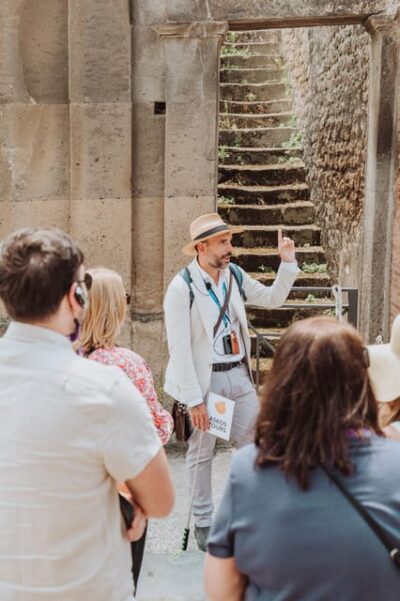
Pompeii rewards a good guide. This two-hour walk makes the sprawling ruins easier to read, with an archaeologist guide explaining how homes, temples, shops, baths, and public spaces worked. I especially like the small-group format and the focus on the city’s most important sights rather than a random wander through broken walls.
I also like the separate priority entrance arrangement, which can save useful time at a busy gate. The main catch is simple but important: the €19 Pompeii admission ticket is not included, so the advertised tour price of $30.25 is not your final adult cost. One other point to watch is group size. The stated limit is 15 people, but one booking party reported a group closer to 20.
For two hours, this is a lively introduction to Pompeii rather than a full-day archaeological study. Guides named in feedback include Raffaele, Ricardo, Antonio, Ornella, PierLuigi, and Rafael. Their strengths appear to be clear explanations, humor, and the ability to connect small details to daily Roman life.
In This Review
- Key points to know before booking
- Meeting at Porta Marina and entering Pompeii
- The western entrance and the Temple of Venus
- The Basilica, Apollo, and Pompeii’s Forum
- The Macellum and the evidence left by the eruption
- The Forum Baths and the Thermopolium
- The House of the Faun and the House of the Vettii
- Via dell’Abbondanza and Pompeii’s street life
- The theater and what the tour leaves out
- Why the archaeologist guide changes the visit
- Cost, group size, and who gets the best value
- Practical details and cancellation terms
- Should you book this Pompeii tour?
- FAQ
- How long does the Pompeii archaeologist tour last?
- What is the tour price?
- How much is admission to Pompeii Archaeological Park?
- Are Pompeii entrance tickets included?
- Where does the tour meet?
- What language is the tour offered in?
- How many people can join the tour?
- What happens if the weather is poor?
Key points to know before booking
- The tour begins at Porta Marina Superiore: Meet at Via Villa dei Misteri 1, outside the archaeological park, and look for the sign marked Pompeii Vip.
- The entry ticket costs extra: Adults pay €19 for Pompeii Park, while admission is free for children under 18.
- The route covers the Forum, temples, baths, shops, homes, and theater: It gives you a strong central overview in about two hours.
- The guide adds the most value at the plaster casts and houses: You get context for how archaeologists interpret Pompeii, not just names and dates.
- The advertised group limit is 15 people: A smaller party should make it easier to hear, ask questions, and keep up.
- Comfortable shoes matter: Pompeii involves extensive walking over ancient streets and uneven surfaces.
Meeting at Porta Marina and entering Pompeii
Your guide waits outside the archaeological park at Porta Marina Superiore, the western entrance to Pompeii. Look for the sign reading Pompeii Vip. This entrance is called Marina because the ancient road once led toward the sea, a useful reminder that Pompeii was tied to trade and movement long before Vesuvius changed everything.
The meeting point is at Via Villa dei Misteri 1, 80045 Pompei. The site is near public transportation, but your booking confirmation should be checked carefully so you arrive at the correct side of the entrance. The experience begins and ends at this meeting point.
The operator arranges access through a separate priority line, but you still need an admission ticket. The $30.25 booking is for the guided experience, not entry to the archaeological park. The afternoon before the visit, you receive a link to purchase a skip-the-line ticket online. You can also buy the €19 ticket on site with help, but sorting it out in advance is the safer choice if your schedule is tight.
This distinction deserves attention. A tour can be excellent and still create confusion if you assume the booking includes admission. Treat the total adult cost as roughly $30.25 for the guide plus €19 for entry, with currency conversion affecting the final amount.
More Pompeii and Vesuvius trips:
- Pompeii: Entry Ticket and Guided Tour with an Archaeologist
★ 4.8 · 19,459 reviews - Pompeii: Entry Ticket with Optional Audio Guide
★ 4.2 · 12,360 reviews - Pompeii: Small Group Tour with an Archaeologist
★ 4.8 · 12,264 reviews
The western entrance and the Temple of Venus
Once inside, the first stop is the Temple of Venus, one of the natural opening points for understanding Pompeii’s setting. Venus was the city’s patron goddess, so her temple had religious and civic importance. The position also offers a visual introduction to the site, with ruined buildings spread across a broad area and Vesuvius forming the dramatic backdrop.
You will spend about ten minutes here. That may sound brief, but the short stops are part of the route’s design. The guide gives you the main idea, points out what matters, and keeps the group moving before the information becomes a blur.
Pompeii is too large to absorb every street and building in a single visit. A planned route helps you see the central places first. After the tour, you can decide if you want to return to a particular house, shop, or public building on your own.
The Basilica, Apollo, and Pompeii’s Forum
The Basilica was the most lavish building in the Forum. It was used for business and the administration of justice, so it tells you that the Forum was not just a ceremonial square. Pompeii’s public life ran through this space, and the Basilica helped manage the practical side of the city.
Next comes the Temple of Apollo, among Pompeii’s oldest places of worship. Its location along the road from Porta Marina toward the public center is significant. The guide can help you see the ancient city as an organized place, with roads leading people from the entrance toward religion, politics, trade, and public business.
The Forum itself is the central anchor of the tour. This was the main square and the heart of everyday civic life. Here, the scale of Pompeii begins to make sense. Instead of seeing isolated ruins, you see how temples, government buildings, markets, and streets worked together.
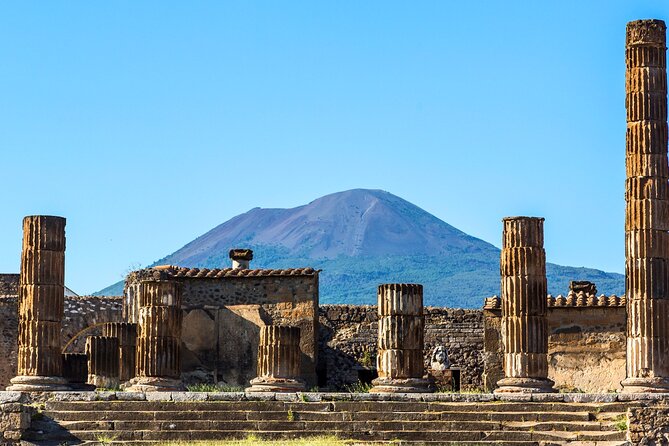
The Temple of Jupiter dominates the Forum’s northern side. Behind it, Vesuvius rises scenically, a view that links the city’s public power with the volcano that later destroyed it. You should allow a moment for the setting, even if your guide is explaining architecture or religious practice. Pompeii’s emotional force often comes from this mix of ordinary urban life and looming natural danger.
The Macellum and the evidence left by the eruption
The Macellum was a monumental food market, used for selling everyday products. It is one of the stops that can make Pompeii feel less like a collection of grand ruins and more like a real town where people bought food, met friends, and handled daily errands.
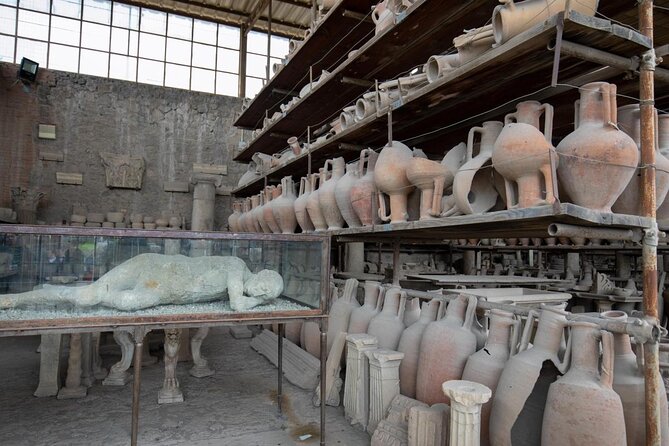
This area may also include plaster casts of bodies. These are not simply statues. They result from an archaeological method used to record the cavities left in the hardened volcanic material after human remains decomposed. Plaster filled those spaces, preserving the positions and outlines created at the moment of the eruption.
The subject can be unsettling. A good guide is useful here because the casts need careful explanation. You learn not only what you are seeing, but also how archaeologists worked it out. One of the strongest aspects of this tour is the attention to evidence, including how experts determine what a building or object was used for.
Some guides also share photographs connected to areas under current excavation, where photography is not allowed. That can provide a glimpse into ongoing archaeological work, though you should not assume every group will see the same restricted area or receive the same material.
A few more Pompeii bookings to compare
- Pompeii Small Group Tour with an Archaeologist
★ 5.0 · 6,593 reviews - Pompeii: Skip-the-Line Entrance Ticket with Audio Guide
★ 4.0 · 2,509 reviews - Naples: Pompeii and Mt. Vesuvius with Lunch and Wine Tasting
★ 4.5 · 2,454 reviews - Pompeii: Archaeological Park Tour with Ticket on request
★ 4.5 · 2,283 reviews
The Forum Baths and the Thermopolium
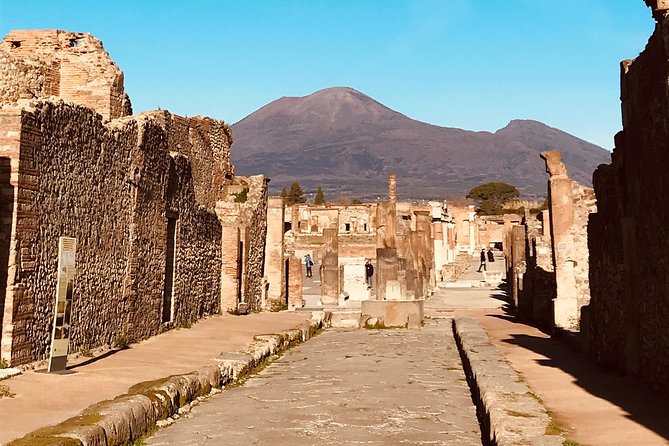
The Forum Baths are among Pompeii’s best-preserved features. Men’s and women’s sections had separate entrances, giving you a clear example of how Roman public bathing was organized. The preserved rooms help turn a familiar modern idea, a public bath, into something more specific: a place with social rules, separate areas, and carefully planned spaces.
The route then moves to the Thermopolium of Vetuzio Placido. This was an old diner or refreshment counter for Pompeii’s residents. It is an appealing stop because it brings the city down to street level. The temples and Forum show public power, while a thermopolium shows what people did when they needed a quick meal or drink.
I find these smaller commercial sites especially useful on a guided visit. Without explanation, you might walk past a counter and see only stonework. With context, you can picture a working neighborhood and understand that Pompeii was made up of routine transactions as much as grand ceremonies.
The House of the Faun and the House of the Vettii
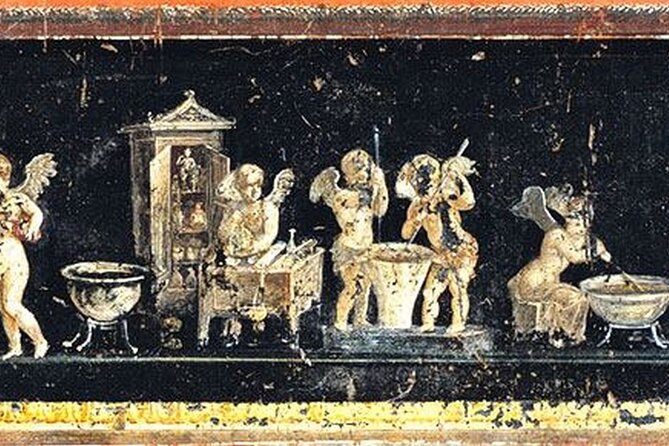
The House of the Faun is one of Pompeii’s largest private residences. Its sidewalk carries the Latin greeting HAVE, a small detail with a wonderfully human feel. It reminds you that Pompeii was not only about public monuments. People also marked entrances, displayed status, and welcomed others into their homes.
The House of the Vettii was among the city’s wealthiest and most famous houses. It is associated with Priapus, the god of prosperity. Both houses are subject to seasonal opening and closing, so they should be treated as possible stops rather than guaranteed interiors.
That distinction matters. The route includes these houses in the plan, but archaeological sites change access schedules. If one is closed during your visit, the guide can still explain its importance and use nearby evidence to fill in the picture. You should not book this experience solely to see one particular house.
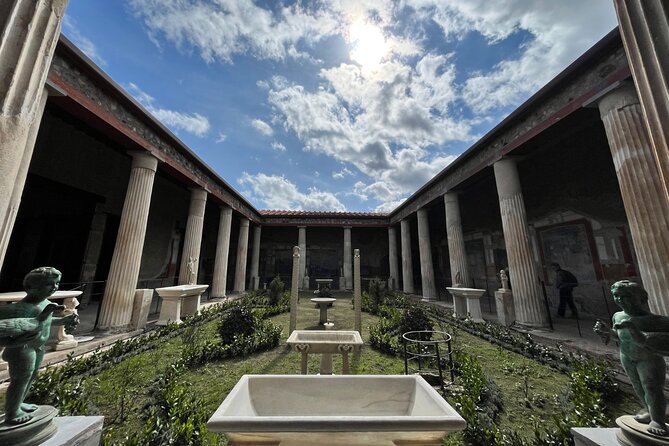
The homes also help explain why a guide matters. Pompeii’s elite residences can appear impressive but confusing. A guide can point out how the entrance, courtyard, decorative elements, and working spaces reflected wealth and social position. You get a better sense of how the city’s upper class lived, not just a list of room names.
Via dell’Abbondanza and Pompeii’s street life
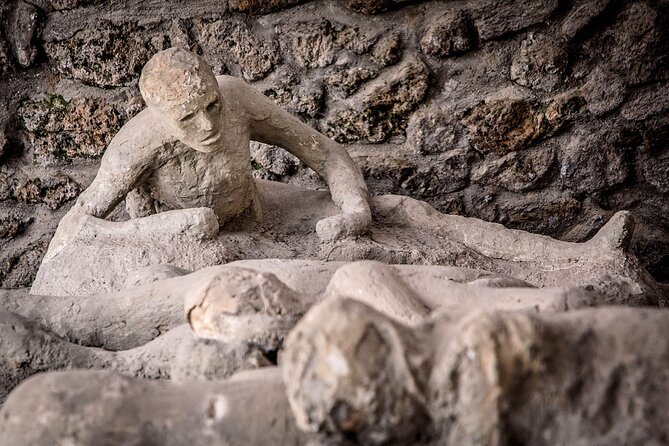
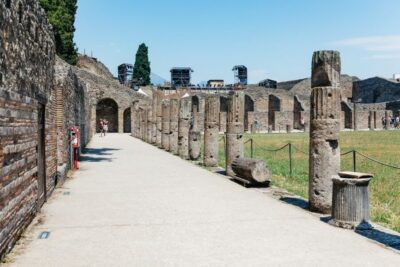
Via dell’Abbondanza was Pompeii’s ancient main street, also known as the decumanus maximus. Walking along it gives the tour a welcome change of scale. After temples and large public buildings, you are back among the routes used for ordinary movement.
This is where practical footwear becomes essential. Pompeii’s surfaces are historic and uneven, and you will be walking for most of the two-hour experience. Wear shoes with good support, especially if you plan to continue exploring after the guided portion.
The street also helps tie the itinerary together. Religious buildings, food shops, baths, homes, and public spaces were not separate attractions scattered without purpose. They connected through roads like Via dell’Abbondanza. A guide can show you how the city functioned as a whole.
The pace appears to be steady rather than rushed. Several people found that two hours passed quickly, while still leaving time to continue alone afterward. That is a good balance for a first visit, but it also means you should not expect to see every famous corner of Pompeii.
The theater and what the tour leaves out
The final listed stop is the Teatro Grande, where comedies and tragedies were performed in the Greco-Roman tradition. The theater gives you a final look at Pompeii as a city of entertainment and shared public life, not just religion, commerce, and government.
The main limitation is coverage. A two-hour highlights route cannot include the entire archaeological park. One account specifically noted that the amphitheater and brothels were not included, while the route focused more on shops, houses, baths, and other central sites.
That may be a drawback if you have a short list of must-see buildings. Tell the guide what interests you during the tour. Some guides, including Antonio, have been described as leaving part of the final time for questions and personal interests. Still, the route is primarily designed around key central sights, not a custom private visit.
If you want the amphitheater or a specific house, check current access and route details before booking. You may be able to explore independently before or after the two-hour walk, depending on the day’s opening arrangements and your energy.
Why the archaeologist guide changes the visit
Pompeii is one of those places where an audio guide can tell you facts but may not help you interpret what you are looking at. The ruins are extensive, and many walls, rooms, and fragments look similar without a sense of purpose.
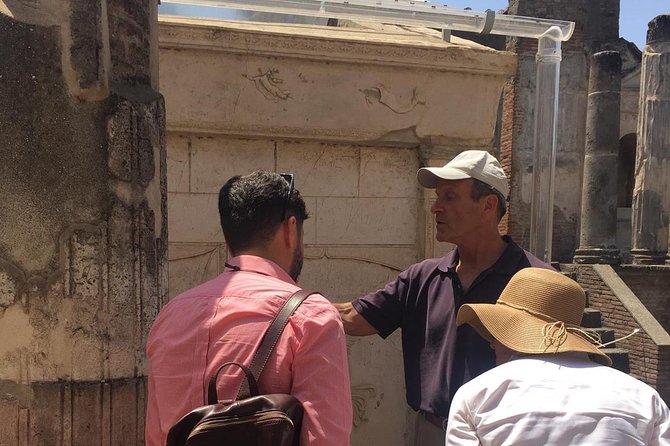
The best guides on this experience appear to do more than recite dates. Ricardo has been praised for explaining how archaeologists know what they know, including clues from objects and language. Raffaele and Rafael are noted for clear explanations and a friendly manner. Antonio is described as funny, engaged, and willing to adjust the final part of the visit to the group’s interests. Ornella is praised for bringing Roman life to the streets through stories and humor.
These are useful qualities at Pompeii. You want someone who can explain both the obvious monument and the small clue beside it. You also want a guide who answers questions without losing the group’s pace.
The guide can be particularly helpful in poor conditions. One account described a wet and windy day when the guide used covered shelters at useful points while continuing the explanation. Weather still affects the experience, and the activity requires good conditions, but thoughtful shelter choices can make an uncomfortable visit more manageable.
There is one equipment warning. One person reported that an earpiece failed and was not replaced during the tour. Another person appreciated that their guide spoke clear English without relying on distorted earphones. The experience may use audio equipment depending on the group and guide, so test any earpiece at once and speak up if you cannot hear.
Cost, group size, and who gets the best value
At $30.25 per person, the guided portion is reasonably priced for an authorized archaeology-focused guide and a two-hour route. Once you add the €19 adult entry ticket, the total is closer to a modest half-day sightseeing expense rather than a simple €30 activity.
The value comes from interpretation and time saved. Pompeii’s scale can make an unguided visit inefficient, especially if you have not studied the site beforehand. A guide points you toward the main public buildings and explains why they matter, so you are less likely to spend your limited time staring at an unmarked wall.
The small-group setup is another plus. The stated maximum is 15 people, and a group of around 12 should feel manageable. It gives you a better chance to ask questions and hear the guide than a large coach group. Still, one party reported about 20 people, so I would confirm the current group limit if a truly intimate group is essential.
This tour suits:
- First-time Pompeii visitors who want a clear route
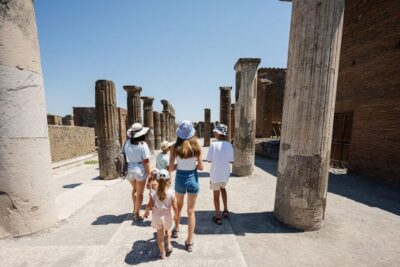
- Families who need history explained in an engaging way
- People arriving from Naples with limited time
- Anyone interested in archaeology, not just scenic ruins
- Visitors who want a guided introduction before exploring alone
It is less suitable for someone who wants a private route, a full-site visit, or guaranteed access to the amphitheater, brothels, or a particular house.
Practical details and cancellation terms
The tour is offered in English and lasts about two hours. Confirmation arrives at booking, and most people can participate. The experience is near public transportation, but the exact transport plan is not part of the tour, so allow enough time to reach Via Villa dei Misteri 1.
Book the entry ticket separately through the link sent the afternoon before the tour, or purchase it on site with assistance. Do not confuse the tour confirmation with the archaeological park admission ticket.
Free cancellation is available up to 24 hours before the start time for a full refund. Changes or cancellations inside that 24-hour window are not accepted for a refund. The activity requires a minimum number of participants and good weather. If the operator cancels for either reason, you are offered another date or experience, or a full refund.
Should you book this Pompeii tour?
I would book it if this is your first Pompeii visit and you want the ruins to make sense rather than simply photograph them. The strongest reasons are the archaeology-led explanations, the small-group format, and the well-chosen route through the Forum, temples, baths, market, homes, main street, and theater.
I would skip it only if you already know Pompeii well or have a short list of sites outside the planned route. In that case, the two-hour highlights walk may feel too general. For most people, though, it provides a strong foundation, and you can continue on your own afterward.
Buy the €19 entry ticket in advance, wear sturdy shoes, arrive at Porta Marina with time to spare, and test the audio equipment immediately. With those details handled, this is a good-value way to meet Pompeii through its streets, buildings, and the evidence left behind by the eruption.
FAQ
How long does the Pompeii archaeologist tour last?
The tour lasts approximately two hours.
What is the tour price?
The listed price is $30.25 per person. This price covers the guided experience, not admission to Pompeii Archaeological Park.
How much is admission to Pompeii Archaeological Park?
Adult admission costs €19. Admission is free for children under 18.
Are Pompeii entrance tickets included?
No. The Viator booking is the ticket to join the guided tour, not the entrance ticket for the archaeological site. A link to purchase a skip-the-line entry ticket is sent the afternoon before the tour.
Where does the tour meet?
The meeting point is outside the archaeological park at Via Villa dei Misteri 1, 80045 Pompei. The guide waits near Porta Marina Superiore with a Pompeii Vip sign.
What language is the tour offered in?
The tour is offered in English.
How many people can join the tour?
The stated maximum is 15 participants. One booking party reported a larger group, so you can confirm the current group size if this is especially important to you.
What happens if the weather is poor?
The experience requires good weather. If the operator cancels because of poor weather, you are offered a different date or experience, or a full refund.
Recently added around Pompeii
- From Pompeii: Bus Transfer to Vesuvius with Park Entry Fee★ 4.2 · 700 reviews
- Pompeii Skip-the-line Tour with Archaeologist Guide★ 5.0 · 559 reviews
- Skip the Line Guided Tour of Pompeii led by an Archaeologist★ 5.0 · 703 reviews
- Visit in Pompeii – Pompeii Private Tour with Ada★ 5.0 · 436 reviews
- Ancient Pompeii Private Tour: Skip the Line & Kid-Friendly Option★ 5.0 · 167 reviews
- Pompeii Private Tour with an Archaeologist and Skip The Line★ 5.0 · 391 reviews
- Private Day Tour to Vesuvius, Herculaneum & Pompeii with Pick Up★ 5.0 · 279 reviews
- Pompeii Private Tour with an Archaeologist and Skip The Line – 3 hours★ 5.0 · 564 reviews
Pompeii & Vesuvius Tours, compared.
Entry Ticket and Guided Tour with an Archaeologist
Read our review →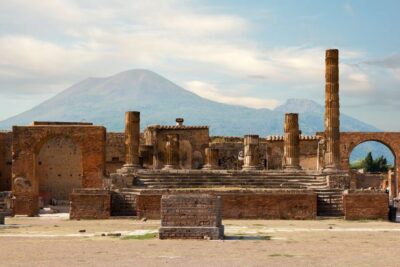


Pompeii Small Group Tour with an Archaeologist
Read our review →
Pompeii, Amalfi Coast and Positano Day Trip from Rome
Read our review →Browse the lists this tour appears in