
Reviewed · POMPEII & VESUVIUS TOURS
Pompeii: Exclusive Tour with Archaeologist and Entry Tickets
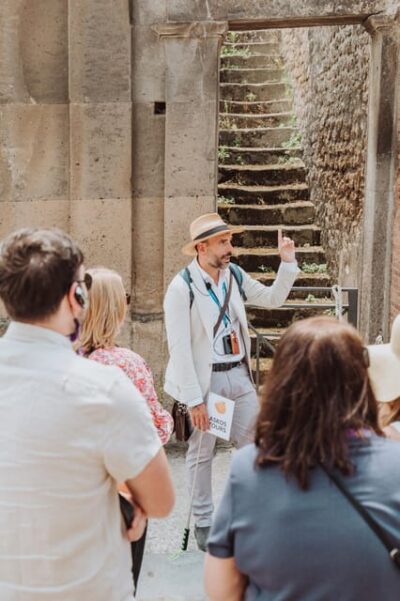
Pompeii rewards a good guide. This two-hour walk gives you skip-the-line entry and a licensed archaeologist who can explain not only what you are seeing, but how Pompeii worked as a Roman city. I especially like the small-group format and the included headsets, which help you follow the guide in a large, noisy archaeological park. The main drawback is time: two hours is enough for a strong introduction, but Pompeii is so vast that you may want to stay for the rest of the day.
I also like the route through both famous monuments and smaller daily-life sites, including bakeries, taverns, baths, houses, and the market. Guides such as Antonio, Riccardo, Livio, Rafael, and Loredana have been praised for bringing warmth, humor, and clear explanations to the walk. Just prepare for uneven Roman streets, sun or rain, and a fair amount of walking.
In This Review
- Key reasons this Pompeii tour works well
- Why a two-hour introduction is useful at Pompeii
- Meeting at Porta Marina beside the Pompeii train station
- Porta Marina and the first steps into the city
- The Basilica and Forum: Pompeii’s civic center
- Jupiter and Apollo: religion in public view
- Forum Baths and the Macellum market
- Three houses, three views of Roman life
- Taverns, bakeries, and the Lupanare
- The Large Theatre and the final orientation
- What the $50 price delivers
- Who should book this Pompeii experience?
- Should you book it?
- FAQ
- How long is the Pompeii tour?
- What is included in the price?
- Where does the tour meet?
- Which languages are available?
- Do I need to bring identification?
- Is transportation included?
- Is the tour suitable for wheelchair users?
Key reasons this Pompeii tour works well
- The Porta Marina meeting point is easy to find: Meet outside the entrance in front of Pompei Scavi, Villa dei Misteri station, where the guide holds a Pompei VIP sign.
- The route covers the city’s essential landmarks: You see the Forum, Basilica, temples, baths, houses, market, brothel, and theatre district.
- An archaeologist adds useful context: The guide explains daily life, excavation methods, inscriptions, art, and the eruption rather than simply naming buildings.
- Headsets make a real difference: You can hear the commentary while standing in open spaces or moving through crowded streets.
- You can keep exploring afterward: The guide points out what deserves more of your time once the group visit ends.
- The private option suits families and focused groups: A shared small group costs $50 per person, while private booking is available if you want a more personal pace.
Why a two-hour introduction is useful at Pompeii

Pompeii is not a compact ruin that you can understand by wandering around one square. It is an entire Roman town with streets, houses, shops, temples, public buildings, entertainment venues, and working neighborhoods. Without a plan, you can spend a lot of time walking and still miss the details that make the site meaningful.
This tour gives you a clear framework. Your guide links the Forum to politics, the market to food and trade, the houses to social status, and the theatres to leisure. That connection is the real value of a guided visit. You are not just looking at walls. You are learning how those walls fit into ordinary Roman life.
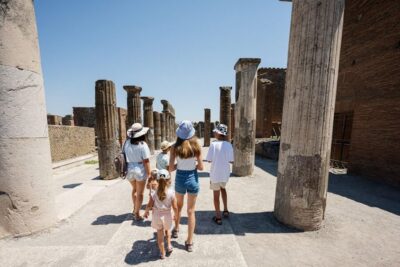
The two-hour length also works well for a first visit, especially if you are traveling with children or combining Pompeii with another Campania sight. Several guides are praised for keeping a good pace and explaining a lot without turning the outing into a dry lecture. Children and adults can follow the broad story, while history fans still get useful detail about Latin, Greek, construction, art, and archaeology.
The tradeoff is obvious. You will not see every open building, and you may want more time at the frescoes or plaster casts. Treat the tour as your orientation, then use the remaining hours to explore independently if the weather and your energy allow.
More Pompeii and Vesuvius trips:
- Pompeii: Entry Ticket and Guided Tour with an Archaeologist
★ 4.8 · 19,459 reviews - Pompeii: Entry Ticket with Optional Audio Guide
★ 4.2 · 12,360 reviews - Pompeii: Small Group Tour with an Archaeologist
★ 4.8 · 12,264 reviews
Meeting at Porta Marina beside the Pompeii train station
The meeting point is outside Pompeii’s Porta Marina entrance, directly in front of the Pompei Scavi, Villa dei Misteri station on the Circumvesuviana railway. Look for a guide holding a sign marked Pompei VIP.
This location is practical, but pay attention to the station name. Pompeii has three train stations, so check your route carefully before leaving. One visitor nearly arrived late after confusing the stations, although the tour team responded quickly to messages. That is a small detail that can save you a stressful start.
Once the group is assembled, the included admission ticket gets you through the ticket line. The park still has internal walking and security procedures, so skip-the-line entry does not mean you teleport into the ruins. It does mean you avoid wasting valuable sightseeing time at the main ticket queue.
Bring your passport or ID card, including for children. Pompeii’s current ticket system requires the full name and surname of every participant, along with ages, to be submitted in advance. Your name must match the ticket, and you should carry an ID or a photo of it.
Porta Marina and the first steps into the city
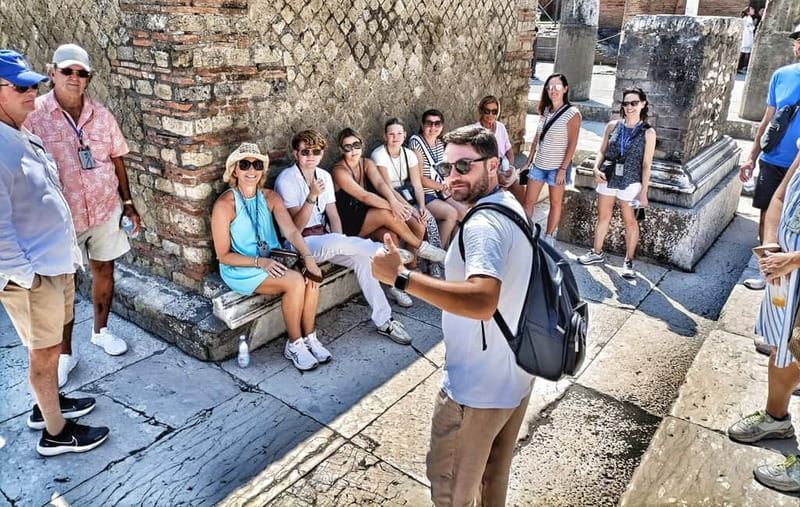
Porta Marina is the original Roman entrance and a fitting way to begin. Here, your guide can explain how visitors and goods entered the city before leading you along the ancient streets.
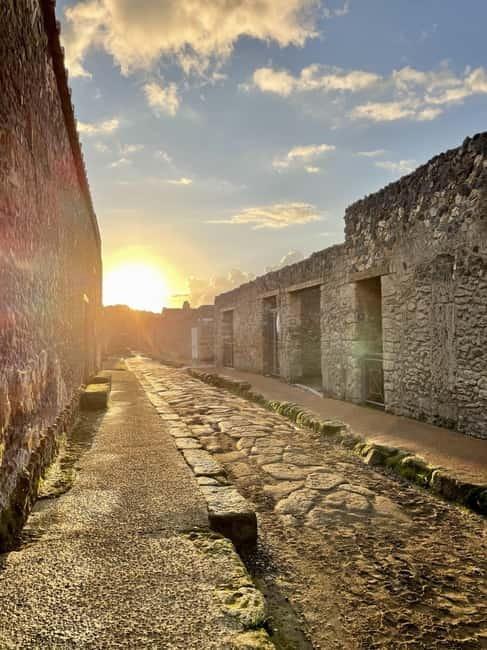
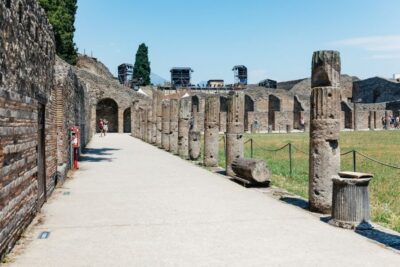
The first impression is powerful because Pompeii feels like a place rather than a collection of isolated ruins. You see worn paving stones, tall walls, doorways, and long street lines. The guide helps you read the city’s layout and imagine how public, commercial, and private spaces worked together.
The streets are uneven and the site is exposed. Comfortable shoes are essential, and water is a must, especially in warm weather. Rain can also make the stone surfaces slippery, so practical clothing matters more than looking polished.
The Basilica and Forum: Pompeii’s civic center
The Basilica was one of Pompeii’s key public buildings. It was connected with business and legal affairs, so it helps you picture the city as an active place of contracts, disputes, and public dealings, not merely a resort town buried by Vesuvius.
Next comes the Foro Civile di Pompei, the main Forum. This broad civic space was the center of public life, with important buildings and temples around it. Your guide can point out how the architecture expressed power and how the Forum organized the city’s political and religious life.
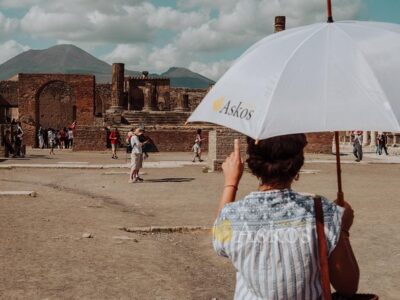
This is one of the tour’s best moments for scale. The Forum gives you a sense of Pompeii’s size and importance, while the archaeologist’s commentary turns large columns and broken walls into parts of a functioning community. It is also a good place for photographs, though the open space can be hot and crowded.
A few more Pompeii bookings to compare
- Pompeii Small Group Tour with an Archaeologist
★ 5.0 · 6,593 reviews - Pompeii: Skip-the-Line Entrance Ticket with Audio Guide
★ 4.0 · 2,509 reviews - Naples: Pompeii and Mt. Vesuvius with Lunch and Wine Tasting
★ 4.5 · 2,454 reviews - Pompeii: Archaeological Park Tour with Ticket on request
★ 4.5 · 2,283 reviews
Jupiter and Apollo: religion in public view
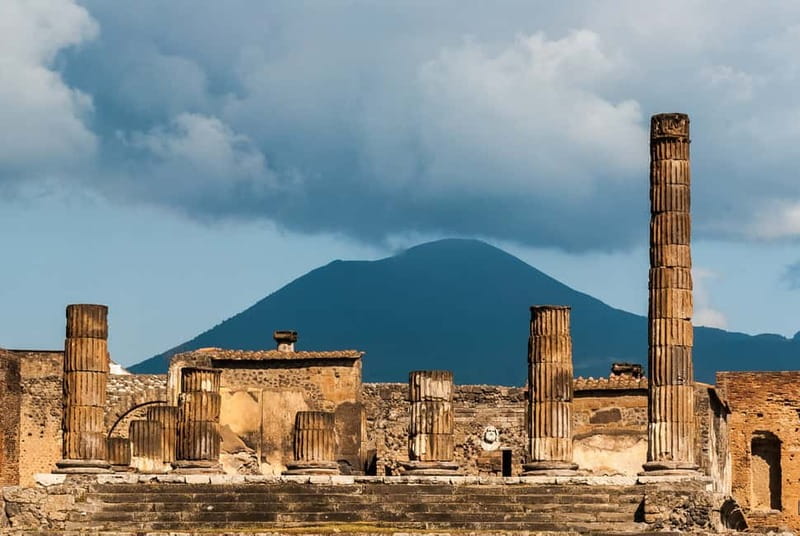
The Temple of Jupiter anchors one side of the Forum and offers a useful introduction to Roman religion and civic identity. The Temple of Apollo, one of the oldest religious sites in Pompeii, adds another layer to the story.
You will not simply be shown two temples and given their names. The guide can explain how religion, politics, and public space overlapped in Roman cities. The location of these buildings mattered. Their placement near the Forum made worship visible and tied religious authority to the civic heart of Pompeii.
This part of the walk is especially helpful if you are new to Roman archaeology. The ruins can look confusing at first, but an expert guide gives you a way to distinguish sacred buildings, government spaces, commercial areas, and homes.
Forum Baths and the Macellum market
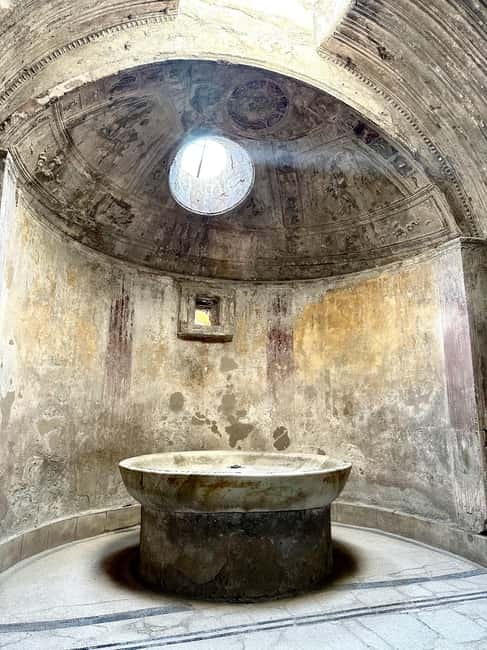
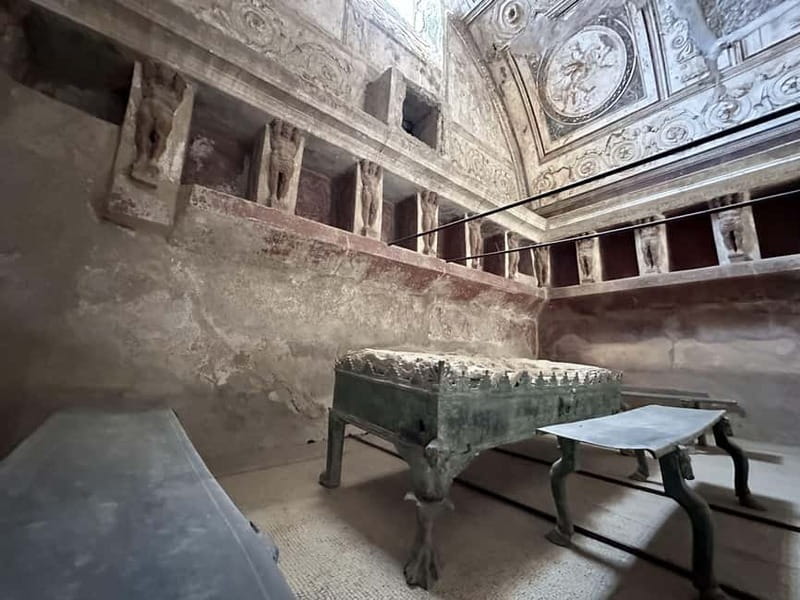
The Forum Baths show how much public infrastructure Pompeii had. Bathing was a social activity as well as a practical one, and the complex gives you clues about heating systems, room use, and the role of public amenities in Roman society.
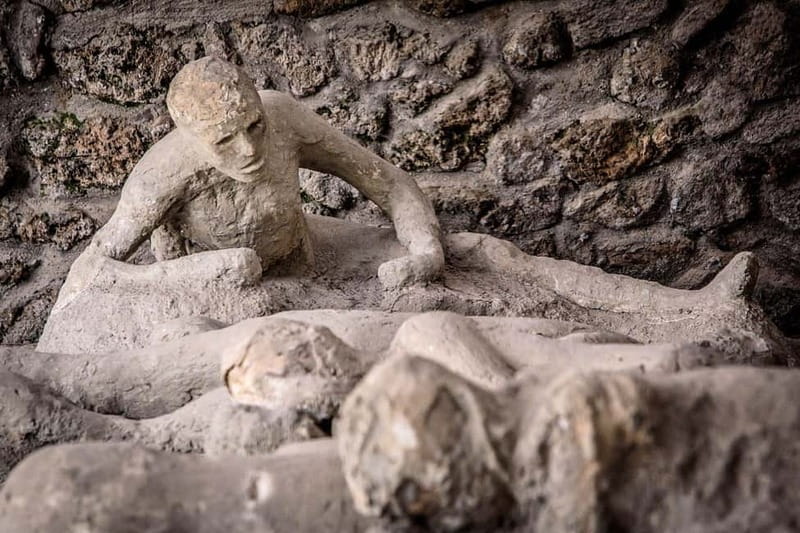
The Macellum was a market area, and it is also connected with some of the site’s most difficult human evidence. Nearby plaster casts preserve the forms of people caught in the eruption. These casts can be haunting, and the guide’s explanation helps place them in their archaeological and human context without reducing them to spectacle.
This is where Pompeii’s beauty and tragedy meet most sharply. One minute you are studying a market plan and ancient commerce. The next, you are confronted with the fact that this was a living city whose residents had very little time to escape. The subject may be upsetting for some children, so families should decide in advance how much detail they want.
Three houses, three views of Roman life
The House of the Tragic Poet is known for its decorative art and offers a glimpse into how Roman homeowners used mosaics, wall paintings, and mythological scenes to express taste and status. It is a reminder that Pompeian homes were not plain shelters. They were carefully arranged social spaces.
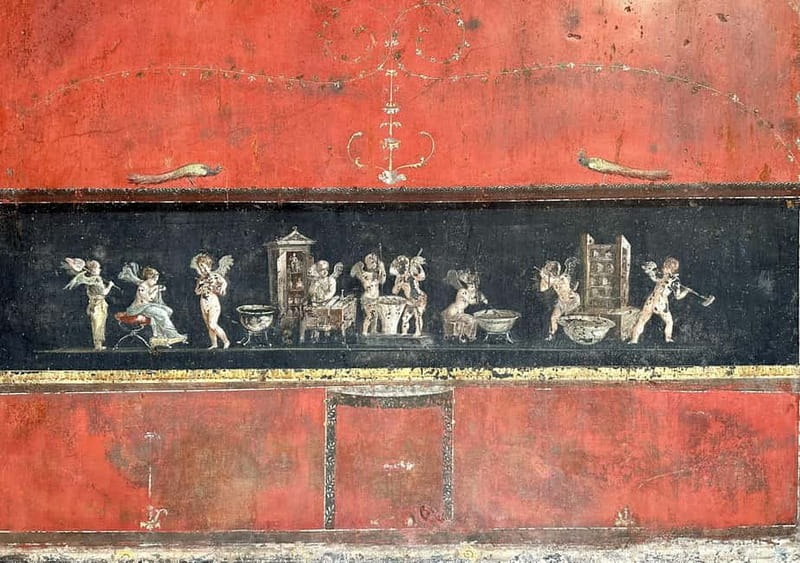
The House of the Vettii is among the tour’s major artistic stops. Its frescoes and rooms help explain the wealth, ambitions, and social position of its owners. The details matter here, and this is exactly where a guide can save you from walking past a painting without understanding what it says about Roman culture.
The House of the Faun gives you another sense of scale and luxury. Its large plan, decoration, and mosaics show how much space and money some Pompeians commanded. Comparing it with other homes helps you see that Pompeii was socially mixed. Wealthy residences existed alongside modest shops, workshops, and crowded streets.
Access to individual buildings can change as conservation work continues. If one room is closed, your guide can still explain its place in the wider site and point out other areas worth seeing after the group tour.
Taverns, bakeries, and the Lupanare
The Thermopolium taverns are among the most engaging stops for anyone interested in daily life. These ancient food counters show that Pompeii’s residents could buy prepared food and drink outside the home. They make the city feel familiar in a way that grand temples do not.
The bakeries offer another practical connection. Ancient ovens and commercial food spaces reveal how residents worked, ate, and supplied the town. These places are often more memorable than a long list of emperors because they connect archaeology with ordinary habits.
The Lupanare, Pompeii’s famous brothel, is a brief but revealing stop. Its small rooms and surviving images provide evidence of the city’s commercial and social life. The setting is cramped, and some content may not suit young children. If you are traveling as a family, ask your guide how the stop will be handled.
These places are also where an archaeologist’s experience has particular value. A professional who has worked on the site can explain how researchers interpret rooms, objects, paintings, and building changes. That kind of context helps you separate solid evidence from the assumptions often repeated in popular accounts of Pompeii.
The Large Theatre and the final orientation
The Large Theatre closes the main route with a look at entertainment and public gatherings. The theatre district helps show that Pompeii was not only a place of work and worship. Performances, social events, and shared leisure were part of city life.
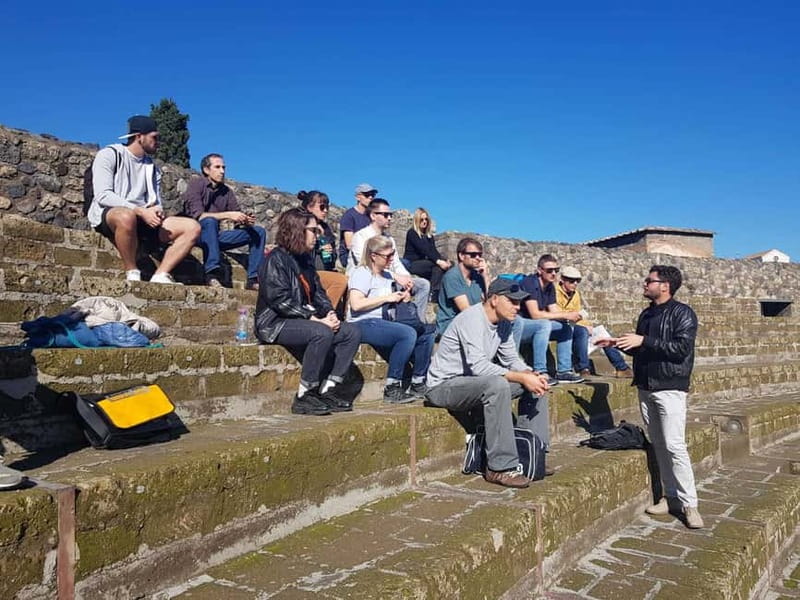
Your guide should allow time for photographs and questions, and the strongest guides keep the group moving without making the visit feel rushed. Antonio, Riccardo, Livio, Rafael, Loredana, and Pierluigi have each been praised for a friendly manner, clear delivery, humor, and attention to the group’s pace. The headsets are particularly useful here and throughout the tour because you can keep listening while viewing the site.
The visit ends at Pompeii Ruins or Piazza Esedra. Before you separate, the guide points out what you should see next on your own. This follow-up advice is important because two hours cannot cover the entire park. One useful approach is to stay for the rest of the day if temperatures are manageable, then explore the areas that caught your interest during the guided walk.
What the $50 price delivers
At $50 per person, this is not the cheapest way into Pompeii. You are paying for admission, a two-hour guided visit, an archaeologist or licensed guide, skip-the-line access, a small group, and a headset.
The value is strongest if this is your first visit. Pompeii’s size and scattered landmarks make a good route worth paying for, and a guide can give you a working understanding of the city before you wander alone. The price also looks better if you would otherwise buy an entry ticket and then try to make sense of the site without help.
Private booking changes the value calculation. If you are traveling with family or friends, paying more for a private slot may be worthwhile because you can ask more questions and potentially shape the pace. The shared small group is the sensible choice for most people who want expert guidance without the private-tour cost.
There is no food, drink, or transportation included. Plan your own route to the entrance and carry water. Pompeii is not suitable for wheelchair users or people with mobility impairments, and electric wheelchairs are not permitted. Pets, swimwear, alcohol, and drugs are also not allowed.
Who should book this Pompeii experience?
I would choose this tour for a first-time Pompeii visitor who wants the main story without spending hours studying a map. It is also a strong choice for families, couples, solo visitors, and history fans who want to ask questions as they go.
The tour suits you particularly well if you are arriving by train, since the meeting point is right by the Pompei Scavi station. It is also useful if you are visiting from Sorrento and want a clear, organized introduction before continuing your day.
You may prefer a longer independent visit if you already know Pompeii well or want to spend extended time in every house and fresco room. Two hours gives you breadth, but not unlimited time for close inspection. Hot weather, rain, and uneven paving can also affect your enjoyment, so choose comfortable footwear and check the forecast.
Should you book it?
Book this Pompeii tour if you want expert interpretation and a well-planned route more than unlimited free time. The guide’s archaeology background, the included ticket, small group, headsets, and access to major public and private sites make $50 a fair price for a first visit.
If you can spare the time, stay in the park afterward. The guided walk gives you the story and the bearings. Your own extra hours give you the freedom to return to the frescoes, houses, theatres, or quieter streets that interested you most.
FAQ
How long is the Pompeii tour?
The tour lasts two hours. The guide also points out important places to continue exploring after the group visit.
What is included in the price?
The price includes skip-the-line entry tickets, Pompeii admission, a licensed archaeologist or guide, a headset, and a shared small-group experience. A private booking option is also available.
Where does the tour meet?
Meet outside Pompeii’s Porta Marina entrance, directly in front of the Pompei Scavi, Villa dei Misteri train station. The guide holds a sign marked Pompei VIP.
Which languages are available?
The live tour guide is available in English, Italian, French, and Spanish.
Do I need to bring identification?
Yes. Bring a passport or ID card, including for children. Full names, surnames, and ages must be provided for all participants, and the ticket information must match the identification.
Is transportation included?
No. You are responsible for getting to the meeting point and arranging your own transportation after the tour.
Is the tour suitable for wheelchair users?
No. The experience is not suitable for wheelchair users or people with mobility impairments. Electric wheelchairs are not permitted.
Recently added around Pompeii
- Pompeii Ruins Private Tour with Optional Skip-the-Line Entry★ 4.9 · 732 reviews
- Pompeii 3hours Villa of Mysteries tour with an Archaeologist★ 4.8 · 486 reviews
- Pompeii: Group Tour with an Archeologist Guide★ 4.4 · 490 reviews
- Pompeii: Skip-the-Line Tickets and Tour with Archaeologist★ 4.9 · 467 reviews
- Pompeii: Small-Group Tour of Pompeii and Herculaneum★ 4.8 · 867 reviews
- Pompeii: Skip-the-Line Guided Tour with Expert Archaeologist★ 4.8 · 196 reviews
- Pompeii: Skip-the-line-Ticket and Guided Tour★ 4.6 · 1,152 reviews
- Pompeii: Skip-the-Line Entry & Audioguide★ 3.8 · 225 reviews
Pompeii & Vesuvius Tours, compared.
Entry Ticket and Guided Tour with an Archaeologist
Read our review →

Pompeii Small Group Tour with an Archaeologist
Read our review →
Pompeii, Amalfi Coast and Positano Day Trip from Rome
Read our review →Browse the lists this tour appears in