
Reviewed · POMPEII & VESUVIUS TOURS
Pompeii and Mount Vesuvius Small Group Tour
History still feels hot here. This full-day outing pairs Pompeii’s remarkably preserved streets with a climb to the crater of Mount Vesuvius, saving you the trouble of arranging two major sights on your own. I like the archaeologist-led visit, especially when guides such as Anna, Teresa, Raffaela, and Benedetto bring daily Roman life into focus. I also like the minibus transfer to the volcano, with admission fees included. The main caution is the physical effort and weather risk: the Vesuvius trail is steep, exposed, and sometimes closed by rain, fog, or strong wind.
This is a good choice if you have one day for the area and want both archaeology and geology. The Pompeii portion is absorbing but brief, and the break between the two visits may be short for a relaxed meal. At $119.77 per person, the price is fair for a small group of up to 14, two guides, two entrance tickets, and mountain transport, though independent visitors who prefer a slow Pompeii visit may get better value by booking the ruins alone.
In This Review
- Key points before you book
- Why combine Pompeii with Vesuvius?
- Meeting your guide at Porta Marina Superiore
- Pompeii in two hours: the right route, at the wrong speed for some
- The Forum
- The Granaries of the Forum
- The House of Menander
- The Stabian Baths
- The Lupanar
- The House of the Faun
- Teatro Piccolo and Teatro Grande
- What two hours at Pompeii gives you, and what it leaves out
- The break between sites: bring a simple lunch plan
- Riding up Vesuvius by minibus
- The Vesuvius crater walk is short, but not easy
- The reward at the crater edge
- Weather closures and the Herculaneum alternative
- Group size, timing, and overall value
- Who should book this Pompeii and Vesuvius tour?
- Should you book it?
- FAQ
- How long does the Pompeii and Mount Vesuvius tour last?
- What is included in the tour price?
- Are food and drinks included?
- Where does the tour start?
- Where does the tour finish?
- Is the Mount Vesuvius hike difficult?
- What should I wear for Mount Vesuvius?
- What happens if Mount Vesuvius is closed?
- Can young children join the tour?
Key points before you book
- Two major sights in one day: You visit Pompeii and Mount Vesuvius during an outing of about eight hours.
- Archaeologist-led Pompeii tour: The two-hour visit focuses on the forum, houses, baths, public buildings, and casts from the eruption.
- A real uphill walk: The final 500 meters to the crater are steep, with loose ground that can be slippery.
- Small-group transport: The minibus carries up to 14 people, while the Pompeii guidance allows up to 20.
- Weather changes the plan: If Vesuvius is closed, the alternative is Herculaneum, although weather decisions and refunds should be clarified before departure.
- Wear proper shoes: Comfortable closed shoes, sun protection, and a light layer are sensible even in warm weather.
Why combine Pompeii with Vesuvius?
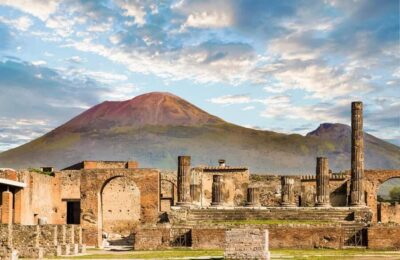
Pompeii and Vesuvius explain each other. The ruins show the human cost of the eruption, while the mountain gives you the physical setting and a view toward the communities that still live around it.
Doing both independently can take careful planning. You need Pompeii admission, a good route through the enormous site, transport up the volcano, a Vesuvius entry ticket, and enough time to get back. This tour handles the main connections by minibus and supplies both admission fees.
The trade-off is a fixed timetable. You will not have an entire day to wander Pompeii, and you cannot simply linger in one house when the group must leave for the mountain. Still, I think the pairing works well for a first visit, especially if you want the broad story rather than a slow archaeological study.
The experience is offered in English. The overall rating is 4.7 out of 5 from 233 ratings, with 93 percent of customers recommending it. That points to a consistently strong day, but the less favorable experiences are worth taking seriously: some people found the organization unclear, the audio equipment unreliable, or the mountain conditions too severe.
More Pompeii and Vesuvius trips:
- Pompeii: Entry Ticket and Guided Tour with an Archaeologist
★ 4.8 · 19,459 reviews - Pompeii: Entry Ticket with Optional Audio Guide
★ 4.2 · 12,360 reviews - Pompeii: Small Group Tour with an Archaeologist
★ 4.8 · 12,264 reviews
Meeting your guide at Porta Marina Superiore
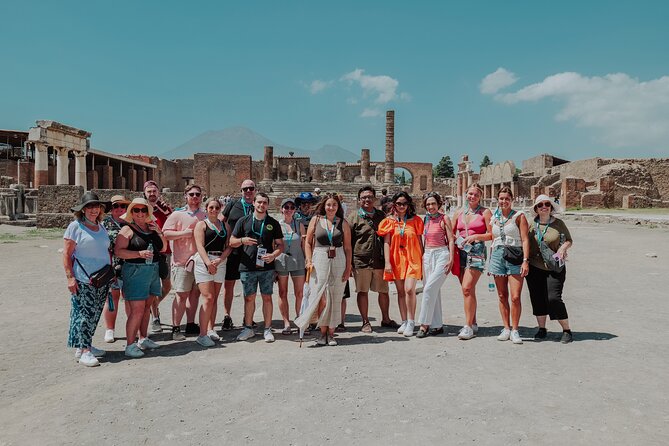
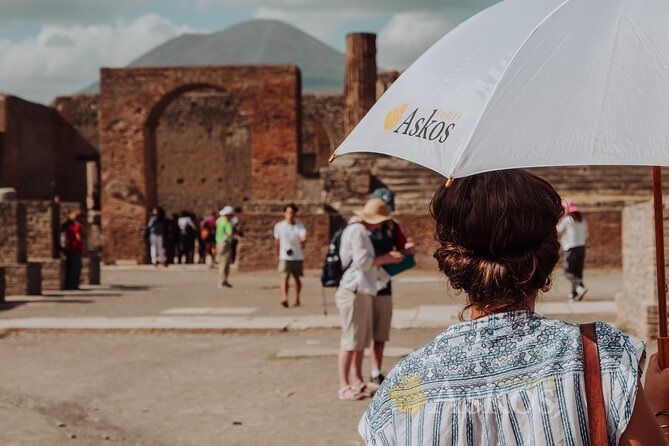
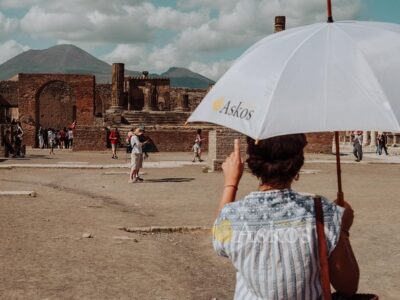
The meeting point is at Via Villa dei Misteri, 2, by Pompeii’s main entrance called Porta Marina Superiore. Look for the guide holding an Askos Tours sign.
That detail matters because Pompeii has several entrances, and a wrong gate can cost valuable time. Arrive with enough margin to find the correct entrance and your group. The official end point is back at the same meeting point.
The day may begin with Pompeii or with Vesuvius, depending on the departure schedule. The supplied itinerary describes Pompeii first, while several accounts describe climbing Vesuvius before touring the ruins. You should check the exact order for your date, since it affects when you eat, how much walking comes early in the day, and how you handle the heat.
Pompeii in two hours: the right route, at the wrong speed for some
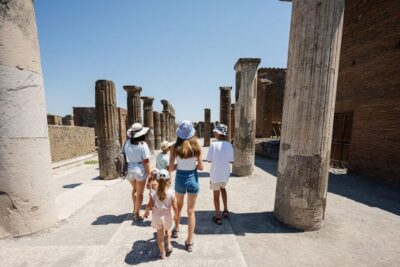
The guided Pompeii visit lasts about two hours. That is enough time to understand the city’s plan and see several famous buildings, but it is not enough to cover the entire archaeological park.
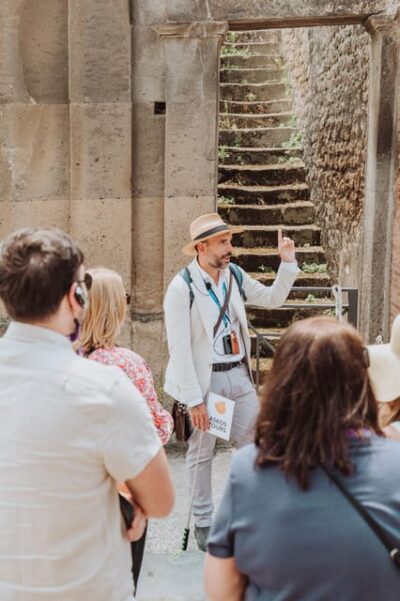
I like having an archaeologist lead this portion. Guides who have worked on excavations can point out details that a basic map will not explain. Anna Sorrento, described as an archaeologist actively involved in uncovering Pompeii, received especially warm praise for her passion and ability to connect the site with current work. Benedetto was also noted for many years of excavation experience, while Teresa, Raffaela, Daniela, Antonella, and other guides were praised for clear explanations and lively storytelling.
The route includes these important stops:
The Forum
Pompeii’s ancient main square is the natural place to begin. It gives you a sense of the city’s civic center and helps you understand how the streets, public buildings, temples, and commercial spaces fit together.
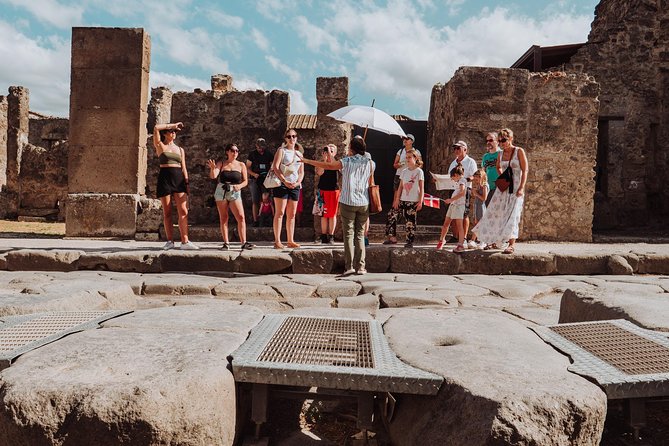
You spend only about 10 minutes here, so listen closely to the guide’s explanation of the layout. Afterward, you walk along Pompeii’s main street, where the worn paving stones and surviving buildings make the city feel less like a collection of ruins and more like a neighborhood interrupted mid-day.
A few more Pompeii bookings to compare
- Pompeii Small Group Tour with an Archaeologist
★ 5.0 · 6,593 reviews - Pompeii: Skip-the-Line Entrance Ticket with Audio Guide
★ 4.0 · 2,509 reviews - Naples: Pompeii and Mt. Vesuvius with Lunch and Wine Tasting
★ 4.5 · 2,454 reviews - Pompeii: Archaeological Park Tour with Ticket on request
★ 4.5 · 2,283 reviews
The Granaries of the Forum
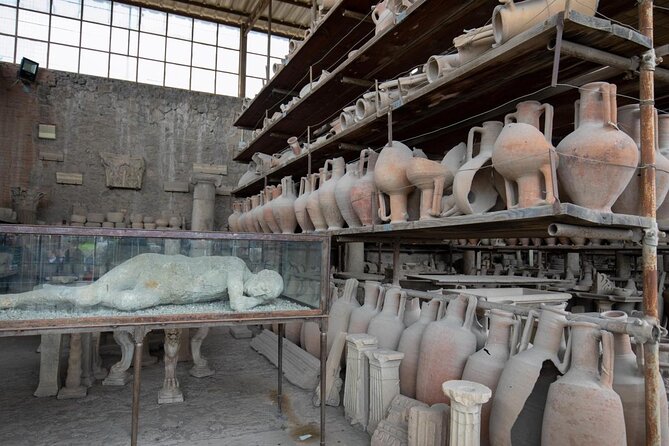
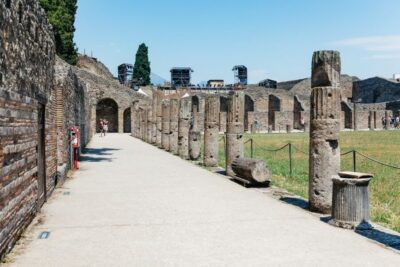
The so-called granaries contain marble tables and fountain baths that once decorated the entrances of houses. You also see casts of eruption victims, including a dog and a tree.
This is one of the most emotionally difficult stops. The casts are not simply archaeological objects. They show the final positions of people and animals caught by the disaster. Your guide’s context is particularly important here, since the displays can otherwise feel stark and disconnected from the lives they represent.
The House of Menander
The House of Menander is among Pompeii’s grandest private residences. Its size, decoration, architecture, and contents reveal the wealth and social position of its owner.
A guided visit helps you read the house as a Roman home, not just a series of rooms. Pay attention to how the guide explains the relationship between public-facing spaces, private quarters, decoration, and status. This is the sort of detail that turns a large residence into a picture of how elite Roman families lived.
The Stabian Baths
The Stabian Baths occupy a broad area near the Brothel lane, the Holconius crossroads, and Via Stabiana. They are considered Pompeii’s oldest thermal complex.
This stop gives you a useful look at public life. Roman baths were not only places to wash. They were social spaces, and the scale of the complex shows how much time and money the city devoted to communal facilities.
The Lupanar
The Lupanar is Pompeii’s most famous brothel. Its small rooms and surviving paintings make it one of the site’s best-known stops.
Expect a queue or crowding here at busy times, and listen for the guide’s explanation rather than rushing through. The building is popular because it is memorable, but its value comes from understanding what it says about urban life, commerce, and social customs in the Roman world.
The House of the Faun
The House of the Faun was one of Pompeii’s largest and most impressive private residences. Its scale gives you another view of elite life, this time on a grander level than the House of Menander.
You may also see the famous dancing faun sculpture associated with the house, although the supplied tour details do not promise a particular display arrangement. The key point is the residence itself: its size helps explain that Pompeii was not a town of uniform homes, but a place with sharp differences in wealth.
Teatro Piccolo and Teatro Grande
The smaller theater, called Teatro Piccolo, is viewed briefly before the tour continues to Teatro Grande, Pompeii’s most important theater.
The large theater shows how entertainment fit into city life. Like the baths and forum, it reminds you that Pompeii was a functioning community with public spaces for business, politics, recreation, and ceremony, not merely a disaster site.
What two hours at Pompeii gives you, and what it leaves out
The strongest reason to take this guided visit is interpretation. Without a guide, Pompeii’s size and repetitive stonework can wear you down. With a good archaeologist, the forum, homes, baths, brothel, and theaters form a readable story.
The limitation is time. Several participants wished they could stay longer, and one especially praised guide had more to share than the schedule allowed. You may have a short period afterward to continue on your own, but the exact free time depends on the day’s timing and the transfer to Vesuvius.
If Pompeii is your main reason for coming, I would consider booking a Pompeii-only visit instead. If Vesuvius is equally important, accept that you are choosing breadth over a complete exploration of the ruins.
The break between sites: bring a simple lunch plan
Food and drinks are not included. The gap between Pompeii and the mountain may be around 10 to 15 minutes on some schedules, while other accounts describe roughly an hour for lunch.
That difference is important. Do not count on a long restaurant meal. A sandwich and drink are the practical choice, and cafes are available down the hill from the Pompeii entrance. Carry water, especially in hot weather, but remember that the tour price does not include refreshments.
The break is also your chance to use the restroom, check your shoes, apply sunscreen, and prepare for the climb. Once you reach Vesuvius, the focus shifts from ruins to exposed trail walking.
Riding up Vesuvius by minibus
The minibus transfer from Pompeii to Vesuvius is one of the tour’s most useful features. It saves you from arranging mountain transport and takes the group toward the upper access point.
The road is winding, with tight bends. One account singled out the driver’s skill on the mountain route, while another noted that the vehicle was not air-conditioned. That may matter on a very hot day, though it was not considered a problem in cooler weather.
At the volcano, a licensed hiking guide leads the group. Mario is the name most often praised in the supplied accounts. He is described as patient with different fitness levels, willing to stop for breaks, and good at explaining both the eruption and the volcano’s current condition.
The Vesuvius crater walk is short, but not easy
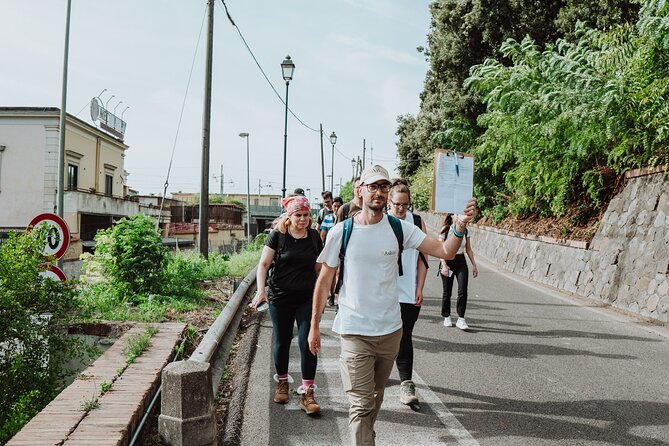
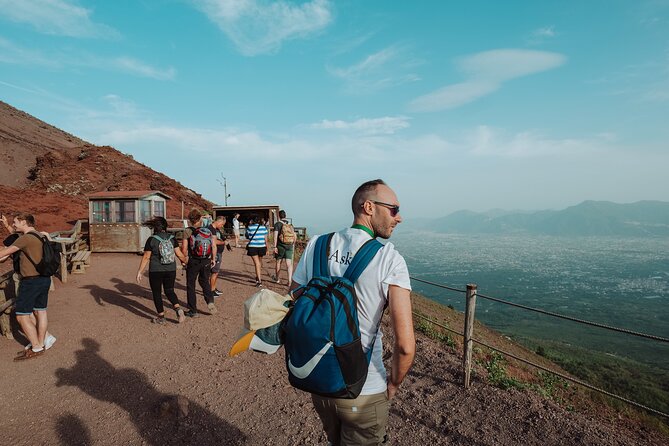
From the entrance, the first 30 minutes involve step walking toward the crater. The last 500 meters are very steep. Other descriptions put the total walk at about 2.5 miles, with roughly three hours on the trails in some schedules.
Those numbers do not tell the whole story. The loose volcanic surface can slide underfoot, and the climb feels much harder in strong sun or extreme heat. One account described temperatures near 100 degrees and said the route was too difficult for many people. Another found the hike manageable at a slow pace. Both impressions can be true, depending on fitness, heat, and weather.
You need closed, comfortable walking shoes. Sandals are a poor choice. Bring sunglasses, sunscreen, water, and a light jacket because the summit can be windy and chilly even after a hot climb.
The group generally moves at a measured pace, with breaks as needed. Mario was repeatedly praised for not rushing people and for explaining the volcano along the way. Some days may also include contact with a volcanist or scientist at the top, who can discuss the eruption and volcanic activity. That is a valuable addition, but it should not be treated as guaranteed on every departure.
The reward at the crater edge
At the top, you can look into the crater, which may still release a small amount of smoke. The trail and crater rim also offer broad views over the Bay of Naples, Capri, Ischia, the edge of the Sorrento coast, and surrounding areas.
Clear weather makes a major difference. Fog can hide Naples, clouds can cover the crater, and rain or wind can reduce visibility to only a few feet. Some people still found the climb worthwhile in mist because the guide’s explanations gave the mountain meaning, but you should not book this experience solely for a guaranteed panorama.
There are souvenir shops along the route and a refreshment stand near the top. The stand sells wine from vineyards on Vesuvius, and cash may be useful if you want to buy a glass. These stops are secondary, but they can make the summit feel less like a bare hike and more like a local mountain visit.
Weather closures and the Herculaneum alternative
Vesuvius is not fully under the tour operator’s control. Park authorities can close the crater path because of heavy rain, fog, high winds, or other safety conditions.
When the volcano cannot be visited for force majeure reasons, the stated alternative is Herculaneum. This is not a weak backup. Herculaneum is smaller and more intimate than Pompeii, with exceptionally well-preserved details that give you another view of life before the eruption.
The important point is communication. One account praised the guide for arranging Herculaneum when heavy rain closed Vesuvius. Two other accounts raised concerns about weather judgment and refunds when the mountain portion was canceled or became inaccessible. Before booking, ask how the replacement visit and any refund are handled in the exact situation you may face. Do not assume that every weather-related change produces the same result.
Group size, timing, and overall value
The Pompeii guide can lead up to 20 people, while the minibus holds up to 14. The experience is advertised as a small group, but the Pompeii portion may feel larger than the mountain portion on some dates.
At $119.77, I see solid value if you want convenience. You are paying for Pompeii and Vesuvius admission, an archaeologist for about two hours, a hiking guide, and transport between the sites. You also avoid the stress of coordinating mountain access after a long visit through the ruins.
The price is less attractive if you want a slow Pompeii day. Two hours passes quickly, and the combined outing can feel long once you add transfers, the break, and the climb. The published duration is about eight hours, though some accounts describe days closer to six hours and others describe extended time on the trails. Plan for most of the day rather than relying on the shortest estimate.
Free cancellation is available up to 24 hours before the local start time. Children under six are not allowed, and the tour is not recommended for people with mobility or walking difficulties. A moderate level of fitness is expected.
Who should book this Pompeii and Vesuvius tour?
I would choose this tour if you:
- Have one day for Pompeii and Vesuvius
- Want an archaeologist to explain the ruins
- Prefer arranged transport to the volcano
- Enjoy a moderate to strenuous uphill walk
- Are comfortable with a fixed schedule
- Want history and geology in the same outing
I would choose a different plan if you want to inspect Pompeii at your own pace, dislike steep walking, or need reliable mountain views. The tour is also a poor fit if heat, loose ground, or changing weather would make the crater trail unpleasant.
The guides are a major strength. Names such as Mario, Anna, Teresa, Raffaela, Benedetto, Daniela, and Antonella appear in the feedback, and several were praised for humor, archaeological detail, patience, and clear explanations. Still, guide quality can vary, and one person found an accent difficult to understand while another reported trouble hearing on the bus.
Should you book it?
Yes, if your priority is seeing the two headline sights in one efficient day. The archaeologist-led Pompeii visit gives the ruins structure, and the Vesuvius hike adds a physical sense of the volcano that destroyed the city.
Book it with realistic expectations. You may not see every corner of Pompeii, the climb is harder than the brief distance suggests, and bad weather can erase the views or close the trail. Wear serious shoes, carry water, keep lunch simple, and confirm the weather policy and exact return arrangements before you go. For a first visit with limited time, the combination offers a strong mix of history, science, and scenery.
FAQ
How long does the Pompeii and Mount Vesuvius tour last?
The advertised duration is approximately eight hours. Individual accounts describe some outings lasting closer to six hours, while others include several hours on the Vesuvius trails, so you should plan to use most of the day.
What is included in the tour price?
The price includes Pompeii Express admission, Mount Vesuvius admission, a two-hour archaeologist-led Pompeii visit, minibus transportation from Pompeii to Vesuvius and back, and a licensed hiking guide for Mount Vesuvius.
Are food and drinks included?
No. You must pay for your own food and drinks. Cafes near Pompeii can provide a sandwich and beverage during the break.
Where does the tour start?
The meeting point is Via Villa dei Misteri, 2, at Pompeii’s main entrance called Porta Marina Superiore. Look for the guide holding an Askos Tours sign.
Where does the tour finish?
The stated end point is back at the Pompeii meeting point, Porta Marina Superiore.
Is the Mount Vesuvius hike difficult?
The hike requires moderate physical fitness. The first 30 minutes from the entrance involve steps, and the final 500 meters are very steep. Loose volcanic ground can also be slippery, especially in warm or wet conditions.
What should I wear for Mount Vesuvius?
Wear comfortable closed shoes suitable for uphill walking. Sunglasses and sunscreen are recommended in summer, and a light jacket can help because the summit may be windy or chilly.
What happens if Mount Vesuvius is closed?
If Vesuvius cannot be accessed because of force majeure, the tour is scheduled to include Herculaneum instead. Weather can also affect visibility, so ask about the operator’s refund arrangements if the mountain portion is canceled or changed.
Can young children join the tour?
Children under six years old are not allowed. The tour is also not recommended for people with mobility or walking impairments.
Recently added around Pompeii
- From Pompeii: Bus Transfer to Vesuvius with Park Entry Fee★ 4.2 · 700 reviews
- Pompeii Skip-the-line Tour with Archaeologist Guide★ 5.0 · 559 reviews
- Skip the Line Guided Tour of Pompeii led by an Archaeologist★ 5.0 · 703 reviews
- Visit in Pompeii – Pompeii Private Tour with Ada★ 5.0 · 436 reviews
- Ancient Pompeii Private Tour: Skip the Line & Kid-Friendly Option★ 5.0 · 167 reviews
- Pompeii Private Tour with an Archaeologist and Skip The Line★ 5.0 · 391 reviews
- Private Day Tour to Vesuvius, Herculaneum & Pompeii with Pick Up★ 5.0 · 279 reviews
- Pompeii Private Tour with an Archaeologist and Skip The Line – 3 hours★ 5.0 · 564 reviews
Pompeii & Vesuvius Tours, compared.
Entry Ticket and Guided Tour with an Archaeologist
Read our review →
Pompeii Small Group Tour with an Archaeologist
Read our review →
Pompeii, Amalfi Coast and Positano Day Trip from Rome
Read our review →Browse the lists this tour appears in