
Reviewed · POMPEII & VESUVIUS TOURS
Pompeii and Herculaneum Small Group Tour with an Archaeologist
Two Roman cities, one unforgettable day. This tour pairs Pompeii’s broad streets and grand public spaces with Herculaneum’s remarkably preserved homes, giving you a useful comparison of life before Mount Vesuvius erupted. I especially like the archaeologist guides, who explain more than names and dates, and the included transport, which removes much of the day’s awkward planning. The main tradeoff is time: two hours at Pompeii can feel rushed in a place this large.
I also like that admission to both sites, headsets, and transport are included, with groups capped at 20 people. The pace is brisk, and the lunch stop may be at a modern shopping center rather than a memorable Pompeii-area restaurant, so bring a snack or plan your expectations.
In This Review
- Key points to know before booking
- Why seeing both ruins together works
- Meeting points and the day’s transport
- Pompeii’s public heart: Basilica, Forum, and main streets
- Pompeii’s houses reveal private Roman life
- Baths, brothel, and theaters
- The lunch break: useful, but not atmospheric
- Herculaneum’s preserved houses and public buildings
- Wood, skeletons, and luxurious rooms
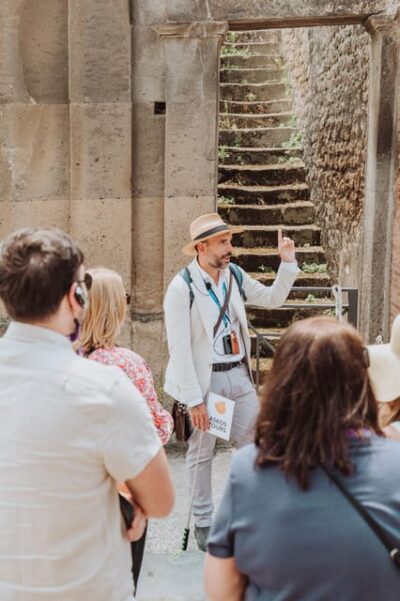
- What the archaeologist adds
- Is $77.09 good value?
- Who should book this tour?
- FAQ
- How long does the Pompeii and Herculaneum tour last?
- Is transportation included?
- Is the return trip to Pompeii included?
- Are admission tickets included?
- Is lunch included?
- What is the maximum group size?
- Should you book it?
Key points to know before booking
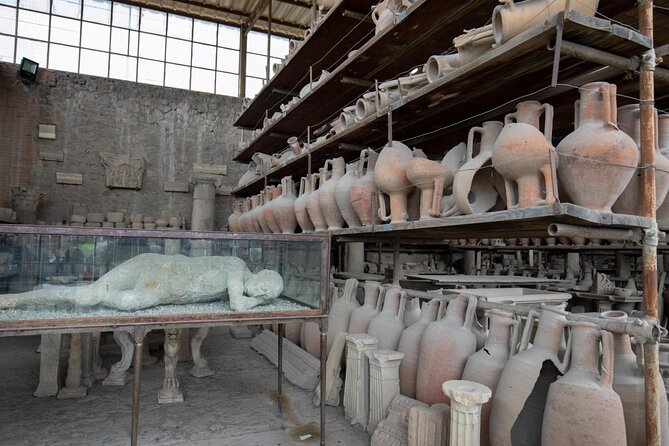
- Two ancient cities in one day: See Pompeii’s Forum, baths, theaters, villas, brothel, and plaster casts, then compare them with Herculaneum’s homes, wooden features, and public buildings.
- An archaeologist leads both visits: Guides such as Michele, Diego, Michael, Paulo, Antonio, Alfredo, and Amadeo are praised for turning architecture and daily life into an understandable story.
- Transport depends on your starting point: Naples, Sorrento, and Rome options use a modern minibus, while the Pompeii option includes a Circumvesuviana train ride to Herculaneum.
- Pompeii gets only about two hours: You will see major highlights, but you will not cover the entire archaeological park at a leisurely pace.
- Herculaneum is smaller and more concentrated: Its preserved houses, carbonized wood, frescoes, and public buildings make it a strong partner to Pompeii rather than an afterthought.
- The price covers major costs: At $77.09 per person, the package includes both entry tickets, guiding, headsets, and selected transport, but not lunch or drinks.
Why seeing both ruins together works
Pompeii and Herculaneum were both struck by the eruption of Mount Vesuvius in AD 79, but they tell different stories. Pompeii spreads across a large urban area, with broad streets, a Forum, theaters, baths, shops, and grand private houses. It gives you a sense of a whole Roman town.
Herculaneum is smaller, yet many details are preserved with unusual clarity. You may see carbonized wooden doors, beams, partitions, and other household fittings that make the past feel close at hand. The contrast is the point. Pompeii helps you understand the city; Herculaneum helps you notice the home.
I would not treat Herculaneum as a quick bonus stop. The House of the Deer, House of the Black Salon, Samnite House, and House of the Wooden Partition offer a close look at domestic life. Seeing both sites also helps you understand why Pompeii deserves more time on a separate visit.
More Pompeii and Vesuvius trips:
- Pompeii: Entry Ticket and Guided Tour with an Archaeologist
★ 4.8 · 19,459 reviews - Pompeii: Entry Ticket with Optional Audio Guide
★ 4.2 · 12,360 reviews - Pompeii: Small Group Tour with an Archaeologist
★ 4.8 · 12,264 reviews
Meeting points and the day’s transport
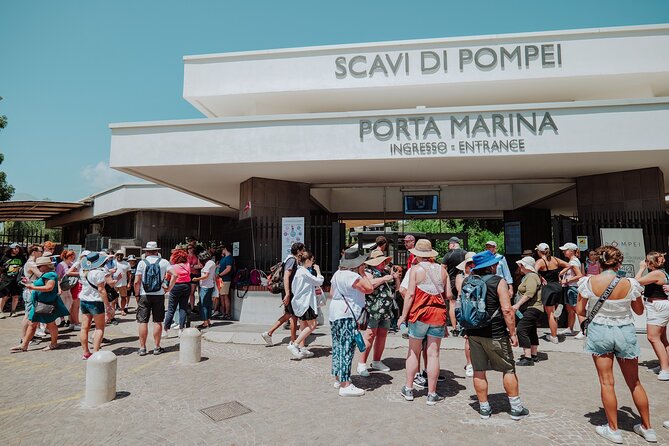
You choose the starting point when booking. The Pompeii meeting point is at Porta Marina Superiore. The Naples departure point is outside Starhotels Terminus, the Sorrento meeting point is Piazza Angelina Lauro, and the Rome option begins with train tickets to Naples followed by full-day transport.
From Naples, Sorrento, and Rome, the tour uses a modern minibus. This is the simplest arrangement because you avoid working out the transfer between the two archaeological parks yourself. The vehicle also gives the day a more organized rhythm, especially after a long morning on foot.
The Pompeii option works differently. Your guide accompanies you on the Circumvesuviana train to Herculaneum, with the one-way ticket included. The ride takes about 30 minutes, followed by a walk of roughly 10 minutes to the ruins. One practical warning: the return journey to Pompeii is not included in that option. If you leave a car at Pompeii, you need to arrange your own way back.
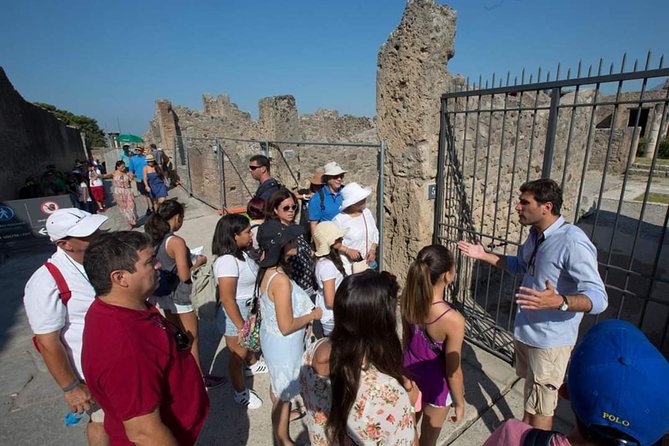
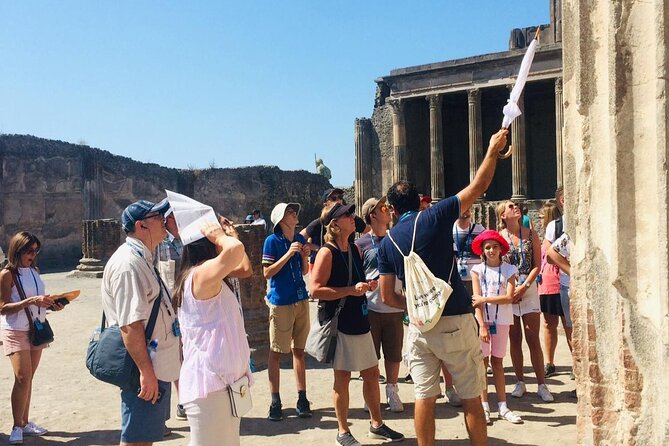
The group can include up to 20 people. That is small enough for a personal feel, though the experience depends on staying close enough to your guide for the headset to work. One person found the guide’s pace too fast and lost the audio connection several times. Stay near the guide, especially in crowded streets or at busy intersections.
Pompeii’s public heart: Basilica, Forum, and main streets
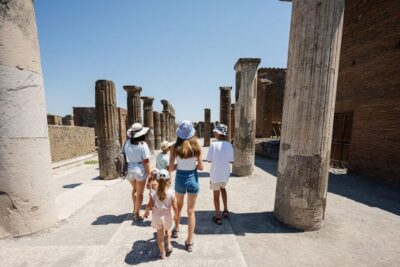
The visit begins with the Basilica, an open portico once used for business and public activity. It is a useful first stop because it introduces Pompeii as a working city, not merely a collection of abandoned houses.
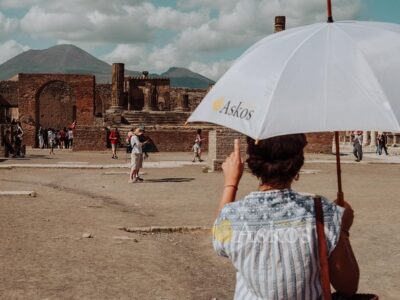
From there, you reach the Forum, the city’s main square. This was the center for civic, religious, and commercial life. Your guide can help you read the remaining columns, platforms, and open spaces, which otherwise may seem like a jumble of stone.
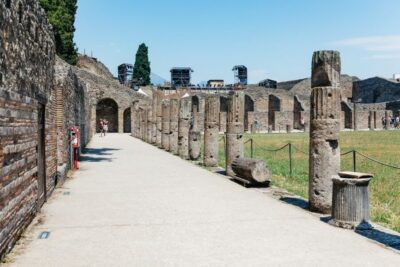
The tour then follows one of Pompeii’s main streets. Look down as you walk. The roadway, sidewalks, and raised stepping stones show how people moved through the city. The street is also where the scale of Pompeii becomes clear. Two hours passes quickly once you begin stopping for explanations and photographs.
This opening section is strong for first-time visitors because it gives you a map in your head. The drawback is that the tour cannot pause at every building. If you want to study inscriptions, side streets, or smaller shops, you will need another visit.
Pompeii’s houses reveal private Roman life
The House of Menander is one of the city’s grander residences, with fine decoration, large rooms, and an impressive layout. It gives you a sense of how wealthy families displayed status through architecture and art.
The House of the Faun takes that idea even further. It was one of Pompeii’s largest private homes, and its scale helps explain the gap between ordinary household life and elite Roman living. This is one of the stops where a guide adds real value, since the plan of a Roman house is not always obvious when walls and roofs are missing.
The granaries beside the Forum offer a more somber experience. You can see marble tables and stone features once used for fountains, along with plaster casts connected to victims of the eruption. A cast of a dog and another of a tree are among the details that bring the disaster down to human and animal scale.
You may not see every plaster cast in the park. One itinerary included only a single mold, while the group spent more time with wall paintings, tile work, and other buildings. That is worth knowing if the casts are your main reason for booking.
A few more Pompeii bookings to compare
- Pompeii Small Group Tour with an Archaeologist
★ 5.0 · 6,593 reviews - Pompeii: Skip-the-Line Entrance Ticket with Audio Guide
★ 4.0 · 2,509 reviews - Naples: Pompeii and Mt. Vesuvius with Lunch and Wine Tasting
★ 4.5 · 2,454 reviews - Pompeii: Archaeological Park Tour with Ticket on request
★ 4.5 · 2,283 reviews
Baths, brothel, and theaters
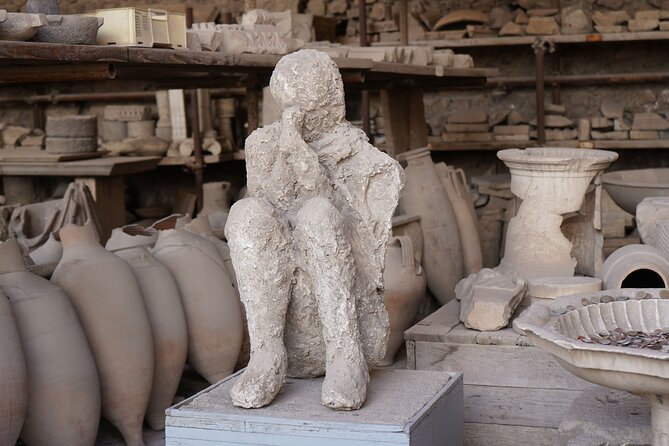
The Stabian Baths are among Pompeii’s oldest thermal complexes. Their rooms help explain how public bathing worked, including the separate spaces used by men and women. The complex occupies a large area near several important streets, so your guide can connect the baths to the wider city plan.
The Lupanar is Pompeii’s most famous brothel. It is a small, direct stop, but the paintings and room arrangement prompt useful discussion about sex work, commerce, and daily life in the ancient city. This is not a place to rush through with children without explaining what they are seeing.
The Odeon, or Teatro Piccolo, was a smaller theater suited to performances that required a more intimate setting. The Teatro Grande was Pompeii’s main theater and gives you a better sense of public entertainment and crowd movement. These two stops work well together because you can compare their size and purpose.
The Pompeii portion is packed. The listed stops allow roughly 10 to 15 minutes each, but walking between them and listening to the guide takes much of the available time. I see this as a highlight tour, not a full archaeological study. You will cover the major sights, but you will not have time to wander freely through every neighborhood.
The lunch break: useful, but not atmospheric
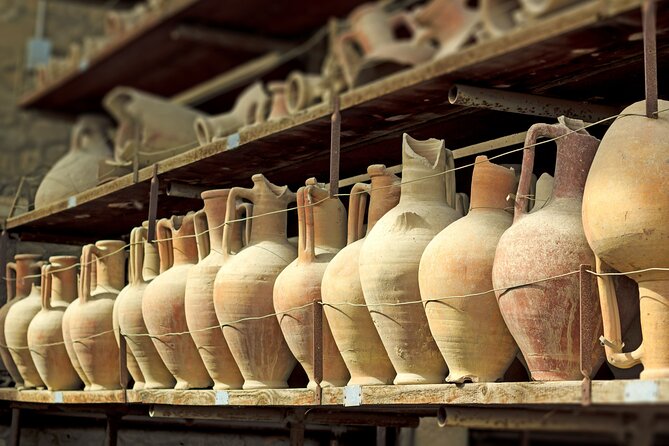
There is a short lunch break before the transfer to Herculaneum, and food is not included. The stop may be at a shopping center, chosen to avoid the tourist traps around the Pompeii entrance. It offers several food choices, including familiar pizza options, but it does not provide the old-town atmosphere many people imagine for a day among Roman ruins.
I would bring a snack, especially if you are starting early or want to eat quickly. The schedule is already tight, and a long sit-down lunch could make the afternoon feel even more rushed. You can also use the break to refill water and prepare for more walking.
Herculaneum’s preserved houses and public buildings
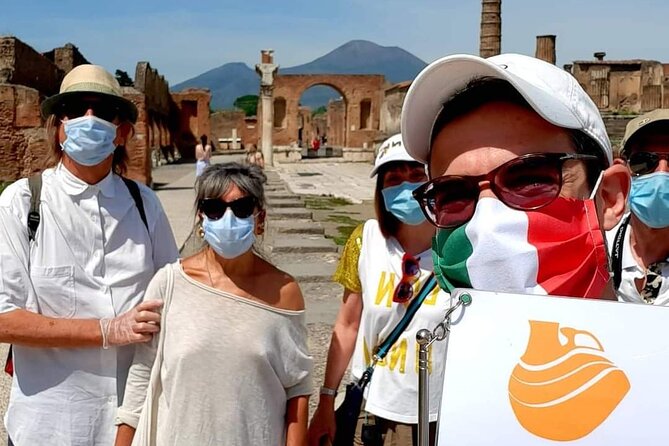
After lunch, the group travels to Herculaneum. The guide leads you to the entrance, and admission is included. The guided visit lasts about two hours, with stops across the archaeological area.
The House of the Deer takes its name from marble statues of stags found in its peristyle. It offers a look at an elegant private residence and the decorative objects used to signal wealth.
At the Terrace of Marcus Nonius Balbus, you learn about one of the city’s leading benefactors. Balbus restored and built public structures, and the honors connected with his death are recorded on his funeral altar. This stop adds a civic and personal side to Herculaneum’s story.
The College of the Augustales is linked to the cult of Emperor Augustus and may also have served as a local administrative center. It helps you see how religion, public honor, and local government overlapped in Roman towns.
The House of the Telephus Relief is unusual because it had private access to the adjoining Suburban Baths. That small design detail is exactly the kind of thing you might miss without a guide. It shows how a prosperous owner could connect a home to public or semi-private bathing facilities.
Wood, skeletons, and luxurious rooms
The House of the Wooden Partition contains one of Herculaneum’s most memorable features: an elegant carbonized wooden divider that survived the eruption. At Pompeii, you often focus on walls, mosaics, and streets. Here, preserved wood makes the rooms feel far more complete.
The House of the Skeleton takes its name from human remains found in an upper room in 1831. It was probably formed by joining three smaller buildings. The stop is brief but important, since it shows how archaeologists build an interpretation from physical evidence.
The Central Baths were built around the beginning of the first century AD and were divided into men’s and women’s sections, each with a separate entrance. As at Pompeii, the baths reveal the practical side of Roman urban life: heating, hygiene, social time, and carefully designed public facilities.
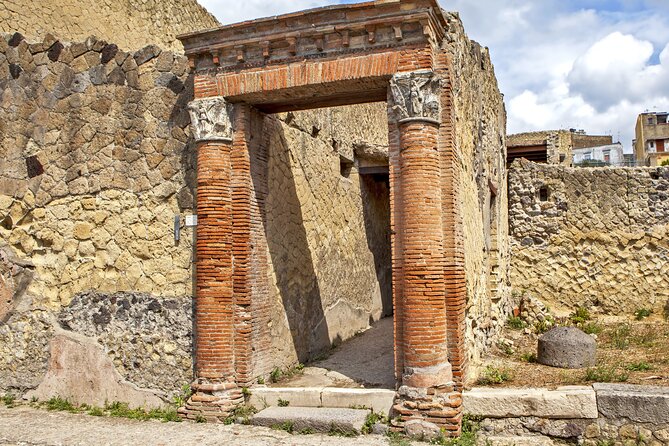
The House of the Black Salon is one of Herculaneum’s more luxurious mansions. Its monumental entrance still preserves carbonized doorposts and a lintel, a rare and striking reminder that these were once functioning homes with doors, rooms, furniture, and private routines.
Casa Sannitica has an atrium surrounded by a gallery with Ionic columns. Its frescoed rooms and distinctive arrangement reflect an older Samnite design tradition. The House of the Beautiful Courtyard is different again, using a courtyard with a stairway and stone balcony instead of the standard atrium.
The House of the Grand Portal completes the route with columns, frescoes, and charred wooden remains. By this point, the contrast with Pompeii should be clear. Herculaneum is not simply smaller. Its preserved details change the way you imagine Roman interiors.
What the archaeologist adds
The strongest part of this experience is the guiding. Several guides, including Michele, Diego, Michael, Paulo, Antonio, Alfredo, Tomas, Amadeo, Vince, and Gianni, are praised for clear explanations, humor, patience, and enthusiasm.
The best guides do more than point at buildings. They explain how a house was arranged, why a bath complex mattered, how city streets functioned, and what small features reveal about class and daily routines. One guide had worked at Pompeii, while another brought a history-teacher’s eye to the ancient world. That kind of background can make plain walls and broken columns much easier to understand.
Headsets are supplied for everyone. They are especially useful when the group spreads out or when other tour groups are nearby. Still, keep within range. At least one account described the guide moving too fast and the audio cutting out.
The tour’s 4.8 rating from 1,350 reviews and 95 percent recommendation rate reflect a consistently strong experience, but they should not hide the pace issue. The tour is at its best when you want context and a clear route. It is less suitable if you prefer to sit quietly in one house, sketch details, or explore without a schedule.
Is $77.09 good value?
At $77.09 per person, the price includes entry to both parks, the guided service at both sites, headsets, and transport based on your departure point. Adult admission alone is listed as 20 euros for Pompeii and 16 euros for Herculaneum, before adding transport and a guide.
That makes the price reasonable if you are coming from Naples, Sorrento, or Rome and want the day handled for you. The Rome option is especially service-heavy because it includes train tickets to Naples plus full-day transport. From Pompeii, the value is still good if you want an archaeologist to organize the Herculaneum transfer and explain the sites.
Lunch, drinks, and personal expenses are extra. You are paying for access, transport, and interpretation, not a food experience or unlimited time inside the parks.
Who should book this tour?
I would choose this tour if you have one day, want to see both sites, and prefer a guide to lead you through the major buildings. It suits history fans, first-time visitors, and anyone who would rather not decode a large archaeological park with a map.
It is also a good choice if you are staying in Naples, Sorrento, or Rome and want transport arranged. The minibus removes much of the day’s friction.
I would think twice if Pompeii is your central goal and you want to explore at your own pace. Two hours is enough for the headline sights, but not enough for a relaxed visit. Consider booking this tour for orientation, then returning to Pompeii another day for a longer look.
Free cancellation is available up to 24 hours before the start time. Most people can participate, but the experience is not recommended for people with visual impairments unless they have a dedicated personal assistant.
FAQ
How long does the Pompeii and Herculaneum tour last?
The full experience lasts approximately six to 11 hours, depending on the departure option. The guided visit is about two hours at Pompeii and about two hours at Herculaneum, with transport and a short lunch break between them.
Is transportation included?
Yes, but the transport depends on where you begin. Naples, Sorrento, and Rome options include minibus transportation. The Pompeii option includes a one-way Circumvesuviana train ticket to Herculaneum with the guide.
Is the return trip to Pompeii included?
No. The Pompeii departure option concludes at the Herculaneum ruins, so you must arrange your own return to Pompeii.
Are admission tickets included?
Yes. Entry to Pompeii and Herculaneum is included in the tour price. The listed adult admission prices are 20 euros for Pompeii and 16 euros for Herculaneum.
Is lunch included?
No. Lunch and drinks are not included. A short lunch break is provided before the transfer to Herculaneum, and you pay for your own food.
What is the maximum group size?
The tour can have a maximum of 20 participants. Headsets are provided so you can hear the archaeologist guide during the visits.
Should you book it?
Book this tour if you want the major sights, a strong historical explanation, and an organized way to connect Pompeii with Herculaneum in one day. The guides are the main reason to choose it, and the included tickets and transport make the cost fair.
Just keep your expectations clear: this is a focused highlight tour, not a slow day among ruins. Stay close to the guide, bring a snack, and save extra time for a return visit to Pompeii if the ancient city gets under your skin.
Recently added around Pompeii
- From Pompeii: Bus Transfer to Vesuvius with Park Entry Fee★ 4.2 · 700 reviews
- Pompeii Skip-the-line Tour with Archaeologist Guide★ 5.0 · 559 reviews
- Skip the Line Guided Tour of Pompeii led by an Archaeologist★ 5.0 · 703 reviews
- Visit in Pompeii – Pompeii Private Tour with Ada★ 5.0 · 436 reviews
- Ancient Pompeii Private Tour: Skip the Line & Kid-Friendly Option★ 5.0 · 167 reviews
- Pompeii Private Tour with an Archaeologist and Skip The Line★ 5.0 · 391 reviews
- Private Day Tour to Vesuvius, Herculaneum & Pompeii with Pick Up★ 5.0 · 279 reviews
- Pompeii Private Tour with an Archaeologist and Skip The Line – 3 hours★ 5.0 · 564 reviews
Pompeii & Vesuvius Tours, compared.
Entry Ticket and Guided Tour with an Archaeologist
Read our review →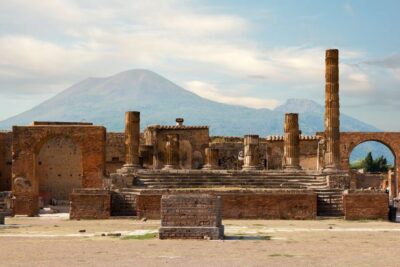

Pompeii Small Group Tour with an Archaeologist
Read our review →
Pompeii, Amalfi Coast and Positano Day Trip from Rome
Read our review →Browse the lists this tour appears in