
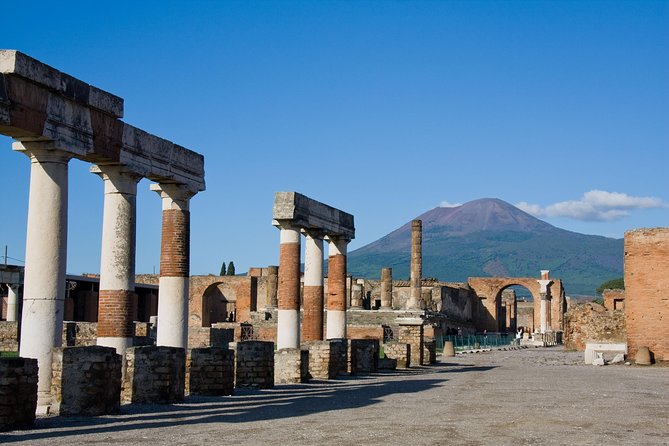
Reviewed · POMPEII & VESUVIUS TOURS
Pompeii 2h Small-Group Tour with Expert Archaeologist
Pompeii rewards a good guide. This two-hour walking tour gives you a brisk route through the city’s major sights, from the grand theaters and Stabian Baths to the House of the Faun and the Forum. I like the way it solves Pompeii’s biggest problem: the site is huge, and it is easy to wander past important buildings without understanding what you are seeing.
I especially like the manageable length and the chance to hear lively explanations from guides such as Luca, Manuela, Roberta, Patrizia, and Barbara. Families also get a useful dose of structure, and several guides have adjusted the pace for children, older relatives, heat, or sudden bad weather. The main drawback is that two hours can only introduce Pompeii, not fully explore it, and the quality of the archaeological detail may depend on the individual guide.
In This Review
- The Pompeii highlights worth your two hours
- Why a two-hour Pompeii tour makes sense
- Meeting at Piazza Esedra
- First stop: Pompeii Archaeological Park
- The Odeon and Teatro Grande
- House of Menander and Roman domestic life
- Stabian Baths and the Lupanar
- Via dell’Abbondanza and the House of the Faun
- The Forum and Basilica
- Guide quality matters more than the title
- Is $32.67 good value?
- Who should book this Pompeii walk?
- Practical advice before you go
- Should you book it?
- FAQ
- How long does the Pompeii tour last?
- Where does the tour meet?
- Where does the tour end?
- Is the tour offered in English?
- How many people can join the tour?
- Is the Pompeii entrance ticket included?
- Is the tour suitable for children?
- Can I cancel for a full refund?
The Pompeii highlights worth your two hours
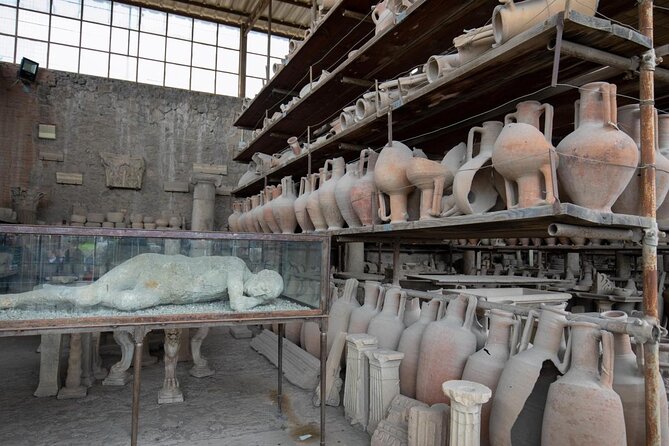
- A brisk route through nine major sights: See the Odeon, Teatro Grande, House of Menander, Stabian Baths, Lupanar, House of the Faun, Forum, and Basilica.
- A practical choice for a first visit: Your guide helps you find important buildings that are easy to miss when you walk alone.
- Small-group pricing with a private upgrade: The standard tour can include up to 30 people, while a private option is available for a more personal visit.
- Family-friendly in the right hands: Guides including Manuela, Patrizia, and Roberta have kept children involved and adapted to family needs.
- A moderate walking pace: Expect uneven ancient streets, standing, and outdoor exposure. Older visitors may appreciate the pauses and shade used by several guides.
- A convenient starting point: Meet at Ristorante Suisse on Piazza Esedra, close to public transportation and about a five-minute walk from the train station according to one practical tip.
Why a two-hour Pompeii tour makes sense
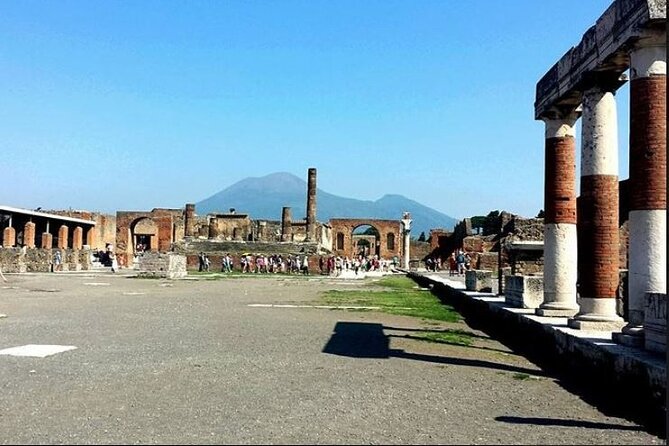
Pompeii is not a compact monument. It is an ancient city with streets, homes, public buildings, shops, theaters, baths, and religious and civic spaces spread across a large archaeological park. You can spend hours here and still leave with entire sections unseen.
That makes this tour useful for a first look. In two hours, you get a guided path through some of the city’s most recognizable places instead of spending your visit studying a map and wondering which turn leads to the best houses.
The route also gives you a basic picture of Roman city life. You move from entertainment spaces to private homes, from public bathing facilities to commercial streets, and finally to the civic center. I like that progression because Pompeii becomes more than a collection of old walls.
The tradeoff is pace. You are likely to stop, listen, take photographs, and move on before you have examined every fresco or room. If you want a slow archaeological study, this is a starting point rather than a complete day at Pompeii.
More Pompeii and Vesuvius trips:
- Pompeii: Entry Ticket and Guided Tour with an Archaeologist
★ 4.8 · 19,459 reviews - Pompeii: Entry Ticket with Optional Audio Guide
★ 4.2 · 12,360 reviews - Pompeii: Small Group Tour with an Archaeologist
★ 4.8 · 12,264 reviews
Meeting at Piazza Esedra
The tour begins at Ristorante Suisse, Piazza Esedra 10/13 in Pompei. That location is useful because it is near public transportation, and the train station is reportedly about a five-minute walk away.
You should allow time to find the exact meeting point and arrive ready to walk. The tour ends back at the meeting point, which keeps the plan simple if you are continuing by train or arranging another activity in Pompeii.
The tour is offered in English and uses a mobile ticket. Confirmation arrives when you book. Since the minimum is six people, the operator can cancel after confirmation if that number is not reached, offering another option or a full refund.
First stop: Pompeii Archaeological Park
The opening visit introduces Pompeii as a city preserved by the eruption of Mount Vesuvius in AD 79. This first segment is short, around ten minutes, so think of it as an orientation rather than a full stop.
Your guide sets up the story of the city and points you toward the famous frescoes and main areas ahead. That context matters. Without it, Pompeii can look like a maze of stone streets and roofless rooms. With it, you begin to understand how the parts fit together.
Because this is an outdoor archaeological site, conditions matter. One guide kept the group in shaded areas during intense heat, while another found covered places during hail and heavy rain. Those small choices can make a major difference, especially if you are visiting with children or an older family member.
The Odeon and Teatro Grande
The Odeon, or Teatro Piccolo, is the smaller theater. You spend about ten minutes here, enough to see its scale and learn how it differed from the much larger Teatro Grande.
The Teatro Grande receives roughly fifteen minutes. It was Pompeii’s main theater and gives you a clear sense of the city’s public entertainment culture. A guide can help you read the structure as a working venue rather than simply a photogenic semicircle of ancient stone.
The two theaters work well together because the contrast is immediate. You see that Pompeii had different spaces for different audiences and performances. If your guide explains the layout well, these stops become some of the easiest places for children to picture people gathering, watching, and reacting to a show.
The limit is that the stops are tightly timed. You may not have much opportunity to linger or ask long questions before the group moves on.
A few more Pompeii bookings to compare
- Pompeii Small Group Tour with an Archaeologist
★ 5.0 · 6,593 reviews - Pompeii: Skip-the-Line Entrance Ticket with Audio Guide
★ 4.0 · 2,509 reviews - Naples: Pompeii and Mt. Vesuvius with Lunch and Wine Tasting
★ 4.5 · 2,454 reviews - Pompeii: Archaeological Park Tour with Ticket on request
★ 4.5 · 2,283 reviews
House of Menander and Roman domestic life
The House of Menander takes about fifteen minutes and is one of Pompeii’s most important homes. It is described as one of the city’s most impressive residences in its architecture, decoration, and contents.
This is where the tour shifts from public life to private life. I value stops like this because a house can reveal more about daily routines, status, design, and decoration than a large public building. The name also helps you remember the site, which is useful when Pompeii begins to blur into a series of similar courtyards and walls.
A strong guide will help you focus on what makes this house different from an ordinary residence. You may find the explanation more useful than simply walking through room after room on your own.
Stabian Baths and the Lupanar
The Stabian Baths receive about fifteen minutes. They occupy a broad area between the Brothel Lane, the Holconius crossroads, and Via Stabiana, and they are considered the oldest thermal complex in Pompeii.
This is one of the best places to understand bathing as a major part of Roman public life. The baths were not merely about washing. They were social and civic spaces, and their size shows how important they were to the city.
The Lupanar follows for around ten minutes. It is Pompeii’s most famous brothel, and its small rooms and painted material make it one of the site’s most talked-about stops. It can be an awkward visit with young children, so families should decide in advance how they want to handle it.
The Lupanar also draws crowds. Your guide’s timing and ability to move the group through busy areas can affect how much you see and hear. One of the tour’s practical strengths is that experienced guides may know how to work around crowded spots, but that benefit will vary by guide and conditions.
Via dell’Abbondanza and the House of the Faun
Via dell’Abbondanza is the main street linking several important parts of Pompeii. It gives you a chance to see the city at street level, where ancient movement, commerce, and everyday routines took place.
The stones can be uneven, so wear sensible shoes and watch your footing. This is not a smooth museum floor. The route requires a moderate level of physical fitness, with walking and standing on old surfaces under the sun.
The House of the Faun takes around ten minutes. It was one of the largest and most impressive private residences in Pompeii. Its size helps you see the gap between an ordinary home and an elite Roman residence.
This stop is especially valuable after the House of Menander. You can compare two private spaces and see how wealth shaped the design of a home. The short time, however, means you will get the key points rather than a room-by-room examination.
The Forum and Basilica
The Foro de Pompeya, or ancient Forum, receives about fifteen minutes. This was the city’s main square, the civic heart where public activity and important buildings came together.
The Forum is one of the places where a guide earns the admission price. On your own, you can see columns and open space, but it is harder to understand the relationships between the square, religious buildings, political functions, and commerce without some explanation.
The Basilica also receives about fifteen minutes. It was an open portico that sheltered merchants and other activities. Its location and structure help complete the picture of Pompeii as a functioning city with spaces for business, public life, and administration.
Ending at the Forum and Basilica gives the route a sensible finish. You begin with an overview and end in the center of civic Pompeii. Afterward, you can return to the meeting point or, if the site rules and your schedule permit, continue exploring on your own. The tour itself ends back at the meeting point.
Guide quality matters more than the title
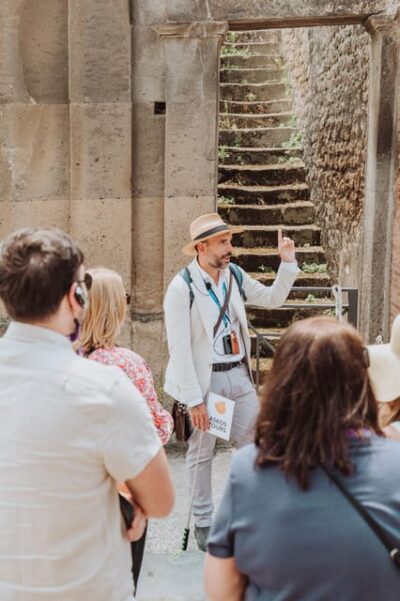
The experience appears to depend heavily on who leads your group. The strongest guide accounts describe Luca’s storytelling, Roberta’s command of archaeology and crowd movement, and Manuela’s ability to keep both adults and children interested.
Patrizia has been especially good with families, while Barbara has been praised for offering choices, taking breaks, answering questions, and seeking shade. One guide named Enzo also handled a larger group well, though the headsets caused hearing trouble for at least one person.
That last point is important. The tour may be described as small-group, but the maximum is 30 people, and groups can occasionally be combined. One booking that expected a small group became a group of about 20 using audio headsets. If hearing clear commentary is essential to you, ask about the expected group size before you commit, and consider the private upgrade if available.
Most of the guide feedback is highly favorable, with a listed rating of 5 from 385 reviews and recommendation from 99 percent of customers. Still, one poor experience raised a real concern: a guide did not make the material engaging for young children and made an inappropriate joke about their presence. That appears to be an exception, but it is a useful reminder that family-friendly depends on the person leading the walk.
There was also some doubt from one participant about whether a guide provided the archaeological depth promised by the tour name. The lesson is simple: expect a useful introduction, but do not assume every guide will offer the same academic detail.
Is $32.67 good value?
At $32.67 per person, the tour is reasonably priced for a guided introduction to a site this large. Your payment covers the guided experience and the itinerary lists admission as included, so you are paying for direction, explanation, and time management rather than simply a ticket.
The value is strongest if this is your first visit, you have only a morning or afternoon, or you are traveling with children who need a clear route. A guide can help you see major sights quickly and place them in context.
The value is weaker if you prefer a quiet, independent visit or want to spend a long time at individual houses and frescoes. Pompeii’s signs are available in English and Italian, and a self-guided audio tour can be purchased in several languages. If you enjoy setting your own pace, independent entry may suit you better.
Admission rules also affect the calculation. The Pompeii entrance ticket is free on the first Sunday of each month, and it is free for people under 18 who show a valid identity document or passport on the day of the tour. Since the tour price and admission arrangements may interact with those rules, check the booking details carefully before paying.
Who should book this Pompeii walk?
I would choose this tour for a first-time visitor who wants the main sights without spending an entire day inside the archaeological park. It also fits a family that prefers a planned route, especially if the children can handle outdoor walking and some adult-focused history.
It can work well for older relatives too. The two-hour length is manageable, and several guides have adjusted the pace, paused when needed, and used shade during hot weather. You still need moderate physical fitness, since Pompeii involves uneven streets and plenty of standing.
I would think twice if you have already visited Pompeii or want specialist-level archaeology. Two hours leaves little room for side buildings, long questions, or repeated looks at the frescoes. The private upgrade may be worth considering if you want more control over the pace and conversation.
Practical advice before you go
Wear comfortable shoes with good support. Pompeii’s ancient paving is uneven, and even a short tour can feel tiring in hot weather.
Bring water and prepare for sun. Shade is not guaranteed, though guides may stop in shaded or covered places when conditions are difficult.
If you are visiting with children, explain that the tour includes houses, theaters, baths, and the Lupanar. The route is marketed as family-friendly, and many guides have done well with children, but the subject matter and style may not suit every child.
Arrive at Ristorante Suisse on Piazza Esedra with enough time to identify the meeting point. If a train delay threatens your arrival, contact the operator as soon as possible. One guide successfully helped a delayed family join a later time, but you should not assume every late arrival can be accommodated.
Free cancellation is available up to 24 hours before the start time. Changes or cancellations inside that window are not refunded, and the local time controls the cutoff.
Should you book it?
Book this Pompeii tour if you want a short, organized introduction and would rather hear the story than decode the ruins alone. The price is fair, the route covers the essential sights, and the best guides bring the city to life with warmth, humor, and clear storytelling.
Choose the private option if group size or hearing is a concern. Choose independent entry if you want to linger, avoid a fixed pace, or study Pompeii in greater depth. For most first-time visitors with limited time, though, this is a sensible way to meet Pompeii without getting lost in its enormous ancient streets.
FAQ
How long does the Pompeii tour last?
The tour lasts approximately two hours.
Where does the tour meet?
The meeting point is Ristorante Suisse at Piazza Esedra 10/13, 80045 Pompei, Italy.
Where does the tour end?
The activity ends back at the meeting point.
Is the tour offered in English?
Yes. The tour is offered in English.
How many people can join the tour?
The maximum group size is 30 people. A minimum of six people is required for the tour to operate.
Is the Pompeii entrance ticket included?
The itinerary states that admission tickets are included. Pompeii also offers free entry on the first Sunday of each month and for people under 18 who show a valid identity document or passport.
Is the tour suitable for children?
Yes, the experience is described as family-friendly. Several guides have successfully adapted the tour for children, though the experience can depend on the individual guide.
Can I cancel for a full refund?
Yes. You can cancel at least 24 hours before the experience start time for a full refund. Cancellations or changes made less than 24 hours before the start time are not refunded or accepted.
Recently added around Pompeii
- From Pompeii: Bus Transfer to Vesuvius with Park Entry Fee★ 4.2 · 700 reviews
- Skip the Line Guided Tour of Pompeii led by an Archaeologist★ 5.0 · 703 reviews
- Visit in Pompeii – Pompeii Private Tour with Ada★ 5.0 · 436 reviews
- Pompeii Skip-the-line Tour with Archaeologist Guide★ 5.0 · 559 reviews
- Ancient Pompeii Private Tour: Skip the Line & Kid-Friendly Option★ 5.0 · 167 reviews
- Pompeii Private Tour with an Archaeologist and Skip The Line★ 5.0 · 391 reviews
- Private Day Tour to Vesuvius, Herculaneum & Pompeii with Pick Up★ 5.0 · 279 reviews
- Pompeii Private Tour with an Archaeologist and Skip The Line – 3 hours★ 5.0 · 564 reviews
Pompeii & Vesuvius Tours, compared.
Entry Ticket and Guided Tour with an Archaeologist
Read our review →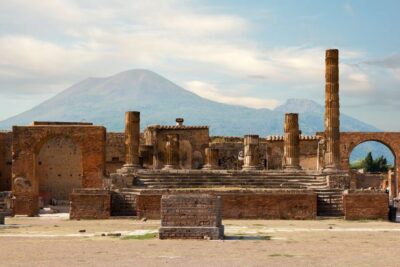

Pompeii Small Group Tour with an Archaeologist
Read our review →
Pompeii, Amalfi Coast and Positano Day Trip from Rome
Read our review →Browse the lists this tour appears in