
Reviewed · POMPEII & VESUVIUS TOURS
Pompeii 2-hour Private Tour with an Archaeologist-Ticket included
Pompeii rewards a slower look. This private walking tour gives you two useful advantages: a personal archaeologist guide and a route through several of the city’s most important buildings, including the Forum, House of the Faun, Stabian Baths, and theaters. I also like that the guide can adjust the pace for your group rather than forcing you to keep up with a large crowd.
The main tradeoff is time. Two hours is enough for a strong introduction, but Pompeii is enormous, and you will see only a small part of it. At $214.75 per person, the price makes the most sense for a small group that values detailed explanations and private attention. Solo visitors or couples may find it costly, while families and groups can get better value from the shared expertise.
In This Review
- Key points before you book
- Why a private guide changes Pompeii
- Meeting at Porta Marina Superiore
- The Basilica and Forum: Pompeii’s public center
- Granaries of the Forum and the casts
- House of Menander and Roman home life
- Stabian Baths: ancient leisure and engineering
- The Lupanar and the less polished side of Pompeii
- House of the Faun: Pompeii at its grandest
- Teatro Piccolo and Teatro Grande
- Is two hours enough for Pompeii?
- Price, group size, and practical value
- Who should book this Pompeii tour?
- Should you book it?
- FAQ
- How long is the Pompeii private tour?
- Where does the tour begin?
- How do I find the guide?
- Where does the tour end?
- Is admission to Pompeii included?
- Is this a private tour?
- What language is offered?
- Is transportation included?
- What should I wear?
- Can I cancel for a refund?
Key points before you book
- Meet at Porta Marina Superiore: Look for the guide holding an Askos Tours sign at the archaeological park entrance.
- A true private experience: Only your group participates, so you can ask questions, pause for photos, and request more attention to daily life, art, or architecture.
- Archaeologist-led context: Guides such as Alessandra, Silvia, Ivan, and Luca have been praised for explaining the site through their archaeological experience.
- A focused two-hour route: You see major public buildings, private homes, baths, the brothel, casts, and both large and small theaters.
- Tickets are included: You do not need to arrange a separate Pompeii admission ticket.
- Plan your own transport: Hotel pickup, drop-off, lunch, and transportation to and from the ruins are not included.
Why a private guide changes Pompeii
Pompeii can be confusing at first. You enter a large ancient city with streets, walls, columns, shops, houses, temples, and open spaces spread across a wide area. Without context, it is easy to admire the stones without understanding how the city worked.
A private archaeologist guide helps turn those remains into a place where people lived, traded, worshipped, bathed, watched theater, and ran businesses. You can ask why a building mattered, how a room was used, or what a particular decoration tells us about Roman society. That is far more useful than simply walking past a doorway with a name on a map.
The strongest praise for this tour centers on the guides. Amedeo has been singled out for his passion, while Alessandra impressed one group with her Ph.D. training and experience working on excavations at Pompeii. Silvia was especially attentive to an older family member and slowed down on rough or steep ground. Luca was praised for pointing out small details and helping the group picture how the city looked and felt before the eruption.
Those details matter. Pompeii is not a place where every important feature is large or obvious. A guide who notices a small architectural clue, a household decoration, or a practical feature of Roman life can give you a much clearer picture of the city.
More Pompeii and Vesuvius trips:
- Pompeii: Entry Ticket and Guided Tour with an Archaeologist
★ 4.8 · 19,459 reviews - Pompeii: Entry Ticket with Optional Audio Guide
★ 4.2 · 12,360 reviews - Pompeii: Small Group Tour with an Archaeologist
★ 4.8 · 12,264 reviews
Meeting at Porta Marina Superiore
The tour begins at the main entrance called Porta Marina Superiore, at Via Villa dei Misteri, 2, in Pompei. Your guide should be holding a sign with Askos Tours written at the top.
This meeting point is worth taking seriously. Pompeii has several entrances, and arriving at the wrong gate can waste a good part of a two-hour tour. The company has provided detailed directions and even a photo to help people find the meeting spot, which is useful if you are arriving by train or local transport.
Give yourself enough time to locate the entrance and the guide. The tour does not include transportation from your hotel, accommodation, or train station, so you are responsible for getting to the ruins.
The route ends at Piazza Esedra. You leave the guide at the archaeological site, but the guide can provide useful directions for reaching your accommodation or the nearest train station. That help is handy if you are unfamiliar with Pompeii’s entrances and surrounding streets.
The Basilica and Forum: Pompeii’s public center
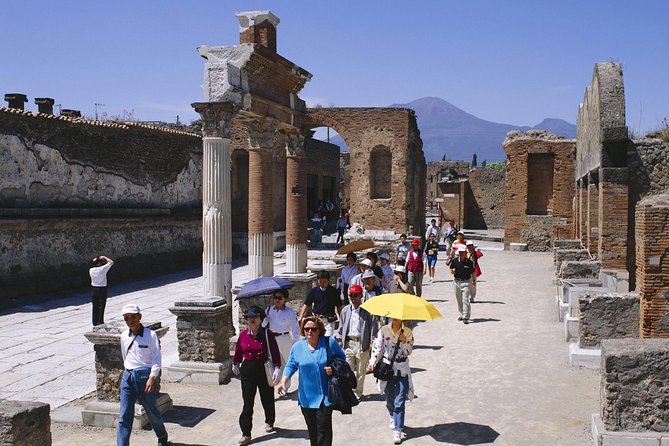
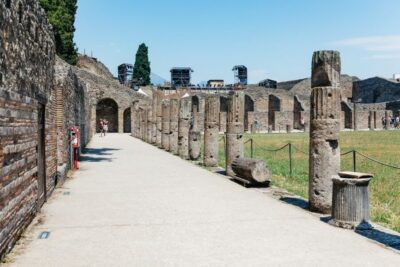
The first major stop is the Basilica, an open portico used for business, legal matters, and commercial activity. Its columns and broad layout give you an early sense of how public life operated in Pompeii.
I find this a good opening stop because it shifts your attention from ruins as objects to ruins as working spaces. Merchants and officials once used this area for practical matters, not sightseeing. A guide can help you read the structure and understand why its location mattered.
From there, you continue to the Forum, the ancient city’s main square. This was Pompeii’s public heart, surrounded by important civic and religious buildings. The open space can look deceptively simple, so the guide’s explanation is especially useful here.
The Forum also helps you understand the scale of Pompeii. You are not just visiting a collection of houses. You are standing in the center of a Roman town where politics, religion, commerce, and public announcements came together.
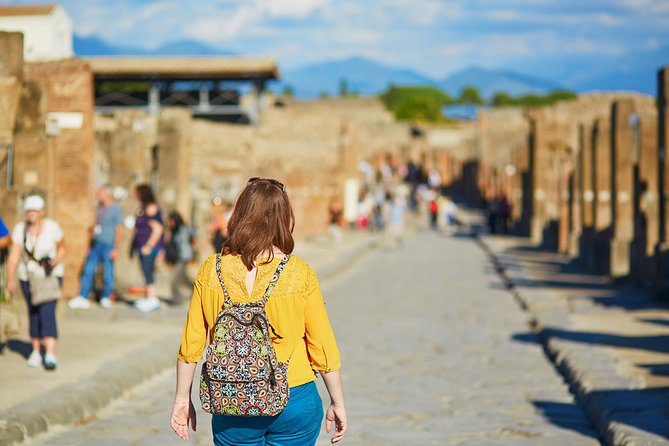
You then walk along one of the city’s main streets. Pompeii’s streets are one of its great strengths, because they show how people moved through the town and connected public spaces with private homes and businesses. The footing can be uneven, so comfortable shoes are essential.
Granaries of the Forum and the casts
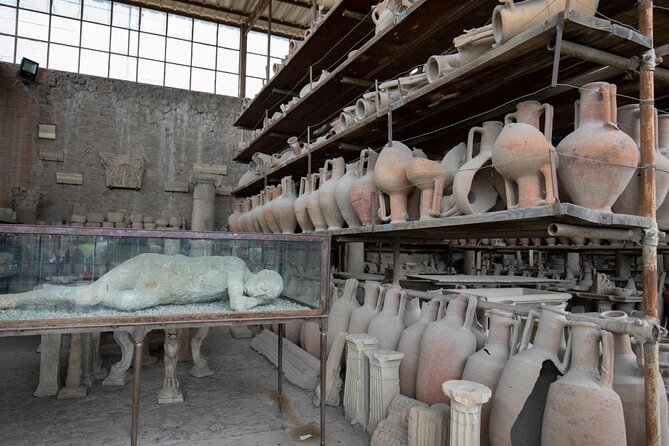
The granaries near the Forum offer an unusual mix of everyday objects and difficult evidence from the eruption. Here you may see marble tables and baths originally connected with fountains and entrances to houses. These pieces show the level of decoration and practical design used in Roman homes.
You can also see casts of victims, including a dog and a tree. These are among the most emotionally powerful objects in Pompeii. They remind you that this was a real disaster affecting ordinary people, animals, homes, and public life.
The guide’s role is important here. The casts can be treated as dramatic sights, but a good explanation keeps the focus on what they reveal and why they were made. The stop is brief, yet it can become one of the most memorable parts of the tour.
If you are visiting with children, prepare them for this section in advance. The family feedback about guides such as Raffaella suggests that children can stay engaged when the story is explained clearly, but the casts may still be unsettling for some young visitors.
A few more Pompeii bookings to compare
- Pompeii Small Group Tour with an Archaeologist
★ 5.0 · 6,593 reviews - Pompeii: Skip-the-Line Entrance Ticket with Audio Guide
★ 4.0 · 2,509 reviews - Naples: Pompeii and Mt. Vesuvius with Lunch and Wine Tasting
★ 4.5 · 2,454 reviews - Pompeii: Archaeological Park Tour with Ticket on request
★ 4.5 · 2,283 reviews
House of Menander and Roman home life
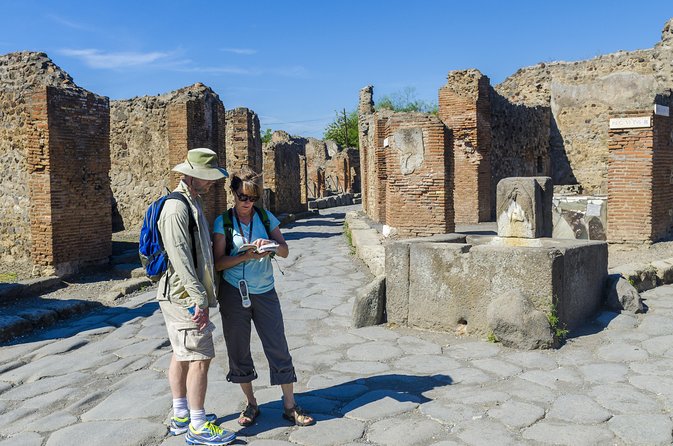
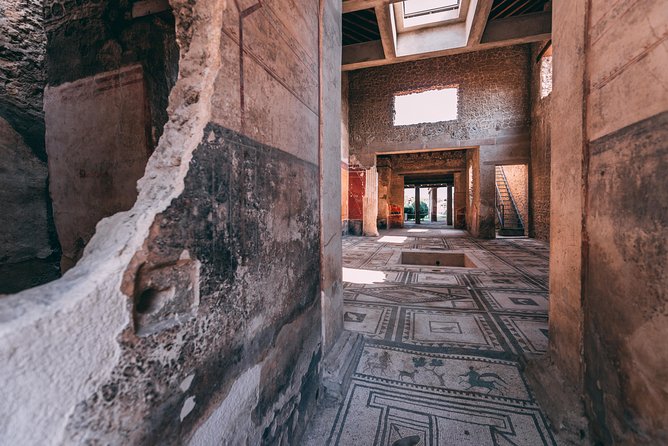
The House of Menander is one of Pompeii’s most lavish private residences. Its architecture, decoration, and contents give you a look at the lifestyle of a wealthy household.
This stop balances the public buildings nicely. After seeing the Forum and granaries, you can consider how private space worked for a prosperous family. The house is not simply a large residence. Its layout and decoration point to status, taste, family life, servants, and social display.
Pay attention to the difference between the grand areas and the practical parts of the home. A guide can help you see how the building functioned beyond its impressive appearance. If your interests lean toward art, domestic life, or social class, tell the guide early. The private format makes it easier to shape the explanation around what you care about.
One person on the tour found the guide especially patient with photo stops and interested in the surviving art and details of daily life. That is a useful advantage over a large group, where stopping for pictures can hold everyone up.
Stabian Baths: ancient leisure and engineering
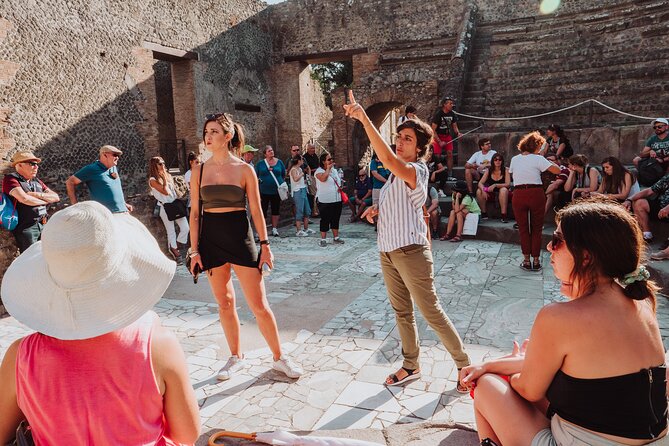
The Stabian Baths occupy a large area between the Brothel lane, the Holconius crossroads, and Via Stabiana. They are described as the oldest thermal complex in Pompeii.
The baths are valuable because they show how Romans combined hygiene, exercise, social time, and architecture. You can look at the layout and imagine a place built for repeated daily use, not a grand monument visited only on special occasions.
The size of the complex also makes clear that bathing was part of public life. A guide can point out how the spaces related to one another and explain the role of the baths within the wider city.
The rough streets and broad distances between sights are the practical challenge here. The tour requires moderate physical fitness, and you should expect to walk over uneven ground. If you have mobility concerns or an older family member in your group, tell the guide at the start. Silvia, for example, was praised for adjusting her pace on difficult sections.
The Lupanar and the less polished side of Pompeii
The Lupanar is Pompeii’s most famous brothel. Its small rooms and surviving decorations offer a direct look at one of the city’s more commercial and private institutions.
This stop can be amusing, awkward, or thought-provoking, depending on your group. The important point is that Pompeii was not only a city of temples, villas, and public squares. It was also a place where people worked, sold services, and lived ordinary, sometimes rough, lives.
The Lupanar is often crowded compared with less famous areas, so your private guide cannot control how many people are in the building. Still, having your own guide means you can ask questions without worrying about keeping a tour group moving.
Parents should decide if the subject is suitable for their children. The tour is not described as adults-only, but the brothel’s purpose is clear.
House of the Faun: Pompeii at its grandest
The House of the Faun was one of Pompeii’s largest and most impressive private residences. Its scale gives you a strong contrast with more modest homes and public buildings.
This is a good place to discuss wealth and social position. The house shows how a powerful family could use architecture, open spaces, decoration, and display to make an impression. Even if some original objects are no longer in place, the design still helps you understand the ambition of the residence.
The House of the Faun can also be a rewarding stop for anyone interested in ancient art. Ask your guide to point out details that are easy to miss from a casual walk. Luca’s style, praised for stopping to show small features, is exactly the kind of approach that suits a house like this.
You should not expect to see every room or every major building in Pompeii during this tour. The value lies in having selected highlights explained well, rather than racing through a much longer list with little context.
Teatro Piccolo and Teatro Grande
The route includes a look at the Teatro Piccolo, or small theater, followed by Teatro Grande, Pompeii’s most important theater.
The two theaters let you compare different kinds of performance spaces. The smaller theater gives you a more intimate setting, while Teatro Grande shows the scale and public importance of major performances in the city.
These stops add variety to the tour. You have already seen civic buildings, homes, baths, and a brothel. The theaters show another part of Pompeii’s social life, where entertainment brought people together.
The theater area also helps finish the tour on a broad note. Pompeii becomes easier to understand when you see how public administration, private wealth, personal services, religion, bathing, and entertainment fit into one urban system.
Is two hours enough for Pompeii?
Two hours is enough if you want a structured introduction to the major highlights. One guide described the time as sufficient because the explanations were focused and well organized. That is a fair assessment for a first visit, especially if you prefer depth over a rushed march across the entire site.
It is not enough to explore Pompeii fully. The archaeological park is large, and opening conditions can change which buildings are accessible. You should think of this tour as a guided foundation, not a complete survey.
The private format helps make the short duration work. You do not spend time waiting for a large group to assemble, and your guide can focus on your questions. A family can keep children involved, a couple can pause for photographs, and a returning visitor can ask for more detail about art or excavation.
If Pompeii is your main purpose in the area, you may want additional time at the site before or after the tour if permitted by your admission arrangements. The supplied details only confirm the guided experience itself, so check current site access rules when planning extra time.
Price, group size, and practical value
The listed cost is $214.75 per person. Tickets, professional archaeological guiding, assistance, and the private format are included. Lunch, hotel pickup and drop-off, and transportation to the ruins are not included.
That price is easier to justify for a family or small group than for one or two people. You are paying for personal attention, not just admission. The strongest value comes from the guide’s ability to explain details, answer questions, adjust walking speed, and connect buildings with daily life.
The tour receives a 4.9 out of 5 rating from 181 ratings, with 98 percent of customers recommending it. The praise is consistent around guide quality, clear directions, patience, and archaeological expertise. One family was especially pleased that Giovanni stayed patient when they were running late and did not make them feel rushed.
Still, a high rating does not remove the basic limitations. The tour is short, the terrain can be rough, and transportation is your responsibility. If you mainly want to wander alone and take photographs, the price may feel high. If you want Pompeii explained by someone who works with the site’s archaeology, it offers a much stronger reason to pay.
The tour operates in all weather. Wear comfortable shoes and dress for changing conditions. Service animals are allowed, and the site is near public transportation.
Who should book this Pompeii tour?
I would choose this tour if you are visiting Pompeii for the first time and want the major sights explained without joining a large group. It also suits families, since a guide can keep children engaged with stories and adjust the pace.
It is a particularly good match for anyone interested in Roman domestic life, architecture, art, or archaeology. Returning visitors may also enjoy it if they want a more focused look at daily life and surviving details.
I would think twice if you have only a passing interest in Pompeii, dislike walking on uneven ground, or are trying to keep costs very low. You may also feel rushed if you expect to see most of the archaeological park in two hours.
Should you book it?
Book this tour if you want expert explanation and private attention more than maximum sightseeing time. The route covers the Forum, public buildings, wealthy homes, baths, the Lupanar, casts, and theaters, giving you a useful picture of Pompeii’s public and private life.
The best reason to choose it is the guide quality. Names such as Alessandra, Silvia, Luca, Paolo, Diego, and Raffaella have been associated with clear explanations, archaeological experience, patience, and lively storytelling. Just arrive at Porta Marina Superiore on time, wear good shoes, and remember that the price does not include transport.
You can cancel for a full refund up to 24 hours before the start time. Changes or cancellations made less than 24 hours ahead are not accepted for a refund.
FAQ
How long is the Pompeii private tour?
The tour lasts approximately two hours.
Where does the tour begin?
The meeting point is Porta Marina Superiore, at Via Villa dei Misteri, 2, 80045 Pompei, Italy.
How do I find the guide?
The guide will hold a sign with Askos Tours written at the top.
Where does the tour end?
The tour ends at Piazza Esedra, where you leave the guide at the ruins.
Is admission to Pompeii included?
Yes. Admission fees to the archaeological park are included.
Is this a private tour?
Yes. Only your group participates in the activity.
What language is offered?
The tour is offered in English.
Is transportation included?
No. Transportation to and from the ruins, hotel pickup, and hotel drop-off are not included.
What should I wear?
Wear comfortable shoes and dress appropriately for the weather. The tour operates in all weather conditions.
Can I cancel for a refund?
Yes. You can cancel at least 24 hours before the start time for a full refund. Cancellations or changes made less than 24 hours before the start time are not accepted.
Recently added around Pompeii
- From Pompeii: Bus Transfer to Vesuvius with Park Entry Fee★ 4.2 · 700 reviews
- Pompeii Skip-the-line Tour with Archaeologist Guide★ 5.0 · 559 reviews
- Skip the Line Guided Tour of Pompeii led by an Archaeologist★ 5.0 · 703 reviews
- Visit in Pompeii – Pompeii Private Tour with Ada★ 5.0 · 436 reviews
- Ancient Pompeii Private Tour: Skip the Line & Kid-Friendly Option★ 5.0 · 167 reviews
- Pompeii Private Tour with an Archaeologist and Skip The Line★ 5.0 · 391 reviews
- Private Day Tour to Vesuvius, Herculaneum & Pompeii with Pick Up★ 5.0 · 279 reviews
- Pompeii Private Tour with an Archaeologist and Skip The Line – 3 hours★ 5.0 · 564 reviews
Pompeii & Vesuvius Tours, compared.
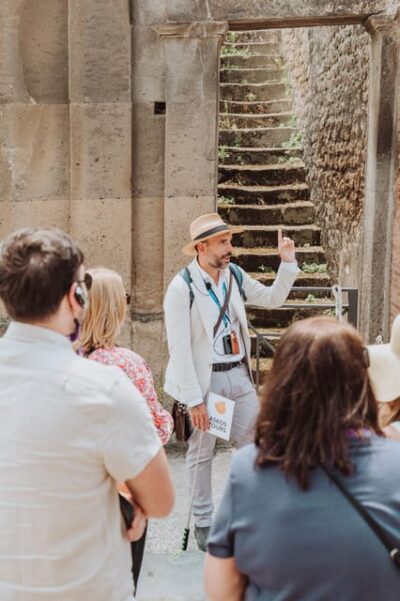
Entry Ticket and Guided Tour with an Archaeologist
Read our review →

Pompeii Small Group Tour with an Archaeologist
Read our review →
Pompeii, Amalfi Coast and Positano Day Trip from Rome
Read our review →Browse the lists this tour appears in