
Reviewed · POMPEII & VESUVIUS TOURS
Explore Pompeii with an Archaeologist
Pompeii rewards a good guide. This two-hour walk pairs skip-the-line admission with an archaeologist who explains what you are seeing, rather than leaving you to decode a maze of walls and paving stones. I like the compact route through major sights, and I like the small-group limit of 20 people, which gives you a fair chance to ask questions. The main catch is time: Pompeii is huge, and two hours only gives you a well-chosen introduction.
The tour costs $35.67 per person and includes admission, guidance, and headsets for groups of 16 or more. That is a sensible price for a first visit, especially if you want help making sense of the ruins. Still, crowds can gather inside popular buildings, and one poorly paced guide could make the experience feel more like an audio recording than a conversation.
In This Review
- Quick take: the details that matter most
- Why a guide helps at Pompeii
- Meeting at Porta Marina Superiore
- The forum and basilica: Pompeii’s public heart
- The Lupanar and the Forum granaries
- The House of Menander and the House of the Faun
- The Stabian Baths and Via dell’Abbondanza
- Thermopolium VI: daily food in ancient Pompeii
- Teatro Grande and Casa dei Vettii
- Is $35.67 good value?
- Who will enjoy this Pompeii tour?
- My booking advice
- FAQ
- How long does the Pompeii tour last?
- How much does the experience cost?
- Is Pompeii admission included?
- Where does the tour meet?
- Where does the tour end?
- How many people can join the tour?
- Are headsets provided?
- Can I cancel for a full refund?
Quick take: the details that matter most
- A focused two-hour route: You visit the forum, basilica, brothel, several famous houses, baths, a street, a food shop, and the theater.
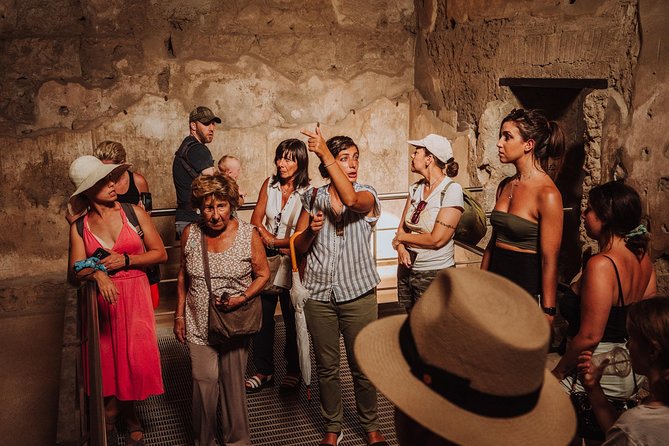
- An archaeologist leads the walk: Guides such as Mario Celentano, Alexandra, Teresa, Rosanna, Ilaria, and Julia have been praised for clear explanations, humor, patience, and strong answers to questions.
- Skip-the-line admission is included: Meet at Porta Marina Superiore, the archaeological park entrance on Via Villa dei Misteri.
- The group can reach 20 people: Smaller than a mass-market outing, but not a private tour. Groups of 16 or more receive headsets.
- Expect uneven walking and heat: Bring a hat or umbrella, a refillable water bottle, and enough energy for old streets and stone floors.
- You can continue alone afterward: The tour ends at Piazza Esedra, leaving you free to explore further if your ticket and energy allow.
Why a guide helps at Pompeii
Pompeii is not a single monument you can understand in one glance. It is a broad ancient town, with streets, homes, public buildings, shops, baths, theaters, and open areas spread across a large archaeological park. Without context, it can be easy to admire the stonework while missing how the pieces fit together.
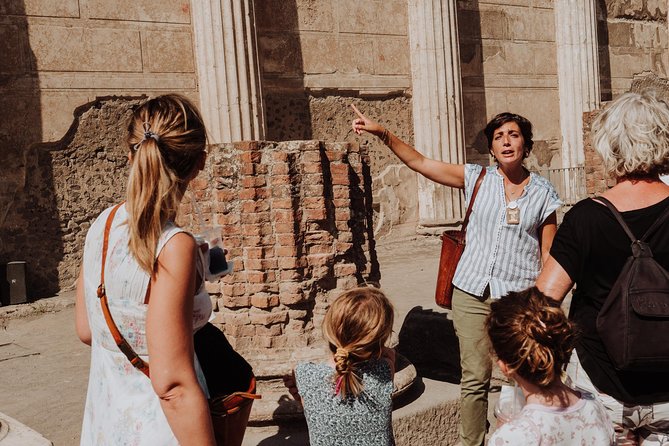
A guide gives each stop a job. The forum becomes the town’s public center. The basilica becomes a place tied to law and business. A thermopolium, with its counter for serving food and drink, gives you a glimpse of ordinary daily life. The houses reveal how wealthy families used decoration, courtyards, and rooms to display status.
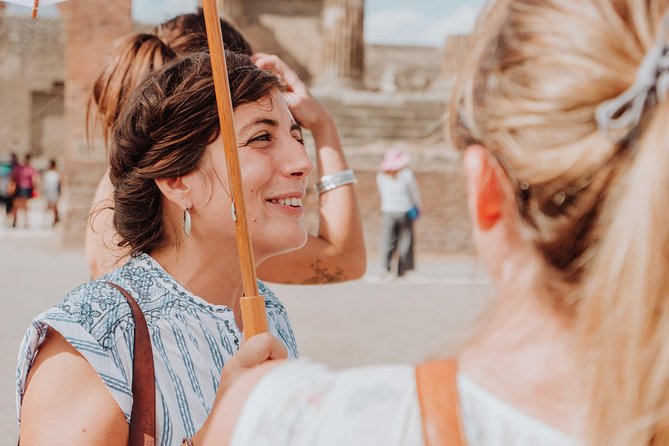
I especially like this kind of tour for a first visit. You get a map in your head before deciding what deserves a longer look. Guides have also been praised for adjusting their pace, explaining material clearly, and answering questions beyond a fixed script. Mario, Teresa, Alexandra, Rosanna, and Ilaria are among the guides singled out for friendly, lively teaching.
That said, the quality depends heavily on the individual guide and the conditions inside the park. One account described slow delivery, limited interaction, and answers that did not meet expectations. The company responded that it would work on pace and question time. If you want a private, highly tailored lesson, this group tour may feel too general.
More Pompeii and Vesuvius trips:
- Pompeii: Entry Ticket and Guided Tour with an Archaeologist
★ 4.8 · 19,459 reviews - Pompeii: Entry Ticket with Optional Audio Guide
★ 4.2 · 12,360 reviews - Pompeii: Small Group Tour with an Archaeologist
★ 4.8 · 12,264 reviews
Meeting at Porta Marina Superiore
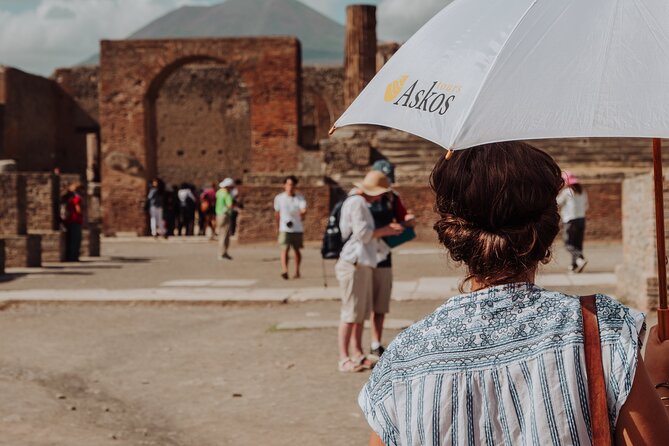
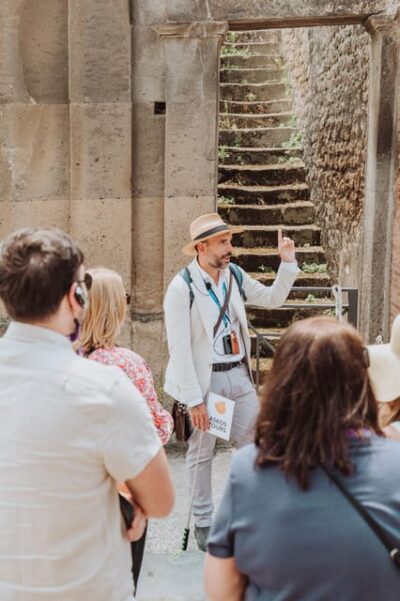
You meet at the main entrance known as Porta Marina Superiore, at Via Villa dei Misteri 2 in Pompei. Look for a guide holding a sign with Askos Tours written at the top. The entrance detail matters because Pompeii has more than one access point, and arriving at the wrong gate can turn a calm start into a rushed one.
The tour ends at Piazza Esedra. Transportation is not included, so you need to arrange your own way to the meeting point and onward from the exit. The site is near public transportation, and one visitor specifically found it easy to reach by train.
The tour is generally suitable for most people, but do not mistake a two-hour duration for an easy stroll. You will walk across uneven ancient surfaces, and the sun can feel strong in exposed areas. A hat, umbrella, and refillable water bottle are practical choices. Water is available from fountains, according to one useful tip from a past participant.
The average booking lead time is about 30 days. That suggests you should reserve ahead if your dates are fixed, particularly during busy periods. Confirmation arrives at booking, and free cancellation is available until 24 hours before the start time. Changes or cancellations inside that final 24-hour window are not accepted for a refund.
The forum and basilica: Pompeii’s public heart
The first major stops are the Forum of Pompeii and the basilica. The forum was the main public square, a broad civic space where the town’s public life gathered. Your guide can help you read the surrounding remains as a connected center rather than a collection of columns.
The basilica, described as the courthouse, adds a useful piece to the picture. Here, the focus shifts from public ceremony and town business to law. Ten minutes at each stop is enough for an introduction, but not for a long architectural lecture. Pay attention to the guide’s explanation, then take mental notes about anything you may want to revisit later.
The tour uses a quick rhythm, with roughly ten minutes assigned to each listed stop. That is helpful if you want to see a lot, but it also means you should not expect long stretches of quiet reflection at every building. A guide who keeps the group moving while leaving room for questions is essential.
The Lupanar and the Forum granaries
The Lupanar, Pompeii’s brothel, is one of the site’s most famous stops. It attracts attention for understandable reasons, but a good explanation helps place it within the wider town rather than treating it as a sensational oddity. You may encounter a line inside, especially when the park is crowded, so the ten-minute schedule can become flexible.
Next come the granaries of the Forum. Their name can sound less exciting than a theater or decorated house, but storage buildings help you picture how Pompeii handled goods and supplies. This is the sort of stop that benefits from an archaeologist’s explanation because the remains may not speak for themselves.
Crowds are a real consideration here and elsewhere. Even in a large archaeological park, popular rooms can have lines. One past participant found that people sometimes had to wait inside the site to enter certain spaces. Headsets help, but noise and crowd movement can still make it hard to hear.
A few more Pompeii bookings to compare
- Pompeii Small Group Tour with an Archaeologist
★ 5.0 · 6,593 reviews - Pompeii: Skip-the-Line Entrance Ticket with Audio Guide
★ 4.0 · 2,509 reviews - Naples: Pompeii and Mt. Vesuvius with Lunch and Wine Tasting
★ 4.5 · 2,454 reviews - Pompeii: Archaeological Park Tour with Ticket on request
★ 4.5 · 2,283 reviews
The House of Menander and the House of the Faun
The House of Menander offers a look at domestic Pompeii and the scale of a wealthy home. You are not simply seeing a private address. You are seeing how architecture, decoration, and room arrangement could signal the position of an important family.
The House of the Faun is one of the best-known residences in Pompeii. Its name comes from a statue of a dancing faun, and the house is associated with impressive scale and decoration. The guide’s role here is to explain how the home functioned and why it matters, rather than letting you walk past a famous name without context.
These houses are a good reason to choose a live guide over a basic recorded explanation. You can ask why one residence is larger than another, how rooms may have been used, or what details suggest wealth. The value is not just in naming a building. It is in learning how to look at it.
Still, do not assume this route covers every famous room in Pompeii. One account noted that active excavation areas were not part of the visit. If current archaeology and newly uncovered sections are your main interest, you will need extra time and perhaps a different format.
The Stabian Baths and Via dell’Abbondanza
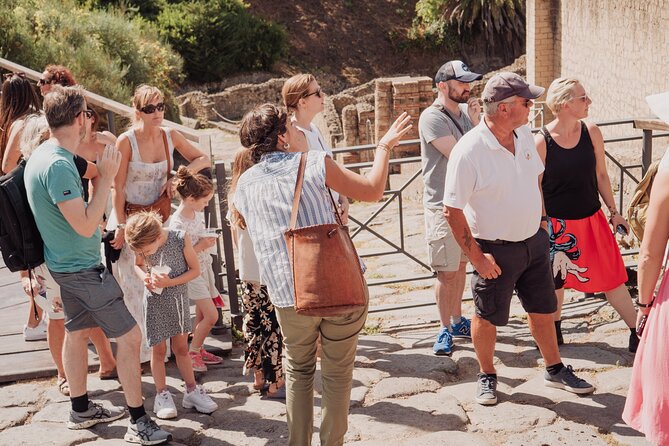
The Stabian Baths show another side of public life. Baths were places for washing, exercise, routine, and social contact. The remains make more sense when your guide points out the different spaces and explains how the complex worked.
Via dell’Abbondanza, the long street included in the route, changes the scale again. Instead of standing in a forum or entering a grand home, you walk through an urban thoroughfare. Ancient streets can reveal a surprising amount: how people moved, where shops opened, and how public and private life met at the edges of buildings.
This is also where you feel the physical demands of the site. Ancient paving is uneven, and you may need to watch your step while listening. Wear practical shoes. The tour is not a good match for someone who needs smooth, level walking throughout.
Thermopolium VI: daily food in ancient Pompeii
Thermopolium VI is the route’s small but memorable window into everyday eating. A thermopolium was a food and drink counter, a place where people could purchase prepared refreshments without cooking at home.
I like this stop because it brings Pompeii down from grand civic buildings to ordinary routines. After the forum, basilica, baths, and wealthy houses, a food shop helps you imagine the town as a lived-in place. The guide can point out the counter and explain what its design tells us about commerce and daily habits.
The stop is brief, so listen for the practical details. This is not a long food-history lesson. It is a compact example of how Pompeii’s ruins preserve both public monuments and small businesses.
Teatro Grande and Casa dei Vettii
The Teatro Grande, or large theater, is the final major part of the route. A theater gives the town another social setting, one tied to performance and shared entertainment. The open scale of the building also provides a change after the tighter rooms of houses and shops.
Casa dei Vettii, the House of the Vettii, returns you to wealthy domestic life. It is another chance to compare private architecture with the public spaces seen earlier. The route closes with a strong pair: a building designed for large audiences and a home designed to express private wealth.
By this point, you will have seen a useful cross-section of Pompeii. You will not have seen everything, but you will have covered civic life, law, commerce, bathing, food, theater, and domestic space. That range is the tour’s main strength.
Is $35.67 good value?
At $35.67, this is a reasonable purchase if you want admission and a live explanation in one booking. Pompeii admission is included, as are the guide’s services and headsets for larger groups. You are paying for a focused orientation, not an entire day of private archaeological research.
The strongest value comes from the route and the guide. An effective archaeologist can save you from wandering between buildings with no sense of importance. The best guides, including Mario, Teresa, Alexandra, Rosanna, and others praised for warmth and clarity, make the site easier to read and remember.
The price is less attractive if you already know Pompeii well or prefer to move at your own pace. You may feel rushed at popular houses, and the group will follow its own timing. A private tour would give you more control, but it would also cost more than this shared option.
The current score is 4.9 from 511 ratings, with 98 percent of participants recommending the experience. That is a strong signal, though it cannot guarantee that every guide or every day will feel the same. The most common positive traits are clear explanations, patience with questions, friendly pacing, and the ability to make Pompeii enjoyable for children as well as adults.
Who will enjoy this Pompeii tour?
I would choose this tour for a first-time visitor who wants a clear route through the major sights. It also suits families, since several guides have been praised for explaining the site in an engaging way for children and adults.
It works well for people on a tight schedule. Two hours gives you a firm introduction, and you can continue exploring after the guided portion. It is also a sensible choice if the idea of entering Pompeii alone feels daunting.
You should think twice if you want to study excavation work, spend a long time inside each house, or avoid groups. The maximum is 20 people, which is modest but not intimate. A crowded day may also make some rooms difficult to hear or enter.
Anyone with limited mobility should consider the uneven surfaces carefully. The supplied information says most people can participate, but it also makes clear through practical advice that this is a walking tour across ancient streets and floors. Service animals are allowed. Only dogs up to 10 kilograms and 40 centimeters in height may enter, and they must be leashed, carried inside buildings, and cleaned up after.
My booking advice
Book this experience if you want a well-priced first look at Pompeii, a guide who can explain the buildings in plain language, and a route that covers the major categories of ancient life. The free cancellation deadline also gives you some flexibility, provided you cancel at least 24 hours before the start time.
Plan to arrive at the correct entrance, bring water and sun protection, and accept that the pace will be brisk. If you have extra time, stay after the tour and explore on your own. Pompeii is too large for two hours, but two hours with a strong guide can give you the structure needed to make the rest of your visit count.
FAQ
How long does the Pompeii tour last?
The tour lasts approximately two hours.
How much does the experience cost?
The listed price is $35.67 per person.
Is Pompeii admission included?
Yes. The Pompeii admission fee is included in the tour price.
Where does the tour meet?
Meet at Porta Marina Superiore, the main entrance to the archaeological park, at Via Villa dei Misteri 2, 80045 Pompei, Italy. The guide will hold a sign with Askos Tours at the top.
Where does the tour end?
The tour ends at Piazza Esedra, 80045 Pompei, Italy.
How many people can join the tour?
The group can include a maximum of 20 travelers per guide.
Are headsets provided?
Headsets are included for groups of 16 or more.
Can I cancel for a full refund?
Yes. You can cancel for a full refund up to 24 hours before the experience start time. Cancellations or changes made less than 24 hours before the start time are not accepted for a refund.
Recently added around Pompeii
- From Pompeii: Bus Transfer to Vesuvius with Park Entry Fee★ 4.2 · 700 reviews
- Pompeii Skip-the-line Tour with Archaeologist Guide★ 5.0 · 559 reviews
- Skip the Line Guided Tour of Pompeii led by an Archaeologist★ 5.0 · 703 reviews
- Visit in Pompeii – Pompeii Private Tour with Ada★ 5.0 · 436 reviews
- Ancient Pompeii Private Tour: Skip the Line & Kid-Friendly Option★ 5.0 · 167 reviews
- Pompeii Private Tour with an Archaeologist and Skip The Line★ 5.0 · 391 reviews
- Private Day Tour to Vesuvius, Herculaneum & Pompeii with Pick Up★ 5.0 · 279 reviews
- Pompeii Private Tour with an Archaeologist and Skip The Line – 3 hours★ 5.0 · 564 reviews
Pompeii & Vesuvius Tours, compared.
Entry Ticket and Guided Tour with an Archaeologist
Read our review →


Pompeii Small Group Tour with an Archaeologist
Read our review →
Pompeii, Amalfi Coast and Positano Day Trip from Rome
Read our review →Browse the lists this tour appears in