

Reviewed · POMPEII & VESUVIUS TOURS
Pompeii: Tour with Archaeologist Guide & Skip-the-Line Entry
Pompeii makes the past feel close. This two-hour walk pairs priority entry with an authorized archaeology guide, so you spend less time in a ticket queue and more time looking at homes, shops, baths, theaters, and streets preserved by Vesuvius. I especially like the guide-led explanations and the chance to see Pompeii’s plaster casts and everyday details with context.
At $57 per person, the price is fair if you want a focused introduction rather than wandering without a plan. The main drawback is the short running time: Pompeii is enormous, and two hours covers the major sights but not the whole site. You can stay afterward to explore more, which makes the tour more useful.
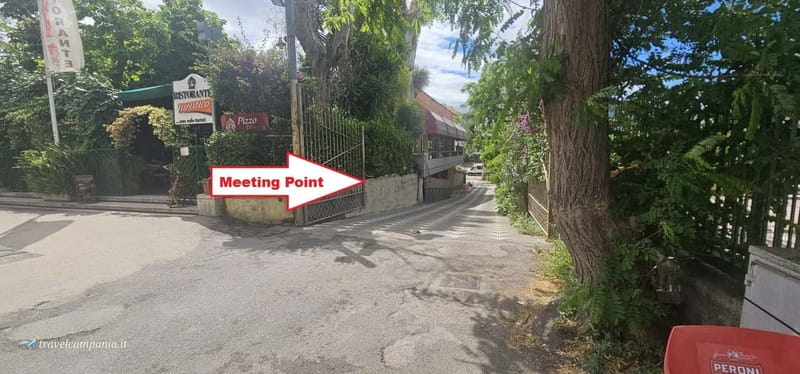
The experience is led in Italian, Spanish, French, English, or German. Guides such as Angelo, Teresa, Lilian, Paolo, Roberta, and Mario have been praised for making the ancient city clear, lively, and easy to follow. I would allow extra time to find the Welcome box meeting point, since the check-in location can be harder to spot than expected.
In This Review
- Key points before you book
- Why a guided Pompeii visit earns its keep
- Starting at Porta Marina
- Teatro Piccolo and the city’s public life
- House of Menander and domestic Pompeii
- Thermopolium, where ancient food was sold
- Terme Stabiane and the Roman bathing routine
- Lupanare and the less polished side of Pompeii
- The Civil Forum and the city’s public heart
- What the two-hour format really gives you
- The guide and audio system matter
- Skip-the-line entry and the meeting point
- Is $57 a fair price?
- Who should book this Pompeii tour?
- Should you book it?
- FAQ
- How long does the Pompeii tour last?
- What is included in the price?
- Does the tour include transportation or lunch?
- Which languages are available?
- What happens if the group has more than eight participants?
- What identification should I bring?
- Are bags and bicycles allowed?
- Is the tour suitable for wheelchair users?
Key points before you book
- The guide adds the missing story: Walls and paving stones make far more sense when someone explains how Pompeii worked as a city.
- The route covers major highlights: You visit Porta Marina, the theaters, House of Menander, Thermopolium, Stabian Baths, Lupanare, and the Forum.
- Two hours is an introduction, not a full visit: Plan to remain inside afterward if you want more houses, gardens, and streets.
- Audio equipment helps in busy areas: A radioguide is used when the group passes eight people, and smaller groups may use an audio guide with an English-speaking guide.
- The route is not suitable for everyone: The activity is not recommended for wheelchair users or people with mobility impairments.
- Bring identification and leave bags behind: A passport or ID card is required, while bags and bicycles are not allowed.
Why a guided Pompeii visit earns its keep
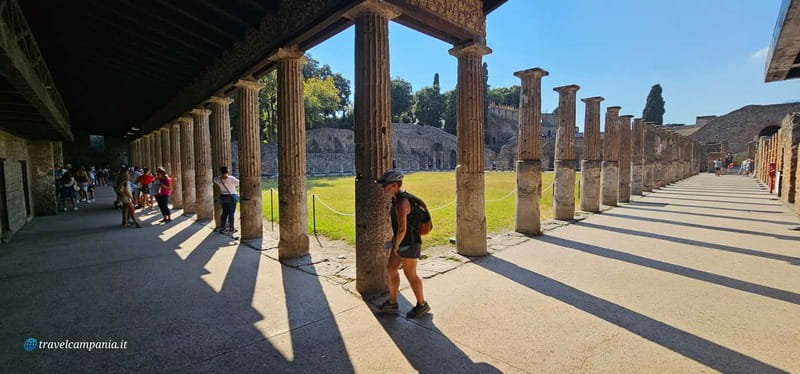
Pompeii can look confusing at first. You see broken columns, roofless rooms, worn mosaics, and long stone streets, but the meaning is not always obvious. A guide supplies the links between those fragments: how people lived, where they shopped, how public baths worked, and why certain buildings mattered.
The setting is unusual because an ancient Roman city remains preserved on such a large scale. Pompeii was founded as early as the 7th century BC and was destroyed in the eruption of Mount Vesuvius in AD 79. Ash and debris covered streets, homes, businesses, public buildings, and human remains.
That disaster was tragic, but the burial also protected details that normally disappear. You can see evidence of domestic life, commerce, public entertainment, and city planning in one place. I find that a guide is most valuable here because the ruins do not explain themselves.
The tour also helps you avoid spending your limited time on the wrong corners. The route moves through a selected group of important places, with short stops that keep the visit moving. You get a broad picture of Pompeii instead of becoming stuck in one house and missing the Forum.
More Pompeii and Vesuvius trips:
- Pompeii: Entry Ticket and Guided Tour with an Archaeologist
★ 4.8 · 19,459 reviews - Pompeii: Small Group Tour with an Archaeologist
★ 4.8 · 12,264 reviews - Pompeii: Skip-the-Line Entrance Ticket with Audio Guide
★ 4.0 · 2,509 reviews
Starting at Porta Marina
The walk begins at the Pompeii meeting point and moves toward Porta Marina, one of the city’s major entrances. The guided explanation here lasts about 10 minutes.
An entrance is a useful place to begin because it gives you a sense of Pompeii as a functioning city, not just a collection of ruins. As you pass through the route, the guide can set up the basic story of the settlement, its growth, and the eruption that ended its life.
Do not expect a long lecture at the first stop. The opening explanation is brief, which is sensible on a two-hour visit. You are being given the framework for everything that follows.
Teatro Piccolo and the city’s public life
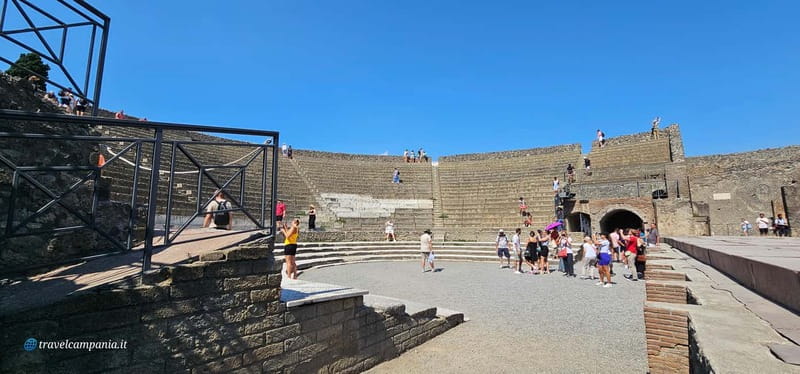
The next stop is Teatro Piccolo, or the small theater, with about 10 minutes of guided explanation. This stop shifts your attention from private houses to entertainment and public culture.
A theater tells you that Pompeii was not simply a place of work and trade. It had organized leisure, performances, and buildings designed for shared experiences. The guide’s role is to point out what you are seeing and explain how it fitted into city life.
The short stop works well as part of the larger route, though theater lovers may want more time than the schedule allows. If this building catches your interest, make a note of it and return after the guided portion ends.
House of Menander and domestic Pompeii
The House of Menander receives roughly 15 minutes. This is one of the stops where the tour moves from public structures into the world of a private Roman home.
The name refers to Menander, a Greek playwright, and the house is known for its decorative elements. The important point for you is not just the artwork. A large home can show how wealth, household organization, decoration, and social status worked in Pompeii.
The guide can help you read the rooms instead of seeing them as empty spaces. Look for the relationship between courtyards, living areas, decorative surfaces, and working parts of the home. Pompeii is especially good at showing that ancient life was not only about temples and emperors. It was also about kitchens, meals, family spaces, servants, and business.
Fifteen minutes is enough for a clear introduction, but it is not enough for every artistic detail. You will need to return on your own if you want a slower look.
A few more Pompei Campania bookings to compare
- Naples: Pompeii and Mt. Vesuvius with Lunch and Wine Tasting
★ 4.5 · 2,454 reviews - Pompeii: Skip-the-line-Ticket and Guided Tour
★ 4.6 · 1,152 reviews - Pompeii: Small-Group Tour of Pompeii and Herculaneum
★ 4.8 · 867 reviews - Pompeii: Guided Tour with Skip-the-Line Entry
★ 4.9 · 812 reviews
Thermopolium, where ancient food was sold
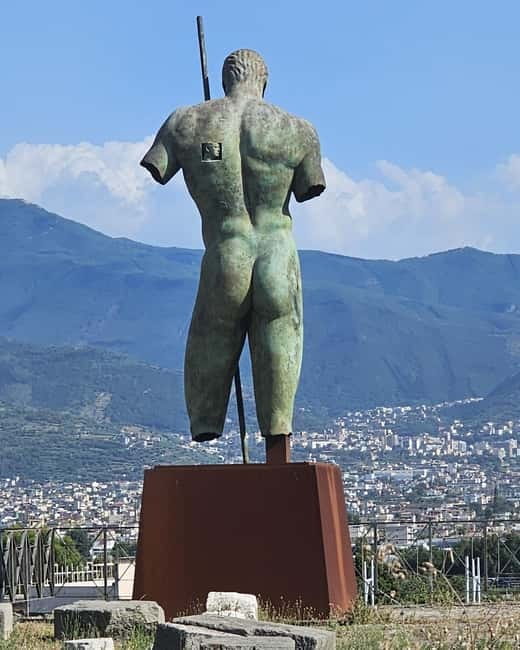
The Thermopolium is given another 15-minute stop. These establishments sold prepared food and drink, making them useful windows into ordinary urban life.
This is one of the more engaging parts of the route because it brings Pompeii down to street level. Instead of thinking only about grand public buildings, you can consider where people bought meals, how shops were arranged, and how commerce shaped daily routines.
The guide can explain the practical clues in the building and connect them to the people who used it. Details like counters, walls, entrances, and working spaces become easier to understand when someone explains their purpose.
I like this stop because it makes the city feel lived in. It also balances the grander sights. Pompeii is not only a place of villas and monuments. It was a working town.
Terme Stabiane and the Roman bathing routine
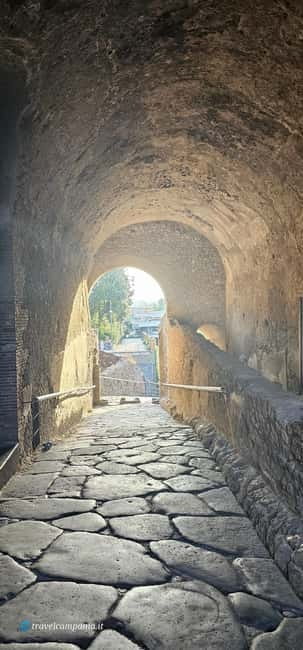
The Stabian Baths receive about 15 minutes. Public baths were important social spaces in Roman cities, and this stop helps show how recreation, hygiene, and public life overlapped.
The baths are valuable because they reveal the practical systems behind Roman comfort. A guide can explain the arrangement of rooms and the way the building served the public. You may find the heating system and sequence of spaces easier to understand with an expert beside you than from a sign alone.
This part of Pompeii also makes a useful comparison with modern life. Bathing was not simply a private task. It could be part of a daily social routine. The short visit gives you the basic idea without slowing the entire itinerary.
If you are interested in Roman engineering or architecture, you will probably want extra time later. The 15-minute visit gives you an overview rather than a full technical study.
Lupanare and the less polished side of Pompeii

The Lupanare is scheduled for approximately 20 minutes, making it the longest stop on the route. Its name refers to a brothel, and the building is one of the places where Pompeii’s less formal and less respectable activities come into view.
This stop often prompts questions because it deals with work and social behavior that public monuments tend to leave out. The guide’s explanation helps place the building within the wider city rather than treating it as a sensational oddity.
The longer stop is useful because the site requires context. Pompeii had many layers of life, and this building reminds you that the ancient city included commerce, pleasure, exploitation, and social divisions alongside religion and politics.
Families should decide in advance whether this subject suits their children. The supplied information does not set a specific age rule, but the site’s purpose is clear enough that parents may prefer to explain it beforehand.
The Civil Forum and the city’s public heart
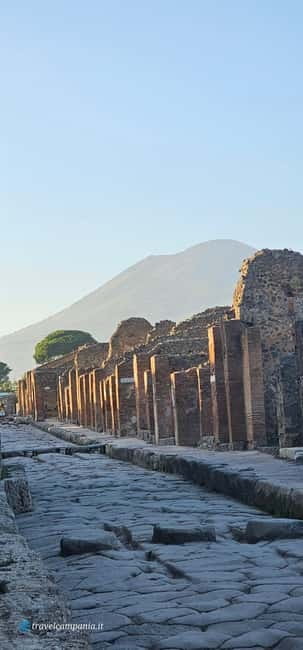
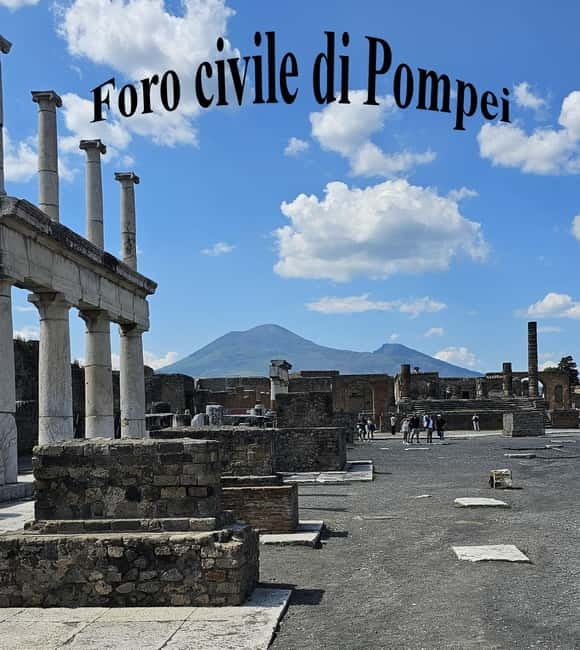
The route then reaches the Foro Civile di Pompei, or Civil Forum, for about 15 minutes of guided touring. This is the natural place to pull the major themes together.
The Forum was the center of public life. It is where the city’s civic, political, religious, and commercial functions came together. After seeing a home, a food shop, a bath, and a theater, you can now place those parts within the larger structure of Pompeii.
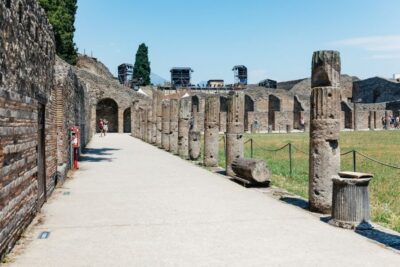
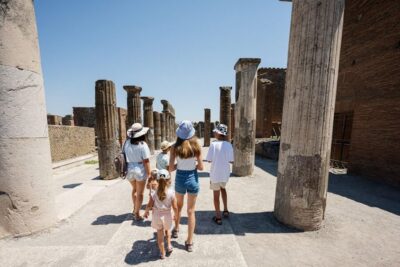
The guide’s explanation is especially helpful here because the open space can be difficult to interpret. Columns and foundations may look impressive, but their purpose is not always clear without a map or an explanation of how the surrounding buildings related to the Forum.
The itinerary includes another 10 minutes of free time at the Forum. Use it to take photographs, check the map, ask a final question, or simply look across the space without having to keep pace with the group.
What the two-hour format really gives you
Two hours is a sensible length for a first orientation. You get movement, variety, and a guide who keeps the story focused. The schedule also avoids the common problem of spending the whole visit in one famous building.
Still, Pompeii is too large to cover properly in two hours. I would treat this as the first part of your visit, not the entire day. After the guided walk, you can remain at the site and continue independently. Several guides have offered suggestions about what to see next, which is useful if you want to make the most of your admission.
The route includes nine timed sections, but the stops are not equal in depth. Porta Marina and the small theater receive short explanations, while the Lupanare gets more time. That balance makes sense for a general introduction, though specialists may wish for more detail at the House of Menander, baths, or Forum.
The pace should suit most people who can walk comfortably over uneven archaeological ground. It is not suitable for wheelchair users or people with mobility impairments, and the activity is not recommended for people over 95.
The guide and audio system matter
The strongest part of this experience is the human explanation. Angelo is praised for being engaging and helpful, while Teresa is described as professional and humorous. Lilian is noted for clear explanations, and Paolo for leading the group well and giving useful background.
Mario has also been praised for helping a family that arrived late, while other guides have adjusted the experience when train delays or bad weather caused problems. That does not guarantee a schedule change, but it suggests that contacting the operator quickly can sometimes prevent a missed visit from becoming a lost day.
The tour uses an audio system when the group passes eight participants. This matters at Pompeii, where large crowds and open spaces can make it hard to hear. One visitor found the earpieces too loud, though also considered them necessary in crowded areas.
If the group has no more than four people in the same language, the format may be an audio guide plus an English-speaking tour guide. This is worth understanding before booking. You may not receive the same fully live commentary format in every group.
The available languages are Italian, Spanish, French, English, and German. Write the names and ages of all participants when reserving, and bring a passport or ID card. A copy of a passport or ID card is accepted according to the provided instructions.
Skip-the-line entry and the meeting point
Priority access is a real convenience, especially when the ticket queue is long. It does not remove the need to check in, so you should still arrive with enough time to find the Welcome box near the starting point.
The meeting point information identifies the start as Guide Pompei and says the activity ends back at the meeting point. Since one visitor found the check-in process difficult, do not wait until the exact starting minute to search. Keep the meeting instructions open on your phone and allow a little extra time.
The Pompeii Express entrance ticket is included. Transport, lunch, and tips are not included, so you need to arrange your own way to the site and plan food separately.
Bags are not allowed, and bicycles are not allowed. The supplied information does not provide a full list of storage arrangements, so travel light and check the current instructions before arrival. A passport or accepted copy should be easy to reach.
Is $57 a fair price?
At $57 per person, this is not the cheapest way to enter Pompeii. You are paying for the entrance ticket, priority access, and an authorized archaeology guide, not just admission.
I think the price is reasonable for a first visit, especially if you value explanation over wandering. The guide helps you understand the design of the streets, the purpose of buildings, and small details such as places connected with horses and road construction. Without that background, you may see plenty but understand less.
The value improves if you stay afterward. The guided portion gives you a map of the site, then you can continue at your own pace. If you only have two hours in Pompeii, the price makes even more sense because the guide helps you use that limited time well.
If you are a repeat visitor, a specialist in Roman archaeology, or someone who prefers a quiet independent visit, you may find the fixed route less appealing. You could still use the admission and return to your favorite areas, but the main benefit is the guide.
Who should book this Pompeii tour?
I would recommend it to first-time visitors, families who want the ruins explained, and anyone making Pompeii a day trip from Naples or Rome. The tour gives you a clear structure without demanding a full day of lectures.
It also suits people who like history presented through everyday details. The Thermopolium, House of Menander, baths, and Lupanare show more than famous monuments. Together, they explain how people ate, washed, worked, socialized, entertained themselves, and used public space.
You should think twice if you have limited mobility, use a wheelchair, or dislike group tours. You should also allow extra time after the tour if you want more than a sample of Pompeii.
Should you book it?
Book this tour if you want Pompeii to make sense, not merely look impressive. The combination of skip-the-line entry, a selected route, and an archaeology guide gives you a strong introduction at a fair price.
I would not book it as your only Pompeii time if you have a full day available. Use the two-hour walk to understand the city, then stay on to explore further. Arrive early at the Welcome box, bring identification, leave bags behind, and be ready for uneven ground.
For most first-time visitors, the guide is the reason to choose this experience. Pompeii is far more rewarding when someone helps you see the city behind the ruins.
FAQ
How long does the Pompeii tour last?
The guided tour inside the archaeological site lasts approximately two hours.
What is included in the price?
The price includes a Pompeii Express entrance ticket and an authorized guide with expertise in archaeology.
Does the tour include transportation or lunch?
No. Transportation and lunch are not included. Tips are also not included.
Which languages are available?
The tour is available in Italian, Spanish, French, English, and German.
What happens if the group has more than eight participants?
A radioguide is included when the group passes eight participants, helping you hear the guide in crowded areas.
What identification should I bring?
Bring a passport or ID card for each participant, including children. A copy of a passport or ID card is accepted.
Are bags and bicycles allowed?
No. Bags and bicycles are not allowed. Alcohol and drugs are also prohibited.
Is the tour suitable for wheelchair users?
No. The activity is not suitable for wheelchair users or people with mobility impairments.
Recently added around Pompei Campania
- Pompeii 3hours Villa of Mysteries tour with an Archaeologist★ 4.8 · 486 reviews
- Pompeii: Small-Group Tour of Pompeii and Herculaneum★ 4.8 · 867 reviews
- Pompeii: Skip-the-line-Ticket and Guided Tour★ 4.6 · 1,152 reviews
- Pompeii: Skip-the-Line Entry & Audioguide★ 3.8 · 225 reviews
- Pompeii: Guided Tour with Skip-the-Line Entry★ 4.9 · 812 reviews
- Pompeii: Afternoon to Sunset Guided Tour with Ticket★ 4.9 · 484 reviews
- Pompeii: Skip-the-Line Entry Ticket with Digital Guide App★ 4.1 · 770 reviews
- Pompeii: Day Tour of Pompeii and Vesuvius with Bus Transfer★ 4.2 · 250 reviews
Pompeii & Vesuvius Tours, compared.
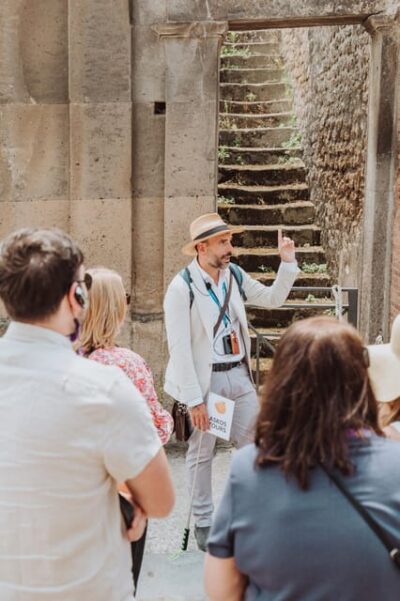
Entry Ticket and Guided Tour with an Archaeologist
Read our review →


Pompeii Small Group Tour with an Archaeologist
Read our review →
Pompeii, Amalfi Coast and Positano Day Trip from Rome
Read our review →Browse the lists this tour appears in