
Reviewed · POMPEII & VESUVIUS TOURS
Pompeii: Afternoon to Sunset Guided Tour with Ticket
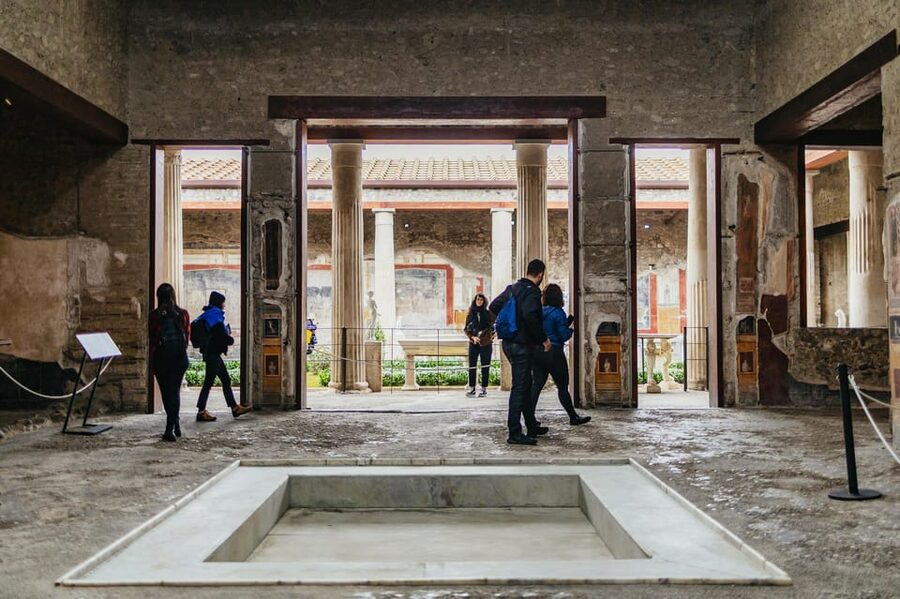
Pompeii rewards a slower look. This 2.5-hour archaeologist-led walk gives you a clear route through the sprawling ruins, with the Forum, Basilica, Thermal Baths, Theater, bakeries, and homes all tied to everyday Roman life. I especially like the later time slot, which can mean softer light, less heat, and fewer people than a morning visit. I also like the small-group option and the lively guides, with Francesco, Frankie, Angelo, and Anna earning especially warm praise for their stories and care. The main drawback is simple: Pompeii is enormous, and two and a half hours only covers selected highlights.
This is a strong choice if you want the site to make sense rather than simply walk around with a map. The $58 price includes Pompeii entry and a live guide, but not transport, and the uneven ancient streets can be tiring or awkward for anyone with limited mobility, heart trouble, or breathing problems.
In This Review
- Key points before you book
- Meeting at Ristorante Bar Sgambati
- Why the afternoon start works so well
- Entering Pompeii through the separate entrance
- The Forum and Basilica explain public Pompeii
- Thermal Baths and the machinery of daily life
- Theater, bakeries, and housing blocks
- Understanding the eruption of Vesuvius
- The guide makes or breaks the experience
- Small groups, private tours, and family fit
- Is $58 a fair price?
- What to expect after the guided walk
- Who should book this Pompeii tour?
- Final verdict: a smart way to meet Pompeii
- FAQ
- Where does the Pompeii tour meet?
- How long does the guided tour last?
- Is Pompeii admission included?
- Is transportation included?
- What languages are available?
- Can I cancel the booking?
Key points before you book
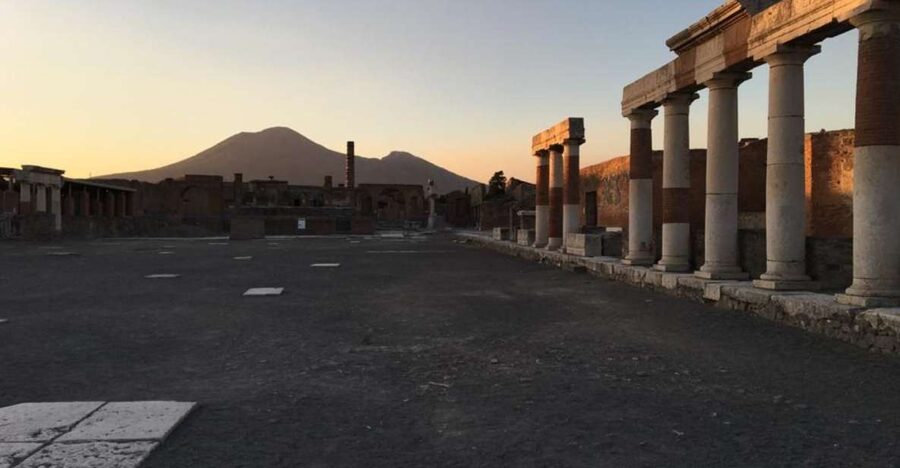
- Late afternoon changes the feel: A start around 3:30 PM has been praised for gentler sun and thinner crowds.
- The guide supplies the missing story: Francesco, also called Frankie, is often praised for humor, care, and clear explanations.
- You see the civic heart first: The Forum, Basilica, baths, and Theater give you a useful framework for understanding Pompeii.
- Small groups make questions easier: Private and small-group formats are available, and smaller parties can feel more personal.
- The ticket is included: You get a skip-the-line ticket through a separate entrance, though you must arrange your own way to Pompeii.
- Two and a half hours is a highlights tour: You will not cover every street, house, or neighborhood in the archaeological park.
Meeting at Ristorante Bar Sgambati
The tour begins at Ristorante Bar Sgambati. Look for the red Enjoy Pompeii sign, which is the useful landmark at the meeting point.
This location matters because the tour does not include transportation. You need to reach the meeting point yourself, so leave enough time if you are arriving by train or connecting from Naples, Sorrento, or elsewhere in Campania. One practical tip is to plan your return before the walk begins. Pompeii can leave you absorbed in the site, and it is easy to lose track of time if you hope to catch a train afterward.
Bring an ID card or a copy, plus a sun hat. The site has very little shade in some areas, and even a late visit can feel hot in summer. Comfortable shoes are essential, not because the tour is a race, but because the route uses ancient streets and uneven surfaces.
More Pompeii and Vesuvius trips:
- Pompeii: Entry Ticket and Guided Tour with an Archaeologist
★ 4.8 · 19,459 reviews - Pompeii: Small Group Tour with an Archaeologist
★ 4.8 · 12,264 reviews - Pompeii: Skip-the-Line Entrance Ticket with Audio Guide
★ 4.0 · 2,509 reviews
Why the afternoon start works so well
Pompeii is exposed, broad, and paved with old stone. A midday visit can be hard work, especially when you stop often to listen. The afternoon setting gives the sun more time to soften, and the light near the end of the tour can make the walls and streets easier on the eyes.
The exact start time depends on availability. A 3:30 PM departure has worked well for many people, but you should check the date you want rather than assume that time is offered.
The timing also helps with crowds. It does not turn Pompeii into an empty ruin, but the late afternoon may feel calmer than the busiest part of the day. You might have a better chance of pausing beside a building without a dense group pressing behind you.
The sunset is a pleasant finishing touch, but it should not be the only reason to book. This is not a dedicated photography outing, and the main value comes from having an archaeologist explain what you are seeing. Still, the closing light gives the walk a quiet mood that suits Pompeii well.
Entering Pompeii through the separate entrance
Your ticket is included, with entry through a separate entrance intended to avoid the main ticket line. That saves time and removes one common bit of travel friction.
Skip-the-line does not mean you can ignore the meeting instructions. You still need to arrive at Ristorante Bar Sgambati and join the guide before entering the archaeological site. Keep your ID or copy handy, since it is listed among the required items.
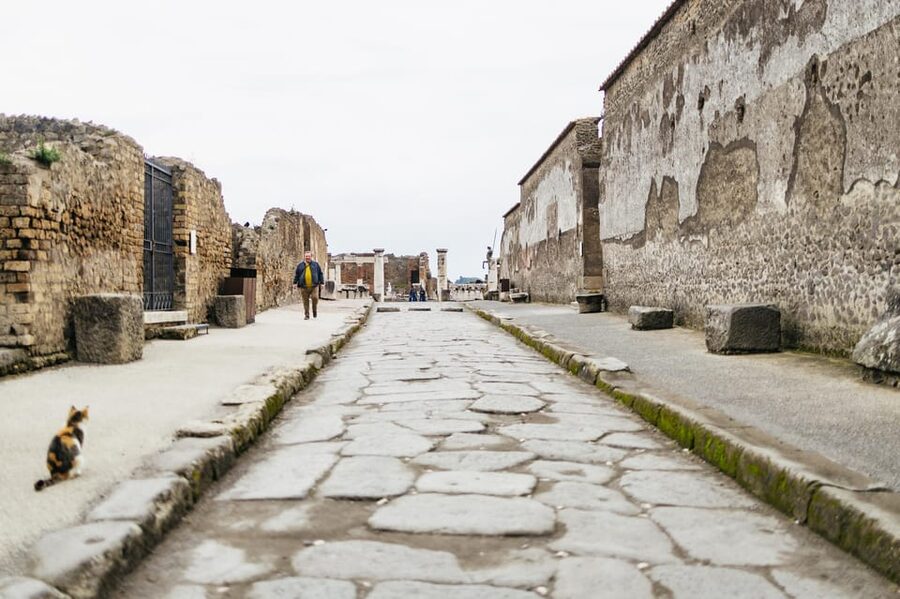
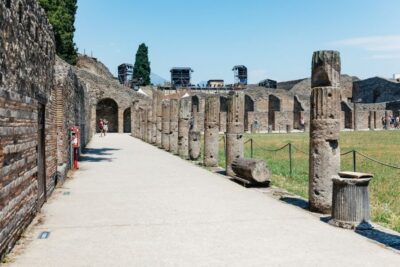
Once inside, the size of Pompeii becomes clear. This is not a compact monument with one obvious route. It is an ancient city with streets, public buildings, houses, workshops, and neighborhoods spread over a large area. A guide helps you choose what deserves your limited time.
The Forum and Basilica explain public Pompeii
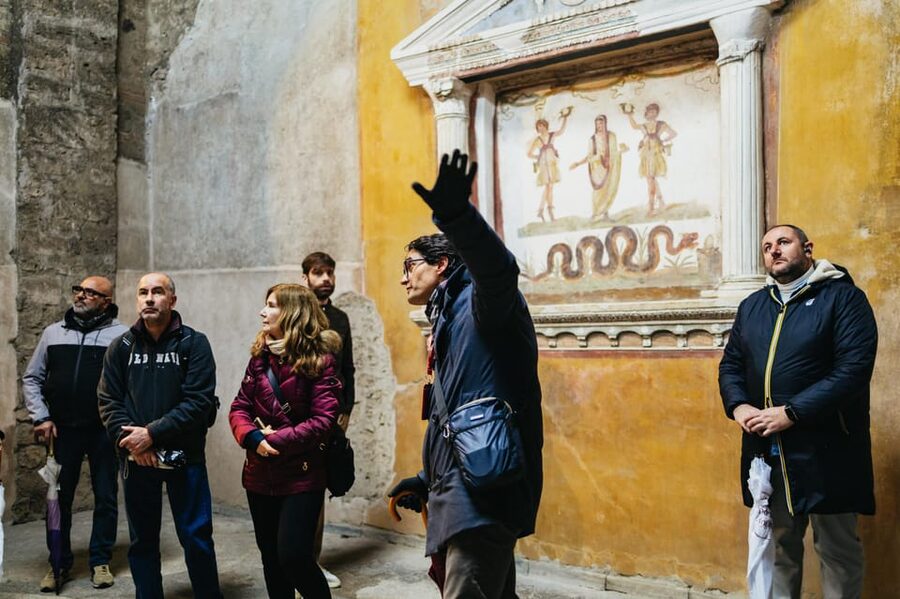
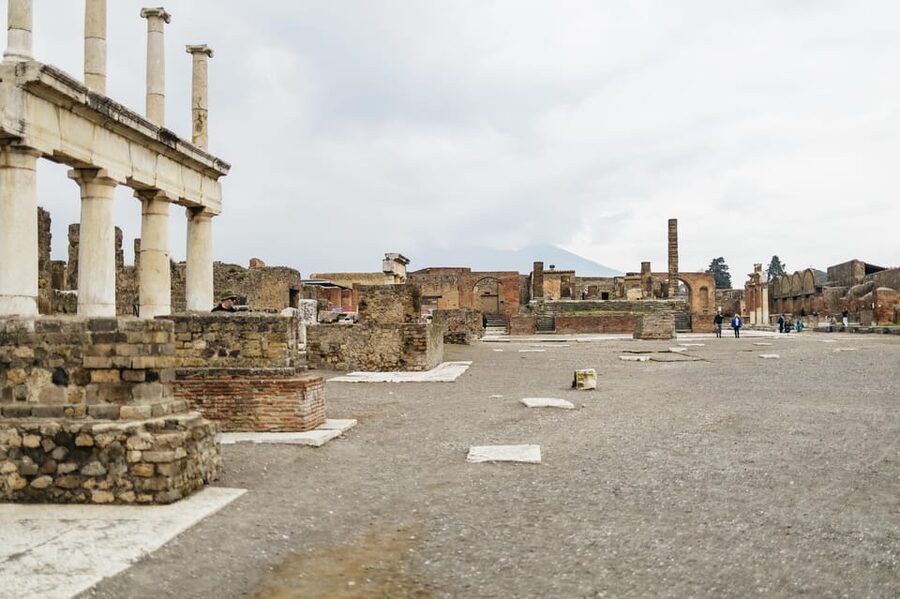
The Forum is the natural place to begin understanding the city. It was the civic center, and the guide can use it to explain how public, religious, and commercial life fit together in Roman Pompeii.
The Basilica is another important stop. Its scale and position help you picture the administrative and legal work that took place in the city before the eruption. Rather than seeing isolated stone walls, you begin to see a working urban center.
This is where an archaeologist guide earns the ticket price. The ruins often require imagination. A roof is gone, a wall may be partial, and the original use of a room is not always obvious. A strong guide connects the surviving structure with the people who used it.
Francesco and Frankie receive repeated praise for mixing facts with humor. That style matters at Pompeii, where a long stream of dates and building names can become hard to absorb. Their approach appears to focus on stories, Roman engineering, architecture, art, daily habits, and the human side of the city.
A few more Pompei Campania bookings to compare
- Naples: Pompeii and Mt. Vesuvius with Lunch and Wine Tasting
★ 4.5 · 2,454 reviews - Pompeii: Skip-the-line-Ticket and Guided Tour
★ 4.6 · 1,152 reviews - Pompeii: Small-Group Tour of Pompeii and Herculaneum
★ 4.8 · 867 reviews - Pompeii: Guided Tour with Skip-the-Line Entry
★ 4.9 · 812 reviews
Thermal Baths and the machinery of daily life
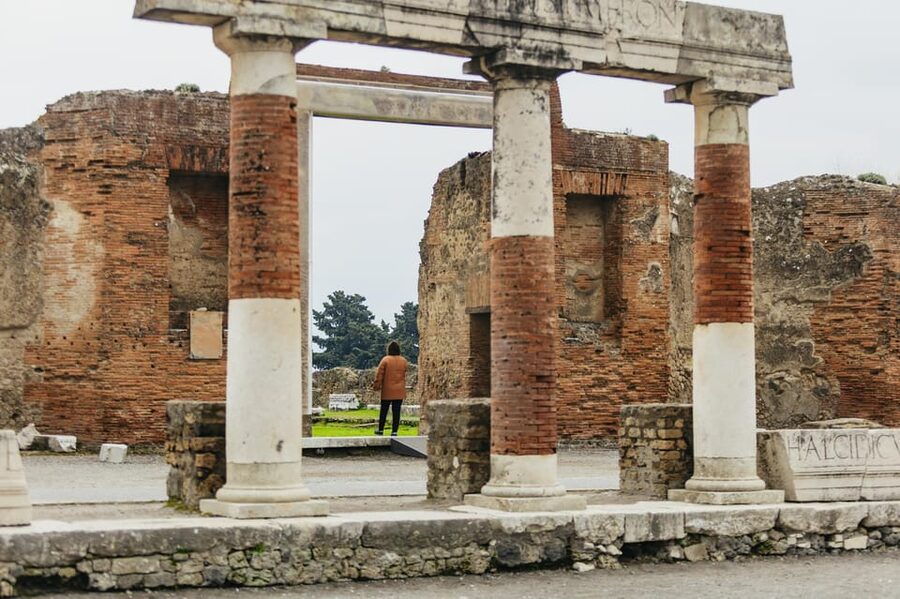
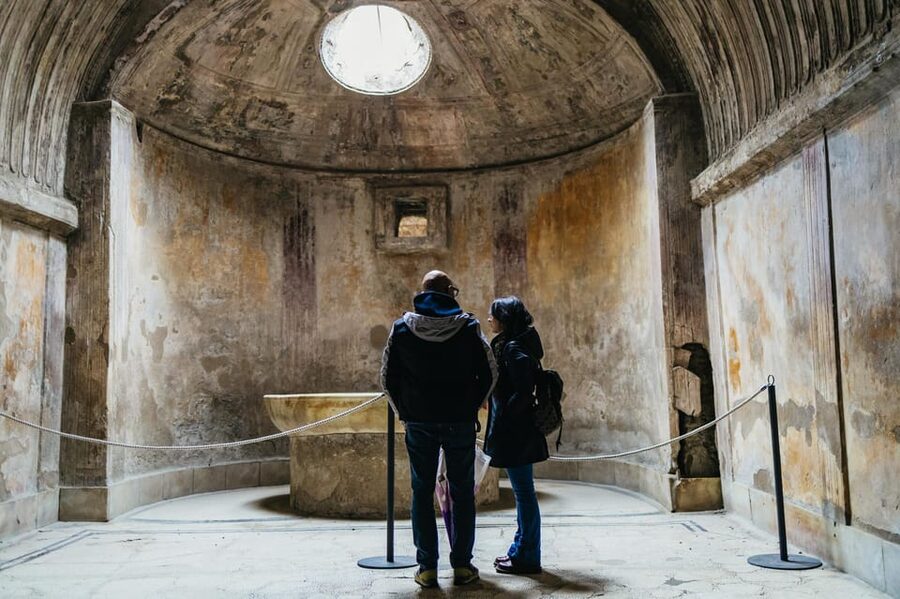
The Thermal Baths show that Pompeii was more than a collection of houses. Public bathing involved social time, washing, exercise, and the Roman heating system. The buildings give your guide a chance to explain how civic design served ordinary routines.
You will not simply pass through and hear a label. The point of the stop is to understand how a Roman bath complex worked and why it mattered to city life. The precise areas open during your visit can vary, so the route may not include every room.
Late afternoon is useful here because you may spend less time standing in full sun while the guide speaks. Francesco has been praised for finding shade during explanations and for adjusting the pace when the heat or distance became difficult.
That care is important for mixed-age groups. The tour has worked for groups ranging from children and teenagers to people in their seventies. It is still a walking tour over old streets, so you should be realistic about your stamina.
Theater, bakeries, and housing blocks
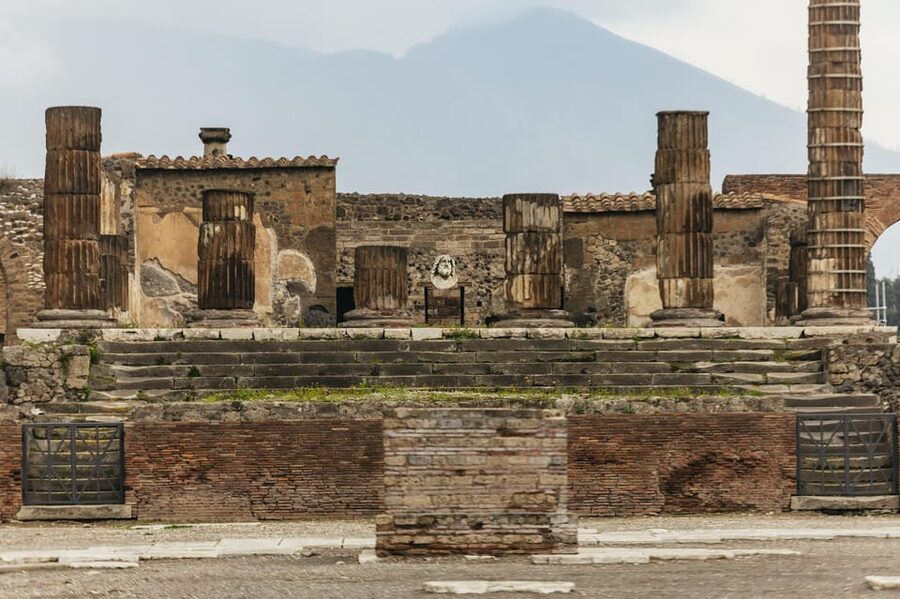
The Theater adds another side of Pompeii. It points to entertainment and public gathering, giving the tour a break from civic offices and bathing facilities.
The route also reaches commercial and residential areas. A bakery can reveal how food was produced and sold, while typical housing blocks show the practical side of city life. These stops are often more memorable than another grand public building because they make Pompeii feel inhabited.
I like this balance in the planned route. You see the official city through the Forum and Basilica, then move into the places where people worked, lived, and bought food. That mix helps you understand Pompeii as a functioning town, not only as an archaeological disaster.
The various neighborhoods also show why a guide is helpful. Without context, a bakery may look like a room with a few heavy stone fixtures. With an explanation, it becomes part of a larger system of work, food, trade, and household life.
You should expect selected examples rather than a complete tour of every residential quarter. If your top priority is one particular house, painting, or building, confirm the route with the guide at the start. A 2.5-hour walk has to make choices.
Understanding the eruption of Vesuvius
The eruption in 79 AD is the event most people associate with Pompeii, but this tour places it within the broader story of the city. You learn about Pompeii before the disaster, then consider how the eruption affected its buildings, population, and later society.
That order is useful. If you begin only with the catastrophe, Pompeii can seem like a frozen tragedy. Seeing the Forum, baths, shops, theaters, and homes first gives you a sense of what was lost.
The guide can also help you avoid treating the ruins as a simple snapshot of Roman life. Archaeology involves evidence, damaged structures, and ongoing interpretation. An archaeologist can explain what is clear, what is inferred, and why certain details matter.
This is one of the strongest reasons to choose a live guide instead of walking alone with a map. You can ask questions as they arise, and the route can respond to your group’s interests. A past visitor specifically appreciated the flexibility of asking questions instead of relying on an audio guide.
The guide makes or breaks the experience
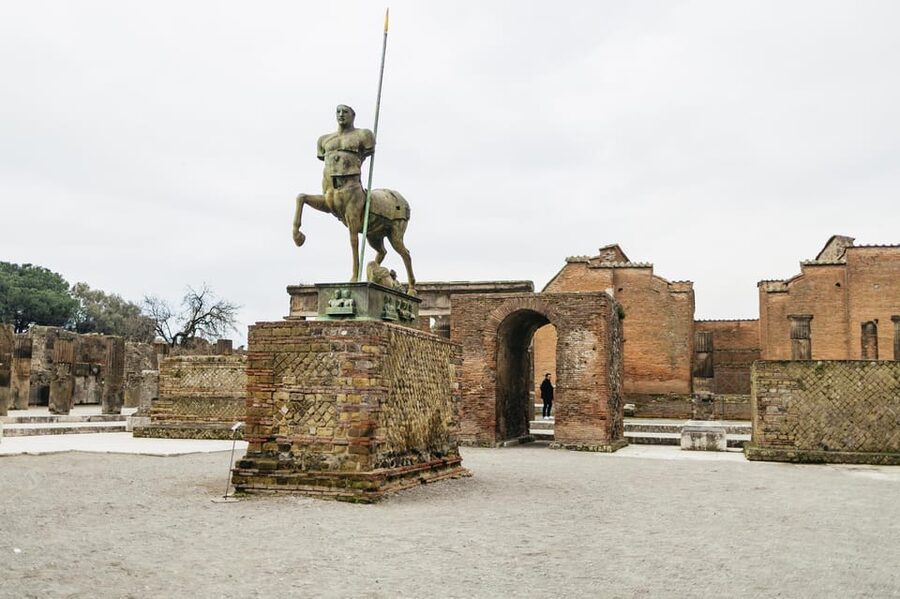
The clearest pattern in the feedback is the quality of the guides. Francesco, often called Frankie, receives especially strong praise for being funny, patient, caring, and well informed. Angelo is praised for passion and clear knowledge, while Anna is described as an archaeologist who brought both expertise and a local connection to the tour.
Names can change by date and language, so you should not book solely in the hope of receiving one particular person. The important point is that the company uses archaeologist guides and offers tours in Italian, English, and French.
A good guide also manages the physical side of Pompeii. The site can be overwhelming, and it is easy to spend too much energy at the first few buildings. Francesco has been praised for showing the key highlights, watching the group’s pace, pointing out uneven ground, and finding shade during stops.
Humor helps, too. Pompeii is serious, but a guide who can explain Roman life with warmth and a few jokes keeps the walk from becoming a lecture. The strongest comments describe guides who made the ruins feel understandable without losing the historical weight of the place.
Small groups, private tours, and family fit
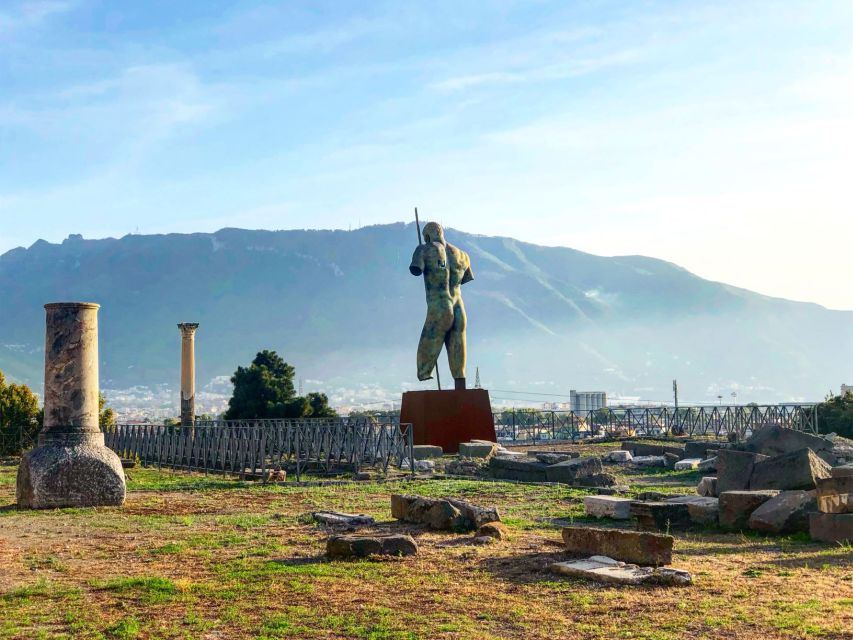
Small-group and private formats are available. A smaller party makes it easier to hear the guide, ask questions, and move at a reasonable pace. It can also feel less formal than a large group using radio headsets.
The experience suits first-time visitors particularly well. If you have never been to Pompeii, you may spend much of your first hour simply trying to understand the scale and layout. A focused route gives you a working map of the city.
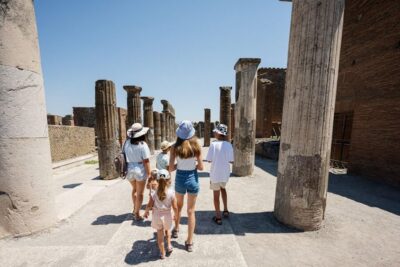
Families can also do well here, especially when children or teenagers have a guide who treats their questions seriously. The tour has been enjoyed by groups with a wide age range, including young people and older adults.
It is less suitable for anyone who struggles with long walks, uneven ground, heat, or standing for explanations. The activity is specifically not recommended for people with mobility impairments, heart problems, respiratory issues, or people over 95. That is not a minor warning at Pompeii. The distances and surfaces are real parts of the experience.
Is $58 a fair price?
At $58 per person, the tour is not the cheapest way into Pompeii. You are paying for two things: the entry ticket and the guide’s time. Transportation is not included, so your total day cost will be higher if you need a train, taxi, or other connection to the meeting point.
The value depends on how you want to use your time. If you are happy reading signs and choosing your own route, an independent visit may cost less. If you want the ruins explained as you walk, the guide can prevent a lot of aimless wandering in a very large site.
The 2.5-hour length is also part of the value. You get a focused introduction without giving the entire day to Pompeii. That works well if you are combining the archaeological site with another Campania plan, or if you know that a full-day archaeological visit would be too tiring.
The tradeoff is coverage. You will see major civic buildings, baths, the Theater, a bakery, and residential areas, but you will not see everything. One useful approach is to treat the guided walk as your foundation, then spend any remaining time visiting an area that interests you most.
What to expect after the guided walk
The formal tour lasts 2.5 hours. Depending on the closing rules, timing, and your group’s pace, you may have a little time afterward to continue on your own. Some people use that extra time to look for the Arena, which is not included in the main route described here.
Do not count on unlimited extra time without checking the day’s arrangements. The archaeological site has its own opening and closing schedule, and your guide can tell you what remains possible at the end.
If you need to catch a train, plan backward from the departure time. Pompeii is large enough that the walk to the exit, the meeting point, and the station can take longer than expected. Give yourself a margin instead of trying to squeeze in one last street.
Who should book this Pompeii tour?
You should consider it if you want:
- A first visit with a clear route through the major highlights
- Historical context from an archaeologist rather than labels alone
- A cooler, quieter alternative to a midday walk
- A small-group or private format
- A tour that begins in Pompeii rather than adding long transport from Rome or Naples
- Time to focus on Roman civic life, homes, businesses, and the eruption
You may want another option if you need full site coverage, have serious mobility or health limits, or prefer to explore alone at your own pace. You should also look elsewhere if transportation from your hotel is essential, since getting to Ristorante Bar Sgambati is your responsibility.
Final verdict: a smart way to meet Pompeii
I would book this tour for a first Pompeii visit, especially with an afternoon start. The cooler light, potentially smaller crowds, included entry, and strong guide style make it a practical package at $58.
Just set the right expectation. You are not seeing every corner of Pompeii. You are getting a well-chosen introduction to the Forum, Basilica, baths, Theater, homes, bakery, and the story of Vesuvius, with a guide who can turn broken walls into a readable city. If you want the site to feel like a place where people once worked, bathed, worshiped, shopped, and watched performances, this is a good use of two and a half hours.
FAQ
Where does the Pompeii tour meet?
Meet at Ristorante Bar Sgambati. Look for the red Enjoy Pompeii sign.
How long does the guided tour last?
The guided visit lasts 2.5 hours. Starting times vary, so check availability for your chosen date.
Is Pompeii admission included?
Yes. The experience includes a skip-the-line entry ticket through a separate entrance.
Is transportation included?
No. You must arrange your own transportation to the meeting point and back afterward.
What languages are available?
The live tour is offered in Italian, English, and French.
Can I cancel the booking?
Yes. You can cancel up to 24 hours in advance for a full refund. A reserve-now, pay-later option is also available.
Recently added around Pompei Campania
- Pompeii 3hours Villa of Mysteries tour with an Archaeologist★ 4.8 · 486 reviews
- Pompeii: Small-Group Tour of Pompeii and Herculaneum★ 4.8 · 867 reviews
- Pompeii: Skip-the-line-Ticket and Guided Tour★ 4.6 · 1,152 reviews
- Pompeii: Skip-the-Line Entry & Audioguide★ 3.8 · 225 reviews
- Pompeii: Guided Tour with Skip-the-Line Entry★ 4.9 · 812 reviews
- Pompeii: Tour with Archaeologist Guide & Skip-the-Line Entry★ 4.5 · 478 reviews
- Pompeii: Skip-the-Line Entry Ticket with Digital Guide App★ 4.1 · 770 reviews
- Pompeii: Day Tour of Pompeii and Vesuvius with Bus Transfer★ 4.2 · 250 reviews
Pompeii & Vesuvius Tours, compared.
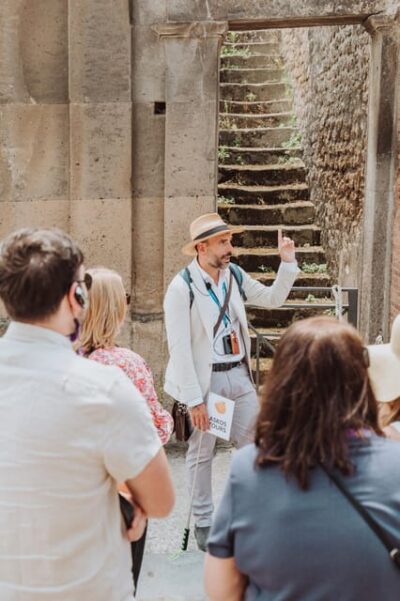
Entry Ticket and Guided Tour with an Archaeologist
Read our review →


Pompeii Small Group Tour with an Archaeologist
Read our review →
Pompeii, Amalfi Coast and Positano Day Trip from Rome
Read our review →Browse the lists this tour appears in