
Reviewed · POMPEII & VESUVIUS TOURS
Pompeii: Small-Group Tour of Pompeii and Herculaneum
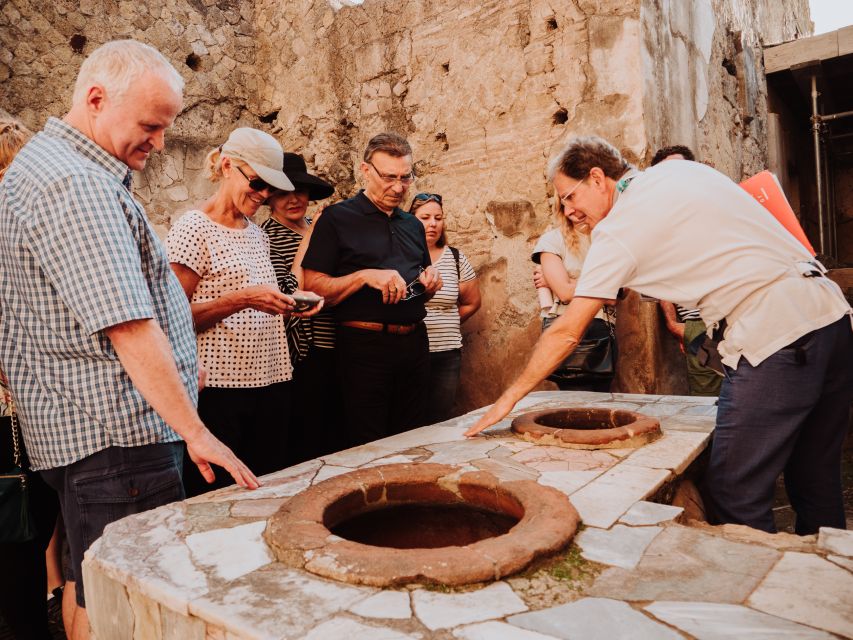
Two Roman cities, one unforgettable day. This 5.5-hour tour pairs Pompeii’s broad, ash-covered streets with Herculaneum’s remarkably preserved houses, paintings, and mosaics. An English-speaking archaeologist leads the walks, putting the ruins into everyday context instead of leaving you to guess what each broken wall once meant.
I especially like the two-site format and the way the tour uses an archaeologist guide. Pompeii shows the scale of an ancient city, while Herculaneum reveals finer domestic details. The main drawback is the pace: two hours at each site, a short 30-minute break, and the train transfer make for a full, tiring half-day.
The group can include up to 20 people, with headsets provided when more than 10 join. Guides such as Diego, Paolo, Vincenzo, Alfredo, Julia, Sergio, and Amedeo have been praised for making complex archaeology clear, lively, and easy to follow. Just remember that the tour finishes at Herculaneum, not back at Pompeii.
In This Review
- Key points to know before booking
- Why seeing both sites gives you a better picture
- Meeting at Porta Marina Inferiore
- Two guided hours through Pompeii
- The 30-minute break: useful, but tight
- Taking the Circumvesuviana to Ercolano
- Herculaneum: smaller, sharper, and better preserved
- What makes the archaeologist guide worth paying for
- Walking conditions, weather, and accessibility
- Is the combined tour good value?
- Who should book this experience?
- Should you book the Pompeii and Herculaneum tour?
- FAQ
- How long does the Pompeii and Herculaneum tour last?
- Where does the tour meet?
- Does the tour include entry tickets?
- What language is the tour conducted in?
- Is transportation back to Pompeii included?
- What should I bring?
- Is the tour suitable for wheelchair users?
Key points to know before booking
- Pompeii and Herculaneum in one half-day: You see the larger city first, then the smaller site with better-preserved buildings.
- An archaeologist leads both walks: Guides explain architecture, daily life, excavation, and the eruption rather than simply pointing out ruins.
- Small group of up to 20 people: This is more personal than a large coach tour, though the group can still feel sizeable at the maximum.
- Entry tickets are arranged: You do not need to handle the admission process yourself, and skip-the-line access is included.
- A short train ride connects the sites: The Circumvesuviana journey to Ercolano takes roughly 20 to 30 minutes.
- The tour ends at Herculaneum: You must arrange your own return to Pompeii or onward travel after the final guided walk.
Why seeing both sites gives you a better picture
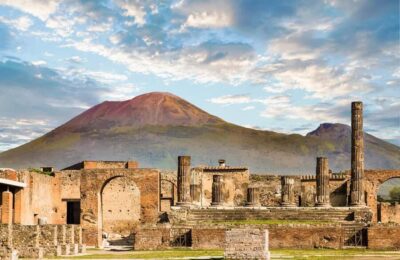
Pompeii and Herculaneum were both buried during the eruption of Mount Vesuvius in 79 A.D., but the disaster preserved them in different ways. That contrast is the main reason I think this combination works so well.
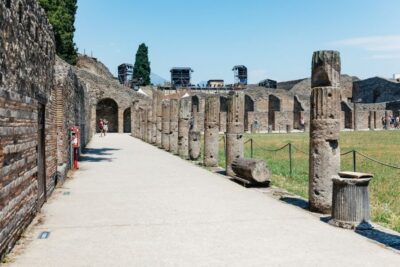
Pompeii was covered by roughly four meters of pumice and volcanic ash. Its streets, shops, public buildings, houses, wall paintings, and plaster casts give you a sense of a large working city suddenly interrupted. You can see how much ground the city covered and how Roman urban life was organized.
Herculaneum was buried under an avalanche of mud around 20 meters thick. The heavier material helped preserve parts of upper floors, wooden objects turned to charcoal, painted walls, mosaics, and domestic details that are less common at Pompeii. The site is smaller, but the surviving interiors can feel more immediate.
I find the pairing useful because Pompeii gives you breadth and Herculaneum gives you detail. At Pompeii, you begin to understand the city. At Herculaneum, you get closer to the private lives of the people who lived there.
More Pompeii and Vesuvius trips:
- Pompeii: Entry Ticket and Guided Tour with an Archaeologist
★ 4.8 · 19,459 reviews - Pompeii: Small Group Tour with an Archaeologist
★ 4.8 · 12,264 reviews - Pompeii: Skip-the-Line Entrance Ticket with Audio Guide
★ 4.0 · 2,509 reviews
Meeting at Porta Marina Inferiore
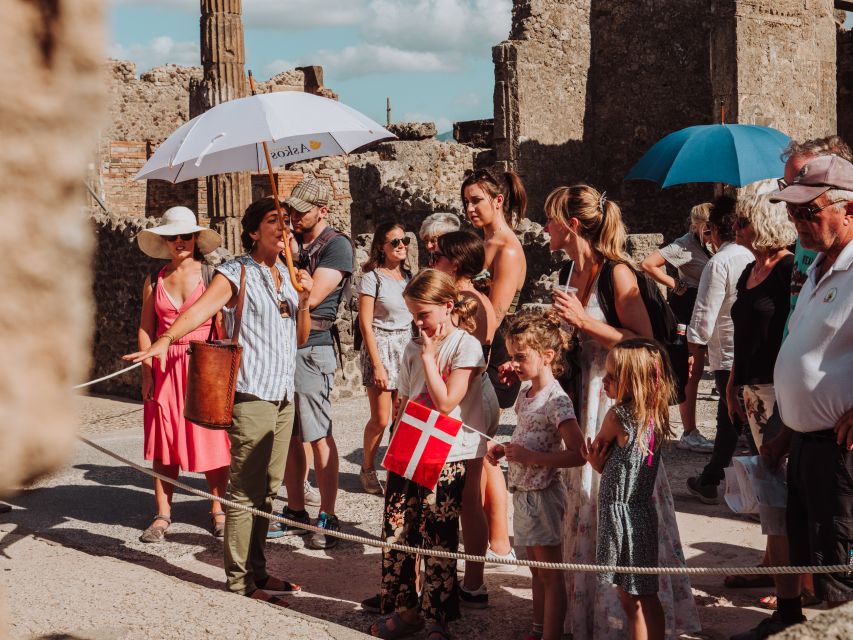
The meeting point is on the left side of the Pompeii entrance called Porta Marina Inferiore, near the Arte bus stop. Look for the guide holding an Askos Tours sign. The location is only a few minutes from the Pompei-Villa dei Misteri Circumvesuviana station, but the entrance area has several tour groups, so allow time to identify the right person.
One practical point matters here: the sign may not be as large or obvious as you expect. It is sensible to have the meeting-point name and the coordinates, 40.7470817565918, 14.484834671020508, saved on your phone.
The tour starts with the Pompeii Archaeological Site. Admission tickets for both locations are provided, so you can focus on finding the guide rather than sorting out entry. Bring your passport or identity card, as this is specifically requested.
Two guided hours through Pompeii
The Pompeii walk lasts about two hours. That is enough time to visit selected highlights and get a clear explanation of the site, but not enough to cover every street and building. Pompeii is enormous, and anyone promising to show you everything in one visit is selling you a fantasy.
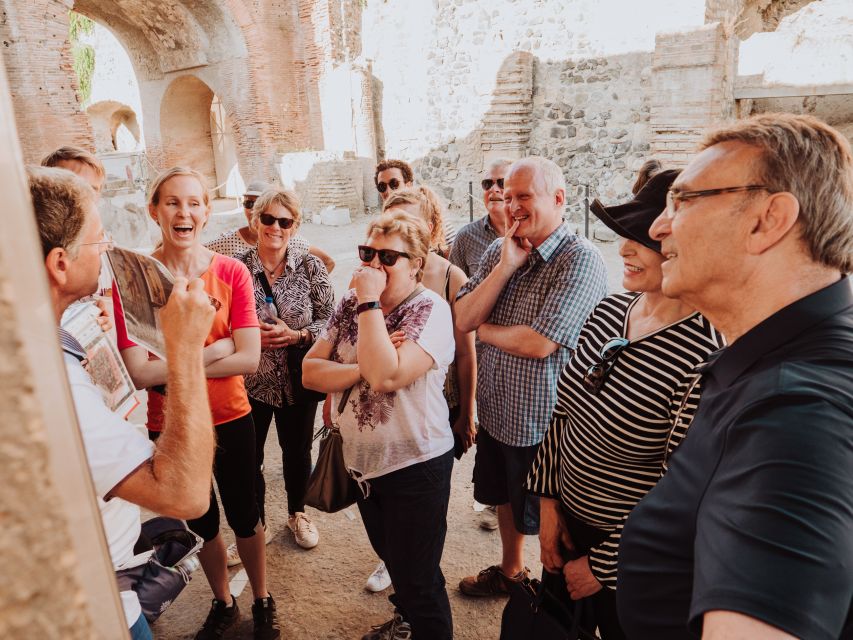
This is where the archaeologist guide matters most. Without context, a Roman wall can look like just another old wall. A guide can explain how the rooms were used, what the decorative details suggest about the owners, and how archaeologists interpret evidence that is still incomplete.
The strongest part of the experience is the connection between physical remains and ordinary life. You are not only looking at ruins caused by a volcano. You are considering how people worked, ate, socialized, decorated their homes, and moved through the city before the eruption.
The plaster casts can also be emotionally difficult. They preserve the final positions of people caught in the ash, and seeing them in person can make the disaster feel far more personal than a textbook account. The site is impressive, but it is not simply a scenic attraction. Give yourself room to process what you are seeing.
The guide also helps you avoid wasting time. Several people have praised guides for choosing quieter routes, returning to important areas when crowds thin, and pointing out sections that you might miss alone. In a place with so many open streets and partial buildings, that direction has real value.
In hot weather, shade and water become important. One guide, Antonio, was praised for caring for the group in high temperatures, while another kept the group in shaded areas whenever possible. You should still bring your own water, hat, sunglasses, and comfortable clothing. The ruins offer little relief from the sun in some sections.
The 30-minute break: useful, but tight
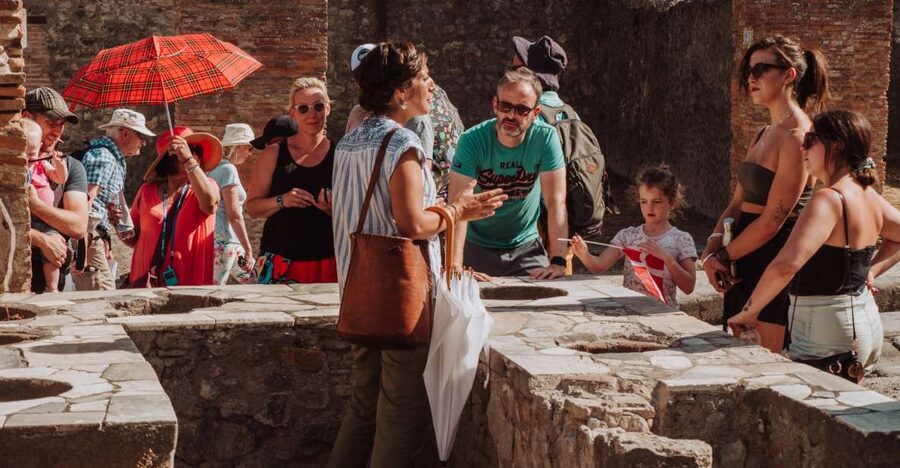
After Pompeii, the schedule allows around 30 minutes for a break. You can buy lunch, use the toilet, or look through the souvenir shops outside the ruins.
This is the weakest part of the schedule. Thirty minutes is enough for a quick sandwich, but it is not much of a rest after two hours of walking. If you want a proper sit-down meal, you may find the time frustrating. Some people have found themselves eating quickly outside rather than cooling down comfortably.
I would treat this as a short refueling stop, not lunch. Eat something before the tour begins, carry water, and keep your expectations modest. If you need a longer meal or a proper break, this combined tour may feel rushed.
The short pause does keep the day moving, however. You are not losing a large part of the tour to an extended restaurant stop, and the two archaeological visits remain the focus.
A few more Pompei Campania bookings to compare
- Naples: Pompeii and Mt. Vesuvius with Lunch and Wine Tasting
★ 4.5 · 2,454 reviews - Pompeii: Skip-the-line-Ticket and Guided Tour
★ 4.6 · 1,152 reviews - Pompeii: Guided Tour with Skip-the-Line Entry
★ 4.9 · 812 reviews - Pompeii: Skip-the-Line Entry Ticket with Digital Guide App
★ 4.1 · 770 reviews
Taking the Circumvesuviana to Ercolano
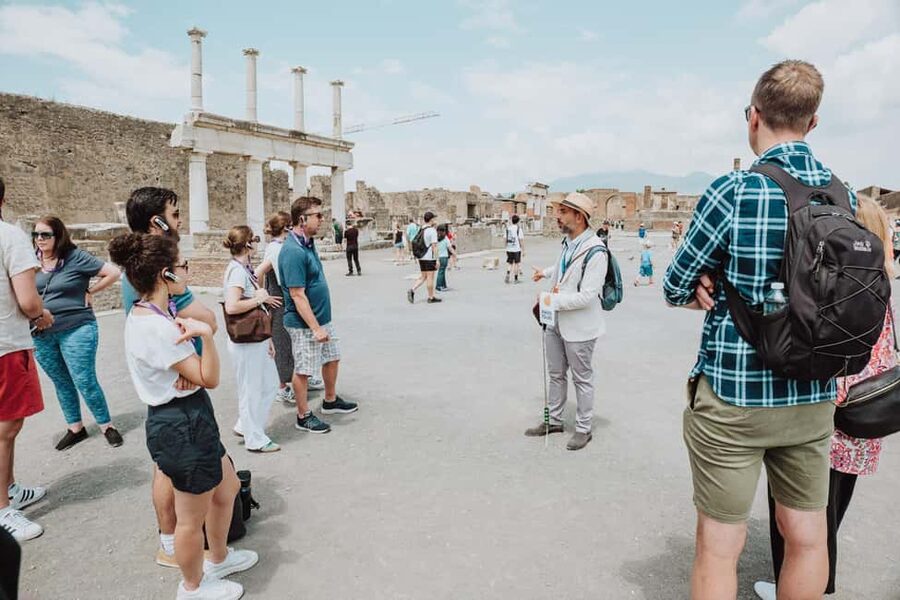
The group then takes the Circumvesuviana train to Ercolano, the town serving Herculaneum. The journey is described as about 20 minutes, while the full transfer allowance is closer to 30 minutes. Train delays are possible, and one reported delay made the day longer than planned.
The train ride is part of the practical character of the tour. This is not a private luxury excursion with every movement handled by a coach. You travel as people in the area often do, and the guide stays with the group. On one occasion when train problems affected the route, the operator used a private minibus instead.
The transfer also gives the guide a chance to continue the story. One guide, Rafael, used the journey to share personal memories of growing up on a farm in the countryside, adding a human touch between the formal site visits.
The important logistical detail is the ending. After the Herculaneum tour, you finish at Parco Archeologico di Ercolano. There is no included ride back to Pompeii. If your car, hotel, or train connection is in Pompeii, plan the return before you book. A local commuter train is available, but one person noted that the walk to the station can involve an uphill walk of roughly 25 minutes.
Herculaneum: smaller, sharper, and better preserved
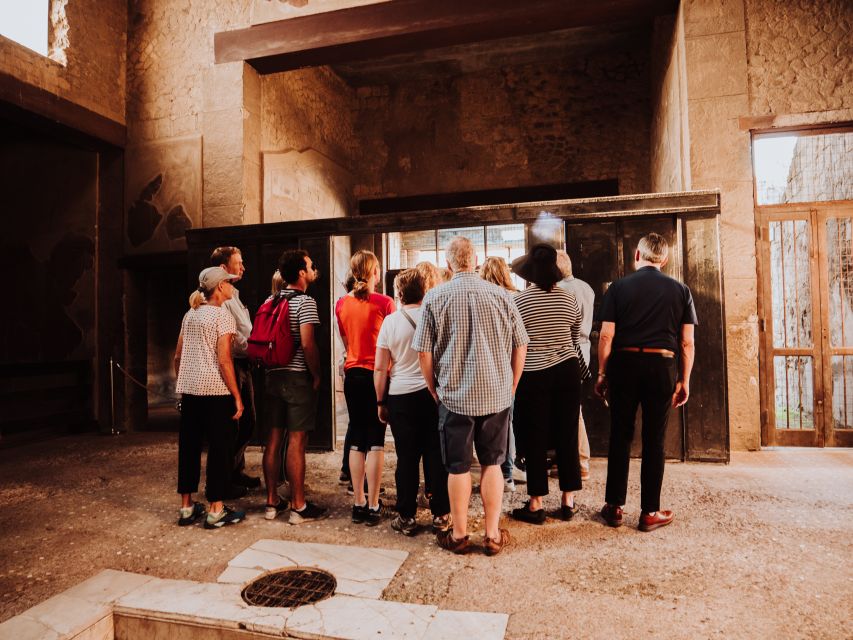
The guided walk at Herculaneum lasts about two hours. The site is far smaller than Pompeii, which makes it easier to understand in a limited amount of time. Yet the preserved details can be even more striking.
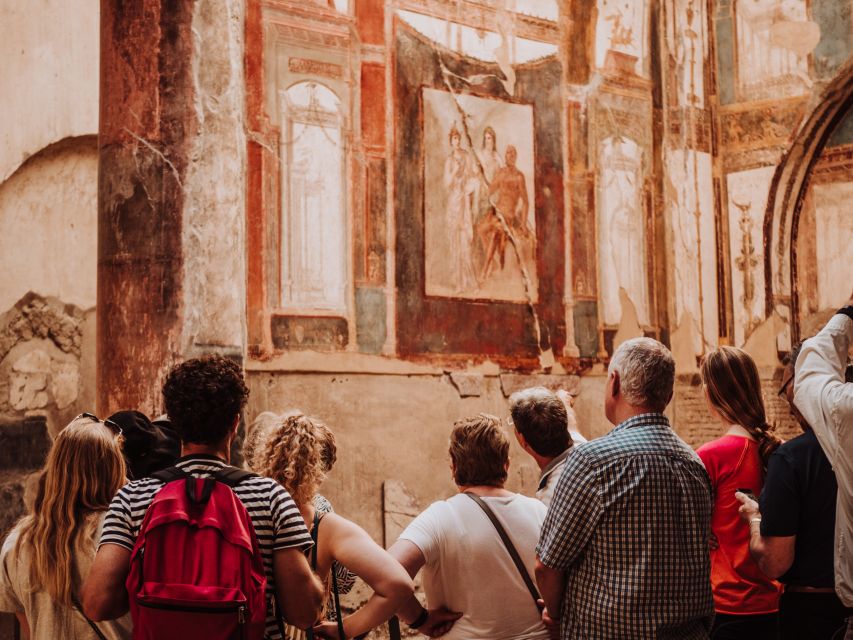
Here you may see second floors, carbonized wooden objects, intact mosaics, paintings, and wall decoration. These details bring you into the homes of wealthier Roman residents and show a level of domestic comfort that can be harder to grasp at Pompeii.
The contrast is powerful. Pompeii often feels like a city laid open, with streets leading past homes, businesses, and public spaces. Herculaneum can feel more intimate, with interiors that reveal the taste and spending power of individual households.
A good guide will connect the two sites rather than treating Herculaneum as an extra stop. Paolo, Alfredo, Diego, and others have been praised for explaining not only what survived, but also how excavations and preservation shape what you see today. That distinction matters because the ruins are not a complete snapshot of Roman life. They are the portion that survived burial, excavation, and centuries of change.
The site can also challenge your assumptions about ancient cities. The paintings, mosaics, and wooden objects are not just decorative leftovers. They help you picture color, furniture, household routines, and social status in a way that bare stone cannot.
What makes the archaeologist guide worth paying for
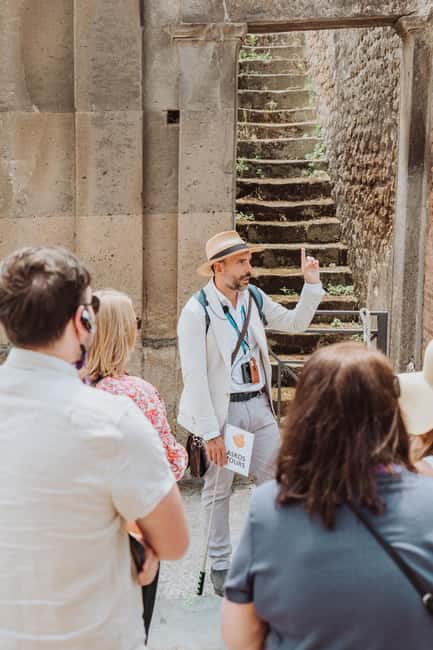
I would not choose this tour simply for transportation or admission. The real purchase is interpretation.
Both sites are large, uneven, and filled with partial remains. There is plenty to see, but not every important detail is self-explanatory. A guide can show you where to look, explain why a feature matters, and answer questions without forcing you to decode a map or audio guide.
The best guiding style here appears to combine archaeology with stories. Guides have been praised for humor, clear explanations, patience, and the ability to bring Roman life back into focus. Vincenzo, Paolo, Antonio, Diego, Amedeo, Julia, and Alfredo are among the names associated with especially strong experiences.
That said, the quality of any guided tour depends partly on the individual guide and the group. A group of 20 is still not private, and a very talkative guide may leave you full of information by the end. One person described the day as long with a great deal to absorb. I would agree that you should expect a concentrated history lesson with a lot of walking.
Headsets are supplied for groups larger than 10. This is a small but important feature. At Pompeii, where streets spread out and other groups gather nearby, being able to hear the guide without standing shoulder to shoulder makes the experience much easier.
Walking conditions, weather, and accessibility
Wear comfortable clothes and sturdy walking shoes. The ground at ancient sites can be uneven, and you will be on your feet for roughly four hours of guided touring, plus the transfer and break.
Summer heat can make the schedule feel harder than the clock suggests. Bring water, sunglasses, and a hat. A raincoat or poncho is also wise because sudden showers can arrive, and much of the tour takes place outdoors.
This experience is not suitable for wheelchair users or people with mobility impairments. If you tire easily, have difficulty with uneven ground, or need frequent long rests, a shorter single-site tour may be a better fit.
The tour is conducted in English, with Italian also available as a language option. Ask about the specific departure language when booking if that choice matters to you.
Is the combined tour good value?
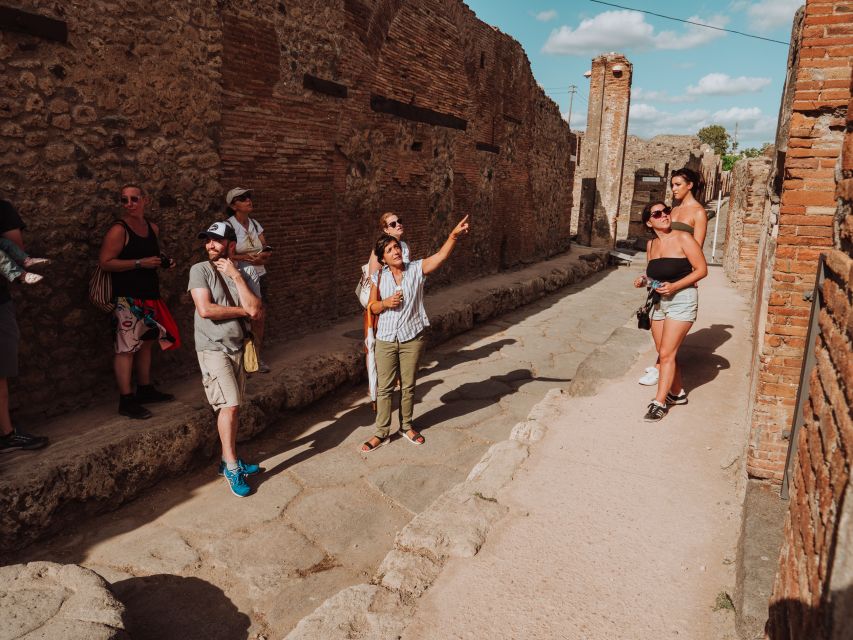
The value depends on what you want from Pompeii and Herculaneum. If you only want to enter the sites and wander independently, a guided tour costs more than admission alone. But the fee covers the structure of the day, tickets, a guide, and the chance to see two major archaeological sites without planning every connection yourself.
The strongest value comes from the archaeologist’s explanations. Many of the most meaningful details are easy to miss when you walk alone. You may recognize a mosaic or a plaster cast, but the guide helps explain how it fits into the larger story of Roman society and the eruption.
It is also efficient for a day trip from Naples or Rome, provided you can manage an early start and the return journey. You visit Pompeii first, transfer to Herculaneum, and finish there. That arrangement saves you from organizing separate bookings, though it does not solve the final transport back to Pompeii.
The combination is less appealing if you want a relaxed lunch, lots of time for photography, or a slow independent exploration. For that, book separate site visits or a private tour with more control over the pace.
Who should book this experience?
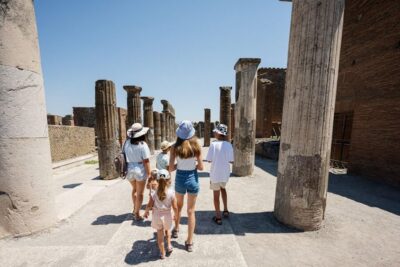
I would recommend it to first-time visitors who want to understand both sites in one day. It suits history fans, families with older children, and anyone who worries that Pompeii will feel confusing without help. One guide kept a 10-year-old engaged, which suggests that a lively presentation can work well for mixed-age groups.
It is also a good match for people who value social history. The guides focus on how people lived, not only on emperors, dates, and volcanic geology. You get a clearer sense of ordinary routines and the refined homes of wealthier residents.
I would think twice if you dislike group schedules, need a long midday rest, or have mobility limitations. The tour is well organized, but it is still a fixed half-day with a short break and a shared train transfer.
Free cancellation up to 24 hours ahead and the option to reserve now and pay later make planning easier. Those policies are useful, but the more important decision is physical: you need to be ready for a long walk in changing weather.
Should you book the Pompeii and Herculaneum tour?
Yes, if your priority is understanding both sites rather than simply checking them off a list. The archaeologist guide, included admission, small-group setting, and efficient transfer make this a strong choice for a first visit.
Book it knowing the tradeoffs. Lunch is brief, the day can run longer if trains are delayed, the group may reach 20 people, and you finish at Herculaneum. If those points work for your plans, this tour gives you an unusually useful comparison: Pompeii’s broad city streets and Herculaneum’s preserved interiors, brought together by guides who know how to make ancient stones speak.
FAQ
How long does the Pompeii and Herculaneum tour last?
The tour lasts 5.5 hours. The schedule includes about two hours at Pompeii, a 30-minute break, roughly 20 to 30 minutes by train, and about two hours at Herculaneum.
Where does the tour meet?
Meet on the left side of the Pompeii entrance called Porta Marina Inferiore, near the Arte bus stop. The guide will hold an Askos Tours sign.
Does the tour include entry tickets?
Yes. Entry tickets for both archaeological sites are provided, and skip-the-line entry is included.
What language is the tour conducted in?
The tour is available in English and Italian. The English option is specifically described in the tour details.
Is transportation back to Pompeii included?
No. The tour ends at Parco Archeologico di Ercolano, so you need to arrange your own onward travel or return to Pompeii.
What should I bring?
Bring a passport or identity card, comfortable clothing, water, sunglasses, and a hat in summer. A raincoat or poncho is useful if showers are possible.
Is the tour suitable for wheelchair users?
No. The experience is not suitable for wheelchair users or people with mobility impairments.
Recently added around Pompei Campania
- Pompeii 3hours Villa of Mysteries tour with an Archaeologist★ 4.8 · 486 reviews
- Pompeii: Skip-the-line-Ticket and Guided Tour★ 4.6 · 1,152 reviews
- Pompeii: Skip-the-Line Entry & Audioguide★ 3.8 · 225 reviews
- Pompeii: Guided Tour with Skip-the-Line Entry★ 4.9 · 812 reviews
- Pompeii: Afternoon to Sunset Guided Tour with Ticket★ 4.9 · 484 reviews
- Pompeii: Tour with Archaeologist Guide & Skip-the-Line Entry★ 4.5 · 478 reviews
- Pompeii: Skip-the-Line Entry Ticket with Digital Guide App★ 4.1 · 770 reviews
- Pompeii: Day Tour of Pompeii and Vesuvius with Bus Transfer★ 4.2 · 250 reviews
Pompeii & Vesuvius Tours, compared.
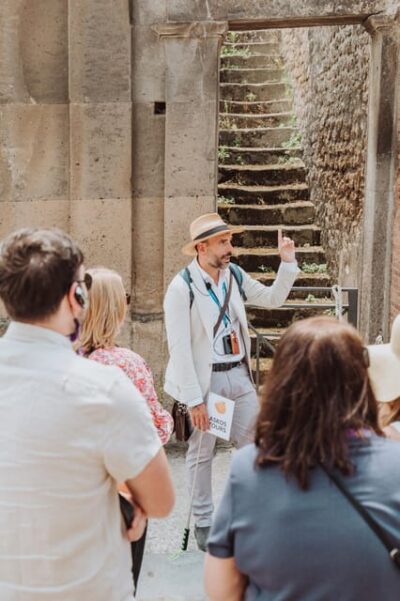
Entry Ticket and Guided Tour with an Archaeologist
Read our review →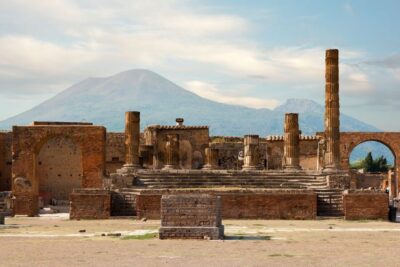
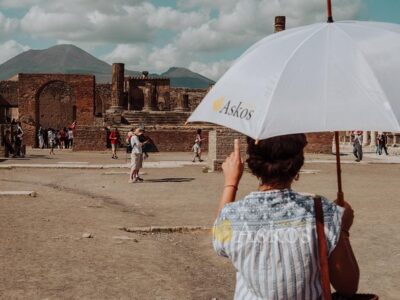
Pompeii Small Group Tour with an Archaeologist
Read our review →
Pompeii, Amalfi Coast and Positano Day Trip from Rome
Read our review →Browse the lists this tour appears in