
Reviewed · POMPEII & VESUVIUS TOURS
Pompeii: Guided Walking Tour with Entrance Ticket
Pompeii makes the past feel surprisingly close. This two-hour walk brings the buried Roman town into focus, from the broad Forum to wine shops, public baths, and the Lupanare. I like the way a live guide turns broken walls into scenes of daily life, and I like that the €20 entrance ticket and headsets are included. The main caution is timing: meeting-point confusion and late starts have affected some departures.
At $50 per person, this is a fair buy if you want Pompeii explained rather than simply photographed. Guides such as Elisa, Salvatore, Francesca, Miguel, Maria, and Mattia have earned especially warm praise for mixing facts with humor. Still, two hours only covers a small portion of this huge site, so you should not expect a complete visit.
In This Review
- Key points to know before booking
- What the two-hour Pompeii route gives you
- Entering through the archaeological site
- The Forum and Pompeii’s public life
- Thermal Baths and ordinary Roman routines
- The Lupanare and the less polished side of Pompeii
- Streets, shops, and signs selling wine
- What the eruption adds to the visit
- Guides, headsets, and the human side of the tour
- Is $50 good value for Pompeii?
- Who should book this Pompeii walk?
- Should you book the Pompeii Guided Walking Tour?
- FAQ
- How much does the Pompeii guided walking tour cost?
- How long does the tour last?
- Where is the meeting point?
- Is the Pompeii entrance ticket included?
- Which languages are available?
- Are headsets provided?
- Does the tour include transportation?
- What should I bring?
- Can people with mobility impairments or wheelchair users join?
Key points to know before booking
- The Forum anchors the tour: You get the essential civic center and a useful introduction to how Pompeii worked.
- The Lupanare adds a frank look at Roman life: The guide explains the building without avoiding its adult subject matter.
- Headsets help in a crowded ruin: You can hear the guide while walking or standing a short distance away.
- The meeting point needs care: Find the garden of Hotel Vittoria, outside the Cellini coral shop on Via Mare.
- The guide makes the difference: The strongest feedback praises clear explanations, humor, patience, and good handling of children.
- Two hours is a smart introduction, not a full exploration: You can remain inside afterward and see areas beyond the guided route.
What the two-hour Pompeii route gives you
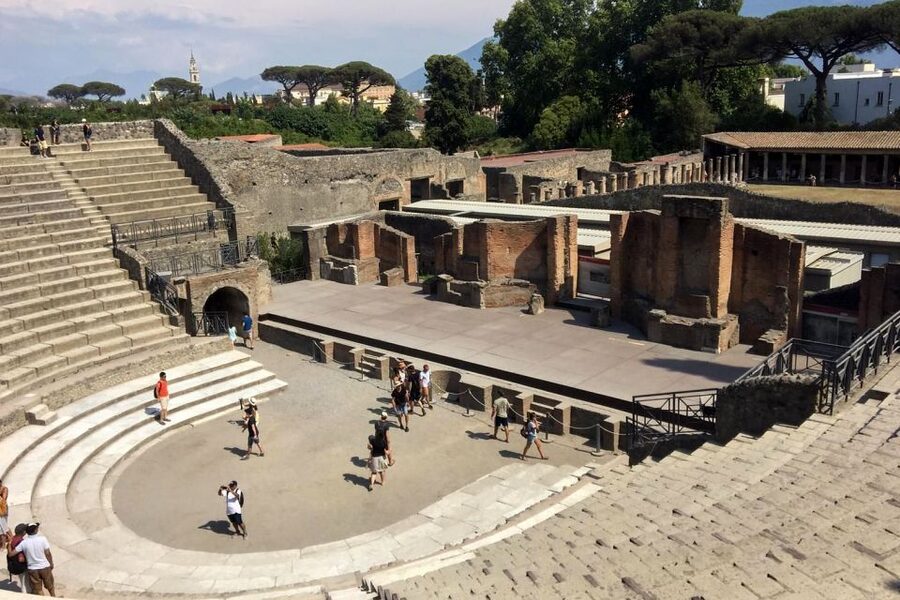
Pompeii is not a single monument. It is a city, with streets, houses, shops, public buildings, baths, and religious and civic spaces spread across a large archaeological area. Volcanic ash from Mount Vesuvius covered the town in 79 A.D., preserving an unusually vivid record of Roman urban life.
That scale is the reason I recommend a guide for a first visit. Without context, you can spend your time looking at stones and trying to guess what each room did. With a guide, a doorway becomes part of a home, a counter becomes a shop, and a paved street starts to make sense as part of an organized city.
The route is designed to show the main sights within two hours. It moves at a purposeful pace, with time for photographs and questions, but it cannot cover every lane and building. One useful feature is that you can continue exploring independently after the guided walk.
The exact sequence may vary, since access and site conditions can change, but the advertised focus includes the Forum, Thermal Baths, Lupanare, streets, shops, and other important buildings.
More Pompeii and Vesuvius trips:
- Pompeii: Entry Ticket and Guided Tour with an Archaeologist
★ 4.8 · 19,459 reviews - Pompeii: Entry Ticket with Optional Audio Guide
★ 4.2 · 12,360 reviews - Pompeii: Small Group Tour with an Archaeologist
★ 4.8 · 12,264 reviews
Entering through the archaeological site
The included entrance ticket removes one job from your morning. The tour includes access to the Pompeii Archaeological Site, listed at €20, and is designed to skip the long ticket line.
That does not mean the entrance area will feel calm. Pompeii can be crowded around the gates, and the meeting area may have several tour groups, shops, guides, and arriving visitors. One practical tip matters more than it should: do not simply look for a bus or a large banner.
The meeting point is at 10:50 a.m. in the garden of Hotel Vittoria, just outside the Cellini coral shop at Via Mare, 80045 Pompei. The guide should carry a sign with the booking name. Give yourself extra time to locate this spot, especially if you are arriving by train or have not visited Pompeii before.
Several bookings have involved people arriving late because of train trouble, traffic, strikes, or trouble finding the group. The operator has sometimes called, used WhatsApp, sent someone to search the area, or waited for delayed participants. That is encouraging, but you should not treat patience as a guarantee. Arrive early and keep the local contact details handy.
The Forum and Pompeii’s public life
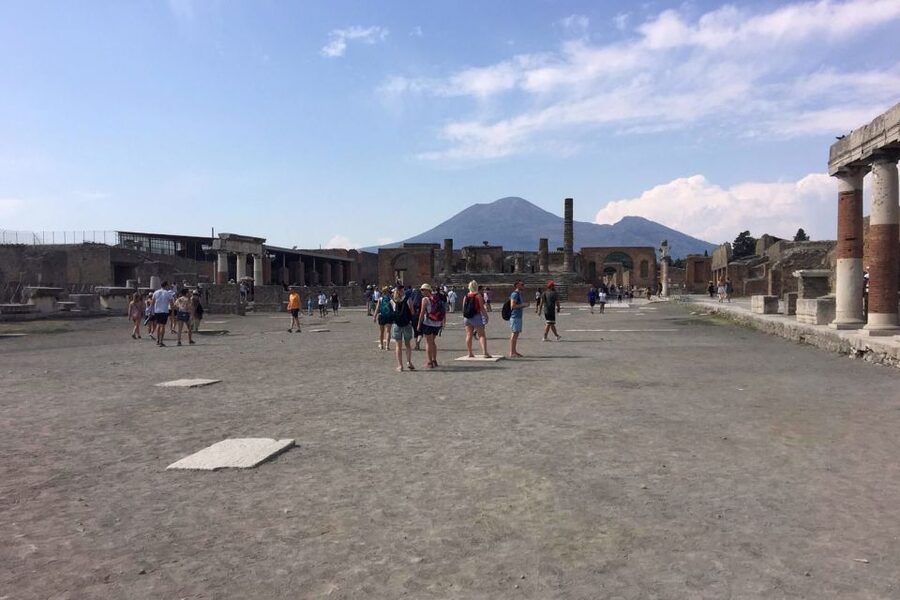
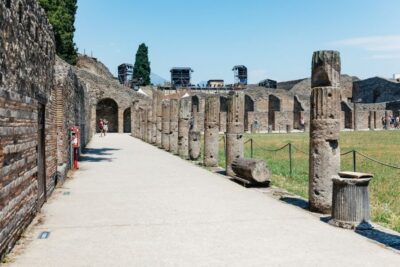
The Forum is the natural heart of the visit. In Roman towns, this open civic space was tied to public business, religion, politics, and commerce. Here, the guide can give you the broad picture before the walk turns to more intimate corners of the city.
This is where the tour’s emphasis on Roman culture becomes useful. You are not only looking at columns and paving. You are learning how public life fitted together with homes, shops, temples, and services.
The Forum also gives you a sense of Pompeii’s size. The ruins extend far beyond the most famous photographs, and the open spaces can make the town feel both grand and strangely empty. The contrast between a busy ancient center and its sudden burial is part of what makes this place so affecting.
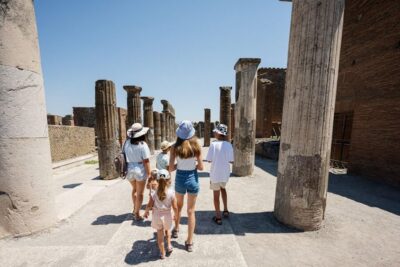
The guide’s skill matters here. The best guides use stories and comparisons to keep the explanation moving. Mattia was praised for being both funny and informative, while Alex was singled out for involving children. That combination helps families and first-time visitors stay engaged during a stop that could otherwise become a long lecture.
Thermal Baths and ordinary Roman routines
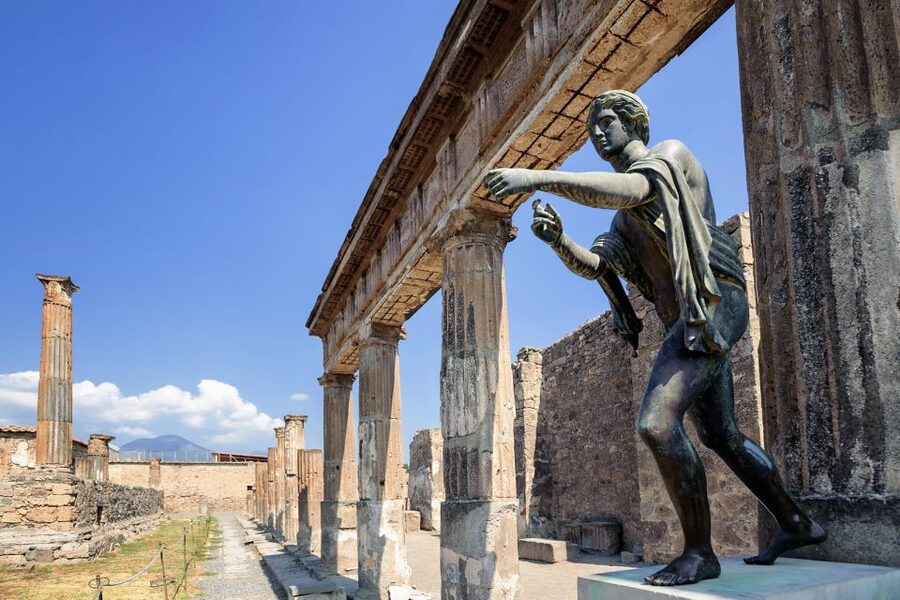
The Thermal Baths show a more practical side of Roman life. Public bathing was not just about getting clean. It was part of social routine, public construction, and city life.
You can expect the guide to explain how the baths fit into the town and what their rooms tell us about Roman habits. The value here is in the structure and use of the building, not only its surviving decoration. Pompeii lets you see the physical setting of routines that written accounts often describe in abstract terms.
This stop also shows why comfortable shoes are essential. Surfaces can be uneven, and the tour involves steady walking across exposed archaeological ground. The site offers little shelter from strong sun in some areas, so dress for the forecast and bring what you need for the weather. The tour operates in rain and other conditions, rather than stopping simply because the day is unpleasant.
Heat is a real issue. One visitor found the tour hot even in mild summer temperatures, while another managed an enjoyable visit despite poor weather. A two-hour route is long enough to feel the sun but short enough to remain manageable for most people who can walk comfortably.
More Walking Tours in Pompeii:
- Herculaneum: 3D Walking Tour with Skip-the-Line Ticket
★ 4.3 · 313 reviews - Discover Pompeii: French Walking Tour of the Buried City
★ 4.8 · 253 reviews - Milan: Guided Walking Tour & Last Supper Visit with Ticket
★ 4.7 · 5,409 reviews - Naples: Street Food Walking Tour with Local Guide
★ 4.8 · 4,256 reviews
The Lupanare and the less polished side of Pompeii
The Lupanare is one of Pompeii’s most talked-about buildings. Its name refers to a brothel, and the site provides a direct look at a part of Roman society that is often cleaned up in popular presentations.
A good guide handles this stop with clarity and a little humor. The supplied tour information specifically promises an explanation of Roman daily life, and the strongest guide feedback repeatedly praises an entertaining style. You should expect the subject to be discussed openly, so this may not suit very young children or anyone seeking a strictly formal presentation.
The importance of the Lupanare is not just its reputation. It helps broaden your view of Pompeii beyond temples, wealthy houses, and official buildings. The city included many kinds of people and activities, and the tour makes room for that less ceremonial side of life.
One past participant noted that the guide was friendly and engaging but less academic than some visitors might prefer. That is a useful distinction. This tour is aimed at making Pompeii understandable and memorable. If you want a specialist archaeological lecture, you may find the commentary lighter than expected.
Streets, shops, and signs selling wine

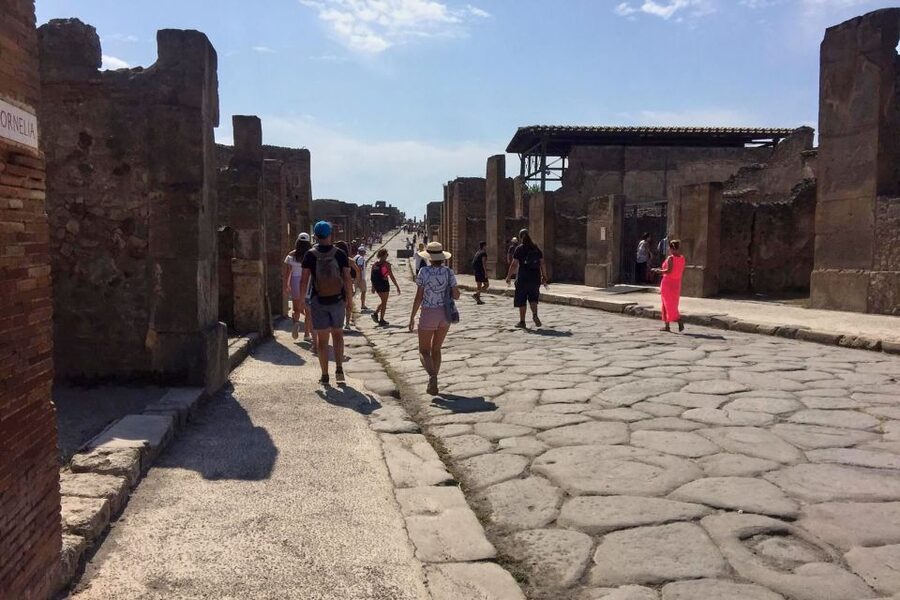
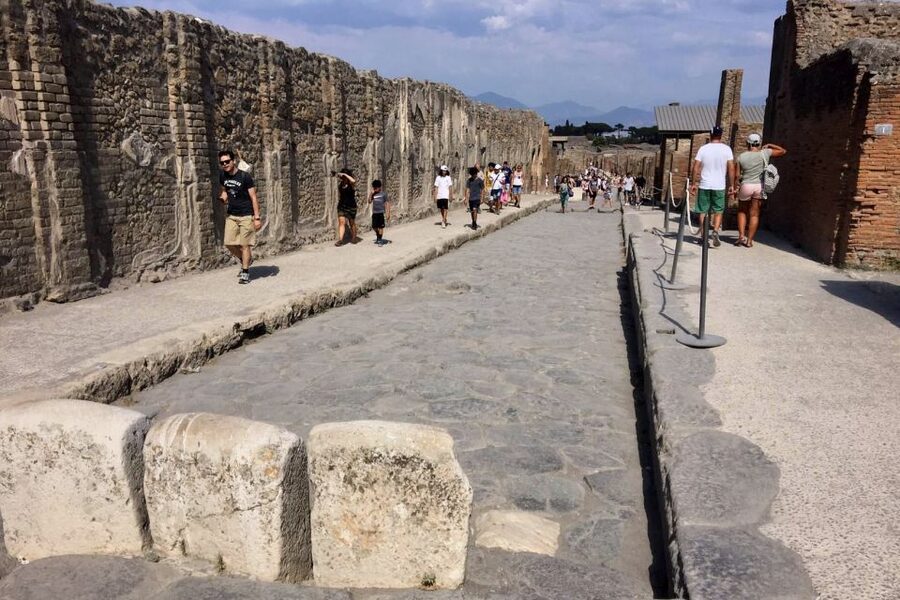
The streets may be the most revealing part of the walk. You see how the city was laid out and how homes and businesses faced onto shared public space.
The tour includes shops with signs advertising produce, including wine. Details like these are small, but they are what make Pompeii feel like a place where people worked, shopped, ate, argued, and went home at the end of the day.
I like this part of the route because it shifts attention away from famous monuments. The Forum explains the city’s public face. The shops and streets show its daily pulse. Together, they give you a more complete idea of Pompeii as a living town before the eruption.
The preservation is remarkable, but it is also incomplete. Much of the city has been excavated over the past few centuries, and sections remain to be uncovered or are closed for protection. One visitor estimated that only around two thirds of the site is currently excavated. You should see Pompeii as an ongoing archaeological project, not a finished museum frozen in perfect condition.
What the eruption adds to the visit
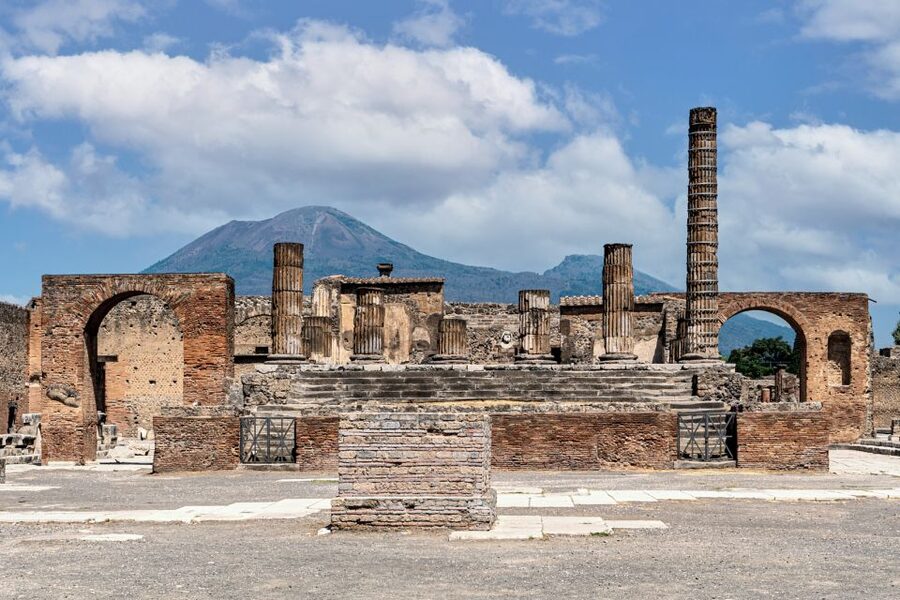
The guide also explains what happened on that day in 79 A.D. This historical context changes the way you look at the ruins. The ash and rock did not simply destroy buildings. They buried streets, interiors, objects, and traces of human activity for nearly two thousand years.
The result can be emotional. The city is not presented only as an ancient backdrop. Its sudden end is visible in the damage, the empty rooms, and the preserved details that still suggest the people who lived there.
Much of Pompeii’s movable art and artifacts has been taken elsewhere for protection or display. The National Archaeological Museum in Naples is important if you want to see more of what was found, but this tour focuses on the city itself. Here, you understand how the pieces fit into streets and buildings.
That distinction matters. A museum can show you a beautiful fresco or object at close range. Pompeii shows you the setting that gave those things meaning.
Guides, headsets, and the human side of the tour
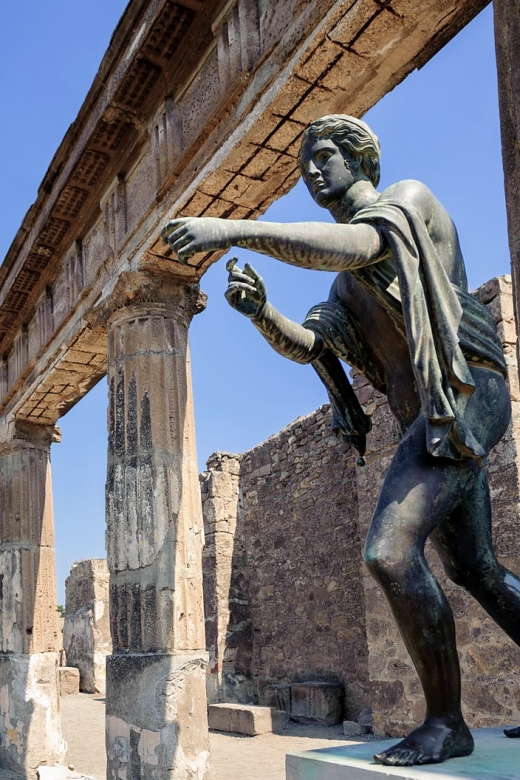
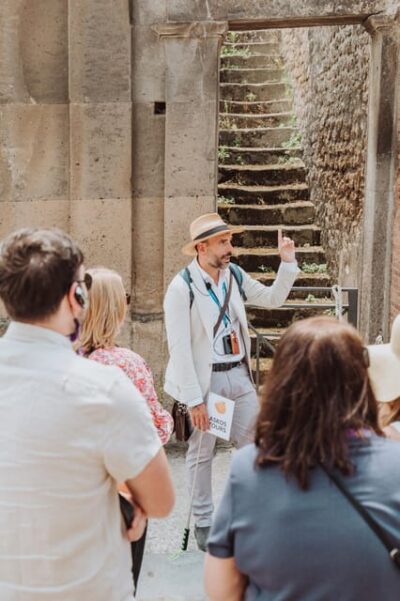
Guide quality is the tour’s biggest strength. The most praised guides are described as funny, warm, energetic, and able to answer questions. Elisa received repeated praise for making the ruins entertaining while explaining them clearly. Francesca was also praised for useful facts and a style that worked for different ages.
You may be assigned a guide in English, French, Spanish, or Italian. A multilingual guide may lead the group, and the exact language arrangement is not guaranteed if only one person books in a particular language. If language is important to you, keep that condition in mind.
Headsets are included so you can hear the commentary clearly. This is especially useful when the guide stops in an open space or when the group spreads out along a street. One person found the audio equipment uncomfortable and preferred an earbud-style design, but most feedback treats the headsets as essential rather than decorative.
The group size can affect the experience. Some departures have felt too large, and one delayed start was linked to group organization. Once underway, the actual explanations were still praised, but a big group can make it harder to keep close, ask questions, or take photographs without blocking others.
Is $50 good value for Pompeii?
At $50, the price is reasonable for a first visit if you value interpretation and convenience. The entrance ticket alone is listed at €20, leaving the rest to cover the guide, organization, and audio equipment.
You are not paying for transport, hotel pickup, food, or drinks. That is fine if you are already near Pompeii, but you need to arrange your own route to the meeting point. The tour is based in Pompeii rather than offering a transfer from Naples or another Campania destination.
The price is strongest for people with limited time. Two hours with a guide can give you a clear framework, then you can stay inside to see more on your own. It is less attractive if you already have strong archaeological knowledge or plan to spend a full day reading detailed material independently.
The rating of 4.3 from 1,423 reviews points to a dependable experience with some organizational weaknesses. The tour itself is generally the reason to book. The arrival process is where you should allow extra patience.
Who should book this Pompeii walk?
I would choose this tour for a first-time visitor who wants the major sights explained without committing to a full day. Families may appreciate the humor and the way some guides involve children. The route also suits anyone arriving by train who wants a fixed two-hour visit before continuing elsewhere in Campania.
It is a good fit if you want:
- A live explanation rather than a self-guided walk
- Entry included in the booking price
- A short introduction to Pompeii’s public and private life
- Help making sense of the Forum, baths, shops, and Lupanare
- A tour in English, French, Spanish, or Italian
- The option to continue alone afterward
It is not suitable for wheelchair users or people with mobility impairments. The walking surfaces, distance, weather exposure, and archaeological setting make that limitation important.
You should also avoid scheduling a tight train connection immediately after the stated end time. Most tours finish as planned, but previous departures have started 30 to 45 minutes late because of meeting-point or group problems. That may be unusual, yet Pompeii is not the place for a rushed exit.
Should you book the Pompeii Guided Walking Tour?
Yes, if you want a clear and lively introduction to Pompeii at a sensible price. The Forum, Thermal Baths, Lupanare, and street shops offer a strong mix of public life, personal routine, and frank social detail. The best guides, including Elisa, Francesca, Salvatore, Miguel, and Mattia, turn the ruins into a readable city.
Book it with realistic expectations. Arrive early at the Hotel Vittoria meeting point, wear sturdy comfortable shoes, prepare for sun or rain, and leave spare time after the tour. If you need a small group, a highly academic lecture, or guaranteed language arrangements for a solo booking, this may not be your ideal choice.
For most first visits, though, the combination of included entry, clear audio, strong guides, and a focused two-hour route makes this a practical way to begin understanding Pompeii.
FAQ
How much does the Pompeii guided walking tour cost?
The tour costs $50 per person. The price includes the Pompeii Archaeological Site entrance ticket, listed at €20.
How long does the tour last?
The guided walk lasts two hours. You may stay afterward to explore parts of the archaeological area that were not included in the guided route.
Where is the meeting point?
Meet at 10:50 a.m. in the garden of Hotel Vittoria, outside the Cellini coral shop at Via Mare, 80045 Pompei. The guide should have a sign with the booking name.
Is the Pompeii entrance ticket included?
Yes. Entrance to the Pompeii Archaeological Site is included, along with skip-the-ticket-line access.
Which languages are available?
Live guides are available in English, French, Spanish, and Italian. A multilingual guide may operate the tour, and a specific language is not guaranteed when only one participant books that language.
Are headsets provided?
Yes. Headsets are included so you can hear the guide clearly during the walking tour.
Does the tour include transportation?
No. Hotel pickup, drop-off, and transportation are not included. You must make your own way to the meeting point in Pompeii.
What should I bring?
Bring comfortable shoes, weather-appropriate clothing, and a passport or ID card for children booked at the child fare.
Can people with mobility impairments or wheelchair users join?
No. The tour is not suitable for people with mobility impairments or wheelchair users.
Recently added around Pompeii
- Pompeii Ruins Private Tour with Optional Skip-the-Line Entry★ 4.9 · 732 reviews
- Pompeii 3hours Villa of Mysteries tour with an Archaeologist★ 4.8 · 486 reviews
- Pompeii: Group Tour with an Archeologist Guide★ 4.4 · 490 reviews
- Pompeii: Exclusive Tour with Archaeologist and Entry Tickets★ 4.9 · 634 reviews
- Pompeii: Skip-the-Line Tickets and Tour with Archaeologist★ 4.9 · 467 reviews
- Pompeii: Small-Group Tour of Pompeii and Herculaneum★ 4.8 · 867 reviews
- Pompeii: Skip-the-Line Guided Tour with Expert Archaeologist★ 4.8 · 196 reviews
- Pompeii: Skip-the-line-Ticket and Guided Tour★ 4.6 · 1,152 reviews
Pompeii & Vesuvius Tours, compared.
Entry Ticket and Guided Tour with an Archaeologist
Read our review →


Pompeii Small Group Tour with an Archaeologist
Read our review →
Pompeii, Amalfi Coast and Positano Day Trip from Rome
Read our review →Browse the lists this tour appears in