
Reviewed · HISTORICAL TOURS
Verona: History and Hidden Gems Guided Walking Tour
Verona rewards a slower look. This two-hour walk with local guide Fabio Massimo Rapanà connects the Arena, medieval squares, Roman gates, river views, and easy-to-miss architectural details into one clear story. At $41 per person, it is a sensible way to get your bearings before exploring Verona on your own.
I like the small groups of up to 10 people, and I like the supplied headsets even more. You can hear Fabio beside a busy street or in a crowded square without standing shoulder to shoulder around a flag. The main consideration is simple: this is a walking tour with many stops but no interior admissions, so you will need comfortable shoes and separate tickets if you want to enter the Arena or other sights.
Fabio was born and raised in Verona, and that local connection shapes the experience. He explains not only what a building is, but why it matters and how it fits into the city’s Roman and medieval past. The route also passes Juliet’s House, but the real focus is the Verona you might miss while hurrying toward the balcony.
In This Review
- Key points to know before booking
- Starting beneath the Italian flag in Piazza Bra
- From early walls to Porta Borsari
- River views and the overlooked details of the Corso
- Piazza delle Erbe and the market’s long story
- Piazza dei Signori and medieval Verona
- Small squares, riverfront views, and local orientation
- Romeo, Juliet, and the truth behind the story
- How Fabio guides the group
- Is two hours enough for Verona?
- Who will get the most from this walk?
- Is the $41 price fair?
- Should you book this Verona walking tour?
- FAQ
- Where does the Verona walking tour start?
- How long does the tour last?
- What languages are available?
- How large is the group?
- Are entry tickets included?
- Is the tour wheelchair accessible?
- What should I bring?
- Can I cancel or pay later?
Key points to know before booking
- A native Veronese guide: Fabio Massimo Rapanà brings personal familiarity with the city alongside formal licensing and a strong command of its history, architecture, and daily character.
- A compact route with broad coverage: In two hours, you move from Piazza Bra and the Roman Arena through Porta Borsari, the Adige River, Piazza delle Erbe, Piazza dei Signori, and Juliet’s neighborhood.
- Small groups make a real difference: With no more than 10 participants, questions are easier, the pace feels more personal, and Fabio can keep the group together without shouting.
- Excellent sound equipment: Each person receives an earpiece connected to Fabio’s microphone, a useful feature for anyone with hearing difficulty or anyone tired of chasing a guide through noisy streets.
- More than famous sights: The walk includes side streets, old foundations, public buildings, church façades, bridges, and tucked-away viewpoints that are easy to pass without context.
- Good first activity in Verona: The route helps you understand the city before returning to places you want to explore at greater length.
Starting beneath the Italian flag in Piazza Bra
The tour begins at Palazzo Barbieri, Verona’s Town Hall, in Piazza Bra. Look for Fabio below the Italian flag. This is a practical meeting point because Piazza Bra is easy to find and puts you immediately beside the city’s most famous Roman monument.
The opening visit to Piazza Bra lasts only a few minutes, but it gives Fabio room to explain how this broad public space relates to the Arena and to modern Verona. You are not simply being led toward a photo stop. You begin by seeing how the square works as the city’s front door.
The Verona Arena receives about 10 minutes. Fabio explains the gladiatorial contests once held here and points out details of the amphitheater’s design. The Arena is one of those monuments that can seem familiar before you arrive, especially if you have seen countless photographs, but a good explanation makes its scale and survival more meaningful.
This part is mainly exterior viewing and photography. Entry is not included, so you will need a separate ticket if you want to attend an opera, concert, or visit inside. That is not a flaw in this particular walk, but it matters when planning your time and budget.
More Walking Tours in Verona
- Verona: Small Group Guided Walking Tour with Arena Tickets
★ 4.9 · 848 reviews - Verona walking tour:food, wine, legends, lunch/dinner & cable car
★ 5.0 · 386 reviews - Verona All in one: Food Walking Tour, Lunch & Wine
★ 5.0 · 342 reviews
From early walls to Porta Borsari
After the Arena, the route follows the foundations of Verona’s early medieval walls toward the Corso, described as one of the oldest streets in the city. This transition is one of the tour’s strongest features because it links separate monuments instead of treating them as isolated stops.
At Porta Borsari, Fabio introduces a Roman-era gateway that once marked an important entrance into Verona. You get around five minutes for a visit and photographs. It is a brief stop, yet it helps you read the street as an old route through the city rather than just a shopping corridor.
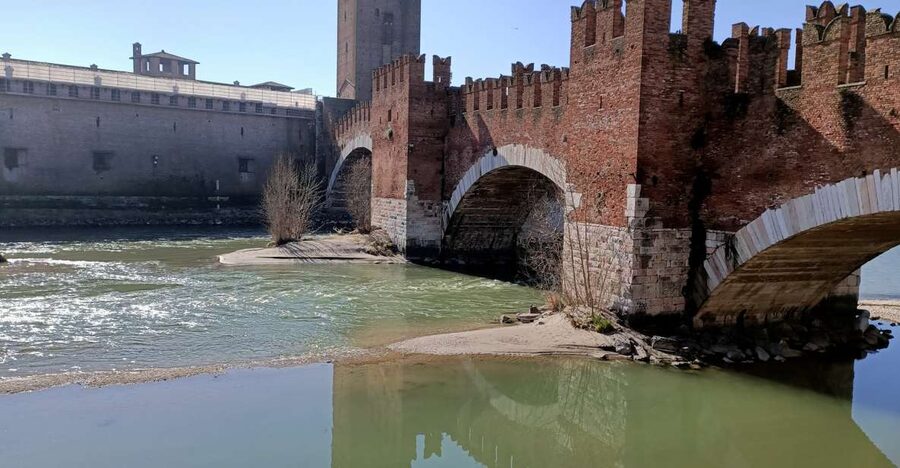
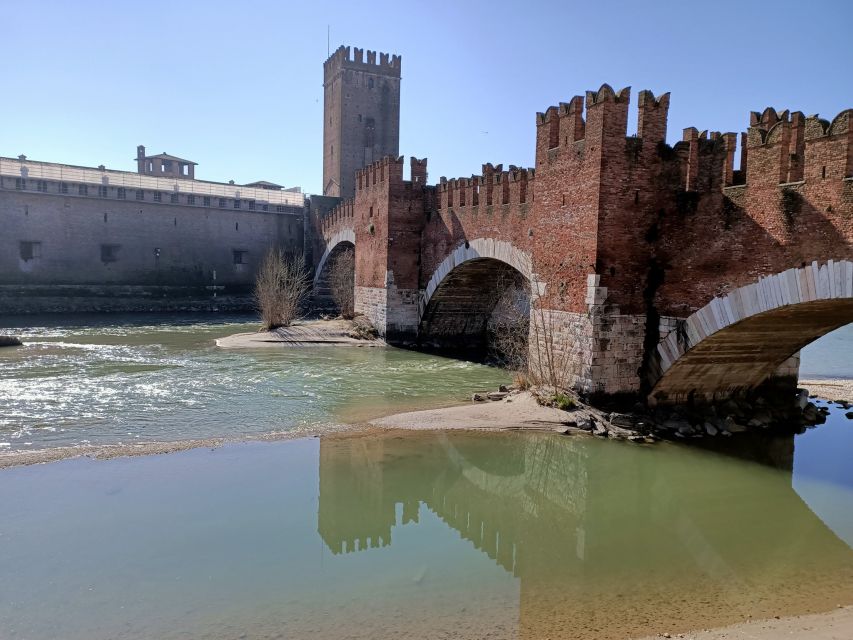
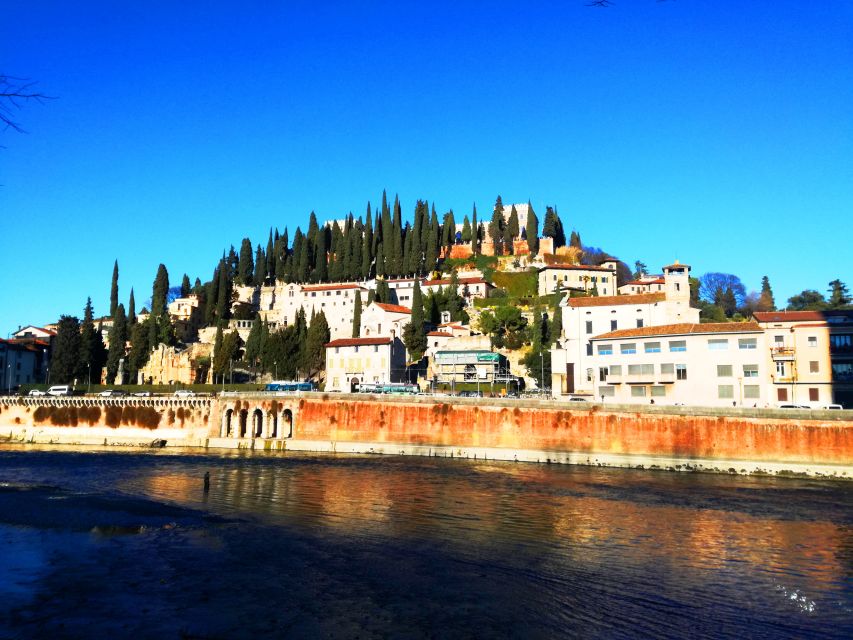
The walk continues toward Porta Jovia, another Roman-era monument, and the Riva San Lorenzo area. The route gives you scenic views toward Castelvecchio and the Ponte Scaligero. These riverfront views add variety after the stone streets and formal squares.
The Ponte Scaligero is especially striking from the outside, with its medieval fortification character and position above the Adige. You do not spend a long period at every location, so keep your eyes open while moving. The tour’s value comes partly from the way Fabio keeps the story moving between landmarks.
River views and the overlooked details of the Corso
Several short stops are marked as secret or lesser-known locations. These are not long sightseeing visits, but they are important to the character of the walk. Fabio points out details that you could easily overlook, including architectural features, old street patterns, and traces of earlier periods.
At Riva San Lorenzo, the river offers a welcome change of pace and a good setting for photographs. Some of the stops along the way last only two minutes, so this is not the right tour for stopping at every doorway or taking a long series of posed pictures.
That quick rhythm suits you if you want a strong orientation in a limited time. It may feel brisk if you prefer lengthy visits at each monument. The route is designed for storytelling, not for entering every church or museum.
One useful feature is the headsets. Fabio speaks through a microphone, and you receive an earpiece. This lets you look at the buildings while listening, rather than choosing between hearing the explanation and finding a place near the guide. It was particularly appreciated by people with some hearing loss, and it also helps in noisy areas.
Piazza delle Erbe and the market’s long story
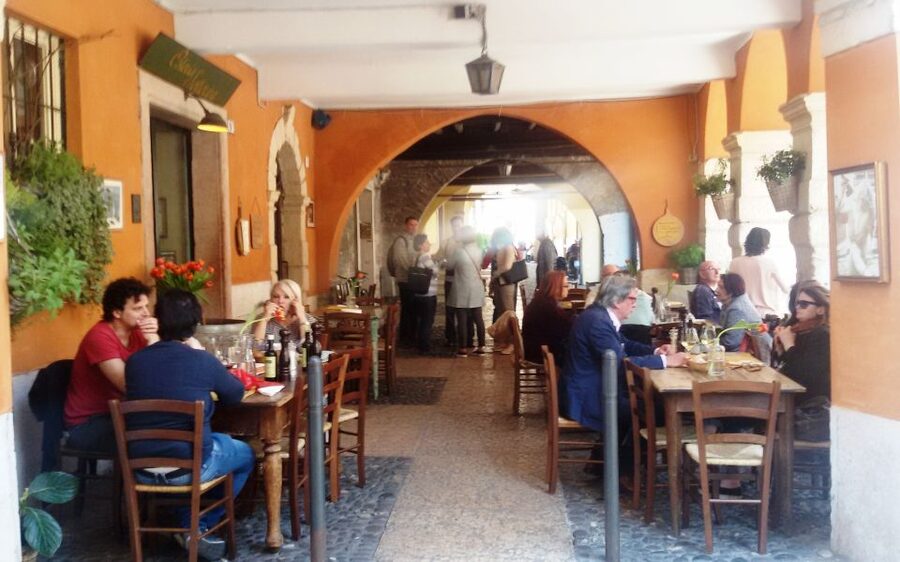
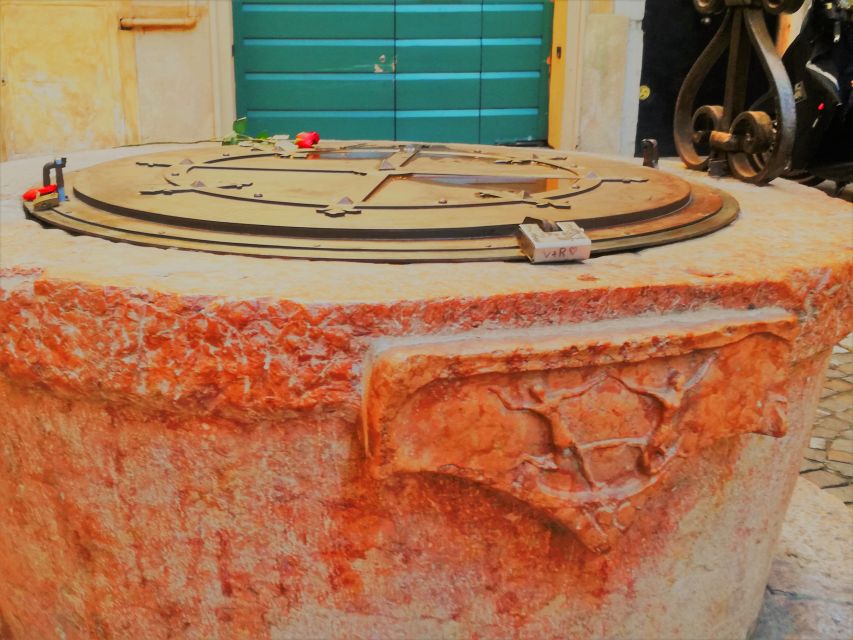
Piazza delle Erbe is one of Verona’s most attractive public spaces, and the tour spends about 10 minutes here. Fabio explains the history of the local market and points out the oldest fountain in the city.
The square is full of historic façades, public activity, and visual details. Look up as you walk. The painted and decorated fronts of the old townhouses are easy to miss when your attention is pulled toward the market stalls and the people around you.
This is also where the tour shows its balance. You see a major Verona sight, but Fabio does not reduce it to a quick description and a photograph. He uses the fountain, market, and façades to explain how the square developed and how public life worked in the city.
Piazza delle Erbe can be busy, and the group will not have unlimited time to linger. Still, the small-group format helps. Fabio can position the group and continue speaking without needing to raise his voice to compete with the entire square.
Still Verona, but a slower afternoon:
- Verona: Hop-on Hop-off Tour 24 or 48-Hour Ticket
★ 4.4 · 2,010 reviews - Verona: Arena di Verona Opera Ticket
★ 4.6 · 721 reviews - Verona: Classic and Hidden Gems Bike Tour
★ 4.9 · 577 reviews - From Verona: Valpolicella and Amarone Wine Tasting Tour
★ 4.9 · 560 reviews
Piazza dei Signori and medieval Verona
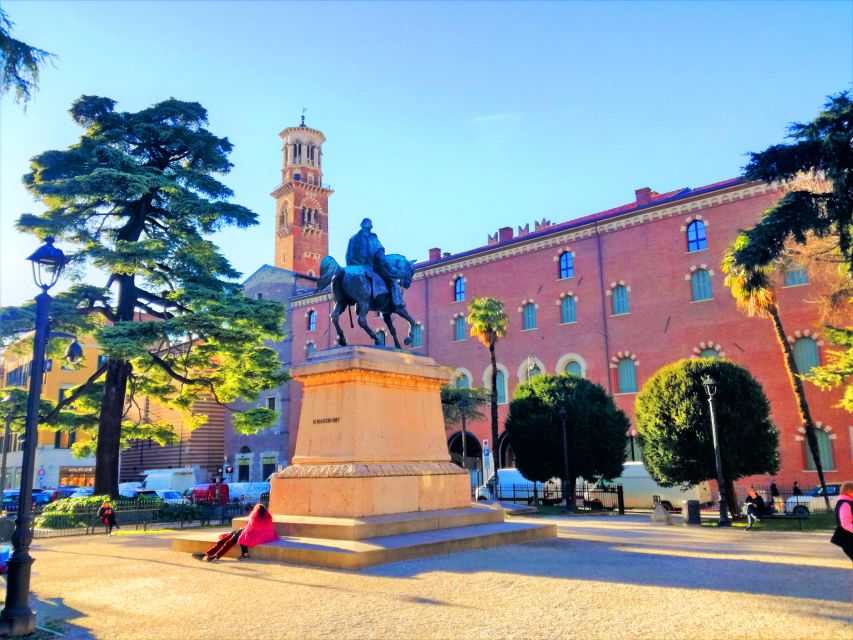
From Piazza delle Erbe, the walk continues into Piazza dei Signori. This square is surrounded by public buildings, including Palazzo della Ragione, Palazzo della Scala, and Palazzo del Capitano. The stop lasts about five minutes, with time for photographs and a short visit.
Fabio shifts the focus here toward medieval Verona and the city’s ruling families. You see the highest tower in the city and begin to understand how power was displayed through towers, palaces, and carefully arranged public spaces.
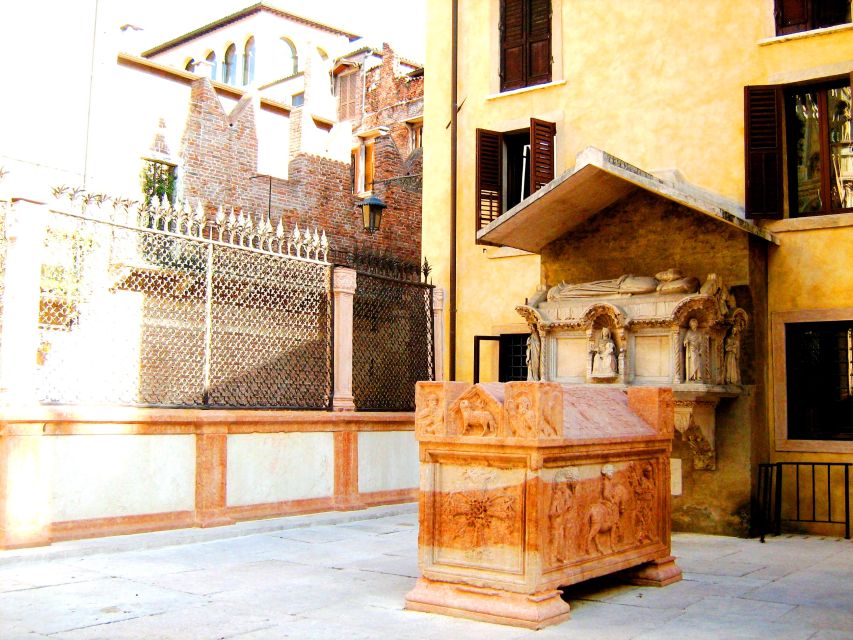
The route then reaches the dramatic Arche Scaligere mausoleums. These ornate Gothic tombs belong to Verona’s powerful della Scala family and are among the city’s most memorable pieces of medieval architecture. They are easy to admire as decoration, but Fabio’s historical explanation helps you understand their purpose and political message.
The Basilica di Santa Anastasia is another notable exterior stop. You receive about five minutes for photographs. Since the tour does not include entry, anyone wanting to study the church interior will need to return independently. That can be a good plan, since the walk gives you a useful first look and leaves you free to choose which places deserve more time later.
Small squares, riverfront views, and local orientation
The route passes through several smaller spaces, including Piazzetta Monte, Piazzetta Bra Molinari, Piazza Indipendenza, and the Courtyard of the Old Market. Some receive only a quick pass or photo stop, while others get a few minutes of explanation.
These short visits are where the real Verona idea becomes practical. You are not being taken far from the central sights, but you are encouraged to notice the streets, courtyards, buildings, and connections between them.
Piazzetta Bra Molinari includes scenic views along the way, and the route continues through quiet-looking corners before returning to the better-known parts of the center. The Courtyard of the Old Market adds another architectural pause and helps show how much of Verona’s character is found in spaces that are not always prominent on a standard sightseeing list.
Fabio’s storytelling is a major part of the experience. He combines historical facts with anecdotes, humor, and comparisons to events in other countries. That wider context makes dates and rulers easier to remember, especially if you do not normally enjoy memorizing Italian political history.
Romeo, Juliet, and the truth behind the story
The tour eventually reaches Casa di Romeo and the area around Juliet’s House. You get a photo stop at Romeo’s house, then see the Arche Scaligere, Piazza Indipendenza, and several nearby points before arriving at Juliet’s House.
Juliet’s balcony is the most commercial and familiar part of the route. The tour does not pretend that Shakespeare’s characters are simple historical figures. Instead, Fabio explains the historical inspiration behind the tragedy and helps separate Verona’s real medieval families from the literary story built around them.
The stop at Juliet’s House lasts about five minutes and is mainly for photographs. Entry is not included, and the tour does not promise a long visit inside. If the balcony is a top priority, you may want to return later with more time. I appreciate that the tour treats it as one part of Verona rather than the entire reason to visit.
The nearby streets also include the Synagogue of Verona, the former Convent of Saint Mary della Scala of the Servants of Mary, Via Dietro Anfiteatro, and additional small points of interest. Some are viewed in passing, but Fabio’s comments give them a place in the city’s wider story.
How Fabio guides the group
The strongest feature here is Fabio himself. He is warm, witty, and deeply familiar with Verona. His explanations cover architecture, geography, culture, and political history without losing the human side of the city.
He also appears attentive to the practical needs of a group. On hot days, he has looked for shade and included chances to cool down or refill water. He has been patient with slower walkers, kept children engaged, and remembered participants’ names and home countries.
Those details matter on a two-hour walk. A guide can know a great deal and still make a tour tiring. Fabio’s style appears to keep the group involved through stories and questions rather than a nonstop lecture.
The headsets are another clear advantage. You can stand at a respectful distance, take photographs, and still hear the explanation. For $41, this kind of small-group organization adds real value compared with a large group of 25 or 30 people following a guide who has to call out every fact.
Is two hours enough for Verona?
Two hours is enough for an introduction, not a complete visit. The route covers many locations, but several stops last only two to five minutes. You will see a great deal from the outside and gain the context needed to decide where to return.
That is a strength if you have only part of a day, are visiting Verona for the first time, or want help planning the rest of your stay. It is also useful before an evening at the opera, since one person used the walk while visiting Verona for that purpose.
I would schedule this early in your stay. Afterward, you can return to the Arena, Basilica di Santa Anastasia, Castelvecchio, Juliet’s House, or other locations that caught your attention. The tour gives you a map in your head, which is often more useful than a long list of disconnected facts.
The route returns to Palazzo Barbieri. Transport is not included, but the central walking route means you do not need a vehicle during the experience. Bring water and comfortable shoes. The tour operates rain or shine, so a forecast with wet weather should change what you pack, not necessarily whether you go.
Who will get the most from this walk?
I would recommend this tour to first-time visitors who want history and architecture explained in plain language. It also suits returning visitors who have seen the Arena and Piazza delle Erbe but suspect they missed the city’s smaller details.
Families can benefit from Fabio’s flexible style, especially if children need stories and visual details to stay interested. The headsets are useful for older participants and anyone who finds it hard to hear a guide in crowded streets.
This is less suitable if you want long interior visits, a food-focused walk, or a completely relaxed pace with plenty of free time at each stop. It is also not a substitute for a full Arena visit or a dedicated museum tour.
The activity is wheelchair accessible, and private or small-group options are available. Languages offered are English, German, Italian, and Spanish. Free cancellation is available up to 24 hours before the tour, and you can reserve now and pay later, which helps if your schedule is still shifting.
Is the $41 price fair?
At $41 per person, the price is fair for a two-hour guided walk limited to 10 people. The fee covers a professional licensed guide, the small-group setting, and headsets. It does not cover food, drinks, transport, or entry tickets.
I see the best value in the interpretation rather than the number of stops. You could walk past Porta Borsari, the old market courtyard, or the Arche Scaligere on your own, but you might not understand what you are seeing. Fabio’s explanations turn a pleasant stroll into a connected account of Verona from Ancient Rome through the medieval period.
If your budget is tight and you are happy to read about the city in advance, you can explore the same streets independently. But if you want to notice more, hear clearly, ask questions, and save time deciding what to revisit, the fee is justified.
Should you book this Verona walking tour?
Book it if you want an informed first look at Verona, especially with a small group and a local guide who clearly cares about the city. The strongest reasons are Fabio’s storytelling, the careful route through both famous and overlooked places, and the excellent headsets.
I would book this near the beginning of your visit and wear shoes made for two hours on city streets. Keep your expectations clear: you will see many sites from outside, move at a steady pace, and need separate tickets for interiors.
Skip it only if you prefer to explore entirely alone or want a slower tour centered on one monument. For most first-time visitors, this walk offers a practical way to understand why Verona is more than the Arena and Juliet’s balcony.
FAQ
Where does the Verona walking tour start?
Meet the guide beneath the Italian flag at Palazzo Barbieri, Verona’s Town Hall, in Piazza Bra.
How long does the tour last?
The walking tour lasts two hours.
What languages are available?
The tour is offered in English, German, Italian, and Spanish.
How large is the group?
The small-group tour allows up to 10 participants. Private options are also available.
Are entry tickets included?
No. Entries are not included, so visits inside the Arena, Juliet’s House, churches, or other attractions require separate arrangements.
Is the tour wheelchair accessible?
Yes, the activity is wheelchair accessible.
What should I bring?
Bring comfortable shoes and water. The tour takes place rain or shine.
Can I cancel or pay later?
You can cancel up to 24 hours in advance for a full refund. A reserve-now, pay-later option is also available.
More History Tours in Verona
- Venice: St. Mark Basilica Ticket, Audioguide+History Gallery
★ 3.9 · 4,780 reviews - Venice’s Best: Basilica, Doge’s Palace, Gondola & History Gallery
★ 4.5 · 2,478 reviews - Historic Milan Tour with Skip-the-Line Last Supper Ticket
★ 4.5 · 1,976 reviews - Venice: City Center Historical Guided Walking Tour
★ 4.2 · 1,873 reviews
Recently added around Verona
- Guided Food Tour with Wine Tasting in Verona★ 4.3 · 229 reviews
- From Verona: Sirmione and Lake Garda Day Tour with Cruise★ 4.6 · 520 reviews
- Verona: Hands-on Fresh Pasta and Tiramisù Cooking Class★ 4.9 · 295 reviews
- Verona: Classic and Hidden Gems Bike Tour★ 4.9 · 577 reviews
- Cavaion: Lake Garda Wine & Food Tasting with Vineyard Tour★ 4.7 · 202 reviews
- Verona: Arena di Verona Opera Ticket★ 4.6 · 721 reviews
- Verona: Montresor Winery Visit with Wine Tasting and Snacks★ 4.6 · 217 reviews
- Discover Valpolicella Vineyards and Wine Tasting Experience★ 4.5 · 341 reviews
Historical Tours, compared.
St. Mark Basilica Ticket, Audioguide+History Gallery
Read our review →
Venice’s Best: Basilica, Doge’s Palace, Gondola & History Gallery
Read our review →
Historic Milan Tour with Skip-the-Line Last Supper Ticket
Read our review →

Rome in a Day Tour with Vatican, Colosseum and Historic Center
Read our review →
Rome Food Tour in the Historic Centre with 8+ Food Tastings
Read our review →
Ancient History and Colosseum Underground Tour
Read our review →Browse the lists this tour appears in