
Reviewed · CYCLING TOURS
Rome: Appian Way, Catacombs, & Roman Aqueducts E-bike Tour
Rome’s best ruins may lie beyond the center. This 4 to 6 hour e-bike ride takes you from Via Labicana to the ancient Appian Way, the Catacombs, the Circus of Maxentius, Villa dei Quintili, the Park of the Aqueducts, and Caffarella Park. I like the rare mix of serious Roman history and open countryside, and I like that the small groups, usually no more than 10 people, allow guides such as Arina, Oscar, Agnese, and Pablo to watch the group closely.
I also like the quality Cannondale e-mountain bikes. Their electric assistance makes the 27-kilometer route manageable, including hills and rough tracks, without turning the day into an athletic contest. The main drawback is clear: about 40 percent of the ride is on city streets, and 60 percent is off-road. You need to feel comfortable handling a bicycle in traffic, on gravel, and over bumpy ground.
- A 2,300-year-old road: Enter the Appian Way through St. Sebastian’s Gate in the Aurelian Walls.
- Two useful tour lengths: Choose four hours without an underground catacomb visit, or six hours with a guided visit inside.
- Strong e-bike equipment: Cannondale electric mountain bikes come with anti-puncture tires, helmets, water, and a small handlebar bag.
- Rome beyond the crowds: The route trades packed central sights for ancient tombs, fields, parks, and huge aqueduct arches.
- A real riding route: Expect 27 kilometers, with rough surfaces and some city traffic between the archaeological parks.
- Good value for active sightseers: At $85 per person, the price covers the bike, guide, equipment, and the longer six-hour route if you choose it.
In This Review
- Why This Route Shows a Different Rome
- Meeting at Via Labicana 49
- Cannondale E-Bikes Make the Distance Manageable
- Through the Aurelian Walls and Onto the Appian Way
- Circus of Maxentius and the Tomb of Cecilia Metella
- The Catacombs: Choose Four or Six Hours
- The Park of the Aqueducts Is the Big Payoff
- Caffarella Park and the Ride Back
- City Traffic Is the Part to Take Seriously
- Guide Quality and Group Size
- Is $85 a Fair Price?
- Who Should Book This E-Bike Tour?
- FAQ
- How long is the Rome Appian Way e-bike tour?
- How far do you ride?
- Is the tour suitable for beginners?
- How much of the route is off-road?
- Are e-bikes included in the price?
- Can children join the tour?
- Is a catacomb visit included?
- Is food included?
- Where does the tour start and finish?
- Should You Book It?
Why This Route Shows a Different Rome

Rome’s famous center is a wonderful walking district, but it can also feel like one long queue between monuments. This ride takes you outside the usual circuit and shows how much ancient Rome remains beyond the Colosseum and Roman Forum.
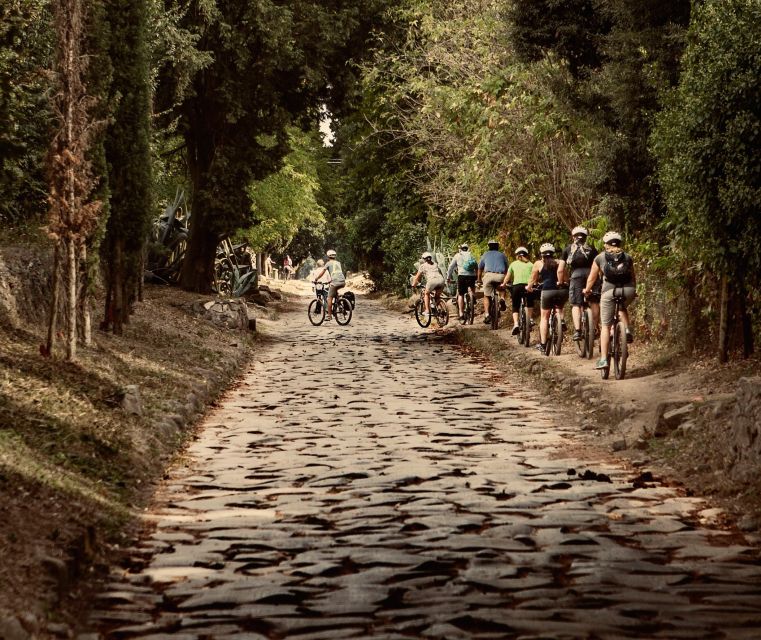
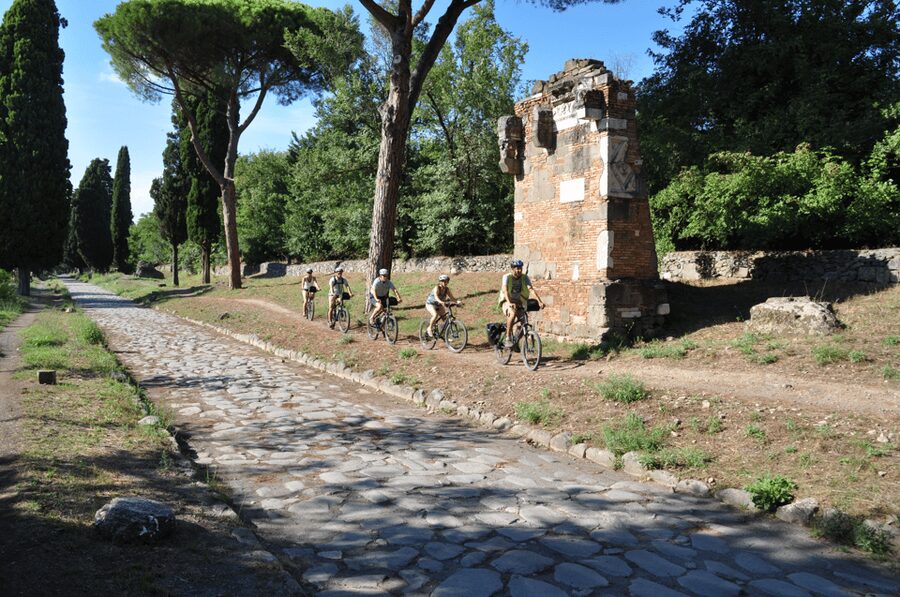
The Appian Way was built about 2,300 years ago as one of the Roman world’s key roads. Here, ancient paving stones, tombs, villas, and monuments appear among grass and trees rather than behind museum glass. You get a sense of Roman power not only from individual ruins, but from the scale of the road and the territory it connected.
The route also links three different kinds of history. The Appian Way explains Rome’s imperial reach, the catacombs introduce early Christian burial traditions, and the aqueducts show the practical engineering that kept the city supplied with water.
That combination gives the tour a pleasing rhythm. You are not standing in one crowded archaeological site for hours. You ride, stop for an explanation, take photographs, and continue into another setting.
Meeting at Via Labicana 49

The starting point at Via Labicana 49 is close enough to reach from either the Colosseum or Manzoni Metro station. From the Colosseum station, allow about 10 to 15 minutes on foot. Walk past the Colosseum and continue as the road becomes Via Labicana.
From Manzoni, the walk takes about 10 minutes. Follow Viale Manzoni toward the Colosseum until it changes into Via Labicana, then look for number 49.
This location matters because the tour begins near central Rome but quickly moves toward the outer archaeological parks. You do not need to arrange a separate transfer to the Appian Way, which saves time and makes the outing easier to fit into a Rome itinerary.
At check-in, you receive a helmet, which is required, along with a five-liter handlebar bag and a biodegradable bottle of water. Wear comfortable shoes. You may also want clothing suited to a long ride and changing conditions, though the supplied information specifically requires comfortable footwear.
More Bike Tours in Rome
- Rome EBike Tour: Appian Way, Catacombs & Roman Aqueducts
★ 5.0 · 1,766 reviews - Rome: Top Highlights & Hidden Gems Tour by Cannondale E-Bike
★ 4.9 · 1,760 reviews - Rome City Small Group Bike Tour with quality Cannondale EBike
★ 5.0 · 1,380 reviews
Cannondale E-Bikes Make the Distance Manageable
The bikes are one of the tour’s strongest features. These are Cannondale e-mountain bikes with anti-puncture tires, rather than basic city bicycles. Electric assistance helps on climbs and lets you cover the full route without arriving exhausted.
That does not mean you simply sit back while the motor does everything. You still pedal, steer, brake, and manage the bicycle over uneven surfaces. The electric power is especially useful when the route reaches gravel, rough paving, or an incline.
Several riders describe the bikes as sturdy, reliable, easy to use, and well maintained. First-time e-bike users have learned the gears and assistance quickly with help from the guides. That is encouraging if you have never used an electric bicycle, but you should still practice basic bike control before arriving if you are unsure.
The equipment has a total weight limit of 300 pounds, or 136 kilograms. Children from 1 to 4 years old can ride in a child seat, up to 49 pounds or 22 kilograms, and join free. Children aged 5 to 8 use a child extension, while children aged 9 and older can ride an e-bike independently.
The tour information calls the level intermediate and warns that it becomes difficult with a child seat or extension. Families have managed the route successfully, including children aged 9, 11, 12, and 14, but the adults should be confident enough to handle the extra weight and the rougher sections.
Through the Aurelian Walls and Onto the Appian Way
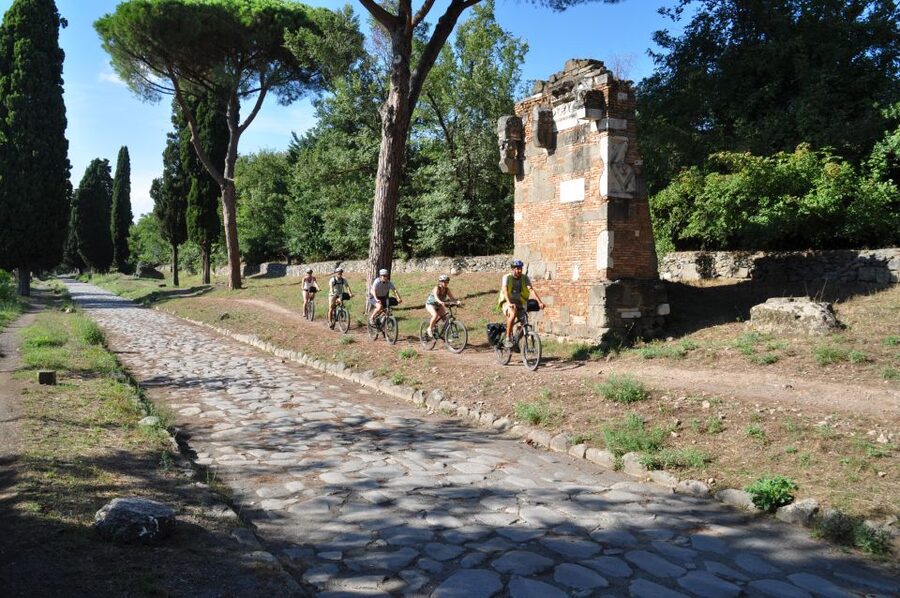
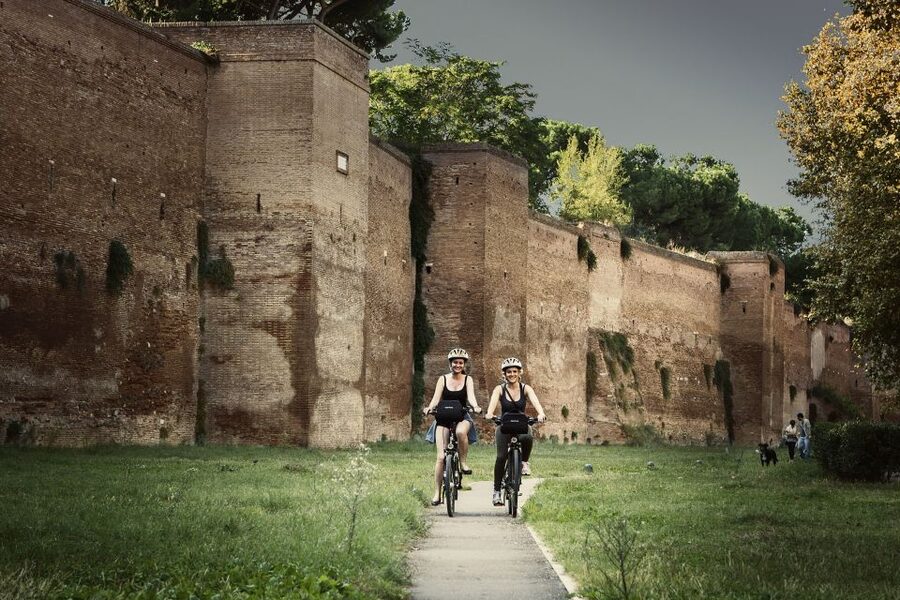
The first major moment comes at St. Sebastian’s Gate, one of the openings in Rome’s Aurelian Walls. Passing through the walls gives the route a strong beginning. You leave modern central Rome and enter an older world of roads, fields, ruins, and scattered monuments.
The Appian Way is not a polished promenade. Parts of the route are uneven, and the ancient paving can be rough. That is part of its appeal, but it also explains why comfortable shoes, a helmet, and basic cycling confidence matter.
Your guide stops along the way to explain the ruins and allow photographs. The pace is generally designed to give you time to look around rather than rush from one site to another. Guides such as Arina, Anna, Cas, Ali, and Bita have been praised for balancing historical explanation with careful group management.
The route passes ancient tombs, mausoleums, and villas linked to Rome’s wealthy families. Even when a ruin is partly collapsed, its position beside the old road helps you understand how the Appian Way once worked as a grand entrance and transport route.
Circus of Maxentius and the Tomb of Cecilia Metella
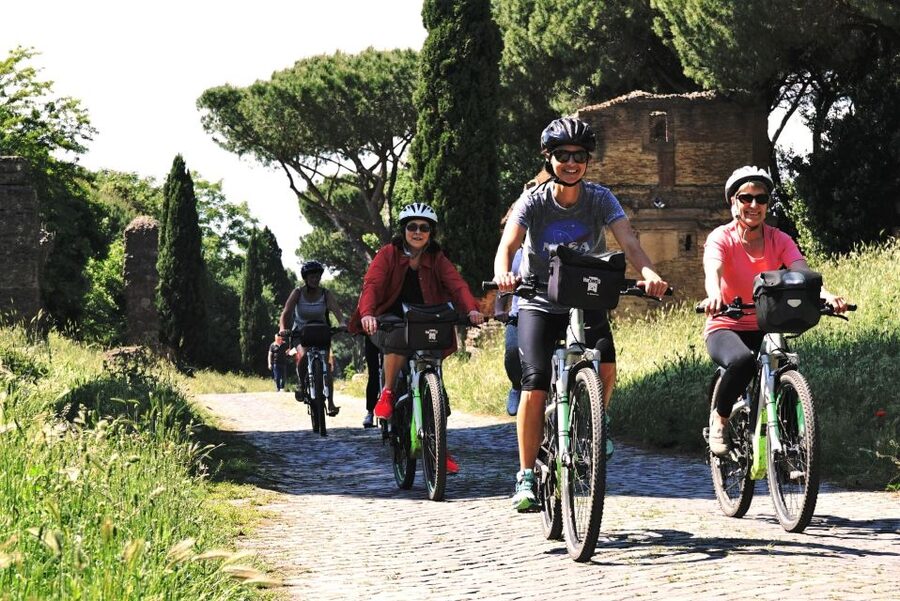
The Circus of Maxentius is one of the route’s notable stops. It offers a glimpse of the large-scale public architecture associated with imperial Rome, away from the better-known central arenas.
The stop at the Tomb of Cecilia Metella adds another layer. Roman roads were lined with tombs and memorials, reminding you that the Appian Way was not just a military and commercial route. It was also a ceremonial approach bordered by monuments designed to preserve family status after death.
This is where a live guide adds real value. The remains can look like isolated stones if you view them alone. A good explanation connects the road, the tombs, the villas, and the people who used this corridor.
The route continues toward Villa dei Quintili, a large aristocratic complex outside the old city. You see how wealthy Roman families built country residences with room, status, and distance from the crowded urban center. The setting helps you picture Rome as a city surrounded by estates and agricultural land, not simply a collection of monuments.
More E-Bike Tours in Rome
- Rome:Appian Way E-bike Tour with Catacombs, Aqueducts & Food
★ 4.9 · 1,210 reviews - Rome: E-Bike Night Tour with Food and Wine Tasting
★ 4.9 · 1,131 reviews - Rome: Appian Way E-Bike Tour Catacombs, Aqueducts & Picnic
★ 4.6 · 727 reviews - Rome: Appian Way & Catacomb Sunset E-bike Tour with Aperitif
★ 4.5 · 682 reviews
The Catacombs: Choose Four or Six Hours
The six-hour version includes a guided underground visit to the Catacombs of St. Callixtus or St. Sebastian. You move below ground through crypts and corridors connected with early Christian burial practices.
This is the most meaningful difference between the two tour options. The four-hour version makes only a short stop of about five minutes at the catacomb entrance, where the guide explains the site’s history and importance. You do not go inside on that shorter outing.
I would choose the six-hour tour if early Christian Rome interests you or if you want the fullest historical program. The catacombs offer an experience that the open-air ruins cannot: narrow underground passages, burial spaces, and a direct connection to the religious communities that lived under Roman rule.
Choose the four-hour tour if you mainly want the Appian Way and aqueducts, or if you prefer a shorter day on a bicycle. It still includes the major outdoor scenery and ruins, but it leaves out the guided underground visit.
Check the exact schedule before booking, since the available starting times vary. On Wednesdays, the outing can also run about 30 minutes longer.
The Park of the Aqueducts Is the Big Payoff
The Park of the Aqueducts is the visual high point of the ride. Long rows of massive stone arches cross the open park, creating one of Rome’s most memorable settings.
The aqueducts show Roman engineering at a scale that is hard to grasp in the city center. These structures carried water over long distances using carefully planned gradients, bringing supplies into Rome without modern pumps. Standing or cycling beneath the arches makes the engineering feel physical rather than abstract.
The tour follows the aqueducts back toward modern Rome. That direction is useful because you see the structures not as a single isolated monument, but as part of a system that connected the countryside with the city.
The park also provides a welcome change after the city sections. You can ride without traffic for much of the route, with broad views and space around you. In warm afternoon light, the arches are especially photogenic, though you should not count on perfect weather. One family still enjoyed the outing in heavy rain, while other riders appreciated the frequent water stops during hot weather.
Caffarella Park and the Ride Back
After the aqueducts, the route crosses the green Caffarella Valley. This section helps explain why the tour feels like both a history outing and a countryside ride.
Caffarella Park gives you a quieter stretch before the final return. The surface can still be uneven, but there is no city traffic in the park sections. Guides keep the group together and return to anyone who has a problem with the e-bike.
The final route includes a stop connected with the Baths of Caracalla before returning to Via Labicana 49. This adds one last Roman landmark before the ride ends close to the center.
The full route covers roughly 17 miles. Reviews from riders who tracked the distance recorded around 16 miles, which is close to the stated 27 kilometers. The e-bike assistance makes the distance realistic for many people, but the ride still takes several hours and includes repeated stops, streets, gravel, and rough tracks.
City Traffic Is the Part to Take Seriously
The tour is safety-conscious, but it is not traffic-free. About 40 percent of the route takes place in the city, connecting the Appian Way with the Park of the Aqueducts. The guides select quieter streets where possible and lead the group through crossings, but Rome traffic cannot be removed from the route.
This is the section that separates a confident cyclist from a hesitant one. You need to steer predictably, follow instructions, keep your distance, and stay alert. Some riders found city riding intimidating but manageable because the guide positioned the group carefully and warned them about busier sections.
The other 60 percent takes place in parks and along the Appian Way, where there is no traffic. Those off-road sections are calmer but can be bumpy. One rider who rarely rides off-road managed well, while another wished the bikes had rear suspension for the roughest ground.
I would not book this as your first ever bicycle ride. If you ride occasionally and can handle gravel, uneven paving, and city streets, the electric assistance should make the distance comfortable. If you feel nervous on a bicycle, try an e-bike in a quiet area before taking this route.
Guide Quality and Group Size
The group is limited to 10 participants, with a minimum of four required for the tour to operate. That is a sensible size for a route involving traffic, crossings, and off-road riding.
Guide quality appears to be a major strength. Names praised in the supplied feedback include Arina, Oscar, Agnese, Pablo, Bita, Ali, Cas, Sina, Anna, Zak, Ximena, and Youp. Their shared strengths are careful riding leadership, clear safety instructions, useful historical context, and a friendly approach with children and first-time e-bike users.
The best guides do not bury you under dates and names. They explain what you are seeing, then let you enjoy the road and scenery. One guide even helped remedy a flat tire during a ride, showing the practical value of having a trained leader with the group.
Languages offered include English, Italian, Spanish, French, German, and Dutch. Since the exact guide depends on the departure, check the selected language when you reserve.
Is $85 a Fair Price?
At $85 per person, this is not the cheapest way to see Roman ruins. It is a fair price if you value the bike, the guide, the route planning, and the ability to cover several distant areas in one outing.
You receive a Cannondale e-mountain bike, anti-puncture tires, helmet, water, handlebar bag, and professional guiding. The six-hour option also includes the guided catacomb visit. Food and drinks are not included, although you can buy refreshments along the way.
The value is strongest for first-time visitors who want more than the central monuments. A self-guided ride would require finding a suitable bicycle, planning a safe route through city traffic, locating the Appian Way and aqueduct park, and arranging the catacomb visit separately.
The price is less appealing if you dislike bicycles, want a slow walking tour, or only have time for central Rome. In that case, a shorter city-based activity may suit you better.
Who Should Book This E-Bike Tour?
I would recommend it to active adults, families with older children, history fans, and repeat visitors who have already seen the central highlights. It is also a good choice if you want a break from crowded streets and indoor museums.
Families should pay close attention to the child rules and the intermediate rating. Children aged 9 and older can ride independently, while younger children use a seat or extension. The ride can be physically manageable with electric assistance, but balance and bike handling still matter.
I would skip it if you are uncomfortable in traffic, have difficulty on rough surfaces, or want a completely relaxed sightseeing vehicle. The word e-bike does not mean effortless. You still ride for 27 kilometers.
The tour has earned a 4.9 rating from 1,421 ratings, and the strongest praise centers on the guides, bike quality, safety, pacing, and the chance to see a quieter side of Rome. Those are exactly the features that matter most on a long bicycle outing.
FAQ
How long is the Rome Appian Way e-bike tour?
You can choose a four-hour or six-hour version. The six-hour option includes a guided visit inside the catacombs, while the four-hour option makes only a short explanatory stop at the entrance.
How far do you ride?
The route is 27 kilometers, or about 17 miles. Some riders recorded close to 16 miles during the six-hour outing.
Is the tour suitable for beginners?
It is rated intermediate. You do not need advanced cycling skills, but you should be comfortable riding a bicycle, handling gravel and uneven ground, and sharing some city streets with traffic.
How much of the route is off-road?
About 60 percent of the route is off-road in parks and along the Appian Way. The remaining 40 percent takes place in the city, where some traffic is unavoidable.
Are e-bikes included in the price?
Yes. The tour includes a Cannondale quality e-mountain bike with anti-puncture tires, plus a helmet, water bottle, and five-liter handlebar bag.
Can children join the tour?
Children aged 1 to 4 can ride in a child seat, up to 49 pounds or 22 kilograms. Children aged 5 to 8 use a child extension, and children aged 9 and older can ride an e-bike independently.
Is a catacomb visit included?
It is included only with the six-hour tour. The four-hour tour stops at the entrance for a brief explanation but does not include the underground visit.
Is food included?
No. Food and drinks are not included, but you can buy refreshments along the way.
Where does the tour start and finish?
The tour starts and ends at Via Labicana 49. The meeting point is about 10 to 15 minutes on foot from the Colosseum Metro station and about 10 minutes from Manzoni Metro station.
Should You Book It?
Book this tour if you want to trade central Rome’s crowds for ancient roads, open parks, aqueduct arches, and a more active day. The six-hour version is the better choice if the catacombs matter to you, while the four-hour option works well when you want the outdoor sights without committing to a full day.
The key question is not fitness alone. It is bike confidence. If you can manage city traffic and uneven tracks, the strong e-bikes and attentive guides make the distance reasonable. If that sounds stressful, choose another way to see the Appian Way.
For the right rider, this is a memorable use of $85. You see major Roman sites, reach places that are awkward to visit independently, and get a genuine look at Rome beyond its famous center.
Recently added around Rome
- Palatine Hill and Roman Forum Tour with Fast-Track Entrance★ 4.2 · 417 reviews
- Tivoli: Villa D’Este & Villa Adriana Pass & App Audioguide★ 4.4 · 364 reviews
- From Rome: Villa D’Este & Villa Adriana Day Trip with Lunch★ 4.4 · 289 reviews
- Vatican Museums & Sistine Chapel Skip-the-Line Guided Tour★ 4.6 · 254 reviews
- Rome: The Three Tenors at St. Paul’s Church Concert Ticket★ 4.7 · 699 reviews
- Tivoli: Villa D’Este Entry Ticket and App Audio Guide★ 4.3 · 191 reviews
- Rome: Capitoline Museums and Centrale Montemartini Tickets★ 4.4 · 328 reviews
- Rome: St. Peter’s Basilica and Papal Tombs Guided Tour★ 4.6 · 477 reviews
Cycling Tours, compared.

Rome EBike Tour: Appian Way, Catacombs & Roman Aqueducts
Read our review →
Top Highlights & Hidden Gems Tour by Cannondale E-Bike
Read our review →
Rome City Small Group Bike Tour with quality Cannondale EBike
Read our review →
Tuscany Bike Tours Through the Chianti Hills with Wine Tasting
Read our review →
Appian Way E-bike Tour with Catacombs, Aqueducts & Food
Read our review →

Browse the lists this tour appears in