
Reviewed · CYCLING TOURS
Appian Way, Catacombs and Aqueducts Park Tour with Top E-Bike
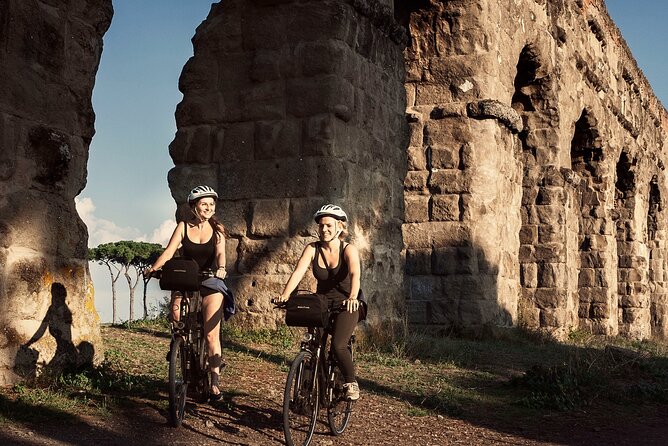
Rome has an ancient side beyond the Colosseum. This small-group e-bike tour carries you from the city center along the Appian Way, past catacombs and imperial ruins, then out to the great aqueducts. I like the electric-assist bicycles, which make a 27-kilometer route possible without turning the day into a test of endurance. I also like the way the tour links several far-flung sites that are awkward to reach on foot or by public transport.
The main consideration is that this is not a gentle sightseeing ride for complete beginners. About 40 percent of the route uses city streets, and the remaining 60 percent is off-road, with narrow sections, rough surfaces, pedestrians, and other bicycles. If you are not fully confident on a bike, or if you have back or neck problems, this may feel more demanding than the e-bike label suggests.
In This Review
- Key points to know before you book
- Why this e-bike tour reaches places walking tours cannot
- Leaving Rome through Porta San Sebastiano
- Riding the ancient Appian Way
- Choosing between the catacombs and the longer route
- The catacombs: worth the longer stop
- Imperial ruins along the Appian Way
- Aqueducts Park and the open countryside
- What the six-hour tour adds near the city
- How hard is the ride?
- Traffic, crowds, weather, and comfort
- Guide quality and group size
- Is $102.79 good value?
- Who should book this Rome bike tour?
- Should you book it?
- FAQ
- How long does the tour last?
- Where does the tour begin and end?
- Is the catacomb visit included?
- Which catacombs are visited?
- How far do you ride?
- Is the tour suitable for beginners?
- Can children join the tour?
- Is a helmet provided?
- What happens if the tour does not reach the minimum number of participants?
Key points to know before you book
- The route covers about 17 miles: You see several major ancient sites in one outing, from Porta San Sebastiano to the Aqueducts Park.
- The 6-hour option adds real value: It includes a 45-minute guided catacomb visit, Villa dei Quintili, and the Baths of Caracalla.
- The e-bikes reduce the strain, not the need to ride well: You still need to steer, brake, balance, and handle city traffic.
- Most of the route leaves modern Rome behind: Sheep pastures, open parks, ancient paving, and monumental aqueducts replace the usual city streets.
- Groups are capped at 10 people: That gives your guide a better chance to keep the group together and answer questions.
- Weekdays are likely the calmer choice: Sunday crowds at the Appian Way and Aqueducts Park can make riding more stressful.
Why this e-bike tour reaches places walking tours cannot
The ancient Appian Way runs far beyond the usual center of Rome. You can walk a short section, but reaching the catacombs, Circus of Maxentius, Cecilia Metella, Villa dei Quintili, and the aqueducts in one day would be a punishing task.
That is where this tour earns its price of $102.79 per person. You are paying for a quality e-bike, helmet, guide, route planning, and access to a large area that would otherwise require a mixture of long walks, taxis, and careful transport planning. The price is not low, but the route covers far more ground than a standard city excursion.
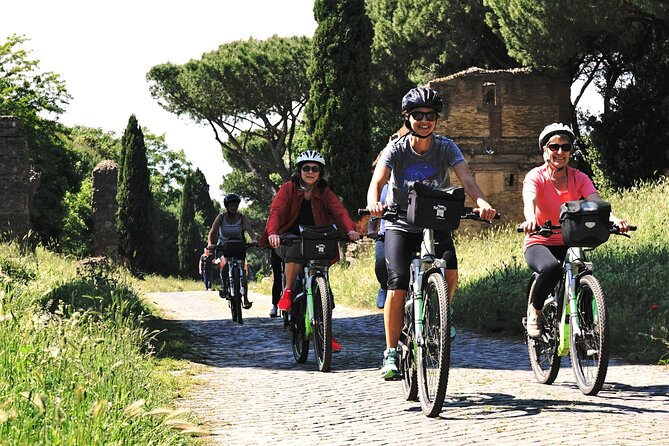
The group size helps, too. With a maximum of 10 people, the guide can keep an eye on the riders and stop to explain the monuments. Guides such as Arina, Bita, Claudia, Fabio, Francesca, Han, Lorenzo, and Zak have been praised for their friendly style and ability to make Roman history easy to follow. The quality may vary slightly by guide, but the strongest part of the experience is consistently the human element.
More Bike Tours in Rome
- Rome EBike Tour: Appian Way, Catacombs & Roman Aqueducts
★ 5.0 · 1,766 reviews - Rome: Top Highlights & Hidden Gems Tour by Cannondale E-Bike
★ 4.9 · 1,760 reviews - Rome: Appian Way, Catacombs, & Roman Aqueducts E-bike Tour
★ 4.9 · 1,421 reviews
Leaving Rome through Porta San Sebastiano
The ride begins at Via Labicana 49, near public transportation. After an equipment briefing and a quick orientation to the bicycle, you leave the central streets and pass through Porta San Sebastiano, one of the grand gates in Rome’s third-century Aurelian Walls.
This first section helps you get used to the bike. You are not instantly thrown onto rough ancient paving. Instead, the route introduces you to the city and its walls before the modern streets gradually give way to the Appian Way Park.
The guide’s role matters here. Around 40 percent of the entire route is in the city, so traffic is unavoidable in some connecting sections. The route is carefully chosen, and the operator describes the tour as safe, but you still need to pay attention. Keep a steady distance from the rider ahead, listen for instructions, and do not treat the e-bike like a motor scooter.
Riding the ancient Appian Way
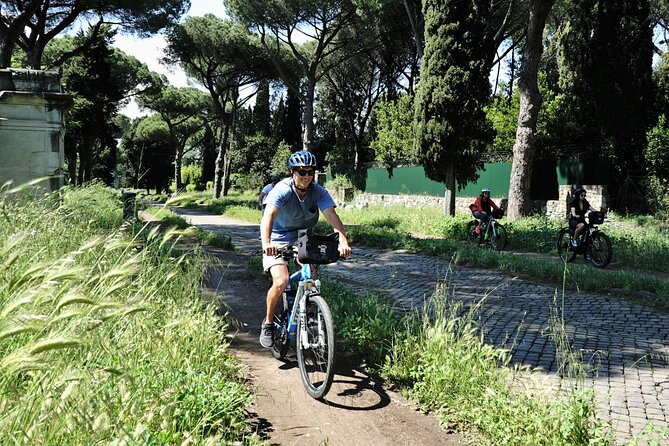
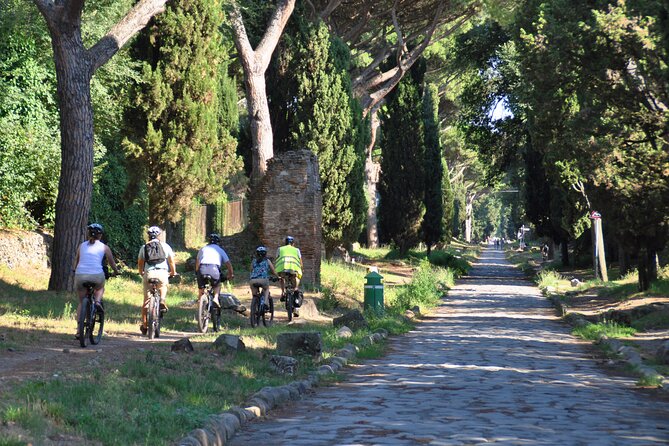
The Via Appia Antica changes character as you ride. At first, it can look like an ordinary Roman road. Then the modern city fades, the ancient paving becomes more apparent, and the setting opens into the Appian Way Park.
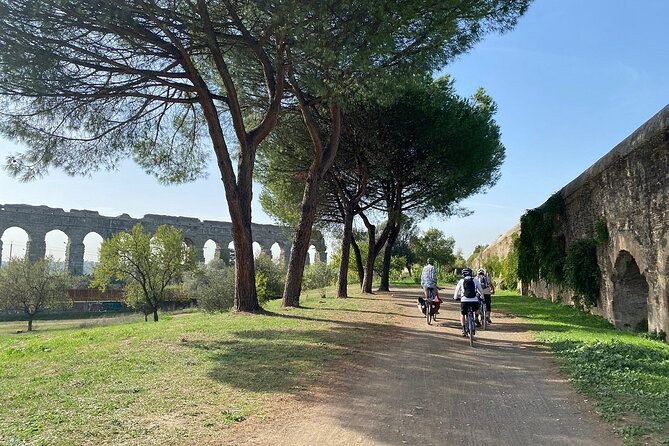
This is the heart of the tour. The old road passes through open countryside, archaeological remains, and quiet stretches where Rome feels surprisingly far away. You may see sheep grazing in the surrounding fields, a reminder that this part of the city is not simply an outdoor museum. It is also a living rural area on Rome’s edge.
The scenery is a major reason to choose the bicycle. You can cover the long distances between monuments while remaining outdoors, and you are not confined to a tour bus window. The trade-off is the surface. Some paths are bumpy, narrow, and uneven. The ride is usually manageable with electric assistance, but your arms, neck, and back still absorb the movement.
The guides generally keep a moderate pace and stop to explain what you are passing. Still, this is not a photo tour with a stop every few minutes. If you want to take a picture, wait for a safe stopping point rather than trying to use your phone while riding.
Choosing between the catacombs and the longer route
The tour comes in two versions, roughly four or six hours long. This is the decision that most affects the day.
The four-hour version gives you the broad route: the Appian Way, catacombs area, Circus of Maxentius, Cecilia Metella, Aqueducts Park, and the surrounding countryside. At the catacombs, you make a short pause to consider the underground burial complex, but the guided visit is reserved for the longer option.
The six-hour version includes a 45-minute guided visit to the catacombs. It also adds Villa dei Quintili and the Baths of Caracalla. If ancient Rome is a priority, I would choose the six-hour tour. The extra time is not just filler. It gives you a proper underground visit and two more substantial archaeological stops.
There are schedule changes on Wednesdays. The longer option visits the Catacombs of San Sebastiano instead of San Callixtus, and the tour can run about 30 minutes longer. The same extra time applies from January 14 to February 11, 2026. On Easter Sunday, April 5, 2026, the catacombs are closed, so the six-hour tour will not operate.
More E-Bike Tours in Rome
- Rome City Small Group Bike Tour with quality Cannondale EBike
★ 5.0 · 1,380 reviews - Rome by Night – Ebike Small Group Tour – Food and Wine (Option)
★ 5.0 · 1,275 reviews - Rome:Appian Way E-bike Tour with Catacombs, Aqueducts & Food
★ 4.9 · 1,210 reviews - Rome: E-Bike Night Tour with Food and Wine Tasting
★ 4.9 · 1,131 reviews
The catacombs: worth the longer stop
The catacombs are among the most unusual places on this route. The complex associated with San Callisto is linked to an immense underground burial site, described as the resting place of around half a million people. The scale alone changes how you see Roman society, early Christianity, and ancient burial practices.
On the six-hour tour, the guided visit lasts about 45 minutes. That is enough time to give the underground passages structure and meaning rather than simply peering into a dark entrance and moving on.
The setting can feel confined. One critical account described arriving with a very large queue at the catacombs and finding the underground space claustrophobic. That concern will matter if you dislike enclosed places. The visit is also one reason the longer tour takes most of a day, so plan your energy accordingly.
The four-hour option is better if you mainly want the open-air ride and a quick look at the site. The six-hour version is better if you want the catacombs to be a central part of your Roman experience.
Imperial ruins along the Appian Way
The Circus of Maxentius is a compact but striking stop. The fourth-century imperial complex included a villa, mausoleum, and circus, where chariot races took place. You may spend only a few minutes here, but the guide can help you picture the site as part of a working imperial estate rather than a collection of broken walls.
Nearby, the Mausoleum of Cecilia Metella gives you one of the Appian Way’s most recognizable monuments. This first-century funerary structure was built in memory of a young woman from a patrician family. Its survival is impressive, especially when seen in the context of the road and the other ancient remains around it.
The short stops are useful for orientation, but they are not full archaeological-site visits. If you want to enter every monument or spend time examining each structure, this tour may feel too fast. Its purpose is to connect many places across a large area, not to provide a lengthy indoor visit at every ruin.
The six-hour route continues to Villa dei Quintili, a huge second-century country estate once owned by two very wealthy brothers. This is one of the strongest additions to the longer version. The scale of the villa helps explain how much land, money, and labor powerful Roman families could command.
Aqueducts Park and the open countryside
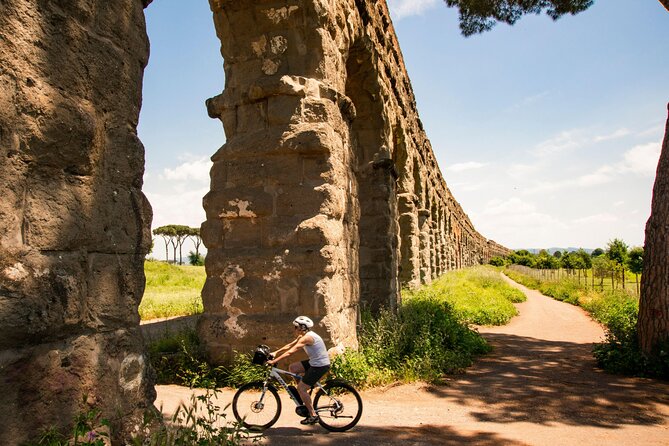
The Aqueducts Park is the visual high point for many people. Here, the remains of Rome’s ancient water system cross the open fields in great stone lines. Your guide explains how underground channels and elevated arches carried water toward the city.
The contrast is wonderful. Rome’s central monuments are crowded between streets and buildings. At the aqueducts, you get sky, grass, long views, and a sense of the engineering system as a whole. This is the sort of place where a bicycle makes practical sense because the park is wide and the route between viewpoints is part of the pleasure.
The park is not always empty. On Sundays, local people, walkers, and cyclists can fill the paths. Maneuvering around them may make the ride feel tense, especially on narrow tracks. I would choose a weekday if your schedule allows it.
The route includes breaks where you may be able to buy food or drinks, but nothing is included. Carrying the provided water bottle is sensible, and you may want to bring a snack if you know you get hungry during active outings. Food can be eaten during a suitable break.
What the six-hour tour adds near the city
The longer itinerary finishes with a view of the Baths of Caracalla. These immense third-century public baths show how central bathing was to Roman social life. The baths were not merely places to wash. They were part of the city’s daily rhythm and public culture.
Seeing the baths from a bicycle route gives you a different perspective from a standard indoor museum visit. You understand their scale and position in relation to the surrounding city. The stop itself is short, so do not expect a full exploration of the complex.
The six-hour itinerary therefore works best for someone who wants a full day of connected Roman sites. You get the countryside, the old road, underground burial spaces, imperial villas, aqueducts, and the baths. The four-hour route works better if you have limited time, less stamina, or another major appointment later in the day.
How hard is the ride?
The tour is rated intermediate, and that description is important. You cover about 27 kilometers, with roughly 60 percent off-road. The e-bike motor makes hills and distance easier, but it does not remove the technical part of cycling.
You need to be comfortable with:
- Riding on uneven and occasionally narrow paths
- Braking and steering around other bicycles and pedestrians
- Crossing or using selected city streets
- Maintaining a steady pace with a small group
- Riding for four to six hours, with stops
The electric assist is useful for riders who are competent but not regular cyclists. Several riders in their sixties found the equipment manageable and felt supported by the guide. Families with teenagers also found the ride a good break from Rome’s endless walking.
Children aged 9 and older can ride an appropriately sized e-bike. Children aged 5 to 8 can use a child extension, but the tour becomes harder with that equipment attached. The operator specifically warns that the route is difficult with a child seat or extension. The bicycle equipment has a maximum weight limit of 300 pounds, or 136 kilograms.
Helmets are mandatory and provided free. The bikes include anti-puncture tires, a front bag, and a biodegradable water bottle. Some riders received Cannondale bicycles, and the equipment has generally been described as well maintained.
Traffic, crowds, weather, and comfort
The operator takes safety seriously, but the route is not traffic-free. City riding connects the two archaeological parks, and some narrow sections require concentration. A guide can manage the group, but you are still responsible for riding sensibly.
Crowds can change the feel of the day. Sunday is likely to be more demanding in both parks, with more people walking and cycling. A weekday should give you more room and less need to brake suddenly.
The weather is another practical factor. One group was caught in a rainstorm and still enjoyed the experience, but rain can make rough paths less comfortable. Wear clothes suitable for active riding and bring an extra layer if the forecast looks uncertain. I would also avoid assuming that Rome’s warm sunshine will last for the whole outing.
The ride is not ideal for anyone with significant neck or back trouble. The ancient paving and off-road sections create repeated jolts, even when the motor is doing much of the work.
Guide quality and group size
A strong guide can turn scattered ruins into a coherent story. The best guides on this route explain the roads, monuments, aqueducts, and Roman customs in an engaging way while also handling the practical work of keeping the group together.
Names praised for their warmth, humor, and command of the subject include Arina, Bita, Claudia, Fabio, Francesca, Han, Lorenzo, Stefan, Zak, and others. I would not book solely around one particular guide because schedules can change, but the repeated praise for the guiding team is encouraging.
The maximum group size is 10. That is small enough for direct questions and useful safety instructions. It also means the group may need to move at the pace of its least confident rider. One negative experience involved a very slow pace and riders following too closely. This may be unusual, but it is a fair reminder that group cycling rarely offers complete freedom.
Is $102.79 good value?
For four hours, the price is reasonable if you value the bike, route planning, and guide. You could rent a bicycle yourself for less, but you would then need to plan the route, find the parks, manage city connections, and understand what you are seeing.
The six-hour version offers the better value for a first visit focused on ancient Rome. The catacomb tour alone adds substance, while Villa dei Quintili and the Baths of Caracalla round out the day. You also avoid spending time arranging separate transport between widely scattered sites.
The price does not include food or drinks, and gratuities are optional. Bring some money for a snack or drink during the route. With a free cancellation deadline of 24 hours before the start time, you have some flexibility, although late cancellations and late changes are not refundable.
Who should book this Rome bike tour?
I would recommend it to you if you:
- Ride a bicycle confidently in ordinary city conditions
- Want to see Rome beyond the Colosseum, Vatican, and central piazzas
- Prefer open air and movement to a full day inside museums
- Enjoy archaeological sites but want them connected by a story
- Are traveling with teenagers who need a break from walking
- Have enough time for the six-hour version
I would think twice if you are a nervous cyclist, have back or neck problems, dislike rough paths, or want to stop for long photographs at every monument. The e-bike makes the distance easier, but it does not turn the route into a passive sightseeing experience.
Should you book it?
Book this tour if you want Rome’s ancient outskirts in one well-planned day. The Appian Way, catacombs, and aqueducts are difficult to combine independently, and the e-bike gives you access without exhausting your legs. Choose the six-hour route if the catacombs and Villa dei Quintili matter to you.
Choose a weekday when possible, and be honest about your cycling ability. If you can handle city streets, uneven paths, and a moderate pace, this is one of the most rewarding ways to see a quieter, more surprising side of Rome.
FAQ
How long does the tour last?
You can choose a tour lasting approximately four or six hours. On Wednesdays, and from January 14 to February 11, 2026, the route may take about 30 minutes longer.
Where does the tour begin and end?
The tour begins at Via Labicana 49, 00184 Rome, and ends back at the same meeting point.
Is the catacomb visit included?
A guided catacomb visit is included only with the six-hour tour. It lasts about 45 minutes. The four-hour option includes a short pause at the catacombs rather than the guided visit.
Which catacombs are visited?
The six-hour tour normally visits the Catacombs of San Callisto. On Wednesdays, it visits the Catacombs of San Sebastiano instead.
How far do you ride?
The route covers approximately 17 miles, or 27 kilometers. About 60 percent of the ride takes place off-road in the parks.
Is the tour suitable for beginners?
The difficulty is intermediate, and you should feel confident riding a bicycle. The e-bike reduces physical effort, but you still need to manage traffic, narrow paths, uneven surfaces, braking, and steering.
Can children join the tour?
Children aged 5 to 8 can use a child extension. Children aged 9 and above can ride an appropriately sized e-bike. The route is more difficult with a child seat or extension.
Is a helmet provided?
Yes. Helmets are provided at no extra cost, and every participant must wear one.
What happens if the tour does not reach the minimum number of participants?
A minimum of four participants is required. If there are three or fewer participants, the tour may be canceled after confirmation. You will then be offered an alternative or a full refund.
Recently added around Rome
- Rome: Pantheon, Trevi Fountain & Roman Squares Guided Tour★ 4.7 · 386 reviews
- Vatican: Pope Francis Tomb and Papal Basilicas Tour★ 4.7 · 340 reviews
- Vatican: St. Peter’s Basilica with Audio Guide and Options★ 3.4 · 269 reviews
- Rome: Vatican Museums Skip-the-line Entry Ticket and Tour★ 4.2 · 400 reviews
- Rome: Vatican Museums & Sistine Chapel Ticket + Tour Options★ 4.7 · 344 reviews
- Vatican: Museums, Raphael & Sistine Chapel + Basilica Option★ 4.7 · 350 reviews
- Vatican Museums & Sistine Chapel Guided Tour★ 4.3 · 832 reviews
- Vatican Museums & Sistine Chapel Entry Ticket★ 4.4 · 245 reviews
Cycling Tours, compared.

Rome EBike Tour: Appian Way, Catacombs & Roman Aqueducts
Read our review →
Top Highlights & Hidden Gems Tour by Cannondale E-Bike
Read our review →
Appian Way, Catacombs, & Roman Aqueducts E-bike Tour
Read our review →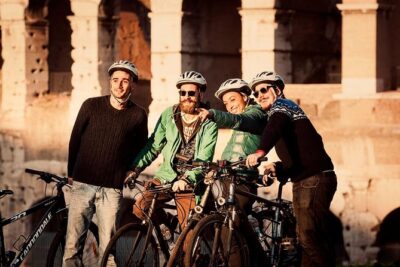
Rome City Small Group Bike Tour with quality Cannondale EBike
Read our review →
Tuscany Bike Tours Through the Chianti Hills with Wine Tasting
Read our review →
Rome by Night – Ebike Small Group Tour – Food and Wine (Option)
Read our review →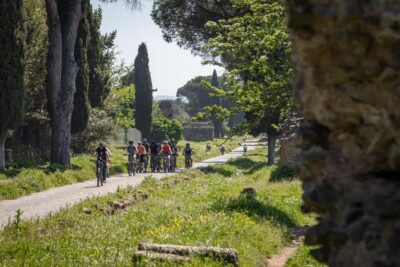
Appian Way E-bike Tour with Catacombs, Aqueducts & Food
Read our review →
Browse the lists this tour appears in