
Reviewed · CITY TOURS
Parma: City Walking Tour
Parma rewards a slow first look. This two-hour walk brings you through the historic center, with a local guide pointing out major monuments, food traditions, and stories tied to Giuseppe Verdi. I like the focus on Parma’s everyday identity, not just its grand buildings, and I like that the route includes the cathedral from the outside. The main consideration is that the tour is bilingual, so explanations may take longer than on a single-language walk.
The meeting point is the IAT tourist office at Strada Garibaldi 18, near Piazza Garibaldi, the city’s central starting point. Guide Alice has earned special praise for her local stories and practical suggestions, though groups can reach about 25 people, and that may make it harder to hear or see every detail.
In This Review
- Key points at a glance
- Why Parma is worth two hours on foot
- Starting at Strada Garibaldi 18 and Piazza Garibaldi
- Following Parma’s main monuments outdoors
- The cathedral as the tour’s visual anchor
- Parma’s food culture beyond famous names
- Giuseppe Verdi’s Parma stories
- A local guide makes the difference
- What the bilingual format means for you
- Group size, earphones, and seeing the details
- Is $27 a fair price?
- Who should book this Parma walk?
- Should you book it?
- FAQ
- Where does the Parma walking tour begin?
- How long does the tour last?
- What languages are offered?
- What time does the tour start?
- Does the tour enter Parma Cathedral or other monuments?
- Is hotel pickup included?
Key points at a glance
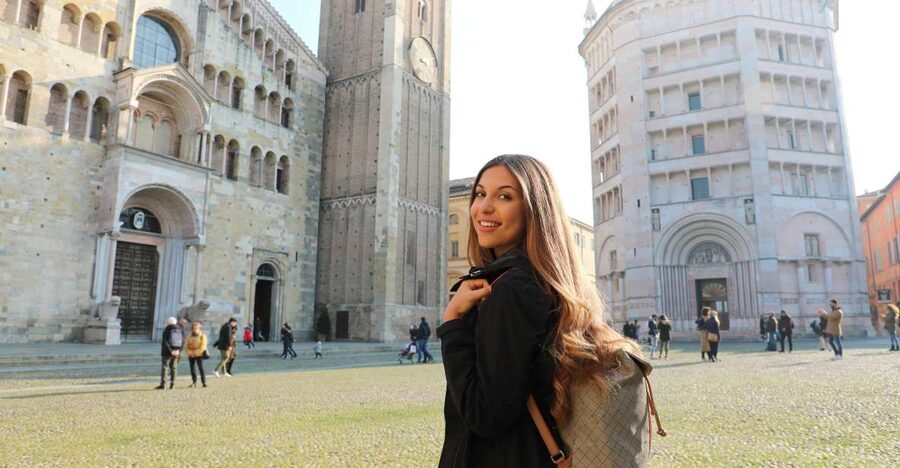
- Parma’s cathedral is a central highlight: You see one of the city’s most important monuments from outside, without an entry visit.
- Food is part of the story: The guide explains the traditions that helped Parma become a major Italian food city.
- Verdi adds a personal thread: Expect anecdotes about the composer and Parma’s connection with opera and music.
- The tour begins at Piazza Garibaldi: The IAT office at Strada Garibaldi 18 is both the meeting point and the return point.
- English and Italian are combined: The tour runs in both languages, which is useful for mixed groups but can reduce the time spent on each explanation.
- The group may be fairly large: Earphones are supplied for groups of six or more, and some departures have included around 25 people.
Why Parma is worth two hours on foot
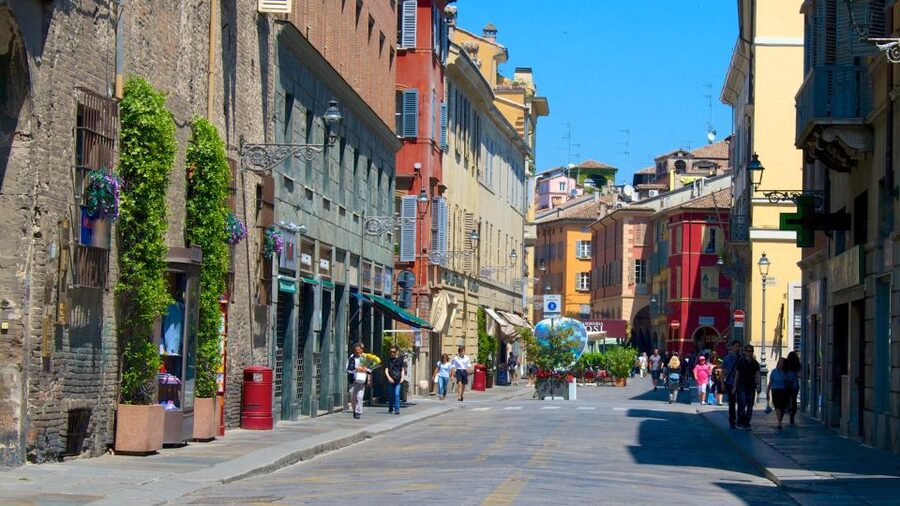
Parma is easy to underestimate. Many people know the name from Parmigiano Reggiano and prosciutto, but the city also carries the weight of the old Duchy of Parma and Piacenza, a university tradition dating from the 11th century, and a strong link with Giuseppe Verdi.
A walking tour gives you a useful first frame for all of this. Instead of treating the city as a collection of unrelated sights, the guide can connect food, music, civic power, religion, and university life. I find that especially useful in Parma because its appeal is spread across the center rather than concentrated in one famous landmark.
The tour stays outdoors. That keeps the pace simple and avoids the time needed for ticket lines, but it also means you will not enter the cathedral or any other monument. You are paying for orientation, stories, and a guided look at the city’s main treasures, not for museum admission.
More Walking Tours in Italy:
- Milan: Guided Walking Tour & Last Supper Visit with Ticket
★ 4.7 · 5,409 reviews - Naples: Street Food Walking Tour with Local Guide
★ 4.8 · 4,256 reviews - Venice Walking Tour and Gondola Ride
★ 3.5 · 3,630 reviews
Starting at Strada Garibaldi 18 and Piazza Garibaldi
The walk begins at the IAT tourist office on Strada Garibaldi 18. This location sits by Piazza Garibaldi, described as the heart of Parma, so it is a sensible place to begin learning the city’s layout.
Starting here matters because you can get your bearings before the tour moves through the center. If Parma is your first stop in Emilia-Romagna, the guide’s opening explanation should help you understand the city as an old political capital, a university town, and a modern food center all at once.
The same address is used for the return. That is convenient if you want to continue sightseeing afterward, since you will finish where you started rather than needing to find your way back from another part of the city.
There is no hotel pickup. You need to make your own way to the IAT office, so allow enough time to arrive before the scheduled start. The regular departure is at 10:00 in the morning every day. On Saturdays there is also a 15:00 departure, giving you a little more freedom if you prefer a later start.
Following Parma’s main monuments outdoors
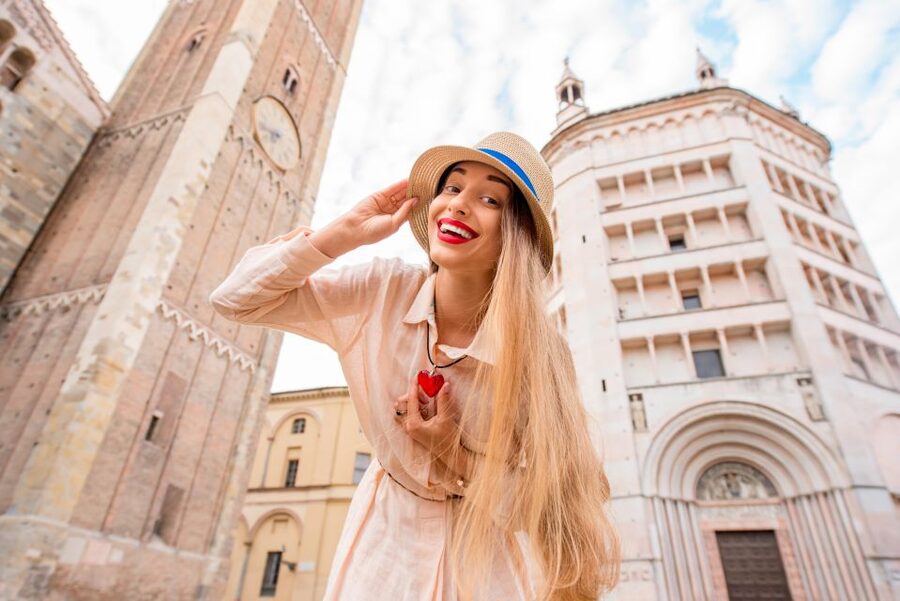
The walking portion covers the main monuments in the historic center, with Parma’s cathedral as the key architectural sight. The guide discusses the buildings and their place in the city, but the tour does not include interior visits.
That distinction is important. If you want to study the cathedral’s interior at length, see its artwork up close, or visit other monuments inside, you will need to return on your own. The walking tour can tell you what deserves a closer look and help you decide how to spend the rest of your day.
One practical weakness is the size of the group. A group of about 25 people can make a narrow street or busy square harder to manage. One person noted that the guide was very well prepared but that there may have been too many people together. Another pointed out that the guide sometimes explained fountains or parts of buildings from too far away, making them difficult to see clearly.
I would stay near the guide whenever possible. If the group spreads out, the best view may not be at the back. Earphones are provided for groups of six or more, which should help with hearing, but they cannot solve every problem when a guide is pointing toward a detail some distance away.
The cathedral as the tour’s visual anchor
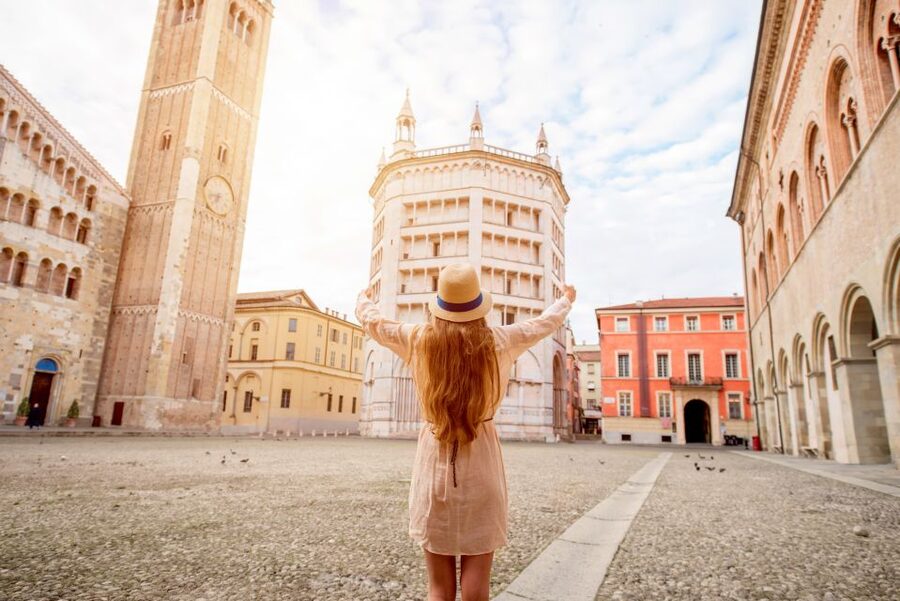
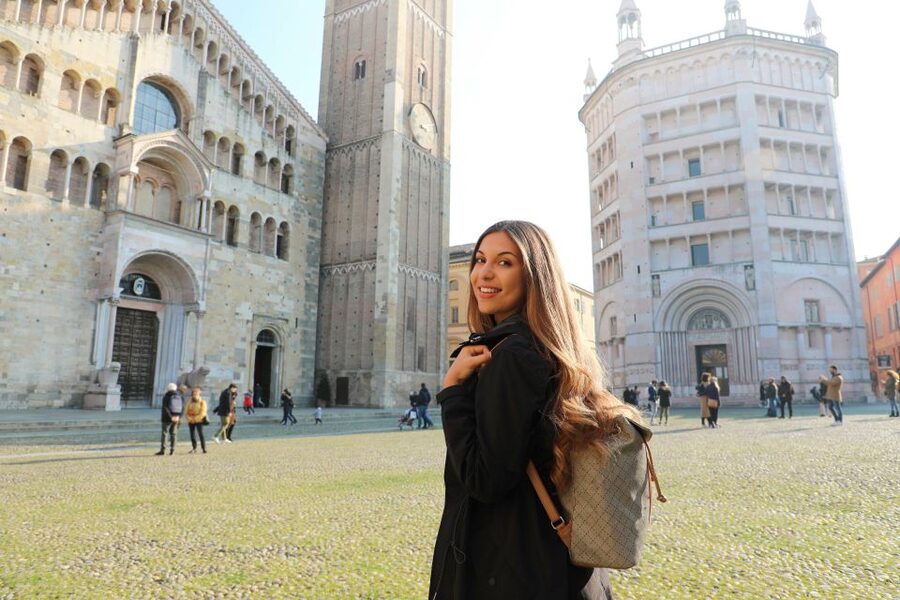
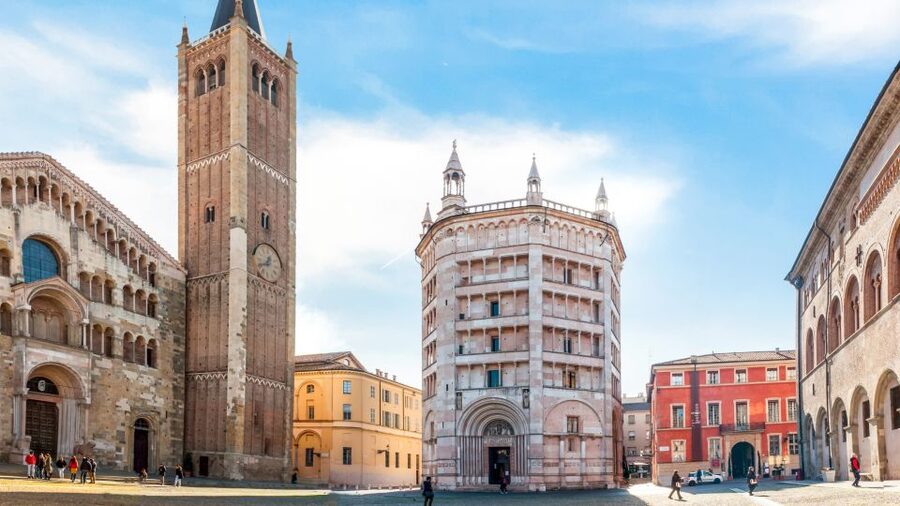
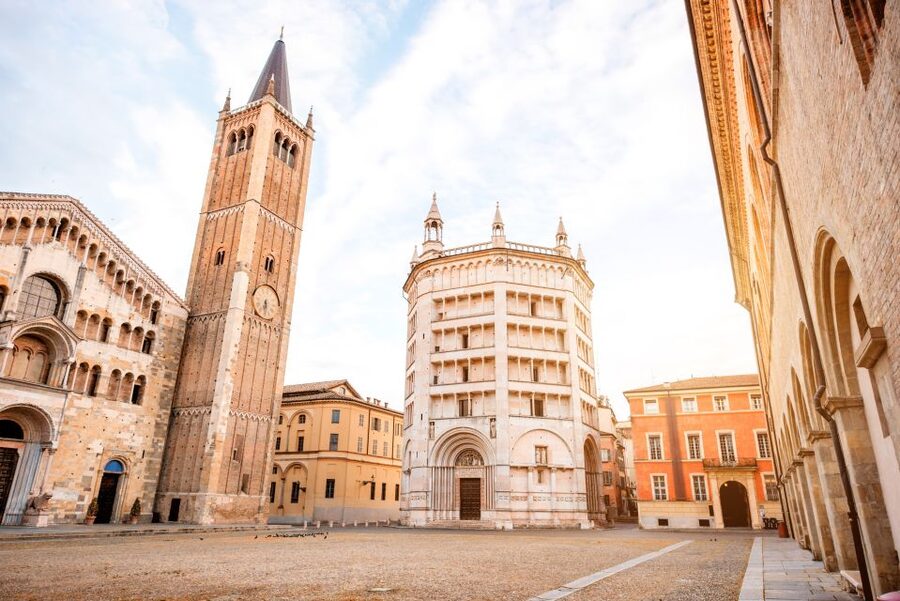
Parma Cathedral gives the tour a clear architectural focus. Even without entering, you can appreciate its role in the center and hear why it matters to the city.
The outdoor approach suits people who want a quick introduction rather than a full art-history visit. You get context without spending the whole morning inside one building. I like this format for a first day in Parma, especially if you also plan to visit food shops, cafés, or museums later.
At the same time, the cathedral is the kind of place that may leave you wanting more. Since there are no entrances, the tour can only take you to the threshold of the experience. If interior art and religious architecture are your main reasons for visiting Parma, treat this walk as a beginning, not a complete cathedral visit.
The guide’s job here is to help you notice what you might otherwise pass. Pay attention to references to the city’s past, the relationship between the central buildings, and any smaller architectural features the guide points out. In a larger group, move closer when the explanation turns to a specific fountain, façade, or detail.
A few more Italy bookings to compare
- Tour Parmigiano Reggiano dairy and Parma ham
★ 5.0 · 601 reviews - Private Half Day Parma Food Walking Tour
★ 5.0 · 561 reviews - Parma: Parmigiano Production and Parma Ham Tour & Tasting
★ 4.9 · 554 reviews - Guided group tour TastyBus: Parmesan Cheese and Parma Ham
★ 5.0 · 241 reviews
Parma’s food culture beyond famous names
Food is one of the most useful parts of this experience. Parma’s reputation rests on products known around the world, but a city walking tour can show you how gastronomy fits into local identity rather than presenting a simple shopping list.
The guide explains the food secrets that helped Parma gain recognition as a creative city for gastronomy. You will not be visiting production sites or taking part in a tasting based on the information provided, so keep your expectations clear. This is food culture explained during a city walk, not a dedicated food tour.
That still has real value. Once you understand why food matters in Parma, you can make better choices after the walk. You may want to look for typical shops, local specialties, or places suggested by the guide. Alice was particularly praised for recommending what to visit later and which typical shops to seek out.
I would listen carefully during this section and write down names if the guide gives them. A two-hour tour passes quickly, and practical suggestions can be more useful than a long list of facts you will forget before lunch.
Giuseppe Verdi’s Parma stories
Parma is also the city of Giuseppe Verdi, and the guide adds anecdotes about the great musician to the route. This gives the walk a human thread. Instead of hearing only about rulers, churches, and old institutions, you get stories connected to a figure whose music still shapes Parma’s public identity.
You do not need to be an opera expert to enjoy this part. Anecdotes make the city easier to remember, particularly when they connect a person to streets, buildings, or local pride. If Verdi interests you, the tour may also help you decide whether to add more music-related sights to your day, though no interior visit is included here.
The Verdi material is one reason this tour offers more than a standard monument checklist. Parma’s character comes from several overlapping traditions: the old duchy, the university, food production, and music. A good guide can make those links clear in a short time.
A local guide makes the difference
The strongest praise has gone to the guides’ preparation, friendliness, and knowledge of Parma. Alice, in particular, was praised for knowing the city’s history and anecdotes well, and for offering useful advice about what to see next.
That local perspective is the main reason to choose this tour over walking Parma alone with a map. You can find the cathedral and central squares yourself, but you may miss the small stories that explain why food, Verdi, and the old duchy still matter.
The experience is not perfect for every style of learner. One participant wanted more conversation and interaction, suggesting that some parts may feel like a traditional guided explanation rather than a lively exchange. Another found the bilingual format less satisfying.
If you prefer a private guide, a highly interactive walk, or a single-language experience, this may not be the best match. If you enjoy listening while a guide organizes the city for you, the format should work well.
The fact that the tour continues in poor weather is also useful. One guide received praise for delivering an accurate visit despite rain. Still, wear proper shoes and bring weather protection. Comfortable footwear is specifically recommended, and this is a two-hour walk over city streets.
What the bilingual format means for you
The tour is offered in Italian and English every day at 10:00, with an extra Saturday departure at 15:00. A bilingual tour opens the experience to mixed groups, but it splits the guide’s speaking time.
For some people, this is only a minor issue. You still receive the main information, and the two-hour length gives the guide room to cover Parma’s monuments, food culture, and Verdi connections. For others, especially people who want detailed history, repeated translation can make the tour feel slower or less focused.
One Italian participant called the bilingual setup a disappointment, while another described the tour as a good initiative that could have benefited from closer presentation of specific details. That tells me the tour is best approached as a broad introduction, not a specialist lecture.
If you are comfortable with a shared Italian and English format, the language arrangement is practical. If you want every minute in English, check the available departure details carefully before booking, since the advertised tour is bilingual rather than English-only.
Group size, earphones, and seeing the details
The supplied equipment includes earphones for groups of six or more. This is a small but meaningful feature. In a city center, traffic, passing conversations, and distance can make a guide hard to hear, and earphones should make the general explanation clearer.
They do not guarantee a close view of every building feature. The tour may include fountains or details on façades, and one piece of feedback specifically noted that the guide could have moved closer while explaining them. If you care about architecture, stay toward the middle of the group and move in when the guide stops.
A group of 25 is not enormous, but it is large enough to affect the experience. You may wait briefly for the group to gather, and you may not get a front-row view at every stop. The benefit is that the tour can still operate as a scheduled public walk rather than requiring a private booking.
Is $27 a fair price?
At $27 per person, the value depends on what you want from a city tour. You are not paying for monument entrances, food samples, hotel transport, or a private guide. You are paying for two hours with a local multilingual guide, a planned route, and an introduction to Parma’s central sights and traditions.
I consider that a reasonable price if Parma is unfamiliar to you and you want context before exploring alone. The guide can save you from spending your first hours wandering without a plan, and practical suggestions about typical shops or later sights may help you use the rest of the day better.
The value is less convincing if you already know the center well or mainly want to enter the cathedral and other monuments. Since all visits are outdoors, you will still need to arrange those interior visits separately.
The tour is also a good fit for a short visit. Two hours leaves time for lunch, shopping, museums, or a self-guided return to the places that caught your attention. I would not book it as your only Parma activity, but I would consider it a useful opening chapter.
Who should book this Parma walk?
I would recommend it to a first-time visitor who wants a clear introduction to Parma’s center, food identity, and Verdi connection. It is also a good choice if you like local anecdotes and want suggestions for typical shops and later sightseeing.
It suits people who are comfortable walking for two hours and listening in a bilingual group. The 10:00 start works well for building a full day around the tour, while the Saturday 15:00 departure helps if your morning is already occupied.
You should think twice if you have mobility impairments, since the activity is explicitly not suitable for people with mobility difficulties. You should also reconsider if you dislike larger groups, need a quiet single-language presentation, or want a tour with interior admissions and tastings.
Free cancellation up to 24 hours before the start and the option to reserve without paying immediately make the booking fairly flexible. Those policies are useful if your Emilia-Romagna plans are still moving, but they do not change the main question: are you looking for a city introduction or a specialized visit?
Should you book it?
Book this tour if you want a well-priced orientation to Parma with local stories, food context, and an outdoor look at the cathedral and central monuments. The guide quality appears to be the strongest part, with Alice earning particular praise for her anecdotes and helpful advice.
Skip it if you need a private, highly interactive, single-language tour or if entering monuments is essential. For most independent visitors, the best use of the walk is to take notes, stay close to the guide, and use the remaining day to return to the sights and shops that interest you most.
FAQ
Where does the Parma walking tour begin?
The tour begins at the IAT tourist office at Strada Garibaldi 18 in Parma, near Piazza Garibaldi.
How long does the tour last?
The guided walking tour lasts two hours.
What languages are offered?
The tour is conducted in Italian and English.
What time does the tour start?
It takes place every day at 10:00. On Saturdays, there is also a 15:00 departure.
Does the tour enter Parma Cathedral or other monuments?
No. The tour visits the monuments from the outside only, and entrances are not included.
Is hotel pickup included?
No. You need to make your own way to the IAT meeting point at Strada Garibaldi 18.
Recently added around Italy
- Florence Uffizi Gallery monolingual Small Group Tour★ 4.0 · 621 reviews
- Florence Private Walking tour with Skip-the-line to Accademia★ 4.5 · 236 reviews
- Uffizi Gallery Entrance Ticket with Priority Access★ 3.5 · 1,029 reviews
- Florence Skip-the-Line Duomo Tour with Guide & Brunelleschi Dome★ 5.0 · 1,176 reviews
- Skip-the-Line Accademia Guided Visit: David Secrets and Beyond★ 4.0 · 525 reviews
- Priority Entrance : Florence Accademia Gallery Timely Tickets★ 4.0 · 603 reviews
- Skip the line : David Guided Experience★ 4.5 · 1,076 reviews
- Private Tour in Siena, San Gimignano and Chianti Day Trip from Florence★ 5.0 · 405 reviews
City Tours, compared.
City Sightseeing Hop-on Hop-off Bus with Audioguide
Read our review →
City Sightseeing Hop-On Hop-Off Bus with Audio Guide
Read our review →
City Sightseeing Rome Hop-On Hop-Off Bus Tour
Read our review →

Fettuccine Pasta Cooking Class in Rome’s City Center
Read our review →
Vatican City: Vatican Museums & Sistine Chapel Entry Ticket
Read our review →

City Sightseeing Florence Hop-On Hop-Off Bus Tour
Read our review →Browse the lists this tour appears in