
Reviewed · CYCLING TOURS
Highlights & Hidden Gems Tour with Top E-bike
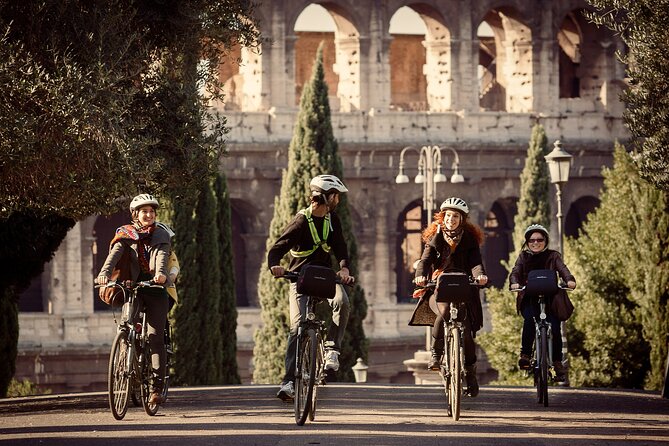
Rome rewards those who keep moving. This four-hour e-bike tour links the Colosseum, Trevi Fountain, Pantheon, and other major sights with quieter corners that are easy to miss on foot. I like the excellent Cannondale bikes, and I like the small maximum group of 10, which gives your guide room to answer questions. The one caution is that Rome still has crowds and traffic, even on carefully chosen bike routes.
The 14-kilometer ride is rated leisure, though you should feel comfortable on a bicycle before booking. I especially like the choice of morning or afternoon departure, and the morning can be a smart pick if you want fewer people and less street activity. The tour does not include interior visits, so it works best as a lively orientation rather than a substitute for time inside the Colosseum, Pantheon, or museums.
In This Review
- Key points to know before you book
- Why an e-bike works so well in Rome
- Starting by the Colosseum and Imperial Forums
- Trevi Fountain, Spanish Steps, and Piazza del Popolo
- Villa Borghese adds the breathing room
- Piazza Navona and the Pantheon
- The old Jewish Quarter and Teatro di Marcello
- Capitol Hill delivers the final view
- Group size, guides, and the pace
- Families and cycling ability
- Choosing morning or afternoon
- Is $102.84 a fair price?
- Who should book this Rome e-bike tour?
- FAQ
- How long does the e-bike tour last?
- How far do you ride?
- What sights are included?
- Does the tour enter the Colosseum or Pantheon?
- What kind of bicycle is provided?
- Is a helmet included?
- What else comes with the bike?
- Can children join the tour?
- How many people can join?
- Where does the tour start and finish?
- Can I cancel for a full refund?
Key points to know before you book
- A 14-kilometer route covers Rome’s major sights efficiently, making it useful on your first day in the city.
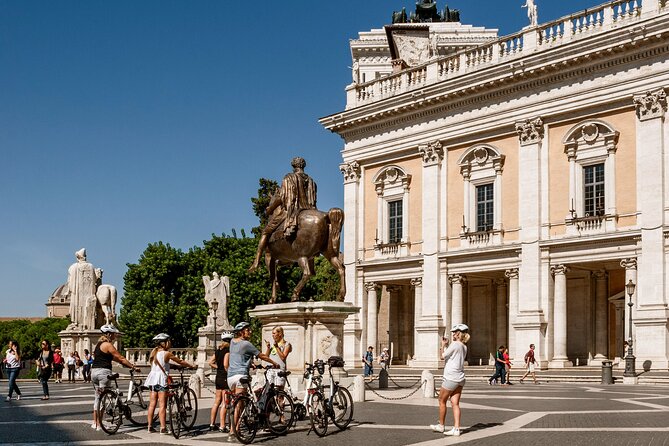
- Cannondale e-bikes make Rome’s hills manageable, with anti-puncture tires, a handlebar bag, and a water bottle included.
- The group is capped at 10 people, and the smaller format can mean more direct help from your guide.
- Morning rides may offer calmer streets, while the afternoon departure gives you more flexibility.
- The route mixes famous monuments with quieter historic areas, including the old Jewish Quarter and Teatro di Marcello.
- Children can join with the right setup, including a child extension for ages 5 to 8 and appropriately sized e-bikes for children 9 and older.
Why an e-bike works so well in Rome
Rome is a city of grand sights spread across a surprisingly large area. You can walk from one monument to the next, but your feet will pay the bill. An e-bike lets you connect the ancient center, Trevi Fountain, Villa Borghese, Piazza Navona, and the Capitol without spending the entire day on pavement.
The electric assistance matters most on Rome’s inclines. The ride is described as leisure level, but Rome is not flat, and a child seat or extension makes the outing more demanding. You still pedal, steer, and watch the road, but the motor takes much of the sting out of the hills.
This is not a race. The schedule allows short stops at each major point, with time for explanations and photographs. You cover a lot of ground, but you do not get long visits inside the monuments. Think of it as a moving introduction to Rome that helps you decide where to return later.
The equipment is a strong part of the package. You receive a top-quality Cannondale e-bike with anti-puncture tires, a helmet, a handlebar bag, and a water bottle. Helmets are mandatory, which is sensible in a city where road surfaces and traffic conditions can change quickly.
More Bike Tours in Rome
- Rome EBike Tour: Appian Way, Catacombs & Roman Aqueducts
★ 5.0 · 1,766 reviews - Rome: Top Highlights & Hidden Gems Tour by Cannondale E-Bike
★ 4.9 · 1,760 reviews - Rome: Appian Way, Catacombs, & Roman Aqueducts E-bike Tour
★ 4.9 · 1,421 reviews
Starting by the Colosseum and Imperial Forums
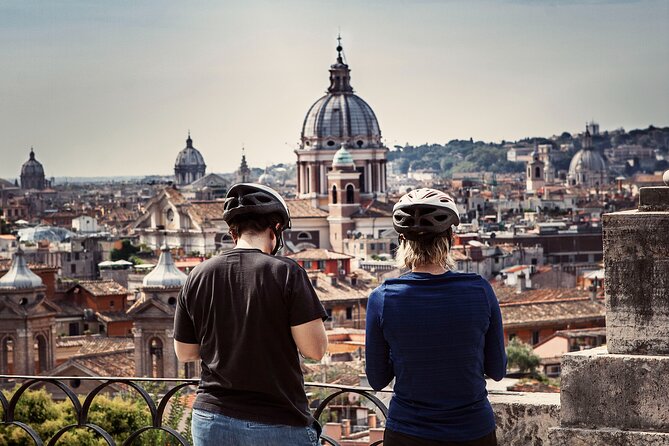
The meeting point is at Via Labicana 49, near the Colosseum. From there, the opening stop is Piazza del Colosseo, where you get a clear view of Rome’s most famous monument while your guide explains its roughly 2,000-year story.
The stop lasts about 10 minutes. That is enough for an orientation and photographs, but not enough for an interior visit. If the Colosseum is high on your list, plan a separate timed entry for another part of your trip. This arrangement has an advantage: you see the building without using the tour’s limited time standing in an admission line.
Next comes Via dei Fori Imperiali, the broad avenue running through the center of Ancient Rome. It gives you a strong sense of how the Forum area fits together. From a bicycle, you see the ruins as part of a wider urban setting rather than as isolated stones behind a museum label.
At Piazza Venezia, the guide brings together three very different periods. You see Trajan’s Column, the Vittoriano Monument, and Palazzo Venezia, a useful lesson in how Rome has layered the ancient, Renaissance, and modern city in one compact area.
These first stops are brief, but their order makes sense. You begin with the Colosseum, follow the ancient center, then reach one of Rome’s main civic squares. If you have just arrived in town, this sequence helps you get your bearings fast.
Trevi Fountain, Spanish Steps, and Piazza del Popolo
The ride continues to the Trevi Fountain, where you pause for an explanation of its design and history. The stop is about 10 minutes, so you have time for pictures and a quick look, but not the relaxed people-watching you might want later.
Trevi can be crowded, and the nearby streets are often full of pedestrians. The bike makes it easier to reach the fountain, but it does not remove the crowds once you arrive. Keep your attention on your guide and your belongings in this busy part of central Rome.
At Piazza di Spagna, the tour pauses for about five minutes at the foot of the Spanish Steps. You see the monumental staircase rising toward Trinità dei Monti church. The stop is short because the square is mainly a visual introduction, not a long break.
Piazza del Popolo receives another quick visit. This was historically the first sight of Rome for many people entering from the north along the Via Flaminia. That detail gives the square more meaning than a simple photo stop. You are seeing an old gateway into the city, not just another handsome piazza.
The short times here are a trade-off. You will not linger at every fountain and staircase, but you can return on foot later if one catches your interest. The benefit is that you keep the route moving and reach places that would be difficult to connect in four hours by walking.
Villa Borghese adds the breathing room
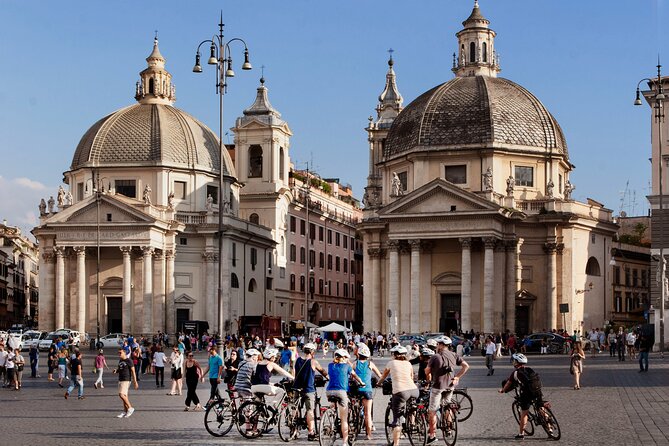
After the busy central streets, Villa Borghese changes the pace. The park offers a scenic view over Rome and a more open setting for photographs. The stop lasts about 15 minutes, the longest pause on the route.
This is one of the most welcome parts of the ride. Rome’s monuments are rewarding, but a few minutes away from stone walls and dense streets helps you appreciate the city’s scale. The view also gives your camera a different subject from the usual close-up of a fountain or church façade.
The guide can point out how the park fits into the route between Piazza del Popolo and the historic center. You get a sense of Rome’s hills and major districts, something that is harder to understand when you move only from one ground-level street to another.
You should still expect an active outing, not a park picnic. The tour has many stops to fit into four hours, and Villa Borghese is one scenic pause within a larger circuit.
More E-Bike Tours in Rome
- Rome City Small Group Bike Tour with quality Cannondale EBike
★ 5.0 · 1,380 reviews - Rome by Night – Ebike Small Group Tour – Food and Wine (Option)
★ 5.0 · 1,275 reviews - Rome:Appian Way E-bike Tour with Catacombs, Aqueducts & Food
★ 4.9 · 1,210 reviews - Rome: E-Bike Night Tour with Food and Wine Tasting
★ 4.9 · 1,131 reviews
Piazza Navona and the Pantheon
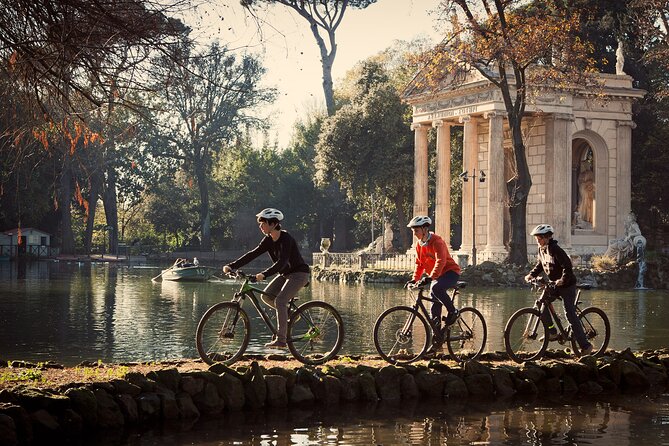
Piazza Navona is one of the tour’s best stops for seeing Rome’s Baroque character. The long, oblong square grew from an ancient stadium, and today its central fountain gives you a front-row view of elaborate sculpture and water.
The bike is useful here because you can circle the square and take in its shape. A walking visit often gives you only one angle before the crowd, cafés, or passing groups pull you onward.
The Pantheon follows, with about 10 minutes in front of one of Antiquity’s oldest and best-preserved buildings. This is another exterior stop. You get the guide’s explanation and time for a photograph, but you should plan a separate visit if you want to see the interior.
That limitation is worth keeping in mind when judging the price. At $102.84 per person, you are paying for the bike, guide, equipment, route planning, and the ability to see a large portion of central Rome. Admission tickets are not part of the experience because the tour does not take you inside these monuments.
For someone with only a short stay, that can be good value. You gain a clear map of the city and a list of places worth revisiting. If your main goal is detailed time inside ancient buildings, a walking tour with interior entry may suit you better.
The old Jewish Quarter and Teatro di Marcello
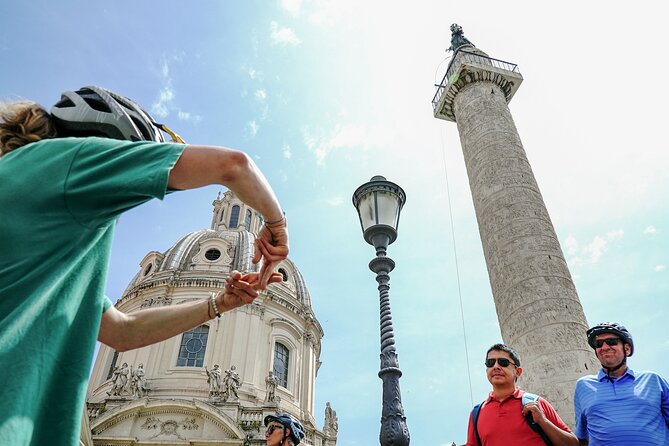
The Antico Quartiere Ebraico, or old Jewish Quarter, is one of the route’s quieter sections. The area brings together archaeological, cultural, and religious layers in a compact neighborhood. The stop lasts about five minutes, so expect an introduction rather than a full neighborhood visit.
I like this part because it keeps the tour from becoming a checklist of Rome’s most photographed monuments. You see a district with its own identity and historical importance, then continue before the schedule loses momentum.
Teatro di Marcello offers another useful comparison. This ancient theater later served as a model for the Colosseum, and the five-minute stop lets your guide explain that connection. It is a fine example of how Rome reuses and reshapes its past.
The brief stops may frustrate you if you want to study every ruin. Still, they provide enough context to make a return visit more rewarding. You will know what you are looking at and why it matters.
Capitol Hill delivers the final view
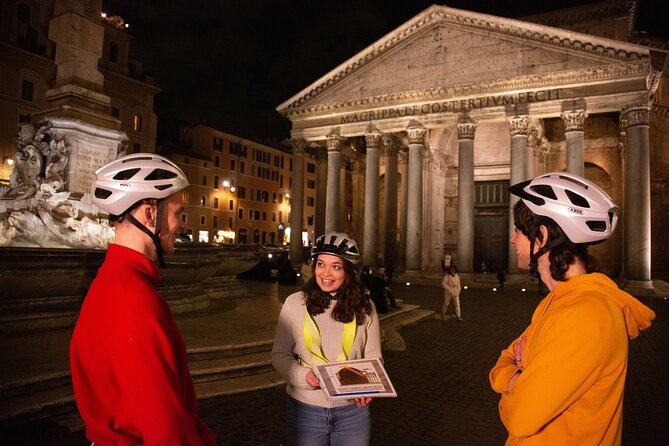
The last major stop is Piazza del Campidoglio on Capitol Hill. Michelangelo designed the 16th-century square, and the position gives you a memorable view toward the Roman Forum.
This is a strong ending because it pulls together much of what you have seen. From the hill, you can look back toward the ancient center after visiting the Colosseum, Imperial Forums, and Teatro di Marcello. The city’s long story becomes easier to read from above.
The stop lasts about 10 minutes. It is enough for the view, an explanation of the square, and photographs. You then cycle back to the original meeting point at Via Labicana 49.
Group size, guides, and the pace
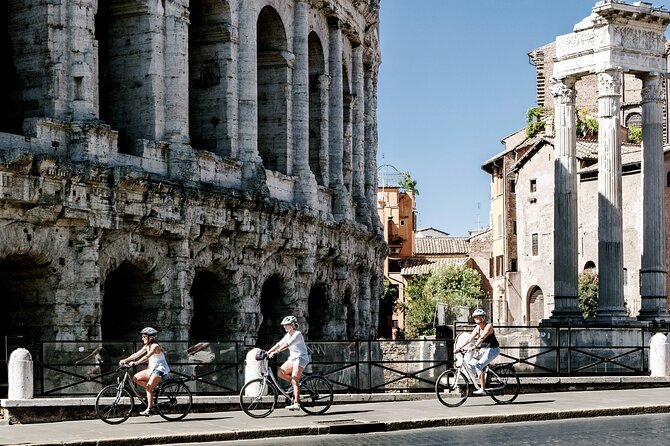
The tour has a maximum of 10 participants, with a minimum of four required for the departure to operate. The small format is useful in Rome, where a large line of bicycles can become awkward at crossings and crowded squares.
A small group also helps you keep up with the guide. One family had a private-feeling ride with guide Aaliyah because they were the only four people on the departure. Another highly praised morning guide was Arina, whose route explanations and handling of the group helped everyone stay together.
Those names do not guarantee who will lead your ride, but they show what the operator aims for: a friendly guide who can explain the sights while keeping the pace comfortable. The strongest feedback focuses on guides who combine clear information with time for photographs.
Rome’s crowds and traffic remain a real factor. The routes are planned to use streets with limited traffic, and some sections have no traffic at all. That improves safety, but it does not make the city empty. You should be confident on a bicycle and ready to follow instructions.
Families and cycling ability
Children ages 5 to 8 can use a child extension, also called a child streamliner. Children 9 and older can ride independently on an appropriately sized e-bike.
The difficulty is listed as leisure, or intermediate when a child seat or child extension is mounted. That distinction matters. A child setup can make steering and balance feel different, especially on hills or when stopping.
The tour is not recommended if you lack confidence on a bicycle. You need to manage the bike, follow the group, and remain alert around roads and pedestrians. The equipment has a weight limit of 300 pounds, or 136 kilograms.
If you are comfortable riding but worry about Rome’s hills, the e-bike should help. If you are uneasy on a bicycle in general, the motor will not solve the basic problem. A walking tour is the safer choice for you.
Choosing morning or afternoon
You can choose a morning or afternoon departure. The morning option may be the better pick if you want less street activity and cooler conditions, though the tour information does not promise empty streets.
The afternoon departure suits a later start or a day when you prefer to sleep in. Since the ride lasts about four hours and returns to the starting point, check how it fits with any timed museum or meal plans.
The tour is often reserved well ahead, with an average booking lead time of about 32 days. That suggests you should reserve early for a particular date or departure, especially if your schedule in Rome is tight.
Free cancellation is available up to 24 hours before the local start time. Cancellations or changes made less than 24 hours before departure are not refunded or accepted. One past booking problem involved a departure that had mistakenly remained open, so it is sensible to confirm your booking details and meeting time before setting out.
Is $102.84 a fair price?
The price is not bargain-level, but it can be reasonable for the amount of Rome you cover. A four-hour rental alone would not provide the route, explanations, safety planning, helmet, water, and support of a guided outing.
The value is strongest if you are new to Rome, have only a few days, or want a clear overview before choosing which sights deserve a longer visit. The tour connects 12 stops without asking you to navigate Rome’s confusing streets on your own.
The value is weaker if you already know the historic center well or want to spend serious time inside monuments. Since admission is not included, you may still pay separately for the Colosseum, Pantheon, museums, or other sites afterward.
I would treat the cost as payment for orientation and efficient movement, not as an all-inclusive sightseeing ticket. For many people, that is a smart use of one morning or afternoon in Rome.
Who should book this Rome e-bike tour?
I recommend it most for first-time visitors, active couples, families with cycling experience, and anyone who wants to see the city’s major sights before exploring them in depth. It is also useful for people who dislike long walking days but still want an active way to see Rome.
You should skip it if you are not self-confident on a bike, need long indoor visits, or prefer a slow pace at each monument. Crowds and traffic can still appear, and the short stops require you to keep moving.
Book the morning if your priority is a calmer ride. Choose the afternoon if you need a later start. Either way, wear comfortable clothes, follow the helmet rule, and leave separate time for the interiors that interest you most.
FAQ
How long does the e-bike tour last?
The tour lasts approximately four hours.
How far do you ride?
You cover about 8.5 miles, or 14 kilometers.
What sights are included?
The route includes the Colosseum, Via dei Fori Imperiali, Piazza Venezia, Trevi Fountain, Spanish Steps, Piazza del Popolo, Villa Borghese Gardens, Piazza Navona, the Pantheon, the old Jewish Quarter, Teatro di Marcello, and Piazza del Campidoglio.
Does the tour enter the Colosseum or Pantheon?
No. The stops provide exterior views, explanations, and time for photographs. Admission tickets are not included.
What kind of bicycle is provided?
You receive a top-quality Cannondale e-bike with anti-puncture tires.
Is a helmet included?
Yes. A helmet is provided free of charge, and wearing one is mandatory.
What else comes with the bike?
A handlebar bag and a water bottle are included.
Can children join the tour?
Yes. Children ages 5 to 8 can use a child extension. Children age 9 and older can ride an appropriately sized e-bike independently.
How many people can join?
The maximum group size is 10 people. At least four participants are required for the tour to operate.
Where does the tour start and finish?
The tour starts at Via Labicana 49, 00184 Rome, Italy, and ends back at the same meeting point.
Can I cancel for a full refund?
Yes, if you cancel at least 24 hours before the experience start time. Cancellations or changes made less than 24 hours before the start are not refunded or accepted.
Recently added around Rome
- Rome: Pantheon, Trevi Fountain & Roman Squares Guided Tour★ 4.7 · 386 reviews
- Vatican: St. Peter’s Basilica with Audio Guide and Options★ 3.4 · 269 reviews
- Vatican: Pope Francis Tomb and Papal Basilicas Tour★ 4.7 · 340 reviews
- Rome: Vatican Museums Skip-the-line Entry Ticket and Tour★ 4.2 · 400 reviews
- Rome: Vatican Museums & Sistine Chapel Ticket + Tour Options★ 4.7 · 344 reviews
- Vatican: Museums, Raphael & Sistine Chapel + Basilica Option★ 4.7 · 350 reviews
- Vatican Museums & Sistine Chapel Guided Tour★ 4.3 · 832 reviews
- Vatican Museums & Sistine Chapel Entry Ticket★ 4.4 · 245 reviews
Cycling Tours, compared.

Rome EBike Tour: Appian Way, Catacombs & Roman Aqueducts
Read our review →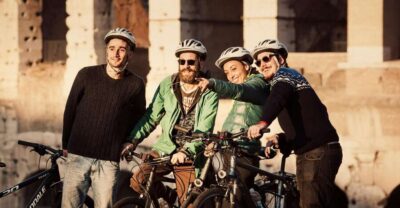
Top Highlights & Hidden Gems Tour by Cannondale E-Bike
Read our review →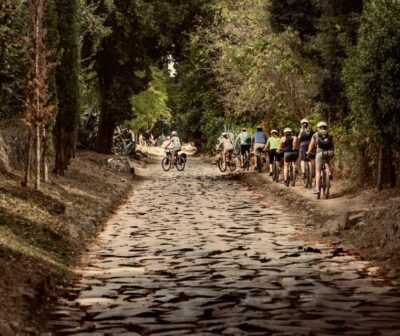
Appian Way, Catacombs, & Roman Aqueducts E-bike Tour
Read our review →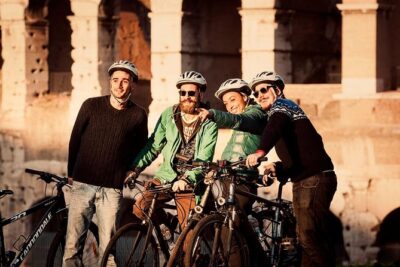
Rome City Small Group Bike Tour with quality Cannondale EBike
Read our review →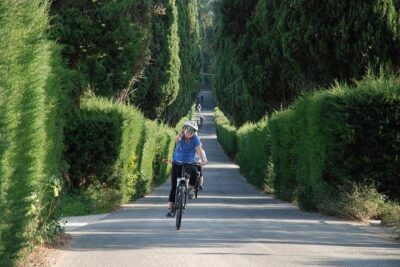
Tuscany Bike Tours Through the Chianti Hills with Wine Tasting
Read our review →
Rome by Night – Ebike Small Group Tour – Food and Wine (Option)
Read our review →
Appian Way E-bike Tour with Catacombs, Aqueducts & Food
Read our review →
Browse the lists this tour appears in