
Reviewed · CITY TOURS
Golf Cart Small-Group Guided Tour: Rome City Highlights
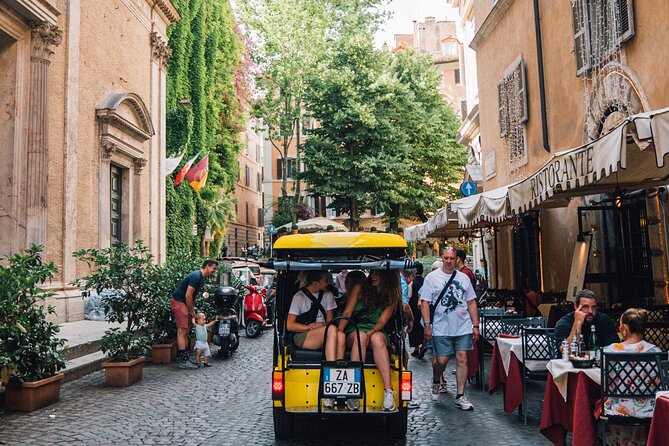
Rome rewards walking, but Rome can also wear you out. This 2.5-hour golf cart tour gives you a lively first look at the city’s major sights without asking you to cross the whole center on foot. I like the efficient route through places such as the Pantheon, Trevi Fountain, Piazza Navona, and Capitoline Hill, along with the easy listening provided by headsets. I also like the included gelato and bottled water, small touches that matter on a hot or tiring day.
The main tradeoff is simple: you see many monuments, but you do not enter them. Stops can be as short as five or ten minutes, so you get a quick look, some explanation, and time for photographs rather than a full visit. At $104 per person, this is best treated as an orientation tour, not a substitute for inside visits to the Colosseum, Pantheon, Vatican Museums, or other major sites.
In This Review
- Quick points before you book
- Why a golf cart works well in central Rome
- Meeting at Via Monterone and settling into the ride
- Pantheon and Piazza Colonna: a short lesson in Roman power
- Trevi Fountain and the included gelato stop
- Spanish Steps and Piazza del Popolo
- Augustus, Piazza Navona, and Via Giulia
- Largo Argentina, the Capitoline Hill, and Piazza Venezia
- Monti and the finish near the Colosseum
- Is $104 a fair price?
- What the short stops really mean
- Who will enjoy this Rome tour most?
- Booking, cancellation, and final advice
- FAQ
- How long does the Rome golf cart tour last?
- What sights are included on the route?
- Does the tour enter the monuments?
- Where does the tour start and end?
- How many people can join the tour?
- Are food and drinks included?
Quick points before you book
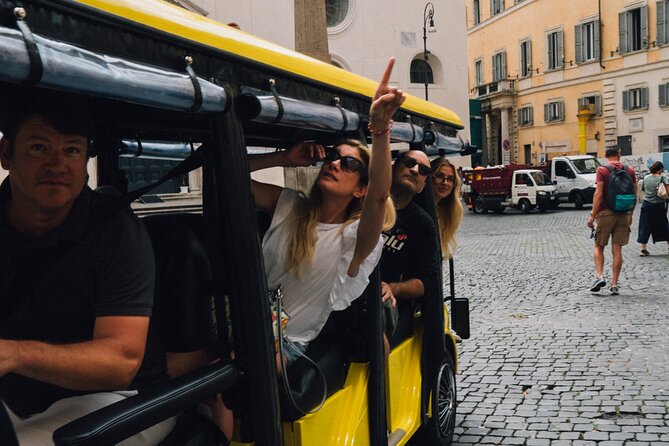
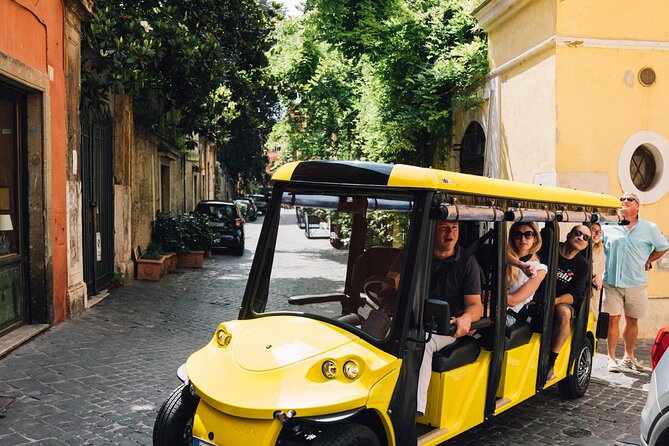
- Seven-seat electric carts: The tour uses compact carts that can slip through Rome’s narrow historic streets more easily than a large bus.
- Maximum of 14 people: Two carts may travel together, with everyone hearing the same guide through headsets.
- A strong first-day route: You cover a wide sweep of central Rome and can mark the places you want to revisit on foot.
- Gelato is included: One serving per person gives the tour a pleasant Roman pause.
- English only: The guide’s commentary and provided headsets are in English.
- The finish is useful: The tour ends outside the Colosseum, though the Colosseum itself is not an included visit.
Why a golf cart works well in central Rome
Rome’s center is full of cobbled lanes, traffic restrictions, grand avenues, and streets where a large sightseeing bus simply cannot go. An electric golf cart offers a middle ground. You cover more ground than you could comfortably walk in two and a half hours, but you remain close to the streets, churches, fountains, and daily life around you.
The route also avoids the tiring rhythm of a standard walking tour. You step out for short visits, take photographs, then return to a seat while the cart carries you to the next neighborhood. That makes this a useful choice for families, older people, and anyone arriving in Rome after a long journey.
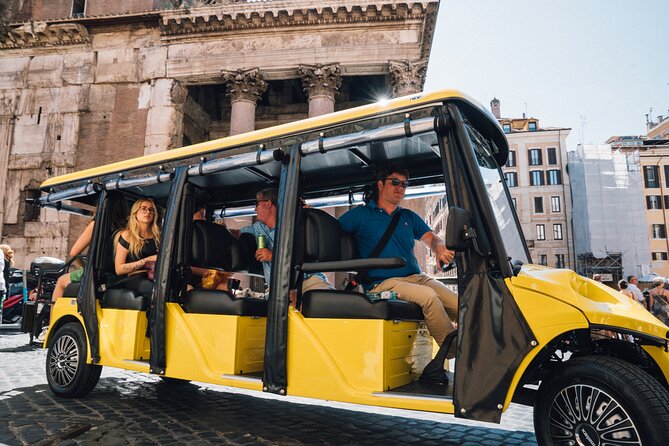
The carts have seven seats. If bookings require two vehicles, both carts travel together, described as moving like connected carriages. Everyone listens to the same guide through earpieces, though people who book together may occasionally be split between the two carts.
That setup keeps the group small enough for a more personal feel, but you should not expect a private tour. The maximum group size is 14, and the guide must divide attention between both vehicles.
More Golf Cart Tours in Rome:
- Rome by Golf Cart Private Tour: Beyond the Landmarks
★ 5.0 · 4,361 reviews - Rome on a Golf Cart Semi-Private Tour Max 6 with Private Option
★ 5.0 · 2,502 reviews - Rome Highlights by Golf Cart Private Tour
★ 5.0 · 2,379 reviews
Meeting at Via Monterone and settling into the ride
You meet at V. Monterone, 19, at the company’s central Rome office. Give yourself extra time. Rome’s street names and lanes can confuse even confident navigators, and the tour cannot hold up for late arrivals.
The meeting point is near public transportation, but the information provided does not name a specific station or line. Check the route before leaving your hotel, and do not count on finding a free taxi quickly, especially if your party needs two vehicles.
Once aboard, you receive a headset so you can follow the guide while the cart is moving. This is one of the most useful features of the tour. Rome is noisy, and without an audio system, much of the commentary would disappear into traffic and city sounds.
Past participants have praised guides including Francesco, Franco, Andrea, Claire, Amber, Marco, Leo, and Val. The strongest pattern is clear: the quality of the experience depends heavily on the person behind the wheel. Good guides mix dates and architecture with jokes, local suggestions, and small details that help the city feel less like a parade of monuments.
One guide, Andrea, works as an archaeologist and brought an obvious affection for ancient stones to his explanations. Franco was praised for linking ancient Rome with the modern city, while Claire was noted for her clear explanations and accommodating manner. Those personal touches are important because the tour moves quickly.
Pantheon and Piazza Colonna: a short lesson in Roman power
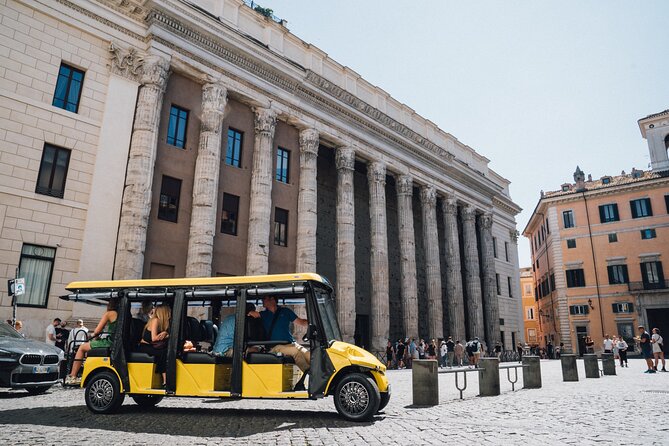
The first major stop is the Pantheon, one of the best-preserved ancient Roman buildings. It has survived for roughly 1,900 years, although the tour only gives you a brief outside visit. Five minutes is enough to admire the huge portico and take a photograph, but not enough for a proper interior look.
If the Pantheon is high on your list, return later on your own. This tour helps you understand where it is and why it matters, but it does not include admission or an extended explanation inside.
The cart then passes through the historic center toward Piazza Colonna. Here you see the Column of Marcus Aurelius, one of only two preserved triumphal columns in Rome. The column is about 1,800 years old and carries a carved spiral telling the story of the emperor’s military campaigns.
This is a good example of the tour’s method. You receive context while moving through the city, then continue before the monument can take over the whole afternoon.
Trevi Fountain and the included gelato stop
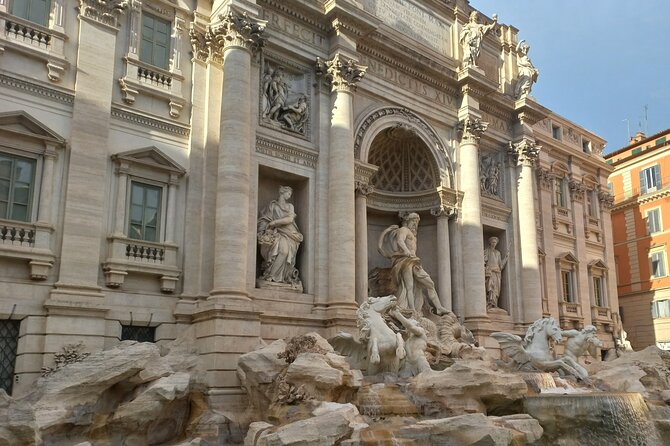
At the Trevi Fountain, you have about ten minutes. That gives you time to reach the fountain, take photographs, and toss in the traditional coin. The tour description notes the familiar custom of throwing one coin, or three, though the important practical point is that the stop is brief.
The fountain was designed by Nicola Salvi and takes its name from the earlier Aqua Virgo aqueduct, built in 19 BC under Marcus Vipsanius Agrippa. Its fame grew further after appearing in the film Roman Holiday, helping make it one of the world’s best-known fountains.
The included gelato is a welcome feature here or nearby, depending on the route and guide. One serving per person is included, while extra food and drinks are not. One particularly memorable flavor combination mentioned was almond, orange jam, and butter crumble, though flavors can vary.
I like the gelato stop because it breaks up the sightseeing. You are not simply being moved from one photo point to another. You get a small taste of everyday Rome, along with a chance to pause.
Still, ten minutes at Trevi can feel tight. The fountain is often crowded, and you may need to move quickly to take photographs and return to the cart. If you want quiet time around the water, plan to come back later.
A few more Rome bookings to compare
- Vatican: Museums & Sistine Chapel Entrance Ticket
★ 4.5 · 144,003 reviews - Vatican Museums & Sistine Chapel Tour with Optional Basilica
★ 4.3 · 67,413 reviews - Colosseum, Roman Forum & Palatine Guided Tour
★ 4.7 · 63,148 reviews - Vatican Museums, Sistine Chapel & St Peter’s Basilica Guided Tour
★ 4.5 · 39,149 reviews
Spanish Steps and Piazza del Popolo
The next stop brings you to Piazza di Spagna and the Spanish Steps. The staircase has 138 steps and was built to connect the Spanish embassy near the Holy See with the church of Trinità dei Monti above.
The tour provides about ten minutes here. You can admire the broad staircase, the square below, and the church above, but the schedule does not leave room for a long climb, lingering photographs, or a relaxed look around the nearby streets.
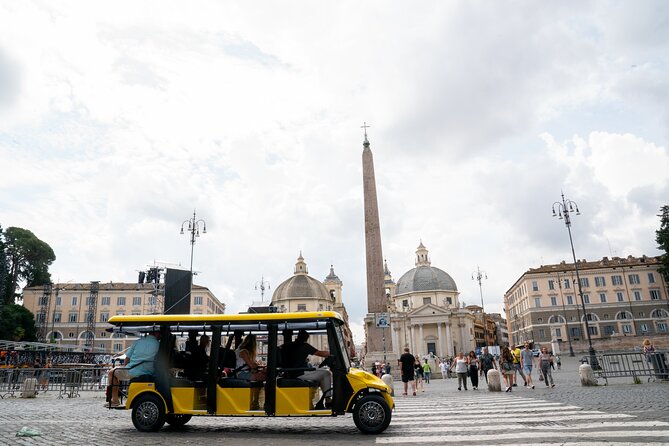
The cart continues to Piazza del Popolo, once the northern gateway to Rome. This was the starting point of the Via Flaminia, the major road leading north toward modern Rimini. The square offers a useful sense of Rome as a city built around roads, movement, and power.
The stop lasts about five minutes, so think of it as a viewing point. You get the shape of the square and its place in Rome’s story, then continue.
Augustus, Piazza Navona, and Via Giulia
The route passes the Mausoleum of Augustus, a large tomb built by Emperor Augustus in 28 BC on the Campus Martius. You do not stop for an extended visit, but seeing it from the cart adds another layer to the ancient city. Rome often reveals its oldest monuments in the middle of ordinary streets, and this drive helps you notice that pattern.
At Piazza Navona, you have another short stop. The square follows the shape of the Stadium of Domitian, built in the first century AD for public games. The modern piazza still carries the outline of that ancient stadium, which is one reason it feels unusually long and open compared with many Roman squares.
The tour then moves along Via Giulia, a historic street about one kilometer long that links the Regola and Ponte districts. This section is less about checking off a single famous monument and more about seeing Rome’s old street plan from a comfortable seat.
I appreciate this part of the route because the city’s character comes from more than its headline attractions. Cobblestones, old façades, lanes, and changing street views give you a better sense of Rome than a stop at one isolated monument can provide.
Largo Argentina, the Capitoline Hill, and Piazza Venezia
At Largo di Torre Argentina, you see the remains of four Republican-era temples. The archaeological area came to light between 1926 and 1929 when an old neighborhood was demolished for new construction.
The site is especially striking because ancient ruins sit below modern street level. The tour gives you around five minutes, enough to understand the basic story and look into the excavation. A full archaeological visit would require more time, so save this one for a later walk if ancient Rome is a major interest.
Piazza del Campidoglio brings you to the foot of the grand staircase leading toward the Capitoline Hill. Michelangelo designed the square according to a unified plan, making it an important example of Renaissance urban design in Rome.
Again, the stop is brief. You can photograph the staircase and absorb the setting, but you will not have time for the Capitoline Museums or a full exploration of the square.
The route then reaches Piazza Venezia, dominated by the large monument to Victor Emmanuel II, often called the Altar of the Fatherland. The square also takes its name from Palazzo Venezia, a 15th-century palace later given to the Republic of Venice for use as an embassy.
This is one of the most visually dramatic portions of the ride. The monument is hard to miss, and the piazza helps you understand the scale of modern Rome’s ceremonial center.
Monti and the finish near the Colosseum
The final drive passes through Monti, Rome’s first rione, or historic ward. Monti is known for cobbled streets, antiques, artisans, restaurants, and bars. The area offers a different mood from the grand spaces earlier in the tour, with a more local and youthful feel.
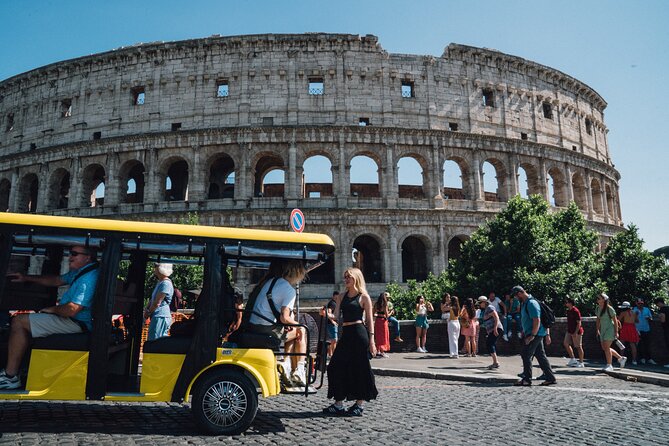
The tour ends at Piazza del Colosseo, outside the Colosseum. This is useful if you plan to visit the amphitheater afterward or want to continue exploring the area, but remember that the Colosseum is not an included stop with admission.
One practical tip: the official end point is the Colosseum, yet one past participant found it worthwhile to ask the driver about returning toward the original meeting area. That extra ride should not be expected as part of the standard service, but it shows why it can be useful to ask politely if your plans change.
Is $104 a fair price?
At $104 per person, the tour is not a bargain in the same way as a self-guided walk. You pay for the vehicle, the English-speaking driver-guide, the headset, bottled water, and gelato, plus the time saved by crossing a large part of central Rome without walking every block.
The value improves if you have only a day or a day and a half in Rome. It also improves if someone in your group has limited stamina, if you want a gentle first afternoon, or if you prefer a guide to explain the city while you look around.
The price is harder to justify if you already know Rome well or want detailed visits inside major buildings. You will still need separate time and tickets for places such as the Colosseum, Vatican Museums, or the Pantheon interior.
Think of the tour as a moving introduction. It shows you what deserves another visit and helps you plan the rest of your stay.
What the short stops really mean
The advertised duration is approximately two hours and 30 minutes. Some feedback describes the ride as lasting closer to three hours, but you should plan around the stated duration rather than count on extra time.
Five-minute stops are enough for a quick look and a few photographs. Ten-minute stops, such as Trevi Fountain and the Spanish Steps, offer a little more breathing room but can still feel rushed if the area is crowded.
One useful way to approach the tour is to choose your priorities in advance. If you care most about Trevi Fountain, Piazza Navona, or the Pantheon, note which places you want to revisit later. The golf cart gives you a map in your head, then you can return on foot when you have more time.
The tour is not built for long guided walks at every monument. One fair criticism is that the guide may continue speaking from the cart rather than walking with the group to explain every detail at close range. The headset solves the sound problem, but it does not turn a five-minute stop into a full site visit.
Who will enjoy this Rome tour most?
I would suggest this experience to:
- First-time visitors who want a clear picture of central Rome
- Families who need a break from long walks
- Older people who prefer a mix of sitting and short walks
- Couples or solo visitors with limited time
- Anyone arriving in Rome who wants an easy first-day activity
- People who enjoy history delivered with humor rather than a formal lecture
It is also useful for solo participants. One person was able to take the tour alone and see a wide section of the city in a short time.
You may want a different experience if you prefer slow photography, detailed archaeology, or long interior visits. The tour moves on a schedule, and the guide cannot delay departure for late arrivals.
The carts may be chilly in cooler weather. Blankets have been offered during cold rides, but bring sensible layers. Heavy rain can also affect the final stop and outdoor photographs, and there is no guarantee of clear weather.
Booking, cancellation, and final advice
You receive confirmation at booking, and free cancellation is available up to 24 hours before the start time. Cancellations or changes made less than 24 hours in advance are not accepted for a refund.
I would book this tour for your first day in Rome, especially if you want to get your bearings fast without wearing out your feet. Guides such as Francesco, Franco, Claire, Andrea, Marco, Leo, and Amber have received strong praise for clear English, humor, patience, and lively explanations.
You should book it if you value orientation, comfort, and a broad look at Rome. Skip it if your main goal is to go inside monuments or spend 30 minutes studying each one. For most first-time visitors with limited time, the golf cart is a smart way to see the city’s big picture, enjoy a gelato, and make a better plan for the days that follow.
FAQ
How long does the Rome golf cart tour last?
The tour lasts approximately two hours and 30 minutes.
What sights are included on the route?
The route includes the Pantheon, Piazza Colonna, Trevi Fountain, the Spanish Steps, Piazza del Popolo, the Mausoleum of Augustus, Piazza Navona, Via Giulia, Largo di Torre Argentina, Piazza del Campidoglio, Piazza Venezia, and the Monti neighborhood.
Does the tour enter the monuments?
No. The tour provides exterior stops and drives past some sites. Admission to the Pantheon is not included, and the Colosseum is not visited inside.
Where does the tour start and end?
It starts at V. Monterone, 19, in central Rome, and ends outside the Colosseum at Piazza del Colosseo.
How many people can join the tour?
Each electric cart has seven seats. The tour can use up to two carts, with a maximum of 14 participants.
Are food and drinks included?
One gelato per person and bottled water are included. Additional food and drinks are not included.
Recently added around Rome
- Rome: Pantheon, Trevi Fountain & Roman Squares Guided Tour★ 4.7 · 386 reviews
- Vatican: Pope Francis Tomb and Papal Basilicas Tour★ 4.7 · 340 reviews
- Vatican: St. Peter’s Basilica with Audio Guide and Options★ 3.4 · 269 reviews
- Rome: Vatican Museums Skip-the-line Entry Ticket and Tour★ 4.2 · 400 reviews
- Rome: Vatican Museums & Sistine Chapel Ticket + Tour Options★ 4.7 · 344 reviews
- Vatican: Museums, Raphael & Sistine Chapel + Basilica Option★ 4.7 · 350 reviews
- Vatican Museums & Sistine Chapel Guided Tour★ 4.3 · 832 reviews
- Vatican Museums & Sistine Chapel Entry Ticket★ 4.4 · 245 reviews
City Tours, compared.
City Sightseeing Hop-on Hop-off Bus with Audioguide
Read our review →
City Sightseeing Hop-On Hop-Off Bus with Audio Guide
Read our review →
City Sightseeing Rome Hop-On Hop-Off Bus Tour
Read our review →

Fettuccine Pasta Cooking Class in Rome’s City Center
Read our review →
Vatican City: Vatican Museums & Sistine Chapel Entry Ticket
Read our review →

City Sightseeing Florence Hop-On Hop-Off Bus Tour
Read our review →Browse the lists this tour appears in