
Reviewed · AUDIO TOURS
Rome: Pantheon Fast-Track Ticket and Official Audio Guide
Ancient Rome is waiting under one famous roof. This one-hour visit pairs the Pantheon’s fast-track entry with a well-produced audio guide that brings the building to life through Emperor Hadrian, Pope Boniface IV, Raphael, and Queen Margherita. I like the clear storytelling and the freedom to walk at your own pace. I also like that part of the purchase supports the Basilica of Santa Maria ad Martyres.
The main catch is practical: you must collect your ticket first at the OhMyGuide Roma Museum Store on Via dei Bergamaschi 49, then walk to the Pantheon. That extra stop is easy to manage, but you should allow time for it. The audio guide also requires a valid ID, passport, driver’s license, or credit card as a deposit.
In This Review
- Key points to know before you go
- Why the Pantheon deserves an audio guide
- Collecting the ticket at Via dei Bergamaschi 49
- Entering the Pantheon and starting the audio guide
- Hadrian and the temple of all the gods
- The oculus, sunlight, and rain
- Pope Boniface IV and the Christian basilica
- The portico and Egyptian granite columns
- Raphael, Margherita, and the people buried here
- The voices, music, and overall presentation
- Is the $6 price good value?
- Who should book this Pantheon visit?
- Final verdict: a smart low-cost way to see the Pantheon
- FAQ
- How long does the Pantheon experience take?
- Where do I collect the Pantheon ticket?
- Is there a live guide?
- What languages are available for the audio guide?
- Do I need identification to borrow the audio guide?
- What clothing is required?
- Is the Pantheon wheelchair accessible?
- Can the Pantheon close or change its opening time?
Key points to know before you go
- The audio guide uses historical voices: Emperor Hadrian, Pope Boniface IV, Raphael, Queen Margherita, and Monsignor Micheletti each explain a different part of the Pantheon’s story.
- The Pantheon ticket costs about $6 per person: That is a low price for timed entry, an audio guide, and a donation to the basilica, though buying directly may sometimes cost less.
- You collect tickets away from the monument: Pick them up at Via dei Bergamaschi 49 during the stated opening hours before going to the Pantheon.
- The oculus is the visual star: The 43.44-meter dome opens to the sky, allowing sunlight and rain into the ancient interior.
- There is no live guide: You explore independently, listening through a supplied device and earbuds inside the Pantheon.
- Dress modestly: Shorts, short skirts, vests, and sleeveless tops are not permitted in the basilica.
Why the Pantheon deserves an audio guide
The Pantheon is one of Rome’s easiest sights to underestimate. From the outside, you see a grand portico and a massive inscription. Inside, the building becomes a lesson in geometry, engineering, religion, and memory.
Without context, you can walk through, admire the dome, take a few photographs, and leave in ten minutes. The audio guide gives your visit shape. It points your attention toward the details that matter, including the dome’s proportions, the oculus, the Egyptian granite columns, and the people buried inside.
I especially like the choice to tell the story through historical figures. Instead of hearing one continuous lecture, you move through different periods and viewpoints. Hadrian explains the emperor connected with the Pantheon seen today. Pope Boniface IV describes the building’s conversion into a Christian basilica in 609 AD. Raphael and Queen Margherita then connect the monument to Renaissance art and the modern Italian monarchy.
The result is more personal than a standard list of dates. You are still learning facts, but you also get a sense of how the Pantheon changed meaning over time.
A few more Rome bookings to compare
- Vatican: Museums & Sistine Chapel Entrance Ticket
★ 4.5 · 144,003 reviews - Vatican Museums & Sistine Chapel Tour with Optional Basilica
★ 4.3 · 67,413 reviews - Colosseum, Roman Forum & Palatine Guided Tour
★ 4.7 · 63,148 reviews
Collecting the ticket at Via dei Bergamaschi 49
Your visit begins at the OhMyGuide Roma Museum Store at Via dei Bergamaschi 49. This is close to the Pantheon, but it is not the entrance to the monument itself. Plan to arrive with enough time to find the shop, collect your ticket, and continue to the Pantheon for your reserved entry.
The pickup point is open Monday through Friday from 9 a.m. to 6 p.m., Saturday from 9 a.m. to 3 p.m., and Sunday from noon to 6 p.m. Those Sunday hours matter. If your booking is early on a Sunday, check the timing carefully because the store does not open until midday.
Once you have the ticket, go directly to the Pantheon and use the line for online bookings or fast-track entry. The separate entrance can save time during busy hours. It is less valuable early in the morning, when the regular line may be short, but it offers useful insurance if you are visiting at a crowded time.
One practical warning: a fast-track ticket does not mean you can ignore the reservation time. You are expected to follow the scheduled time closely. Even with a prebooked ticket, entry procedures can take a little time, so avoid arriving at the pickup shop at the last possible minute.
Entering the Pantheon and starting the audio guide
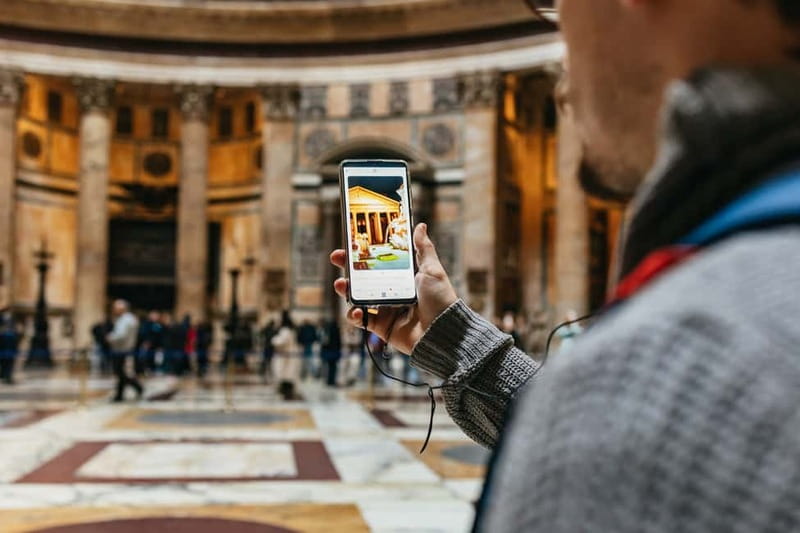
After you reach the Pantheon, you collect the audio guide inside. The supplied equipment includes a phone or audio device with earbuds. Some people prefer using their own phone and headphones, but the provided setup is simple and works without needing to download anything.
To borrow the device, you must leave a valid passport, ID card, driver’s license, or credit card as a deposit. A photocopy, a photo of your passport, a student card, or a digital ID is not accepted. Bring a physical document or credit card if you want to use the included guide.
The audio guide is available in Chinese, English, French, German, Italian, Portuguese, Russian, Spanish, Arabic, Dutch, Korean, and Polish. That broad language choice makes this a useful option for mixed-language groups.
There is no live guide leading you from point to point. I see that as a benefit if you like quiet, independent sightseeing. You can pause, sit, listen, and look around without trying to keep up with a group. If you want to ask questions or hear spontaneous stories, a live tour would suit you better.
Hadrian and the temple of all the gods
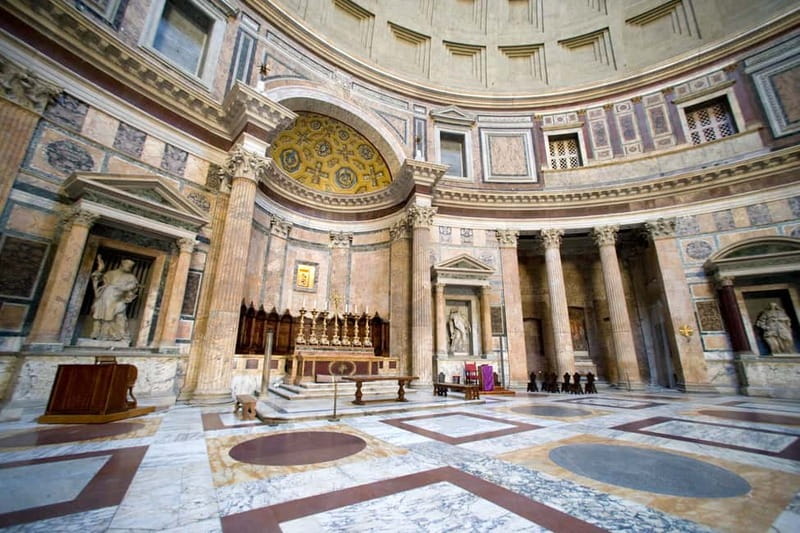
The first major voice is Adriano, or Emperor Hadrian, who commissioned the Pantheon in the form you see today. The building has earlier origins, but the present structure belongs to the Roman imperial period. Hearing Hadrian speak about Rome gives the first part of the visit an appealing human angle.
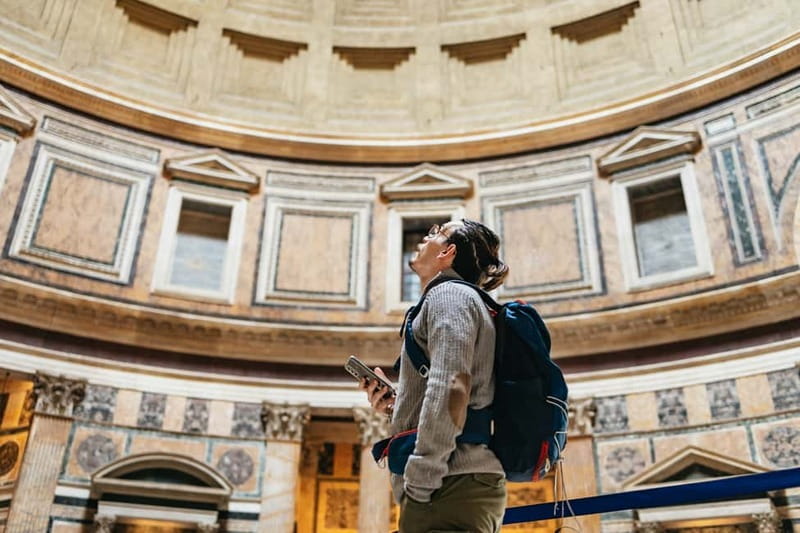
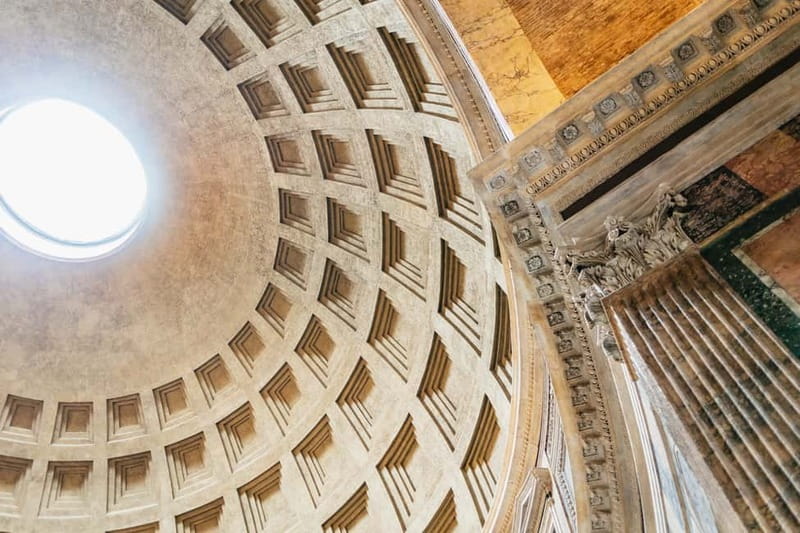
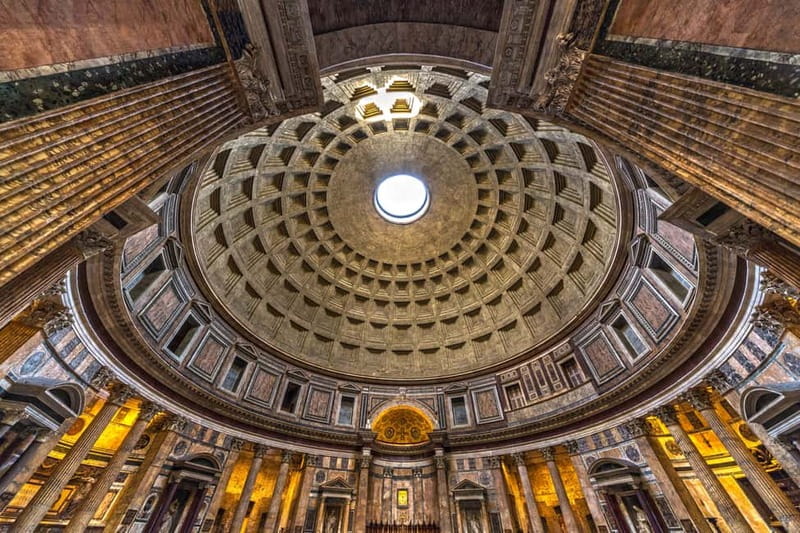
The guide also draws attention to the Pantheon’s geometry. The dome has a diameter of 43.44 meters, a measurement that helps you grasp its scale. Look upward and notice how the circular floor plan, the huge dome, and the open oculus work together.
The Pantheon is not impressive only because it is old. Its design still feels controlled and balanced. The audio commentary helps you see that the building was planned around proportion, light, and movement. You are not simply looking at a large room. You are looking at a carefully ordered space built to direct your eye toward the sky.
Still Rome, but a slower afternoon:
- Vatican Museums, Sistine Chapel & St Peter’s Basilica Guided Tour
★ 4.5 · 39,149 reviews - Rome: Colosseum, Palatine Hill and Roman Forum Guided Tour
★ 4.8 · 32,814 reviews - Rome: Guided Tour of Colosseum, Roman Forum & Palatine Hill
★ 4.7 · 27,897 reviews - Rome: Colosseum & Forum with Audio Guide App -Optional Arena
★ 4.2 · 24,770 reviews
The oculus, sunlight, and rain
The oculus is the Pantheon’s most famous feature, and the audio guide gives it the attention it deserves. This round opening at the top of the dome lets sunlight enter the building and move across the interior like a natural sundial.
The effect changes with the hour. You may see a bright patch of light on the walls, floor, or architectural details. The opening also means rain can enter the building. The Pantheon’s interior drainage system handles the water, but the larger point is symbolic and practical: the building is connected directly to the sky.
I recommend stopping beneath the dome for a few minutes rather than rushing through the commentary. The audio guide works best when you listen while looking up. The music and voices are designed to create a reflective mood, and the quiet pacing gives you room to notice the building instead of treating it like a quick photo stop.
The experience may feel crowded at times. One hour is enough for the main visit, but a busy interior can make it harder to stand in your preferred spot or hear every section clearly. If you want the calmest possible visit, choose an early time when available.
Pope Boniface IV and the Christian basilica
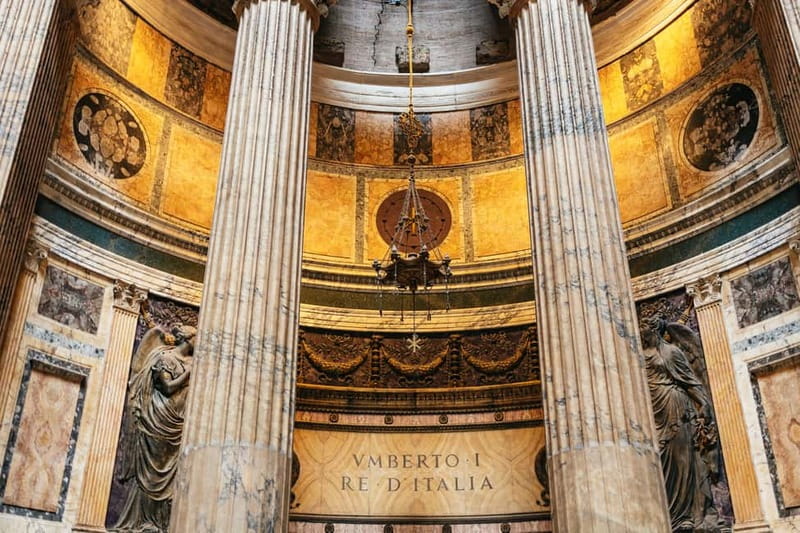
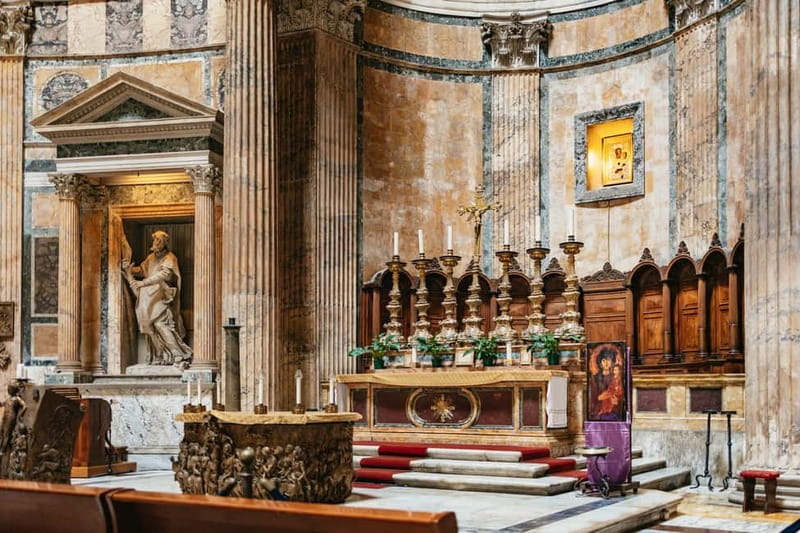
The Pantheon was converted into the Basilica of Santa Maria ad Martyres by Pope Boniface IV in 609 AD. This change helped protect the building from the destruction and removal of its materials that affected many ancient Roman structures.
The audio guide explains this transition through Boniface’s voice. That shift is central to understanding why the Pantheon survives in such good condition. You are seeing a Roman temple that later became a Christian church, not a monument frozen in only one period.
The church remains active, so this is a place of worship as well as a historic site. That affects how you should behave inside. Dress must be suitable, and visitors in shorts, short skirts, vests, or sleeveless shirts may be refused entry.
The religious setting also changes the mood. The Pantheon is not simply an archaeological ruin. It continues to function as a basilica, with religious services and occasional events. Openings can be postponed, and the building can close early for Masses, concerts, or other activities.
The portico and Egyptian granite columns
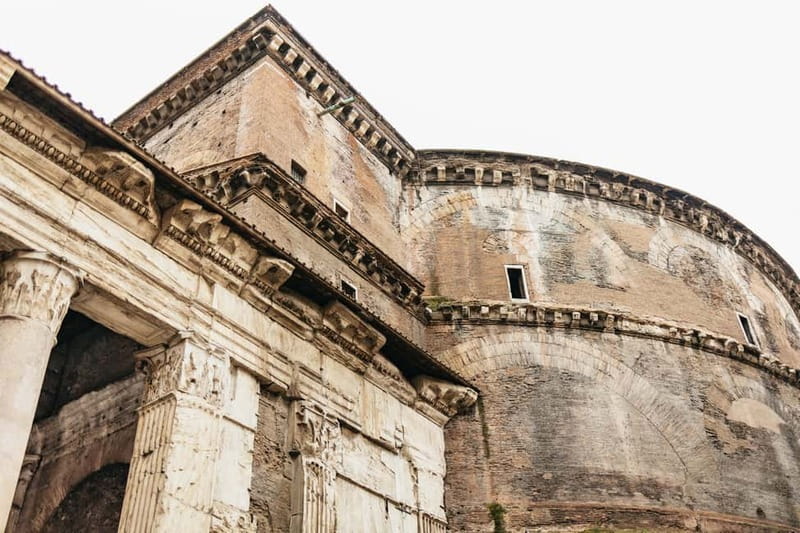
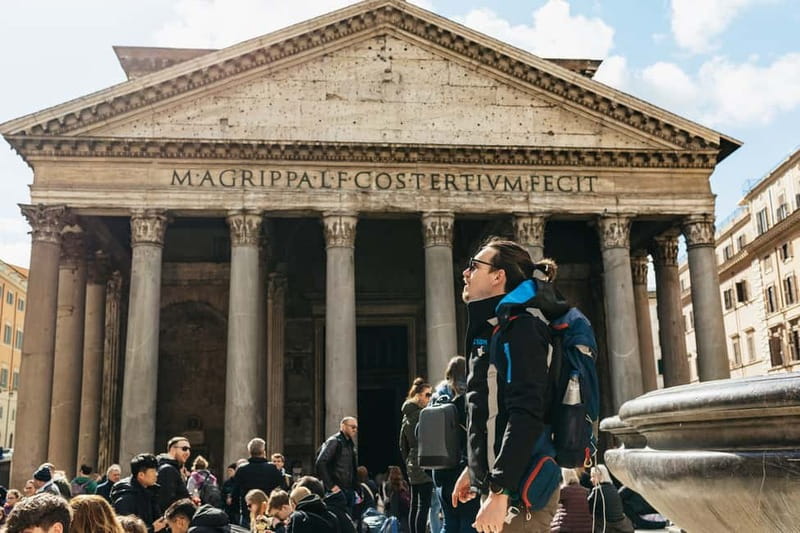
Before or after entering the rotunda, take time to study the portico. Its columns are made from pink granite brought from Egypt. They are enormous, but the entrance can make them easy to overlook because visitors naturally hurry toward the famous interior.
The portico creates a strong contrast. Outside, the building presents a formal classical facade with tall columns and a triangular pediment. Inside, the open oculus and rounded dome produce a very different feeling.
The audio guide keeps this transition connected to the larger story. Classical architecture inspired later artists, architects, and political leaders. The Pantheon became a model to study, copy, and admire long after the Roman Empire disappeared.
Raphael, Margherita, and the people buried here
Raphael Sanzio of Urbino, the Renaissance painter and architect, is buried in the Pantheon. His tomb links the building to the artists who admired ancient design and helped revive classical ideas in Renaissance Italy.
The guide asks why Raphael and other Renaissance figures chose this place for their final rest. The answer is tied to admiration for the Pantheon’s architecture and its place in Rome’s artistic life. This section gives the building a personal connection that a simple architectural tour might miss.
You also hear from Queen Margherita. She is buried here with King Umberto I and Vittorio Emanuele II of Savoy. Their presence brings the story forward from ancient Rome and the Renaissance to the era of Italian unification and the royal family.
The Pentecost tradition adds a memorable detail. Each year, red rose petals are released through the oculus to recall the descent of the Holy Spirit upon the Apostles. It is a striking example of how the Pantheon’s ancient opening continues to serve a religious ceremony today.
The voices, music, and overall presentation
The audio guide is voiced by professional actors, including Sergio Rubini, Alessandro Haber, Daniele Parisi, Giusi Cataldo, and Monsignor Daniele Micheletti. Monsignor Micheletti, the archpriest rector of the Pantheon, offers guidance on seeing the building as both a monument and a church.
That variety keeps the presentation from feeling flat. The historic figures offer different viewpoints, while the rector explains the building’s current religious role. Original music by Antonio Fresa, performed by the Orchestra of Teatro La Fenice, adds atmosphere without replacing the information.
I would not choose this experience if you dislike audio commentary or prefer to read labels at your own speed. The guide contains a good deal of information, and the interior can be crowded. Still, the ability to pause and wander helps. You can listen to one section, look carefully, then move on when ready.
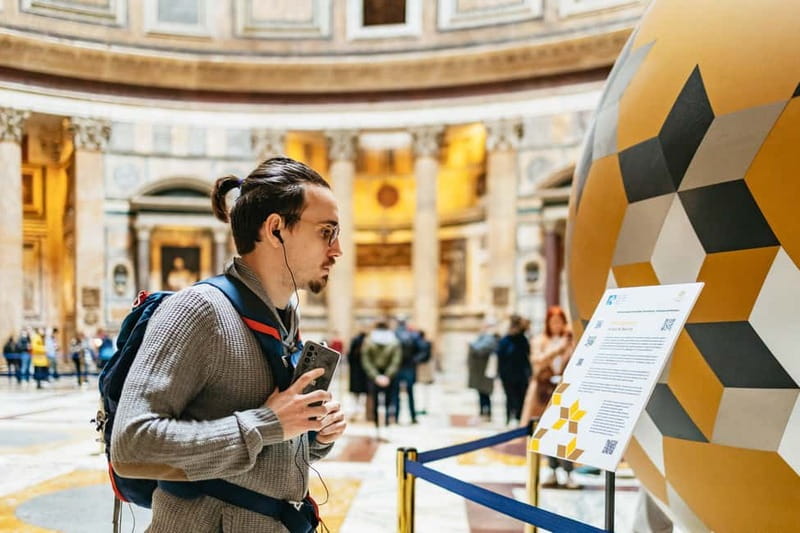
The supplied guide may also include images to help you match the commentary to specific features. That is useful when several architectural details look similar or when the interior is full of people.
Is the $6 price good value?
At about $6 per person, this is an inexpensive way to add structure to a Pantheon visit. You receive the entry ticket, the official audio guide, and a donation to the Basilica of Santa Maria ad Martyres.
The fast-track portion is worth the most during busy periods. Early in the morning, the time saved may be modest because the regular line can be short. Later in the day, avoiding a long wait can make the small extra cost feel worthwhile, especially if you have another timed activity afterward.
There is one price concern. A booking may not be the absolute cheapest way to enter, since buying on-site or through the official site can sometimes save money. You are paying for convenience, a reserved time, and the audio guide, not just admission.
For me, the audio guide is the strongest part of the value. The Pantheon is free of clutter but not free of questions. A good explanation helps you understand why the dome matters, why the building survived, and why so many later figures chose it for burial.
Who should book this Pantheon visit?
I would recommend it to first-time visitors who want more than a quick look at the dome. It also suits independent sightseers who prefer an audio guide to a group tour.
Families with older children may find the historical voices more engaging than a long written explanation. The one-hour length is manageable, and you can move at your own pace rather than follow a guide through a fixed route.
It is also a good fit if you have already visited the Pantheon and want a fuller explanation this time. The building does not change, but the way you understand it can.
I would hesitate if you are trying to keep costs as low as possible and are happy to arrange admission directly. I would also think twice if your schedule is tight enough that the ticket pickup stop creates stress. The store is nearby, but it is still another place you must reach before entering.
The Pantheon is wheelchair accessible, though the exact ease of movement can depend on crowd levels and current arrangements. Dress appropriately, bring the required physical ID or credit card, and allow a little extra time for ticket collection.
Final verdict: a smart low-cost way to see the Pantheon
I would book this experience if I wanted a simple, well-organized Pantheon visit with useful historical context. The fast-track ticket removes some queue anxiety, while the audio guide turns a short stop into a focused lesson in Roman engineering, Christian history, Renaissance art, and Italian monarchy.
The ticket pickup is the main inconvenience, and direct admission may sometimes cost less. But at roughly $6, the combination of entry, commentary, and support for the basilica is strong value. Go early if you want fewer people, follow your reservation time, and do not forget the dress code or the physical ID needed for the audio device.
FAQ
How long does the Pantheon experience take?
The activity lasts about one hour. Starting times depend on availability.
Where do I collect the Pantheon ticket?
You collect it at the OhMyGuide Roma Museum Store, Via dei Bergamaschi 49, Rome. After pickup, go directly to the Pantheon and use the online booking line.
Is there a live guide?
No. The experience includes an audio guide, but no live guide.
What languages are available for the audio guide?
The guide is available in Chinese, English, French, German, Italian, Portuguese, Russian, Spanish, Arabic, Dutch, Korean, and Polish.
Do I need identification to borrow the audio guide?
Yes. You need a valid passport, ID card, driver’s license, or credit card as a deposit. Photocopies, phone pictures, student cards, and digital IDs are not accepted.
What clothing is required?
The basilica requires suitable clothing. Shorts, short skirts, vests, and sleeveless shirts are not permitted.
Is the Pantheon wheelchair accessible?
Yes, the activity is listed as wheelchair accessible.
Can the Pantheon close or change its opening time?
Yes. Masses, concerts, special events, postponed openings, and early closures can affect the scheduled service time.
Recently added around Rome
- Palatine Hill and Roman Forum Tour with Fast-Track Entrance★ 4.2 · 417 reviews
- Tivoli: Villa D’Este & Villa Adriana Pass & App Audioguide★ 4.4 · 364 reviews
- From Rome: Villa D’Este & Villa Adriana Day Trip with Lunch★ 4.4 · 289 reviews
- Vatican Museums & Sistine Chapel Skip-the-Line Guided Tour★ 4.6 · 254 reviews
- Rome: The Three Tenors at St. Paul’s Church Concert Ticket★ 4.7 · 699 reviews
- Tivoli: Villa D’Este Entry Ticket and App Audio Guide★ 4.3 · 191 reviews
- Rome: Capitoline Museums and Centrale Montemartini Tickets★ 4.4 · 328 reviews
- Rome: St. Peter’s Basilica and Papal Tombs Guided Tour★ 4.6 · 477 reviews
Audio Tours, compared.

Colosseum & Forum with Audio Guide App -Optional Arena
Read our review →
La Fenice Opera House Entry Ticket with Audio Guide
Read our review →
St. Peter’s Basilica & Dome Entry Ticket & Audio Tour
Read our review →
Cathedral & Brunelleschi’s Dome Ticket & Audio App
Read our review →
Michelangelo’s David Priority Ticket & Audio App
Read our review →
Uffizi Priority Ticket & Masterpieces Audio App
Read our review →
City Sightseeing Hop-On Hop-Off Bus with Audio Guide
Read our review →Browse the lists this tour appears in