

Reviewed · UFFIZI & ACCADEMIA GALLERY TOURS
Florence: Uffizi Priority Ticket & Masterpieces Audio App
Art rewards patience, but Florence often tests it. This Uffizi ticket helps you get past the ticket-buyers’ queue and into one of Europe’s great museums with a self-guided audio app in your pocket. I like the clear meeting-point support and the freedom to set your own pace. The main catch is that priority entry does not remove the mandatory security check, and the audio guide requires your own charged phone and headphones.
The Uffizi is a huge collection, not a quick photo stop. I especially like that the app points you toward major works by Botticelli, Leonardo da Vinci, Michelangelo, Giotto, and Caravaggio without forcing you to follow a live group. The drawback is that the audio content is fairly basic, and some visitors find the route harder to follow without a map.
In This Review
- Key points to know before booking
- What this Uffizi experience actually provides
- Finding the yellow-vested host at the Uffizi
- How much time does priority entry save?
- Installing the audio app before you arrive
- The Uffizi route, from medieval art to the Renaissance
- The ancient statues in the long corridors
- How good is the mobile audio guide?
- Breaks, stairs, and practical museum details
- A walk beside the Vasari Corridor
- Is $31 a fair price?
- Who should book this Uffizi ticket?
- My advice for making the visit work
- Should you book it?
- FAQ
- Where is the meeting point for the Uffizi ticket?
- How early should I arrive?
- Does the ticket skip the security check?
- Is a live guide included?
- Do I need to bring headphones?
- When should I install the audio app?
- What languages are available in the audio app?
- How long should I allow for the Uffizi visit?
- Can I bring water or luggage inside?
Key points to know before booking
- Meet under Benvenuto Cellini: Find the ACCORD staff member in a yellow vest at the corner of the Uffizi ticket office and Via Lambertesca.
- Priority means the ticket queue, not security: You skip the ticket-buyers’ and ticket-pickup lines, but everyone still passes through museum security.
- Bring your own listening kit: Install the app over Wi-Fi before arriving, charge your phone, and pack headphones.
- Allow two to four hours: A brisk visit can cover the main works, while art lovers may spend four hours or more.
- The route includes major Renaissance art: Botticelli’s Birth of Venus, Leonardo’s Annunciation, Caravaggio’s Medusa, and Michelangelo’s only painting on wood are among the key sights.
- The bonus has a local flavor: The booking includes a selection of Tuscan food tastings, including extra-virgin olive oil, truffle specialties, schiacciata, and cantuccini.
What this Uffizi experience actually provides

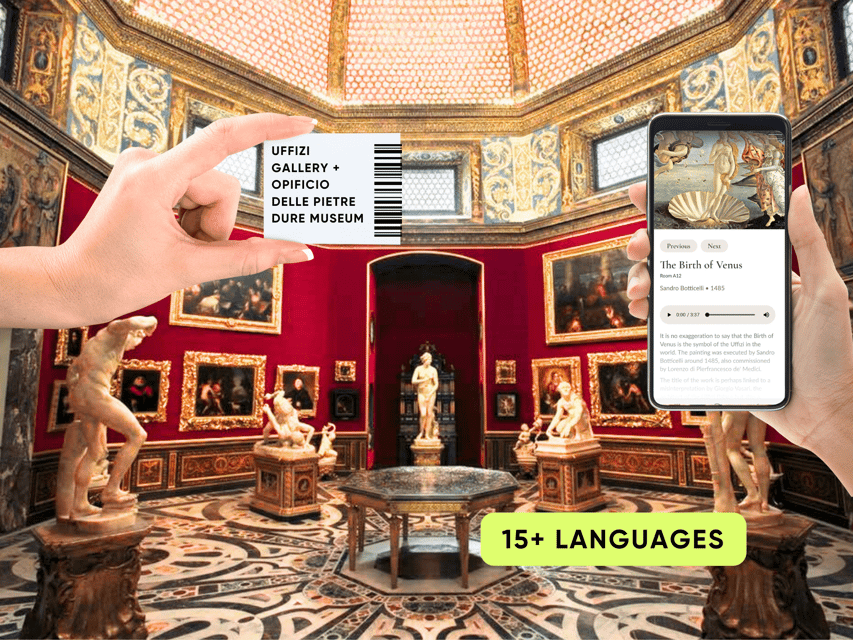
This is not a live museum tour. You receive a reserved-date, reserved-time entrance ticket, help from an English-speaking or Italian-speaking host, and access to a multilingual mobile audio app. The app languages include English, Italian, Turkish, Spanish, French, German, Chinese, Portuguese, Polish, Japanese, Russian, Dutch, Korean, Hungarian, Greek, Croatian, Romanian, and Ukrainian.
That distinction matters. If you want a guide standing beside you and explaining every room, this is the wrong format. If you prefer to pause, skip a painting, revisit a favorite, or move ahead of a slow group, the setup gives you much more control.
The audio content is designed to focus your attention on important works. It adds information beyond the short labels beside the paintings, though it does not provide a full scholarly treatment of the collection. I would treat it as a useful introduction, not a replacement for a private art historian.
More Uffizi and Accademia tickets:
- Florence: Skip-The-Line Uffizi Gallery Timed Entry Ticket
★ 4.5 · 27,832 reviews - Florence Accademia Gallery Tour with Entrance Ticket Included
★ 4.5 · 6,148 reviews - Florence: Skip-the-Line Uffizi Small Group Tour
★ 4.6 · 5,926 reviews
Finding the yellow-vested host at the Uffizi
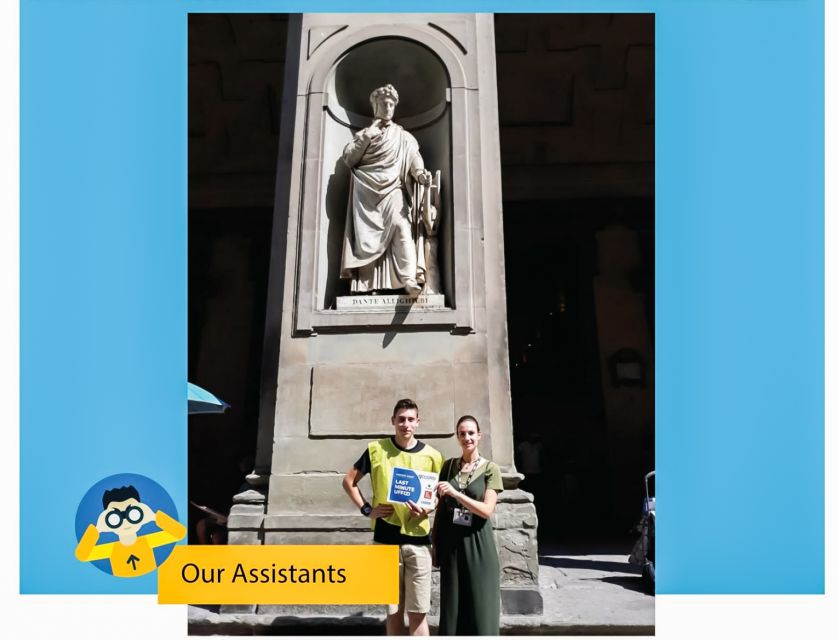
The meeting point is one of the strongest parts of the arrangement, provided you follow the directions closely. Arrive at least 15 minutes before your assigned time and look for the ACCORD assistant in a yellow vest near the corner of the Uffizi Gallery ticket office and Via Lambertesca.
The host is positioned by the statue of Benvenuto Cellini, under the Loggia. This is a much better landmark than simply searching for a general Uffizi entrance, since the museum has several doors and the surrounding streets can feel confusing on a first visit.
The staff member checks your booking, gives you the entrance tickets, and directs you to Door No. 1. That small handoff removes an annoying part of a museum visit: figuring out which ticket office, queue, and entrance apply to your reservation.
Allow a little extra time to find the meeting spot. A few minutes saved at the museum can disappear if you arrive late or search the wrong side of the building. The staff has helped people who were lost, but you should not count on a late arrival being harmless.
How much time does priority entry save?
The ticket is useful because the normal ticket-buyers’ queue can become very long, especially in summer and at popular morning times. The priority line is normally much faster, and some visitors enter within minutes of meeting the host.
It is not a magic pass through every line. All Uffizi visitors must go through security, and that check can take about 10 to 15 minutes at busy times. Some people still wait in an entry line even with priority access, though it is generally the line connected with their reserved admission time rather than the full ticket-purchase queue.
That is an important value point. You are paying for convenience and time control, not guaranteed instant entry. In Florence, avoiding the uncertainty of the public ticket line can be worth a great deal, particularly if you have a timed lunch, another museum booking, or a short stay.
Early morning is a sensible choice. A 9:30 arrival has worked well for visitors who wanted a quieter start, though no time completely guarantees light crowds.
Installing the audio app before you arrive
The day before your visit, you should receive a WhatsApp reminder with the meeting-point information and instructions for downloading the mobile audio application. The app is also connected to the voucher details.
Install it at home or at your lodging while you have Wi-Fi. This is one task you do not want to leave until you are standing near the Uffizi with a weak connection, a crowded street, and a fixed entry time.
Bring:
- A fully charged smartphone
- Your own headphones
- Your passport or ID card
- Identification for children, if applicable
Headphones are not supplied. This has been a real stumbling block for some people, since playing audio aloud is awkward in a museum and may not be practical. The audio guide can be helpful even if you choose to read some of the information instead, but you need a working device and a way to listen.
A small power bank is a smart addition, although the booking information only specifically requires a charged phone. One visitor received help charging a power bank from staff during the visit, but I would regard that as friendly assistance rather than something to plan around.
A few more Florence bookings to compare
- Tuscany Day Trip from Florence: Siena, San Gimignano, Pisa and Lunch at a Winery
★ 5.0 · 21,634 reviews - Florence: Timed Entrance Ticket to Michelangelo’s David
★ 4.6 · 16,983 reviews - Florence: Michelangelo’s David Skip-the-Line Entry Ticket
★ 4.5 · 12,764 reviews - The Best tour in Florence: Renaissance & Medici Tales – guided by a STORYTELLER
★ 5.0 · 12,316 reviews
The Uffizi route, from medieval art to the Renaissance

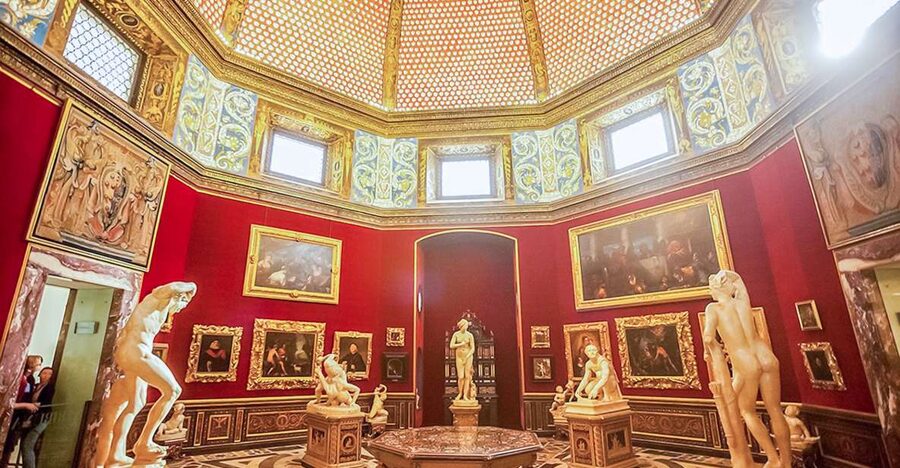
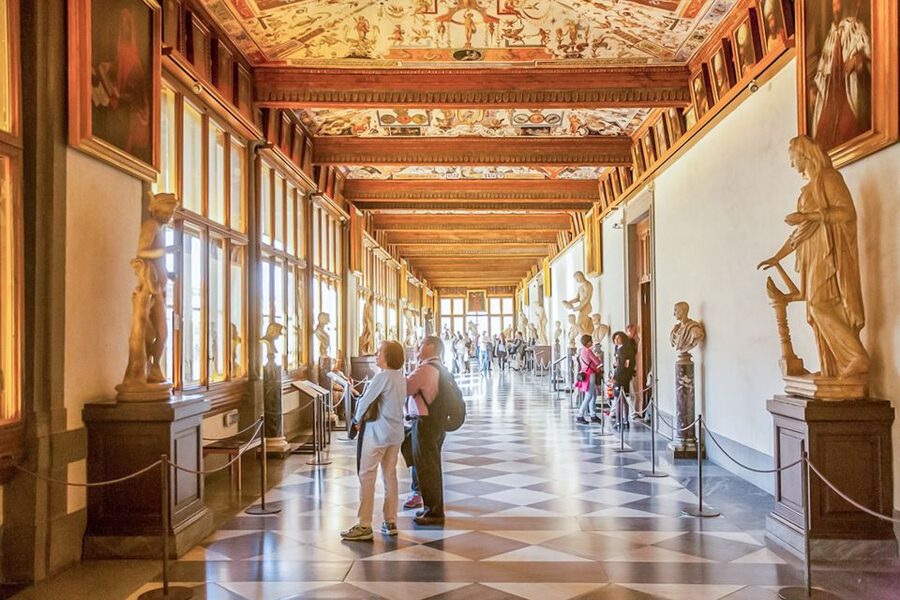
Once inside, you enter one of Europe’s oldest museums and move through a broad sweep of Italian art, beginning in the Middle Ages and continuing through the Renaissance and later periods. The building itself is part of the experience, with long corridors, rooms arranged in sequence, and ancient sculptures lining the passageways.
The museum can feel overwhelming at first. There is simply too much good material to absorb in one pass. The app helps by directing you to selected masterpieces and giving you a manageable thread through the collection.
You will encounter the work of Giotto, whose paintings mark an important change from the more formal medieval style. You then reach the Florentine Renaissance, where artists developed new ways to show space, human emotion, movement, and the natural world.
Botticelli is one of the main reasons many people come to the Uffizi. His Birth of Venus is the famous centerpiece, but it deserves more than a quick photograph. Look at the flowing lines, the pale figures, the windblown hair, and the way the composition turns a mythological scene into something almost theatrical.
The app can give you a short framework for looking. That is valuable here because the room often attracts a crowd, and it is easy to see the painting without really studying it.
Leonardo da Vinci’s Annunciation offers a different experience. It is an early work, full of careful observation and experimental thinking. The audio content draws attention to details that can disappear when you are simply moving from one famous painting to the next.
Caravaggio’s Medusa supplies a sharp change in mood. Its dramatic face and forceful presentation are hard to miss, but the story behind the image adds another layer. This is the kind of stop where a few minutes of explanation can make the painting more memorable.
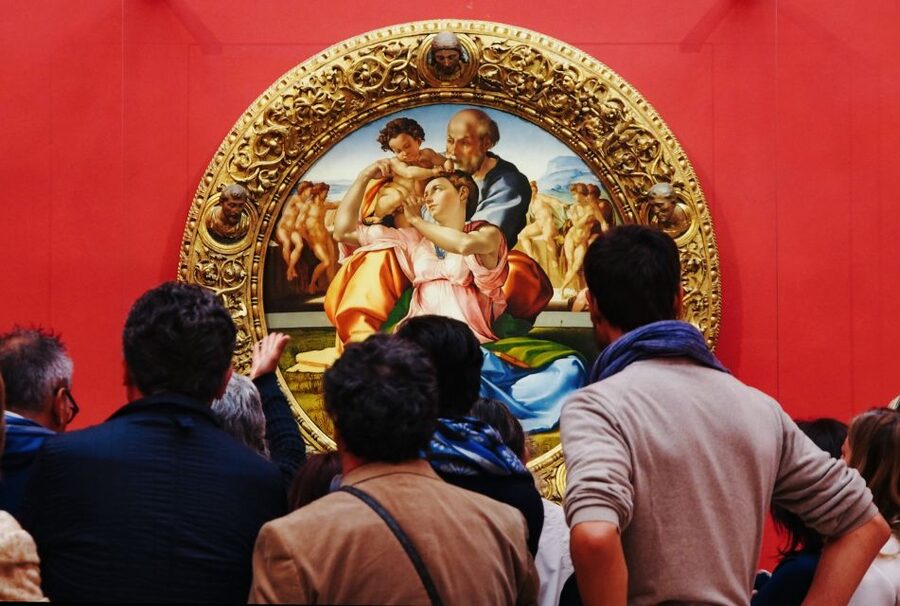
Michelangelo’s painting on wood is another important point in the route. The Uffizi holds the only painting made on wood by Michelangelo, making it an especially worthwhile stop for visitors who know his sculpture better than his painting.
The ancient statues in the long corridors

Do not spend the whole visit staring only at paintings. The Uffizi corridors contain an important collection of ancient statues and busts linked to the Medici family.
Many are ancient Roman copies of Greek sculptures that no longer survive in their original form. That gives these objects a double interest: you are looking at Roman works, while also seeing echoes of lost Greek art.
The sculpture displays also change the rhythm of the visit. After several rooms of painted panels, the three-dimensional figures give your eyes a break and let you think about how the Medici collection was arranged and displayed.
The corridors are easy to follow once you get moving, and arrows above doorways help guide you through. Still, the route is not always obvious on your first pass. Several people would have appreciated a museum map, and I agree that one would make the visit easier to plan.
How good is the mobile audio guide?
The app is best for independent visitors who want a short explanation of the main works. It lets you listen or read, and you can stop whenever the room gets crowded or a painting catches your eye.
I like the control. You are not forced to walk at a group’s speed, wait for everyone to gather, or stand in one spot while a guide finishes a long explanation. You can spend four hours inside if the collection grabs you, or keep moving after two hours if your attention starts to fade.
The content is not equally detailed for every object. Some people expect a full tour and find the information too brief. The audio also may not follow the physical route perfectly, so you should use the museum arrows and room signs as well as the app.
There is no live guide included. A few experiences connected with similar museum bookings can create confusion because a host may offer a short orientation or because another booking includes a live guide. For this ticket, the main service is ticket assistance and a digital audio guide. Plan accordingly.
Breaks, stairs, and practical museum details
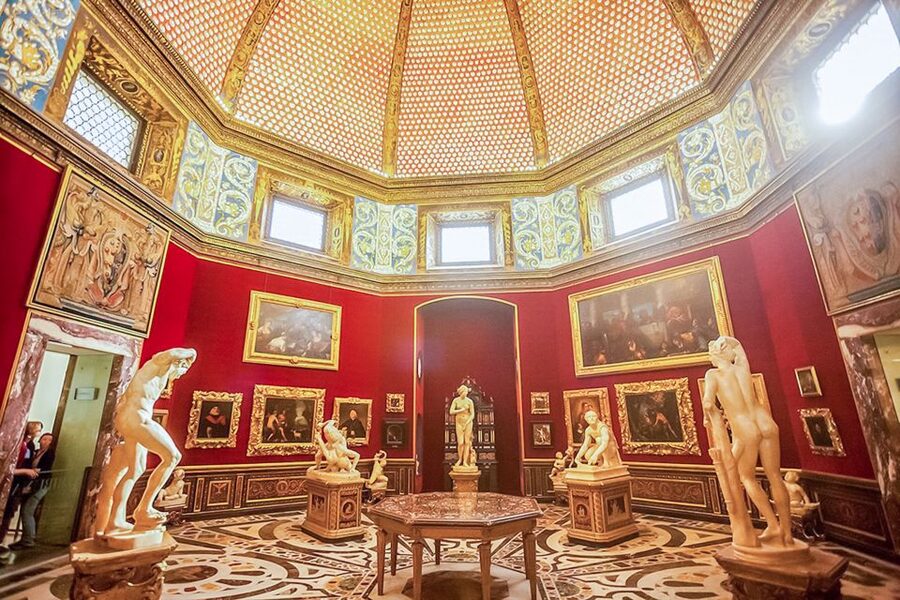
The visit involves stairs, including roughly 120 steps to reach the starting level according to one detailed account. An elevator is available for going down, and the museum is wheelchair accessible, but anyone with limited mobility should ask staff for the most suitable route.
A small cafeteria sits on a terrace. This can provide a useful pause before deciding whether to leave or continue through the collection. You can bring one bottle of water per person, up to 500 milliliters.
Large bags and luggage are not allowed, and pets are not allowed inside. Keep your belongings light so you are not delayed at security or forced to solve a storage problem near the entrance.
The Uffizi is a place where comfort affects how much art you can enjoy. Wear shoes you can walk in, keep your phone accessible, and do not schedule the museum so tightly that you must rush through the final rooms.
A walk beside the Vasari Corridor
After leaving the gallery, take time to walk outside along the Vasari Corridor. This historic passage connects the Uffizi with the Pitti Palace, and the exterior route gives you views of Florence’s streets and architecture.
The corridor itself is not presented as an interior visit with this booking. Think of this as a short architectural add-on after the museum, not a separate guided tour.
It is a pleasant way to let the visit settle. You have spent hours looking at paintings and sculpture, and then you can connect the museum to the city around it.
Is $31 a fair price?
The price is $31 per person. The official Uffizi admission listed for adults is €29, while reduced admission for European Union visitors aged 18 to 25 is €2 and children aged 0 to 17 enter free under the stated museum rates.
That makes the value depend on your circumstances. For a standard adult, the extra amount pays for the reserved booking, ticket handling, priority access, host support, and audio app. If you are comfortable buying directly from the museum and do not need audio content, you may find the markup harder to justify.
For a first visit during a busy period, I think the convenience is reasonable. The Uffizi is too important to risk losing hours in a public queue, especially when your Florence schedule is short. The bonus Tuscan tastings, including olive oil, truffle products, schiacciata, and cantuccini, add some appeal, though the exact tasting arrangement is not described in detail, so I would not make that the main reason to book.
The ticket is a better buy for adults who value certainty than for eligible visitors who qualify for the museum’s very low reduced or free admission. Families should check the children’s ticket rules carefully before paying the same package price for everyone.
Who should book this Uffizi ticket?
I would recommend it for:
- First-time Uffizi visitors who want help finding the main masterpieces
- Independent visitors who dislike fixed group tours
- People visiting Florence during a crowded season
- Anyone with a tight itinerary and no desire to gamble on the public ticket line
- Art lovers who want several hours inside without being rushed by a guide
- Visitors who can comfortably use a smartphone and headphones
I would look elsewhere if you want a detailed live explanation of every room, a supplied headset, or a complete museum map. A private guide or small-group tour would better suit someone who wants extended discussion and questions answered on the spot.
My advice for making the visit work
Download the app before leaving your hotel. Do not wait until you reach the meeting point.
Arrive 15 minutes early and look specifically for the yellow ACCORD vest beside the Benvenuto Cellini statue. Have your ID and booking information ready.
Start with the app’s major works, then let your own interests take over. The Uffizi contains far more than the standard highlights, and you may find yourself spending extra time with a lesser-known painting or one of the Medici sculptures.
Plan on two to four hours. Two hours can cover the main route at a brisk pace, while four hours gives you time to pause, listen, take photographs where permitted, and sit with the collection.
Should you book it?
Yes, if you want a practical way into the Uffizi and prefer to explore alone. The priority ticket and host support remove much of the ticketing confusion, while the app gives enough direction to keep the museum from feeling like an endless parade of rooms.
Book it with realistic expectations. You still pass through security, the audio is introductory rather than extensive, and you must bring headphones and prepare the app in advance. For a first Uffizi visit during a busy time in Florence, that tradeoff is likely worth the $31. For eligible reduced-price visitors, families comparing official rates, or anyone seeking a full live tour, check other options first.
FAQ
Where is the meeting point for the Uffizi ticket?
Meet at the corner of the Uffizi Gallery ticket office and Via Lambertesca, under the Loggia near the statue of Benvenuto Cellini. Look for an ACCORD staff member wearing a yellow vest.
How early should I arrive?
Arrive 15 minutes before your reserved entry time so the host can provide your ticket and direct you to Door No. 1.
Does the ticket skip the security check?
No. All visitors must pass through security. At busy times, this check may take approximately 10 to 15 minutes.
Is a live guide included?
No. The experience includes an English-speaking or Italian-speaking host for entry assistance and a multilingual mobile audio app, but not a live museum guide.
Do I need to bring headphones?
Yes. Headphones are not included, and the audio guide is installed on your own smartphone.
When should I install the audio app?
Install it before the visit using a Wi-Fi connection. The app instructions are provided with your voucher and sent with the reminder information.
What languages are available in the audio app?
The app is available in English, Italian, Turkish, Spanish, French, German, Chinese, Portuguese, Polish, Japanese, Russian, Dutch, Korean, Hungarian, Greek, Croatian, Romanian, and Ukrainian.
How long should I allow for the Uffizi visit?
Allow about two to four hours, depending on your pace and how many works you study. Some people may want to stay longer.
Can I bring water or luggage inside?
You may bring one water bottle of up to 500 milliliters per person. Luggage and large bags are not allowed, and pets are not allowed.
Recently added around Florence
- Florence Uffizi Gallery monolingual Small Group Tour★ 4.0 · 621 reviews
- Florence Private Walking tour with Skip-the-line to Accademia★ 4.5 · 236 reviews
- Uffizi Gallery Entrance Ticket with Priority Access★ 3.5 · 1,029 reviews
- Florence Skip-the-Line Duomo Tour with Guide & Brunelleschi Dome★ 5.0 · 1,176 reviews
- Skip-the-Line Accademia Guided Visit: David Secrets and Beyond★ 4.0 · 525 reviews
- Priority Entrance : Florence Accademia Gallery Timely Tickets★ 4.0 · 603 reviews
- Skip the line : David Guided Experience★ 4.5 · 1,076 reviews
- Private Tour in Siena, San Gimignano and Chianti Day Trip from Florence★ 5.0 · 405 reviews
Uffizi & Accademia Gallery Tours, compared.
Skip-The-Line Uffizi Gallery Timed Entry Ticket
Read our review →
Florence Accademia Gallery Tour with Entrance Ticket Included
Read our review →


Skip the line: Uffizi and Accademia Small Group Walking Tour
Read our review →

Accademia Gallery Guided Tour with Entry Ticket
Read our review →
Uffizi Gallery and Accademia Gallery Guided Tour
Read our review →Browse the lists this tour appears in