
Reviewed · WALKING TOURS
Rome: Ghostly Nighttime Walking Tour
Rome gets stranger after sunset. This two-hour evening walk links famous squares, churches, bridges, and statues with tales of executions, murder, restless spirits, and Rome’s most troubling characters. I like the way it turns familiar sights into something new, and I like that you see the city without the daytime heat and crowds. The main drawback is that the tour is more historical than frightening, so anyone expecting haunted-house scares may find it too mild.
I also like the compact route. You move from Campo de’ Fiori toward Castel Sant’Angelo, with frequent stops rather than one long lecture. Guides such as Maham, Dinara, Sarah, Diletta, and Domenica have earned praise for clear storytelling, good energy, and willingness to answer questions. Still, this is a walking tour after dark, so comfortable shoes and close attention to the guide are essential.
In This Review
- Key points to know before you book
- Why Rome’s dark side works so well at night
- Starting under Giordano Bruno’s watch
- Piazza Farnese and the city of public power
- Small Madonnas and the less obvious Rome
- Crossing Ponte Sisto after sunset
- The Fountain of the Mask and Rome’s unsettling details
- The church of bones and death
- Santa Maria in Monserrato degli Spagnoli
- Ending at Castel Sant’Angelo
- What the $28 price really buys you
- Practical advice for a smoother walk
- Who should book this Rome ghost walk?
- Should you book it?
- FAQ
- Where does the Rome Ghostly Nighttime Walking Tour start?
- Where does the tour end?
- How long does the walking tour last?
- What language is the tour in?
- How much does the tour cost?
- What sights are included along the route?
- Is a guide included?
- Is a private group available?
- What should I bring?
Key points to know before you book
- The route begins at Giordano Bruno’s statue: Meet directly in front of the statue in Campo de’ Fiori, where the guide carries an iPad or red sign.
- The stories mix ghosts with real brutality: Expect accounts involving popes, emperors, artists, murders, executions, and paranormal activity.
- You see Rome’s center in a different light: Campo de’ Fiori, Ponte Sisto, Via Giulia, Santa Maria in Monserrato, and Castel Sant’Angelo all gain a darker edge.
- The tour is delivered in English: A live guide leads the walk, and private groups are available.
- The experience lasts two hours: Starting times vary, so check the available departure when booking.
- The price is $28 per person: That is fair for a guided evening walk if you value storytelling and unusual historical details more than major interior visits.
Why Rome’s dark side works so well at night
Rome can feel almost overloaded with famous sights. In daylight, you hurry from one grand piazza to another, competing with traffic, heat, and crowds. After dark, the same streets become quieter and more atmospheric, and a guide can shift your attention from the polished monuments to the grim events that took place around them.
The tone here is eerie rather than theatrical. You are not promised actors, costumes, jump scares, or supernatural proof. Instead, the guide builds suspense around old stories, local traditions, notorious figures, and places connected with death.
That balance is important. The tour suits you if you enjoy history with a morbid streak. It is less suitable if you want a strictly academic lecture or a full horror production. One of the strongest features is the way the guide keeps the group involved. The best guides use questions, pictures, and expressive storytelling instead of simply reciting dates.
Maham has been praised for charisma, enthusiasm, and clear explanations. Dinara is noted for strong English and entertaining storytelling. Sarah brings upbeat energy and keeps the group together, while Diletta is especially good for visitors who like art and historical detail. The exact guide can vary, but these comments point to the main strength of the experience: the person leading it matters greatly.
More Walking Tours in Rome
- Rome: Trastevere & Campo de Fiori Street Food Walking Tour
★ 4.9 · 2,768 reviews - Rome: Paranormal Night Walking Tour & Secret Backstreets
★ 4.9 · 1,921 reviews - Rome by Night Walking Tour – Legends & Criminal Stories
★ 4.5 · 1,003 reviews
Starting under Giordano Bruno’s watch
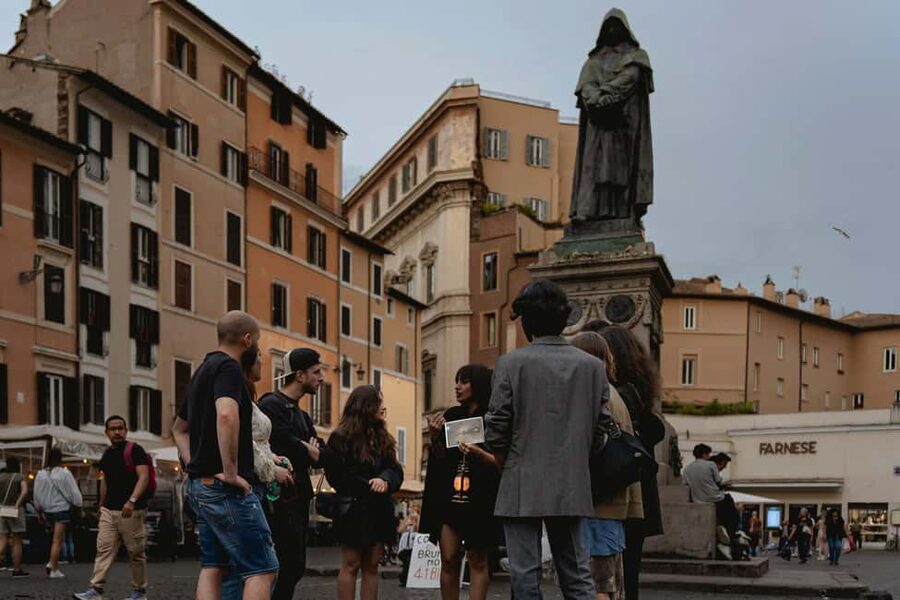
Your meeting point is in the center of Campo de’ Fiori, directly in front of the statue of Giordano Bruno. Look for a guide holding an iPad or a red sign. This is a practical meeting spot, but Campo de’ Fiori can be busy, so give yourself enough time to locate the statue and guide.
The opening stop is more than a simple roll call. Giordano Bruno’s statue immediately sets the mood. He is presented as a figure tied to Rome’s darker religious and political past, and the guide uses the setting to introduce themes of authority, punishment, belief, and memory.
You spend about 15 minutes here. That pace is useful because you get the story without standing in one place for too long. It also gives the guide a chance to explain how the city’s public squares once served very different purposes from the café-filled spaces you see today.
Campo de’ Fiori is a strong starting point because the contrast is so sharp. By day, it is a familiar Roman square. At night, with a story attached to the statue and surrounding buildings, it feels more unsettling.
Piazza Farnese and the city of public power
The walk continues to Piazza Farnese, another major Roman square with an impressive architectural setting. Here, the focus remains on the people and events linked to the area rather than on sightseeing alone.
You can expect another guided stop of roughly 15 minutes. The format gives you time to look around while listening, though you should not expect an extended visit inside a monument. This is an outdoor storytelling tour, and the square functions as a stage.
The value of this stop comes from seeing how Rome’s grand spaces can carry unpleasant memories beneath their elegant façades. The guide connects the physical setting with stories of power, punishment, and scandal. You may already know the square from a daytime walk, but the evening presentation encourages you to notice its darker associations.
Small Madonnas and the less obvious Rome
One of the more unusual parts of the route is the stop at the Madonna della Pietà, also described as one of Rome’s small Madonna images. These small religious images appear in corners and along streets, and they are easy to miss when you are rushing between major monuments.
The tour gives you a reason to slow down. You spend about 15 minutes hearing the story tied to this particular image and its place in the city’s religious culture.
This is one of the better reasons to choose a guided walk instead of simply downloading a ghost-story podcast. A guide can point out details you would probably pass without noticing. The stop is also a reminder that Rome’s darker stories do not always happen beside its grandest landmarks.
Still Rome, but a slower afternoon:
- Vatican: Museums & Sistine Chapel Entrance Ticket
★ 4.5 · 144,003 reviews - Vatican Museums & Sistine Chapel Tour with Optional Basilica
★ 4.3 · 67,413 reviews - Colosseum, Roman Forum & Palatine Guided Tour
★ 4.7 · 63,148 reviews - Vatican Museums, Sistine Chapel & St Peter’s Basilica Guided Tour
★ 4.5 · 39,149 reviews
Crossing Ponte Sisto after sunset
At Ponte Sisto, the tour becomes a moving walk through Rome’s historic center. The bridge provides a change of scenery and a chance to see the city from the river crossing, while the guide continues with stories connected to the area.
The route includes about 15 minutes of walking and guided sightseeing here. Expect to pause, listen, and continue rather than spend a long period on the bridge.
Nighttime makes this section especially effective. Bridges are naturally good places for ghost stories because they connect one district to another and offer open views with fewer distractions. Still, keep your expectations measured. The appeal is the combination of place and narrative, not a guaranteed paranormal encounter.
The Fountain of the Mask and Rome’s unsettling details
The Fountain of the Mask adds another small-scale stop to the walk. Like the Madonna image, it is the kind of feature you might overlook without someone drawing your attention to it.
The guide uses the fountain as a setting for another short story, with around 15 minutes devoted to sightseeing and explanation. These smaller stops help prevent the tour from becoming a parade of only famous attractions. You get a sense of how strange details are scattered throughout ordinary Roman streets.
I find this format more rewarding than a route that simply lists major landmarks. You are encouraged to look closely, listen for local legends, and understand how Roman streets can hold several layers of meaning.
The church of bones and death
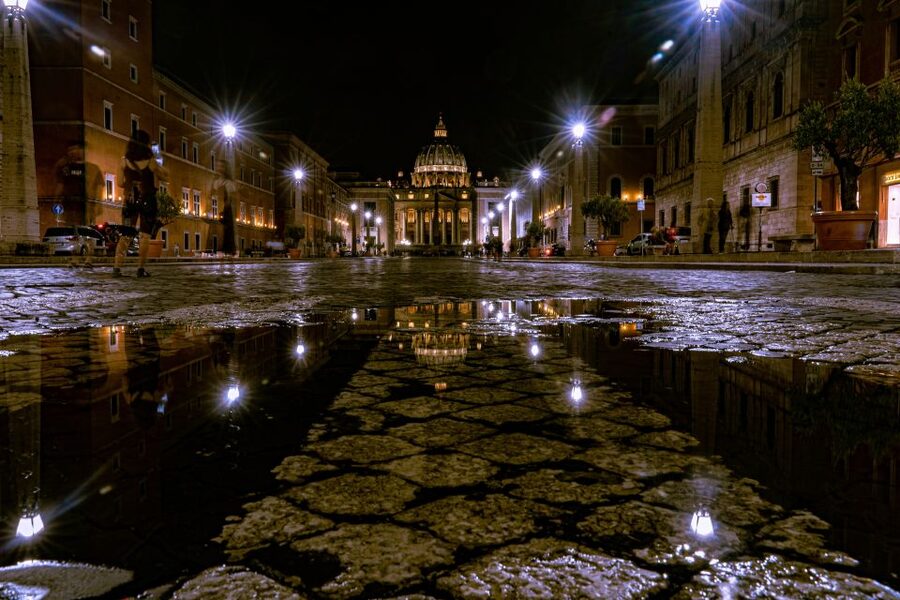
The Chiesa di Santa Maria dell’Orazione e Morte is likely to be one of the most memorable stops. The church is associated with death, and the tour highlights a chapel decorated with human bones.
This is where the experience delivers its strongest visual and emotional material. The subject is not merely a ghost story. It points to older customs surrounding death, prayer, burial, and remembrance.
You should expect the guide to frame the site through its grim details and historical setting. If you are sensitive to macabre religious imagery, keep that in mind before booking. The material is part of the tour’s central appeal, but it will not suit every child or every adult.
The stop also shows why the experience works better for people who want more than cheap scares. A bone-decorated chapel has a real physical presence, and the guide’s explanation gives that sight context instead of treating it as a prop.
Santa Maria in Monserrato degli Spagnoli
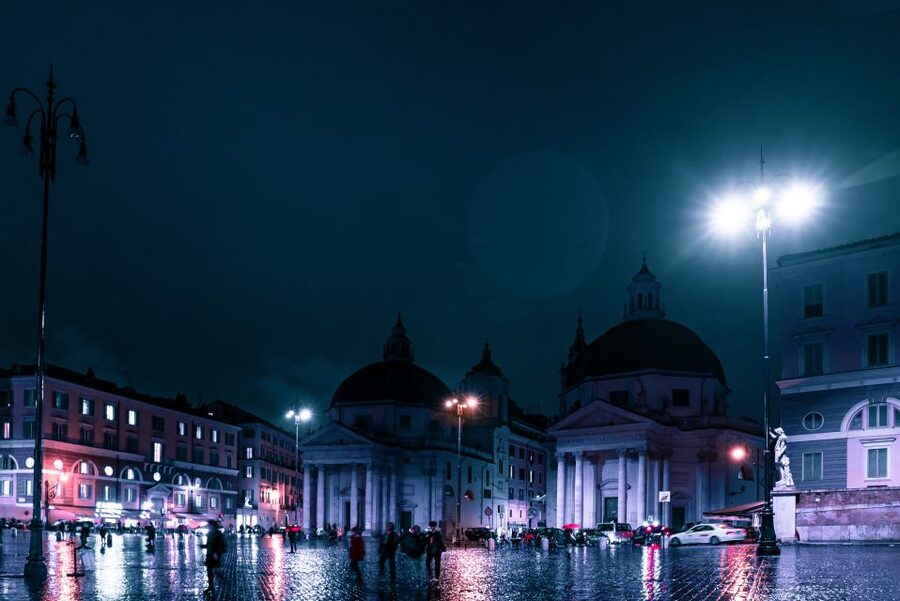
The route then reaches Santa Maria in Monserrato degli Spagnoli. This church brings art, religion, and darker stories together, and it gives the guide another setting for discussing Rome’s less comfortable past.
You spend about 15 minutes on guided sightseeing here. The stop is useful for visitors who enjoy the connection between Roman art and the people who commissioned, used, or suffered around these spaces.
Diletta has received particular praise for combining art knowledge with historical storytelling and for handling detailed questions. If your guide has a similar background, this church may become one of the most rewarding parts of the walk. If not, the stop still works as a short atmospheric pause before the route heads toward the final landmark.
Ending at Castel Sant’Angelo
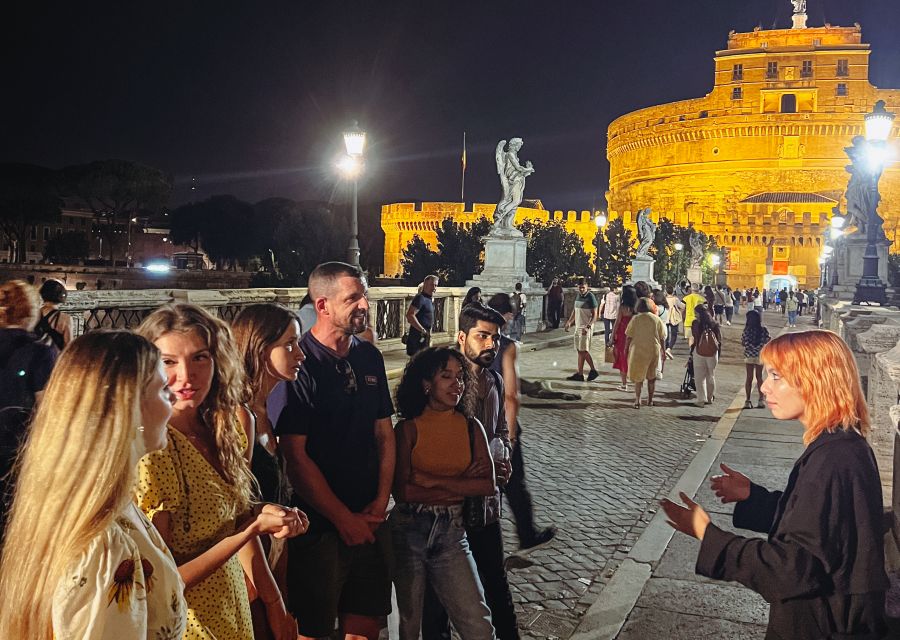
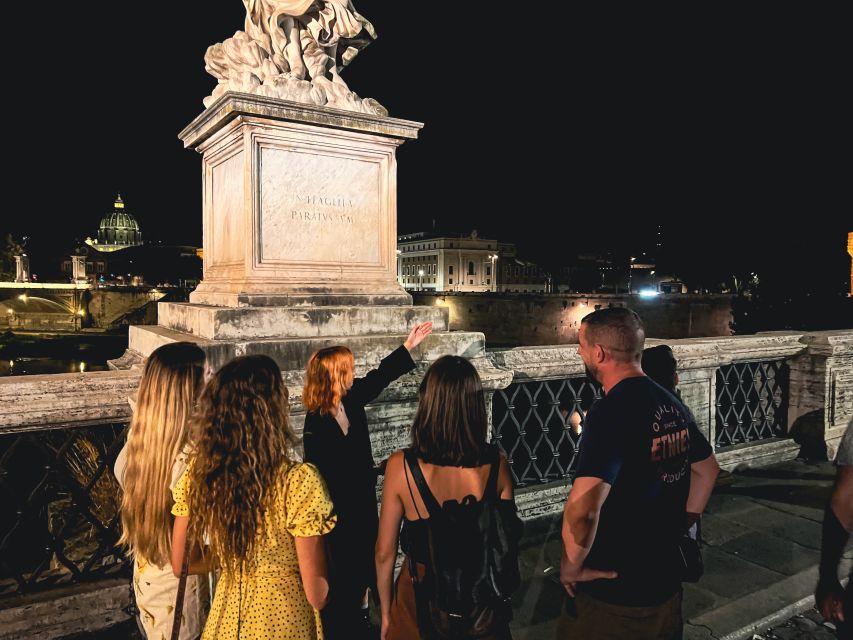
The final major stop is Castel Sant’Angelo, one of Rome’s most imposing sights after dark. Its fortress-like appearance fits the mood perfectly, and its connection to popes, imprisonment, death, and legends gives the guide plenty to work with.
The route description places the finish at Castel Sant’Angelo. The meeting information also says the activity ends back at the meeting point, so confirm the exact ending arrangement when you book. Either way, plan your evening around the route rather than assuming you will finish near your hotel or at a particular transport stop.
This last section gives the tour a strong visual finish. You have moved through squares, bridges, churches, and smaller street details, then arrive at one of Rome’s best-known monumental silhouettes. The guide’s stories about a bridge long associated with corpses and the grim events around the castle bring the evening to a suitably chilling close.
Castel Sant’Angelo is also a useful place to continue your night. The tour does not include entry to the castle, so you are seeing it from outside. If you want to visit the interior, plan that separately.
What the $28 price really buys you
At $28 per person, this is not a bargain for transportation or monument admission because neither is included. You are paying for a live English-speaking guide, a planned two-hour route, and the storytelling that connects the stops.
That is fair value if you enjoy guided walks. A good guide can help you notice small Madonnas, fountains, churches, and street corners that would otherwise receive no attention. You also get an evening activity that avoids the hottest part of the day and offers a fresh angle on places you may already have seen.
The value depends heavily on your expectations. If you want access inside several churches or Castel Sant’Angelo, this is not the right product. If you want an entertaining historical walk with a spooky theme, the price is reasonable.
The high overall rating is supported by repeated praise for clear English, strong energy, engaging delivery, and useful local suggestions. Several guides are singled out for making the evening interactive and easy to follow. That consistency matters because a ghost walk lives or dies by its storyteller.
Practical advice for a smoother walk
Wear comfortable shoes. The route includes repeated walking between stops, and the tour does not provide transportation.
Bring a camera if you like photographing Rome at night. You may find the evening views more appealing than the daytime versions, though the tour is built around listening rather than taking photographs at every stop.
Check the starting time carefully. The experience lasts two hours, but the available departure times vary by date. An evening start can fit neatly after dinner or serve as one of your final activities in Rome.
The tour is in English. You should be comfortable listening outdoors and following a guide through the city. The group format is social, and the experience works especially well if you enjoy asking questions or reacting to stories with other people.
Private groups are available. That option may suit you if you want a more personal pace or prefer not to join a shared group, though the supplied information does not give a separate private-group price.
You can cancel up to 24 hours before the activity for a full refund, and the reserve-now, pay-later option lets you hold a place without paying immediately. Those terms are useful when your Rome schedule is still shifting.
Who should book this Rome ghost walk?
I would recommend it to first-time visitors who want a different introduction to central Rome, couples looking for an unusual evening activity, and history fans who enjoy stories about crime, religion, power, and death.
It is also a good choice after you have already seen the major sights. The route does not replace a standard Rome city tour, but it changes how you view familiar places. You may walk past Campo de’ Fiori or Ponte Sant’Angelo the next day and remember the stories attached to them.
Families should consider the age and sensitivity of everyone in the group. The experience includes murders, executions, corpses, bones, and paranormal themes. It is not presented as a children’s attraction.
You should skip it if you dislike walking at night, want a formal art-history tour, or expect constant scares. The mood is spooky, but the strongest material is historical and atmospheric.
Should you book it?
Book this tour if you want Rome after dark, enjoy a good story, and prefer unusual details to another standard monument checklist. The route is well chosen, the price is sensible for a live two-hour experience, and the guides are repeatedly praised for warmth, clarity, and energy.
I would treat it as a lively historical walk with ghostly seasoning, not a horror show. Wear good shoes, arrive at the Giordano Bruno statue early, and confirm the exact end point. For the right audience, it is a memorable way to see Rome’s famous streets from their darker side.
FAQ
Where does the Rome Ghostly Nighttime Walking Tour start?
Meet directly in front of the statue of Giordano Bruno in the center of Campo de’ Fiori. The guide will hold an iPad or red sign.
Where does the tour end?
The route information places the finish at Castel Sant’Angelo. The activity details also state that it ends back at the meeting point, so confirm the exact end point when booking.
How long does the walking tour last?
The tour lasts two hours.
What language is the tour in?
The live tour guide speaks English.
How much does the tour cost?
The listed price is $28 per person.
What sights are included along the route?
Stops include Giordano Bruno’s statue, Piazza Farnese, Madonna della Pietà, Ponte Sisto, the Fountain of the Mask, Santa Maria dell’Orazione e Morte, Santa Maria in Monserrato degli Spagnoli, and Castel Sant’Angelo.
Is a guide included?
Yes. A local guide leads the ghost walking tour.
Is a private group available?
Yes, a private group option is available.
What should I bring?
Bring comfortable shoes and a camera.
Recently added around Rome
- Palatine Hill and Roman Forum Tour with Fast-Track Entrance★ 4.2 · 417 reviews
- Tivoli: Villa D’Este & Villa Adriana Pass & App Audioguide★ 4.4 · 364 reviews
- From Rome: Villa D’Este & Villa Adriana Day Trip with Lunch★ 4.4 · 289 reviews
- Vatican Museums & Sistine Chapel Skip-the-Line Guided Tour★ 4.6 · 254 reviews
- Rome: The Three Tenors at St. Paul’s Church Concert Ticket★ 4.7 · 699 reviews
- Tivoli: Villa D’Este Entry Ticket and App Audio Guide★ 4.3 · 191 reviews
- Rome: Capitoline Museums and Centrale Montemartini Tickets★ 4.4 · 328 reviews
- Rome: St. Peter’s Basilica and Papal Tombs Guided Tour★ 4.6 · 477 reviews
Walking Tours, compared.
Guided Walking Tour & Last Supper Visit with Ticket
Read our review →
Rialto Bridge & Offbeat Unusual Venice Walking Tour
Read our review →
Private 3 hrs Venice Tour: St Mark’s, Walking tour & Boat tour
Read our review →
Skip the line: Uffizi and Accademia Small Group Walking Tour
Read our review →Browse the lists this tour appears in