
Reviewed · WALKING TOURS
Rome by Night Private Walking Tour
Rome glows after the day crowds leave. This private evening walk links the Roman Forum, Trajan’s Column, Michelangelo’s Campidoglio, Caesar’s death site, the Pantheon, and Piazza Navona in about two and a half hours. I like the quiet nighttime setting and the way the illuminated ruins give familiar sights a fresh look. The main consideration is simple: this is a walking tour, and some archaeological areas may be harder to see clearly after dark.
I also like the private format, since your group can ask questions and set the pace more easily than on a large group outing. Guides Barbara and Vincent have earned especially warm praise for their storytelling and personal approach. The $157.28 per-person price is not low, particularly for a 2.5-hour walk, so the value depends on how much you care about focused guiding and a private experience.
In This Review
- Key Details Before You Book
- Why Rome Looks Different After Dark
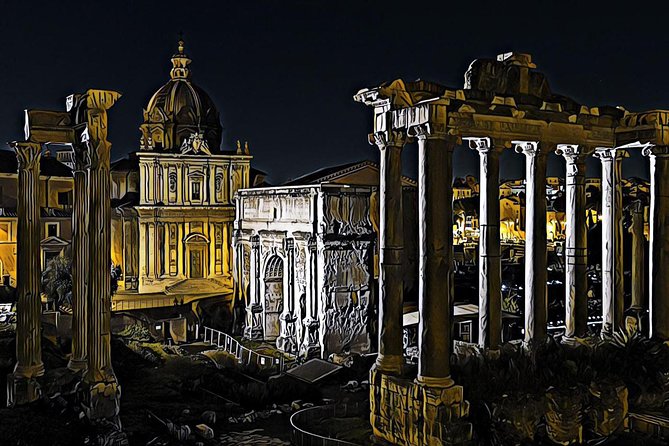
- The Roman Forum: Rome’s Story in Ruins
- Trajan’s Column and the Reach of Empire
- Michelangelo’s Campidoglio at Night
- Caesar’s Murder at Largo di Torre Argentina
- The Pantheon and Roman Engineering
- Piazza Navona and Rome’s Baroque Rivalries
- Guides Who Keep the Walk Personal
- Is $157.28 Per Person a Fair Price?
- Walking, Meeting Point, and Practical Fit
- Who Should Book This Evening Walk?
- Should You Book Rome by Night?
- FAQ
- How long is the Rome by Night Private Walking Tour?
- What time does the tour begin?
- Where does the tour start?
- Where does the tour finish?
- Is this a private tour?
- Is the tour offered in English?
- Is transportation included?
- What sights are included on the walking route?
- Is the tour suitable for people with limited mobility?
- Can I cancel for a full refund?
Key Details Before You Book
- Rome after 8:30 p.m.: The tour begins at Piazza del Colosseo when the main daytime rush has eased.
- Six major historic areas: The route covers the Roman Forum, Trajan’s Column, Piazza del Campidoglio, the site of Caesar’s murder, the Pantheon, and Piazza Navona.
- A private English-speaking experience: Only your group participates, with both a professional guide and local guide included.
- A strong family option: Guide Vincent kept both a history-loving 22-year-old and a less enthusiastic 19-year-old involved by asking questions and encouraging discussion.
- A point-to-point walk: You start at Piazza del Colosseo, 21, and finish at Piazza Navona, with no hotel pickup or private transport.
- Flexible cancellation: You can receive a full refund if you cancel at least 24 hours before the start time.
Why Rome Looks Different After Dark
Rome can be tiring in daylight. The Colosseum area fills with tour groups, traffic, school parties, vendors, and people trying to photograph the same ancient stones. At night, the city takes on a slower rhythm. The monuments are lit, the streets can feel calmer, and your guide has more room to tell the story without competing with a noisy crowd.
This tour begins at 8:30 p.m., which makes it useful for a first evening in Rome or for a day when you have already spent hours inside museums and churches. You do not need another scheduled indoor attraction. Instead, you walk from one major landmark to the next and let the city provide the setting.
The private format matters here. If your group is curious about Roman emperors, Renaissance design, ancient religion, or the political life of Julius Caesar, you can ask questions as they come up. A standard group tour often needs to keep moving. On this walk, the guide can spend more time on the subjects that hold your attention.
There is one tradeoff. Night lighting creates atmosphere, but it does not always reveal every detail. If your main goal is to study carvings or archaeological remains closely, a daylight visit may serve you better. I would treat this experience as a storytelling walk with spectacular views, not as a substitute for a full daytime archaeological visit.
More Walking Tours in Rome
- Rome: Trastevere & Campo de Fiori Street Food Walking Tour
★ 4.9 · 2,768 reviews - Rome: Paranormal Night Walking Tour & Secret Backstreets
★ 4.9 · 1,921 reviews - Rome by Night Walking Tour – Legends & Criminal Stories
★ 4.5 · 1,003 reviews
The Roman Forum: Rome’s Story in Ruins
The first major part of the walk follows the ruins of the Roman Forum. This is where the guide traces Rome from the mythological founding by Romulus through the rise of the Roman state and the eventual fall of the Roman Empire.
The Forum is easier to understand with a guide because the remaining columns and foundations can look like a jumble of stones without context. Your guide helps connect the fragments to the people and events that shaped Rome. You learn about the figures who turned a small settlement into the center of a huge empire.
At night, the Forum takes on a more dramatic character. Lights pick out parts of the ruins while other sections fade into darkness. That effect is beautiful, though it can also make the site less precise for anyone who wants to examine every structure.
The route is especially useful for first-time visitors who want a broad framework. Instead of memorizing isolated names, you follow the change from legend to republic, empire, and collapse. That story gives the other stops on the walk a clearer place in Roman history.
Trajan’s Column and the Reach of Empire
The next stop focuses on Trajan’s Column, a monument celebrating Emperor Trajan’s military victories. The tour connects the column to the expansion of the Roman Empire and to Trajan’s conquest of Dacia, in the region of present-day Romania.
The column is easy to pass without understanding what it represents. Its carved spiral tells a long military story, with scenes of battles, soldiers, engineering, and imperial power. You will not be visiting the inside of the monument on this walk, but the guide can explain why it was built and how Roman rulers used public monuments to shape their image.
This stop adds a useful political layer to the Forum. Rome was not simply a city of temples and grand buildings. It was also a state that used architecture to celebrate conquest and authority. Trajan’s Column helps you see how military success became part of the city’s public message.
Because the tour is outdoors and after dark, look closely at the lighting around the column and listen to the explanation. You may not see every carved figure from street level, but the monument’s overall design and purpose remain clear.
Michelangelo’s Campidoglio at Night
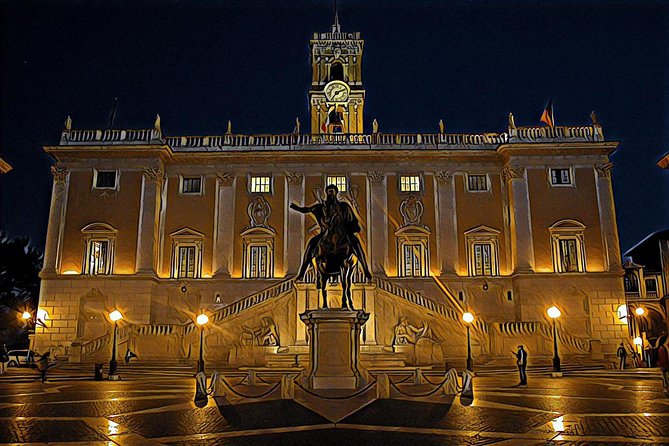
Piazza del Campidoglio is one of the most carefully designed squares in Rome. Michelangelo created its Renaissance plan, including the arrangement of the buildings, paving pattern, and decorative details.
This is a welcome change from the ancient ruins. The Forum shows Rome as an archaeological site, while Campidoglio shows how later artists reshaped the city and its relationship with the past. Michelangelo’s design creates order and ceremony, drawing the eye toward the center of the square.
The nighttime view is one of the strongest parts of the route. From the square, you can look across the Roman Forum as the ruins are picked out by lights. That view helps explain why Rome feels like several cities layered on top of one another. Ancient imperial buildings sit below a Renaissance civic space, and both remain part of the modern city.
Campidoglio is also a good place to slow down. The tour is not only a march between famous names. The guide can point out the style and decorations, then explain how Renaissance artists treated the ancient world as a source of inspiration.
Still Rome, but a slower afternoon:
- Vatican: Museums & Sistine Chapel Entrance Ticket
★ 4.5 · 144,003 reviews - Vatican Museums & Sistine Chapel Tour with Optional Basilica
★ 4.3 · 67,413 reviews - Colosseum, Roman Forum & Palatine Guided Tour
★ 4.7 · 63,148 reviews - Vatican Museums, Sistine Chapel & St Peter’s Basilica Guided Tour
★ 4.5 · 39,149 reviews
Caesar’s Murder at Largo di Torre Argentina
The walk continues through the archaeological area associated with the murder of Julius Caesar. This is one of Rome’s most memorable historical stories because the event changed the direction of the Roman world.
The stop is valuable because it links a physical place to a political crisis. Caesar was not killed simply because of a personal quarrel. The guide explains the reasons that made him such a powerful and controversial figure, along with the forces that led to his assassination.
The site itself is archaeological rather than polished and monumental. You may find it less immediately impressive than the Pantheon or Piazza Navona. Its importance comes from the event connected to it, so this is a stop where a good explanation matters more than grand architecture.
If you have a strong interest in ancient history, you may want to ask questions here. The private setting allows more room for discussion about Caesar’s rise, his role in Roman politics, and the consequences of his death.
The Pantheon and Roman Engineering
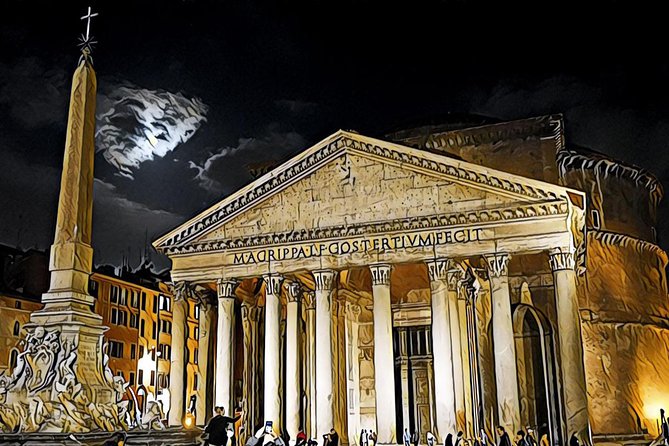
The Pantheon is described as the best-preserved building from ancient Rome, and it gives the tour a chance to move from political history to engineering, architecture, and religion.
Even from the outside, the Pantheon is striking. Its massive columns and broad facade show the confidence of Roman building. The guide explains how the structure worked and why its design remains so important. The building also offers a way to understand Roman religious life and the changing uses of monumental architecture.
Nighttime changes the mood here. The square can feel more atmospheric, and the stone facade takes on a different tone under artificial light. Yet the darkness again brings a practical limitation: you may not see every architectural detail as sharply as you would during the day.
I would not book this tour solely to study the Pantheon. The value comes from hearing how this one building fits into the larger story of Roman construction, belief, and civic life. It is one piece of a carefully connected walk.
Piazza Navona and Rome’s Baroque Rivalries
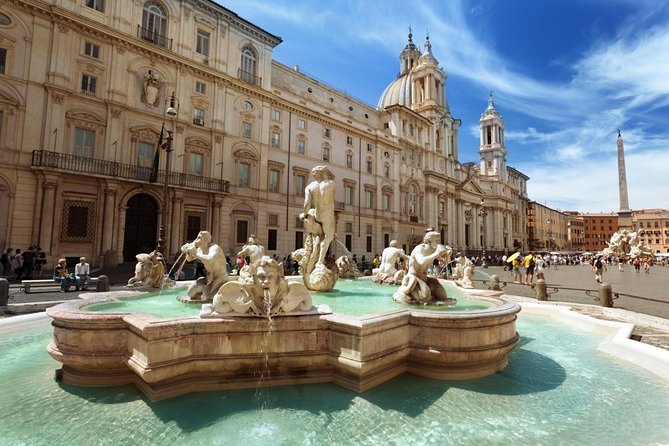
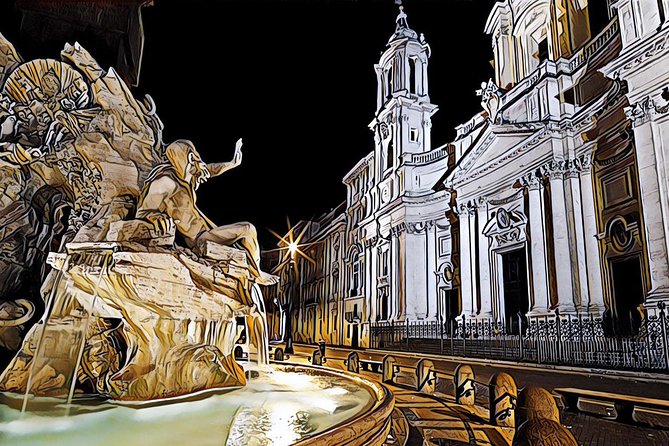
The final stop is Piazza Navona, Rome’s great Baroque square. The design reflects the work of major artists including Bernini and Borromini, and the guide uses the square to discuss art, architecture, and daily life in Baroque Rome.
Piazza Navona is a fitting end because it feels open, theatrical, and social after the solemn ruins earlier in the evening. The square’s fountains, buildings, and long shape show how Rome turned older foundations into a setting for art and public life.
The guide also introduces the rivalry and contrasting styles of Bernini and Borromini. You get more than a list of artists. The square becomes a way to discuss how artists worked, competed, and influenced the look of Rome.
The official endpoint is Piazza Navona, which gives you a practical choice after the walk. You can continue exploring the area on foot, find food nearby, or arrange a taxi. Two taxi stations are close to the square.
One review describes a guide taking the group to a good gelato restaurant and offering advice about tiramisu after the main route. That was done on request, so you should not treat it as a guaranteed part of the tour. Still, it shows how the private format can make room for useful local suggestions when time and guide availability allow.
Guides Who Keep the Walk Personal
The guide can make or break a history walk, and this experience has received especially strong praise for its personal style. Barbara is praised for explaining the major sights from the Colosseum and Forum through the Pantheon and Trevi Fountain, with food advice added when requested.
Vincent received particular praise for involving an entire family. He answered unusual questions, asked questions of his own, and adjusted his approach to different interests. A 22-year-old with a strong interest in history found plenty to discuss, while a 19-year-old who was less drawn to the subject was also brought into the conversation.
That detail matters. A good private guide does not simply recite dates. The guide watches your group, notices what catches your attention, and changes the level of detail. The walk may last longer than the planned 2 hours 30 minutes if the conversation continues, though you should not assume an extension is guaranteed.
The experience is offered in English. A professional guide and local guide are included, and only your group takes part. That makes it a good match for families, couples, or friends who want to ask questions without worrying about holding up strangers.
Is $157.28 Per Person a Fair Price?
At $157.28 per person, this is a premium walking tour. You are paying for a private group, a professional guide, local guiding, an evening schedule, and a route through some of Rome’s most important historic areas.
The value depends on your group size and priorities. For a couple, the total cost can feel high for a 2.5-hour walk. For a family or small private group, the price may make more sense because you are not sharing the guide with a large crowd and can shape the conversation around your interests.
There are no entrance tickets listed as included, and the tour does not include hotel pickup, drop-off, or private transportation. You should also remember that the experience is entirely on foot. The price is therefore about access to focused guiding and a calmer evening route, not about transport or admission benefits.
Group discounts are available, which may improve the value for larger parties. The tour is also booked an average of 98 days ahead, so advance planning is sensible if your dates are fixed.
Walking, Meeting Point, and Practical Fit
You meet at Piazza del Colosseo, 21, in Rome at 8:30 p.m. The tour ends at Piazza Navona. Since transport is not included, plan your route to the starting point and your return from the endpoint before you leave.
The walk requires a moderate level of physical fitness. You should be comfortable walking between several historic areas for roughly two and a half hours. Wear practical shoes and keep your evening plans flexible, especially if the guide spends extra time answering questions.
The meeting area is near public transportation, and taxi stations are close to Piazza Navona. Service animals are allowed. Confirmation arrives when you book, and the mobile ticket makes it easy to keep the booking details with you.
Free cancellation is available until 24 hours before the start time for a full refund. Cancellations or changes made less than 24 hours before the start are not accepted for a refund.
Who Should Book This Evening Walk?
I would recommend it most strongly to first-time visitors who want a clear introduction to Rome’s ancient, Renaissance, and Baroque eras in one outing. It also suits families because the private guide can adjust the storytelling for different ages and interests.
History fans will appreciate the route from Romulus and the Roman Forum to Trajan, Caesar, and the Roman emperors. Art lovers will get more from Campidoglio and Piazza Navona, particularly if they want to understand the contrast between Michelangelo’s Renaissance design and the later Baroque work of Bernini and Borromini.
You may want to skip it if you prefer museums, indoor attractions, or highly detailed archaeological study. The nighttime setting is attractive, but it can limit what you see. You should also compare the price with a group walking tour if keeping costs low matters more than privacy.
Should You Book Rome by Night?
Book this tour if you want a private, story-led introduction to Rome after the heat and crowds of the day. The strongest reasons are the illuminated monuments, the route’s wide historical range, and guides such as Barbara and Vincent who appear comfortable turning a standard walk into a real conversation.
I would be more cautious if you need included transportation, entrance tickets, or a low-cost option. For the right group, especially a family or small party that enjoys questions and history, the price can be justified. For everyone else, the key question is simple: do you want to see Rome at night with your own guide, or would you rather spend less and accept a larger group?
FAQ
How long is the Rome by Night Private Walking Tour?
The tour lasts approximately 2 hours and 30 minutes.
What time does the tour begin?
The start time is 8:30 p.m.
Where does the tour start?
The meeting point is Piazza del Colosseo, 21, 00184 Roma RM, Italy.
Where does the tour finish?
The tour ends at Piazza Navona, 00186 Roma RM, Italy.
Is this a private tour?
Yes. Only your group participates in the private tour or activity.
Is the tour offered in English?
Yes. The experience is offered in English.
Is transportation included?
No. Hotel pickup, hotel drop-off, and private transportation are not included.
What sights are included on the walking route?
The route includes the Roman Forum, Trajan’s Column, Piazza del Campidoglio, the archaeological area associated with Julius Caesar’s murder, the Pantheon, and Piazza Navona.
Is the tour suitable for people with limited mobility?
The tour requires a moderate level of physical fitness. Specific accessibility details beyond service animals being allowed are not provided.
Can I cancel for a full refund?
Yes. You can cancel at least 24 hours before the experience start time for a full refund. Cancellations made less than 24 hours before the start time are not refunded.
Recently added around Rome
- Rome: Pantheon, Trevi Fountain & Roman Squares Guided Tour★ 4.7 · 386 reviews
- Vatican: Pope Francis Tomb and Papal Basilicas Tour★ 4.7 · 340 reviews
- Vatican: St. Peter’s Basilica with Audio Guide and Options★ 3.4 · 269 reviews
- Rome: Vatican Museums Skip-the-line Entry Ticket and Tour★ 4.2 · 400 reviews
- Rome: Vatican Museums & Sistine Chapel Ticket + Tour Options★ 4.7 · 344 reviews
- Vatican Museums & Sistine Chapel Guided Tour★ 4.3 · 832 reviews
- Vatican Museums & Sistine Chapel Entry Ticket★ 4.4 · 245 reviews
- Vatican: Museums, Raphael & Sistine Chapel + Basilica Option★ 4.7 · 350 reviews
Walking Tours, compared.
Guided Walking Tour & Last Supper Visit with Ticket
Read our review →
Rialto Bridge & Offbeat Unusual Venice Walking Tour
Read our review →
Private 3 hrs Venice Tour: St Mark’s, Walking tour & Boat tour
Read our review →
Skip the line: Uffizi and Accademia Small Group Walking Tour
Read our review →Browse the lists this tour appears in