

Reviewed · MUSEUMS
Guided tour of the salt pans of Trapani and the Salt Museum
Salt has a surprisingly good story. This short tour links Trapani’s working salt pans with a family-run museum, showing how seawater becomes the crystals on your table. I especially like the changing colors of the pans, from white salt and pink evaporation pools to blue reflections, and the chance to follow the process close up. The main catch is getting there: the saltworks sit about a 15-minute drive from central Trapani, and public transportation is not provided.
The tour is priced at about $21.77 per person and lasts roughly 75 minutes. That is fair value for a guided walk, museum visit, historic mill, and small tasting, though the English time slots can be limited. For the best atmosphere, I would choose a late-afternoon departure, especially one around 6 p.m., when the setting sun can turn the pans into sheets of copper and rose.
In This Review
- Key points to know before you go
- Why Trapani’s salt pans are worth your time
- The 50-minute walk through the salt pans
- Collecting salt makes the process memorable
- Inside the Salt Museum and 1400s mill
- The best time to visit: sunset or daytime
- Getting there from Trapani is the main challenge
- Is $21.77 good value?
- Who will enjoy this saltworks visit?
- Booking, language, and cancellation details
- Should you book the Trapani salt pans tour?
- FAQ
- How long does the guided salt-pan tour last?
- Where does the tour start and finish?
- Is the tour offered in English?
- Is transportation from Trapani included?
- Is the tour private?
- Can children and most adults take part?
- Are service animals allowed?
- What happens if bad weather cancels the tour?
Key points to know before you go
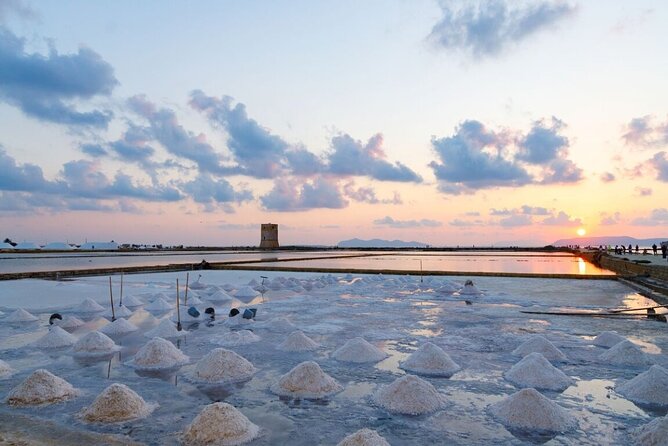
- Working salt pans, not just a display: You follow the real production process and see salt forming in the tanks.
- A 1400s mill and family museum: The second half takes place inside an old baglio, with historic tools and stories of the family that has managed the site for generations.
- Color and wildlife: The WWF reserve protects plants and birds, while the pans shift between white, gray, pink, and blue.
- Good value at $21.77: The fee covers both the salt-pan walk and the museum, with a small tasting included.
- Plan your transport carefully: There is no public transportation from Trapani to the site, so you need a car or taxi.
- English is available, but not always frequent: Confirm your preferred language and time when booking.
Why Trapani’s salt pans are worth your time

Trapani’s saltworks are not a polished attraction built only for sightseeing. They are a working place, shaped by seawater, sun, wind, clay, and human labor. That gives the visit a useful sense of purpose. You are not simply looking at decorative ponds. You are seeing an old trade still carried out in much the same way as it was in the past.
The salt pans lie within the Riserva Naturale Saline di Trapani e Paceco, a protected area known for its plants and birdlife. The setting is open and low, with broad views toward the sea and pools that reflect the sky. The colors are subtle but striking. White salt gathers in some areas, gray clay marks the ground, and the water in other tanks can take on pink tones.
I like that the scenery is tied directly to the work. The shallow pools are not there for decoration. Each stage helps remove water and concentrate the salt. The guide explains how seawater moves through the pans and how the crystals form as evaporation continues.
The walk is described as relaxing and suitable for all age groups. It follows the perimeter of the salt pan and reaches the edges of the tanks, where the water can act like a mirror. You may also collect some salt with your hands, bringing the process down to a simple, memorable action.
More Museum Tours in Sicily:
- Guided tour of the Trapani Salt Pans and Salt Museum
★ 4.7 · 423 reviews - Vatican: Museums & Sistine Chapel Entrance Ticket
★ 4.5 · 144,003 reviews - Vatican Museums & Sistine Chapel Tour with Optional Basilica
★ 4.3 · 67,413 reviews
The 50-minute walk through the salt pans
The first part lasts about 50 minutes, making it the longer and more scenic half of the visit. You meet at Via Salina Chiusa in Paceco, then follow the guide around the Culcasi salt pans.
The guide’s job here is to explain the production stages without turning the visit into a technical lecture. The best part is the connection between what you see and what you use every day. Salt begins as seawater, then passes through a series of shallow tanks as heat and evaporation do their work.
You can see how different areas of the saltworks serve different purposes. Some tanks hold seawater at an earlier stage, while others show more concentrated water and forming crystals. The exact colors depend on the water, light, clay, and stage of production, so the scene can change during the day.
The pans are particularly photogenic near sunset. A late visit can give you soft light across the water, with pink and orange reflections over the white salt. If you choose an evening departure, allow yourself a little time afterward to enjoy the view. The nearby room can also offer an aperitif, according to the tour information, though this is not part of the listed price.
The guide may also explain the Archimedes screw, a simple but clever device used to move water. It is one of those practical details that makes the tour more than a walk beside pretty ponds. You begin to see the saltworks as a carefully managed system.
The reserve adds another layer. You might spot protected plants and birds among the pools, although the tour is not presented as a dedicated bird-watching outing. The main subject is salt, with nature forming the setting around it.
One small point to keep in mind is the season. Salt production and the look of the pans change through the year. If your main goal is to see large amounts of salt gathered in the beds, you may find another season more rewarding than the one in which you visit. The museum remains useful at any time, but the outdoor portion can look different from the pictures depending on weather and timing.
Collecting salt makes the process memorable
Many food and craft tours explain a process from behind a barrier. This one lets you get closer. The chance to collect salt from the tanks by hand gives you a direct connection to the work.
It is a small gesture, but it helps you understand the product. You see the crystals, feel their texture, and then taste the result. A small salt tasting is included, adding a simple finish to the explanation.
The guides are often praised for making the process clear and lively. That matters here because salt production can sound dry on paper. A good explanation helps you understand why the pans are arranged as they are and why water needs to move through several stages before the salt is ready.
The English guides are generally easy to follow. One guide has been described as speaking English perfectly, while another uses a stronger Italian accent that can require more concentration. That is not unusual on a local tour, but it is worth knowing if you depend on every word.
Inside the Salt Museum and 1400s mill
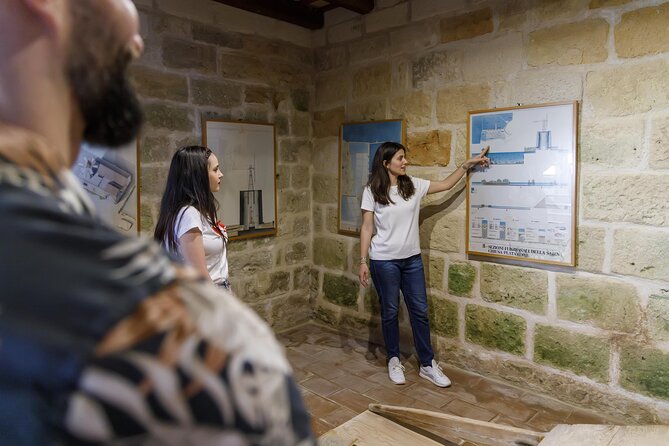
The second stop lasts about 25 minutes and takes place at the Museo del Sale. The museum sits inside an ancient baglio, a traditional fortified farm complex, and includes an old mill dating from the 1400s.
This section shifts from open views to working history. You see tools used in the salt pans and learn about the physical effort involved in harvesting and moving salt. The focus is not only on machinery. The museum also tells the story of the family that has managed the saltworks across generations.
That family connection gives the museum a personal quality. You are learning about a business that has remained tied to the sea and to local work, rather than visiting a large institution with displays removed from their original setting.
The historic mill is one of the most interesting objects on the tour. The Archimedes screw and other equipment show how people solved the practical problem of moving water around the pans. For me, these details offer more value than a room full of general information about salt.
The museum is included in an official European Union guide, which reflects its cultural importance. Still, keep your expectations sensible. This is a small museum, not a major national collection. One part of the visit can feel crowded when more people are present, and it may be harder to hear the second guide clearly.
The guides themselves are a major part of the museum visit. The family’s connection to the site comes through in the way the story is told, and the strongest tours use anecdotes to make the old tools and labor feel real.
A few more Sicily bookings to compare
- From Trapani: Cruise to Favignana and Levanzo with lunch
★ 4.2 · 2,286 reviews - From Milazzo: Panarea and Stromboli Boat Trip by Night
★ 4.2 · 1,605 reviews - Agrigento: Valley of the Temples Skip-the-Line Sunset Tour
★ 4.5 · 1,512 reviews - From Trapani: Day Cruise to Favignana & Levanzo with Lunch
★ 4.3 · 1,483 reviews
The best time to visit: sunset or daytime
The salt pans look different under different light. During the day, you can study the white salt, gray clay, and pink water more clearly. In the evening, the wide pools reflect the sky and the low sun can create the most dramatic views.
Several tour times may be available, but English departures are not always frequent. If you want an English guide, check the time carefully before finalizing your plans. A late-afternoon slot, including one around 6 p.m., can work well because you receive the guided explanation and may stay afterward for sunset.
Weather matters. The tour requires good conditions, and poor weather can lead to a new date or a full refund. That policy makes sense for an outdoor salt-pan visit, where wind and rain can reduce both comfort and visibility.
Bring practical footwear and protection from the sun, though the supplied information does not specify a required dress code. The walk is presented as suitable for most people, and service animals are allowed.
Getting there from Trapani is the main challenge
This is the detail I would take most seriously before booking. The meeting point is in Paceco at Via Salina Chiusa, 1, with the ticket redemption point listed as Via Chiusa in Nubia. The tour returns to the same meeting point.
The salt pans are about a 15-minute drive from downtown Trapani, but that short distance does not mean easy access. Public transportation from Trapani is not provided. You need your own car or a taxi.
A taxi can change the value calculation. One visitor paid an additional €60 for a round trip, which is much more than the tour itself. If you are staying in Trapani without a car, ask for a taxi price before setting out and confirm whether the driver will wait or return at an agreed time.
The provider operates a salt business and guided visits, not transportation services. That means you should treat the journey as your own responsibility. The meeting address is clear, but the lack of a public bus makes planning essential.
If you are driving, the tour is easier to fit into a day that includes the saltworks and nearby sights. If you are relying on taxis, the low ticket price becomes less important than the total cost of reaching the site and returning.
Is $21.77 good value?

At $21.77 per person, the tour offers a lot for a short visit. You receive roughly 50 minutes in the salt pans, 25 minutes in the museum, an English-speaking guide, admission to both areas, and a small tasting.
I consider that good value if you already have transportation. The visit combines nature, food, local work, and family history in one compact stop. It also gives you something different from the usual churches, ruins, and viewpoints of western Sicily.
The value is less clear if you must pay a high taxi fare. In that case, transportation can cost several times more than admission. The tour itself remains reasonably priced, but your full outing may not be.
The 75-minute duration is useful for a busy schedule. You can learn the process without sacrificing most of your day. On the other hand, if you prefer a slow photographic visit, the official tour time may feel brief, especially if you hope to linger for sunset afterward.
Who will enjoy this saltworks visit?
I would recommend it to anyone curious about how ordinary food is produced. You do not need a special interest in salt to enjoy the changing colors, the sea views, and the old equipment.
It suits families because the route is described as appropriate for all age groups, and collecting salt by hand gives younger visitors something concrete to do. It also works for history fans who prefer working traditions over grand monuments.
Food-minded visitors will appreciate the tasting and the connection between the salt pans and Sicilian cooking. Photographers should consider the late afternoon, when the reflected light can be especially attractive.
This is less suitable for anyone who wants a large museum, extensive indoor displays, or a long independent walk. It is also not a carefree choice for visitors without a car. Plan the taxi before booking, not after arriving in Trapani.
The private format means only your group participates in the activity, which can make the outdoor explanations more personal. The museum may still have more people present, and one account found it difficult to hear the second guide when that section was crowded.
Booking, language, and cancellation details
Confirmation is provided at booking. The tour is offered in English, but English time slots may be less frequent than Italian ones, so check the language selection with care.
Free cancellation is available up to 24 hours before the start time for a full refund. Changes or cancellations made within 24 hours are not refunded. The cut-off follows local time.
Because the visit depends on good weather, the provider may cancel in poor conditions. In that case, you can receive another date or a full refund.
Should you book the Trapani salt pans tour?
I would book it if you have a car, can arrange a reasonably priced taxi, or are already planning to visit the Nubia and Paceco area. The tour offers a clear look at a working Sicilian tradition, and the combination of salt pools, protected nature, an old mill, and family history is unusually well balanced.
Choose a late-afternoon time if sunset matters to you. Choose a daytime slot if you want the clearest look at the salt and the production stages. Either way, confirm that the departure is in English.
The salt pans are not a grand monument, and the museum is small. That is part of the appeal, but it also sets the right expectation. You are visiting a living workplace with a modest museum attached, not a major attraction designed for an entire afternoon.
For about $21.77, I think the guided visit is a smart addition to a Trapani itinerary. Just solve the transportation problem first. Once you do, the salt, sea, birds, old machinery, and sunset light make this a memorable way to understand a part of Sicily that most visitors simply pass by.
FAQ
How long does the guided salt-pan tour last?
The full experience lasts approximately 1 hour and 15 minutes. The salt-pan walk takes about 50 minutes, followed by a 25-minute visit to the Salt Museum.
Where does the tour start and finish?
It starts at Via Salina Chiusa, 1, 91027 Paceco, Trapani, Italy. The activity ends back at the meeting point.
Is the tour offered in English?
Yes. The experience is offered in English, although English time slots may be infrequent.
Is transportation from Trapani included?
No. Transportation is not included, and public transportation from Trapani to the salt pans is not provided. You need a car or taxi.
Is the tour private?
Yes. Only your group participates in the private tour or activity.
Can children and most adults take part?
Most people can participate, and the route is described as suitable for all age groups.
Are service animals allowed?
Yes. Service animals are allowed.
What happens if bad weather cancels the tour?
If poor weather causes cancellation, you can choose another date or receive a full refund. You can also cancel for a full refund if you do so at least 24 hours before the start time.
Recently added around Sicily
- Trapani: Salt Pans Sunset Tour and Flamingo Way★ 4.4 · 252 reviews
- Trapani: 2-Hour Salt Flats Tour★ 4.9 · 286 reviews
- Full Day Boat Tour San Vito Lo Capo to Castellammare del Golfo★ 5.0 · 292 reviews
- Boat tour to Egadi Favignana and Levanzo islands from Trapani★ 5.0 · 614 reviews
- Mini Cruise to Favignana and Levanzo with lunch on board★ 4.0 · 270 reviews
- 8-Hour Boat Tour from Castellammare del Golfo to San Vito Lo Capo★ 5.0 · 357 reviews
- Egadi Islands Tour: Favignana and Levanzo from Trapani★ 5.0 · 607 reviews
- Favignana and Levanzo, Egadi islands tour by boat from Trapani★ 5.0 · 720 reviews
Museums, compared.


Vatican Museums & Sistine Chapel Tour with Optional Basilica
Read our review →
Vatican Museums, Sistine Chapel & St Peter’s Basilica Guided Tour
Read our review →
Skip-The-Line Uffizi Gallery Timed Entry Ticket
Read our review →
Vatican Museums, Sistine Chapel & Basilica Tour
Read our review →
Vatican Museums & Sistine Chapel Skip-the-Line Entry Ticket
Read our review →Vatican Museums, Sistine Chapel & Basilica Tour
Read our review →
Vatican Museums & Sistine Chapel Guided Tour
Read our review →Browse the lists this tour appears in