
Reviewed · SKIP THE LINE
Agrigento: Valley of the Temples Skip-the-Line Sunset Tour
Ancient stones glow at sunset. That is the simple magic of this two-hour visit to Agrigento’s Valley of the Temples, where a local guide leads you past five Doric temples from the Hellenic period. I especially like the cooler evening timing and the chance to see the temples first in natural light, then illuminated after dark. I also like that the guide adds the stories and context that turn scattered ruins into a real place with people, beliefs, and daily life. The main caution is the amount of walking, plus the fact that the tour may be conducted in both Italian and English, which can make explanations feel slower or harder to follow.
The $51 price is fair if you want history explained rather than simply photographed. Guides such as Rosanna, Liz, Anna, Enza, Alessio, and Benedetto have earned praise for lively storytelling, good group management, and local insight. Just arrive early, wear proper shoes, and take the meeting-point instructions seriously. Late arrivals cannot join, since the ticket is tied to the tour’s starting time.
In This Review
- Key points to know before booking
- Why sunset is the right time at Agrigento
- Meeting under the olive tree near the Juno entrance
- Starting at the Valley of the Temples
- Climbing toward the Temple of Hera Lacinia
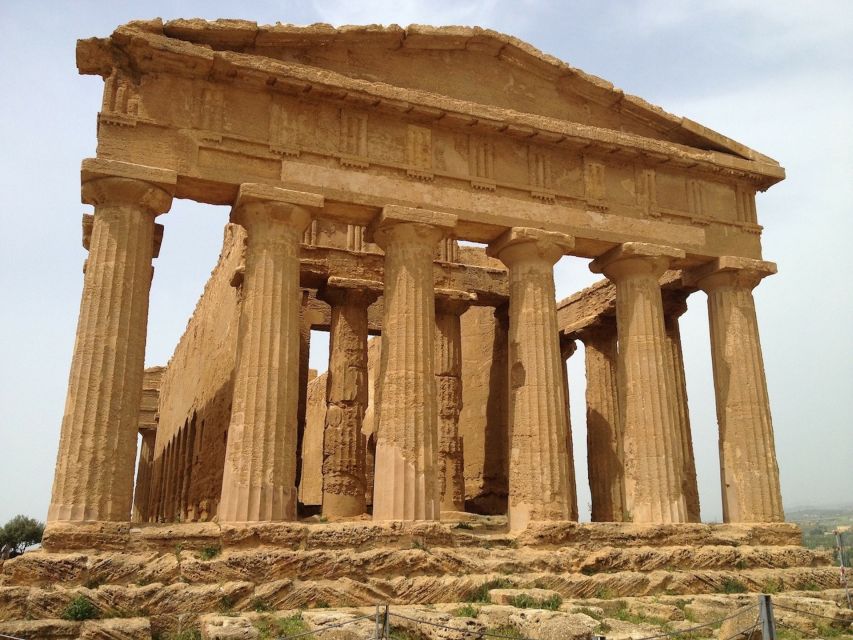
- The Temple of Concordia, the essential stop
- Heracles and the broken remains of Olympian Zeus
- What the guides add to the experience
- Walking, heat, clothing, and access
- Is $51 a fair price?
- Who should book this sunset visit?
- Should you book the Agrigento sunset tour?
- FAQ
- How long does the Agrigento sunset tour last?
- How much does the tour cost?
- Where do I meet the guide?
- How early should I arrive?
- What happens if I arrive late?
- Does the tour skip security?
- Which temples will I see?
- Is the tour offered in English?
- What should I bring?
Key points to know before booking
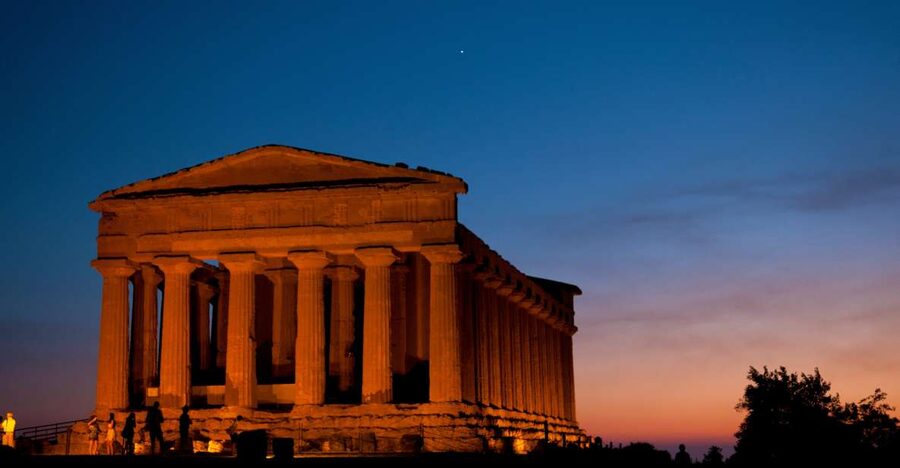
- Sunset changes the whole visit: Low light warms the sandstone, and the temples later take on a different look when illuminated.
- The Temple of Concordia is the star: This fifth-century Doric temple is among the best-preserved Greek temples in Sicily.
- Five temples are included: The route covers Hera Lacinia, Concordia, Heracles, Olympian Zeus, and another temple area in the Valley of the Temples.
- Expect a proper walk: The route crosses an open archaeological site, with uphill sections and little shade.
- Guides make the ruins readable: Stories about ancient life, local customs, plants, animals, and family connections add life to the stones.
- Bilingual guiding has trade-offs: Italian and English may be spoken during the same tour, so some explanations take longer.
Why sunset is the right time at Agrigento
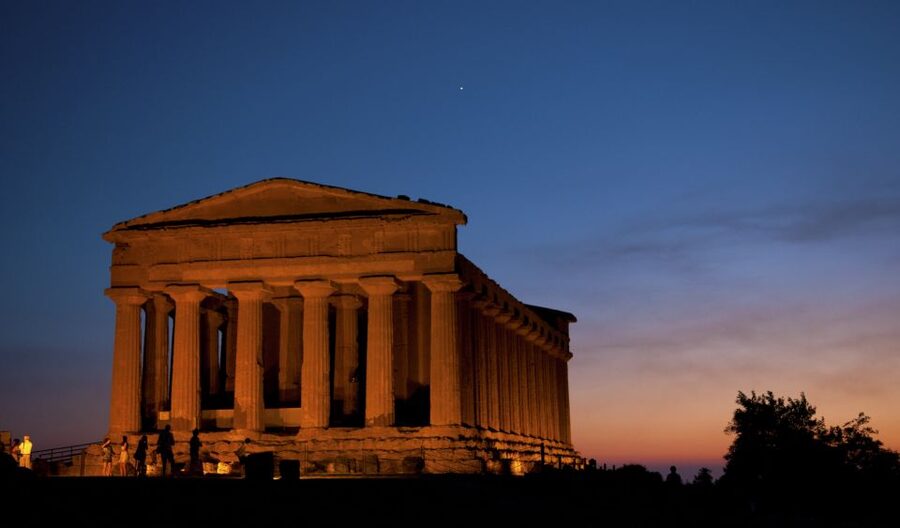
The Valley of the Temples is impressive at any hour, but sunset gives you two different experiences in one visit. You begin while the site is still touched by daylight, when you can study the temple shapes, columns, and broken blocks clearly. As the sun drops, the warm rays pick out the honey-colored stone and give the ruins a softer, more dramatic look.
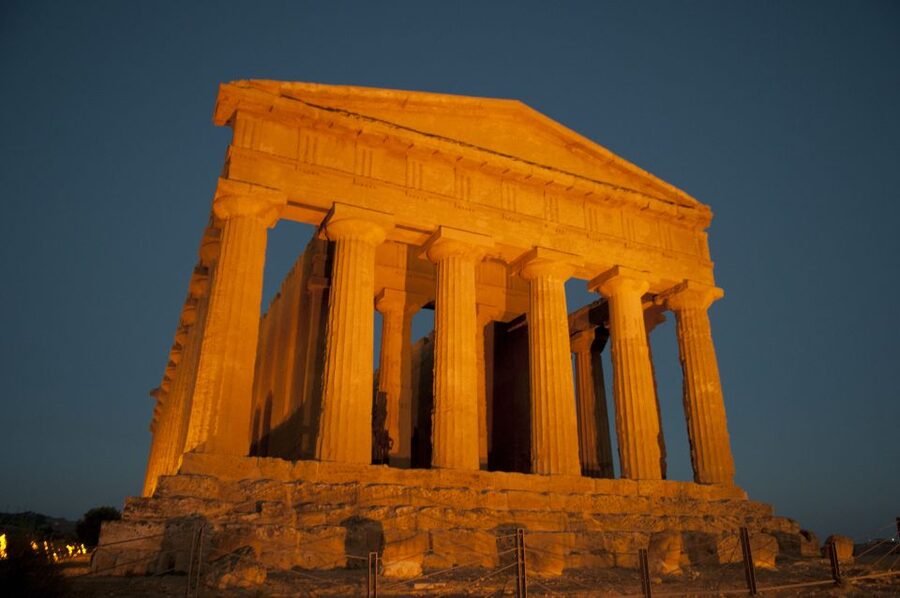
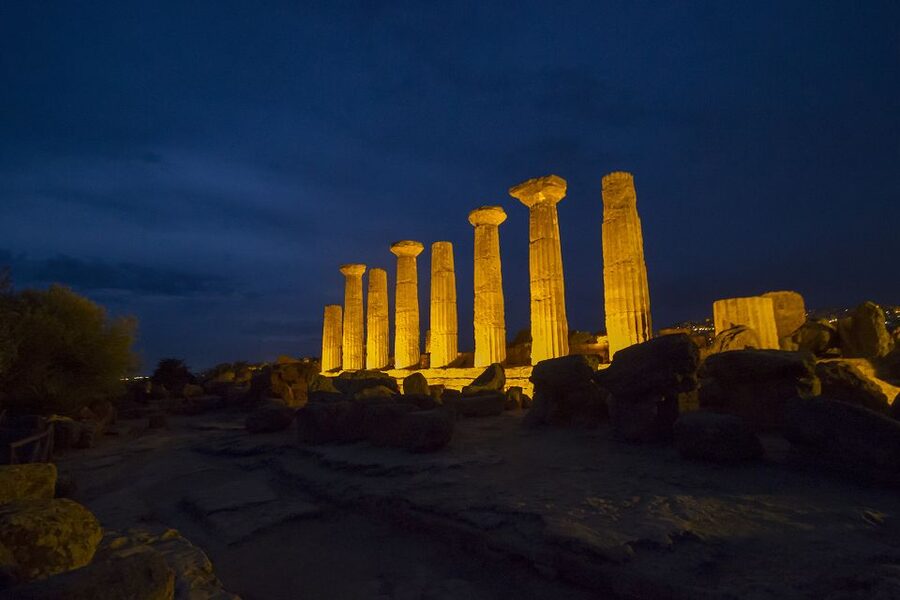
Then the lights come on. The Temple of Concordia, especially, takes on a more theatrical character after dusk. You are not simply looking at the same building in darker conditions. The mood changes from archaeological site to ancient monument, and the views across the valley feel quieter and more atmospheric.
The timing also helps with Sicily’s heat. Several people who took the tour in summer appreciated avoiding the hottest part of the day. That matters here because the route is exposed and involves more walking than some visitors expect. Sunset is not a shortcut, but it is a more comfortable way to cover the ground.
The trade-off is practical. In the evening, some refreshment facilities may be closed, so bring water. Also, sunset times change through the year. Check the available departure time for your date rather than assuming the tour always begins at the same hour.
A few more Sicily bookings to compare
- From Trapani: Cruise to Favignana and Levanzo with lunch
★ 4.2 · 2,286 reviews - From Milazzo: Panarea and Stromboli Boat Trip by Night
★ 4.2 · 1,605 reviews - From Trapani: Day Cruise to Favignana & Levanzo with Lunch
★ 4.3 · 1,483 reviews
Meeting under the olive tree near the Juno entrance
The meeting point is under an olive tree in front of the Lemonade stand, before the main gate at the Juno Temple entrance. This is not the sort of place where you want to arrive with only a minute to spare. The site is large, and the wrong entrance can cost you valuable time.
The ticket is handed to you directly by the guide at the meeting point. You then pass through airport-style security before entering. In the high season, security can take up to 30 minutes, so arriving 30 minutes before the scheduled start is sensible even if the guide begins the formal tour at the stated time.
One past visitor found the guide did not appear until the official start time, despite the early-arrival advice. That is worth knowing, but it does not change the safest plan: get to the correct entrance early, find the olive tree, and wait there with your booking details ready.
The skip-the-line benefit refers to express security access and organized entry. It does not mean you can ignore the security process. Bags and visitors still pass through airport-style checks, and busy periods can create a wait.
Starting at the Valley of the Temples
The opening section gives you your first look at the ancient plateau and the broad setting around the ruins. The Valley of the Temples is not a single building or compact courtyard. It is an extended archaeological area, so the guide helps you understand how the different remains relate to one another.
This first half-hour is useful for getting the overall picture. You begin to see the scale of the ancient settlement, the position of the temples, and the way the site stretches across the ridge. The guide’s job here is not just to name stones. The best guides described what buildings may have looked like and what life was like when the area was inhabited.
The walk is part of the experience, not dead time between monuments. You move along the ancient route with views opening up as you go. Still, you should expect sun, uneven surfaces, and a steady pace. A few people found the amount of walking greater than expected, so this is not ideal if you want a short stroll with frequent places to sit.
Climbing toward the Temple of Hera Lacinia
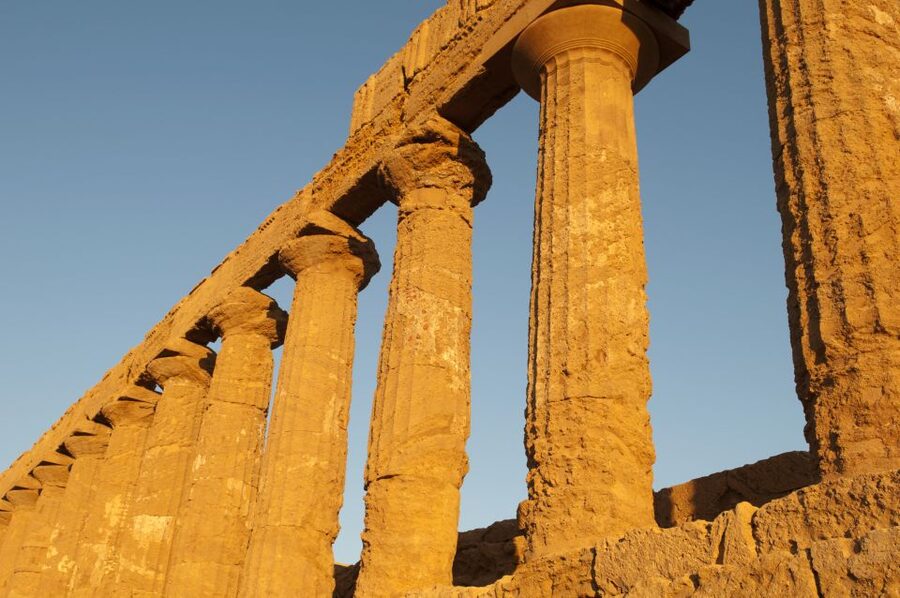
The Temple of Hera Lacinia sits on a high spur at the eastern end of the valley. Its position gives it extra drama, and the approach lets you appreciate how ancient builders placed major temples above the surrounding area.
This section can feel more strenuous than the flat-looking name Valley of the Temples suggests. You are walking uphill toward the temple, often in open conditions. Wear comfortable shoes with a firm sole, and keep water close rather than buried in a day bag.
The reward is the combination of structure and setting. The guide can point out the temple’s surviving features while also explaining its place within the wider sacred area. At sunset, the stone takes on the warm color that makes photographs particularly appealing.
If you are visiting with children, the tour can work well when they enjoy stories and movement. Several guides have been praised for keeping younger members of the group interested. It is still worth preparing children for a two-hour walk rather than presenting this as a quick monument stop.
Still Sicily, but a slower afternoon:
- Stromboli: Sunset Trekking at Sciara del Fuoco
★ 4.6 · 1,372 reviews - Boat Tour Egadi Day discover Favignana and Levanzo from Trapani
★ 5.0 · 1,183 reviews - From Milazzo: Lipari and Vulcano Day Trip
★ 4.3 · 1,166 reviews - Agrigento: Valley of the Temples Ticket & App Audioguide
★ 4.3 · 1,160 reviews
The Temple of Concordia, the essential stop
The Temple of Concordia is the strongest reason to choose this tour if you have limited time in Agrigento. Dating from the fifth century, it is one of the best-preserved Doric temples in Sicily. Its columns, proportions, and surviving body give you a much clearer idea of a Greek temple than most ruined sites can manage.
Your guide pauses here for about 30 minutes, combining explanation, sightseeing, and time for photographs. That balance matters. You get the structure explained, but you are not rushed away just as the light becomes interesting.
I like this stop because Concordia makes the earlier ruins easier to understand. After seeing fallen blocks and partial walls, you can look at a nearly complete temple and recognize the Doric order, the repeated columns, and the scale of the building. The guide’s stories also help you picture how the temple functioned, rather than treating it as a handsome shell.
At sunset, try to look beyond your camera screen. The warm light on the sandstone is one of the tour’s most praised features, and the later illumination gives you a second set of photographs. The site looks different after dark, not simply dimmer.
Heracles and the broken remains of Olympian Zeus
The ancient Greek Temple of Heracles comes next. Here the experience shifts from a largely intact monument to ruins that require more help from your imagination. This is where a strong guide earns the admission price by explaining what the building once looked like and how its remains fit into the ancient complex.
After Heracles, you see the ruins of the Temple of Olympian Zeus. The scale of this temple is part of its interest, even though the surviving remains are far less complete than Concordia. Large fallen pieces and scattered architectural elements give you a sense of ambition, but they do not explain themselves.
The final part includes self-guided time, which is welcome. You can pause for your own photographs, take in the evening view, or revisit a detail that caught your eye. The tour is not an unbroken lecture. Several people appreciated having time to look around independently after the guide’s explanation.
The full route visits five temples in total. The named highlights include Hera Lacinia, Concordia, Heracles, and Olympian Zeus, along with another temple area within the valley. Ask your guide to clarify the fifth stop if you want to keep a precise checklist of each monument.
What the guides add to the experience
The guide is the main reason to pay for this tour instead of entering alone. Without help, you can admire columns and stone blocks, but it is easy to miss why a partial wall matters or how the buildings once related to one another.
Several guides received especially warm praise. Rosanna was described as friendly, relatable, and full of historical background, with personal family anecdotes that connected Agrigento’s past to local life. Liz was praised for humor, enthusiasm, and her clear affection for the site. Anna brought strong storytelling, while Enza handled a group of 23 people effectively.
Benedetto used picture books and visual references to help explain the ruins. Alessio was noted for being well-prepared and entertaining. Other guides, including Mario, Graziella, and Elizabeth, were praised for clear explanations and a lively approach.
The best part of the guiding is the range of information. You may hear about architecture and archaeology, but guides have also added details about Sicilian customs, local plants, animals, and the surrounding area. One guide even managed to keep children involved while answering a steady stream of questions.
There is one repeated limitation. The tour can run in Italian and English at the same time. That makes the experience accessible to both language groups, but it can split your attention and lengthen each stop. One person felt a single-language tour would have been easier to follow. If you need very detailed architectural analysis, the presentation may also feel more story-based than technical.
Whisper audio devices are not automatically provided for children. You can ask the guide about adding one and pay directly on site. Adults have praised the audio quality when whisper equipment was available, but do not assume every child will receive a headset without arranging it.
Walking, heat, clothing, and access
Bring comfortable shoes, a sun hat, sunscreen, water, and clothing suited to the forecast. These are not minor suggestions. The temples sit in an open archaeological area, and the sunset hour reduces the heat but does not remove the need for sun protection.
You should plan for uphill walking and uneven ground. The tour lasts two hours, with roughly four half-hour sections, and the distance can feel greater in hot weather. There is no promise of a shuttle between temples, and some evening facilities may be closed, so carry what you need from the start.
The activity information gives mixed guidance about wheelchair access. One section lists the tour as wheelchair accessible, while another says it is not suitable for wheelchair users. Because the route includes walking across the archaeological site and an uphill approach to Hera Lacinia, anyone using a wheelchair should confirm current conditions with the provider before paying.
The same advice applies if you have limited stamina. This is a guided walk, not a vehicle tour. You may enjoy it very much if you can manage a steady route, but it is not the best choice if you need frequent transport or rest stops.
Is $51 a fair price?
At $51 per person, you are paying for entry, express security access, and two hours with a live guide in Italian and English. The value depends on how much you want from the site.
If you already know Greek temple architecture and prefer to read signs at your own speed, independent entry may suit you better. The paid tour will feel less necessary if your main goal is a quick photo of Concordia.
I think the price works well for most first visits. The Valley of the Temples is large, the remains vary from impressive to fragmentary, and the guide provides the missing framework. You also get the most attractive time of day, cooler conditions than midday, and the chance to see the buildings illuminated.
The strongest value comes from the combination of guide and timing. A basic entrance ticket gets you onto the site, but it does not give you the stories, route management, or explanation of what you are seeing. With 23 people in one group, the guide must keep an eye on the pace and make sure nobody is left behind. That can make the visit feel less private, but it is useful on a long open route.
Free cancellation up to 24 hours before the start and reserve-now, pay-later booking add flexibility. The important condition is the strict start time. If you arrive late, the ticket cannot be used for a later entry.
Who should book this sunset visit?
I would choose this tour for a first visit to Agrigento, especially if you want the site explained in plain language. It suits people who enjoy history, photography, and a steady walk, and it is a good fit for anyone trying to avoid the hottest daytime hours.
Families can do well here if children are comfortable walking and listening. The guides have shown they can keep kids involved, but the open site, evening timing, and lack of automatic child whisper devices require a little planning.
Couples and photographers will appreciate the changing light. You get golden stone before sunset and illuminated temples afterward, which is more varied than a standard midday visit.
I would think twice if you need a shuttle, want a quiet private tour, or prefer highly technical discussion of architectural details. You should also confirm accessibility before booking if anyone in your group uses a wheelchair.
Should you book the Agrigento sunset tour?
Yes, if you want a guided introduction to the Valley of the Temples at its most photogenic and comfortable time. The Temple of Concordia, the golden light, and the later illumination make the evening timing worth choosing, while guides such as Rosanna, Liz, Anna, Enza, and Benedetto have shown how much personality a good local explanation can add.
Book in advance for a popular departure, arrive 30 minutes early, and bring water and proper shoes. If bilingual explanations bother you or you need a slower route, ask about language and accessibility before committing. For most first-time visitors who can manage the walk, this is a strong way to turn Agrigento’s ruins into a memorable evening rather than a collection of beautiful stones.
FAQ
How long does the Agrigento sunset tour last?
The tour lasts two hours. Check the available starting times for your chosen date because the departure changes with the season and sunset.
How much does the tour cost?
The listed price is $51 per person. This includes the entry ticket and guided tour.
Where do I meet the guide?
Meet under the olive tree in front of the Lemonade stand, before the main gate at the Juno Temple entrance. The meeting point is near the Ticket Office Valle dei Templi, Tempio di Giunone.
How early should I arrive?
You should arrive 30 minutes before the scheduled start. This allows time to find the meeting point and pass through security.
What happens if I arrive late?
Late arrivals cannot join the guided tour. The entry ticket is valid only at the tour’s scheduled starting time.
Does the tour skip security?
The tour includes skip-the-line access through an express security check. All visitors must still pass through airport-style security, and the wait may reach 30 minutes during high season.
Which temples will I see?
The route includes the Temple of Hera Lacinia, Temple of Concordia, Temple of Heracles, and Temple of Olympian Zeus, plus a fifth temple area in the Valley of the Temples.
Is the tour offered in English?
Yes. The live guide speaks Italian and English. Both languages may be used during the same tour.
What should I bring?
Bring comfortable shoes, a sun hat, sunscreen, water, and clothing suitable for the weather. A child whisper device is not included automatically, but you can request one from the guide and pay for it on site.
Recently added around Sicily
- Stromboli: sunset trekking to Sciara del Fuoco – Ashàra★ 4.5 · 270 reviews
- Quad Tour Excursion from the Castle to the Sea★ 5.0 · 194 reviews
- Syracuse: Ortigia Private Walking Tour★ 4.8 · 181 reviews
- Syracuse: Coast and Sea Caves Full Transparent Boat Tour★ 4.8 · 330 reviews
- Syracuse: Ortigia Island and Sea Caves Boat Tour with Drinks★ 4.6 · 337 reviews
- Syracuse: Ortigia Sunset Cruise with Aperitif★ 4.8 · 291 reviews
- Syracuse: Neapolis Archaeological Park Small Group Tour★ 4.7 · 350 reviews
- Syracuse: Ortigia and Neapolis Guided Walking Tour★ 4.7 · 205 reviews
Skip the Line, compared.
Skip-The-Line Uffizi Gallery Timed Entry Ticket
Read our review →
Vatican Museums & Sistine Chapel Skip-the-Line Entry Ticket
Read our review →
Skip-the-Line Group Tour of the Vatican, Sistine Chapel & St. Peter’s Basilica
Read our review →
Michelangelo’s David Skip-the-Line Entry Ticket
Read our review →
Vatican Museums & Sistine Chapel Skip-The-Line Ticket
Read our review →
Vatican, Sistine Chapel & St. Peter’s Skip-the-Line Tour
Read our review →
Skip-the-Line Vatican, Sistine Chapel & St. Peter’s | Small Group
Read our review →
Vatican Museums Sistine Chapel Skip-the-Line Ticket
Read our review →Browse the lists this tour appears in