
Reviewed · MUSEUMS
Guided tour of the Trapani Salt Pans and Salt Museum
Salt can be a surprisingly good tour guide. This 75-minute walk through the Culcasi salt pans and museum gives you two things I especially like: a close look at salt production and a tasting of flavored fleur de sel made by a family of salt workers spanning four generations. The main consideration is the one-hour walk, which requires basic fitness and may not suit anyone expecting a short, mostly indoor visit.
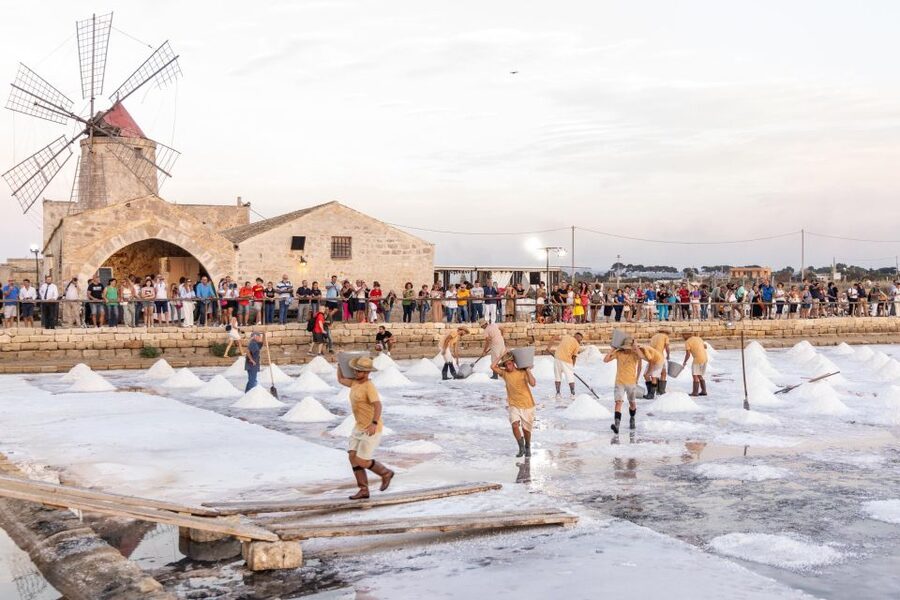
I also like the setting inside the WWF reserve, where white salt, pink pools, gray clay, blue water, and open sky do most of the visual work. The ancient mill and farmhouse museum add human scale to the visit, though the tour will feel less appealing if you want a broad history lesson about all of Sicily rather than a focused look at one salt-making family.
In This Review
- Key points to know before you book
- Why Trapani’s salt pans are worth your time
- The meeting point below the windmill
- Walking the salt route through the working pans
- What the Culcasi family adds to the visit
- Inside the salt museum and 1400s mill
- The salt tasting: small, but more useful than it sounds
- Is $21 a good value?
- Who will enjoy this tour most
- Practical advice for a better visit
- Should you book the Trapani salt pans tour?
- FAQ
- How long does the salt-pan and museum tour last?
- Where does the tour begin?
- Is the tour offered in English?
- How much does the experience cost?
- What does the ticket include?
- Do I need to be fit for the tour?
- What should I bring?
Key points to know before you book

- Four generations of salt workers: The Culcasi family still presents its own working salt tradition.
- Salt you can touch: You can collect forming salt by hand from the production tanks during the walk.
- A real tasting included: Sample whole salt and flavored fleur de sel, including varieties linked to the Slow Food Presidium.
- A 1400s mill: The museum occupies an old farmhouse and includes an ancient salt mill dating from the 1400s.
- A full hour on foot: Comfortable shoes, a hat, and basic fitness are important.
- A strong value at $21: The fee includes the guide, salt-pan entry, museum visit, and tasting.
Why Trapani’s salt pans are worth your time

Trapani’s salt pans give you a different kind of Sicilian outing. Instead of moving from one grand church or archaeological site to another, you follow seawater as it changes into the salt used at the table.
That change happens in a series of shallow tanks. Sun, wind, clay, and seawater work together, and the colors shift across the site. You can expect white salt crystals, pink-toned pools, gray clay, and blue water reflecting the sky. The view is wide and open, with little to distract you from the simple process in front of you.
I like this kind of visit because it makes an everyday ingredient feel specific. Salt is no longer just something in a shaker. You see where it forms, touch it in the tanks, and then taste different versions of it at the end.
The setting also matters. The salt pans sit inside a WWF reserve, so the walk includes protected plants and birds as well as industrial activity. You are not visiting a factory floor. You are walking through a coastal place where nature and human work have shared the same ground for generations.
More Museum Tours in Sicily:
- Vatican: Museums & Sistine Chapel Entrance Ticket
★ 4.5 · 144,003 reviews - Vatican Museums & Sistine Chapel Tour with Optional Basilica
★ 4.3 · 67,413 reviews - Vatican Museums, Sistine Chapel & St Peter’s Basilica Guided Tour
★ 4.5 · 39,149 reviews
The meeting point below the windmill
Start at Via Salina Chiusa, 1, at the ticket office in the forecourt below the windmill. Look for the guide behind the salt sales counter.
That detail is useful because the salt pans are an open site, and the windmill is an obvious visual marker. You do not need to search around for a separate museum entrance or wait beside the road. The tour begins from the sales area and then moves out onto the salt-pan route.
English and Italian tours are offered with a live guide. Since much of the visit involves explaining the stages of production, the guide is important. The tanks and colors are easy to see on your own, but the reason for each stage is what turns the walk into a proper tour.
The duration is listed as 75 minutes. Plan on spending that full amount of time at the site, since the experience has two connected parts: the outdoor walk and the museum visit.
Walking the salt route through the working pans
The first part follows the perimeter of the salt pan. You will walk toward the banks where the shallow water mirrors the sky, with the guide explaining how seawater gradually becomes salt.
This route is not presented as a strenuous mountain hike, but it is still a one-hour walk. The important practical point is that you should not book it expecting to stand in one place for most of the visit. Wear comfortable shoes, choose comfortable clothing, and bring a hat. Sun protection is especially sensible in an open area surrounded by reflective salt and water.
The route is suitable for all age groups in principle, but the basic fitness requirement should be taken seriously. One person booked without realizing that an hour of walking was involved and was unable to participate after becoming ill. That is a useful warning for anyone recovering from sickness, managing low stamina, or arranging the outing for someone who needs frequent rests.
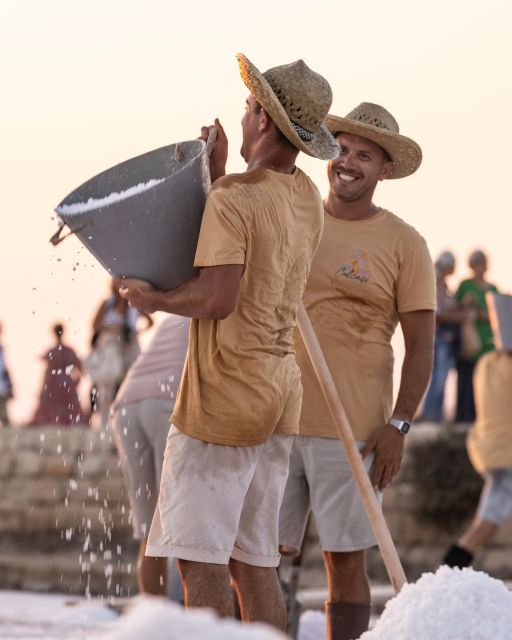
The reward for making the walk is a close look at salt in different stages. You can see crystals forming in the tanks and collect some with your hands. That small act gives the visit a practical edge. You are not only hearing how salt is made. You are handling the product before it reaches the kitchen.
The colors make the walk more interesting than the subject might suggest. White salt catches the eye first, but the pink pools, gray clay, and blue water keep the route from becoming repetitive. I would bring a camera, but the real value is the changing view as you move around the pans rather than one single lookout point.
What the Culcasi family adds to the visit
The Culcasi salt pans are presented by the family that runs them, and the salt trade has been part of the family story for four generations. That gives the visit a personal focus.
You are not simply receiving a general explanation of salt production. You are also following the work and memory of one family tied to this place. The museum portion brings that story into an old farmhouse, where the physical setting helps connect the tools and methods to daily labor.
Salt work is often described in a romantic way from a distance. This tour has a chance to correct that picture by showing the effort involved in tending the pans and moving through the production stages. The family connection makes the work easier to understand as a living occupation, not just an old Sicilian custom preserved for display.
The tour is also the only experience proposed by the Culcasi family at these salt pans. That matters if you prefer a direct, small-scale presentation rather than a general sightseeing stop. At the same time, the information provided does not specify the group size, so you should not assume a private tour.
A few more Sicily bookings to compare
- From Trapani: Cruise to Favignana and Levanzo with lunch
★ 4.2 · 2,286 reviews - From Milazzo: Panarea and Stromboli Boat Trip by Night
★ 4.2 · 1,605 reviews - Agrigento: Valley of the Temples Skip-the-Line Sunset Tour
★ 4.5 · 1,512 reviews - From Trapani: Day Cruise to Favignana & Levanzo with Lunch
★ 4.3 · 1,483 reviews
Inside the salt museum and 1400s mill
The second part takes you inside the ancient salt museum. It is housed in an old farmhouse and includes an ancient mill dating from the 1400s.
The museum gives you shelter from the open salt pans and adds objects and family context to the outdoor process. After seeing the tanks, you can better understand why the tools and buildings matter. The farmhouse is not a modern exhibition hall, and that is part of its appeal. The setting connects the display to the work that took place there.
The old mill is the key feature. Its age gives the visit a clear historical anchor, while the family story keeps the subject from becoming a dry lesson about machinery. You can trace the link between sea, salt, manual labor, and the people who made a living from it.
The museum is included in the official guide of the European Union, according to the information provided. That does not mean you should expect a large museum with many galleries. It is a focused collection in an old building, best suited to people who enjoy local history and working traditions.
The salt tasting: small, but more useful than it sounds

The tasting includes whole salt and fleur de sel in different aromas produced by the Culcasi operation. You can sample flavored varieties as well as the plain product.
This is one of the strongest parts of the experience for food-minded visitors. Fleur de sel is the delicate salt gathered from the surface of salt ponds, and tasting it after seeing where it forms gives you a better sense of its texture and use.
The flavored salts also make the stop more memorable. You can compare aromas rather than treating every sample as the same basic seasoning. The tasting includes fleur de sel associated with the Slow Food Presidium, which gives this part of the visit added local and culinary interest.
I would not book the tour only for a large food tasting. The tasting is one element of a 75-minute visit, not a meal or a cooking class. But at $21, having it included alongside the guided walk and museum makes the overall price feel fair.
Is $21 a good value?
At $21 per person, the tour offers a clear package: entry to the Culcasi salt pan, a live guided walk, admission to the salt museum, the ancient mill, and a tasting of several salts.
I see good value here because the experience combines three types of activity. You get time outdoors, a cultural visit indoors, and a food sample connected directly to the place. Many short stops offer only a view or a shop. This one gives you a reason to understand what you are looking at.
The value depends on your interest. If you enjoy local production, food traditions, coastal nature, and family history, the price is easy to justify. If you want a major museum, a long formal history lecture, or a quick photo stop, you may find the 75-minute format less satisfying.
After the tour, you can continue with an aperitif overlooking the salt pans or have dinner at the restaurant. Those options make it possible to turn the visit into a longer stop, especially if you want to enjoy the view without rushing away after the museum.
Who will enjoy this tour most
I would recommend this experience to several kinds of visitors:
- People interested in how local food is made
- Families who want a hands-on activity outdoors
- Visitors looking for a nature stop near Trapani
- Anyone who enjoys working museums and traditional crafts
- Food lovers who want to taste different salts
- Photographers drawn to water, sky, clay, and unusual colors
It also works well for someone who wants a break from churches, ruins, and city streets. You get open air and a slower pace, but the guide gives the outing enough structure to keep it from feeling like an aimless walk.
The tour may be a poor fit if you cannot comfortably walk for about an hour. It is listed as wheelchair accessible, but the route still requires a one-hour walk. Those two facts should be considered together. If you have specific mobility needs, confirm that the walking route suits you before booking.
The tour is offered in English and Italian. If you need another language, this experience may not be the right choice.
Practical advice for a better visit

Wear shoes you can walk in comfortably. The salt-pan route is outdoors, and the ground around working pools is not the place for delicate footwear.
Bring a hat and dress for comfort. The route is exposed, and the combination of sun, sky, water, and white salt can feel bright even when the walk itself is easy.
Allow enough time to arrive at the ticket office below the windmill. The meeting point is not described as the museum interior, so begin at the sales counter and find the guide there.
Keep your expectations focused. This is a local salt-making experience, not a full survey of Trapani or a large museum. Its strength is the direct connection between the pans, the family, the old mill, and the tasting.
The experience has a 4.7 rating from 423 bookings, with especially strong praise for the clear information about salt and harvesting, plus the chance to sample different salts and seasoned varieties. A small number of low scores point to the importance of reading the walking requirement carefully and understanding what the visit includes before you commit.
Free cancellation up to 24 hours before the start gives you some flexibility, and you can reserve without paying immediately. Those policies are useful, but the more important booking decision is physical: make sure the one-hour walk works for you.
Should you book the Trapani salt pans tour?
Book it if you want a short, unusual outing that connects Sicily’s coast, food, nature, and family work. The strongest reasons are the chance to touch salt in the tanks, taste several locally made varieties, and visit a 1400s mill in the family museum.
Skip it if you want a quick stop with little walking or a large museum packed with broad historical displays. The experience asks you to spend about an hour on foot, and its appeal comes from a close look at one salt-making tradition.
For $21, I think it is a sensible choice for curious visitors who have the stamina for the route. Bring a hat, wear good shoes, and treat the tasting as the finishing touch to a place you have just learned to see differently.
FAQ
How long does the salt-pan and museum tour last?
The guided tour lasts 75 minutes. It includes an outdoor walk through the salt pans and a guided visit to the salt museum.
Where does the tour begin?
The meeting point is the ticket office in the forecourt below the windmill at Via Salina Chiusa, 1. Find the guide behind the salt sales counter.
Is the tour offered in English?
Yes. Live guided tours are offered in English and Italian.
How much does the experience cost?
The listed price is $21 per person.
What does the ticket include?
It includes entry and a guided tour of the Culcasi salt pan and salt museum, plus a tasting of whole salt and fleur de sel in different aromas produced by the Culcasi operation.
Do I need to be fit for the tour?
Yes. The route involves about one hour of walking, and a basic level of fitness is required.
What should I bring?
Bring comfortable shoes, a hat, and comfortable clothes.
Recently added around Sicily
- Stromboli: sunset trekking to Sciara del Fuoco – Ashàra★ 4.5 · 270 reviews
- Quad Tour Excursion from the Castle to the Sea★ 5.0 · 194 reviews
- Syracuse: Ortigia Private Walking Tour★ 4.8 · 181 reviews
- Syracuse: Coast and Sea Caves Full Transparent Boat Tour★ 4.8 · 330 reviews
- Syracuse: Ortigia Island and Sea Caves Boat Tour with Drinks★ 4.6 · 337 reviews
- Syracuse: Ortigia Sunset Cruise with Aperitif★ 4.8 · 291 reviews
- Syracuse: Neapolis Archaeological Park Small Group Tour★ 4.7 · 350 reviews
- Syracuse: Ortigia and Neapolis Guided Walking Tour★ 4.7 · 205 reviews
Museums, compared.


Vatican Museums & Sistine Chapel Tour with Optional Basilica
Read our review →
Vatican Museums, Sistine Chapel & St Peter’s Basilica Guided Tour
Read our review →
Skip-The-Line Uffizi Gallery Timed Entry Ticket
Read our review →
Vatican Museums, Sistine Chapel & Basilica Tour
Read our review →
Vatican Museums & Sistine Chapel Skip-the-Line Entry Ticket
Read our review →Vatican Museums, Sistine Chapel & Basilica Tour
Read our review →
Vatican Museums & Sistine Chapel Guided Tour
Read our review →Browse the lists this tour appears in