
Reviewed · WALKING TOURS
Catacombs and Roman Countryside Half-Day Walking Tour
Rome’s best stories often sit outside the center. This half-day outing takes you beyond the usual ruins to the Catacombs of San Callisto, the ancient Appian Way, and towering aqueducts, with transport between sites. I like the mix of underground history and open countryside, and I like that you can see far-flung sights without wrestling with Rome’s public transport. The main concern is timing: traffic, heat, or a split vehicle group can stretch this advertised three-hour tour much longer.
The $78.44 price is fair if you value a guide, catacomb admission, and bus transfers. You will not get a long, leisurely walk at every stop, but you will cover places that are awkward to connect on your own. Guide quality can make or break the outing, and names such as Marcelo, Mariah, Tatia, Anna, Francesca, and Mario have been associated with warm, informative departures.
In This Review
- Key points at a glance
- Why leave central Rome for the Appian Way?
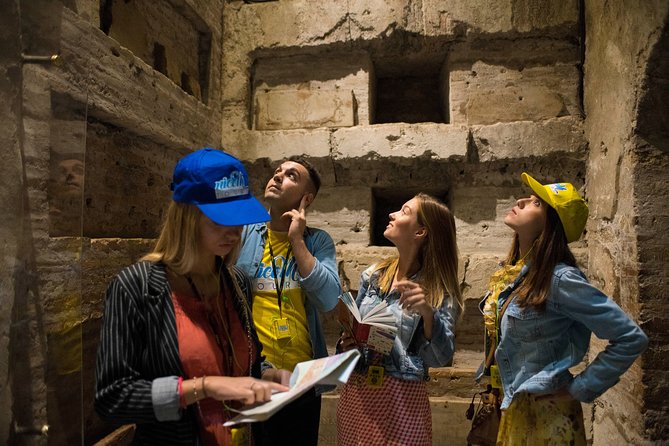
- Entering the Catacombs of San Callisto
- The Circus of Maxentius and Cecilia Metella
- Walking the Queen of Roads
- Getting close to Rome’s ancient aqueducts
- How good are the guides?
- Is $78.44 a good value?
- Practical details that affect your morning
- Who should book this Rome countryside tour?
- Should you book it?
- FAQ
- Where does the tour start?
- Where does the tour end?
- How long does the tour last?
- Is transportation included?
- Which catacombs does the tour visit?
- Is catacomb admission included?
- What clothing is required?
- Is the tour offered in English?
- Can I cancel for a refund?
Key points at a glance
- The Catacombs of San Callisto are the main event: Expect about an hour underground, with explanations of early Christian burial customs, martyrs, popes, and the crypt of St. Cecilia.
- The Appian Way gives you Rome beyond the monuments: You walk along one of the ancient world’s great roads, dating from around 312 BC.
- The aqueduct stop is highly visual: You can get close to the massive arches and see the engineering that carried water toward Rome.
- Transport saves time and effort: A coach or van links scattered sites that would be cumbersome to visit independently.
- Dress carefully for the catacombs: Your shoulders and knees must be covered. This rule is enforced.
- Plan for a flexible morning: The official duration is about three hours, but traffic can add 30 to 60 minutes.
Why leave central Rome for the Appian Way?
Rome’s center can feel like an open-air museum with a traffic problem. The countryside south of the city offers a different view: low walls, grass, ancient stones, and long stretches of road where the modern city feels farther away.
That change of setting is the point of this tour. You still get major Roman sights, but you are not spending the entire morning in front of monumental fountains and crowded piazzas. You see the places where Rome expanded, buried its dead, carried water, and linked its territory to the rest of Italy.
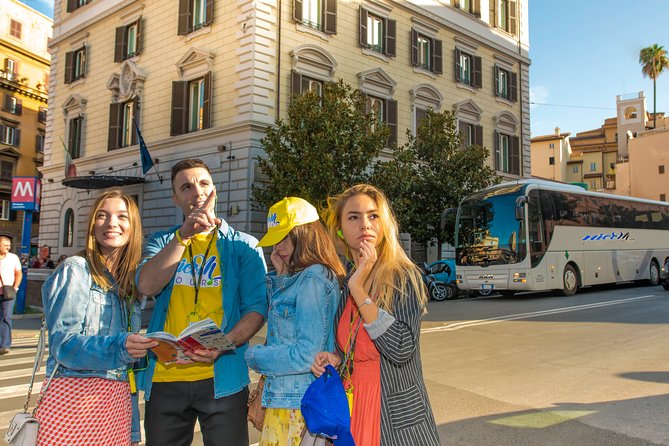
The tour begins at 9:45 am on Via Cavour, 224, near central Rome and public transport. You do not receive hotel pickup, so allow time to find the meeting point. The end is back at the same location, which makes it easy to continue sightseeing or return to your hotel.
The group can reach a maximum of 25 people. That is small enough for a guide to keep the outing moving, though the actual vehicle arrangement matters. On one departure, the group was split between two vans while the guide rode with only one section. Headsets were hard to hear in the other vehicle. If clear commentary matters to you, ask how the group will be divided before setting off.
More Walking Tours in Rome
- Rome: Trastevere & Campo de Fiori Street Food Walking Tour
★ 4.9 · 2,768 reviews - Rome: Paranormal Night Walking Tour & Secret Backstreets
★ 4.9 · 1,921 reviews - Rome by Night Walking Tour – Legends & Criminal Stories
★ 4.5 · 1,003 reviews
Entering the Catacombs of San Callisto
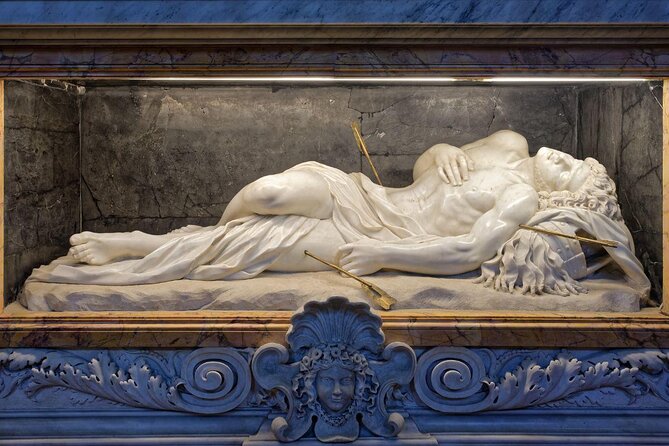
The catacombs are the most distinctive stop. San Callisto is among Italy’s largest and most important underground cemeteries. It contains the burial place of an estimated 500,000 Christians, along with dozens of martyrs and popes.
The site includes the Crypt of St. Cecilia and the Crypt of the Popes. Your guide explains how underground burial spaces were organized and how early Christian communities used these tunnels. The focus is not on a room filled with visible bones. The remains have largely been removed, so you should come for the underground passages, symbolism, and religious history rather than a macabre display.
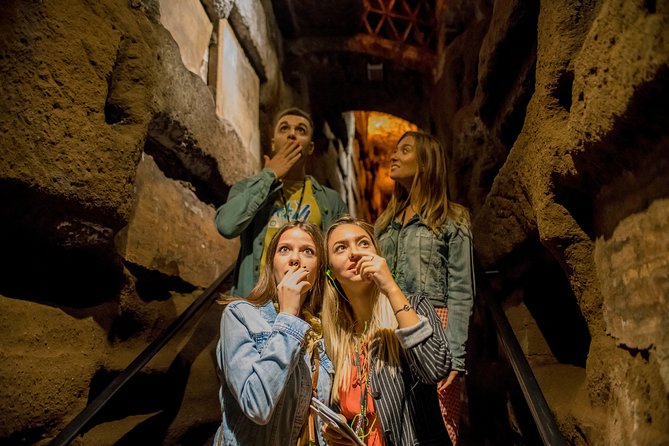
The catacomb visit lasts about an hour and includes admission. You follow a guide through the tunnels, where the setting itself does much of the work. The narrow corridors and low light make the past feel close, even when the explanation is simple.
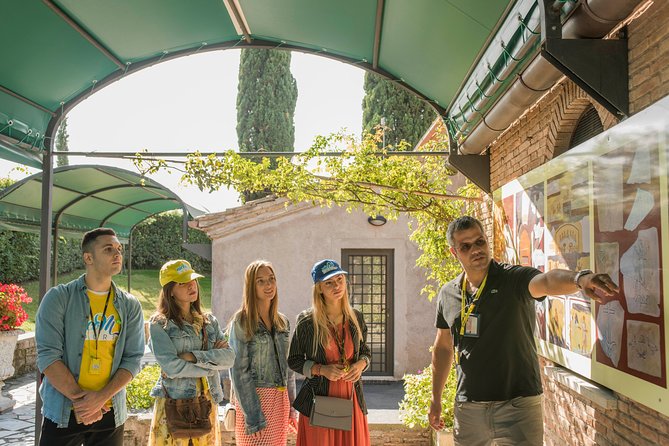
Guides who bring this stop to life tend to use drawings and diagrams before taking the group below. That helps you understand what you are seeing instead of simply walking through dark passageways. Anna, Marcelo, and Mariah have been praised for making the history clear and engaging, while one guide helped a visitor who felt uneasy underground.
If you have claustrophobia, tell the guide at the start. The tour does go below ground, and the experience may not suit everyone. The supplied information does not promise special access or a shorter route, so this is an important personal consideration.
The catacombs can become crowded, especially around Easter. When several groups gather, it may be difficult to hear every word. Headsets are available if requested, but ask for one early rather than assuming you will automatically receive it.
The Circus of Maxentius and Cecilia Metella
After the catacombs, the vehicle continues through the Roman countryside toward the Circus of Maxentius. This is not Rome’s famous Circus Maximus in the city center. It is a separate, better-preserved structure in Caffarella Park.
The stop helps you see how much ancient Rome lies beyond the standard circuit. The setting is more open, and the ruins do not compete with the density of the central monuments. The visit is part of the route rather than a long, formal stop, so do not expect an extensive exploration of the complex.
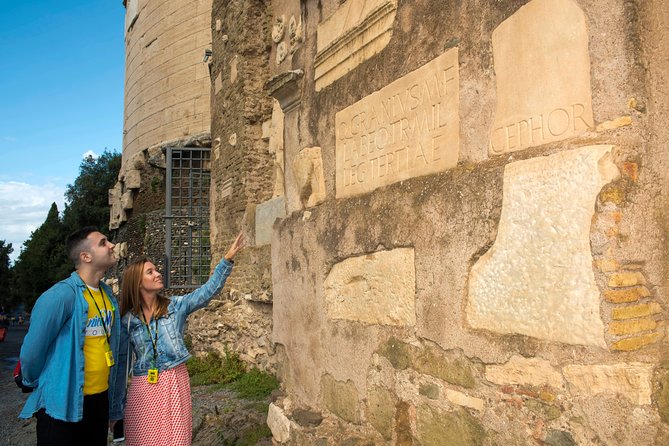
The tour then makes an external visit to the Mausoleum of Cecilia Metella. This large tomb sits on a hill along the Appian Way and was built in the first century BC for a Roman noblewoman.
You see the mausoleum from outside, with no admission fee included or required for this portion. The structure is impressive because of its size and position. It looks less like a private grave and more like a fortified landmark beside one of Rome’s great roads.
This stop lasts about 30 minutes. That is enough for photographs and an explanation from the guide, but not enough for a detailed archaeological visit. If you want to explore every building in the Appian Way Archaeological Park, you need a separate plan and more time.
Walking the Queen of Roads
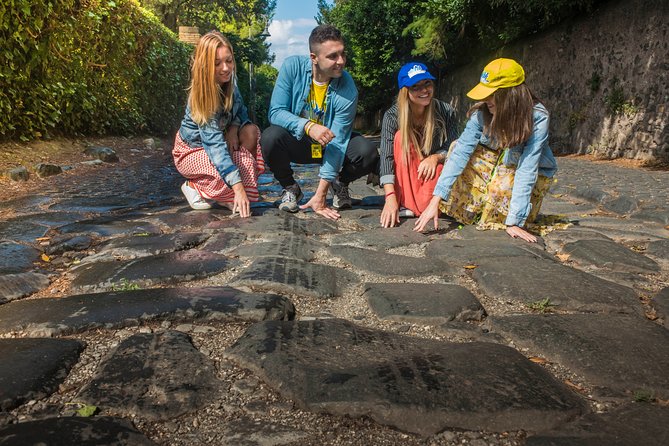
The Appian Way is one of the tour’s most valuable outdoor stops. Romans called it the Queen of Roads, and it once connected Rome with Brindisi in southern Italy. From there, routes continued toward Greece and the eastern Mediterranean.
The road began in 312 BC, making it one of the oldest major roads in the Roman world. Its importance was strategic and commercial. It was not simply a path between villages. It helped Rome move armies, goods, officials, and messages across its expanding territory.
You walk along part of the ancient route for about 30 minutes. That may sound brief, but it is a welcome change after the underground visit and the vehicle ride. The road’s worn stones and surrounding countryside show a side of Roman engineering that feels less polished than the Colosseum, but more connected to daily movement.
Wear shoes with a firm sole. The information provided does not specify the exact walking surface or distance beyond the scheduled 30-minute walk, but the ancient road is made for sturdy footwear rather than delicate city shoes. You should also be ready for sun, since the route includes open areas.
One detailed account describes roughly four hours in the sun when the whole outing ran long. That is a useful warning even though the stated duration is three hours. Bring water, use sun protection, and avoid scheduling a tight lunch reservation immediately afterward.
The walk is not presented as a strenuous hike. Most departures combine walking with short vehicle transfers, and several descriptions characterize the amount of walking as manageable. Still, a moderate level of fitness is required.
Still Rome, but a slower afternoon:
- Vatican: Museums & Sistine Chapel Entrance Ticket
★ 4.5 · 144,003 reviews - Vatican Museums & Sistine Chapel Tour with Optional Basilica
★ 4.3 · 67,413 reviews - Colosseum, Roman Forum & Palatine Guided Tour
★ 4.7 · 63,148 reviews - Vatican Museums, Sistine Chapel & St Peter’s Basilica Guided Tour
★ 4.5 · 39,149 reviews
Getting close to Rome’s ancient aqueducts
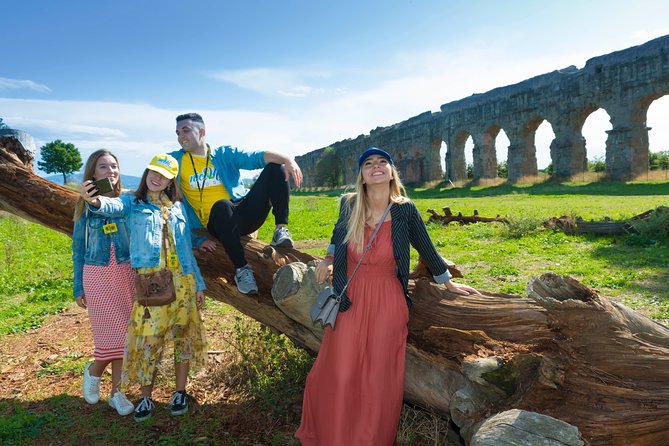
The aqueduct stop provides the tour’s biggest visual payoff. Rome’s aqueducts were built to carry water from distant sources into the city, and the surviving arches show the scale of that undertaking.
The guide explains why this area was chosen for the aqueducts. The countryside offered the space and terrain needed for long elevated channels, while the gradual slope helped water move toward Rome. You have time to take photographs and walk close to the remains.
The aqueducts are not decorated like imperial monuments. Their power comes from scale, repetition, and age. When you stand near the arches, the practical side of Roman civilization becomes clear. These structures supported baths, fountains, homes, and public life across the city.
Some people may find the aqueduct stop less exciting than the catacombs. That is fair. The visit is mainly about seeing the remains, hearing the explanation, and taking in the open setting. If you have already visited aqueducts elsewhere in Italy, this part may feel familiar. If you have never seen one up close, it is a memorable and worthwhile stop.
How good are the guides?
The guide is the strongest variable in this experience. The best departures feature someone who can connect dates and names to what is directly in front of you, while also managing transport, questions, and timing.
Marcelo has been praised for being informative, funny, and easy to approach. Mariah has been noted for speaking several languages and for helping with restaurant suggestions after the tour. Tatia has a history background and has been described as patient and well prepared. Anna receives similar praise for explaining the catacombs, symbolism, Appian Way, and aqueducts.
Francesca and Mario have also been associated with a warm, accommodating departure, including kindness toward a family with a toddler. That suggests the outing can work for families, although the underground setting and walking surfaces may not suit every young child.
The guide usually gives commentary during the drive and at the stops. This is where headsets can help. One poor departure involved a hot, stuffy vehicle and weak headset reception after the group was divided. That is not a small issue. Much of the route is spent moving between sites, so bad audio can erase a large part of the experience.
If you hear poorly, speak up quickly. Do not wait until the end of the morning. The operator has acknowledged audio problems and group separation as issues to address.
Is $78.44 a good value?
At $78.44 per person, the tour is not the cheapest way to see a road and aqueduct. But the price includes bus transportation, a professional guide, and admission to San Callisto. Those details matter because the sites are spread across the southern edge of Rome and the surrounding countryside.
You are paying for coordination as much as admission. A self-guided visit would require working out transport to the Appian Way, reaching the catacombs, finding the aqueducts, and keeping an eye on opening times and route changes. One useful benefit of a guided visit is simply knowing where to go. The archaeological area is large enough that you might otherwise wander without seeing the right sections.
The value is strongest for a first visit to Rome, a short stay, or anyone who wants to see more than the historic center. It is also a sensible choice for teenagers who enjoy ancient engineering, burial customs, and physical ruins rather than only grand interiors.
The value is weaker if you want a slow pace, extensive independent exploration, or a private guide. You only get about 30 minutes at the mausoleum and Appian Way, and the aqueduct stop is a focused visit rather than a full day in the park.
Food and drinks are not included. Bring what you need, especially because traffic may extend the morning.
Practical details that affect your morning
Wear clothing that covers your shoulders and knees. The catacombs enforce this rule for both men and women, and you can be refused entry if your clothing does not comply. This is the single most important packing detail.
Bring water, comfortable shoes, and sun protection. The route includes outdoor walking and open countryside. Rain does not necessarily ruin the experience, as one wet departure still enjoyed the route, but weather will affect comfort at the Appian Way and aqueducts.
Do not bring luggage expecting storage. No luggage storage is available. Keep your belongings to what you can carry comfortably during the catacomb visit and outdoor stops.
The tour is offered in English and uses a mobile ticket. Confirmation arrives when you book. Cancellation is free if you cancel at least 24 hours before the start time. Changes or cancellations inside that window are not accepted, and a minimum number of participants is required for the tour to operate.
Allow more than three hours in your schedule. The official duration is approximate, and traffic can add 30 to 60 minutes. The return point is the original meeting location on Via Cavour, but do not build an important timed attraction immediately after the tour.
Who should book this Rome countryside tour?
I would choose this outing if you have already seen the Colosseum and Roman Forum, or if you want a quieter counterpoint to them. It gives you underground Christian history, a working road from the ancient world, and monumental water engineering in one morning.
It suits families with older children, history fans, first-time visitors, and anyone who dislikes arranging several distant sites alone. It also works well when you want a change from the city center without giving up substantial Roman history.
I would hesitate if you dislike enclosed spaces, cannot meet the dress code, have limited walking ability, or need a firm end time. I would also think twice if you are sensitive to heat, crowded underground sites, or poor vehicle audio.
Should you book it?
Book this tour if you want an efficient introduction to Rome’s southern archaeological zone. The catacombs are the anchor, while the Appian Way and aqueducts add open-air variety and a strong sense of place.
Go in with realistic expectations. This is not a leisurely countryside walk or a private archaeological study. It is a compact group excursion with a capable guide, shared transport, and several short visits.
For many people, the combination is worth the price. You see sites that are awkward to connect independently, learn enough context to understand them, and return to central Rome with a fuller picture of the ancient city.
FAQ
Where does the tour start?
It starts at Via Cavour, 224, 00184 Rome, Italy, at 9:45 am.
Where does the tour end?
The tour ends back at the original meeting point on Via Cavour.
How long does the tour last?
The stated duration is approximately three hours. Traffic can make the outing 30 to 60 minutes longer.
Is transportation included?
Yes. Bus or van transfers between the main stops are included.
Which catacombs does the tour visit?
The itinerary specifies the Catacombs of San Callisto. The tour information also notes that San Sebastiano may be used on some departures, so confirm the location for your date.
Is catacomb admission included?
Yes. Admission to the Catacombs of San Callisto is included.
What clothing is required?
Both men and women must cover their shoulders and knees to enter the catacombs. The dress code is strictly enforced.
Is the tour offered in English?
Yes. The experience is offered in English.
Can I cancel for a refund?
You can cancel at least 24 hours before the local start time for a full refund. Cancellations or changes made less than 24 hours before the start time are not accepted, and a minimum number of participants is required for the tour to operate.
Recently added around Rome
- Rome: Pantheon, Trevi Fountain & Roman Squares Guided Tour★ 4.7 · 386 reviews
- Vatican: Pope Francis Tomb and Papal Basilicas Tour★ 4.7 · 340 reviews
- Vatican: St. Peter’s Basilica with Audio Guide and Options★ 3.4 · 269 reviews
- Rome: Vatican Museums Skip-the-line Entry Ticket and Tour★ 4.2 · 400 reviews
- Rome: Vatican Museums & Sistine Chapel Ticket + Tour Options★ 4.7 · 344 reviews
- Vatican Museums & Sistine Chapel Guided Tour★ 4.3 · 832 reviews
- Vatican Museums & Sistine Chapel Entry Ticket★ 4.4 · 245 reviews
- Vatican: Museums, Raphael & Sistine Chapel + Basilica Option★ 4.7 · 350 reviews
Walking Tours, compared.
Guided Walking Tour & Last Supper Visit with Ticket
Read our review →

Rialto Bridge & Offbeat Unusual Venice Walking Tour
Read our review →
Private 3 hrs Venice Tour: St Mark’s, Walking tour & Boat tour
Read our review →

Skip the line: Uffizi and Accademia Small Group Walking Tour
Read our review →Browse the lists this tour appears in