
Reviewed · POMPEII & VESUVIUS TOURS
Skip-the-Line Pompeii Guided Tour from Sorrento
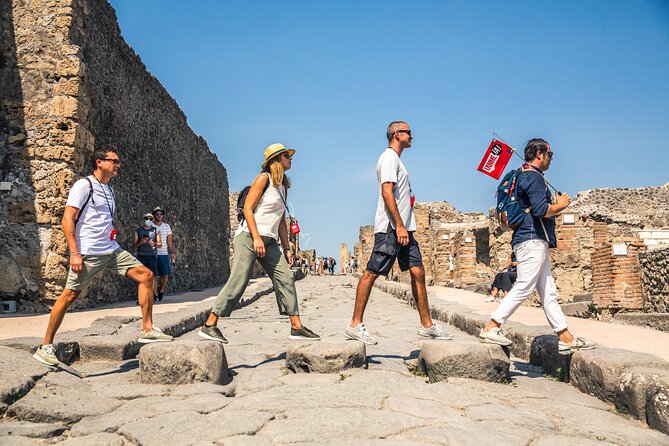
Ancient streets tell the story. This half-day trip from Sorrento makes Pompeii easier to handle, pairing air-conditioned transport with a guided walk through the city’s main ruins. I like the central meeting point in Piazza Torquato Tasso, and I like the early departure option, which can get you inside before the worst heat and crowds. The main caution is physical: Pompeii’s rough stones, slopes, and steps can be hard going.
The tour costs $90.70 per person and lasts about five hours, including the return ride. Skip-the-line entry saves useful time, but this is a brisk introduction rather than a full day at the enormous archaeological park. Guides such as Luisa, Lucio, Roberta, Patricia, and Nello have been praised for bringing the ruins to life, though one report found the local guide’s pace too fast.
In This Review
- Key points to know before booking
- Why this Pompeii tour works from Sorrento
- The coach from Sorrento and the morning advantage
- Entering Pompeii through the Civil Forum
- Temple of Jupiter and the Roman Capitolium
- Macellum, markets, and everyday commerce
- Via dell’Abbondanza and the Stabian Baths
- The Lupanar, Pompeii’s most famous brothel
- The House of the Faun and the city’s wealthy elite
- The Basilica and the Large Theater
- What the two-hour Pompeii walk really gives you
- Walking conditions and mobility concerns
- Is $90.70 a fair price?
- Who should book this Sorrento Pompeii tour?
- Final verdict: book it for an efficient first visit
- FAQ
- Where does the Pompeii tour depart from?
- Where does the tour end?
- How long does the experience last?
- Is Pompeii admission included?
- Does the tour include skip-the-line access?
- Is transportation included?
- Is the tour offered in English?
- How large can the group be?
- Is the tour suitable for people with mobility difficulties?
- Can I cancel for a full refund?
Key points to know before booking
- Early morning is the smart choice: The 7:30 a.m. departure can mean cooler conditions, thinner crowds, and an earlier entry into Pompeii.
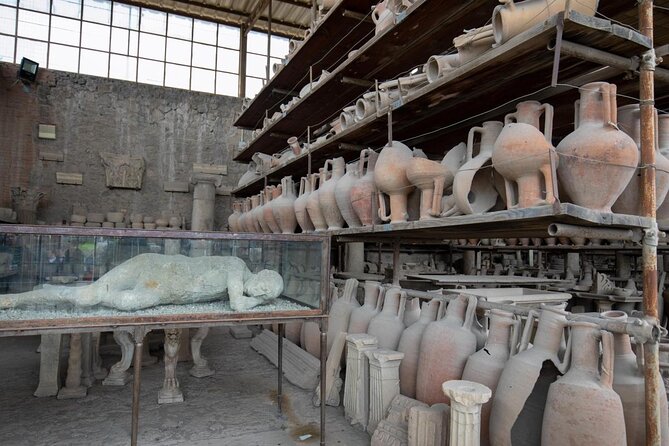
- You see the essential sights: The route includes the Forum, Temple of Jupiter, Macellum, Via dell’Abbondanza, baths, Lupanar, House of the Faun, Basilica, and Large Theater.
- The coach ride removes a headache: Round-trip transport from central Sorrento is included in a comfortable, air-conditioned vehicle.
- Guiding is the main value: A good guide explains what each building did, instead of leaving you with a field of broken walls and unanswered questions.
- The walking is demanding: Ancient paving stones, inclines, and steps require steady footing and enough stamina to keep up.
- You will not see everything: The guided portion lasts roughly 90 minutes to two hours, and free time to wander alone is not guaranteed.
Why this Pompeii tour works from Sorrento
Pompeii is close enough to Sorrento for a half-day visit, but getting there on your own can still involve transport planning, tickets, navigation, and figuring out where to begin. This outing takes care of the basic machinery. You meet at the IAMME IA! Gray Line Amalfi Coast office at Piazza Torquato Tasso 16, then ride by coach to the archaeological park and return to the same central area.
That arrangement is especially useful if you are staying in Sorrento and want to avoid piecing together trains, buses, or taxis. The pickup point is in the heart of town and near public transportation, so it is relatively simple to reach.
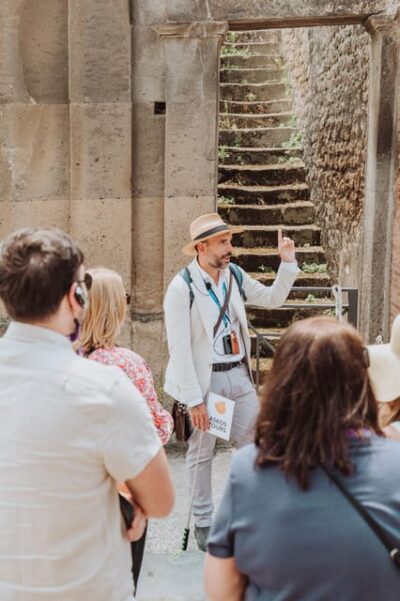
The tour is offered in English. The guide may be multilingual, and the group can reach 29 people. That is not an intimate private walk, but it is still a manageable size for a major site. For groups larger than 10, headphones are supplied inside Pompeii so you can hear the guide more clearly.
I particularly like the balance of transport and site time. You are not spending the entire day on a bus, yet you get enough time inside to understand the basic plan of the ancient city. The tradeoff is that Pompeii is vast. You will see important sections, but you will leave many streets, houses, and public buildings unexplored.
More Pompeii and Vesuvius trips:
- Sorrento: Skip-the-Line Pompeii Express Tour by Train
★ 4.8 · 2,038 reviews - Priority Access Pompeii & Mt. Vesuvius Full day from Sorrento
★ 4.5 · 1,376 reviews - Pompeii Express Guided Tour by Train from Sorrento
★ 4.5 · 770 reviews
The coach from Sorrento and the morning advantage
The air-conditioned coach is more than a minor comfort in Campania. Pompeii can be hot, and the ride from Sorrento is easier when you can sit back rather than worry about connections. The driving itself is handled for you, which is valuable on roads that can be busy and confusing.
The early tour has a clear advantage. A 7:30 a.m. start has been praised for getting groups into Pompeii before the site becomes crowded. By late morning, the same lanes can feel much warmer and more congested. If you have a choice between morning and afternoon, I would choose morning unless your schedule makes that impossible.
The tour allows time for a restroom stop and a snack around the beginning or end of the visit. Food and drinks are not included, so plan to buy or carry your own refreshments. Do not count on the archaeological walk as a relaxed lunch outing. It is a guided sightseeing block with a set return transfer.
Drivers and the Sorrento-based team have also earned praise for punctuality and friendly service. Nello has been singled out for an entertaining introduction, while drivers including Giuseppe, Rosario, and Vincenzo have been appreciated for smooth or capable driving. Names can change by departure, but the pattern is clear: the transport side is one of the tour’s dependable strengths.
Entering Pompeii through the Civil Forum
Once inside, the walk begins with the Archaeological Park of Pompeii, a city buried by ash and pumice during the eruption of Mount Vesuvius in 79 A.D. The preservation is what makes the place so powerful. You are not looking at a single monument isolated from daily life. You are walking through streets, homes, shops, public buildings, and religious spaces that once worked together as a living Roman city.
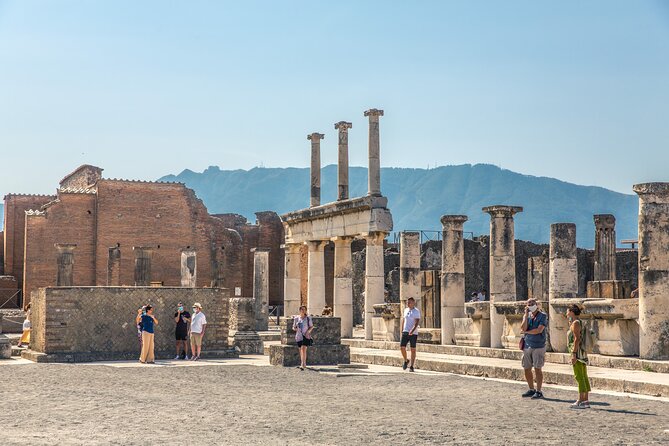
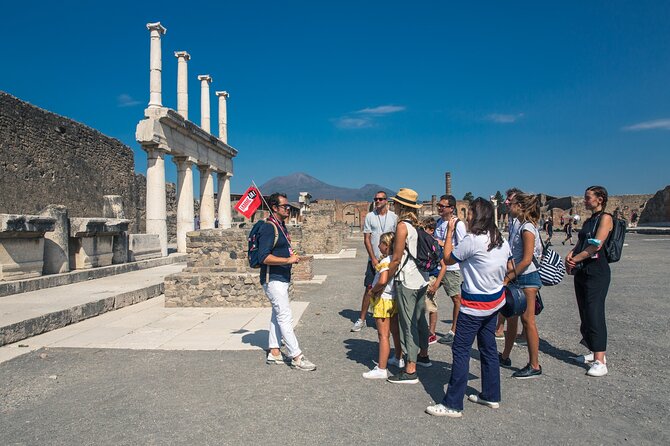
The Civil Forum is the natural place to understand that system. It was the center for administration, law, trade, markets, and public worship. A guide can help you read the open square as the city’s civic heart, rather than simply a broad area surrounded by columns.
The scale can be surprising. Pompeii is not a compact museum where every object fits neatly into one room. The Forum gives you a starting point and helps you see how public life was organized. It is also an excellent place to look toward Mount Vesuvius, whose presence adds a sobering edge to the visit.
Temple of Jupiter and the Roman Capitolium
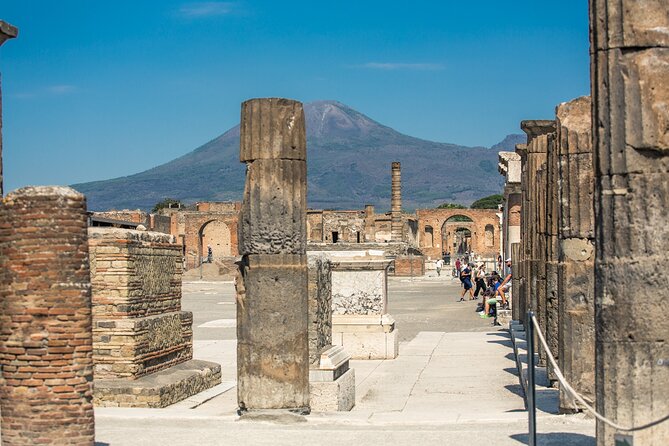
At the north end of the Forum, the Temple of Jupiter commands attention. Mount Vesuvius rises behind it, creating one of the site’s most memorable views. The building was radically remodeled after Pompeii became a Roman colony in 80 B.C.
The temple became a Capitolium, dedicated to Jupiter, Juno, and Minerva. Those three gods reflected the model of Rome’s Capitolium, and the statues were placed high enough to be seen across the Forum. That detail helps you understand the building’s public role. It was not just a place for private prayer. It announced Roman authority in the city’s main square.
This is one of the stops where a guide earns the admission price. Without context, you might notice a raised platform and scattered columns. With an explanation, the ruins reveal changes in government, religion, and identity.
A few more Sorrento bookings to compare
- Sorrento: Exclusive Capri Boat Tour and Optional Blue Grotto
★ 4.8 · 3,170 reviews - Sorrento Farm and Food Experience including Olive Oil, Limoncello, Wine tasting
★ 5.0 · 2,524 reviews - Capri Blue Grotto Small-Group Boat Day Tour From Sorrento
★ 4.5 · 2,511 reviews - From Sorrento/Nerano: Amalfi and Positano Boat Tour
★ 4.6 · 2,440 reviews
Macellum, markets, and everyday commerce
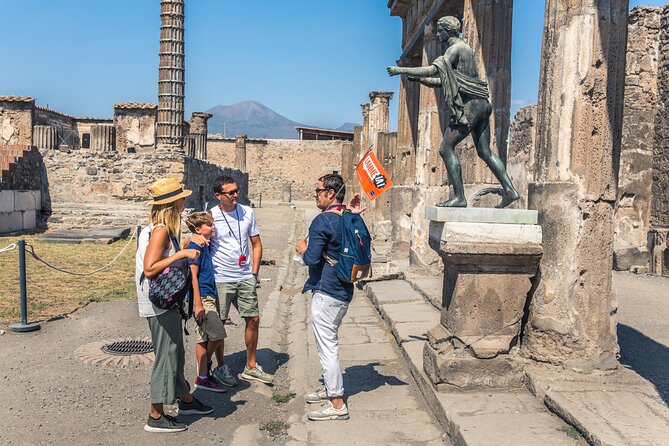
The Macellum was a market building with a quadriporticus, a worship hall, and rooms arranged around a central area. Copies of two marble statues appear in wall niches, along with a fragment of a larger statue connected to the imperial cult.
A large room on one side has a masonry counter that may have been used for selling fish. That small, practical clue is worth lingering over. Pompeii becomes more understandable when you connect grand temples with ordinary buying and selling.
The building also included a meeting room for a religious board. You get a glimpse of how commerce, worship, and public loyalty could occupy the same complex. It is the kind of place that can be easy to pass without a guide, especially when a group is moving through a busy archaeological site.
Via dell’Abbondanza and the Stabian Baths
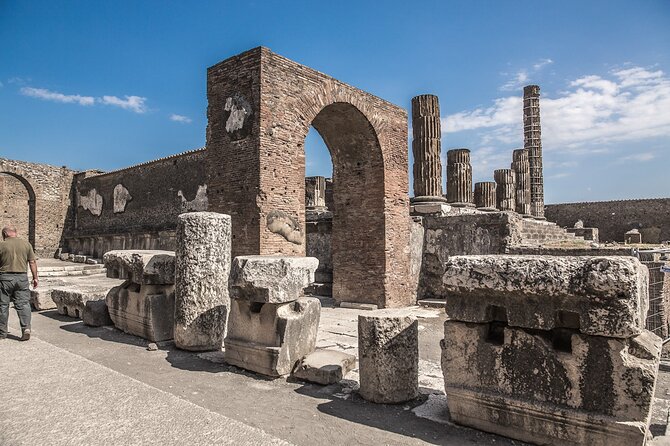
Via dell’Abbondanza was Pompeii’s main east-west street, running from the Forum toward Porta Sarno. In ancient times, it was lined with shops, workshops, cafes, snack bars, and places selling food and drink.
The street gives you a better feel for ordinary city life than a grand monument can. Look at the layout as you walk. This was a working commercial road, crowded and noisy, with people stopping to buy meals, conduct business, and use local services.
The tour then visits the Stabian Baths, also called the Terme Stabiane. These baths date to the years after the colony of veterans was founded by General Sulla in 80 B.C. Men’s and women’s areas had separate entrances, and the men’s section included spaces for changing, cold baths, warm baths, and hot baths.
The earthquake of 62 A.D. damaged the baths heavily, a reminder that Pompeii had already suffered a major disaster before the eruption. This stop is useful because it shows Roman engineering and social custom in a practical setting. You are seeing where people went to wash, socialize, and follow a daily routine.
The scheduled stops at Via dell’Abbondanza and the baths are short, around 10 minutes each. That keeps the route moving, but it also means you may want more time if you are fascinated by domestic details or ancient plumbing.
The Lupanar, Pompeii’s most famous brothel
The Lupanar is a small, purpose-built brothel on a narrow side street near the center of Pompeii. It had five small ground-floor rooms with masonry beds, plus erotic frescoes above the doors.
The images are often described as a visual menu of services. Graffiti left by people who used the building gives the site an unusually direct connection to the language and social life of ordinary Romans. The house was linked to Quintus Poppaeus Sabinus of the Poppei family, relatives of Poppea Sabina, Nero’s second wife.
This can be an awkward stop for families, though the tour has worked well for groups with children of different ages. Your guide sets the tone, and the site is approached as part of Pompeii’s social history rather than as a cheap spectacle.
Because the Lupanar is small and famous, it can become crowded. Stay close enough to hear the explanation, and do not expect a quiet, leisurely look inside.
The House of the Faun and the city’s wealthy elite
The House of the Faun occupies an entire city block and was one of Pompeii’s largest private residences. Its name comes from the bronze dancing faun found in the main atrium.
The house shows a different side of the city from Via dell’Abbondanza. Two peristyle gardens, elaborate mosaics, and a grand layout point to considerable wealth. The famous Alexander Mosaic depicts the battle between Alexander the Great and Darius III of Persia, linking Pompeii’s private homes to the wider Greek and Hellenistic world.
Even when original pieces are displayed elsewhere or protected, the setting still communicates the owner’s taste and status. This is a place where you should look down as well as up. Floors, garden layouts, and the relationship between rooms often tell as much as the walls.
The House of the Faun is also a good example of why a guided route is helpful. The site’s size can make it hard to know which details matter. A guide can point out the key features before the group moves on.
The Basilica and the Large Theater
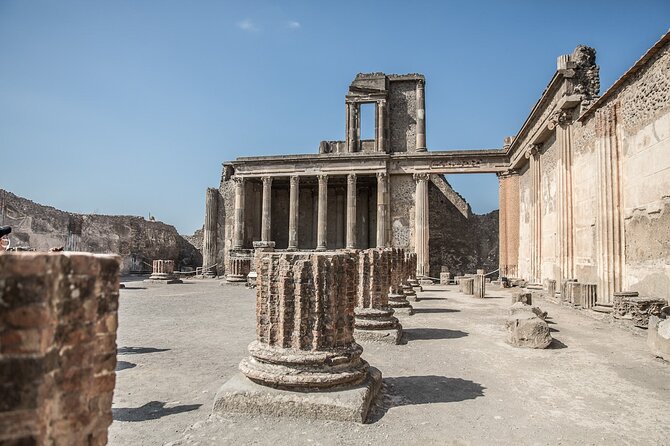
The Basilica was the Forum’s grandest building, covering about 1,500 square meters. It served business and the administration of justice. Its name may sound familiar because later Christian basilicas borrowed this architectural form, but in Pompeii it was a civic and legal building.
The stop gives you another look at public life. The Forum was not simply a religious plaza. It was also where money changed hands, disputes were handled, and official business took place.
The final major stop is the Large Theater. Roman builders used a natural depression on a hillside to create the auditorium, which was divided into five sections. Tragedies based on Greek and Roman traditions were performed on its stage.
The theater helps close the tour on a more entertaining note. Pompeii was not only a place of work, worship, and politics. It had performances and shared leisure, too. The surviving form of the auditorium makes it easier to imagine how an audience would have been arranged.
The theater stop is usually brief, around 10 minutes. You will have time to take photographs and hear the main explanation, but not enough to study every architectural feature.
What the two-hour Pompeii walk really gives you
The guided portion is often described as roughly 90 minutes to two hours, while the full experience lasts about five hours with transport. That distinction matters. You are not receiving a full-day archaeological study.
I see the limited time as both a strength and a weakness. It is a strength if you want a clear introduction without exhausting yourself or losing an entire day from Sorrento. The route covers the central civic zone, a major shopping street, baths, a brothel, a luxury house, a basilica, and a theater. That is a strong selection.
It is a weakness if you already know Pompeii well or want to explore at your own pace. One person found there was no free time to revisit buildings, browse the bookstore, or wander alone. The guide used the allotted time for continuous commentary, which is efficient but not very flexible.
The best approach is to treat the tour as an organized first look. You get the map in your head, learn what you are seeing, and avoid wasting time. If you want more, you can plan a longer return visit another day.
Walking conditions and mobility concerns
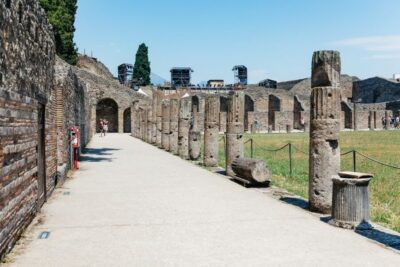
Pompeii is not an easy walk. Ancient paving stones are uneven, and the route includes inclines and steps. Some people have needed rest breaks, and guides have helped those who were moving more slowly. Still, the group needs to keep moving, and one report described a guide who continued ahead while people struggled to keep up.
The tour is not wheelchair accessible. The supplied information says most people can participate, but anyone with mobility concerns should take the terrain seriously. A stroller may be allowed, yet that does not make the stones comfortable or safe for every child.
I would choose this tour only if you can walk steadily over rough ground for the duration of the Pompeii visit. Wear sturdy shoes, leave room for pauses, and tell the guide early if you need a slower pace. If uneven surfaces are a serious problem, a museum-based alternative may suit you better.
Is $90.70 a fair price?
At $90.70, the tour is not the cheapest way to reach Pompeii. But the price includes round-trip transport from central Sorrento, an official Pompeii guide, admission, skip-the-line access, and headphones for larger groups.
That bundle has real value. You avoid buying separate transport and entrance tickets, and you do not have to work out a route through a huge site on your own. The guide is especially important here. Pompeii can look like a pile of walls if you do not know what you are seeing, while a good explanation turns a counter into a food shop, a platform into a temple, and a street into a place of daily trade.
The price is less attractive if you want long independent exploration. You are paying for structure and efficiency, not unlimited time. Group discounts may help reduce the cost for larger parties, and free cancellation is available when you cancel at least 24 hours before the start time.
Who should book this Sorrento Pompeii tour?
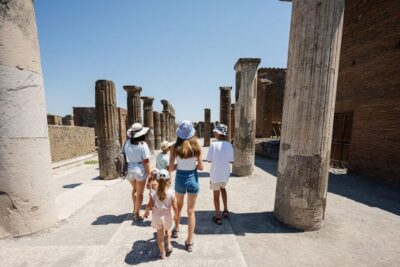
I would recommend it to first-time visitors staying in Sorrento who want the major Pompeii sights without spending the whole day managing transport. Families can also do well, especially when the guide uses stories and humor. Luisa, also called Lulu, has been praised for keeping children interested while helping the group avoid getting lost.
It suits people who value clear explanations and a planned route. It is also a good choice if you prefer an early start and want to beat some of the crowds and heat.
I would hesitate if you have limited mobility, dislike group pacing, or want to examine every house and mosaic. A maximum group size of 29 is reasonable, but it is still a group tour. You may need to stay close, listen through headphones, and accept that the guide decides the route and timing.
Final verdict: book it for an efficient first visit
Book this tour if you want Pompeii made simple from Sorrento. The coach is comfortable, the meeting point is central, the ticket is included, and skip-the-line access removes one common delay. The strongest guides, including Lulu, Lucio, Roberta, Patricia, and Nello, have made the ancient city engaging, clear, and even fun.
Go in knowing what you are buying: a well-organized, guided introduction to Pompeii, not a private archaeological expedition. Choose the morning departure, wear proper shoes, bring water and a snack, and be ready for uneven ground. For most first-time visitors with reasonable walking ability, $90.70 is a fair price for a focused and useful half-day.
FAQ
Where does the Pompeii tour depart from?
The tour departs from IAMME IA! Gray Line Amalfi Coast at Piazza Torquato Tasso 16 in Sorrento, Italy.
Where does the tour end?
The activity ends back at the same meeting point in Sorrento.
How long does the experience last?
The full experience lasts approximately five hours, including transportation between Sorrento and Pompeii.
Is Pompeii admission included?
Yes. Entry to the Pompeii Archaeological Site is included in the tour price.
Does the tour include skip-the-line access?
Yes. Skip-the-line admission is included, allowing the group to head inside without using the standard admission line.
Is transportation included?
Yes. The tour includes round-trip transportation in an air-conditioned vehicle from the central Sorrento meeting point.
Is the tour offered in English?
Yes. The experience is offered in English, though the guide may be multilingual.
How large can the group be?
The maximum group size is 29 people. Headphones are provided inside Pompeii for groups larger than 10.
Is the tour suitable for people with mobility difficulties?
The tour is not wheelchair accessible, and Pompeii has uneven ancient paving, inclines, and steps. You need enough mobility to walk over rough ground and keep up with the group.
Can I cancel for a full refund?
Yes. You can cancel at least 24 hours before the experience starts for a full refund. Changes or cancellations made less than 24 hours before the start time are not accepted for a refund.
Recently added around Sorrento
- Capri Boat Tour from Sorrento with Limoncello★ 5.0 · 170 reviews
- The Three Tenors in Sorrento★ 5.0 · 205 reviews
- Sorrento Farm by Tuk Tuk: Cheese, Limoncello & Hands-On Pizza★ 5.0 · 628 reviews
- Full-Day Amalfi Coast Experience from Sorrento, Naples or Salerno★ 5.0 · 1,275 reviews
- Private Sunset Boat Tour with Prosecco from Sorrento★ 5.0 · 176 reviews
- Capri Boat & Land Tour from Sorrento with Limoncello Tasting★ 4.5 · 250 reviews
- Full-Day Capri, Anacapri and Blue Grotto Tour from Sorrento★ 5.0 · 204 reviews
- Guided Day Tour of Pompeii and Herculaneum with Light Lunch★ 4.5 · 311 reviews
Pompeii & Vesuvius Tours, compared.
Entry Ticket and Guided Tour with an Archaeologist
Read our review →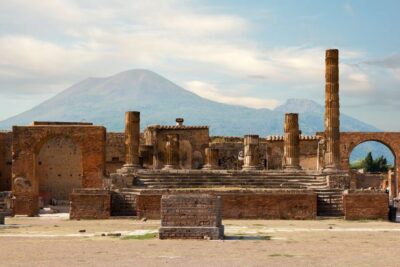


Pompeii Small Group Tour with an Archaeologist
Read our review →
Pompeii, Amalfi Coast and Positano Day Trip from Rome
Read our review →Browse the lists this tour appears in