Reviewed · TICKETS
Siena: Palazzo Pubblico Entry Ticket
Frescoes do the talking here. Siena’s Palazzo Pubblico packs remarkable art into a short, easy visit, and I especially like the Maestà by Simone Martini and the open view from the Loggia dei Nove. At just $7, it is one of Siena’s better-value cultural stops. The main drawback is important: Ambrogio Lorenzetti’s famous Allegory and Effects of Good and Bad Government may be closed for restoration.
I also like that the visit lets you move at your own pace instead of tying you to a guide or audio device. Bring your passport or ID, exchange your voucher inside the Cortile del Podestà, and allow about an hour. The ticket does not include Torre del Mangia, so check your booking carefully if climbing the tower is part of your plan.
In This Review
- Key points to know before entering
- Why Palazzo Pubblico matters in Siena
- Finding the ticket office in the inner courtyard
- The Sala del Risorgimento and Siena’s modern national story
- Spinello Aretino in the Sala di Balìa
- Carved coffers and reliquaries in the Sala dei Cardinali
- Beccafumi’s vault and Taddeo di Bartolo’s chapel
- The Sala del Mappamondo and Simone Martini’s Maestà
- The missing Lorenzetti frescoes and what to expect
- The Loggia dei Nove and the countryside view
- Is one hour enough for the museum?
- How the $7 ticket measures up
- Accessibility and practical limits
- Who should book the Palazzo Pubblico?
- FAQ
- How long does the Palazzo Pubblico visit take?
- What is included in the ticket?
- Is Torre del Mangia included?
- Where do I exchange my voucher?
- What should I bring?
- Are large bags and pets allowed?
- Is the museum wheelchair accessible?
Key points to know before entering
- Simone Martini’s Maestà is the star: See one of Gothic Italy’s most important paintings in the Sala del Mappamondo.
- The frescoed rooms are the real collection: The building itself is as important as the objects displayed inside it.
- Lorenzetti’s government frescoes may be unavailable: Restoration work can change what is open to view.
- The Loggia dei Nove is included: You get a lovely look across the Sienese countryside without buying a separate ticket.
- The $7 price is strong value: This is an affordable way to see Siena’s civic center and major medieval art.
- The tower costs extra: Torre del Mangia is not part of this entry ticket, though you can ask about buying access at the ticket office.
Why Palazzo Pubblico matters in Siena
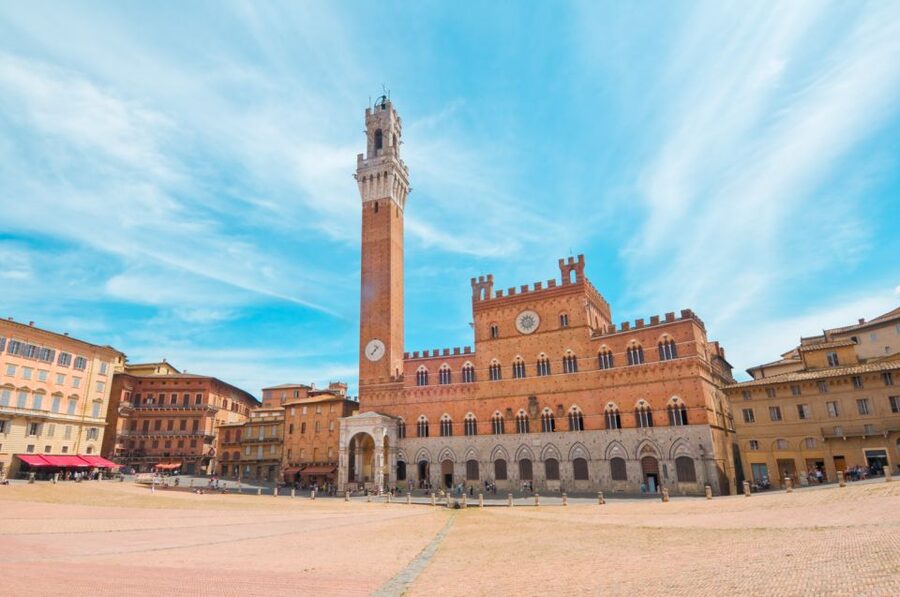
The Palazzo Pubblico is not simply an old government building with paintings on the walls. It was built in the 13th century as the working center of Siena’s public life, and the rooms were designed to show how the city wanted government to function.
That makes the Civic Museum different from a standard art gallery. You are not walking through neutral white rooms. You are seeing paintings in the halls where councils met, officials worked, and civic decisions were made.
I find that setting helps explain the art. Siena’s medieval rulers used pictures to express religious faith, public duty, justice, and the rewards of good leadership. Even if you know little about Sienese history, the wall-to-wall decoration makes the message clear: these rooms were meant to impress.
The visit lasts about one hour, which is enough time to see the main rooms without turning the stop into an all-day museum session. Art lovers may want longer, especially if Lorenzetti’s frescoes are open, but most people can fit this visit neatly between other sights on Piazza del Campo.
A few more Italy bookings to compare
- Vatican: Museums & Sistine Chapel Entrance Ticket
★ 4.5 · 144,003 reviews - Milan: Cathedral and Duomo’s Terraces Entrance Ticket
★ 4.6 · 61,054 reviews - Venice: Doge’s Palace Reserved Entry Ticket
★ 4.6 · 42,716 reviews
Finding the ticket office in the inner courtyard
The entrance detail is easy to miss. Do not stop at the exterior wall along Via di Salicotto if your map sends you there. Go inside the Cortile del Podestà, where you will find the ticket office.
You need to exchange your voucher for an entry ticket before entering the museum. Arrive at least 10 minutes before your booked time, and keep your passport or ID card with you. The process is generally straightforward, but the courtyard instruction matters because the Palazzo’s exterior can make the ticket office seem as if it belongs to another building.
If you are coming from Siena’s train station, a useful local tip is to look for the escalators leading from the shopping area across from the station into Siena. They can save you a long uphill walk. Once you reach the historic center, the Palazzo Pubblico is in the city’s main square, Piazza del Campo.
Large bags and luggage are not allowed. Assistance dogs are permitted, but other pets are not. Flash photography is also prohibited, which helps protect the paintings and keeps the rooms calmer.
The Sala del Risorgimento and Siena’s modern national story
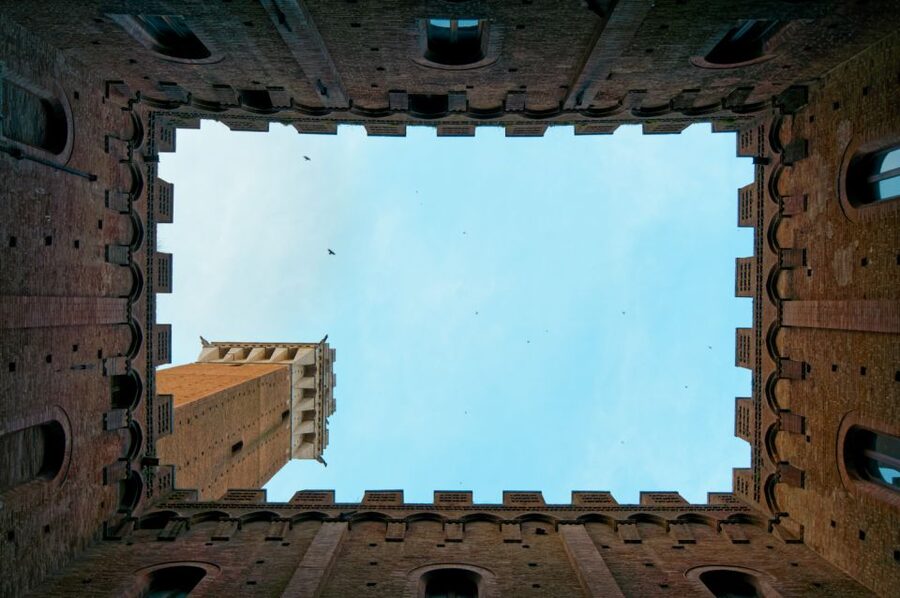
Your route begins in the Sala del Risorgimento. Its frescoes depict the life of Vittorio Emanuele II, the first king of Italy.
This room provides a change of period from the medieval art found elsewhere in the palace. The subject is the Risorgimento, the 19th-century movement that led to Italian unification, so you get a brief look at how Siena connected its older civic identity with the newly unified country.
The room is worth seeing even if your main interest is medieval painting. It gives the museum a wider timeline and shows that the Palazzo Pubblico continued to carry political meaning long after the Middle Ages.
Spinello Aretino in the Sala di Balìa
Next comes the Sala di Balìa, decorated with 15th-century wall paintings by Spinello Aretino and Martino di Bartolomeo.
The paintings are part of the pleasure here. They are not isolated panels hung at eye level. They cover the walls and make you look around, above, and across the room. Details can be easy to miss at first, so I recommend slowing down for a moment before moving on.
This is also where the palace begins to feel like a series of connected civic statements. Each room has its own subject and visual style, yet the route keeps returning to Siena’s ideas about authority, faith, and public responsibility.
Still Italy, but a slower afternoon:
- Vatican Museums & Sistine Chapel Tour with Optional Basilica
★ 4.3 · 67,413 reviews - Colosseum, Roman Forum & Palatine Guided Tour
★ 4.7 · 63,148 reviews - Vatican Museums, Sistine Chapel & St Peter’s Basilica Guided Tour
★ 4.5 · 39,149 reviews - Rome: Colosseum, Palatine Hill and Roman Forum Guided Tour
★ 4.8 · 32,814 reviews
Carved coffers and reliquaries in the Sala dei Cardinali
The Sala dei Cardinali shifts attention from large fresco cycles to precious objects and architectural details. Look for the carved coffers that hold reliquaries.
This room is useful for anyone who wants more than paintings. The objects show the importance of craftsmanship in Siena’s religious and civic life, while the decorated ceiling and surrounding architecture remind you that even practical storage was given visual care.
You may find this room quieter in feeling than the larger frescoed halls. It is a good place to focus on materials and small details before reaching the museum’s most famous paintings.
Beccafumi’s vault and Taddeo di Bartolo’s chapel
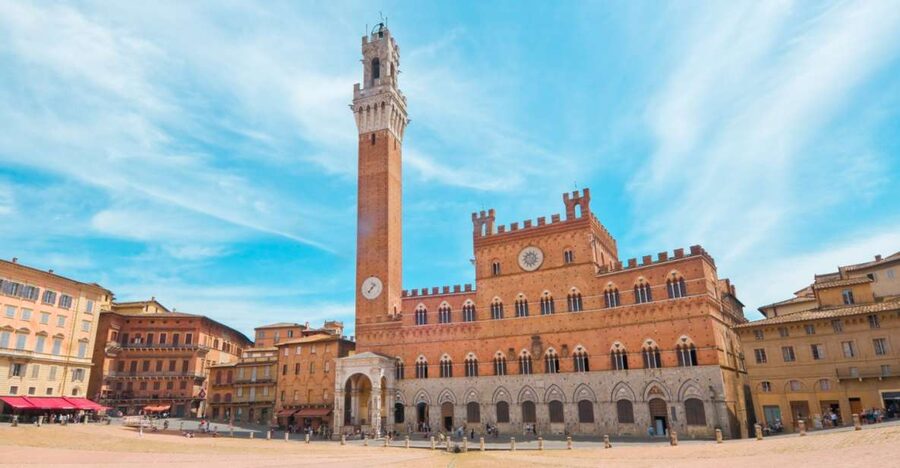
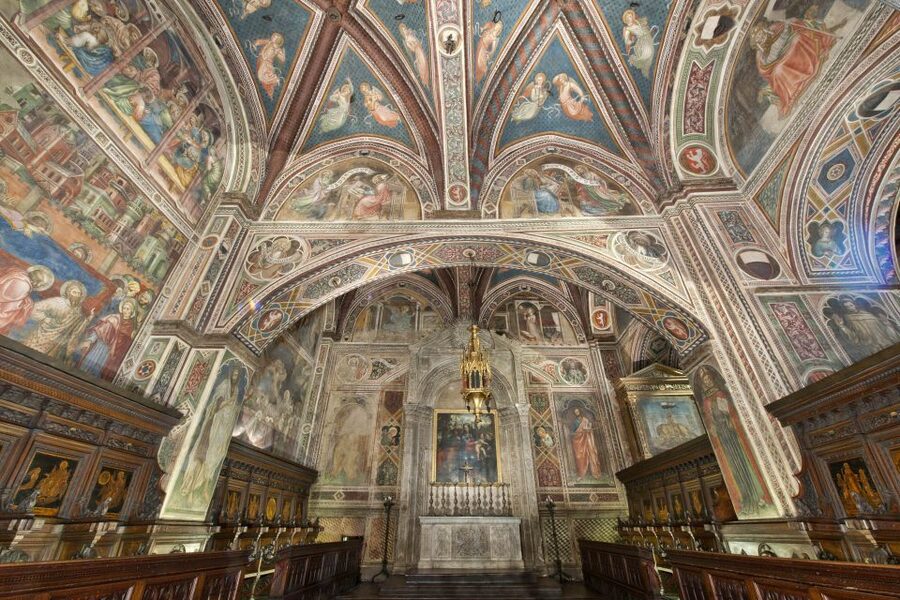
The Sala del Concistoro is known for its Beccafumi vault. Look upward before concentrating on the walls, because the ceiling is a major part of the room’s appeal.
The route also includes Taddeo di Bartolo’s 15th-century Cappella. The chapel adds a more intimate setting to the visit, with religious art presented in a space built for worship rather than council meetings.
Together, these rooms show the range of the palace. You move from national history to medieval wall paintings, carved objects, a decorated civic vault, and a chapel. The experience works best if you treat the building as one connected work of art rather than rushing toward a single famous picture.
The Sala del Mappamondo and Simone Martini’s Maestà
The Sala del Mappamondo is the widest room in the Palazzo Pubblico. It once served as the meeting place of the General Council, so its size reflects the importance of public government in medieval Siena.
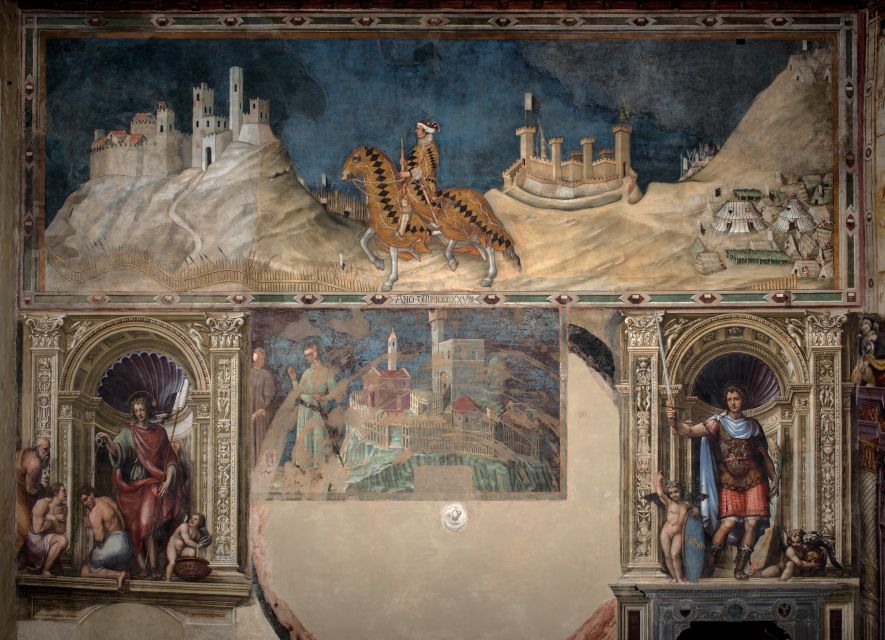
Here you will see Simone Martini’s Maestà, a Gothic masterpiece and one of the museum’s major highlights. The painting presents the Virgin Mary in a formal, richly detailed setting, surrounded by saints and angels. Its elegance is easy to appreciate even if you are not an art specialist.
Give the Maestà more than a quick glance. Look at the fine decorative patterns, the arrangement of the figures, and the careful treatment of fabric and ornament. The painting rewards close attention because its impact comes from both the overall composition and its small details.
The Sala del Mappamondo is also valuable because the painting remains in the kind of civic setting that gives it meaning. This was not originally a picture made only for private pleasure. It was part of a public environment, where religious belief and government authority appeared side by side.
The missing Lorenzetti frescoes and what to expect
The most important caution concerns Ambrogio Lorenzetti’s Allegory and Effects of Good and Bad Government. This celebrated series is one of Siena’s great artistic treasures, and many people come specifically to see it after reading about its political ideas or studying its imagery.
Restoration work can mean that the frescoes are not currently on display. That can be disappointing, particularly if this is the reason you chose the museum. Conditions may change, so I would check the current status before your visit if Lorenzetti is essential to your plans.
Even without that cycle, the Palazzo Pubblico remains worthwhile. Simone Martini’s Maestà, the other frescoed rooms, the chapel, the carved coffers, and the palace architecture give you plenty to see. Just set your expectations correctly: the museum can be excellent without offering every famous room on every date.
The Loggia dei Nove and the countryside view
The ticket includes access to the 14th-century Loggia dei Nove. This is one of the best parts of the visit for anyone who wants a break from enclosed rooms.
From the loggia, you can look beyond the Palazzo Pubblico toward the Sienese countryside. The view gives useful context to the city’s position and offers a visual pause after the intense decoration indoors.
Some people refer to this as a terrace or a top-level viewpoint, so pay attention to the route rather than assuming the museum ends after the frescoed rooms. The panoramic view is not a substitute for Torre del Mangia, but it is a pleasant bonus included with the museum ticket.
If you are deciding between the Civic Museum and the tower, know that they are separate experiences. The tower ticket is not included here, though you can ask at the ticket office about purchasing access directly.
Is one hour enough for the museum?
For a first visit, yes. One hour gives you time to follow the main route, pause at the Maestà, notice the painted ceilings, and step out to the Loggia dei Nove.
You may need more time if you are studying art closely or if Lorenzetti’s cycle is open. The museum’s rooms are not endless, but they are visually dense. Wall-to-wall frescoes can take longer to read than a collection of individual objects.
I would plan the museum as part of a larger visit to Piazza del Campo rather than as a full morning on its own. The compact duration is a strength for a busy Siena day, especially if you want to combine art, food, and time in the square.
How the $7 ticket measures up
At $7 per person, this is a strong buy. You get access to a major medieval civic building, several decorated rooms, Simone Martini’s Maestà, historic artifacts, and the Loggia dei Nove.
The value becomes even better if you are interested in Siena’s art or political story. You are seeing important works in their original public setting, not just checking off a small gallery. The low price also makes the museum a sensible choice for families or anyone building a full day around modest admission costs.
The ticket is less satisfying if you mainly want Torre del Mangia or Lorenzetti’s Allegory and Effects of Good and Bad Government. In that case, confirm exactly what is open and remember that the tower requires a separate ticket.
Accessibility and practical limits
The museum is wheelchair accessible. The elevator door is 69 centimeters wide, and the elevator is 83 centimeters deep, so check those measurements against your chair or mobility device before booking.
Access can be suspended during extraordinary events, and opening hours may change. The scheduled entry time is therefore useful, but it is not a promise that every room will be available in every circumstance.
There is no guided tour and no audio guide included. That suits you if you prefer to set your own pace, but you may want to read a little about Siena’s civic art before arriving. A small amount of preparation will help you understand why the paintings focus so strongly on government, justice, religion, and communal life.
The activity uses a small group format limited to 10 participants, though the museum visit itself is primarily an independent entry experience rather than a guided walk.
Who should book the Palazzo Pubblico?
I recommend this ticket for first-time visitors to Siena, art lovers, history fans, and anyone who wants a rewarding indoor stop in the center of town. It is also a good choice if you have only an hour and want something more substantial than a quick look around the square.
You should book with some caution if your entire plan depends on seeing Lorenzetti’s frescoes. Restoration can change the route, and the available rooms may be more limited than the size of the building suggests.
For the clearest plan, check three things before paying: the current opening hours, whether the Allegory and Effects of Good and Bad Government is on view, and whether you also want a separate Torre del Mangia ticket. If those details suit your schedule, the $7 admission gives you a fine look at Siena’s art, politics, and setting in one compact visit.
FAQ
How long does the Palazzo Pubblico visit take?
The stated duration is one hour. You can spend longer if you want to study the frescoes and objects in detail.
What is included in the ticket?
The ticket includes entrance to Siena’s Civic Museum inside the Palazzo Pubblico and access to the Loggia dei Nove.
Is Torre del Mangia included?
No. Access to Torre del Mangia is not included, but tickets may be purchased directly at the ticket office.
Where do I exchange my voucher?
Enter the Cortile del Podestà and go to the ticket office there to exchange your voucher for an entry ticket.
What should I bring?
Bring your passport or ID card. Arrive at the ticket office 10 minutes before your booked time.
Are large bags and pets allowed?
Luggage and large bags are not allowed. Pets are also not permitted, except for assistance dogs.
Is the museum wheelchair accessible?
Yes. The museum is wheelchair accessible. The elevator door is 69 centimeters wide, and the elevator is 83 centimeters deep.
Recently added around Italy
- Florence Uffizi Gallery monolingual Small Group Tour★ 4.0 · 621 reviews
- Florence Private Walking tour with Skip-the-line to Accademia★ 4.5 · 236 reviews
- Uffizi Gallery Entrance Ticket with Priority Access★ 3.5 · 1,029 reviews
- Florence Skip-the-Line Duomo Tour with Guide & Brunelleschi Dome★ 5.0 · 1,176 reviews
- Skip-the-Line Accademia Guided Visit: David Secrets and Beyond★ 4.0 · 525 reviews
- Priority Entrance : Florence Accademia Gallery Timely Tickets★ 4.0 · 603 reviews
- Skip the line : David Guided Experience★ 4.5 · 1,076 reviews
- Private Tour in Siena, San Gimignano and Chianti Day Trip from Florence★ 5.0 · 405 reviews
Tickets, compared.
Cathedral and Duomo’s Terraces Entrance Ticket
Read our review →
Skip-The-Line Uffizi Gallery Timed Entry Ticket
Read our review →
Naples Underground Entry Ticket and Guided Tour
Read our review →
Pantheon Fast-Track Ticket and Official Audio Guide
Read our review →
Entry Ticket and Guided Tour with an Archaeologist
Read our review →