Reviewed · GUIDED
Rome: Trevi Fountain District and Underground Domus Guided Tour
Rome keeps some of its best stories below street level. This short tour pairs the famous Trevi Fountain with Vicus Caprarius, a small archaeological site hidden about 30 feet beneath the modern city. I like the unusual setting and the clear focus on Roman water engineering. I also like the small-group format, capped at 15 people, which gives the guide room to answer questions.
The main caution is size. The underground site is compact, with only a few rooms and levels, not a maze of tunnels. At $53.10 per person for about 55 minutes, the price makes the most sense if you want a guided explanation and a more focused visit, not simply a quick look at the ruins.
In This Review
- Key points to know before booking
- Why this short tour is different from a standard Trevi Fountain stop
- Meeting at Vicolo del Puttarello 25
- Going nine meters below Rome
- The cistern connected to the Vergine aqueduct
- Roman rooms, marble, coins, and amphorae
- The Trevi Fountain stop
- What the guides add to the experience
- Is $53.10 per person fair?
- Timing, comfort, and practical limits
- Who will enjoy this tour most?
- Should you book the Vicus Caprarius and Trevi tour?
- FAQ
- Where does the tour begin?
- How long does the tour last?
- Is Trevi Fountain the main focus of the tour?
- What can I see underground?
- Is the tour offered in English?
- How many people can join the tour?
- Can people with mobility impairments take this tour?
- What is included in the price?
Key points to know before booking

- A cinema basement revealed ancient Rome: Vicus Caprarius was found in 1999 beneath a cinema near the Trevi Fountain.
- The tour is really about water: You will see a tank linked to the Vergine aqueduct and learn how Roman water systems worked.
- The archaeological site is small: Expect a compact underground visit, not a large network of passages.
- The best guides bring the site to life: Erika, Michelle, Noemi, and Neomi received especially warm praise for their energy and clear explanations.
- Trevi Fountain is part of the experience, not the main tour: You get time to see the fountain and take photos, but this is not a full walking tour of the district.
- Plan for stairs and limited mobility: The site is not suitable for people with mobility impairments.
Why this short tour is different from a standard Trevi Fountain stop
Most people reach Trevi Fountain, squeeze into the crowd, take a few photographs, and move on. This experience gives you a second way to understand the area. Instead of looking only at the Baroque fountain above ground, you go below the pavement to see the older water system and buildings that shaped this part of Rome.
That contrast is the tour’s best idea. At street level, Trevi is grand, noisy, and crowded. Below it, the focus shifts to masonry, water channels, tanks, pottery, coins, and fragments of Roman decoration. The connection between the two levels helps explain why this part of the city became known as the City of Water.
The tour lasts roughly 55 minutes. That makes it easy to fit between other central Rome sights, especially if you are already visiting the Pantheon, Spanish Steps, or Trevi Fountain. You will not spend half a day underground, and that is either a strength or a weakness depending on your expectations.
I see it as a short specialist visit. It works best when you want one unusual archaeological stop rather than another large museum or major monument.
A few more Rome bookings to compare
- Vatican: Museums & Sistine Chapel Entrance Ticket
★ 4.5 · 144,003 reviews - Vatican Museums & Sistine Chapel Tour with Optional Basilica
★ 4.3 · 67,413 reviews - Colosseum, Roman Forum & Palatine Guided Tour
★ 4.7 · 63,148 reviews
Meeting at Vicolo del Puttarello 25
You meet directly at Vicolo del Puttarello 25, at the entrance to Vicus Caprarius, just a few steps from Trevi Fountain. There is no hotel pickup, so you need to make your own way there. The site is near public transportation, but the narrow central streets around Trevi can be confusing, so give yourself time to find the exact address.
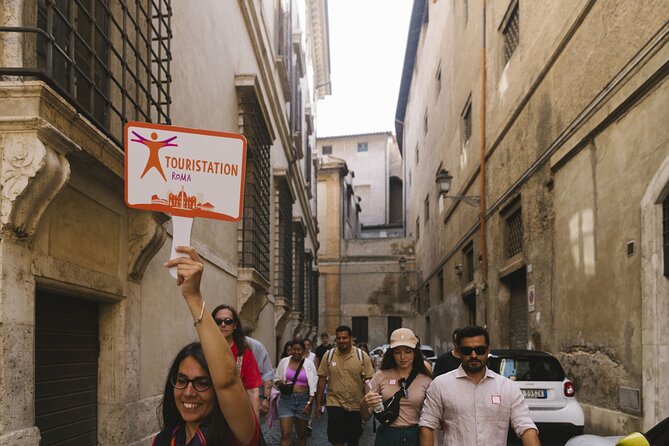
At the entrance, Touristation staff assist with ticket redemption and reserved entry. The reserved ticket matters most when the area is crowded. You are not wandering in alone and hoping to find your way through the rooms. The guide leads the group and explains what you are seeing as you move through the archaeological remains.
The group can include up to 15 people. That is not a private tour, but it is small enough to feel more personal than a large city walk. A good guide can keep the group together, respond to questions, and point out details that are easy to miss on a self-guided visit.
Going nine meters below Rome
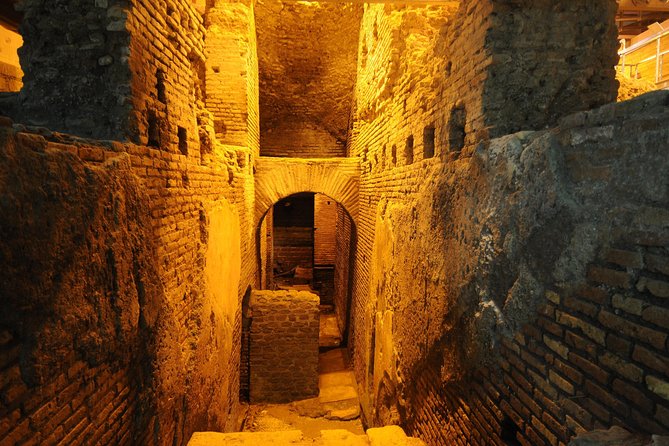
The descent takes you about nine meters below the present street level. That change in height is not just a dramatic entrance. It reveals one of Rome’s central facts: the modern city sits on top of centuries of rebuilding.
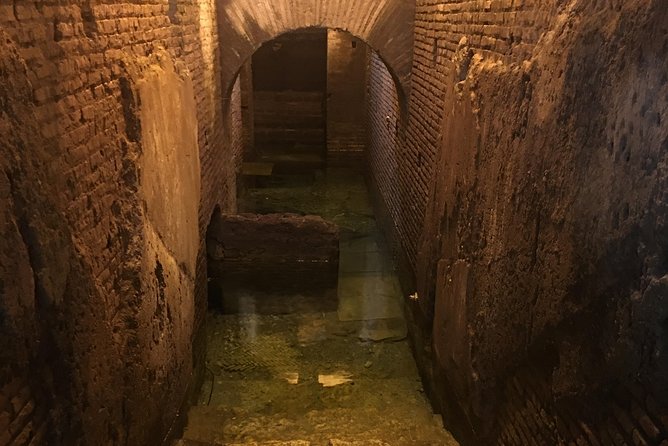
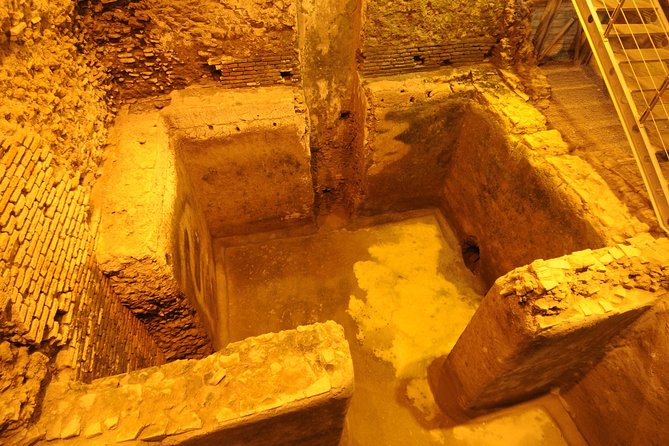
The site was discovered in 1999 in the basement of a cinema. That detail gives the visit a pleasing sense of surprise. An ordinary modern building was sitting above Roman remains, including part of a villa and an ancient cistern. Rome is full of such layers, but you do not always get to see them in a compact, accessible way.
The underground rooms are not huge. Several people found the space smaller than expected, describing it as essentially one compact area with two levels. You should picture a focused archaeological excavation, not an underground city that stretches for blocks.
That limitation is worth knowing before you pay. If you enjoy close looks at a small site and careful explanation, the scale works well. If you want long passageways, many chambers, or a major subterranean complex, this may feel brief.
The cistern connected to the Vergine aqueduct
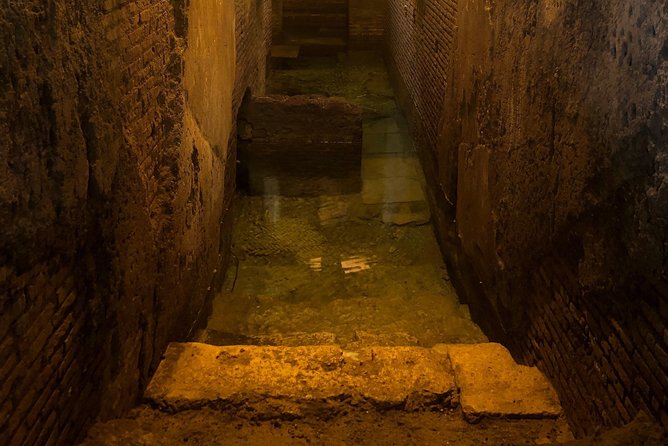
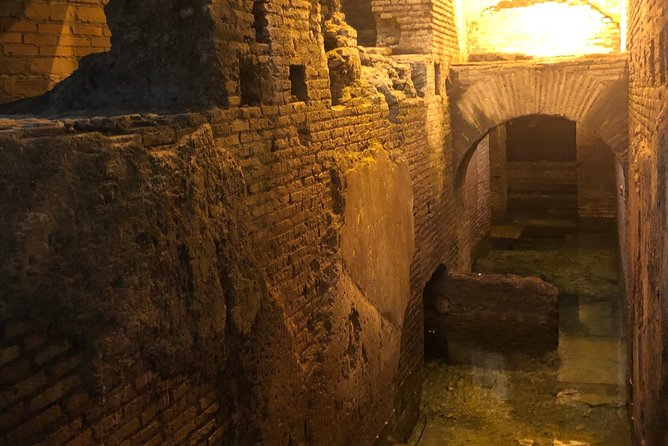
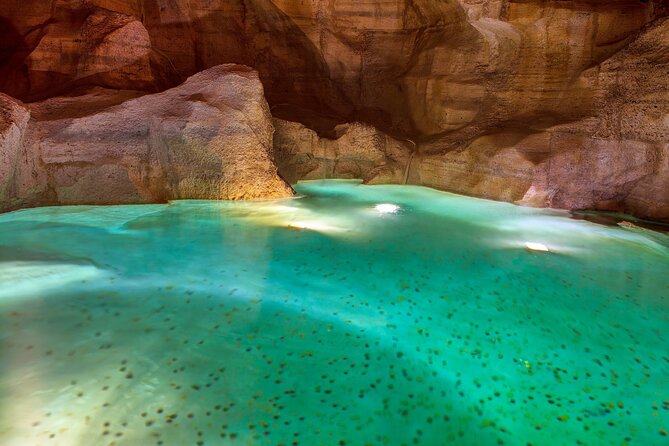
Water is the heart of the visit. Inside Vicus Caprarius, you can see a water tank connected to the Vergine aqueduct, the ancient system associated with the water that still feeds the Trevi area.
Your guide explains how Roman builders managed water thousands of years ago. The point is not only that the Romans built aqueducts. It is that water shaped daily life, public fountains, sanitation, wealth, and the growth of the city.
This is where a good guide makes a real difference. The remains are not always self-explanatory. A wall, tank, or channel can look like a pile of old stone until someone explains its purpose and places it within the wider water network.
The strongest comments about the tour focus on this subject. People found the explanation of the water system educational and were surprised by how advanced the engineering was. If you are curious about how Rome’s fountains receive their water, this tour gives the Trevi Fountain a useful backstory.
Still Rome, but a slower afternoon:
- Vatican Museums, Sistine Chapel & St Peter’s Basilica Guided Tour
★ 4.5 · 39,149 reviews - Rome: Colosseum, Palatine Hill and Roman Forum Guided Tour
★ 4.8 · 32,814 reviews - Rome: Guided Tour of Colosseum, Roman Forum & Palatine Hill
★ 4.7 · 27,897 reviews - Rome: Colosseum & Forum with Audio Guide App -Optional Arena
★ 4.2 · 24,770 reviews
Roman rooms, marble, coins, and amphorae
The archaeological collection adds human detail to the engineering story. You may see precious polychrome marble coverings, which point to the decoration and status of the Roman building. These fragments help you picture rooms that were more carefully finished than the plain underground walls might suggest.
One of the better-known finds is the head of Alessandro Helios. The site also contains a collection of 800 coins, a remarkable group that adds clues about trade, occupation, and the people who used the area.
Another distinctive item is the spatheia, African amphorae designed to transport oil. These vessels connect the site to the wider Roman world. Even in a small underground room near Trevi, you are looking at evidence of shipping, commerce, food storage, and long-distance supply.
I like this part of the tour because it keeps the history concrete. You are not hearing only dates and emperors. You are seeing the objects that moved through Roman life, from decorative marble to oil containers and coins.
The site also includes remains of a Roman villa. The guide explains how the building and water structures changed over time. The layered arrangement is the real subject: modern Rome above, later construction beneath it, and Roman remains below that.
The Trevi Fountain stop
After the underground visit, the tour includes time at Trevi Fountain. The fountain is free to see in the open city, but the experience gives you a chance to connect the monument with the water system you have just studied.
You can take photographs and, if you wish, throw a coin into the fountain. The familiar legend says that a coin ensures your return to Rome. The tour also includes information about the Fountain of Love legend, a smaller local detail that can add a bit of fun to the stop.
Keep your expectations in check. This is not a full guided tour of the Trevi district, and it does not promise a long explanation of every nearby street or building. Some people booked it expecting an extensive Trevi Fountain walk and felt disappointed when most of the detailed commentary focused on the underground site.
Trevi itself can also be difficult for a group. Crowds may make it hard to hear the guide or find a clear place for photographs. The fountain is still worth seeing, but the underground portion is the main reason to book this particular experience.
What the guides add to the experience
The guide can make or break a small archaeological visit. The most warmly praised guides include Erika, Michelle, Noemi, and Neomi. Erika was especially appreciated for combining strong historical explanations with humor and an easy, friendly manner.
Michelle received praise for being detailed, energetic, and careful with her explanations. Noemi was singled out for making the ancient water system easy to understand. Neomi was also praised for her passion and enthusiasm during a late October visit.
These comments point to a useful pattern. The site itself is compact, so the value comes from interpretation. A guide who tells a clear story can turn one cistern, a few walls, and a collection of objects into a worthwhile hour. A guide who gives only basic facts may leave you feeling that you could have seen the same thing alone.
The tour is offered in English. Since guide assignments can change, you cannot assume you will receive a particular person. Still, the repeated praise for the guiding team is a positive sign, especially for visitors who want history explained rather than simply pointed out.
Is $53.10 per person fair?
At $53.10 per person, this is not the cheapest way to enter Vicus Caprarius. Some people felt the guided price was high compared with the much lower cost of a self-guided entry ticket, which was described as about 4 euros per person.
That comparison is fair. The physical site is small, and you can see much of it without spending a long time there. If you already know Roman archaeology, read display panels carefully, and prefer exploring alone, the guided option may not feel like good value.
The tour becomes more worthwhile when you value the guide’s time and the reserved entry. You are paying for the explanation of the aqueduct, the history of the excavation, the meaning of the artifacts, and the connection to Trevi Fountain. You are also buying a fixed appointment and a small group rather than trying to arrange the visit on your own.
I would judge the price by your interest level. For a first-time Rome visitor trying to cover every major sight, the cost may be hard to justify for less than an hour. For someone on a repeat visit, or anyone who enjoys Rome’s lesser-known archaeological layers, it offers a fresh angle on a place you may already have seen.
The included Italian gelato is a pleasant extra, but it should not drive your booking decision. The water history and underground remains are the real product.
Timing, comfort, and practical limits
The short duration is useful. You can place the tour into a busy day without giving up a major block of time. It also offers a break from the heat and noise at street level, especially during warmer months.
You should be comfortable with stairs and an underground setting. The tour is not suitable for people with mobility impairments, so check your own needs carefully before booking. The provided details do not promise special access arrangements.
Wear practical shoes. The tour involves moving through an archaeological site below street level, where surfaces and passageways may not feel like a modern museum. The exact conditions are not described in detail, so it is sensible to choose footwear that gives you steady footing.
The meeting point is close to Trevi Fountain, but do not confuse the fountain itself with the ticket redemption point. Report to Vicolo del Puttarello 25 first. The experience is offered in English, and confirmation is provided when you book.
Free cancellation is available if you cancel at least 24 hours before the start time. Changes or cancellations inside that period are not accepted for a refund. The tour also requires a minimum number of participants, and if that minimum is not met, you are offered another date or experience, or a full refund.
Who will enjoy this tour most?
I would recommend it to:
- Repeat visitors to Rome who have already seen the major sights
- People interested in Roman engineering, aqueducts, and urban archaeology
- Families who want a short history stop with unusual artifacts
- Visitors who prefer small groups to large walking tours
- Anyone curious about what lies beneath Rome’s modern streets
- People who want a guided explanation rather than a quick self-guided visit
I would be more cautious about recommending it to someone expecting a large underground complex. The rooms are compact, and the visit can feel short. I would also hesitate if your only goal is to see Trevi Fountain, since you can visit the fountain without booking a tour.
Should you book the Vicus Caprarius and Trevi tour?
Book it if you want the story below Trevi Fountain, not just another photograph of the fountain. The chance to see an ancient cistern, Roman villa remains, marble decoration, coins, and African oil amphorae in one small site is unusual. The water connection also gives you a better understanding of why Trevi became such an important part of Rome.
Skip it if you want extensive tunnels or a full walking tour of the Trevi neighborhood. At $53.10, the price asks you to value the guide and the interpretation. If that sounds worthwhile, this is a concise and distinctive addition to a Rome itinerary. If you prefer to inspect a small excavation at your own pace, a cheaper self-guided visit may suit you better.
FAQ
Where does the tour begin?
The tour begins at Vicus Caprarius, Vicolo del Puttarello 25, 00187 Roma RM, Italy. You should report to this address to meet the guide and redeem your ticket.
How long does the tour last?
The experience lasts approximately 55 minutes. About 45 minutes is allocated to Vicus Caprarius, followed by roughly 10 minutes at Trevi Fountain.
Is Trevi Fountain the main focus of the tour?
No. Trevi Fountain is included as a short stop after the underground archaeological visit. The detailed guided portion focuses on Vicus Caprarius, the Roman remains, and the water system.
What can I see underground?
You can see remains of a Roman villa, an ancient cistern connected to the Vergine aqueduct, polychrome marble coverings, the head of Alessandro Helios, a collection of 800 coins, and spatheia amphorae used to transport oil.
Is the tour offered in English?
Yes. The tour is offered in English.
How many people can join the tour?
The maximum group size is 15 travelers.
Can people with mobility impairments take this tour?
No. The experience is listed as unsuitable for people with mobility impairments. It also involves going underground to the archaeological site.
What is included in the price?
The price includes Touristation staff assistance, reserved entry to Vicus Caprarius, the guided tour, Trevi Fountain access, and Italian gelato. Hotel pickup, hotel drop-off, food, and drinks are not included.
Recently added around Rome
- Rome: Pantheon, Trevi Fountain & Roman Squares Guided Tour★ 4.7 · 386 reviews
- Vatican: St. Peter’s Basilica with Audio Guide and Options★ 3.4 · 269 reviews
- Vatican: Pope Francis Tomb and Papal Basilicas Tour★ 4.7 · 340 reviews
- Rome: Vatican Museums Skip-the-line Entry Ticket and Tour★ 4.2 · 400 reviews
- Rome: Vatican Museums & Sistine Chapel Ticket + Tour Options★ 4.7 · 344 reviews
- Vatican: Museums, Raphael & Sistine Chapel + Basilica Option★ 4.7 · 350 reviews
- Vatican Museums & Sistine Chapel Guided Tour★ 4.3 · 832 reviews
- Vatican Museums & Sistine Chapel Entry Ticket★ 4.4 · 245 reviews
Guided, compared.
Colosseum, Roman Forum & Palatine Guided Tour
Read our review →
Vatican Museums, Sistine Chapel & St Peter’s Basilica Guided Tour
Read our review →
Colosseum, Palatine Hill and Roman Forum Guided Tour
Read our review →
Guided Tour of Colosseum, Roman Forum & Palatine Hill
Read our review →
Colosseum & Forum with Audio Guide App -Optional Arena
Read our review →
Colosseum, Roman Forum and Palatine Hill Guided Tour
Read our review →
Naples Underground Entry Ticket and Guided Tour
Read our review →