Reviewed · GUIDED
Rome: Guided Roman Catacombs Tour with Transfers
Ancient Rome goes underground here. This Domitilla catacombs tour takes you 16 metres below the Appian Way, where burial chambers, early Christian symbols, and a subterranean basilica reveal a side of Rome most visitors miss. I like the small-group format and the simple round-trip minivan transfer, which removes a fiddly journey from the city center. The main drawback is time: the full outing lasts 90 minutes, but the underground visit itself is about one hour.
I also like the guides’ clear passion for the subject. Guides such as Francesca, Mario, Marina, Daniel, and Samuele have been praised for making a serious topic lively, answering questions patiently, and explaining small details about Roman life and death. The catacombs are cool on a hot day, but their narrow passages and enclosed spaces are not suitable for people with claustrophobia.
In This Review
- Key points to know before booking
- Why the Domitilla Catacombs are worth your time
- Meeting in central Rome and riding toward the Appian Way
- Descending 16 metres below Rome
- Wall paintings, symbols, and the change from pagan Rome
- The underground Basilica of Nereus and Achilleus
- Small groups, language choices, and guide quality
- Is $65 good value for a 90-minute tour?
- Practical clothing and packing advice
- Who should book this catacombs tour?
- Should you book the Domitilla Catacombs tour?
- FAQ
- Where does the tour meet in Rome?
- Is transportation included?
- How long do I spend inside the catacombs?
- What language is the guide available in?
- Can I bring luggage into the catacombs?
- Is the tour suitable for people with claustrophobia or wheelchair users?
Key points to know before booking
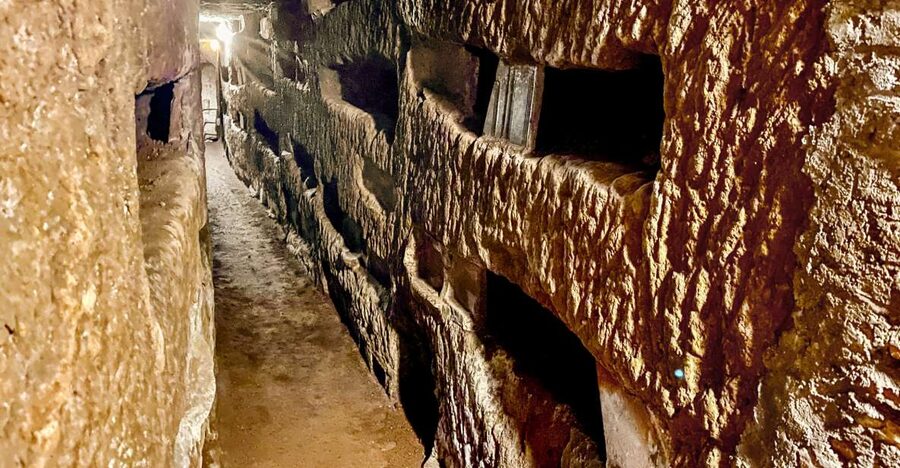
- You descend 16 metres into four levels of burial chambers, with the route passing through the ancient Domitilla catacombs.
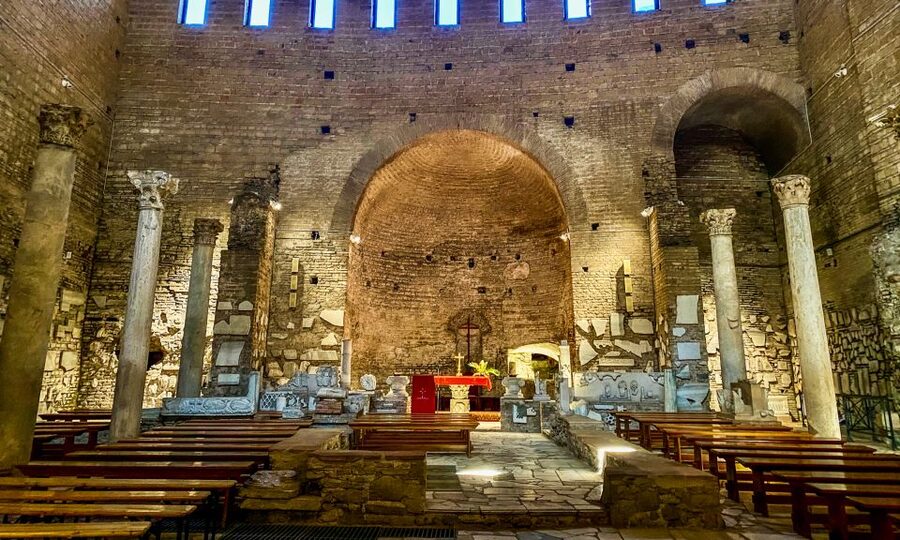
- The 4th-century Basilica of Nereus and Achilleus is the tour’s most striking stop, hidden below ground.
- A central meeting point and 15-minute minivan ride each way make the visit easy to fit into a busy Rome schedule.
- Ancient wall paintings show biblical and mythological figures, offering clues about changing religious beliefs.
- Groups are limited to 10 or 16 people, depending on the option you select, with private tours also available.
- Expect a short, focused visit, not a half-day archaeological outing. That keeps the tour manageable, but some people may find the price high for 90 minutes.
Why the Domitilla Catacombs are worth your time
Rome offers no shortage of grand monuments. The Colosseum, Roman Forum, and Pantheon all command attention above ground. The Domitilla catacombs offer something quieter and stranger: a look at how people buried their dead, expressed faith, and marked identity below the surface of the city.
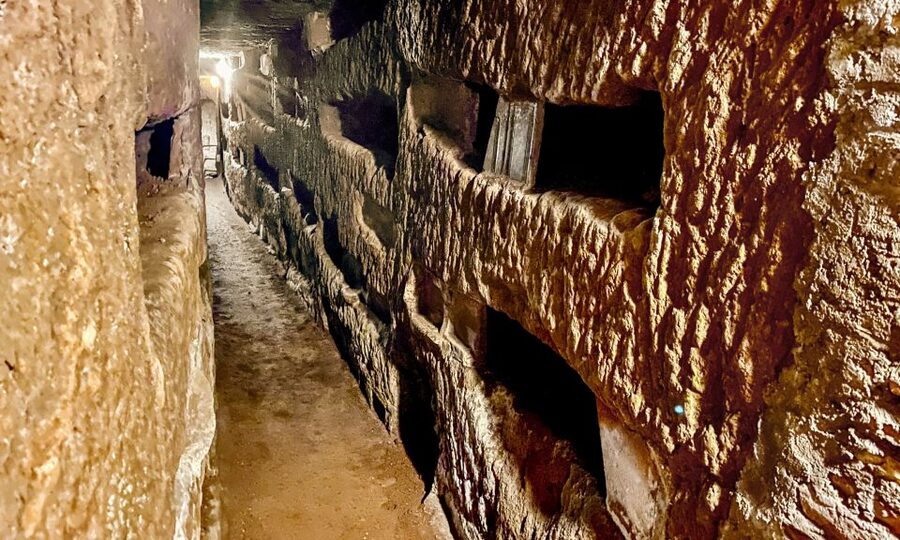
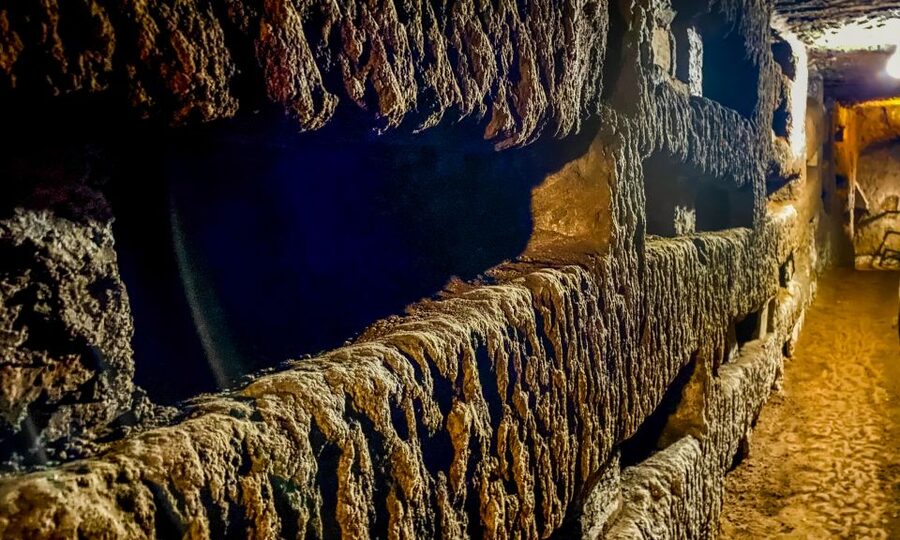
The catacombs are among Rome’s largest and oldest underground burial sites. Their corridors extend across four levels, reaching about 52 feet, or 16 metres, below ground. You do not simply walk into one crypt and walk back out. The route leads through a network of chambers and passages, giving you a sense of how much effort went into creating this subterranean world.
The subject is not only death. Your guide connects the burial spaces to the shift from pagan Roman customs to Christianity. That makes the tour useful even if you are not especially religious. You hear how symbols, paintings, burial practices, and early Christian worship fit into the wider story of Rome.
I especially like the way the tour brings attention to small details. The best guides do not just point at a wall and give you a date. They explain what a symbol may have meant, why a figure appears in a particular setting, and how the site reflects the changing beliefs of the people who used it.
A few more Rome bookings to compare
- Vatican: Museums & Sistine Chapel Entrance Ticket
★ 4.5 · 144,003 reviews - Vatican Museums & Sistine Chapel Tour with Optional Basilica
★ 4.3 · 67,413 reviews - Colosseum, Roman Forum & Palatine Guided Tour
★ 4.7 · 63,148 reviews
Meeting in central Rome and riding toward the Appian Way
The tour begins at Via Francesco Giambullari 4, in the square in front of the stairs. Arrive about five minutes early and look for a staff member holding a yellow label. This is not a hotel pickup, so allow enough time to reach the meeting point on foot or by public transport.
From there, you board a minivan for the ride toward the Appian Way. The transfer takes about 15 minutes in each direction. That may sound minor, but it matters in Rome, where reaching an outlying archaeological site can consume far more time than expected if you arrange everything yourself.
The included transport keeps the visit compact. You do not have to work out how to reach the catacombs, find the entrance, or arrange a ride back into the center. The driver also takes care of the city traffic, an advantage on a hot day or during a packed sightseeing schedule.
The ride itself is functional rather than scenic. Think of it as a practical connection between central Rome and the underground site. One important caution: a recent account described the outward ride as uncomfortably fast, while another praised the driver for finding a quick route around traffic. Driving conditions and individual tolerance can vary, but if you dislike brisk city driving, this is worth keeping in mind.
Air conditioning has generally been appreciated during hot weather, though one person found the vehicle hot and lacking effective air conditioning. If you are visiting in summer, carry water and do not count on the minivan being perfectly cool every time.
Descending 16 metres below Rome
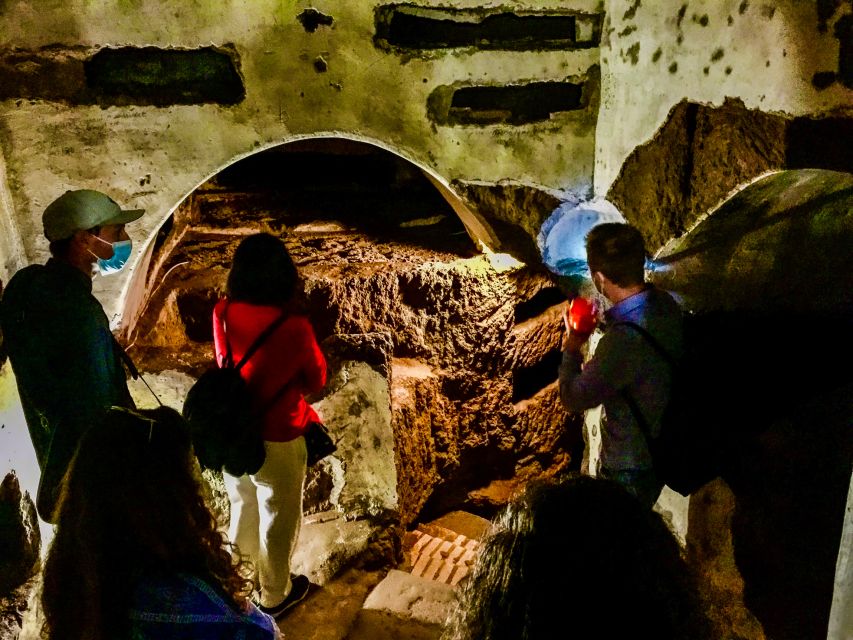
Once at the Catacombs of San Domitilla, the guided portion lasts about one hour. You gradually descend into the underground complex, leaving behind traffic, sunlight, and the familiar Roman streets.
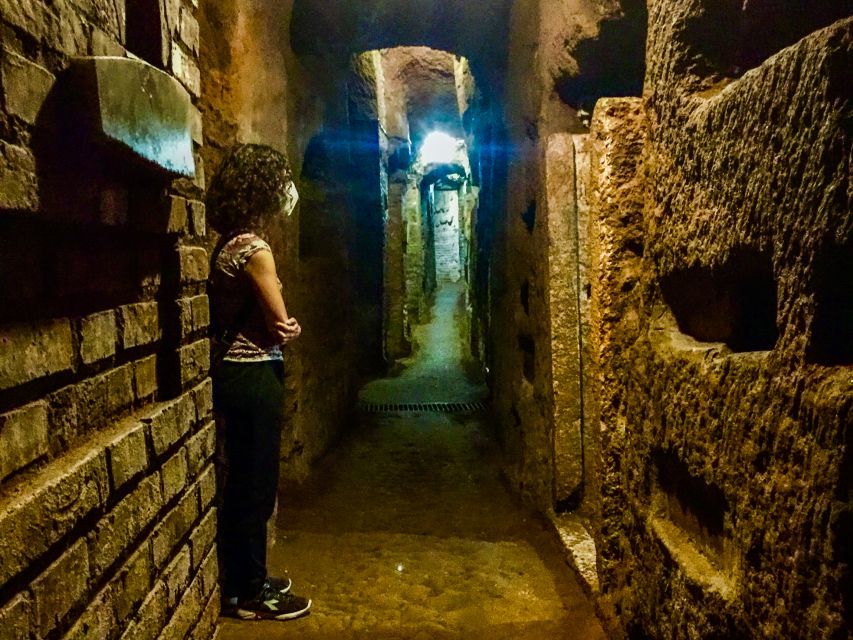
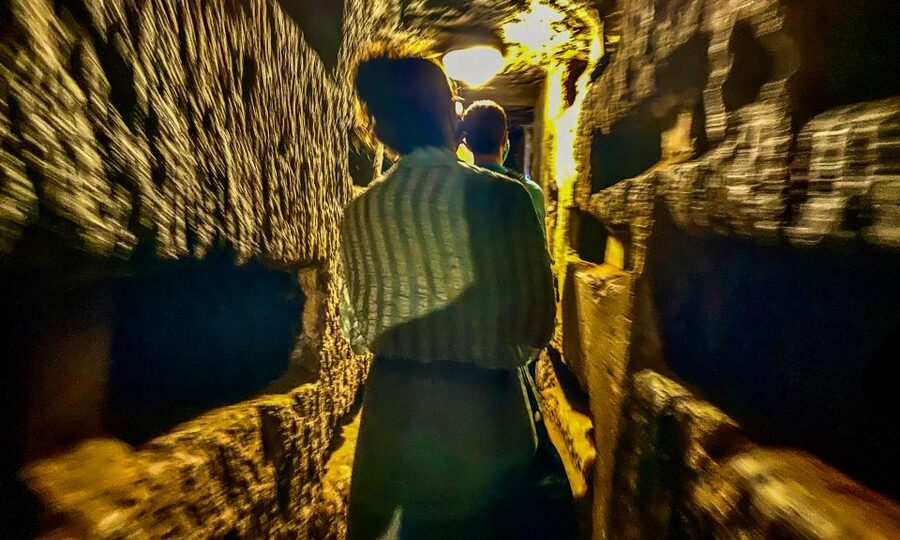
The physical route involves a moderate amount of walking. You move through dark corridors and enclosed chambers, often with limited room around you. Comfortable shoes are a sensible choice, not a formality. The ground and steps can make sturdy footwear more useful than fashionable sandals.
The darkness is part of the setting, but the route is lit enough to navigate. You may want to bring your phone as a flashlight, though do not use the camera inside. Photography is not allowed within the facility, so treat the underground visit as a place to look carefully rather than a place to collect pictures.
The catacombs do not resemble the famous bone displays in Paris. You should not expect walls stacked with skulls and skeletons. Instead, the interest comes from the carved burial spaces, the layout of the passages, the art, and the knowledge that these chambers were shaped for generations of Roman burials.
That distinction is important. If your main goal is a dramatic macabre spectacle, this may feel restrained. If you want to understand early Christian burial customs and see an archaeological site with your own eyes, the experience is far more rewarding.
Wall paintings, symbols, and the change from pagan Rome
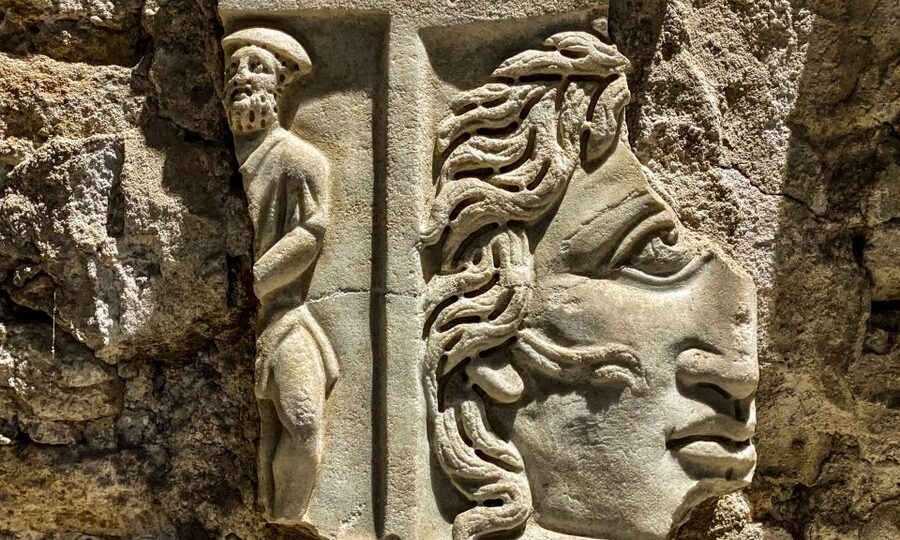
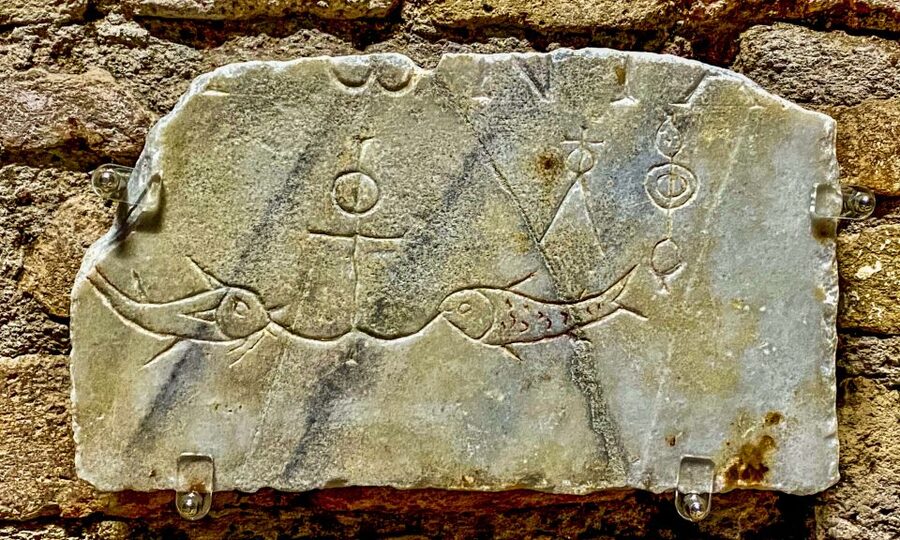
The wall paintings are among the main reasons to visit. You see biblical and mythological figures, along with symbols tied to early Christian belief. Your guide explains the religious meaning behind these images and places them within a period when Christianity was still developing its public identity.
The combination of pagan and Christian references makes the site especially interesting. Rome did not switch overnight from one belief system to another. The catacombs reflect a long period of change, when old cultural habits and new religious ideas existed close together.
This is where a strong guide makes a major difference. Francesca has been praised for her friendly, informative approach, while Mario has been singled out for combining clear explanations with humor. Marina was appreciated for answering questions in impressive English, and Daniel for speaking at a measured pace that was easy to follow.
Guide quality can never be guaranteed by name, since staffing changes. Still, the consistent pattern here is encouraging: the experience depends heavily on an expert explaining what you are seeing, and the guides have generally made that short hour count.
The subject can also feel serious. The catacombs are connected with early Christian martyrs, persecution, and the practical problems of burial in ancient Rome. A good guide keeps the tone respectful without making the visit gloomy. Several guides have been praised for adding gentle humor and everyday details, which helps turn a difficult subject into a human one.
Still Rome, but a slower afternoon:
- Vatican Museums, Sistine Chapel & St Peter’s Basilica Guided Tour
★ 4.5 · 39,149 reviews - Rome: Colosseum, Palatine Hill and Roman Forum Guided Tour
★ 4.8 · 32,814 reviews - Rome: Guided Tour of Colosseum, Roman Forum & Palatine Hill
★ 4.7 · 27,897 reviews - Rome: Colosseum & Forum with Audio Guide App -Optional Arena
★ 4.2 · 24,770 reviews
The underground Basilica of Nereus and Achilleus
The final part of the underground visit is the Basilica of Nereus and Achilleus, a 4th-century church below ground. It provides a strong ending because it shifts your attention from burial corridors to a place built for Christian worship.
The basilica is not grand in the way of Rome’s famous churches. Its impact comes from its location and age. You are standing in a worship space beneath the city, surrounded by the physical remains of a community that practiced its faith in a very different Roman world.
This stop also ties together the main themes of the tour. The paintings show belief through images. The burial chambers show how families and communities dealt with death. The basilica shows organized worship taking shape underground.
Do not expect a long period for independent wandering. The group follows a set route, and the guide controls the pace. That helps preserve the site and keeps a small passage from becoming crowded, but it means the experience feels structured rather than leisurely.
Small groups, language choices, and guide quality
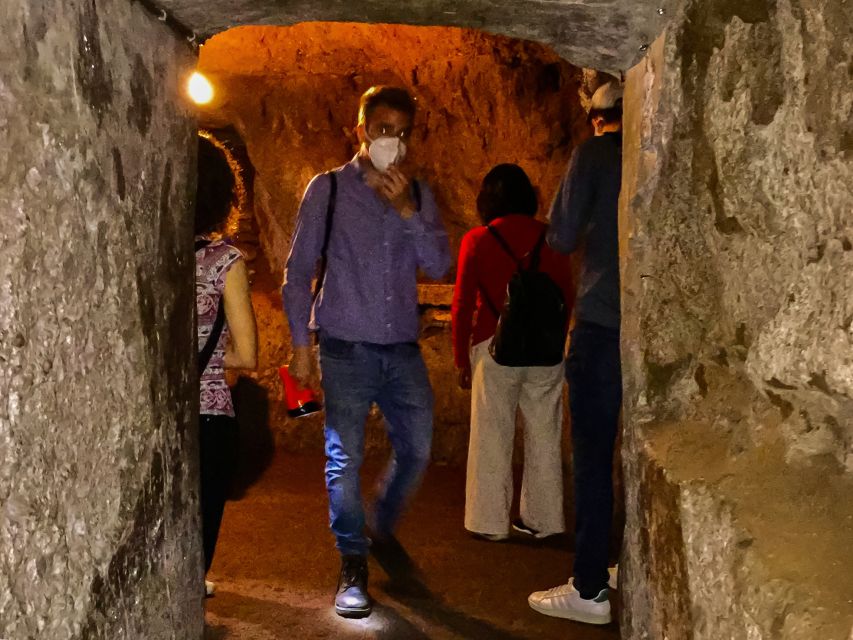
The group size depends on the option you choose. Maximum numbers are listed as either 10 or 16 people, and private tours are available. If you want to hear every explanation and ask questions, the smaller option is worth considering.
A small group also matters physically. The passages are not designed for a large crowd. Fewer people make it easier to move through the route without constant stops, and you are more likely to hear the guide in the enclosed spaces.
Live guiding is available in Italian, German, English, Spanish, Portuguese, and French. Check the language at booking, since the quality of your understanding depends on being matched with the right option.
Families can enjoy the tour, especially if older children or teenagers have an interest in Roman history. One family found the guide engaging enough to hold the attention of two teenagers, and another parent said a son was still repeating the historical facts afterward. Younger children may find the darkness, quiet, and serious subject less appealing.
The tour is also a good choice for people who have already seen Rome’s main monuments. It gives you a different form of history, one based less on famous architecture and more on daily customs, belief, and burial.
Is $65 good value for a 90-minute tour?
At $65 per person, this is not the cheapest short activity in Rome. The visit lasts 1.5 hours, including roughly 30 minutes of transportation and about one hour underground. If you judge it by time alone, the price may feel steep.
The fee includes the catacombs entrance ticket, professional guide, transport from central Rome and back, and a luggage deposit during the tour. Those extras change the calculation. You are paying for a guided archaeological visit plus a simple transfer, not only for access to the site.
I think the value is strongest if you are staying near the center, have limited time, and do not want to arrange transport to the Appian Way. It is also useful on a hot afternoon, when the cool underground setting offers a break from Rome’s streets.
The value is weaker if you prefer long, slow visits or want several archaeological sites in one outing. Some people felt the tour was brief, while others thought the hour underground was exactly enough. I would book it for the quality and unusual subject, not because it gives you a large quantity of sightseeing.
The private option may make sense for couples or families who want a tailored pace. For most people, though, a small shared group should provide the best balance between cost and personal attention.
Practical clothing and packing advice
Dress for church entry. Knees and shoulders must be covered, so avoid short skirts and sleeveless shirts. This rule applies even though much of the tour takes place underground.
Wear comfortable shoes and bring a reusable water bottle. Headphones are also listed among the recommended items, which may help you hear the guide clearly, especially if the group is larger.
Do not bring large bags, trolleys, or large backpacks. A luggage deposit is included for the duration of the tour, but the catacombs themselves do not allow luggage or bulky bags inside. Pets and baby strollers are not allowed either.
Drones and knives of any kind are strictly forbidden at the monuments. Anyone under 18 must carry valid identification or proof of age.
The route is not suitable for wheelchair users, and people with claustrophobia should skip it. The underground passages are dark and enclosed, even though the route is lit enough for normal navigation.
Weather and calendar events can affect the operation. If the tour is canceled, you are offered another date or a full refund. You can also cancel up to 24 hours before the start for a full refund, and the reserve-now, pay-later option keeps you from paying at the time of booking.
Who should book this catacombs tour?
I would recommend it most strongly to you if:
- You enjoy Roman history beyond the Colosseum and Forum.
- You want to learn about early Christianity in a real archaeological setting.
- You prefer a short activity with transport already arranged.
- You are visiting during hot weather and welcome a cool underground hour.
- You like asking questions and learning from a live guide.
- You want something quieter and less familiar than Rome’s main attractions.
I would think twice if you dislike enclosed spaces, need step-free access, or want a long, self-guided visit. The experience is focused and informative, but it is not a broad tour of several catacomb sites.
Should you book the Domitilla Catacombs tour?
Book it if you want Rome’s history to feel personal rather than monumental. The Domitilla catacombs show burial customs, religious change, underground art, and early Christian worship in one compact visit. The transport makes the logistics easy, and the guides have repeatedly brought warmth, humor, and clear explanations to a serious subject.
Skip it if you expect piles of bones, dramatic rooms, or several hours of exploration. You will see burial chambers, wall paintings, and the Basilica of Nereus and Achilleus, but the visit is controlled and relatively short.
For a first trip to Rome, I would place it after the essential ancient sites, unless underground history is a special interest. For a return visit, a history-minded family, or a hot afternoon when you want an experience far from the usual route, $65 is a fair price for an unusual and well-organized hour beneath the city.
FAQ
Where does the tour meet in Rome?
Meet at Via Francesco Giambullari 4, 00184 Rome, in the square in front of the stairs. Arrive five minutes before the scheduled start and look for staff holding a yellow label.
Is transportation included?
Yes. Round-trip minivan transportation from the central meeting point is included. The ride takes about 15 minutes each way.
How long do I spend inside the catacombs?
The guided visit inside the Catacombs of San Domitilla lasts about one hour. The total activity lasts 1.5 hours, including transportation.
What language is the guide available in?
Live guides are available in Italian, German, English, Spanish, Portuguese, and French. Select the preferred language when booking.
Can I bring luggage into the catacombs?
No. Luggage, large bags, trolleys, and large backpacks are not allowed inside the monuments. A luggage deposit is included for the duration of the tour.
Is the tour suitable for people with claustrophobia or wheelchair users?
No. The tour is not suitable for people with claustrophobia or wheelchair users. It includes moderate walking through dark, enclosed underground spaces.
Recently added around Rome
- Palatine Hill and Roman Forum Tour with Fast-Track Entrance★ 4.2 · 417 reviews
- Tivoli: Villa D’Este & Villa Adriana Pass & App Audioguide★ 4.4 · 364 reviews
- From Rome: Villa D’Este & Villa Adriana Day Trip with Lunch★ 4.4 · 289 reviews
- Vatican Museums & Sistine Chapel Skip-the-Line Guided Tour★ 4.6 · 254 reviews
- Rome: The Three Tenors at St. Paul’s Church Concert Ticket★ 4.7 · 699 reviews
- Tivoli: Villa D’Este Entry Ticket and App Audio Guide★ 4.3 · 191 reviews
- Rome: Capitoline Museums and Centrale Montemartini Tickets★ 4.4 · 328 reviews
- Rome: St. Peter’s Basilica and Papal Tombs Guided Tour★ 4.6 · 477 reviews
Guided, compared.
Colosseum, Roman Forum & Palatine Guided Tour
Read our review →
Vatican Museums, Sistine Chapel & St Peter’s Basilica Guided Tour
Read our review →
Colosseum, Palatine Hill and Roman Forum Guided Tour
Read our review →
Guided Tour of Colosseum, Roman Forum & Palatine Hill
Read our review →
Colosseum & Forum with Audio Guide App -Optional Arena
Read our review →
Colosseum, Roman Forum and Palatine Hill Guided Tour
Read our review →
Naples Underground Entry Ticket and Guided Tour
Read our review →