
Reviewed · MOTORBIKE & SCOOTER RENTALS
Rome Afternoon Sightseeing Vespa Sidecar Tour with Gourmet Gelato
Rome looks different from a Vespa sidecar. Forget wrestling with a map and city traffic. This four-hour tour carries you between major sights with a licensed driver at the handlebars, while your guide explains what you are seeing. I like the clever mix of famous monuments and everyday Roman streets, and I like that the sidecar feels more stable than a standard two-wheel Vespa.
The gourmet gelato stop is another welcome touch, especially during a warm afternoon. My main caution is seating: each Vespa carries two passengers, with one behind the driver and one in the sidecar. You can switch at stops, but you should not book expecting a private sidecar seat for every passenger throughout the ride.
In This Review
- Key points to know before you book
- Why a sidecar works so well in Rome
- Piazza della Repubblica begins the afternoon
- Quirinal Hill and the presidential palace
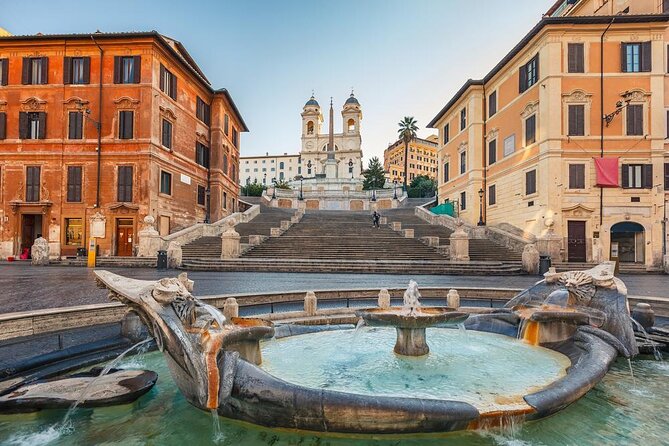
- Trevi Fountain, Rome’s grandest coin toss
- The Pantheon provides the main interior visit
- Piazza Navona turns an ancient stadium into a Baroque square
- St. Peter’s Square and the scale of Bernini
- Janiculum Hill brings the best city view
- Trastevere shows the city’s everyday side
- Piazza Venezia and the huge white monument
- The Colosseum appears as the grand finale
- Santa Maria Maggiore closes the circuit
- Gelato and the practical value of the price
- Seating, comfort, and who should book
- Should you book the Rome sidecar tour?
- FAQ
- Do I drive the Vespa during the tour?
- How long is the tour?
- Where does the tour start and finish?
- Is the Pantheon entrance included?
- Does the tour include entry to the Colosseum or St. Peter’s Basilica?
- Can children join the tour?
- What happens if the weather is poor?
Key points to know before you book
- You do not drive: Professional drivers handle Rome’s traffic, so you can watch the streets instead of worrying about navigation.
- The tour covers a lot of ground: You see the Trevi Fountain, Pantheon, Piazza Navona, St. Peter’s Square, Trastevere, the Colosseum area, and more in about four hours.
- The sidecar is the star: It gives you a playful, open-air ride and a more stable option than a two-wheel scooter.
- Seats are shared: One person rides in the sidecar and one sits behind the driver, with seat changes possible during stops.
- The Pantheon entrance is included: Most other sights are viewing stops rather than interior visits.
- The afternoon timing works well: The 2:30 p.m. start lets you see Rome in changing light and finish with gelato.
Why a sidecar works so well in Rome
Rome is not a tidy city built for sightseeing circuits. Its ancient center is full of narrow lanes, uneven paving, busy intersections, and monuments scattered across a large area. A walking tour can be rewarding, but you will cover fewer districts. A hop-on, hop-off bus gives you range, but not the same sense of being in the city.
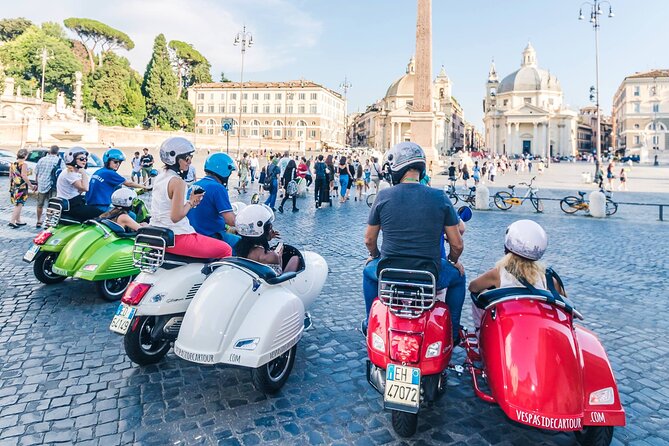
The Vespa sidecar offers a useful middle ground. You move quickly enough to reach distant sights, yet slowly enough to notice the streets, churches, fountains, and trattorias along the way. You are not sealed behind glass, and you do not need to concentrate on driving.
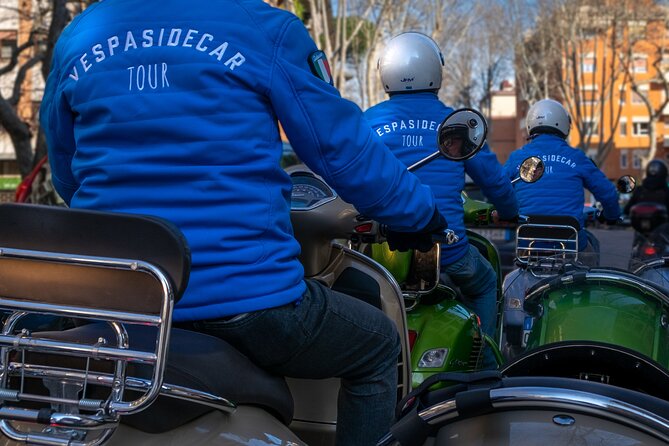
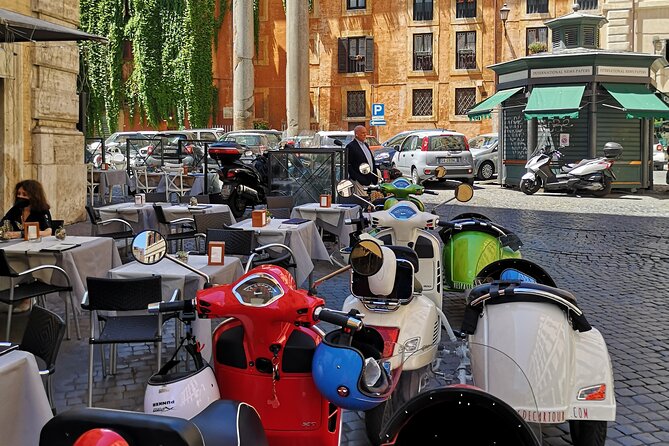
The driving is handled by licensed professionals, a major advantage in Roman traffic. Several guides are singled out for their friendly manner, including Matteo, Barbara, Alessio, Monica, and Alex. Drivers such as Davide, Manuel, Raffaele, and Matteo are also praised for careful handling and a calm approach.
You receive a helmet with a sterilized disposable head cover, plus a headset for the commentary. That matters because the ride itself can be noisy. One practical warning: some riders have found the narration difficult to hear while moving, so check that your headset is working before the group leaves.
A few more Rome bookings to compare
- Vatican: Museums & Sistine Chapel Entrance Ticket
★ 4.5 · 144,003 reviews - Vatican Museums & Sistine Chapel Tour with Optional Basilica
★ 4.3 · 67,413 reviews - Colosseum, Roman Forum & Palatine Guided Tour
★ 4.7 · 63,148 reviews
Piazza della Repubblica begins the afternoon
The meeting point is at Piazza della Repubblica, at 2:30 p.m. This is a sensible starting place because the square introduces you to Rome’s later rebuilding as the capital of unified Italy.
The piazza is arranged around the Fontana delle Naiadi, an elaborate fountain framed by large nineteenth-century buildings. On one side, the remains of the Baths of Diocletian give the square an unusual contrast: grand modern Rome beside what can look like a partly demolished ancient structure.
You spend about ten minutes here. It is enough for an introduction and a few photographs, not a full architectural study. Think of this as the opening chapter rather than a major stop.
Quirinal Hill and the presidential palace
The route continues to the Palazzo del Quirinale, one of Rome’s most important political buildings. The palace sits on the Quirinal Hill, the highest of Rome’s traditional seven hills, in an area also called Monte Cavallo.
Its past is unusually layered. The building has housed popes, kings of Italy, and presidents of the Italian Republic. You get about five minutes here, so the value is in the guide’s explanation and the setting rather than an extended visit inside.
This is one reason the tour works best as an introduction to Rome. You receive short bursts of context at places you might otherwise pass without understanding.
Trevi Fountain, Rome’s grandest coin toss
The Trevi Fountain receives a longer stop of about thirty minutes. That is welcome because this is one place where you need time to take in the details, find a good angle, and deal with the crowds around the basin.
The fountain is about 20 meters wide and 26 meters high. Its story begins with the Aqua Virgo aqueduct in 19 B.C., while the fountain you see today took shape during the Renaissance and was completed in 1762 under Giuseppe Pannini, after work by Nicola Salvi.
The name Trevi refers to Tre Vie, or three streets, because the fountain marks the meeting point of three roads. Your guide can help turn a beautiful photo stop into a more meaningful one.
Do not expect a quiet visit. Trevi is one of Rome’s most heavily visited sights, and thirty minutes may feel short if you want a long photo session. Still, arriving with a guide and a clear time limit keeps the afternoon moving.
Still Rome, but a slower afternoon:
- Vatican Museums, Sistine Chapel & St Peter’s Basilica Guided Tour
★ 4.5 · 39,149 reviews - Rome: Colosseum, Palatine Hill and Roman Forum Guided Tour
★ 4.8 · 32,814 reviews - Rome: Guided Tour of Colosseum, Roman Forum & Palatine Hill
★ 4.7 · 27,897 reviews - Rome: Colosseum & Forum with Audio Guide App -Optional Arena
★ 4.2 · 24,770 reviews
The Pantheon provides the main interior visit
The Pantheon is the strongest architectural stop on the route, and the entrance ticket is included. This ancient building is remarkably well preserved, with a vast concrete dome and an oculus at its center that provides the main natural light.
The building was completed in its present form in A.D. 126. Its earlier connection to Marcus Agrippa is reflected in the familiar inscription on the front, while the interior shows why the Pantheon remains one of Rome’s great architectural achievements.
You have about thirty minutes here. That is enough to enter, look upward through the oculus, and listen to an explanation of the structure. Rain can enter through the opening, so the floor may be wet in poor weather.
The Pantheon is also a good test of the guide’s teaching style. Alex and Alessio are praised for making the building interesting even for teenagers, which is no small task in a city full of ancient stones and long explanations.
Piazza Navona turns an ancient stadium into a Baroque square
Piazza Navona is included in the route as a sightseeing stop. The square occupies the site of an ancient Roman stadium, but its present character comes from the Baroque period.
Bernini’s Fountain of the Four Rivers is the main attraction, surrounded by grand façades, cafés, artists, and open space. You may find this stop less structured than the Pantheon or Trevi Fountain, since the listed timing does not specify a separate visit length. The guide’s commentary gives the square its shape and meaning.
This is a good place to look beyond the central fountain. The oval plan reveals the outline of the old stadium, a useful reminder that Rome often places one period directly on top of another.
St. Peter’s Square and the scale of Bernini
The ride then reaches St. Peter’s Square in Vatican City. The immense colonnades designed by Gian Lorenzo Bernini create one of Europe’s most recognizable public spaces, opening toward St. Peter’s Basilica.
The square can hold more than 300,000 people, though the scale is hard to grasp until you are standing within it. The tour gives you an exterior view and time to take photographs. Do not assume this tour includes entry to St. Peter’s Basilica or the Vatican Museums. The included entrance specifically covers the Pantheon.
That distinction is important when comparing this tour with a dedicated Vatican visit. The sidecar tour gives you a broad Roman orientation, not a full museum or basilica tour.
Janiculum Hill brings the best city view
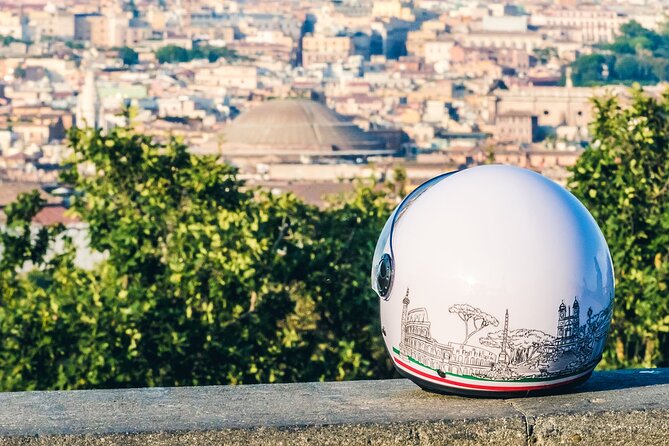
The stop at Terrazza del Gianicolo, or Janiculum Hill, is one of the afternoon’s most useful breaks. You get about fifteen minutes to stretch, breathe, and look over Rome from above.
Janiculum is often called Rome’s eighth hill, although it lies outside the ancient seven-hill core. Its paths and monuments also recall the defense of the city, including the battles connected with Giuseppe Garibaldi and the defense against French troops.
The view is the reason to linger. From here, Rome spreads below you in a way that helps connect the separate monuments seen earlier. After several short urban stops, this pause adds space and perspective.
Trastevere shows the city’s everyday side
The ride through Trastevere shifts the mood. Instead of grand monuments and formal squares, you pass through narrow lanes, local trattorias, and streets that reveal a more ordinary side of Rome.
The neighborhood is known for its bohemian character, though the real pleasure is simply seeing how the old lanes fit together. The sidecar is particularly useful here because the route can pass through streets that would be tiring to cover on foot in a single afternoon.
The drive also passes through the Jewish Ghetto. This gives you a glimpse of another historic district without turning the tour into a long walking lecture. You should think of this section as a moving introduction. If you want to explore Trastevere or the Jewish Ghetto in depth, plan a separate walk.
Piazza Venezia and the huge white monument
Piazza Venezia brings you to the Monumento Nazionale a Vittorio Emanuele II, often called the Altare della Patria. The enormous white structure was inaugurated in 1911 to honor Victor Emmanuel II, the first king of unified Italy.
It also contains the Institute for the History of the Italian Risorgimento and the Central Museum of the Risorgimento. Since 1921, the Tomb of the Unknown Soldier has been here, guarded beside an eternal flame.
The monument is hard to miss and easy to photograph, though some people find its scale overpowering. That is part of the point. The guide can explain how the building reflects the creation of modern Italy, not just ancient Rome.
The Colosseum appears as the grand finale
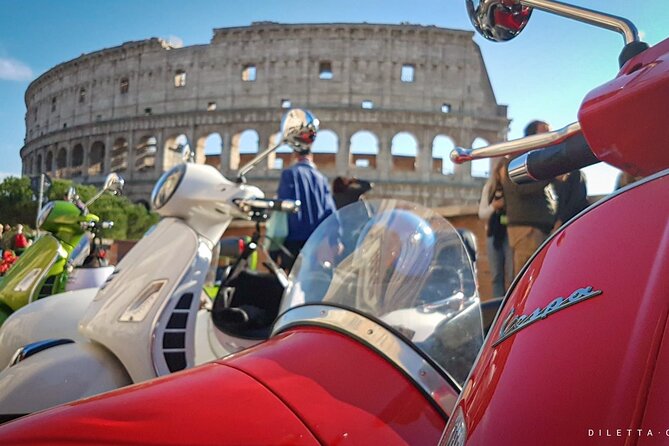
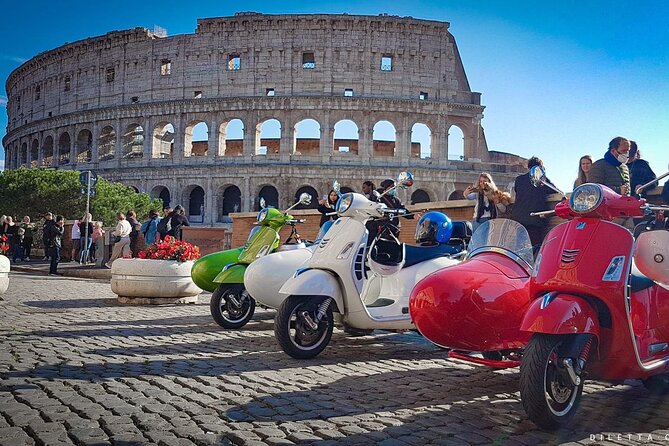
The route passes the Colosseum, Rome’s Flavian Amphitheatre and one of the city’s defining sights. With nearly 2,000 years of history, it remains a powerful reminder of the Roman Empire’s public spectacles and engineering.
This is a sightseeing stop, not a Colosseum interior tour. If entering the amphitheatre is high on your list, you will need a separate ticket and visit. The advantage here is speed: you get the landmark and its setting without spending hours in an entrance queue.
The Colosseum also makes a strong visual contrast with the sidecar itself. You move through modern traffic beneath a monument built for crowds nearly two millennia ago. Rome is good at that sort of collision.
Santa Maria Maggiore closes the circuit
The Basilica di Santa Maria Maggiore is one of Rome’s four major basilicas and the largest of the churches dedicated to the Virgin Mary in the city.
The stop adds a major religious site to the route, balancing the ancient monuments, political buildings, and open squares already seen. As with several other locations, the value comes from the exterior view and the guide’s explanation unless a separate entry is arranged.
By this point, you have seen a broad selection of Rome: imperial, papal, royal, republican, residential, and religious. That range is the tour’s real strength.
Gelato and the practical value of the price
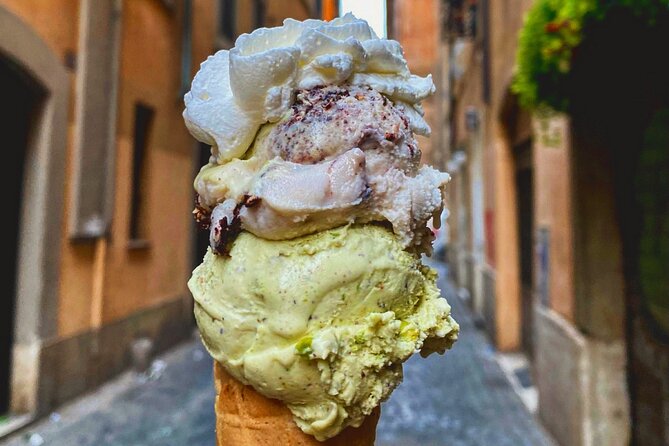
The tour costs $163.26 per person. That is not a cheap way to get from one Roman sight to another, but the price includes much more than transport. You are paying for a professional driver, a live guide, helmets, headsets, a small group of no more than 12 people, the Pantheon entrance, and gourmet gelato in a historic alley.
The value is strongest if you have only a short stay or want a city overview before choosing where to return. In four hours, you cover ground that would take much longer on foot, with far less effort.
The tour is also more personal than a large bus circuit. You can ask questions, hear commentary at each stop, and get help with photographs. One particularly nice touch is that guides may take photos for you at famous landmarks.
The gelato stop is not a substitute for a meal, but it is a well-timed treat after a warm ride. Tell the operator about dietary needs when booking, since special requirements should be provided in advance.
Seating, comfort, and who should book
Each Vespa accommodates two people. One sits behind the driver, and one sits in the sidecar. At stops, you can switch positions so both people have a turn in the sidecar.
If you book a single seat, you may share the vehicle with another person. For an odd-numbered booking, you accept that the sidecar position will alternate with the seat behind the driver. Clarify this before departure if the arrangement matters to you.
The sidecar can hold up to 110 kilograms, or 242 pounds, and has a maximum height of 1.90 meters. The maximum weight for riding behind the driver is 118 kilograms, or 260 pounds. Children must be at least five years old and accompanied by an adult. A child may sit behind the driver only if taller than 150 centimeters. Otherwise, the child sits in the sidecar.
Most people can take part, and service animals are allowed. The tour is not permitted for pregnant passengers. You should also be comfortable getting in and out of the sidecar, though assistance may be available.
I would choose this tour for first-time visitors, families with children, couples, and repeat visitors who want a different way to cross the city. It suits you if you enjoy movement, short stops, photos, and a lively overview. It is less suitable if you want long museum visits, a slow food tour, or a quiet study of one neighborhood.
The tour requires good weather. Free cancellation is available up to 24 hours before the 2:30 p.m. start, while cancellations or changes inside that window are not refunded or accepted. If poor weather forces cancellation, you can receive a different date or a full refund.
Should you book the Rome sidecar tour?
Yes, if you want to see Rome’s major sights in one lively afternoon without driving yourself. The professional drivers remove the hardest part of scooter touring, while the sidecar provides the fun, open-air feel that makes the route memorable.
Book it early if your dates are fixed, since it is often reserved well ahead of time. I would schedule it near the beginning of your stay, then return later to the Pantheon, Trevi Fountain, Trastevere, or the Colosseum if one of them deserves more time.
Just set your expectations correctly: this is a fast, wide-ranging introduction with selected stops, not a collection of full monument tours. If that sounds right, the combination of Roman streets, expert commentary, scenic viewpoints, and excellent gelato makes the $163.26 price easier to justify.
FAQ
Do I drive the Vespa during the tour?
No. Professional drivers operate the Vespas, so you sit back and enjoy the route.
How long is the tour?
The experience lasts approximately four hours and begins at 2:30 p.m.
Where does the tour start and finish?
It starts at P.za della Repubblica, 41, 00185 Rome, and returns to the same meeting point.
Is the Pantheon entrance included?
Yes. The Pantheon entrance ticket is included in the tour price.
Does the tour include entry to the Colosseum or St. Peter’s Basilica?
The provided inclusions specify the Pantheon entrance only. The Colosseum and St. Peter’s Square are sightseeing stops, so you should not assume interior admission is included.
Can children join the tour?
Yes. Children must be at least five years old and accompanied by an adult. Seating rules apply based on the child’s height.
What happens if the weather is poor?
The tour requires good weather. If it is canceled because of poor conditions, you will be offered another date or a full refund.
Recently added around Rome
- Rome: Pantheon, Trevi Fountain & Roman Squares Guided Tour★ 4.7 · 386 reviews
- Vatican: St. Peter’s Basilica with Audio Guide and Options★ 3.4 · 269 reviews
- Vatican: Pope Francis Tomb and Papal Basilicas Tour★ 4.7 · 340 reviews
- Rome: Vatican Museums Skip-the-line Entry Ticket and Tour★ 4.2 · 400 reviews
- Rome: Vatican Museums & Sistine Chapel Ticket + Tour Options★ 4.7 · 344 reviews
- Vatican: Museums, Raphael & Sistine Chapel + Basilica Option★ 4.7 · 350 reviews
- Vatican Museums & Sistine Chapel Guided Tour★ 4.3 · 832 reviews
- Vatican Museums & Sistine Chapel Entry Ticket★ 4.4 · 245 reviews
Motorbike & Scooter Rentals, compared.
Florence Vespa Tour: Tuscan Hills and Italian Cuisine
Read our review →

Rome Morning Vespa Sidecar Tour in Rome with Cappuccino
Read our review →
Chianti Vespa Tour with Lunch from Florence & E-car Option
Read our review →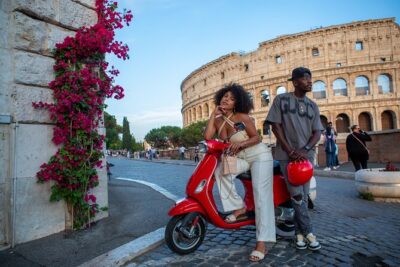
Rome Vespa Scooter Tour with Professional Photographer
Read our review →
Highlights Vespa Sidecar Tour with Coffee and Gelato
Read our review →
Tuscany Vespa Tour: Lunch & Wine Tasting, Countryside Roads
Read our review →Browse the lists this tour appears in