
Reviewed · MOTORBIKE & SCOOTER RENTALS
Rome Morning Vespa Sidecar Tour in Rome with Cappuccino
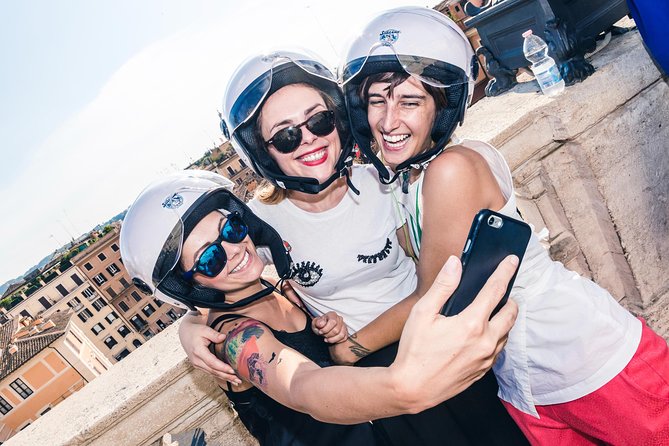
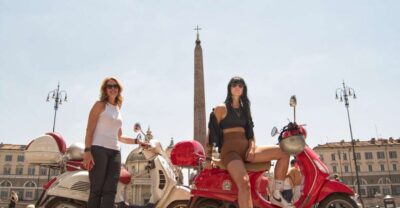
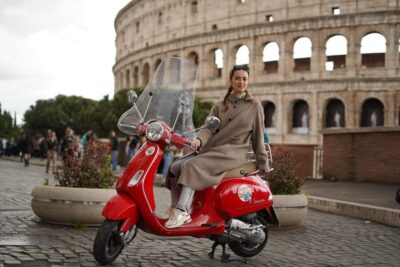
Rome looks different from a Vespa. The city opens up quickly as your driver slips through narrow streets, busy squares, and grand avenues while you sit back with a helmet, headset, and camera ready. This three-hour morning tour covers major sights such as the Trevi Fountain, Pantheon, Colosseum, Vatican area, and Janiculum Hill without asking you to walk between them.
I especially like the friendly drivers and guides, who combine safe driving with lively stories about Rome. The cappuccino and cornetto stop is another smart touch: it gives you a short rest and a taste of an ordinary Italian morning. The main drawback is that you share a Vespa with another person if you book one seat, so you may need to alternate between the sidecar and the rear saddle.
At $163.26 per person, this is not a budget sightseeing ride. Still, the price includes a licensed guide, professional driver, helmet, headset, breakfast, and entry to the Pantheon. You are paying for speed, convenience, and a memorable way to get your bearings in Rome, not simply for transportation.
In This Review
- What makes this Rome Vespa tour special
- Starting at Piazza della Repubblica at 9 a.m.
- Quirinal Palace and the Trevi Fountain
- Entering the Pantheon and taking a Roman coffee break
- Piazza Navona and St. Peter’s Square
- Janiculum Hill for Rome’s best views
- Trastevere, the Jewish Ghetto, and Rome’s everyday streets
- Piazza Venezia and the Colosseum
- Santa Maria Maggiore and the full morning route
- Drivers, headsets, and comfort
- Is $163.26 good value?
- Who should book this ride?
- Should you book the Rome Vespa Sidecar Tour?
- FAQ
- Where does the Rome Vespa sidecar tour start?
- Where does the tour end?
- How long does the tour last?
- What food and drink are included?
- Is Pantheon admission included?
- Does the tour include Colosseum admission?
- Does the tour include entry to St. Peter’s Basilica?
- How many people can join the tour?
- Can children join the tour?
- What happens if the weather is poor?
What makes this Rome Vespa tour special
- You see twelve major sights in about three hours, including the Trevi Fountain, Pantheon, Piazza Navona, St. Peter’s Square, Colosseum, and Santa Maria Maggiore.
- The sidecar offers a relaxed view of Rome, while your driver handles traffic, parking, and unfamiliar streets.
- A cappuccino and cornetto are included, giving the morning a distinctly Roman pause.
- The Pantheon admission is covered, adding real value to a route that otherwise focuses on exterior views and photo stops.
- Headsets keep the commentary clear, even while the Vespas move through city traffic.
- Janiculum Hill provides a sweeping Rome view, and the route also passes through the Jewish Ghetto and Trastevere area.
Starting at Piazza della Repubblica at 9 a.m.
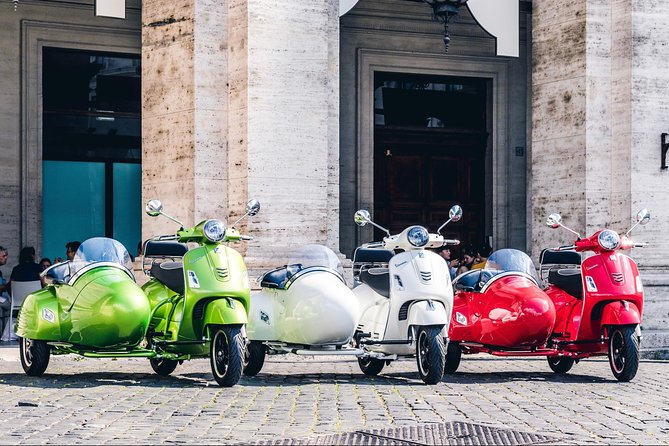
The tour begins at Piazza della Repubblica, at P.za della Repubblica 41, near public transportation. Arriving a little early is sensible because the group needs to get organized, fit helmets, distribute headsets, and assign seats.
Piazza della Repubblica makes a fitting starting point. It was shaped during Rome’s redevelopment after the city became Italy’s capital, and its broad circular form feels very different from the medieval lanes you will visit later. Look for the Fontana delle Naiadi, whose figures and flowing water add drama to the square.
The group is limited to twelve people. That is small enough to feel personal, though you should still expect several Vespas moving together through Rome. The guide narrates throughout the ride, while professional drivers concentrate on the road.
A few more Rome bookings to compare
- Vatican: Museums & Sistine Chapel Entrance Ticket
★ 4.5 · 144,003 reviews - Vatican Museums & Sistine Chapel Tour with Optional Basilica
★ 4.3 · 67,413 reviews - Colosseum, Roman Forum & Palatine Guided Tour
★ 4.7 · 63,148 reviews
Quirinal Palace and the Trevi Fountain
The first short stop is the Quirinal Palace, set on Rome’s highest hill. This grand building has served as a home for popes, kings of Italy, and presidents of the Italian Republic. You will not tour the interior, but the outside gives you a useful glimpse into the political history of modern Italy.
The stop lasts about five minutes, so treat it as an orientation point rather than a full visit. The short pause also helps the group stay on schedule.
Next comes the Trevi Fountain, where you have about thirty minutes. This is one of the tour’s most important photo stops, and the morning timing helps before the square grows even more crowded later in the day. The fountain measures about 20 meters wide and 26 meters high, so it is far larger and more theatrical than many first-time visitors expect.
Its story reaches back to the Aqua Virgo aqueduct, built in 19 B.C. The present Baroque fountain was completed in 1762 after work by Nicola Salvi and Giuseppe Pannini. The name comes from Tre Vie, meaning three streets, because three roads meet here.
You can take photos, study the carvings, and enjoy the fountain without having to plan your own route through Rome’s center. Keep your expectations practical: this is a sightseeing stop, not a quiet private visit. The Trevi Fountain is one of Rome’s busiest places.
Entering the Pantheon and taking a Roman coffee break
The Pantheon is the only listed interior visit, and your entrance fee is included. That matters because the building is more than another impressive facade. Inside, you can see the enormous dome and its central oculus, the round opening that provides the building’s main natural light.
Completed in its present form in A.D. 126, the Pantheon is among the best-preserved buildings from ancient Rome. The oculus also means that weather can affect the interior atmosphere, with sunlight or rain entering through the opening.
You have about thirty minutes here. That is enough for a focused look, although not enough for a slow study of every detail. Your guide’s commentary helps you notice the engineering and design rather than simply stepping in, taking a photo, and stepping out.
The breakfast stop adds a welcome change of pace. You receive a traditional cappuccino and cornetto, the Italian pastry commonly eaten in the morning. Bottled water is also mentioned in the experience details and has been appreciated as a useful extra.
This is not a long restaurant meal. Think of it as a short cafe break that lets you warm up, sit down, and reset before the next stretch of sightseeing. Some riders have also appreciated small comfort touches such as blankets and hot-water bottles during cooler conditions, though these should not be treated as a guaranteed part of every departure.
Piazza Navona and St. Peter’s Square
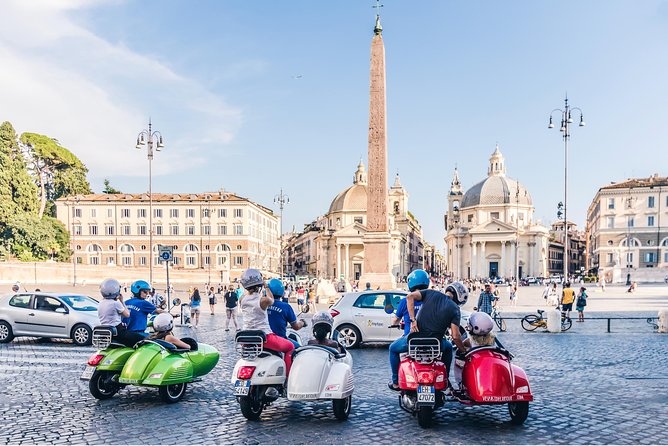
The route continues through Piazza Navona, one of Rome’s most recognizable public spaces. The square follows the footprint of an ancient Roman stadium, which explains its long, open shape. Today, Baroque buildings and fountains define the scene, including Bernini’s Fountain of the Four Rivers.
The sidecar is especially useful here because you see the square as part of a moving city rather than as an isolated stop on a walking route. At the same time, the schedule means you may not have a long independent visit. Listen to the guide and use the pauses for photos.
St. Peter’s Square brings a different scale. Bernini designed the great oval space in the 17th century, creating a monumental approach to St. Peter’s Basilica. The square is in Vatican City and can hold more than 300,000 people.
This tour does not include entry to St. Peter’s Basilica or the Vatican Museums. You see the square from the outside, which is valuable for orientation, but you will need a separate plan if you want to tour the basilica or museums. That distinction is important when comparing this ride with a dedicated Vatican tour.
Still Rome, but a slower afternoon:
- Vatican Museums, Sistine Chapel & St Peter’s Basilica Guided Tour
★ 4.5 · 39,149 reviews - Rome: Colosseum, Palatine Hill and Roman Forum Guided Tour
★ 4.8 · 32,814 reviews - Rome: Guided Tour of Colosseum, Roman Forum & Palatine Hill
★ 4.7 · 27,897 reviews - Rome: Colosseum & Forum with Audio Guide App -Optional Arena
★ 4.2 · 24,770 reviews
Janiculum Hill for Rome’s best views
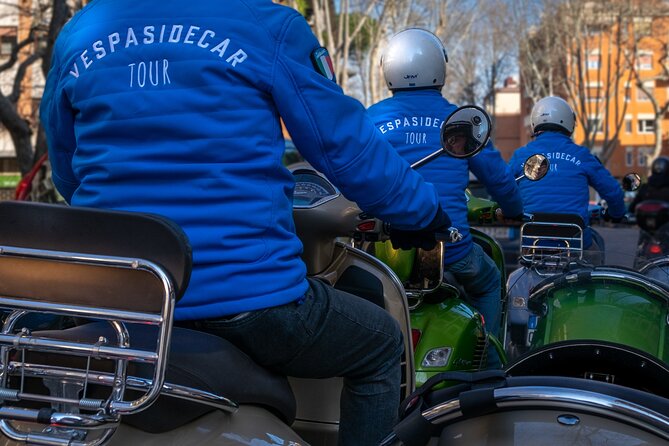
Janiculum Hill, often called Rome’s eighth hill, sits just outside the ancient city. The ride up gives you a break from central streets and leads to one of the route’s best outlook points.
From the Terrazza del Gianicolo, you can look across Rome’s rooftops and domes. The stop lasts about fifteen minutes, so you have time for photos and a quick look around, but not a leisurely hilltop walk.
Janiculum also carries strong links to the defense of Rome. Giuseppe Garibaldi fought here against French troops, and statues along the paths honor people connected with that struggle. The setting combines open views with a clear link to Italy’s 19th-century unification.
I consider this stop particularly useful because it changes the rhythm of the morning. After fountains, palaces, and ancient buildings, you get fresh air and a broad view of the city. Bring a layer if the morning is cool, since an open hilltop can feel less sheltered than central Rome.
Trastevere, the Jewish Ghetto, and Rome’s everyday streets
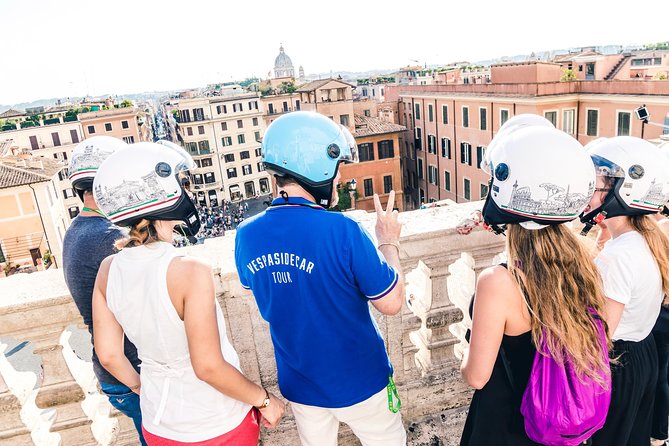
One of the best parts of the route is the drive through Rome’s older neighborhoods. You pass typical trattorias, narrow lanes, and the bohemian streets of Trastevere before reaching the picturesque Jewish Ghetto.
This section is less about checking off a monument. It shows you how Rome’s historic center works as a living neighborhood, with restaurants, alleys, old facades, and small streets threading between famous sites.
A Vespa sidecar has a clear advantage over a large bus here. It can move through tighter streets and bring you closer to the city’s texture. You also avoid the effort of navigating these streets on foot, which can be tiring after several hours of sightseeing.
The tradeoff is that you do not have much time to stop and explore these neighborhoods independently. If Trastevere or the Jewish Ghetto catches your interest, make a note of it and return later for a meal or a longer walk.
Piazza Venezia and the Colosseum
At Piazza Venezia, the Monumento Nazionale a Vittorio Emanuele II dominates the view. The white monument honors Victor Emmanuel II, the first king of unified Italy, and was opened in 1911. Its huge staircase and bright stone make it impossible to miss.
The monument also contains the Institute for the History of the Italian Risorgimento and the Central Museum of the Risorgimento. Since 1921, it has held the Tomb of the Unknown Soldier, guarded by two soldiers beside an eternal flame.
The tour focuses on the exterior and the surrounding view. It does not include admission to the monument’s interior. Still, the stop helps explain the story of modern Italy, a useful counterpoint to the ancient ruins elsewhere on the route.
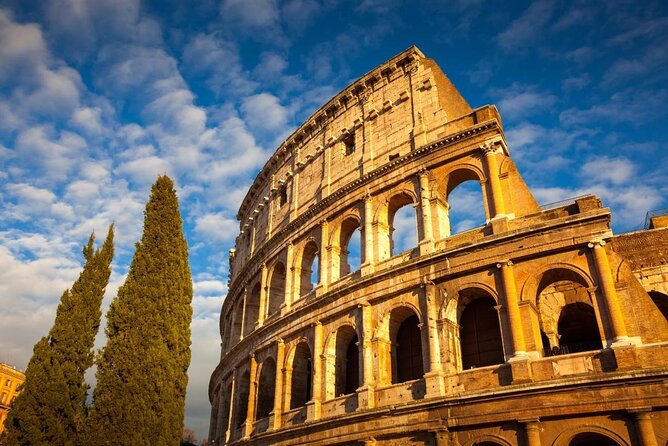
The Colosseum is another major highlight. The Flavian Amphitheater was built almost 2,000 years ago and remains Rome’s most familiar symbol. You see it as part of the larger city route rather than on a dedicated interior visit.
This distinction matters. The tour offers an efficient introduction and excellent photo opportunities, but the Colosseum entrance is not included. If you want to walk through the arena, underground areas, or upper levels, you will need a separate ticket and more time.
The route may finish near the Colosseum before returning to the original meeting point, depending on the day’s operation. The stated end point is back at Piazza della Repubblica, so allow time after the tour for the return and for any nearby plans.
Santa Maria Maggiore and the full morning route
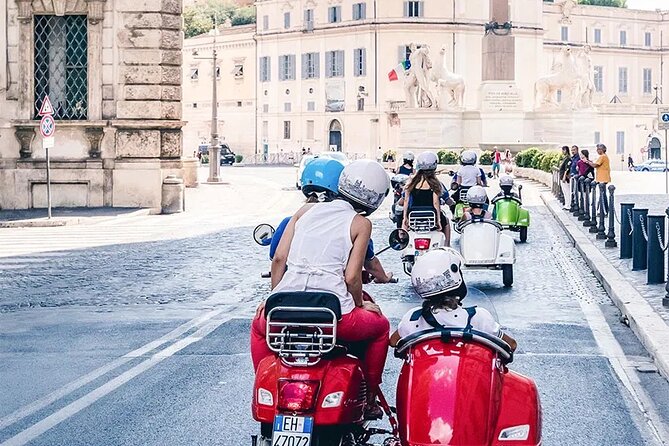
Santa Maria Maggiore is one of Rome’s four major basilicas and the largest Roman church dedicated to the Virgin Mary. The tour presents it as another important exterior sight on the route.
Like Piazza Navona, St. Peter’s Square, and the Vittorio Emanuele monument, it adds variety. You are not seeing only ancient ruins. You are also moving through Rome’s religious, political, artistic, and neighborhood life.
The route covers a lot in a short time. That is its strength, but also its limit. You get a broad first look at Rome, with brief stops and commentary, rather than extended time at each place. I would use this tour early in a Rome visit, then return to the sights that deserve a longer visit.
Drivers, headsets, and comfort
The drivers are a major part of the experience. You do not need to handle Roman traffic, find parking, or work out a route between distant landmarks. That lets you look around instead of staring at a map.
The headsets are also important. Your licensed guide can speak while the group is moving, and you are less likely to miss information in traffic or wind. The commentary is presented live, not simply as a recorded track.
Names praised in the feedback include Luca, Claudio, Matteo, Barbara, Alessio, Massimo, Manuel, Alessandro, Tomas, and Alejandro. Individual assignments can change, but the repeated pattern is clear: the experience depends heavily on guides who mix history, humor, and personal attention with drivers who remain calm and careful.
You receive a CE-approved helmet with a sterilized disposable head cover. Children must be accompanied by an adult and must be at least five years old. Children taller than 150 centimeters may sit behind the driver; otherwise, they must sit in the sidecar.
Is $163.26 good value?
At $163.26 per person, the tour costs more than a standard walking tour or public bus ride. The comparison is not quite fair, though, because this is a private-feeling transport experience with a driver, guide, equipment, breakfast, and Pantheon admission.
The price makes the most sense if you value three things:
- Seeing many parts of Rome in one morning
- Avoiding long walks between scattered sights
- Having a fun, unusual ride that becomes part of the holiday
It makes less sense if you want long visits inside monuments. The Colosseum, Vatican Museums, and St. Peter’s Basilica are not included, and most stops are exterior visits.
The tour also saves you the cost and stress of arranging transport between the Trevi Fountain, Pantheon, Janiculum Hill, Vatican area, Colosseum, and Santa Maria Maggiore. For a first morning in Rome, that convenience can be worth the premium.
Who should book this ride?
I would recommend it to first-time visitors who want a fast introduction to Rome, families with older children, couples, and anyone who finds a full day of walking difficult. It also suits repeat visitors who want to see the city from a fresh angle.
You need to be comfortable sitting on a moving Vespa and following safety instructions. Pregnant participants are not permitted. The sidecar limit is 110 kilograms, or 242 pounds, with a maximum height of 1.90 meters. The rear saddle has a maximum weight of 118 kilograms, or 260 pounds.
If you book one seat, you share the Vespa with another participant. Each vehicle carries two people, one in the sidecar and one behind the driver. At stops, you may be able to swap positions so both people get a sidecar turn. Groups with an odd number of participants must alternate seats at stops.
The experience requires good weather. Free cancellation is available up to 24 hours before the start time, but changes or cancellations inside that window are not accepted. If poor weather forces cancellation, you are offered another date or a full refund.
Should you book the Rome Vespa Sidecar Tour?
Book it if you want a lively overview of Rome, easy transport between major sights, and a morning that feels more memorable than a standard bus circuit. The sidecar, cappuccino, clear headsets, Pantheon entry, and panoramic stop at Janiculum Hill give the experience a strong mix of fun and practical value.
Skip it if your main goal is extended time inside the Colosseum, Vatican Museums, or other monuments. For most first visits, I would book this near the start of your stay, use it to mark places you want to revisit, and then explore your favorites at a slower pace.
FAQ
Where does the Rome Vespa sidecar tour start?
The tour starts at P.za della Repubblica 41, 00185 Rome, at 9 a.m.
Where does the tour end?
The activity ends back at the meeting point in Piazza della Repubblica.
How long does the tour last?
The tour lasts approximately three hours.
What food and drink are included?
Breakfast includes a traditional cappuccino and cornetto. Water is also provided according to the experience details.
Is Pantheon admission included?
Yes. The entrance ticket to the Pantheon is included.
Does the tour include Colosseum admission?
No. The route includes a visit to the Colosseum area, but entry to the Colosseum is not included.
Does the tour include entry to St. Peter’s Basilica?
No. The tour visits St. Peter’s Square, but admission to St. Peter’s Basilica is not included.
How many people can join the tour?
The tour has a maximum of twelve participants.
Can children join the tour?
Yes. Children must be accompanied by an adult and must be at least five years old. Children taller than 150 centimeters may sit behind the driver; shorter children must sit in the sidecar.
What happens if the weather is poor?
The tour requires good weather. If it is canceled because of poor weather, you can choose another date or receive a full refund.
Recently added around Rome
- Palatine Hill and Roman Forum Tour with Fast-Track Entrance★ 4.2 · 417 reviews
- Tivoli: Villa D’Este & Villa Adriana Pass & App Audioguide★ 4.4 · 364 reviews
- From Rome: Villa D’Este & Villa Adriana Day Trip with Lunch★ 4.4 · 289 reviews
- Vatican Museums & Sistine Chapel Skip-the-Line Guided Tour★ 4.6 · 254 reviews
- Rome: The Three Tenors at St. Paul’s Church Concert Ticket★ 4.7 · 699 reviews
- Tivoli: Villa D’Este Entry Ticket and App Audio Guide★ 4.3 · 191 reviews
- Rome: Capitoline Museums and Centrale Montemartini Tickets★ 4.4 · 328 reviews
- Rome: St. Peter’s Basilica and Papal Tombs Guided Tour★ 4.6 · 477 reviews
Motorbike & Scooter Rentals, compared.
Florence Vespa Tour: Tuscan Hills and Italian Cuisine
Read our review →
Chianti Vespa Tour with Lunch from Florence & E-car Option
Read our review →
Highlights Vespa Sidecar Tour with Coffee and Gelato
Read our review →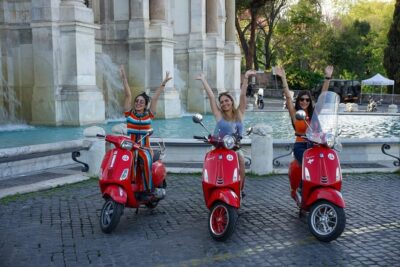
Browse the lists this tour appears in