Reviewed · GUIDED
Ravenna: UNESCO Monuments and Mosaics Guided Tour
Ravenna rewards anyone who looks up. This walking tour makes the city’s ancient mosaics easier to understand, especially at San Vitale and the starry Mausoleum of Galla Placidia. I like the expert storytelling and the included entrance tickets, while the main consideration is that you will walk over cobblestones and stand for parts of the visit.
I also like the choice between a focused two-hour route and a full three-hour visit to all five UNESCO monuments. Guides such as Chiara, Marco, Roberta, Serena, and Cinzia have been praised for clear explanations, humor, and good pacing. The only real drawback is that the shorter option leaves Sant’Apollinare Nuovo for independent visiting, so art lovers should choose the longer route.
In This Review
- Key points to know before booking
- Why Ravenna’s mosaics deserve a guided visit
- Starting in Piazza San Francesco
- San Vitale and the imperial gold
- The starry dome of Galla Placidia
- The Neonian Baptistery and its ancient design
- Sant’Apollinare Nuovo and a long story in mosaics
- The Chapel of Saint Andrew inside the Archbishop’s Museum
- Essential or Complete: which route works better?
- The value of $33 and skip-the-line entry
- Practical details that make the day easier
- Who will get the most from this tour?
- Should you book the Ravenna UNESCO mosaics tour?
- FAQ
- How long does the Ravenna UNESCO monuments tour last?
- What monuments are included in the Essential Experience?
- Which monuments are included in the Complete Experience?
- Where does the tour meet?
- What languages are available?
- Do I need to bring earphones?
- Is the tour wheelchair accessible?
Key points to know before booking
- Five major UNESCO monuments: The complete route visits the Chapel of Saint Andrew, Neonian Baptistery, San Vitale, Galla Placidia, and Sant’Apollinare Nuovo.
- A guide who explains the symbols: You learn how to read the gestures, colors, clothing, and religious scenes in the mosaics.
- Skip-the-line access: Included entry tickets save time, especially when queues form at the most popular monuments.
- Two sensible tour lengths: Choose the two-hour Essential Experience or the three-hour Complete Experience.
- Bring wired earphones: The radio guide system requires earphones with a jack connection.
- Good value at $33: The price includes a local guide and admission to the sites covered by your selected route.
Why Ravenna’s mosaics deserve a guided visit
Ravenna is not a city where you simply check off a church and move on. The mosaics are full of small details, but many of their meanings are hard to grasp without context. A guide can point out who is being honored, how power is shown, and why certain figures face one another across a wall or apse.
The city’s art reflects a meeting point between the Roman world and the Byzantine East. Ravenna served as an important capital during late antiquity, and its churches preserve a visual language shaped by imperial power and Christian belief.
That setting gives the tour more depth than a standard sightseeing walk. You move between religious buildings, but you also follow the story of a city caught between political worlds. Your guide fills the walking stretches with background about Ravenna, its former canals, its rulers, and its role in the 400s and 500s.
I would especially recommend a guide if you do not already know early Christian art. Without help, the gold backgrounds and formal figures can blur together. With a good explanation, you begin to notice gestures, symbols, processions, and changes in artistic style.
A few more Italy bookings to compare
- Colosseum, Roman Forum & Palatine Guided Tour
★ 4.7 · 63,148 reviews - Vatican Museums, Sistine Chapel & St Peter’s Basilica Guided Tour
★ 4.5 · 39,149 reviews - Rome: Colosseum, Palatine Hill and Roman Forum Guided Tour
★ 4.8 · 32,814 reviews
Starting in Piazza San Francesco
The tour begins at the Tourist Information Office at Piazza San Francesco 7. Enter the office and check in at the front desk, where staff register your booking and direct you to the guide.
This is a useful starting point because you do not have to hunt for a church entrance or search for a guide in a crowded square. From there, the group walks through Ravenna’s historic center at a relaxed pace.
The tour is offered in English, Italian, German, and French. Guide assignments can change, but the strongest experiences have come from guides who combine specialist training with a warm local manner. Roberta, described as a qualified archaeologist, was praised for making the period clear and easy to follow. Marco has been singled out for passion, humor, and his ability to keep a group moving through busy conditions.
Group size can vary. Some visits have had only five people, while another group numbered eight. Smaller groups make it easier to hear explanations and get a good viewing position, but you should still expect the normal movement of a shared guided tour.
San Vitale and the imperial gold
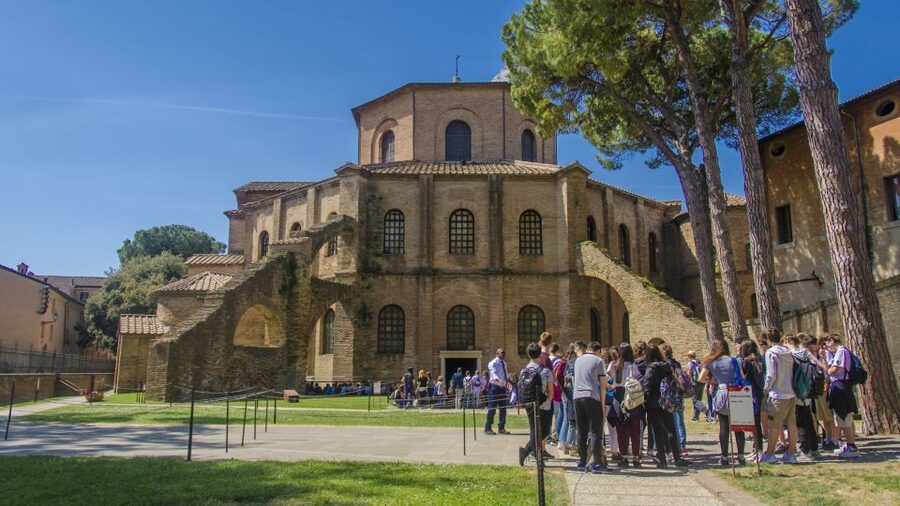
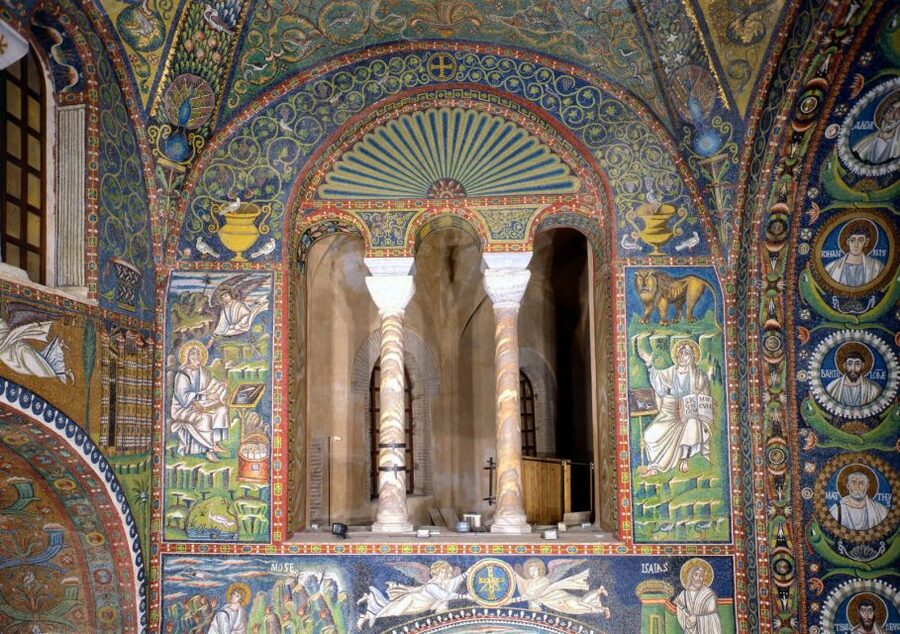
The Basilica of San Vitale is one of the tour’s major moments. Its soaring interior already feels unusual before you begin studying the walls and apse. Then the mosaics draw your attention upward and forward, especially the famous portraits of Emperor Justinian and Empress Theodora.
Your guide helps you see more than gold and color. The imperial figures are presented with ceremony, symbols of authority, and carefully arranged attendants. The decoration links religious power with the rule of the Byzantine court.
This is also a place where position matters. The best view of the mosaics may not be directly in front of you, and a good guide will move the group so you can see the important details without craning your neck. One guide was praised for making sure everyone reached the right viewpoint.
San Vitale can become crowded, and other groups may be inside at the same time. Skip-the-line entry helps you avoid wasting time before entering, but it does not guarantee an empty church. A considerate guide who keeps the group compact is a real advantage here.
The starry dome of Galla Placidia
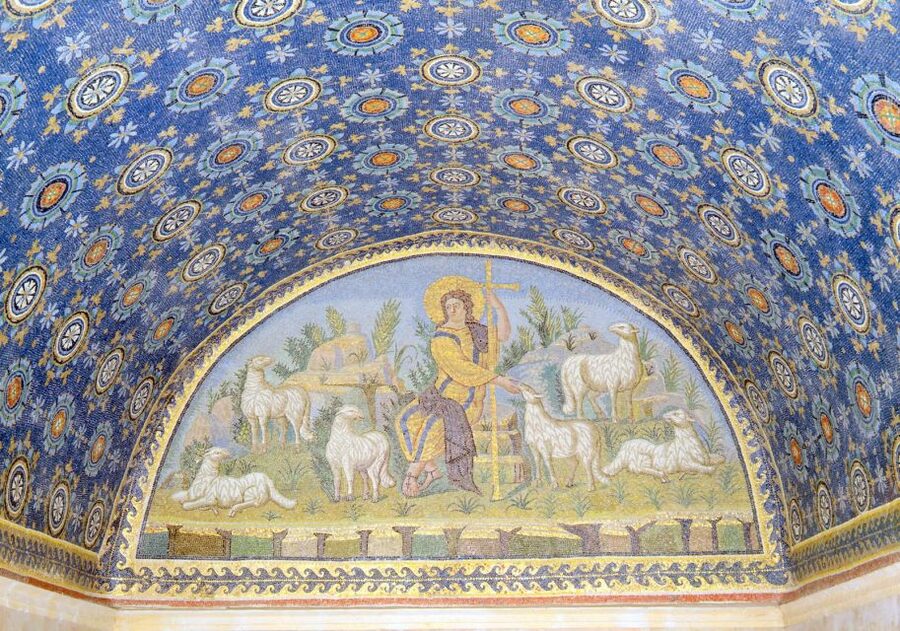
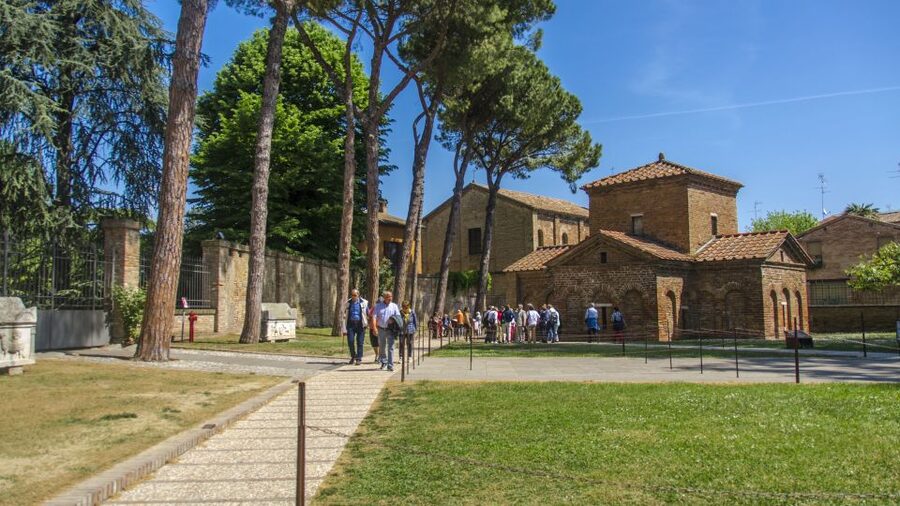
The Mausoleum of Galla Placidia is smaller than San Vitale, but it can make the stronger first impression. Its interior is dark and intimate, with a deep blue dome covered in stars and a golden cross at the center.
This is the stop where you should slow down and let your eyes adjust. The contrast between the shadowy room and the glittering ceiling creates a powerful effect. The building’s size makes the decoration feel close rather than distant.
Your guide explains the religious images and the meaning behind the design, helping you understand why the chapel has inspired visitors for centuries. Dante Alighieri is said to have admired the starry interior, and the tour connects the monument with Ravenna’s place in his story.
The chapel is compact, so space can be tight when several groups arrive. You may not have a seat, and much of the visit involves standing while looking upward. If you have neck or balance problems, take your time and tell the guide if you need a pause.
Still Italy, but a slower afternoon:
- Vatican: Museums & Sistine Chapel Entrance Ticket
★ 4.5 · 144,003 reviews - Vatican Museums & Sistine Chapel Tour with Optional Basilica
★ 4.3 · 67,413 reviews - Milan: Cathedral and Duomo’s Terraces Entrance Ticket
★ 4.6 · 61,054 reviews - Venice: Doge’s Palace Reserved Entry Ticket
★ 4.6 · 42,716 reviews
The Neonian Baptistery and its ancient design
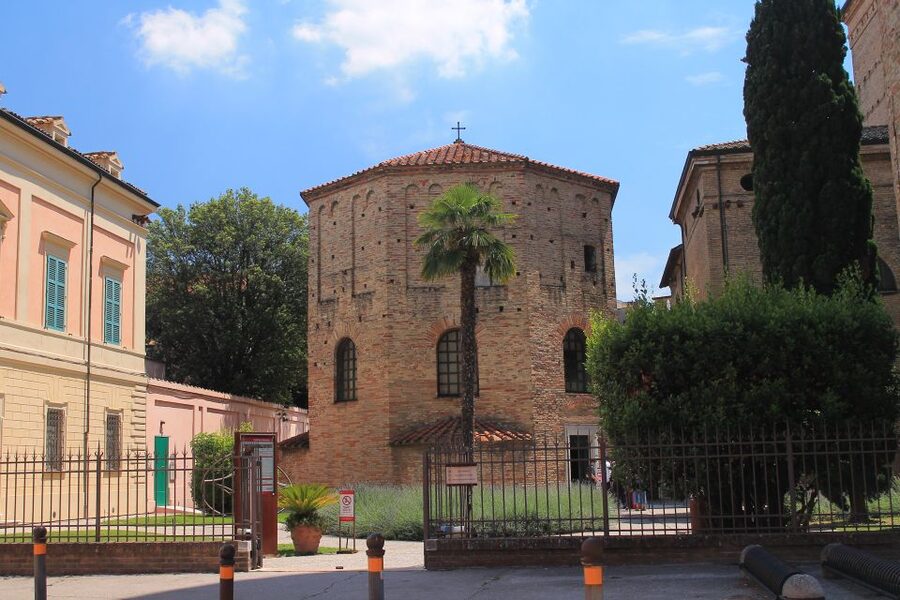
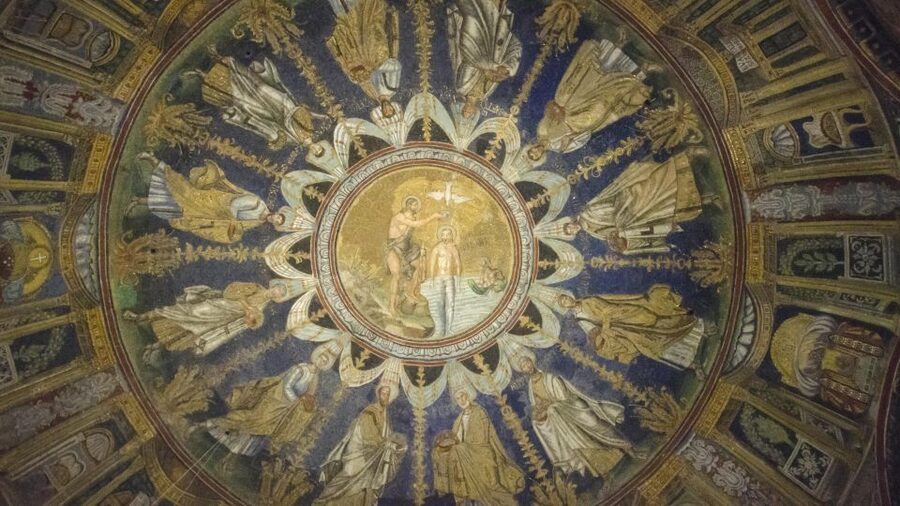
The Neonian Baptistery is one of Ravenna’s oldest buildings and one of the most important stops for understanding early Christian decoration. Its central baptismal scene is surrounded by figures and architectural details that show a strong Hellenistic and Roman influence.
The building is not as large as a basilica, but the dome rewards careful looking. The circular composition draws your eye around the scene, and a guide can explain why the figures are arranged as they are and how the imagery relates to baptism.
This is a good example of why the tour is not only about taking photographs. A camera can record the colors, but it does not explain the religious setting or the artistic choices. You will get more from the building if you listen first, then take time for your own pictures.
The Neonian Baptistery may include uneven surfaces and limited seating. The walking route between monuments also includes cobblestones, so comfortable shoes are sensible.
Sant’Apollinare Nuovo and a long story in mosaics
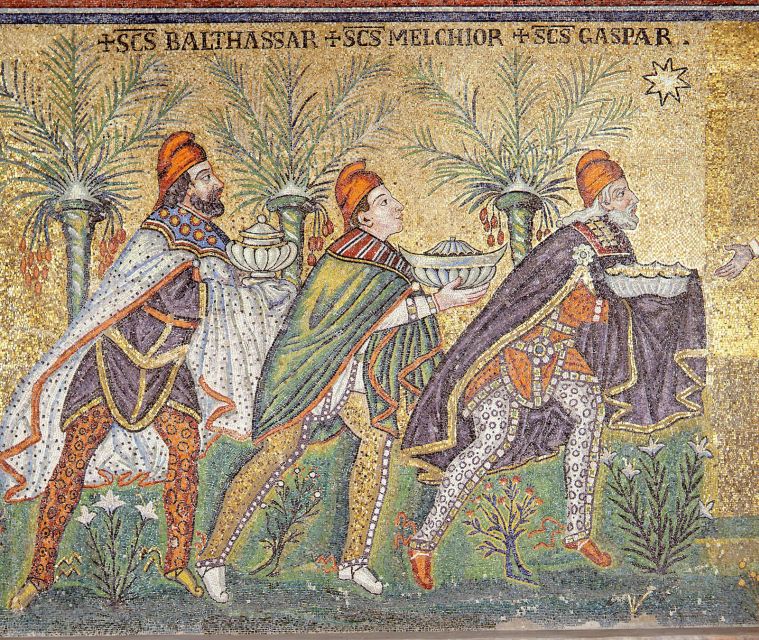
Sant’Apollinare Nuovo is included in the Complete Experience and is the key reason I would choose the three-hour option if your schedule allows. The basilica contains one of the longest mosaic cycles in the world, with scenes connected to the life of Christ.
The scale changes the way you look. Instead of one small chapel or one central dome, you follow long bands of images along the walls. The scenes form a visual sequence, and the guide helps you understand what you are seeing rather than treating each panel as a separate picture.
The basilica also shows how art can carry layers of political and religious meaning. Your guide explains the figures, processions, and changes made over time, drawing attention to details you would probably pass without noticing.
The Essential Experience does not include a guided visit here. After the two-hour route, you may continue independently to Sant’Apollinare Nuovo. That is a useful compromise if you want the main highlights with a shorter guided session, but you will lose the guide’s explanation at one of Ravenna’s most extensive sites.
The Chapel of Saint Andrew inside the Archbishop’s Museum
The Complete Experience also includes the Chapel of Saint Andrew, preserved inside the Archbishop’s Museum. This is a more contained and unusual visit than the large basilicas.
The chapel is important because it survives as an early Christian archiepiscopal space. Its setting inside the museum adds another layer to the day, since you are not only entering a church but also seeing how Ravenna’s religious collections have been preserved.
For visitors with a strong interest in early Christian art, this stop helps justify the extra hour. If your main goal is simply to see the famous gold mosaics, you may find San Vitale, Galla Placidia, and Sant’Apollinare Nuovo more immediately striking.
Essential or Complete: which route works better?
The two-hour Essential Experience includes:
- Neonian Baptistery
- Basilica of San Vitale
- Mausoleum of Galla Placidia
You may then visit Sant’Apollinare Nuovo independently. This version suits a short stop in Ravenna, a busy day trip, or anyone who wants a clear introduction without spending three hours inside monuments and on foot.
The three-hour Complete Experience includes all five sites:
- Chapel of Saint Andrew
- Neonian Baptistery
- Basilica of San Vitale
- Mausoleum of Galla Placidia
- Basilica of Sant’Apollinare Nuovo
I would pick the Complete Experience for a first visit if you care about art, history, or architecture. It gives the mosaics a proper sequence and removes the need to work out separate admission and timing for the final sites.
The Essential Experience is not a lesser tour. It concentrates on three of Ravenna’s most memorable interiors. But if you are making a special trip to the city, the extra hour provides a fuller picture and makes better use of the included ticket arrangement.
The value of $33 and skip-the-line entry
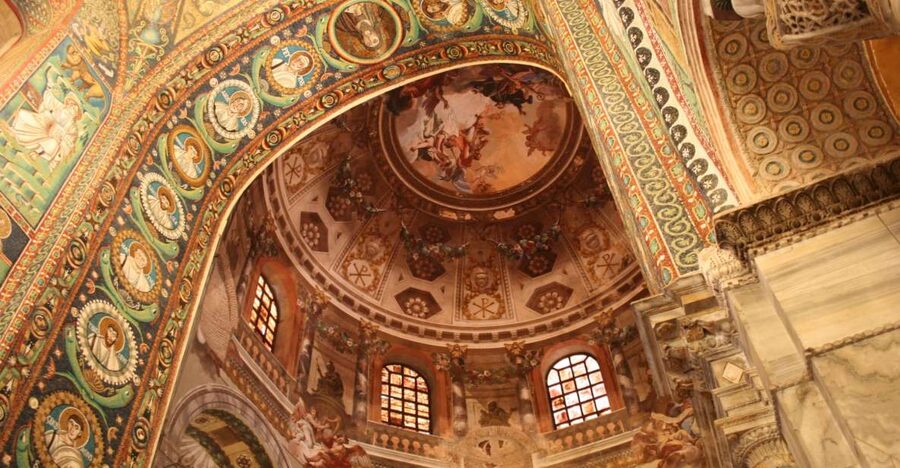
At $33 per person, this tour offers solid value because the cost includes the local guide and entrance tickets to the monuments covered by your chosen option. You are not paying only for a walk around town. You are paying for access plus interpretation.
The time savings can matter just as much as the admission cost. Several of Ravenna’s monuments can develop long lines, and moving between sites on your own means keeping track of opening arrangements and ticket requirements. The tour handles that part for you.
You also receive free time at some locations to take photographs or look around after the explanation. One visit finished earlier than the full three-hour estimate, which suggests the exact pace can vary with the group and conditions.
The payment terms are flexible. You can reserve now and pay later, and cancellation is free up to 24 hours before the tour for a full refund. Check the available starting times when booking because the tour lasts two or three hours depending on your selection.
Practical details that make the day easier
Bring a passport or identity card. A copy is accepted, which is useful if you prefer to keep your original document secure.
Bring your own earphones with a jack connection for the radio guide system. This is an easy detail to miss, and without suitable earphones you may not hear every explanation clearly.
The route is wheelchair accessible, but it still includes walking between monuments, cobblestones, and uneven surfaces. Not every building has seating, so you should expect to stand during parts of the visit.
Pets are not allowed. Weather can affect the walk, so an umbrella is sensible in rainy conditions. One guide helped a group find a gift shop when heavy rain arrived, but it is better to come prepared.
A relaxed pace does not mean a fully seated tour. Wear shoes that handle old stone streets, and allow yourself time to look upward without rushing from room to room.
Who will get the most from this tour?
I would recommend it to first-time visitors, day trippers from Bologna, and anyone who wants the major mosaics explained in plain language. It is also a strong choice for solo visitors, since you get structure and company without needing to arrange a private guide.
Art students and history fans should choose the Complete Experience. The Chapel of Saint Andrew and Sant’Apollinare Nuovo add useful context, while San Vitale and Galla Placidia supply the unforgettable visual moments.
Families with older children may also find the storytelling helpful, especially if young visitors need a reason to look beyond the gold surface. The amount of standing and the uneven streets could be tiring for very young children or anyone with limited mobility.
Independent museum-goers may prefer to visit alone, particularly if they want unlimited time at each mosaic. Still, the symbolism and historical setting are difficult to reconstruct without help, and the skip-the-line access can save a large part of the day.
Should you book the Ravenna UNESCO mosaics tour?
Yes, if you want to understand what you are seeing instead of simply photographing beautiful walls. The guides are the main strength, with repeated praise for clear English, humor, patience, and detailed explanations from people such as Chiara, Marco, Roberta, Serena, and Cinzia.
Choose the Essential Experience when time is tight and you want the three most concentrated highlights. Choose the Complete Experience when Ravenna is a main destination, since all five monuments create a more satisfying picture of the city’s art and position between East and West.
At $33, with entry included and lines avoided, this is an easy recommendation for most first-time visitors. Just bring wired earphones, wear good shoes, and remember that Ravenna’s greatest treasures are often overhead.
FAQ
How long does the Ravenna UNESCO monuments tour last?
You can choose a two-hour Essential Experience or a three-hour Complete Experience.
What monuments are included in the Essential Experience?
The Essential Experience includes the Neonian Baptistery, Basilica of San Vitale, and Mausoleum of Galla Placidia. You may continue independently to Sant’Apollinare Nuovo afterward.
Which monuments are included in the Complete Experience?
The Complete Experience includes the Chapel of Saint Andrew, Neonian Baptistery, Basilica of San Vitale, Mausoleum of Galla Placidia, and Basilica of Sant’Apollinare Nuovo.
Where does the tour meet?
The meeting point is the Tourist Information Office at Piazza San Francesco 7. Enter the office and check in at the front desk.
What languages are available?
The tour is available in English, Italian, German, and French.
Do I need to bring earphones?
Yes. Bring your own earphones with a jack connection for the radio guide system.
Is the tour wheelchair accessible?
Yes, the tour is wheelchair accessible. The route still includes walking, cobblestones, uneven surfaces, and standing at some monuments, so consider these conditions when booking.
Recently added around Italy
- Florence Uffizi Gallery monolingual Small Group Tour★ 4.0 · 621 reviews
- Florence Private Walking tour with Skip-the-line to Accademia★ 4.5 · 236 reviews
- Uffizi Gallery Entrance Ticket with Priority Access★ 3.5 · 1,029 reviews
- Florence Skip-the-Line Duomo Tour with Guide & Brunelleschi Dome★ 5.0 · 1,176 reviews
- Skip-the-Line Accademia Guided Visit: David Secrets and Beyond★ 4.0 · 525 reviews
- Priority Entrance : Florence Accademia Gallery Timely Tickets★ 4.0 · 603 reviews
- Skip the line : David Guided Experience★ 4.5 · 1,076 reviews
- Private Tour in Siena, San Gimignano and Chianti Day Trip from Florence★ 5.0 · 405 reviews
Guided, compared.
Colosseum, Roman Forum & Palatine Guided Tour
Read our review →
Vatican Museums, Sistine Chapel & St Peter’s Basilica Guided Tour
Read our review →
Colosseum, Palatine Hill and Roman Forum Guided Tour
Read our review →
Guided Tour of Colosseum, Roman Forum & Palatine Hill
Read our review →
Colosseum & Forum with Audio Guide App -Optional Arena
Read our review →
Colosseum, Roman Forum and Palatine Hill Guided Tour
Read our review →
Naples Underground Entry Ticket and Guided Tour
Read our review →