
Reviewed · POMPEII & VESUVIUS TOURS
Pompeii: Skip-the-Line Entry Ticket with Audio Guide or Tour
Pompeii makes ordinary Roman life unforgettable. I like the fast entry through the Vox City point and the freedom to explore at your own pace with a phone-based audio guide. I also like how easily the visit brings small details to life, from painted mosaics and wine jars to the temples of Venus, Apollo, and Jupiter. The main drawback is the audio app, which can be awkward to download, navigate, or trigger automatically.
At $37 per person, this is a reasonable choice if you want to avoid the ticket queue and prefer a flexible visit. Choose the live guide if you want the ruins explained in a clear order, especially on a first visit. Choose the self-guided option if you would rather stop for photos, wander down side streets, and stay after the two-hour guided portion.
In This Review
- Key points to know before you go
- Why Pompeii rewards a slow walk
- Picking up your ticket at Piazza Esedra
- What the two-hour visit covers
- The self-guided audio option
- The Forum, temples, and Vesuvius views
- Houses, baths, and everyday Roman life
- The theaters, markets, and city infrastructure
- The victim casts and the eruption of 79 C.E.
- Is $37 good value?
- Weather, crowds, and what to bring
- Who should choose this Pompeii experience?
- Should you book it?
- FAQ
- Where do I pick up the Pompeii entry ticket?
- Is the ticket a direct mobile entry ticket?
- Does the ticket skip the Pompeii ticket line?
- How long does the experience last?
- Is a live guide included?
- What languages are available for the audio guide?
- Do I need my own phone and headphones?
- Should I download the audio guide before arriving?
- Does the ticket include the suburban villas?
- Can I cancel the booking?
Key points to know before you go
- The ticket pickup is close to the entrance: Exchange your voucher at the Vox City information point in Piazza Esedra, in front of Hotel Vittoria.
- Fast entry saves real time: You skip the line for buying admission tickets, which matters most on busy days.
- The audio guide uses your own phone: Bring a charged smartphone, headphones, and enough internet access to download it before arrival.
- The site is much larger than two hours suggests: Two hours covers the main sights, but you can often remain inside and continue exploring.
- The live guide is the stronger history option: Guided tours are available in English, Spanish, and Italian, with art historians or experienced local guides.
- Suburban villas are excluded: The ticket does not include the Villa of the Mysteries, Villa of Diomedes, or Villa Regina.
Why Pompeii rewards a slow walk
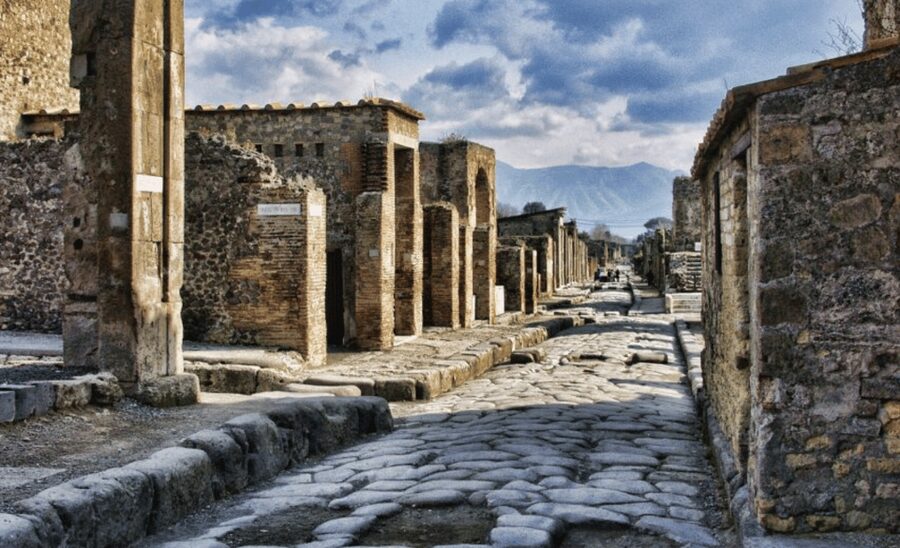
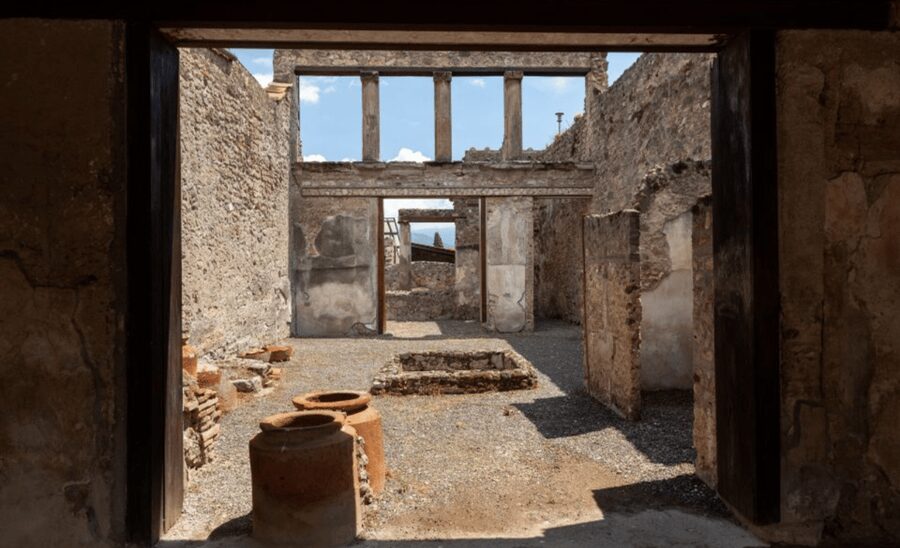
Pompeii is not a single monument. It is an entire Roman town, with streets, houses, temples, shops, theaters, fountains, baths, and public squares left under volcanic ash after the eruption of Mount Vesuvius in 79 C.E.
That scale changes how you should approach the visit. You are not simply moving from one famous room to another. You are crossing a city where daily routines were interrupted. A worn street, a fountain, or a row of shopfronts can be as revealing as a grand temple.
The preservation gives the place unusual force. At the House of the Faun, you can picture the wealth of a large Roman residence. In the public baths, mosaics and rooms show how leisure and social life were organized. At the Forum, Vesuvius rises behind the ancient civic center, creating one of the most memorable views in the whole site.
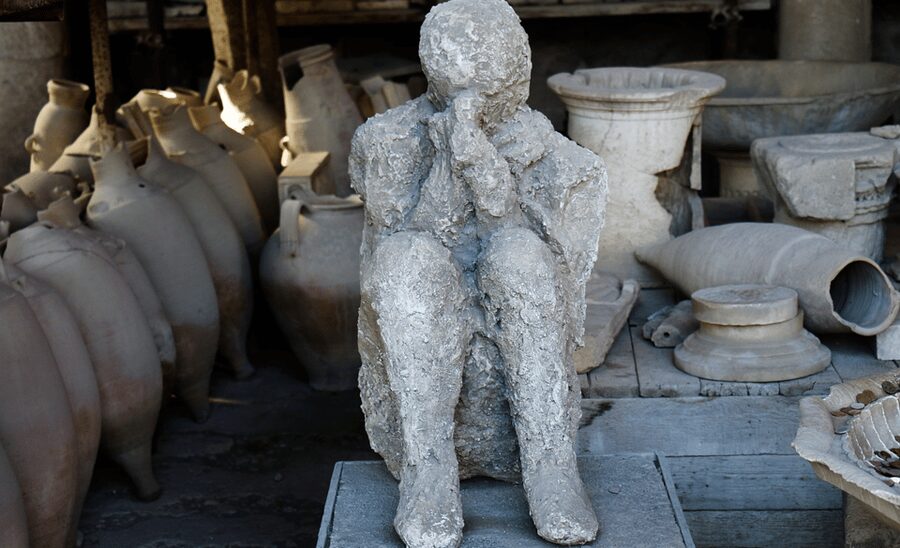
You may also encounter the plaster casts of victims. They are difficult to see, but they give a human weight to the eruption. Pompeii is fascinating because it preserves Roman life, yet the preservation came through terrible destruction.
More Pompeii and Vesuvius trips:
- From Naples: Pompeii Ruins & Mount Vesuvius Day Tour
★ 4.3 · 11,459 reviews - Naples or Sorrento: Full-Day Pompeii and Mount Vesuvius Tour
★ 4.6 · 4,235 reviews - Herculaneum: Skip-the-Line Guided Tour with Archaeologist
★ 4.8 · 3,439 reviews
Picking up your ticket at Piazza Esedra
Your first task is not walking into the ruins. It is exchanging the booking voucher for the official entry ticket.
Go to the Vox City information point in Piazza Esedra, in front of Hotel Vittoria. The pickup point is near the excavation entrance, and the process is generally quick. Have the voucher ready on your phone so staff can locate the booking without delay.
This arrangement has one clear benefit: you avoid searching for a ticket office once you arrive. Several people have found the kiosk easy to locate, even when the entrance area was busy. Staff can also help with directions and, in some cases, the audio guide download.
Do not assume the voucher itself is your final admission ticket. You need to exchange it at the information point first. If you have a live tour, meet the guide there as well and arrive about five minutes before the booked time.
The guided tours are offered in English, Spanish, or Italian. The host or greeter may speak English, Spanish, or Italian, so select your preferred language carefully when booking.
What the two-hour visit covers

A two-hour visit is enough to see major parts of Pompeii, but it is not enough to see everything in a relaxed way. The excavated city covers roughly 44 hectares, and the full area is sometimes described as about 50 hectares. Either way, this is a large site.
A live tour gives you a useful framework. Instead of trying to decide which of dozens of streets to follow, you are led toward important buildings and given context as you go. This is especially useful when crowds gather around popular houses or when several routes appear to lead in the same direction.
The tour can include major public spaces, temples, theaters, residences, baths, and views toward Vesuvius. A good guide also helps you notice details that are easy to miss when you are focused only on the biggest buildings.
The tour lasts about two hours, but you may be allowed to remain in Pompeii afterward and continue on your own. This is one of the best features of the guided option. You get an organized introduction, then time to revisit a favorite area or cover more ground.
One experienced guide named Grace received especially warm praise for her clear English, humor, and friendly manner. Another guide, Maria, was appreciated for her cheerful explanations, while Mario was described as a pleasure to have on the tour. A guide with decades of experience at Pompeii was also praised for fitting a great deal into two hours despite crowds.
Guide quality can vary on any scheduled departure, but these details show what the better tours offer: a strong sense of place, lively explanation, and help finding your way through a very big archaeological area.
The self-guided audio option
The audio guide is a different sort of experience. It does not necessarily lead you along a fixed route. Instead, it provides descriptions of points of interest that you select on a digital map.
This freedom suits you if you dislike being hurried. You can stop to take photos, spend extra time in a house, skip a less interesting building, or wander without keeping up with a group.
The audio commentary is available in English, French, Spanish, German, and Italian. It also includes a digital map, which is important because Pompeii can be confusing. Several people found the short explanations useful and easy to understand. The audio clips often give just enough information to explain a building without turning every stop into a lecture.
The app also has many points of interest. That sounds helpful, but it creates a problem: you may see a long list without knowing which sites deserve priority. One useful improvement would be a clear highlights route or a short list of essential stops.
You should also know that the audio guide may not match the official site numbers or building names exactly. Some users found the names hard to follow, while others had to select each location manually because the automatic playback did not work.
That GPS feature is useful when it works. In practice, it can be unreliable. The audio may fail to start when you enter a zone, or the app may not identify your position accurately. You may need to stop, find the building on the map, and tap the correct audio section yourself.
Download the audio guide before you arrive. Internet service at the site may be weak, and a failed download can waste valuable time. Bring headphones and a fully charged phone. A portable battery is sensible if you plan to stay for several hours and listen to many clips.
A few more Naples bookings to compare
- Naples: Naples Underground Entry Ticket and Guided Tour
★ 4.4 · 21,781 reviews - From Naples: Sorrento, Positano and Amalfi Full-Day Tour
★ 4.6 · 10,988 reviews - From Naples: Sorrento, Positano & Amalfi Coast – Small Group Tour
★ 5.0 · 8,643 reviews - Naples: Catacombs of San Gennaro Entry Ticket & Guided Tour
★ 4.6 · 7,941 reviews
The Forum, temples, and Vesuvius views
The Forum is one of the natural anchors for a Pompeii visit. It was the city’s civic center, and the view toward Vesuvius gives the ruins their strongest sense of drama.
From here, you can visit or view the temples of Venus, Apollo, and Jupiter. Each represents a different part of the city’s religious life, and together they show how public buildings shaped the town.
The Forum can be crowded, especially during popular time slots. A live guide can help you understand what you are seeing without wasting time trying to piece together the layout from a modern map.
For a self-guided visit, use the map before wandering too far. Pompeii’s streets do not always feel intuitive, and it is easy to walk past an important building without realizing it. Mark the Forum and major temples as early targets, then build your route around them.
Houses, baths, and everyday Roman life

Pompeii’s private homes often make the strongest impression because they turn abstract history into something physical.
The House of the Faun is a major stop. Its size and decoration reveal the wealth of the people who lived there. Look for the layout of rooms, courtyards, decorative floors, and the way the house opens onto the street.
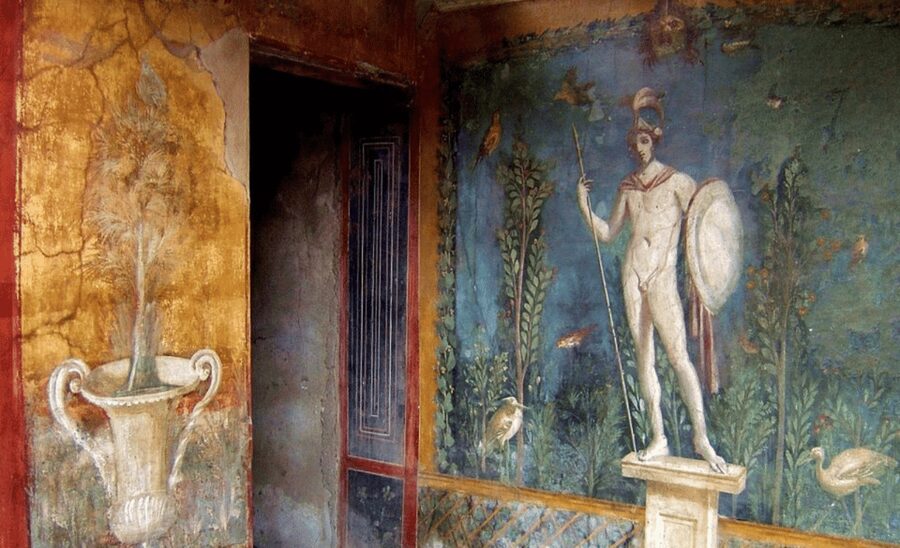
The public baths offer a different picture. Intricate mosaics and the arrangement of the rooms show how bathing combined practical needs, social contact, and decoration. These are not empty stone shells. They preserve the setting for habits that were central to Roman city life.
Small inscriptions can be just as entertaining. At Sirico’s house, you can see the phrase Salve lucru, meaning Welcome, profit. It gives the residence a human voice, with a touch of commercial humor that feels surprisingly modern.
Wine jars labeled Vesuvinum provide another memorable detail. The name plays on Vesuvius and vinum, the Latin word for wine. Details like these are exactly why a guide can be useful. A person who points them out helps you see Pompeii as a lived-in town rather than a collection of ruins.
The theaters, markets, and city infrastructure
Pompeii’s theaters help show how public entertainment fit into city life. You can pause near the grand theater and imagine the scale of an audience gathering there, then compare that public setting with the smaller spaces of private homes.
Markets and commercial areas reveal another side of the city. Shopfronts and work areas suggest that Pompeii was not just a place of grand villas and religious buildings. It was a functioning community where people sold goods, prepared food, worked, worshiped, and socialized.
The aqueduct remains, fountains, and water systems also deserve attention. They are easy to pass without much thought, but they explain how a Roman town supplied its residents and organized public water access.
The audio guide can provide useful snippets at many of these points. The live guide is better if you want the pieces connected into one story. A self-guided visitor may need to do more of that connecting alone.
The victim casts and the eruption of 79 C.E.
The eruption is always present at Pompeii, even when you are looking at an ordinary house or street.
Ash from Vesuvius buried the city and helped preserve buildings, objects, and traces of daily life. The same event killed residents and froze the city at a particular moment. The plaster casts of victims make that contrast painfully clear.
These casts are not simply another stop on a sightseeing route. Give yourself time to process what you are seeing. The site can feel playful and curious in one room, then suddenly somber in the next.
The best explanation of the eruption should connect geology, architecture, and human behavior. A live guide can give you that wider frame. An audio guide offers shorter information at selected points, so you may need to read or listen beyond the basic clip if you want a fuller account.
Is $37 good value?
At $37, the ticket costs more than bare admission, but you are paying for convenience and added interpretation.
The strongest value comes from the skip-the-line entry. On a crowded day, avoiding the ticket queue can make a noticeable difference, particularly when you have limited time in Campania or are fitting Pompeii between Naples, Sorrento, or another excursion.
The audio option is more mixed. Some people find the concise clips and map very useful, especially because they can move independently. Others find the app difficult to download, hard to follow, or too thin on broader historical explanation.
If you already have a good Pompeii guidebook and are comfortable navigating a large site, the audio portion may not justify much extra cost. If you want a simple introduction without joining a group, it can still be worthwhile.
The guided option offers better value for a first visit if the price difference is manageable. You get a route, live explanations, crowd management, and the chance to ask questions. The best guides can also help you see more in two hours than you might manage alone.
Weather, crowds, and what to bring
Pompeii is an outdoor archaeological site, so weather has a direct effect on your day.
On a sunny summer visit, heat can limit how much you see. Bring water, wear comfortable shoes, and plan on taking breaks. Several people underestimated the warmth even when rain or clouds had been forecast.
Rain creates a different problem. Wet stone streets and open ruins can make walking slower, and heavy rain may send you out earlier than planned. Check the forecast before you go and dress for exposure to sun or rain.
The site can be quiet in winter, when the skip-the-line benefit may matter less. On busy dates, the fast entry is more valuable. Either way, keep your timing flexible and do not expect to cover every corner in two hours.
You also need:
- A charged smartphone
- Headphones
- The audio guide downloaded before arrival
- A map, either from the site or in digital form
- Water and weather-appropriate clothing
The ticket does not include the suburban villas. That means you cannot use it to visit the Villa of the Mysteries, Villa of Diomedes, or Villa Regina. If those locations are priorities, check their admission arrangements separately.
Who should choose this Pompeii experience?
I would choose the live guided option for a first visit, families who want a clear route, and anyone who worries about getting lost in a sprawling archaeological site. It is also a good fit if you want the meaning behind the buildings rather than a series of disconnected facts.
I would choose the audio option if you value independence. It works best for people who are comfortable using a map app, carrying headphones, and selecting stops manually when GPS playback fails.
The ticket also suits anyone with a fixed schedule. Fast entry and a pickup point close to the excavation entrance reduce uncertainty, though you still need to allow time to exchange the voucher.
You may want a different arrangement if you need a highly polished audio experience, do not have a smartphone, or want a detailed, chronological account of Pompeii. The audio guide is not a substitute for a strong human guide in every situation.
Should you book it?
Book this experience if skipping the ticket queue matters and you want either a flexible audio visit or an optional live tour. The easy pickup at Piazza Esedra, the nearby entrance, and the chance to remain inside after a guided portion make it practical.
For the best overall visit, I would pay for the guided option if this is your first time at Pompeii. If you choose the audio version, download it early, bring a map, and treat the app as a helpful reference rather than a perfect route planner.
Pompeii itself is the reason to go. The ticket makes entry easier, but the real reward is seeing a whole Roman city, from grand temples and villas to jokes scratched into walls and wine jars with a volcanic pun.
FAQ
Where do I pick up the Pompeii entry ticket?
Exchange your voucher at the Vox City information point in Piazza Esedra, in front of Hotel Vittoria.
Is the ticket a direct mobile entry ticket?
No. You need to exchange the voucher for the official entry ticket at the Vox City information point before entering.
Does the ticket skip the Pompeii ticket line?
Yes. It lets you skip the line for purchasing entry tickets at the site.
How long does the experience last?
The listed duration is two hours. Visitors often spend two to four hours inside, and people using the guided option may be able to stay and continue exploring after the tour.
Is a live guide included?
A live guide is included only if you select the guided tour option. Guided tours are available in English, Spanish, or Italian.
What languages are available for the audio guide?
The audio commentary is available in English, French, Spanish, German, and Italian.
Do I need my own phone and headphones?
Yes. Bring a charged smartphone and headphones. The audio guide is downloaded to your own device.
Should I download the audio guide before arriving?
Yes. The instructions recommend scanning the QR code on your voucher and downloading it before arrival because internet service at Pompeii may be unreliable.
Does the ticket include the suburban villas?
No. It does not include the Villa of the Mysteries, Villa of Diomedes, or Villa Regina.
Can I cancel the booking?
You can cancel up to 24 hours in advance for a full refund. The reserve-now-and-pay-later option is also available.
Recently added around Naples
- Vesuvius National Park Skip-the-Line Ticket★ 3.8 · 221 reviews
- Naples: The Holy Mile 3-Hour Guided Tour★ 4.9 · 711 reviews
- Pompeii and Vesuvius Full-Day Tour from Amalfi Coast★ 4.4 · 319 reviews
- From Naples: Pompeii & Herculaneum with Archaeologist Guide★ 4.8 · 665 reviews
- From Naples: Pompeii and Herculaneum Tour with Lunch★ 4.3 · 444 reviews
- From Naples: Pompeii Guided Tour with Skip-the-Line Tickets★ 4.8 · 1,171 reviews
- Naples: Day Trip to Pompeii and Capri★ 4.4 · 272 reviews
- From Naples: Pompeii & Amalfi Coast Full-Day Trip★ 4.5 · 279 reviews
Pompeii & Vesuvius Tours, compared.

Entry Ticket and Guided Tour with an Archaeologist
Read our review →




Pompeii Small Group Tour with an Archaeologist
Read our review →
Pompeii, Amalfi Coast and Positano Day Trip from Rome
Read our review →Browse the lists this tour appears in