
Reviewed · POMPEII & VESUVIUS TOURS
Pompeii: Private Tour with an Archaeologist
Pompeii still feels startlingly close. This private walk through the ruined Roman city pairs skip-the-line entry with a guide who can explain the streets, homes, temples, and human stories behind the stones. I especially like the chance to ask questions at your own pace, and I like that the route covers major public buildings as well as private houses. The main concern is the price: at $508.15 for a group up to one, this is a costly choice unless personal attention matters greatly to you.
The three-hour route includes the Forum, Temple of Apollo, House of Menander, brothel, theaters, House of the Faun, House of the Vettii, and amphitheater. Guides such as Nicoletta, Patrizia, Laura, Mena, and Michele have been praised for warmth, flexibility, and clear storytelling, though one guest questioned whether the assigned guide truly had an archaeologist’s credentials. Wear sturdy shoes, since Pompeii means long walking over ancient paving and uneven ground.
In This Review
- Key points to know before booking
- Starting at Porta Marina Superiore
- Porta Marina and the first steps into Pompeii
- Temple of Apollo and the civic center
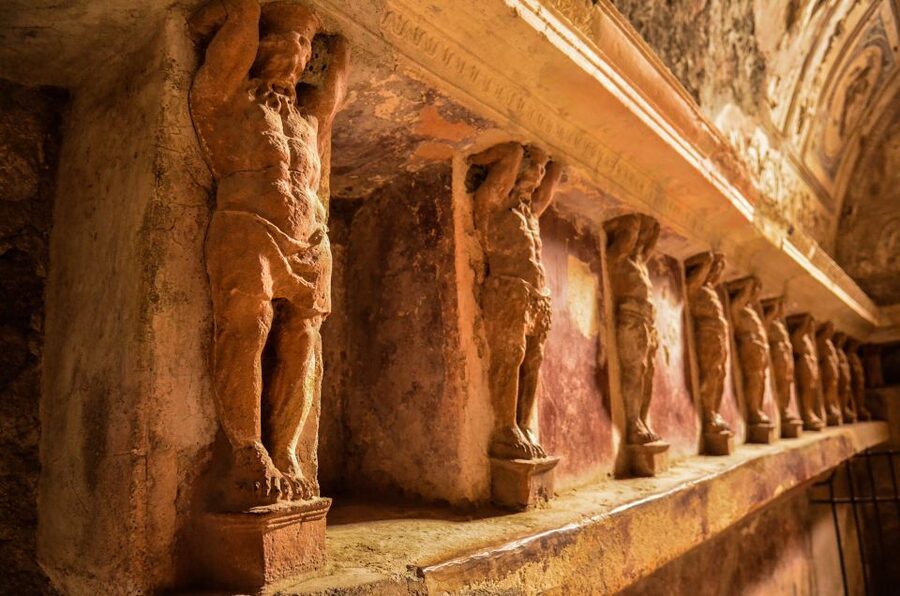
- House of Menander and the Forum Baths
- The Lupanare and Pompeii’s franker side
- House of the Faun and the city’s grand homes
- The theaters and the Amphitheater of Pompeii
- The plaster casts and the human cost
- Why the archaeologist guide matters
- Is $508.15 good value?
- Three hours, weather, shoes, and practical limits
- Who should book this Pompeii tour?
- FAQ
- Where does the Pompeii tour begin?
- How long does the private Pompeii tour last?
- Is admission included?
- What languages are available?
- Does the tour include transportation or food?
- Can I cancel the tour for a refund?
- Should you book it?
Key points to know before booking
- Porta Marina Superiore is the meeting point: Find your guide at the main gate, in front of Hortus, the bar-restaurant with lemons and oranges hanging outside.
- The route covers Pompeii’s big sights: You see temples, civic buildings, baths, houses, shops, theaters, the brothel, plaster casts, and the amphitheater.
- Private guiding changes the pace: You can ask questions, pause for explanations, and discuss your own interests instead of following a large group.
- The displayed price is high: At $508.15 for a group up to one, the value depends on how much you want expert attention and skip-the-line access.
- Three hours is useful but not unlimited: You get a strong first look at Pompeii, but the site is large and you may want extra time afterward.
- Check the accessibility details carefully: The activity is described as wheelchair accessible in one place and not suitable for wheelchair users in another, so confirm before paying.
Starting at Porta Marina Superiore
Your tour begins at Porta Marina Superiore, one of Pompeii’s main entrances. Look for the guide in front of Hortus, the bar-restaurant marked by lemons and oranges outside. That detail matters because Pompeii has several gates and ticket entrances, and arriving at the wrong one can waste precious tour time.
The meeting point puts you at the western side of the ancient city, close to the route’s first sights. You do not receive transportation, food, or drinks, so arrange those separately. The activity ends back at the meeting point, with a second possible drop-off reference at the Pompeii ticket office, Scavi di Pompei, Porta Marina Superiore.
The tour is private, which is its biggest practical advantage. Your group can ask about architecture, religion, daily life, or the eruption without waiting for a guide to finish addressing a crowd. Guides have also adjusted the route to personal interests and shifted the pace around busy areas, a useful benefit at a site where narrow lanes and popular houses can slow everyone down.
More Pompeii and Vesuvius trips:
- From Naples: Pompeii Ruins & Mount Vesuvius Day Tour
★ 4.3 · 11,459 reviews - Naples or Sorrento: Full-Day Pompeii and Mount Vesuvius Tour
★ 4.6 · 4,235 reviews - Herculaneum: Skip-the-Line Guided Tour with Archaeologist
★ 4.8 · 3,439 reviews
Porta Marina and the first steps into Pompeii
Porta Marina introduces Pompeii as a real city rather than a collection of isolated ruins. As you pass through the gate, your guide begins to explain how the city functioned and what the eruption of Mount Vesuvius preserved in ash in 79 A.D.
I find this opening valuable because Pompeii can seem confusing at first. Walls, columns, paved streets, and open spaces spread in every direction. A guide gives those remains a place in the city’s plan and helps you notice details that would otherwise look like ordinary rubble.
The walk is intense in the best sense. You are not simply looking at a few famous objects. You are moving through streets, public spaces, houses, shops, fountains, and entertainment buildings, with the feeling of a town interrupted rather than a town erased.
Temple of Apollo and the civic center
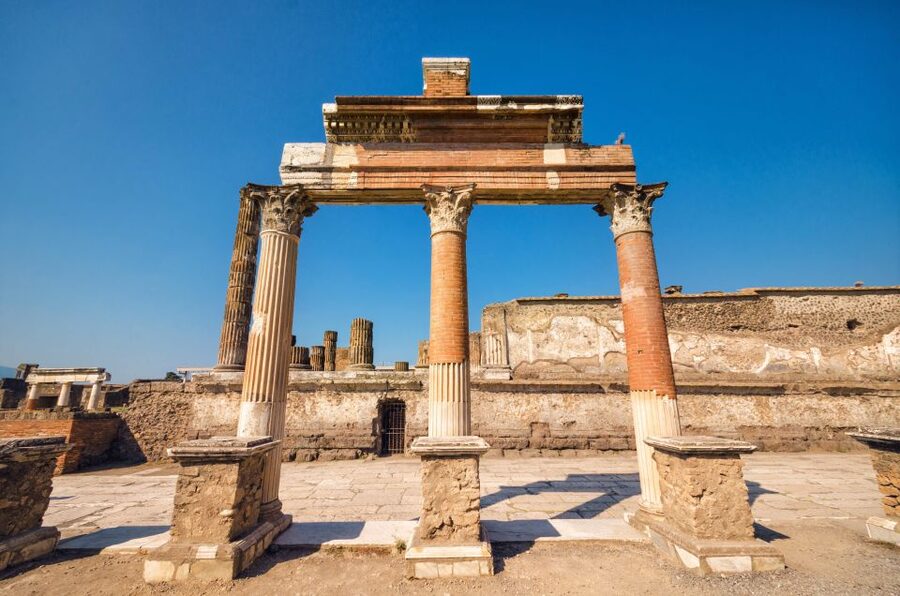
The Temple of Apollo is one of the early major stops. It helps frame Roman public life, where religion, politics, commerce, and social activity were closely tied together.
Next comes the Foro Civile di Pompei, the main civic Forum. This is one of the tour’s key orientation points. The Forum gives you a broad view of Pompeii’s public heart and lets your guide connect the surrounding buildings to the city’s institutions.
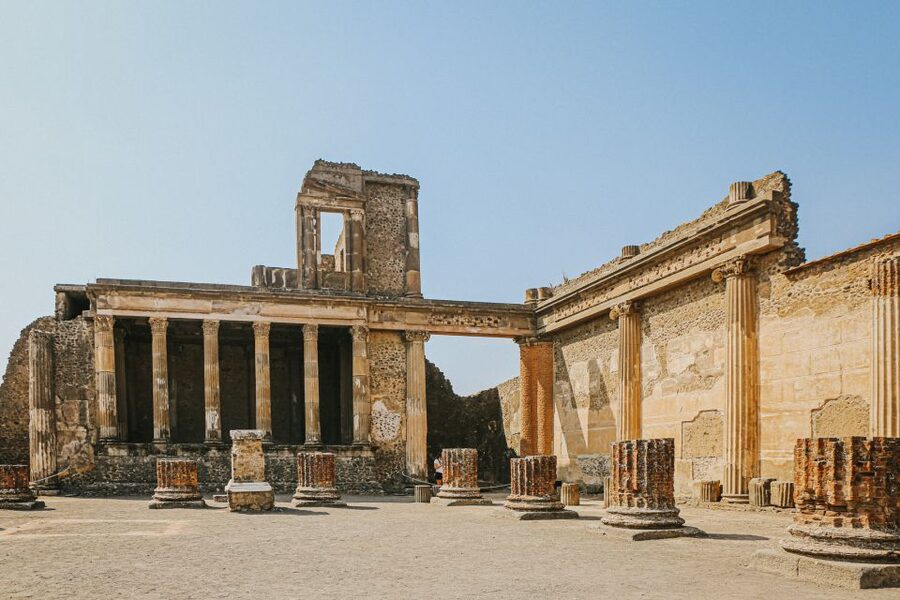
The Basilica follows. Despite the name, this was not a Christian church. In Roman cities, a basilica could serve legal and business purposes. That distinction is exactly the kind of small but important point a guide can clarify while you are standing among the columns.
The Temple of Jupiter also appears among the tour’s central sights. Your guide can place it within the Forum area and explain how religion and civic authority were presented side by side. If you enjoy ancient history, this section provides the clearest look at Pompeii as an organized Roman community, not merely a disaster site.
House of Menander and the Forum Baths
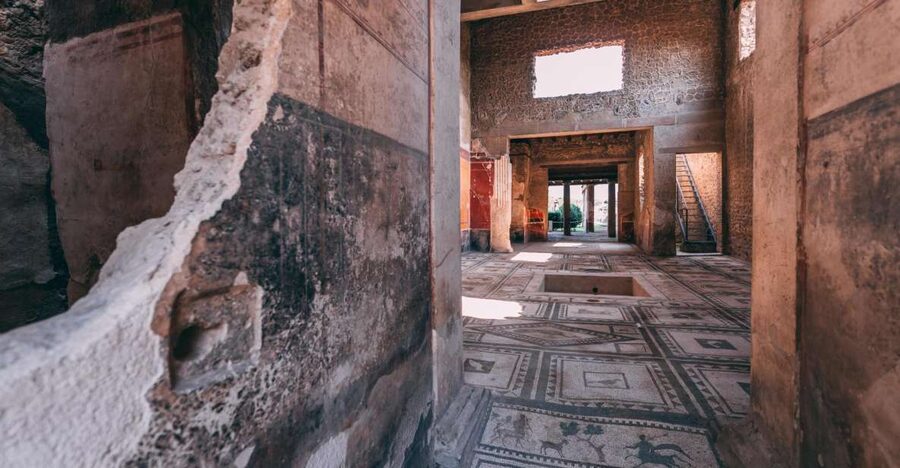
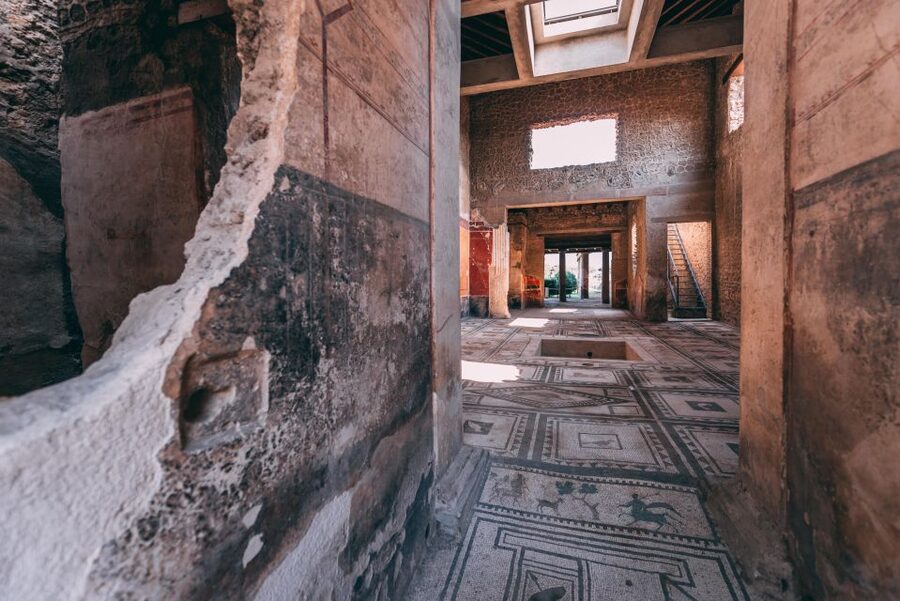
The House of Menander shifts the focus from public buildings to domestic life. Private houses are where Pompeii becomes especially human. You can see how wealth, decoration, household space, and status shaped daily living.
The house takes its name from a connection to Menander, the Greek playwright. The stop is useful because it shows that Roman culture was not limited to Latin public inscriptions or military power. Greek art and theater also influenced elite Roman homes.
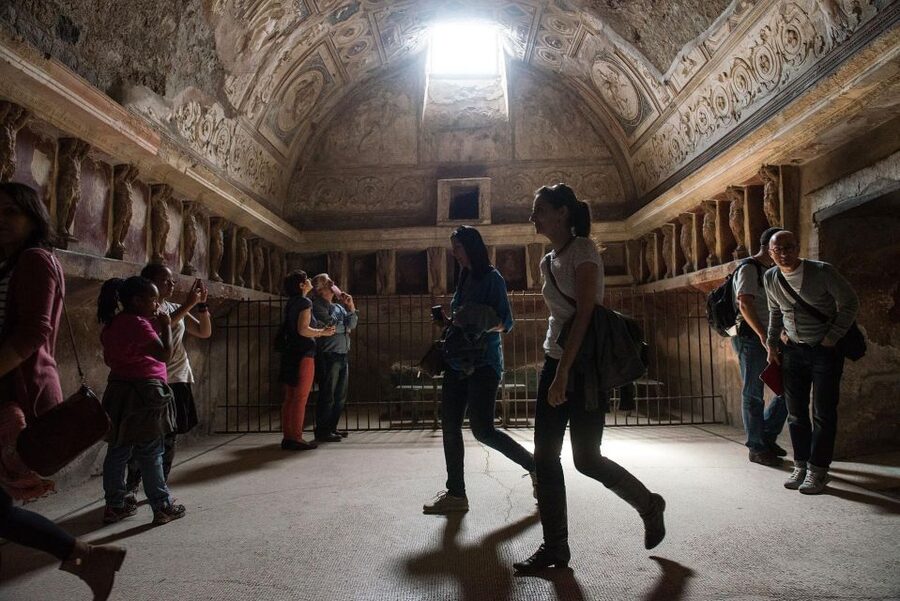
The Forum Baths offer another view of ordinary routines. Public baths were social spaces as well as places to wash. A guide can help you understand how bathing fit into the rhythm of Roman life and why these buildings mattered to people across the city.
Expect plenty of standing during this part of the walk. Three hours may sound short, but explanations at each stop add up. If you want long photo breaks or detailed time inside every house, you may need to continue exploring after the formal tour.
A few more Naples bookings to compare
- Naples: Naples Underground Entry Ticket and Guided Tour
★ 4.4 · 21,781 reviews - From Naples: Sorrento, Positano and Amalfi Full-Day Tour
★ 4.6 · 10,988 reviews - From Naples: Sorrento, Positano & Amalfi Coast – Small Group Tour
★ 5.0 · 8,643 reviews - Naples: Catacombs of San Gennaro Entry Ticket & Guided Tour
★ 4.6 · 7,941 reviews
The Lupanare and Pompeii’s franker side
The Lupanare, or brothel, is one of Pompeii’s most talked-about stops. Its presence reminds you that the city’s preserved remains include not only temples and wealthy homes, but also the less polished parts of urban life.
This stop can feel crowded, depending on the day and opening conditions. A private guide helps by explaining what you are seeing and answering questions without turning the visit into a rushed glance at the doorway.
Pompeii’s famous erotic images and small rooms often attract attention, but the greater value is the context. The brothel is one piece of a larger urban economy that included shops, fountains, public buildings, and homes. Your guide can help you avoid reducing Pompeii to its more sensational details.
House of the Faun and the city’s grand homes
The House of the Faun is among Pompeii’s most important residences. Its scale gives you a sense of the wealth that existed in the city before the eruption.
The name refers to a faun statue associated with the house. This is also where the contrast between grand private living and the broader city becomes clear. Pompeii was not socially equal. Large residences, modest homes, commercial spaces, and public facilities sat within the same urban system.
The House of the Vettii continues that look at wealth and decoration. Both houses help you understand how Roman families used architecture to display status. Your guide can point out the relationship between courtyards, rooms, decoration, and movement through the home.
These houses may be especially rewarding if you like art and archaeology. They also require patience. Access to particular buildings can change, and popular interiors may be busy. A private guide cannot control every closure or crowd, but can help you use the available time well.
The theaters and the Amphitheater of Pompeii
The Large Theatre brings public entertainment into view. Pompeii’s theaters show that performance, music, and communal gatherings were part of city life long before the eruption.
The Amphitheater of Pompeii provides a different scale. It was built for large public spectacles and remains one of the site’s most recognizable structures. Seeing both theater areas in one tour helps you compare smaller performance spaces with a venue designed for a much larger audience.
For families, these stops can keep younger visitors engaged. One guide was praised for holding children’s attention, and another tour included 12-year-old twins who reportedly enjoyed the experience. That does not guarantee every child will love three hours of ruins, but a lively guide and varied route improve the odds.
The plaster casts and the human cost
The plaster casts of victims are among Pompeii’s most difficult sights. They bring the eruption out of the realm of dates and architecture and back to the people who lived and died here.
A good guide handles this part with care. Nicoletta was praised for keeping attention on the humanity of the people affected, not treating the casts as mere spectacle. That approach matters. Pompeii is fascinating because it preserves daily life, but the preservation came through a tragedy.
The casts may be emotionally heavy, especially for children. You can ask your guide for context and take a moment before moving on. The private format makes that easier than it would be in a large group that must keep to a fixed pace.
Why the archaeologist guide matters
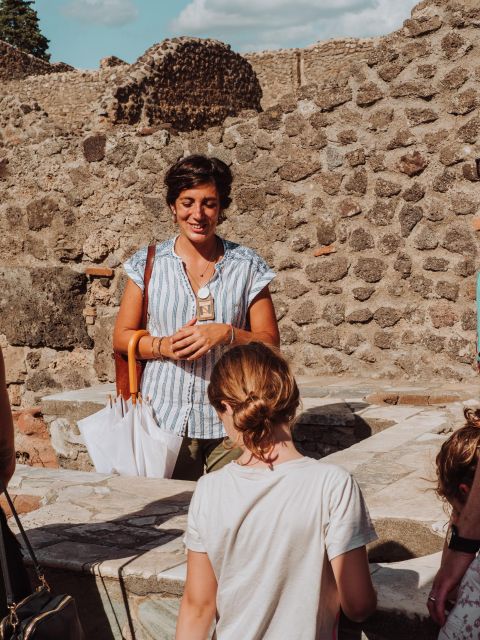
The strongest part of this experience is the guide rather than the entrance ticket. Pompeii can be read as a long series of walls, but an excellent archaeologist-guide turns those walls into evidence of work, worship, family life, trade, entertainment, and social rank.
Several guides received especially strong praise. Nicoletta was described as both warm and able to explain fine archaeological details. Patrizia adapted the route to personal preferences. Laura was valued for changing pace around crowds. Mena gave historical context, answered questions freely, and offered suggestions for what to see next. Michele’s passion helped visitors notice details underfoot and in plain sight.
Paola was praised for explaining not only the city and eruption, but also excavation and preservation. Diego focused on art, history, and culture. These descriptions point to the kind of guide this tour aims to provide: someone who can connect physical remains with the work of interpreting them.
Still, pay attention to the wording of your booking confirmation. The experience is advertised with a certified archaeologist-guide, but one person felt the assigned guide did not match that promise. That appears to be an exception among otherwise very positive feedback, yet it is a fair consideration when the price is this high.
Is $508.15 good value?
The listed cost is $508.15 per group up to one. That wording is unusual, so check the final price for your exact party before booking. If the amount applies to a private group rather than literally one individual, the value improves as more people share the cost.
You are paying for a private format, a live guide, skip-the-line admission fees, and a focused three-hour route. You are not paying for transport, meals, drinks, or personal expenses. If you are arriving from Naples, Sorrento, or elsewhere in Campania, you must arrange your own way to Pompeii.
I would consider this a premium purchase. It makes the most sense if you care about archaeology, want to ask many questions, have limited time, or strongly dislike large group tours. If you are happy to read signs and explore independently, the price may be difficult to justify.
The 4.9 rating from 168 reviews supports the idea that guide quality is usually high. Even so, a rating cannot remove the basic tradeoff: a private specialist-led visit costs much more than entering Pompeii on your own.
Three hours, weather, shoes, and practical limits
Wear comfortable shoes. Pompeii’s ancient paving and long walking route demand more from your feet than a normal city stroll. Bring water and plan for sun or rain, though food and drinks are not included.
The tour operates in any weather. Rain protection is recommended, but the instructions also say umbrellas are not allowed, creating a practical contradiction. A small raincoat is the safer choice, and you should confirm the current rule before arriving.
Skip-the-line admission is included, which can save time at the entrance. On the first Sunday of each month, admission is free, but tickets cannot be reserved ahead of time and entry is not guaranteed. I would not choose that day for this paid tour if guaranteed access is important to you.
The accessibility information also conflicts. One section describes the activity as wheelchair accessible, while another says it is not suitable for wheelchair users. Contact the operator before booking if anyone in your group uses a wheelchair or needs a step-free route.
Language choices are unusually broad: English, Italian, Spanish, German, French, Portuguese, Japanese, Chinese, Russian, and more are listed. Confirm your preferred language and guide availability before you commit.
Who should book this Pompeii tour?
I would recommend it to first-time visitors who want Pompeii explained rather than simply photographed. It also suits history, archaeology, anthropology, and ancient Roman culture enthusiasts who will make good use of a private guide’s time.
Families can benefit from the varied route and the chance to keep children involved with questions. The private setting also helps if your group needs a slower pace or has specific interests.
I would be less likely to recommend it to budget-conscious visitors, independent explorers, or people who want a relaxed half-day wandering without a fixed three-hour structure. You may also find the route demanding if you are uncomfortable with uneven walking or hot weather.
FAQ
Where does the Pompeii tour begin?
Meet your guide at Porta Marina Superiore, the main Pompeii gate, in front of Hortus bar-restaurant. Look for the building with lemons and oranges hanging outside.
How long does the private Pompeii tour last?
The tour lasts three hours. Starting times depend on availability.
Is admission included?
Yes. Skip-the-line admission fees are included in the tour.
What languages are available?
The listed guide languages are Japanese, English, Spanish, Italian, German, French, Portuguese, Chinese, and Russian. Confirm your preferred language when booking.
Does the tour include transportation or food?
No. Transportation, food, drinks, and personal expenses are not included.
Can I cancel the tour for a refund?
You can cancel up to 24 hours in advance for a full refund. The reserve-now, pay-later option is also available.
Should you book it?
Book this tour if you want Pompeii to make sense and you value direct access to a guide who can explain small details, answer questions, and adapt the route. The strongest praise centers on warm, engaging guides who make the ruins feel personal rather than remote.
Skip it if $508.15 is beyond your budget or if you prefer self-guided exploration. Before paying, confirm the group pricing, guide credentials, preferred language, and accessibility details. With those points settled, this is a strong choice for a serious, well-guided first visit to Pompeii.
Recently added around Naples
- Vesuvius National Park Skip-the-Line Ticket★ 3.8 · 221 reviews
- Naples: The Holy Mile 3-Hour Guided Tour★ 4.9 · 711 reviews
- Pompeii and Vesuvius Full-Day Tour from Amalfi Coast★ 4.4 · 319 reviews
- From Naples: Pompeii & Herculaneum with Archaeologist Guide★ 4.8 · 665 reviews
- From Naples: Pompeii and Herculaneum Tour with Lunch★ 4.3 · 444 reviews
- From Naples: Pompeii Guided Tour with Skip-the-Line Tickets★ 4.8 · 1,171 reviews
- Naples: Day Trip to Pompeii and Capri★ 4.4 · 272 reviews
- From Naples: Pompeii & Amalfi Coast Full-Day Trip★ 4.5 · 279 reviews
Pompeii & Vesuvius Tours, compared.
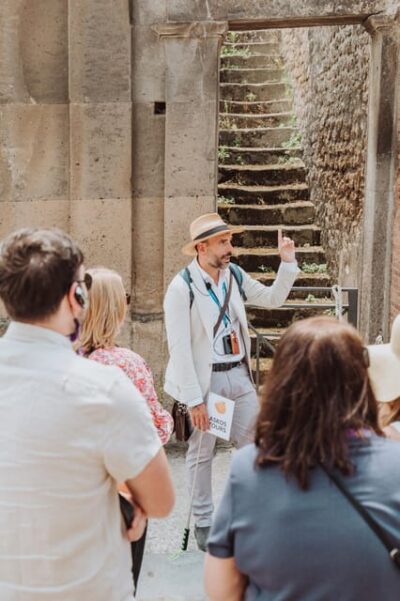
Entry Ticket and Guided Tour with an Archaeologist
Read our review →

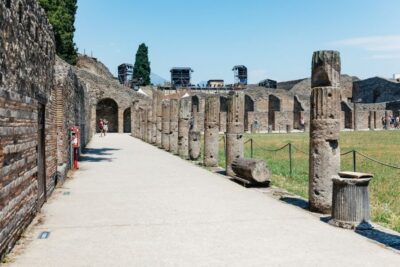
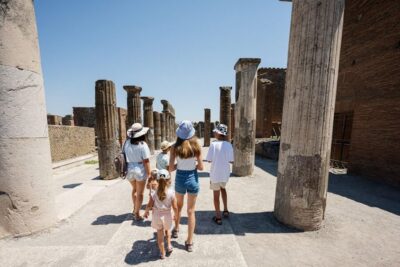

Pompeii Small Group Tour with an Archaeologist
Read our review →
Pompeii, Amalfi Coast and Positano Day Trip from Rome
Read our review →Browse the lists this tour appears in