
Reviewed · POMPEII & VESUVIUS TOURS
Naples: Pompeii Self Guided Audio Tour
Pompeii rewards a slower, curious visit. This smartphone audio tour makes the ruins easier to read, with 60-plus geolocated stops covering the amphitheater, House of the Vettii, brothel, baths, taverns, frescoes, and mosaics. I like the clear explanations and the interactive map, which help you move through a huge site without missing its best-preserved corners.
I also like the price: $4.70, less than half the usual on-site audioguide cost, with access that remains yours for future visits. The trade-off is that this is not a person walking beside you, and the app can be fiddly. You must download the content before entering Pompeii, and a few users had trouble with navigation or getting the app to keep their place.
In This Review
- Key points to know before you go
- A low-cost way to make sense of Pompeii
- What you see in four hours at the ruins
- The amphitheater and Pompeii’s public life
- House of the Vettii and the best-preserved interiors
- The brothel, baths, and the less polished side of Roman life
- Taverns, bread, frescoes, and daily routines
- How well the map works inside Pompeii
- Price, ticket costs, and what you actually receive
- Who will get the most from this audio tour
- Practical setup before you enter
- Final verdict: is the $4.70 Pompeii guide worth it?
- FAQ
- Is the Pompeii entrance ticket included?
- Is there a meeting point?
- How long is the audio guide valid?
- How do I activate the Pompeii guide?
- Do I need internet inside Pompeii?
- Which languages are available?
- Can I use the guide again on another visit?
- Can I cancel the booking?
Key points to know before you go
- More than 60 marked points of interest: Hear about major houses, public buildings, artwork, food, bathing, and Roman trades.
- A map that helps shape your visit: The app shows points of interest and marks places you have visited, though it does not always show your exact position.
- Four hours from first activation: That is enough for a focused visit, but Pompeii is large, so avoid rushing.
- Download everything on Wi-Fi first: Mobile service inside the excavations can be poor.
- Useful for independent sightseers: Start at any open entrance and set your own pace, with no meeting point or fixed group.
- Good value at $4.70: You pay only for the digital guide. Your Pompeii entrance ticket is separate.
A low-cost way to make sense of Pompeii
Pompeii can feel confusing at first. You walk along ancient streets, pass one doorway after another, and quickly realize that a bare wall tells only part of the story. The ITGUIDES app fills in that missing layer with short audio segments, written descriptions, photographs, and an interactive map.
The guide is not limited to dates and names. It explains how Roman baths worked, what people ate in ancient taverns, how bread was made, and why urine was collected for processing wool. Those small details are useful because they turn Pompeii from a field of ruins into a place where ordinary work, meals, business, and leisure once took place.
You receive access through the ITGUIDES app. After buying the activity, download the free app, enter its menu, and use the contact page to send your app user ID and booking number. The provider then activates the Pompeii content. Instructions are included with your voucher, and help is available through WhatsApp using the number shown in the app.
That setup is not quite as instant as pressing play on a rented device at the entrance. Still, several people found the activation help quick, with one person receiving assistance in about two minutes. I would complete the process before leaving your hotel or apartment, not while standing at the Pompeii gate.
More Pompeii and Vesuvius trips:
- From Naples: Pompeii Ruins & Mount Vesuvius Day Tour
★ 4.3 · 11,459 reviews - Naples or Sorrento: Full-Day Pompeii and Mount Vesuvius Tour
★ 4.6 · 4,235 reviews - Herculaneum: Skip-the-Line Guided Tour with Archaeologist
★ 4.8 · 3,439 reviews
What you see in four hours at the ruins
The audio tour has more than 60 points, so it does not force you into one strict route. You use the map to choose what interests you, then walk to the next marked location. This is a useful approach at Pompeii because restoration work can close individual buildings, and your route may need to change during the day.
The four-hour validity begins with your first activation. That timing matters. Do not activate the guide days before your visit unless you intend to listen right away. Instead, prepare the app and download its files in advance, then activate it when you are ready to enter.
You will not hear every point in a single short visit unless you keep moving. The audio clips are generally brief and easy to follow, but the site itself demands time. You may want to pause for photographs, examine a mosaic, or wait for access to a house. The guide works best as a flexible menu rather than a race to collect every check mark.
The amphitheater and Pompeii’s public life
The amphitheater is one of the first major stops to seek out. Its size gives you a sense of how public entertainment shaped Roman life, while the audio adds context that is difficult to get from the stone alone.
The app also points you toward other major public spaces and explains how buildings were used. I like this combination of map and narration because it gives you a reason to look closely. Instead of simply admiring a wall, you can listen for the role it played in the city.
The map is especially useful when you are trying to build a route around the large site. It helps you see which points are nearby and marks places already visited. One small flaw is that the check mark may not appear if a location contains more than one audio clip, even after both have played. You may need to check the point manually before moving on.
House of the Vettii and the best-preserved interiors

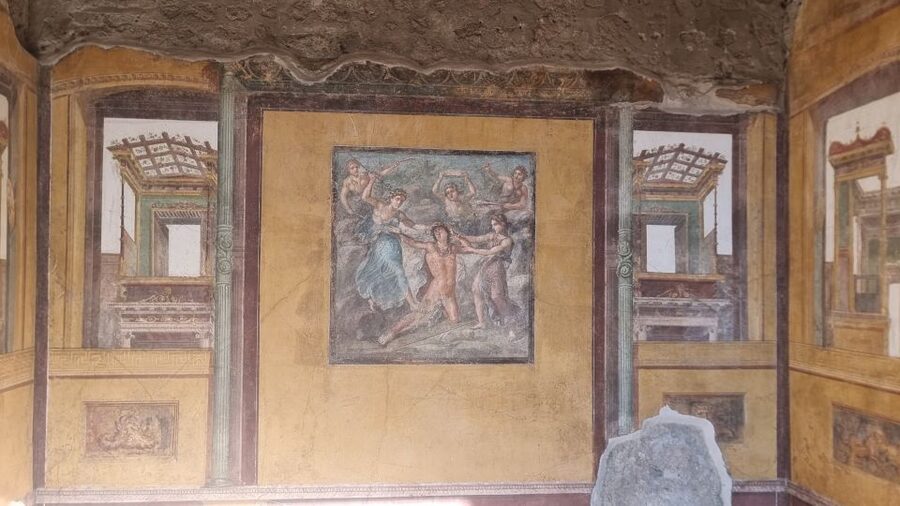
Pompeii’s private homes are often the most rewarding stops because they show how decoration, rooms, courtyards, and daily routines fit together. The House of the Vettii is one of the featured points, along with other domus and locations known for their frescoes and mosaics.
The app map helps you find the houses with the strongest surviving decoration. That is more practical than wandering and hoping you happen upon an open doorway. Since access and restoration can change, the guide cannot guarantee that every building will be available on every visit, but it gives you a strong list of places to look for.
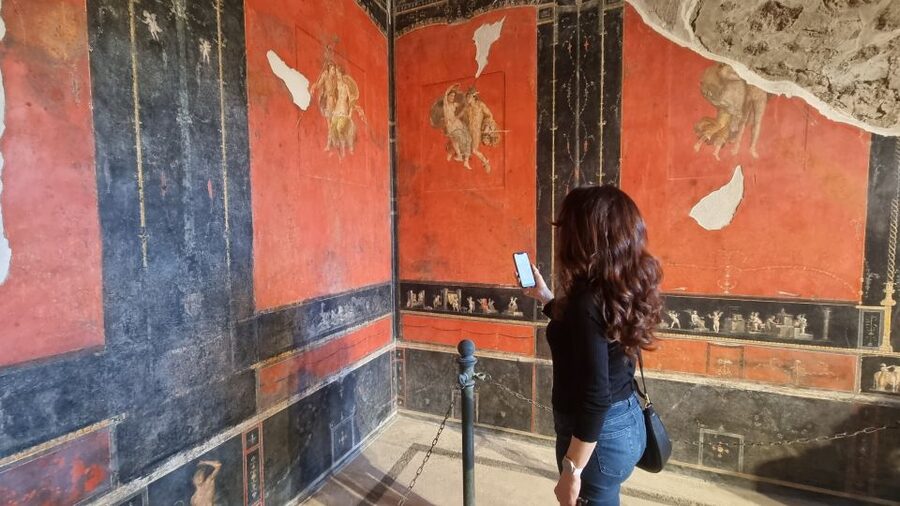
The written descriptions add another layer. Hypertext lets you tap names of gods, heroes, and technical terms for more information. If a mythological scene or architectural feature catches your eye, you can read beyond the short audio instead of stopping the whole visit to search elsewhere.
That feature suits curious visitors who like to follow their own questions. It may be less useful if you want a fast, purely spoken route. Pompeii rewards attention, but not every visitor wants to read extra material while walking over ancient paving stones.
A few more Naples bookings to compare
- Naples: Naples Underground Entry Ticket and Guided Tour
★ 4.4 · 21,781 reviews - From Naples: Sorrento, Positano and Amalfi Full-Day Tour
★ 4.6 · 10,988 reviews - From Naples: Sorrento, Positano & Amalfi Coast – Small Group Tour
★ 5.0 · 8,643 reviews - Naples: Catacombs of San Gennaro Entry Ticket & Guided Tour
★ 4.6 · 7,941 reviews
The brothel, baths, and the less polished side of Roman life
The lupanare, or brothel, is included among the named stops. The audio places it within the city rather than treating it as a quick curiosity. This helps you see Pompeii as a working town with many kinds of businesses and services.
The Roman baths receive their own explanation. You learn how bathing worked, including the different stages and the practical systems behind them. The subject becomes much easier to understand when you are looking at the actual rooms and fittings instead of reading a short sign.
The guide also covers everyday sanitation and production. The detail about urine being used in wool processing is the sort of memorable fact that makes the ancient economy easier to picture. It is not just an odd Roman habit. It shows how useful materials were collected and reused in a society with very different ideas about waste.
These subjects give the tour a welcome edge. Pompeii is famous for grand villas and dramatic destruction, but the strongest audio stops also deal with food, trade, labor, and hygiene. I would pay close attention to those sections if you have already seen Pompeii’s headline buildings on an earlier visit.
Taverns, bread, frescoes, and daily routines
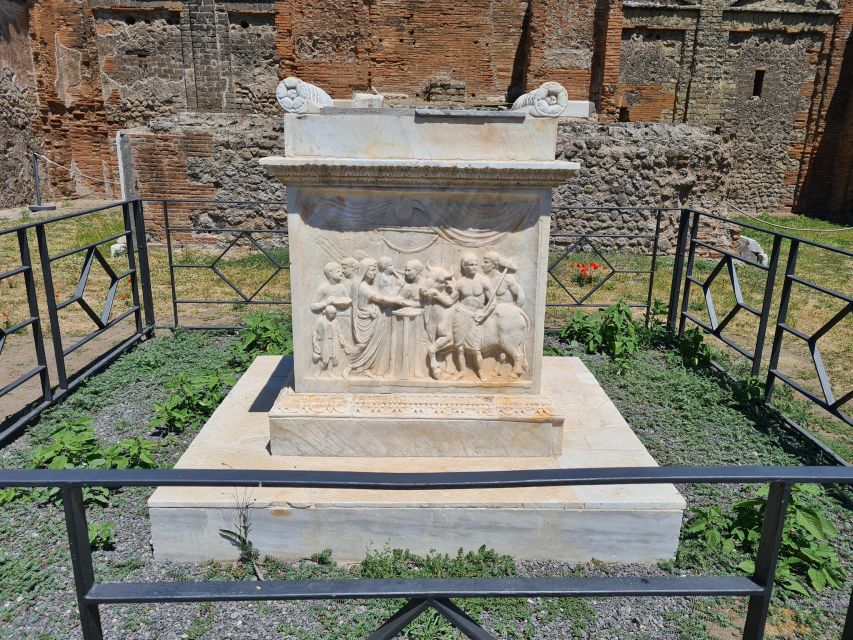
The audio descriptions include what people ate in Roman taverns and how bread was made. That focus on food makes the streets more readable. A counter or shopfront becomes part of a daily routine rather than another fragment of masonry.
You also hear about the city’s frescoes and mosaics, with the map pointing you toward well-preserved examples. Pompeii’s artwork can be easy to overlook when the site is crowded or when several rooms compete for attention. A marked route helps you decide where to spend your limited time.
The narration is available in Italian, English, French, German, and Spanish. Several users praised the voice quality and found the speech clear and easy to understand. Audio clips are not overly long, which makes it easier to listen outdoors and then continue walking without losing the thread of your visit.
If you enjoy long academic talks, you may find some sections too short. The strength here is accessibility. You get enough explanation to understand what you are seeing, with written material available when you want more.
How well the map works inside Pompeii

The interactive map is the app’s most useful tool. It shows the marked sites, lets you plan a route, and indicates which points you have already heard. That last feature is valuable at Pompeii, where it is easy to turn down a side street and forget which houses you passed.
There are limits. The map may not show a small dot for your current location, so orientation can feel like using a paper map. You need to compare the paths around you with the lines on the screen. The map is still helpful, but you should not expect turn-by-turn navigation.
Another irritation is that the app may return you to a wider map view after an audio clip finishes. You then need to zoom in again to find your location and the next nearby stop. If you leave the app to take a photograph, it may restart when you return, according to one user experience.
I would carry a portable battery and keep the app open as much as possible. Before the visit, practice opening a point, playing its audio, returning to the map, and finding the next marker. A few minutes of preparation can prevent frustration once you are inside.
Price, ticket costs, and what you actually receive

At $4.70 per person, this is a very inexpensive addition to a Pompeii visit. The price is advertised as more than 50 percent below the ticket-office audioguide, and the guide remains available for future visits rather than ending when you leave the ruins.
That repeat access improves the value. You can listen again later, use the content on another Pompeii visit, or take your time with sections you skipped. The ITGUIDES catalog also includes audio guides for other Italian archaeological and artistic sites, though those are separate products unless you purchase them.
The Pompeii entrance ticket is not included. There is no meeting point, transport, or guide waiting at the gate. You buy the admission ticket separately and enter during the archaeological site’s opening hours, then use the app whenever you choose.
This arrangement suits someone who already wants an independent Pompeii visit. If you prefer a personal expert who can answer questions, manage the route, and react to closures, the cheaper price comes with a clear compromise. You are responsible for the phone, the map, the timing, and the direction.
Who will get the most from this audio tour
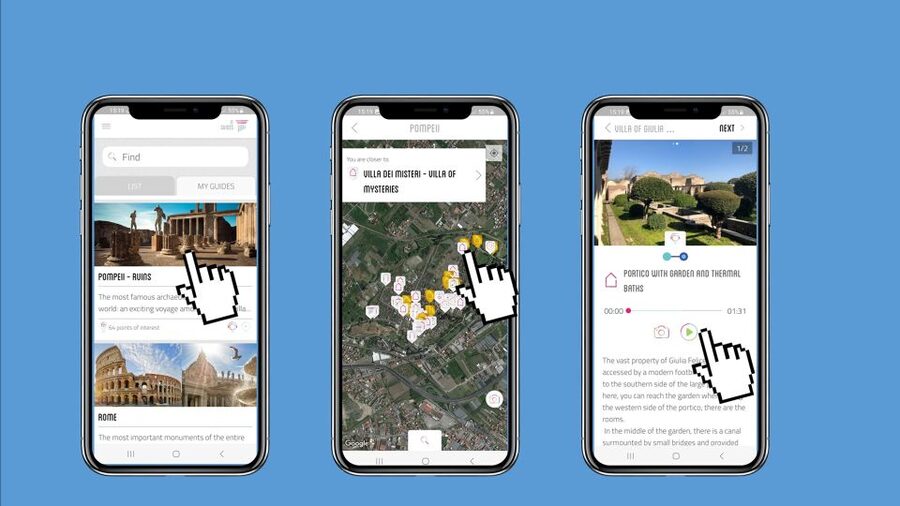
I would choose this for independent visitors who want more than the limited signs but do not want to pay for a private guide. It is also a good match for families who need to pause, split up briefly, or move at different speeds.
The short audio clips work well when you want information without standing still for long periods. The written text and clickable terms are helpful for anyone who wants extra detail about mythology, architecture, or Roman customs.
It is less suitable if you are not comfortable installing an app or following digital instructions. The activation process is manageable, but it requires a few steps. You also need enough phone battery and storage to download the content before the visit.
A two-hour visit may feel rushed. One person who had only two hours wished for more time and had trouble getting the app to work properly. For a better experience, give yourself close to the full four-hour validity, especially if you want to see many houses and artwork stops.
Wheelchair access is listed as available. Since the ruins are spread across a large archaeological area, you should still plan your route around the specific places you want to reach and any closures on the day.
Practical setup before you enter
Use Wi-Fi or a strong cellular connection to download every audio file, photograph, map, and written description. Do not count on reliable internet inside the excavations.
Before heading out, send the required app user ID and booking number through the contact page so the provider can activate the guide. If anything goes wrong, use the WhatsApp contact in the app menu rather than waiting until you are at the entrance.
Fully charge your phone. Keep the downloaded map available, and try not to close the app every time you take a picture. If you do leave it, be ready to reopen the guide and zoom back to the area you were exploring.
You can use the guide in English, Italian, French, German, or Spanish. Since the content is yours after purchase, you can listen again later when you have more time to study a house or term.
Final verdict: is the $4.70 Pompeii guide worth it?
Yes, if you want an affordable, self-paced way to understand Pompeii. The strongest reasons to buy are the low price, the 60-plus marked stops, the clear audio, and the map that helps you find important houses, artwork, public buildings, and everyday-life details.
I would not choose it as a replacement for a personal archaeological guide if this is your once-in-a-lifetime Pompeii visit and you want conversation or help with every turn. The app has real navigation quirks, and you must prepare it properly before arrival.
For most independent sightseers, though, it offers a lot for $4.70. Download it early, allow plenty of time, and treat the map as a helpful guide rather than a perfect GPS. That small amount of preparation lets you focus on the ancient streets, frescoes, baths, taverns, and homes that make Pompeii so absorbing.
FAQ
Is the Pompeii entrance ticket included?
No. The price covers the ITGUIDES audio guide, map, photographs, and written content. You must purchase the Pompeii archaeological site entrance ticket separately.
Is there a meeting point?
No. This is a self-guided smartphone activity with no meeting point. You can begin at any open entrance during the ruins’ opening hours.
How long is the audio guide valid?
The guide is valid for four hours from first activation.
How do I activate the Pompeii guide?
Download the free ITGUIDES app, open its menu, and use the contact page to send your app user ID and booking number. The provider will then activate the Pompeii content.
Do I need internet inside Pompeii?
You should download all guide content before entering. Internet service can be poor inside the archaeological site, so use Wi-Fi or a strong connection beforehand.
Which languages are available?
The audio guide is available in Italian, English, French, German, and Spanish.
Can I use the guide again on another visit?
Yes. The audio guide remains yours after purchase and can be reused on future visits.
Can I cancel the booking?
Yes. You can cancel up to 24 hours in advance for a full refund. A reserve-now, pay-later option is also available.
Recently added around Naples
- Vesuvius National Park Skip-the-Line Ticket★ 3.8 · 221 reviews
- Naples: The Holy Mile 3-Hour Guided Tour★ 4.9 · 711 reviews
- Pompeii and Vesuvius Full-Day Tour from Amalfi Coast★ 4.4 · 319 reviews
- From Naples: Pompeii & Herculaneum with Archaeologist Guide★ 4.8 · 665 reviews
- From Naples: Pompeii and Herculaneum Tour with Lunch★ 4.3 · 444 reviews
- From Naples: Pompeii Guided Tour with Skip-the-Line Tickets★ 4.8 · 1,171 reviews
- Naples: Day Trip to Pompeii and Capri★ 4.4 · 272 reviews
- From Naples: Pompeii & Amalfi Coast Full-Day Trip★ 4.5 · 279 reviews
Pompeii & Vesuvius Tours, compared.

Entry Ticket and Guided Tour with an Archaeologist
Read our review →




Pompeii Small Group Tour with an Archaeologist
Read our review →
Pompeii, Amalfi Coast and Positano Day Trip from Rome
Read our review →Browse the lists this tour appears in