
Reviewed · SKIP THE LINE
Milan: San Sepolcro Crypt Skip-the-Line Entry Ticket
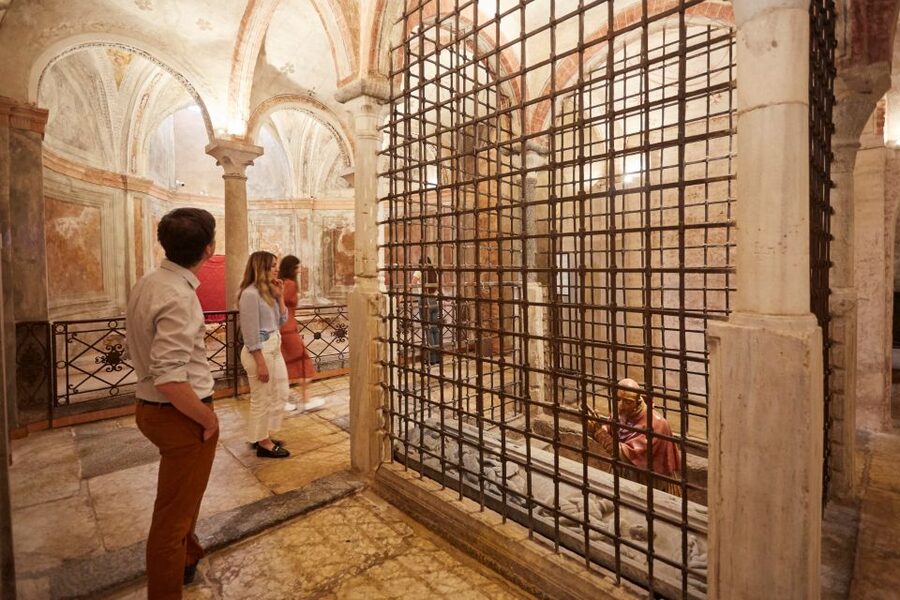
Step below Milan’s busy streets. The San Sepolcro Crypt offers a rare look at the city beneath the city, with a medieval church built over the forum of ancient Mediolanum. I like the chance to walk across original Roman paving stones, and I like the recently restored late 13th-century frescoes and vaults. The main drawback is size: this is a small underground site, and many visitors may need only 10 to 15 minutes, not the full 30 minutes.
The $11 ticket is a fair price if you value unusual historical places and want a short stop near the Pinacoteca Ambrosiana. It is less convincing if you expect a large church, many rooms, or a long guided visit. The atmosphere is quiet and sacred, but the space can feel more like a narrow underground passage than a full museum.
In This Review
- Key points to know before you go
- What San Sepolcro reveals about Milan’s oldest center
- Entering through Piazza San Sepolcro
- The compact underground church
- The Roman forum stones are the real time machine
- Restored vaults and late 13th-century frescoes
- How much value do you get for $11?
- Who will enjoy the crypt most?
- A practical way to fit it into your Milan day
- The main strengths and weaknesses
- Should you book San Sepolcro Crypt?
- FAQ
- Where is the entrance to the San Sepolcro Crypt?
- How long does the visit take?
- What does the ticket include?
- How much does admission cost?
- Is the crypt accessible to wheelchair users?
- Can I bring a baby stroller?
- Can I cancel the booking?
Key points to know before you go
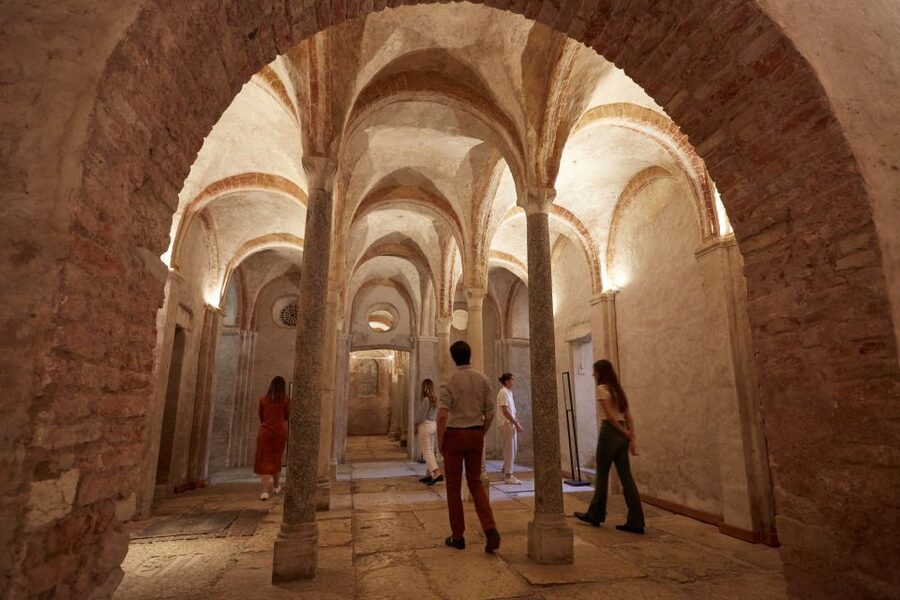
- Roman forum under your feet: Large slabs of white Verona stone formed part of the pavement of Milan’s ancient forum.
- A church below ground: San Sepolcro was founded in 1030 and was built entirely underground.
- Medieval art is the main attraction: Restored vaults and late 13th-century frescoes give the crypt its strongest visual appeal.
- Very short visit: The official duration is 30 minutes, but the compact layout may take only 10 to 15 minutes to see.
- Easy central location: Enter through the courtyard beside the Pinacoteca Ambrosiana in Piazza San Sepolcro.
- Stairs and a tight interior: The crypt is not suitable for wheelchair users, and baby strollers are not allowed.
What San Sepolcro reveals about Milan’s oldest center
Milan is often presented through its cathedral, grand shopping arcades, and handsome palaces. San Sepolcro offers a different view. Here, the city’s past is under your shoes.
The crypt sits on the site of the forum of Mediolanum, the Roman city that occupied this part of Milan. The forum was the center of public life, where civic and religious business took place. You are not simply looking at old stones in a display case. You are seeing surviving pieces of the ground where Roman Milan once carried on its daily affairs.
That makes the visit valuable even before you study the paintings. The crypt connects several layers of the city in one small space: Roman paving, a medieval church, and later restoration work. Milan can feel modern and fast above ground. Below, the pace changes quickly.
I especially like the use of the large white Verona stone slabs. They come from the pavement of the ancient Roman forum and were admired by Leonardo da Vinci. The slabs are not flashy, but they give the site a physical link to the Roman period. You can look at a reconstruction in a history book, or you can stand on the material that once formed part of the forum itself.
A few more Milan bookings to compare
- Milan: Cathedral and Duomo’s Terraces Entrance Ticket
★ 4.6 · 61,054 reviews - Milan: Da Vinci’s Last Supper Guided Tour
★ 4.7 · 10,143 reviews - Milan: Science and Technology Leonardo da Vinci Museum Entry
★ 4.5 · 7,169 reviews
Entering through Piazza San Sepolcro
The entrance is in Piazza San Sepolcro, but finding the actual staircase takes a little attention. Go through the gate into the courtyard where the exit of the Pinacoteca Ambrosiana is located. Near the statue of Federico Borromeo, look for the staircase leading down to the crypt.
This detail matters because the piazza and surrounding buildings may not immediately make the entrance obvious. I would allow a few extra minutes to locate the courtyard rather than arriving at the last moment. The meeting point is not a separate street-level visitor center. It is tucked inside this courtyard setting.
Once you go downstairs, the experience changes from an ordinary Milan walk to a visit below the historic center. The stairway also explains one of the practical limits of the site. This is an underground church reached by steps, not a broad modern attraction with easy open access.
You receive entry to the crypt, and the ticket is designed to let you pass the ticket line. It does not describe a guided tour, named guide, audio tour, or transport. You should therefore plan on exploring the space independently.
The compact underground church
San Sepolcro was founded in 1030, which gives the crypt a long medieval life even before you consider the Roman remains beneath it. Its most unusual feature is simple: the church is entirely underground.
That setting creates the strongest part of the visit. You are surrounded by stone, low medieval architecture, and the sense that Milan has been built layer upon layer. The sacred character of the place is important too. This is not only an archaeological room. It was designed and used as a church, and the religious purpose still shapes how the space feels.
Do not expect a vast subterranean complex. One critical point is the scale. The interior is small, with a corridor-like arrangement and rooms that may contain little to see beyond their architecture and decoration. If you enjoy concentrated historic sites, this can feel special. If you prefer a long route with several galleries, it may feel too brief.
The official duration is 30 minutes. That gives you enough time to enter, examine the floor and artwork, and pause in the quiet. In practice, you might be finished in closer to 10 or 15 minutes, especially if you move quickly or have already seen many medieval churches in Italy.
I would treat the short length as part of the planning rather than a flaw by itself. San Sepolcro works well as one stop in a central Milan walking day. It is not a half-day attraction.
The Roman forum stones are the real time machine
The most distinctive part of the crypt is the old Roman pavement. The large slabs of white Verona stone came from the forum of Mediolanum and now form part of the floor below the church.
This is where the visit moves beyond a standard church interior. Frescoes can be moved, restored, or viewed in many places. A surviving section of a Roman forum floor gives you a direct physical connection to the ancient city.
Look down as you walk. The pavement may not deliver a dramatic reveal, but its value grows when you understand what it represents. This was the forum, the public center of Roman Milan, where civil and religious activities took place. The crypt was built over that important urban space, so the church’s location is as meaningful as its walls.
Leonardo da Vinci was fascinated by these stones, a detail that adds a personal connection to Milan’s artistic and engineering past. You do not need a long lecture to appreciate the point. The same old paving that caught Leonardo’s attention remains part of the experience today.
For me, this is the best reason to choose San Sepolcro over a generic small church. You are not visiting only for decoration. You are tracing the city’s Roman foundation beneath its medieval one.
Still Milan, but a slower afternoon:
- Milan: City Sightseeing Hop-On Hop-Off Bus with Audio Guide
★ 4.0 · 6,256 reviews - Milan Cathedral: Duomo Terraces Ticket (No Church Access)
★ 4.6 · 6,111 reviews - Milan: Milan Cathedral Direct Entrance – Terrace Excluded
★ 4.5 · 5,782 reviews - Milan: Guided Walking Tour & Last Supper Visit with Ticket
★ 4.7 · 5,409 reviews
Restored vaults and late 13th-century frescoes
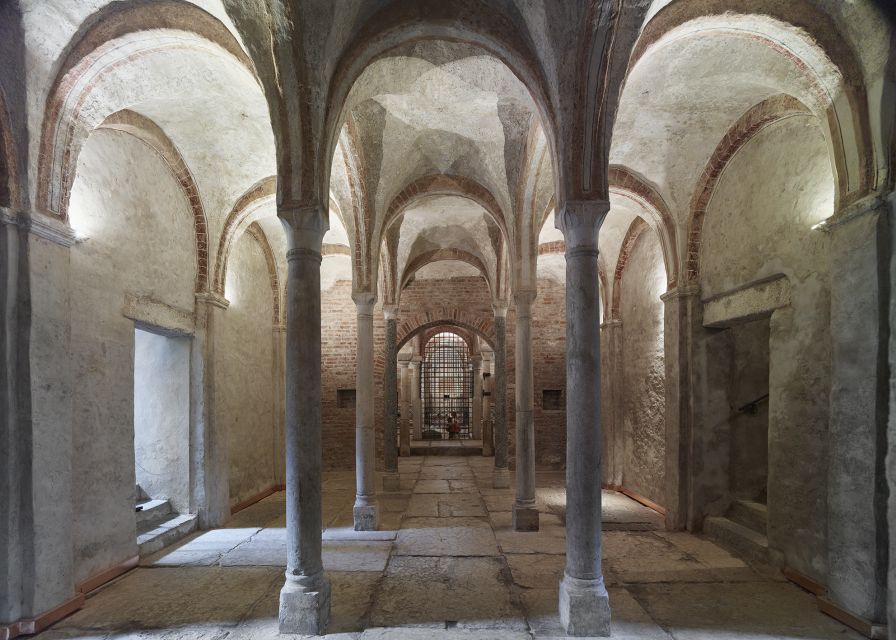
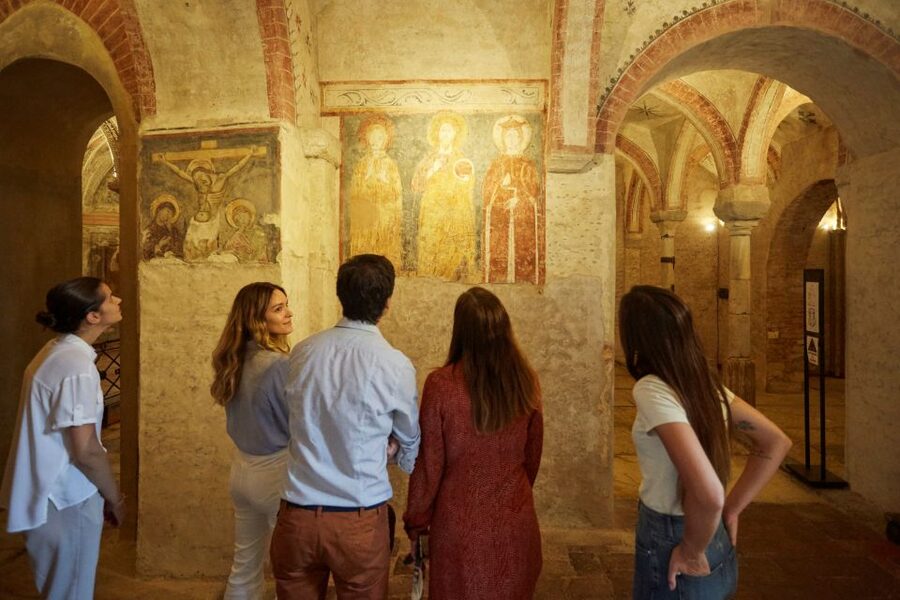
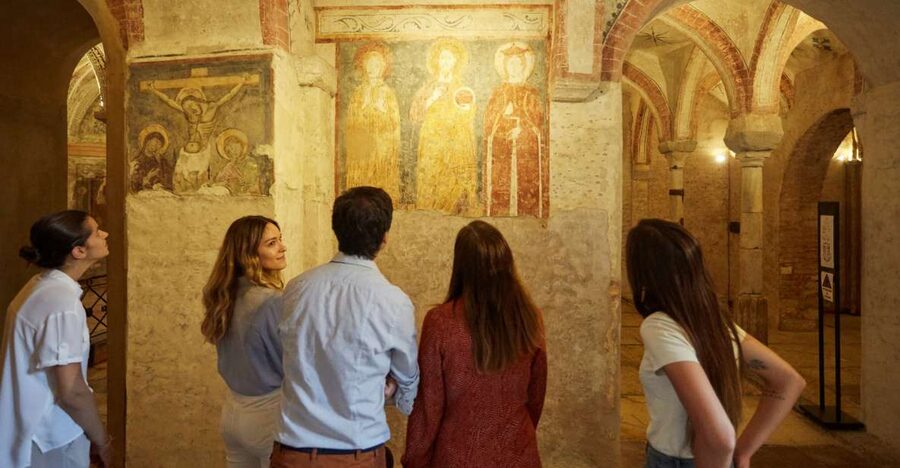
The other main attraction is the decoration overhead. Recently restored vaults reveal medieval work from the late 13th century, including frescoes and painted details.
The restoration gives the paintings a clearer presence. You can study the colors, figures, and patterns without treating the crypt as a dark, forgotten basement. The frescoes are the visual focus, and they reward a slower look.
At the same time, keep your expectations sensible. This is not a large fresco cycle spread across a grand cathedral. The paintings occupy a compact underground setting, and the visitor route is limited. Their appeal comes from age, atmosphere, and context rather than scale.
I would spend a few quiet minutes looking upward, then compare the frescoed vaults with the stone floor below. The contrast tells the story of the site better than either feature alone. Roman civic life is represented underfoot, while medieval religious art fills the space above.
The restored decoration is also the part most likely to impress you if you enjoy medieval art. The paintings have a sense of place because they remain in the church for which they were made. You are not seeing fragments arranged in a modern gallery.
How much value do you get for $11?
At $11 per person, San Sepolcro is not an expensive Milan attraction. The price becomes reasonable if you care about archaeology, medieval churches, or unusual places close to major sights. The skip-the-line feature also helps if a ticket queue is operating when you arrive.
The value is less clear if you measure admission by minutes. Some people may spend only 10 minutes inside. At that pace, the ticket can feel costly for a very small site, particularly if you expected more rooms or a larger collection.
I would not book this as your only paid sight in Milan. I would add it to a day already focused on the historic center, especially if you plan to visit the Pinacoteca Ambrosiana. Its location makes it easy to combine with other nearby stops, though the crypt ticket itself covers only entry to San Sepolcro.
The ticket does offer flexibility. You can cancel up to 24 hours in advance for a full refund, and the reserve-now, pay-later option lets you hold a place without paying at the time of booking. Those terms are useful when your Milan plans are still shifting.
Who will enjoy the crypt most?
I would recommend San Sepolcro to you if you like places where history is visible in the structure itself. The best fit includes:
- People interested in Roman Milan and urban archaeology
- Visitors who enjoy medieval churches and frescoes
- Anyone who prefers small, quiet sites to major crowds
- Art and history lovers visiting the Pinacoteca Ambrosiana area
- Families with older children who can manage stairs and appreciate a short stop
- Repeat visitors who want something beyond Milan’s best-known sights
The crypt may disappoint you if you want a large, highly furnished church or a visit packed with objects. It is also a poor choice if you need step-free access. Wheelchair users cannot use the site, and baby strollers are not allowed.
Because the interior is compact, I would also think carefully about your own sightseeing style. Some people love a 30-minute historical pause. Others may feel they have paid for an experience that ends almost as soon as it begins.
A practical way to fit it into your Milan day
Plan San Sepolcro as a short central-Milan stop, not as a main event. Give yourself enough time to find the courtyard entrance, go down the stairs, inspect the Roman stones, look closely at the frescoes, and leave without rushing.
The 30-minute time frame is useful as a planning allowance. It does not mean you will be occupied every minute. If you have a timed admission, arrive with a little margin because the entrance is inside the courtyard rather than plainly marked on the piazza.
Once inside, I would follow this simple order:
- Take in the underground layout before focusing on details.
- Look at the Roman forum pavement and the white Verona stone slabs.
- Study the late 13th-century frescoes and restored vaults.
- Pause in the church’s quiet atmosphere.
- Leave time to find your way back through the courtyard.
There is no transport included, and no guide is specified. The visit is self-directed, so you control the pace. That suits an independent sightseeing day, but you should not expect a staff member to provide a long historical explanation.
The main strengths and weaknesses
San Sepolcro’s strongest qualities are its setting and its layers of history. The Roman forum pavement gives the crypt a direct connection to ancient Milan, while the medieval church and frescoes show how the same ground gained a new religious purpose centuries later.
The atmosphere is another clear strength. Underground stone, old paving, and restored decoration create a serious, quiet place. It feels different from the open squares and grand avenues above.
The weaknesses are just as clear. The crypt is small. One route through a narrow space may be all you need, and some rooms may have little decoration or interpretation. The experience can feel disappointing if the words ancient church lead you to imagine a large underground complex.
The ticket also depends on what you value. At $11, it is affordable by Milan sightseeing standards, but the short visit means the price is not automatically a bargain. I would pay it for the historical setting, not simply for the amount of time inside.
The overall rating of 4.2 from 512 bookings suggests a generally positive experience with some real limits. The praise centers on the magic of walking over Roman forum paving and seeing medieval frescoes. The lower marks focus on the small size, the short visit, and one serious booking problem involving an empty meeting point. I would keep your confirmation details handy and make sure you understand exactly where the entrance is.
Should you book San Sepolcro Crypt?
Book it if you want a brief, atmospheric look at Milan’s Roman and medieval layers, especially if your day already takes you to the Pinacoteca Ambrosiana. The Roman forum stones and restored frescoes make this more than a routine church visit.
Skip it if you need wheelchair access, dislike stairs, or want a large attraction with hours of material to explore. Also skip it if $11 feels too high for a visit that may take only 10 to 15 minutes.
My call: this is a worthwhile short stop for history-minded visitors, but only when you choose it for its unusual setting. Go for the Roman pavement, the medieval vaults, and the sense of old Milan below modern Milan. Do not go expecting a sprawling crypt.
FAQ
Where is the entrance to the San Sepolcro Crypt?
The entrance is in Piazza San Sepolcro. Go through the gate of the courtyard where the exit of the Pinacoteca Ambrosiana is located, then look for the staircase near the statue of Federico Borromeo.
How long does the visit take?
The stated duration is 30 minutes. Because the crypt is compact, you may see the main features in about 10 to 15 minutes.
What does the ticket include?
The ticket includes skip-the-line entry to the Crypt of San Sepolcro.
How much does admission cost?
The listed price is $11 per person.
Is the crypt accessible to wheelchair users?
No. The crypt is not suitable for wheelchair users.
Can I bring a baby stroller?
No. Baby strollers are not allowed.
Can I cancel the booking?
Yes. You can cancel up to 24 hours in advance for a full refund. A reserve-now, pay-later option is also available.
Recently added around Milan
- Milan: City Highlights Walking Tour with The Last Supper★ 4.9 · 195 reviews
- Milan: The Milan Pass City Card★ 4.0 · 655 reviews
- Milan: Skip-the-Line Guided Walk and “The Last Supper”★ 4.5 · 606 reviews
- Milan: Duomo & Rooftop Tour with Optional Hop-On Hop-Off Bus★ 4.5 · 262 reviews
- Milan: Duomo and The Last Supper Skip-the-Line Guided Tour
- Milan: Leonardo’s Last Supper and Michelangelo’s Pietà Tour★ 4.6 · 559 reviews
- Milan: Sforza Castle and Michelangelo’s Pietà Rondanini Tour★ 4.7 · 1,119 reviews
- Milan: QC Termemilano Spa Admission Ticket★ 4.6 · 685 reviews
Skip the Line, compared.
Skip-The-Line Uffizi Gallery Timed Entry Ticket
Read our review →
Vatican Museums & Sistine Chapel Skip-the-Line Entry Ticket
Read our review →
Skip-the-Line Group Tour of the Vatican, Sistine Chapel & St. Peter’s Basilica
Read our review →
Michelangelo’s David Skip-the-Line Entry Ticket
Read our review →
Vatican Museums & Sistine Chapel Skip-The-Line Ticket
Read our review →
Vatican, Sistine Chapel & St. Peter’s Skip-the-Line Tour
Read our review →
Skip-the-Line Vatican, Sistine Chapel & St. Peter’s | Small Group
Read our review →
Vatican Museums Sistine Chapel Skip-the-Line Ticket
Read our review →Browse the lists this tour appears in