
Reviewed · TRAIN EXPERIENCES
From Rome: Ostia Antica Guided Half-Day Trip by Train
Ancient Rome’s working city is waiting by the tracks. This half-day outing takes you from Rome to Ostia Antica, the former harbor town that fed and supported the capital, with a small group and an English-speaking guide. I like the easy train ride and the chance to see Roman life beyond emperors, temples, and grand monuments.
I also like the site’s quiet atmosphere. You can walk through taverns, warehouses, public baths, apartment buildings, theaters, and communal toilets without the crowds that often fill Rome’s famous ruins. The main consideration is that this is an outdoor walking tour across a large archaeological park, so hot weather, uneven ground, and comfortable footwear matter.
The four-hour schedule gives you about three hours at the ruins, followed by the option to remain in Ostia, visit the modern town, or continue to the beach. At $58 per person, the tour is good value if you want context and smooth transport, though independent visitors can reach Ostia Antica by train for less.
In This Review
- Key points to know before booking
- Why Ostia Antica is worth your morning
- Meeting at Cafe Piramide in Rome
- The short train ride to Ostia Antica
- Walking the Decumanus Maximus
- The Baths of Neptune and its famous mosaic
- The Forica: Rome without the marble polish
- The amphitheater and 3,500 Roman spectators
- Taverns, warehouses, and the business of a port
- A small group makes the ruins easier to understand
- Stay longer, visit the museum, or go to the beach
- Price, timing, and who gets the best value
- Should you book the Ostia Antica tour?
- FAQ
- How long does the Ostia Antica tour take?
- Where does the tour meet in Rome?
- Is the train ticket included?
- What does the tour visit at Ostia Antica?
- Can I go to the beach after the tour?
- Is the tour suitable for wheelchair users or baby strollers?
Key points to know before booking
- A 15-minute train ride takes you from central Rome to Ostia Antica, making this one of the easiest ancient sites to add to a Rome stay.
- The three-hour guided walk focuses on everyday Roman life, including commerce, bathing, entertainment, food, and public sanitation.
- The Baths of Neptune feature a striking sea-god mosaic, with Neptune shown riding a four-horse chariot.
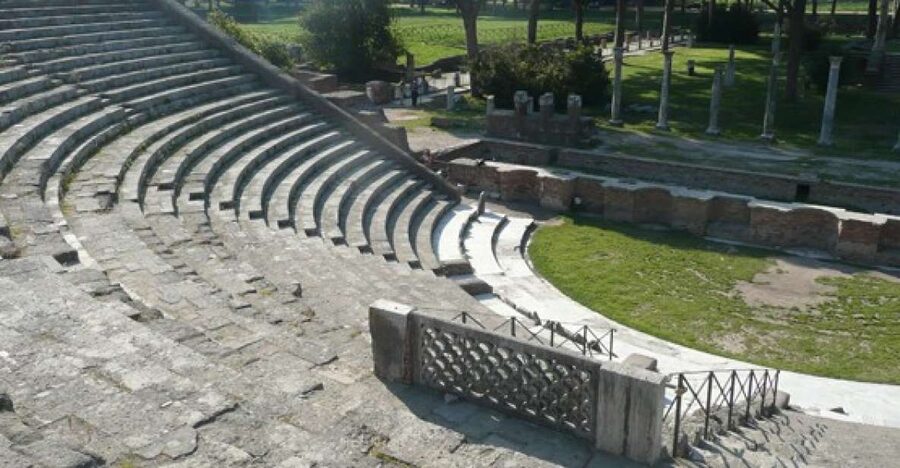
- The amphitheater once held about 3,500 spectators, giving you a clear sense of how Roman public entertainment worked.
- The group is limited to 12 people, which makes it easier to hear the guide and ask questions.
- You can stay after the tour, explore more of the ruins, visit the museum, continue to modern Ostia, or head to the beach.
Why Ostia Antica is worth your morning
Ostia was founded in the 4th century BC and grew into an important commercial and military port for Rome. Its role was practical: goods came through the harbor and helped keep the capital supplied. The remains give you a view of the people who worked, shopped, bathed, worshiped, and socialized there.
That makes Ostia different from Rome’s grand political center. At the Colosseum, you focus on spectacle. At Ostia, you notice the ordinary systems that made urban life possible. You walk along streets where merchants, dock workers, soldiers, families, and customers once moved through the day.
The site is also large. You can wander on your own, but it is not always easy to understand what you are looking at from a wall, column base, or faded mosaic. A good guide supplies the missing pieces and points out details you might otherwise walk past.
Several guides have earned especially strong praise for their delivery and care. Rob is described as witty and clear, sometimes acting out scenes to make the past easier to picture. Alberto Terrasi is repeatedly praised for his friendly manner, strong explanations, and ability to keep the group moving without making the visit feel rushed. Cat, Laura, Caterina, Liv, and Roberto are also noted for bringing the site to life through stories and well-timed stops.
The guide matters here more than at a compact monument. Ostia has enough ground to cover that a well-paced route helps you see the major areas without spending the whole morning trying to read signs and interpret remains.
A few more Rome bookings to compare
- Rome to Pompeii Guided Tour with Wine & Lunch by High Speed Train
★ 5.0 · 1,379 reviews - Rome: Pompeii Tour with Wine and Lunch by High Speed Train
★ 4.8 · 485 reviews - From Rome: Day Trip to Venice by High-Speed Train
★ 4.6 · 352 reviews
Meeting at Cafe Piramide in Rome
The tour begins at Cafe Piramide beside the Piramide Metro Station on Line B, Rome’s blue metro line. When you face the metro station, the cafe is on your right, close to the train tracks and the train exit. Look for the white umbrellas outside and the City Wonders sign.
Give yourself enough time to find the cafe. One useful detail is easy to miss: white umbrellas across the street can draw your attention in the wrong direction. If you are coming from Termini by metro, allow extra time for the station crowds and the transfer.
There is no hotel pickup. You need to reach the meeting point yourself, so this tour works best for anyone already comfortable using Rome’s metro system. The guide provides the return train ticket and gathers the small group before departure.
The short train ride to Ostia Antica
The outward train ride takes about 15 minutes. That short journey is a major advantage. You leave Rome’s central streets and quickly reach an archaeological site that feels far removed from the city’s busiest monuments.
The train is not a scenic railway excursion, and the ride itself is simply transportation. Its value is convenience. You avoid arranging a private transfer, and the guide handles the group’s movement to the ruins.
On arrival, the walk from the Ostia Antica station to the archaeological site takes less than five minutes. The return trip is listed at about 20 minutes, and the guide accompanies the group back toward Rome during the tour’s scheduled return. If you stay in Ostia after the guided portion, your return train is unescorted, although your ticket is provided and the guide gives instructions for getting back to Piramide.
If public transportation is affected by a strike or another unexpected problem, a minibus is provided at no extra cost. That backup is reassuring, especially when you have a tight Rome schedule.
Walking the Decumanus Maximus
The guided visit lasts about three hours. One of the main routes follows the Decumanus Maximus, the broad thoroughfare through the ancient town.
Walking here gives you a useful sense of scale. This is not just a scattering of isolated ruins. Streets, building fronts, courtyards, shops, and public structures make Ostia feel like a real town. The surviving walls can help you picture buildings that once rose higher than the fragments suggest.
Look along the walkways for Roman statues and architectural details. The guide’s role is to connect these physical remains with daily routines. You may hear how people used the commercial spaces, how public facilities served the town, and how Ostia’s port function supported Rome.
The walk is rewarding but not effortless. The archaeological park is broad, and the surface can be uneven. You should bring sturdy walking shoes, water, sun protection, and a hat in warm weather. The supplied information also recommends sports shoes and mentions a towel and beachwear if you plan to continue to the coast.
Still Rome, but a slower afternoon:
- Vatican: Museums & Sistine Chapel Entrance Ticket
★ 4.5 · 144,003 reviews - Vatican Museums & Sistine Chapel Tour with Optional Basilica
★ 4.3 · 67,413 reviews - Colosseum, Roman Forum & Palatine Guided Tour
★ 4.7 · 63,148 reviews - Vatican Museums, Sistine Chapel & St Peter’s Basilica Guided Tour
★ 4.5 · 39,149 reviews
The Baths of Neptune and its famous mosaic
The Baths of Neptune are among the most memorable stops. Their central feature is a well-preserved mosaic showing the sea god Neptune being pulled by a four-horse chariot.
A mosaic can be easy to treat as decoration. Here, it also helps you picture the atmosphere of a Roman bathing complex, where bathing was part of public social life rather than a quick private chore. The guide explains the imagery and places the baths within the larger town.
This is one area where the tour’s storytelling adds real value. Without context, you see a floor pattern. With an informed explanation, you begin to understand how art, public buildings, leisure, and civic identity worked together.
There is also a toilet break during the visit, with time for a snack or drink at the on-site snack bar. That pause is welcome because three hours outdoors can be tiring, particularly in summer.
The Forica: Rome without the marble polish
The communal Forica, or public washrooms, is one of the most human stops on the route. A marble bench has 20 evenly spaced holes along four walls of a large open room.
It is a funny detail, but it also makes ancient life feel immediate. Grand monuments can make Rome seem like a world of generals and senators. The Forica reminds you that cities also depend on ordinary bodily needs, shared facilities, and practical public services.
The stop is brief, yet memorable. It gives the guide an opening to discuss social habits and the less polished side of urban life. You may even be invited to sit for a moment and experience the space in a very literal way.
The amphitheater and 3,500 Roman spectators
The amphitheater dates to 12 BC and once held about 3,500 people. Taking a place in the seating area lets you imagine the roar of a local crowd rather than only the enormous spectacles associated with Rome itself.
This smaller scale is useful. It helps you understand that entertainment buildings were not limited to the capital. A port town with a large population needed its own public venues and shared experiences.
The amphitheater is also a good example of how the guide shapes the visit. A few rows of stone and a stage area may not explain themselves. Stories, reconstructions, and clear descriptions can turn the structure into a functioning public space in your mind.
Taverns, warehouses, and the business of a port
Ostia’s commercial buildings are central to the experience. The remains include taverns, warehouses, thermal baths, and theaters, each showing a different part of town life.
The warehouses are especially important because they connect the ruins to Ostia’s purpose. This was a port city, not simply a residential suburb. Goods moved through its spaces, and the town’s prosperity depended on trade and transport.
The taverns and shops bring the story down to street level. You can imagine people stopping for food, drinks, errands, or business while moving through the Decumanus Maximus. Guides such as Alberto and Rob have been praised for using vivid stories and occasional humor to explain these settings.
This is one reason I would not treat Ostia as a quick photo stop. The site rewards attention. The more you notice the relationship between streets, businesses, public buildings, and homes, the more coherent the town becomes.
A small group makes the ruins easier to understand
The maximum group size is 12 people. That is small enough for you to hear explanations without constantly standing shoulder to shoulder with strangers.
A small group also helps with questions. At a site this broad, you may want to ask about a mosaic, building use, Roman customs, or how the port connected to Rome. A guide can respond without losing control of the schedule.
The strongest guide comments focus on three things: clear historical explanations, lively storytelling, and careful group management. Rob is praised for keeping track of everyone on the trains and for using small performances to make scenes easier to imagine. Alberto is praised for finding shade on hot days and maintaining a good pace. Cat is noted for selecting important highlights while still keeping the walk moving.
The pace is active, but the tour does not need to feel hurried. You receive a guided route through the key areas, and some guides allow short breaks to look around independently. Since the site is vast, you may still want extra time after the official tour.
Stay longer, visit the museum, or go to the beach
The scheduled service ends at Piramide Metro Station at approximately 1:00 PM, but you do not have to return with the guide. You can remain at Ostia Antica, explore the modern town of Ostia, or continue to a nearby beach.
Staying at the archaeological park is the best option if you want more ruins. The guided route covers the principal highlights, but a large site naturally contains more than can fit into three hours. One practical winter tip is to visit the museum soon after the guided portion because it may close early, around 1:30 PM in winter.
The beach option makes this tour more flexible than a standard archaeological excursion. Pack beachwear and a towel if you want to turn the morning into a longer outing. The tour information also recommends sports shoes, so plan for walking rather than treating the beach as the only activity.
If you choose to remain in Ostia, remember that the return journey is on your own. You receive the train ticket and instructions, but there is no escort back to Rome.
Price, timing, and who gets the best value
At $58 per person, the cost includes the return train ticket, entry to Ostia Antica, and the live English-speaking guide. You are paying mainly for the guide’s interpretation and the ease of joining an organized small group.
The price is fair if this is your first visit. Ostia’s size and worn remains can make independent exploration less clear, especially if you want to understand how the port functioned and how ordinary Romans used the town.
Independent visitors may prefer to buy their own transport and admission and spend a full day at their own pace. That option gives you more freedom, but you lose the organized route and the steady explanation of what you are seeing. For many first-time visitors, the guide is the part that turns a collection of ruins into a readable town.
The four-hour length suits a busy Rome itinerary. You can visit in the morning and still have much of the afternoon available. It is also a useful choice if Pompeii is too far for your schedule but you want a substantial Roman archaeological site.
The tour is best for adults, older children, and anyone interested in social history, architecture, archaeology, and ancient urban life. It is not suitable for wheelchair users, and baby strollers are not allowed. You should be prepared for a long outdoor walk on uneven surfaces.
Free cancellation is available up to 24 hours before departure, and you can reserve now and pay later. Starting times vary, so check availability before planning other activities around it.
Should you book the Ostia Antica tour?
Book this tour if you want to understand how Rome worked, not just admire its biggest monuments. The short train ride, included admission, limited group size, and strong guide quality make it an efficient half-day choice.
I would especially recommend it if you have already seen the Colosseum and Roman Forum and want a quieter site with more everyday detail. It can also serve as a convenient alternative to Pompeii when you are staying in Rome.
Skip it only if you dislike extended outdoor walking, need step-free access, or prefer complete independence. If you do book, wear comfortable shoes, bring water, and consider packing beachwear. Try to stay after the tour if your schedule allows, since the guided three hours can only cover part of Ostia Antica.
FAQ
How long does the Ostia Antica tour take?
The experience lasts four hours. The outward train takes about 15 minutes, the guided visit lasts about three hours, and the return train takes about 20 minutes.
Where does the tour meet in Rome?
Meet at Cafe Piramide beside Piramide Metro Station on Line B. When facing the station, the cafe is on your right, near the train tracks and train exit. Look for the white outdoor umbrellas and the City Wonders sign.
Is the train ticket included?
Yes. The price includes a return train ticket from Rome to Ostia Antica. If you remain in Ostia after the tour, your return journey is unescorted, but the ticket is provided.
What does the tour visit at Ostia Antica?
The route includes the Decumanus Maximus, the Baths of Neptune, the amphitheater, the communal Forica, taverns, warehouses, thermal baths, theaters, statues, and other preserved remains.
Can I go to the beach after the tour?
Yes. You may remain at Ostia, explore the modern town, or go to a nearby beach after the guided portion. Bring beachwear and a towel if you plan to do this.
Is the tour suitable for wheelchair users or baby strollers?
No. The tour is not suitable for wheelchair users, and baby strollers are not allowed. Comfortable or sports shoes are recommended for the walking route.
Recently added around Rome
- Palatine Hill and Roman Forum Tour with Fast-Track Entrance★ 4.2 · 417 reviews
- Tivoli: Villa D’Este & Villa Adriana Pass & App Audioguide★ 4.4 · 364 reviews
- From Rome: Villa D’Este & Villa Adriana Day Trip with Lunch★ 4.4 · 289 reviews
- Vatican Museums & Sistine Chapel Skip-the-Line Guided Tour★ 4.6 · 254 reviews
- Rome: The Three Tenors at St. Paul’s Church Concert Ticket★ 4.7 · 699 reviews
- Tivoli: Villa D’Este Entry Ticket and App Audio Guide★ 4.3 · 191 reviews
- Rome: Capitoline Museums and Centrale Montemartini Tickets★ 4.4 · 328 reviews
- Rome: St. Peter’s Basilica and Papal Tombs Guided Tour★ 4.6 · 477 reviews
Train Experiences, compared.
Bernina Red Train, Swiss Alps & St Moritz From Milan
Read our review →
Swiss Alps Bernina Red Train and St.Moritz Tour from Milan
Read our review →
Rome to Pompeii Guided Tour with Wine & Lunch by High Speed Train
Read our review →
Guided tour of Pompeii skip-the-line and round-trip train
Read our review →
Pompeii Tour with Wine and Lunch by High Speed Train
Read our review →
Browse the lists this tour appears in