

Reviewed · POMPEII & VESUVIUS TOURS
From Naples: Pompeii & Herculaneum with Archaeologist Guide
Two Roman cities, one volcanic disaster. This seven-hour trip from Naples makes it possible to see both Pompeii and Herculaneum in a single day, with an archaeologist guide explaining the buildings, artwork, streets, and human stories that are easy to miss on your own. I especially like the small-group format, limited to 20 people, and the skip-the-line tickets, which save valuable time at two of Campania’s busiest ancient sites.
The tour also earns praise for its guides. Raphael, Roberta, Michele, Vito, Gennaro, and others are singled out for clear explanations, humor, and a knack for pointing out small details. The main drawback is time: two hours at each site gives you the essential sights, but Pompeii is large enough to occupy several days.
In This Review
- Key points to know before booking
- Why seeing both sites in one day works
- Meeting in Naples and riding to Herculaneum
- Herculaneum: smaller, quieter, and remarkably preserved
- The lunch break: useful, but budget carefully
- Pompeii: streets, shops, villas, and the final hours of a city
- What the two-hour Pompeii walk cannot provide
- The guide is the main reason to choose this tour
- Price and overall value at $168.79
- Who should book this Pompeii and Herculaneum tour?
- Should you book it?
- FAQ
- Where does the tour begin?
- Where does the tour end?
- How long does the tour last?
- Which languages are available?
- Is transportation included?
- Are entrance tickets included?
- Is lunch included?
- What should you bring?
- Is the tour suitable for wheelchair users or people with mobility impairments?
Key points to know before booking
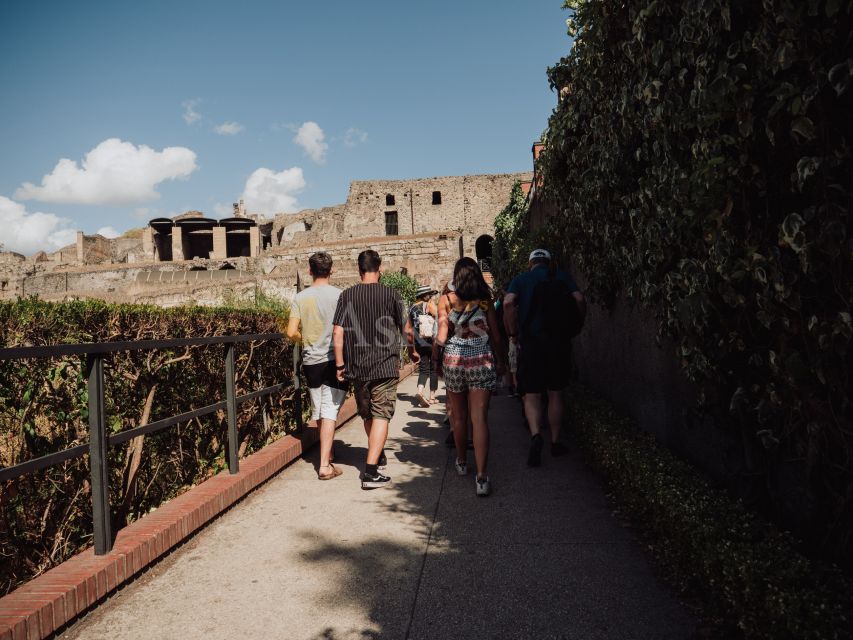
- Herculaneum comes first: You spend about two hours exploring exceptionally preserved wood, mosaics, paintings, baths, houses, and the ancient shoreline.
- Pompeii follows after lunch: A short break separates the two guided visits, with about two hours devoted to the city’s major public buildings and homes.
- A real archaeologist leads the walking tours: Guides explain how Romans lived, rather than simply naming buildings and dates.
- The minibus keeps the day efficient: Shared transport connects Naples, Herculaneum, and Pompeii without making you arrange separate train journeys.
- Expect uneven ground and stairs: The tour is not suitable for wheelchair users or people with limited mobility.
- Lunch is not included: You get a break before Pompeii, so bring food or budget for a restaurant meal.
Why seeing both sites in one day works
Pompeii and Herculaneum were both destroyed by Mount Vesuvius in 79 AD, but the experience at each site feels different. Pompeii was buried in volcanic ash and pumice, while Herculaneum was covered by a much deeper surge of mud and other volcanic material.
That difference matters. Pompeii gives you a broad picture of an ancient Roman town, with long streets, large public buildings, shops, bakeries, baths, and grand private houses. Herculaneum is smaller, but its preservation can be startling. Carbonized wooden objects, painted walls, mosaics, and household details make the town feel more intimate.
I like this pairing because the sites answer different questions. Pompeii helps you understand the shape of Roman urban life. Herculaneum brings you closer to the materials and rooms that people used every day.
Trying to visit both independently in one day would require careful transport planning and a strict timetable. This tour handles the transfers and admissions, leaving you to concentrate on the sites. The tradeoff is a fixed schedule. You will not have time to wander freely for hours at either location.
More Pompeii and Vesuvius trips:
- From Naples: Pompeii Ruins & Mount Vesuvius Day Tour
★ 4.3 · 11,459 reviews - Naples or Sorrento: Full-Day Pompeii and Mount Vesuvius Tour
★ 4.6 · 4,235 reviews - Herculaneum: Skip-the-Line Guided Tour with Archaeologist
★ 4.8 · 3,439 reviews
Meeting in Naples and riding to Herculaneum
The day begins at the entrance to Starhotels Terminus, directly opposite Naples Central Station. Look for the guide holding an Askos Tours sign. This is a practical meeting point if you are arriving by train or staying near the station, but you should allow extra time to find the hotel entrance and group.
The first minibus ride takes about 45 minutes. Transportation is shared, modern, and air-conditioned, with a professional English-speaking driver. Tolls and parking are included, which removes several small costs and hassles from the day.
The minibus is a major advantage for this itinerary. You are not switching between regional trains, walking from stations, and trying to judge how long the queues may be. Still, seating space can feel a little tight for some people, especially on a full departure. If you need a baby seat, request one in advance.
Your driver waits only up to five minutes for late arrivals. Naples Central Station is busy, so do not arrive at the last second. Bring your passport or identity card, and leave large luggage behind because bags are not allowed on the tour.
Herculaneum: smaller, quieter, and remarkably preserved
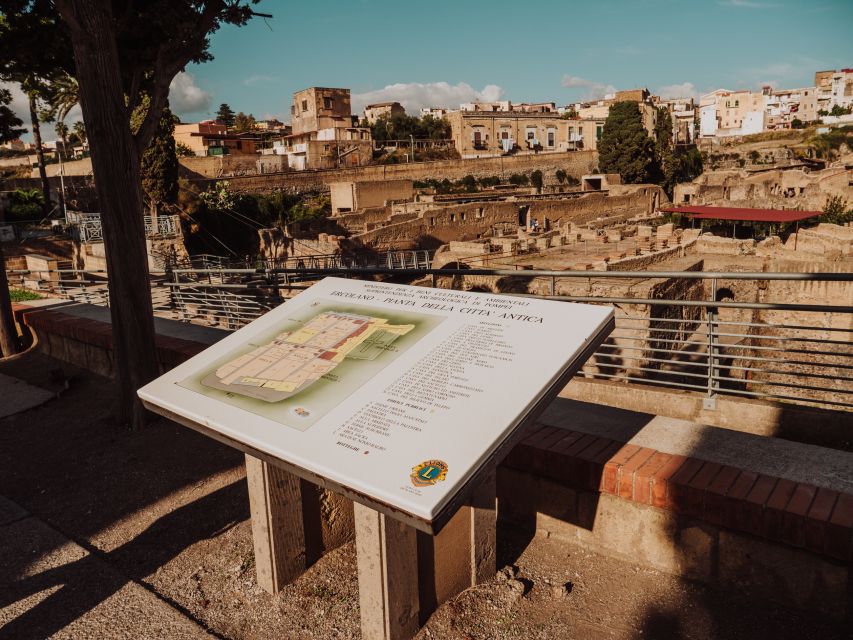
Herculaneum is the first major stop, with about two hours for the guided visit. The ancient town was buried beneath a 20-meter-deep layer of mud, which helped preserve materials that usually disappear over time.
Here, you can see carbonized wooden objects, intact wall paintings, and mosaics. Those details give the site a different feel from Pompeii. Instead of seeing only stone foundations, you may find yourself looking at doors, furniture fragments, decorative surfaces, and rooms that retain a strong sense of shape and purpose.
The guide takes you through several important locations:
- The Temple of the Augustali
- The ancient beach area, where more than 300 skeletons were found
- The Thermal Baths
- The Forum
- The Samnite House
- The Gymnasium
- The House of the Deer
The shoreline area is especially sobering. It connects the remains of the town to the people who tried to escape the eruption. You will also see how public and private spaces fitted together, from bathhouses and religious buildings to elegant homes.
Herculaneum rewards close attention. A guide can point out a painted detail or construction feature that you might walk past without understanding. Michele, who has worked archaeologically at Herculaneum, received particular praise for leading visitors to important areas and explaining what they were seeing. Other guides, including Roberta and Raphael, were also praised for answering questions and adding useful trivia.
Two hours is a good introduction, but it is not a complete study of the site. The pace is designed to keep the group moving and make the second half of the day possible. If Herculaneum is your main reason for visiting Campania, you may eventually want a separate, longer visit.
The lunch break: useful, but budget carefully
After Herculaneum, the minibus takes about 30 minutes to Pompeii. The schedule includes a break of roughly 40 to 45 minutes before the guided walk begins.
Meals are not included. You can bring your own food if you prefer, or eat at a nearby restaurant. One booking experience reported paying about €30 per person for a restaurant meal, so ask about prices before ordering if you are watching your budget.
The break is short. This is not the moment for a leisurely meal with several courses. Eat efficiently, use the restroom, and be ready when the group reconvenes. If you are visiting in hot weather, use the pause to buy water and prepare for more walking.
This is also the point where the fixed schedule becomes most noticeable. You cannot extend lunch because you are enjoying the meal, and you cannot use the time to return to a favorite room at Herculaneum. That structure is the price of seeing two archaeological sites in one day.
A few more Naples bookings to compare
- Naples: Naples Underground Entry Ticket and Guided Tour
★ 4.4 · 21,781 reviews - From Naples: Sorrento, Positano and Amalfi Full-Day Tour
★ 4.6 · 10,988 reviews - From Naples: Sorrento, Positano & Amalfi Coast – Small Group Tour
★ 5.0 · 8,643 reviews - Naples: Catacombs of San Gennaro Entry Ticket & Guided Tour
★ 4.6 · 7,941 reviews
Pompeii: streets, shops, villas, and the final hours of a city

The Pompeii visit lasts about two hours and begins with skip-the-line entry at the Pompeii Archaeological Site. The ancient city was buried by volcanic ash from Mount Vesuvius in 79 AD, preserving streets and buildings beneath the eruption material.
The route includes many of Pompeii’s best-known sights:
- Marina Gate
- Basilica
- Forum
- Forum Baths
- Lupanar
- Bakery
- House of the Faun
- Termopolium Capuano
- House of the Tragic Poet
- Plaster casts
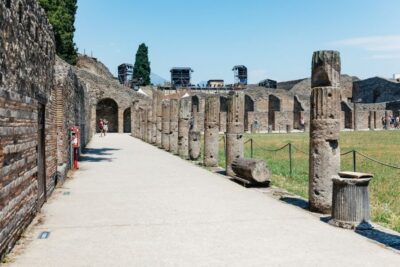
The Forum gives you the clearest sense of Pompeii as a functioning city. This was not simply a collection of villas. It had civic buildings, religious spaces, shops, food outlets, baths, and businesses serving a large local population.
The bakery and thermopolium are useful stops for understanding ordinary life. The bakery points to the practical work behind daily meals, while the thermopolium shows how residents could buy prepared food. These places help turn Pompeii from a set of impressive ruins into a community of workers, families, customers, and officials.
The houses provide a different view. The House of the Faun is famous for its scale and decoration, while the House of the Tragic Poet offers a look at Roman domestic design and artistic taste. The plaster casts are among the most affecting sights, since they preserve the positions of people caught during the disaster.
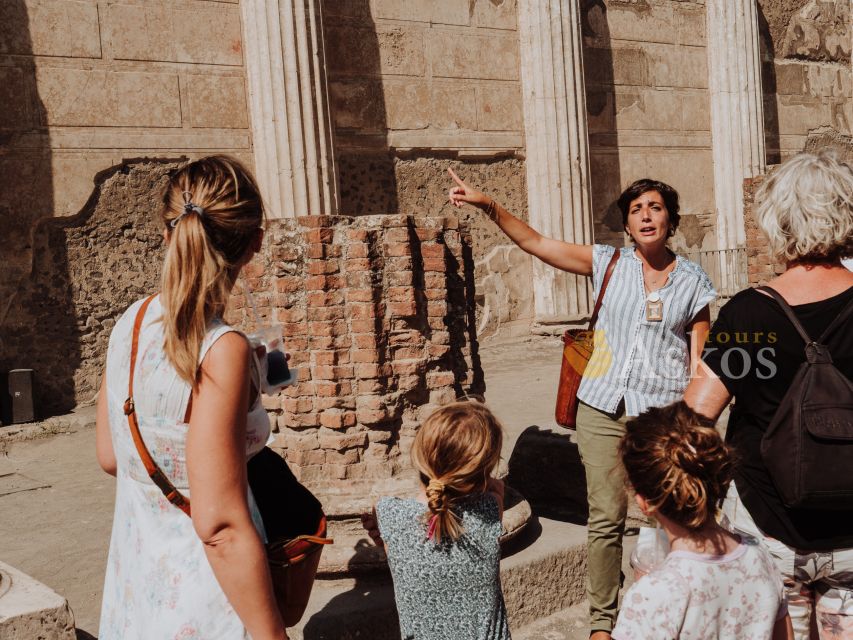
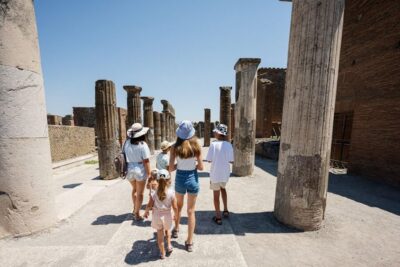
Your guide’s job here is especially important. Pompeii can feel overwhelming because there is so much to see and the streets stretch in several directions. A good guide selects the key areas, explains the city’s layout, and keeps the group moving without turning the visit into a race.
Gennaro, Raphael, Roberta, Julia, and other guides received strong praise for making the ancient city understandable and entertaining. Raphael was noted for quick thinking in crowded conditions, while Julia was praised for giving thorough answers. That matters at Pompeii, where a clear explanation can save you from staring at a wall and wondering what made it important.
What the two-hour Pompeii walk cannot provide
Pompeii is enormous compared with the portion covered on this tour. Two hours is enough to see major public buildings, selected houses, commercial spaces, and plaster casts, but you will not see every excavation.
Several people who enjoyed the tour still wished for more time. That is a fair criticism, not a flaw in the planning. Adding another hour or two at Pompeii would make the day longer and more tiring, and it could reduce the time available at Herculaneum.
I would think of this as a strong first visit rather than a final Pompeii visit. You get a well-chosen introduction, useful context, and a route through the most important highlights. If you already know Pompeii well, the schedule may feel too brief. If you are visiting for the first time, the structure protects you from missing the famous areas.
Wear comfortable walking shoes. The ground is uneven, and you will encounter stairs, slopes, and significant changes in level. The tour is not suitable for wheelchair users or people with mobility impairments. It runs in rain or shine, so carry a raincoat when wet weather is possible.
The guide is the main reason to choose this tour
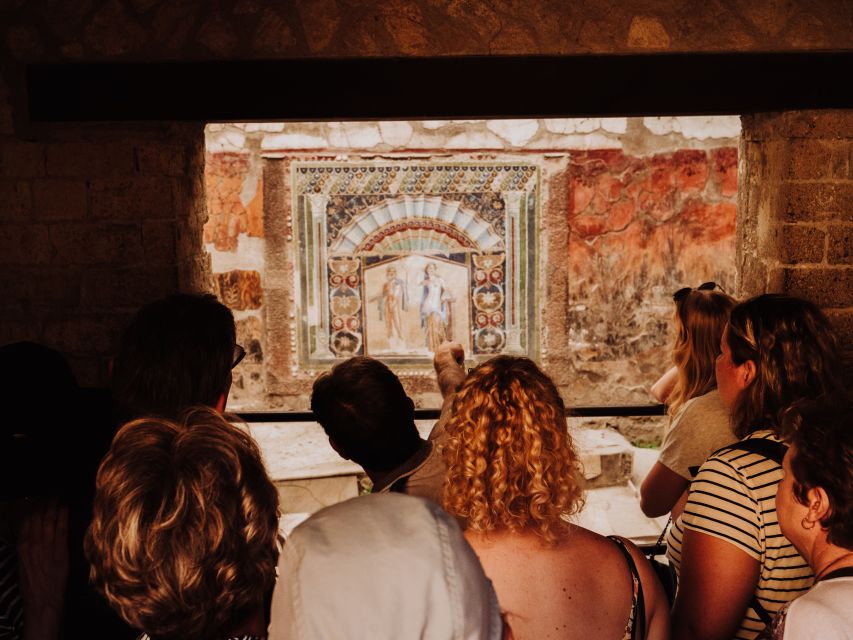
The entrance tickets and minibus are useful, but the guide determines the quality of the day. The strongest part of this experience is the way the archaeologist guides connect buildings to daily life.
You are not simply told that a forum was a forum. You learn how public buildings, homes, shops, baths, and religious spaces worked together. At Herculaneum, the guide can direct your attention to preserved wood or a mosaic. At Pompeii, the guide can explain why a bakery, bath, or food counter mattered.
The guide names are not fixed, so you cannot book a particular person. Still, the feedback highlights several guides, including Raphael, Roberta, Michele, Vito, Gennaro, Julia, Michael, and Giarno. The recurring strengths are clear English, humor, patience, and a strong command of both sites.
Headsets may be provided, especially useful in crowded areas. They let you hear explanations without standing shoulder to shoulder with the guide. In a group of up to 20 people, that can make a real difference.
The small-group size also allows some personal interaction. You can ask questions, though the guide must keep the group on schedule. This format is more personal than a large coach tour but less flexible than a private guide.
Price and overall value at $168.79
At $168.79 per person, this is not a bargain-priced day trip. But the price includes shared minibus transportation, an archaeologist guide, Pompeii entry, Herculaneum entry valued at €16, tolls, parking, and skip-the-line access.
The value depends on your priorities. If you want to visit both sites in one day and avoid arranging trains, tickets, and timing yourself, the package is convenient. It also gives you expert interpretation, which is the part most likely to change how much you get from the ruins.
If you prefer slow exploration, the cost may feel less worthwhile because the schedule limits independent time. You are paying for efficiency and explanation, not unlimited time inside the parks.
The skip-the-line entry is particularly useful during busy periods. Long ticket queues can eat into an already tight schedule. Walking past them does not make the archaeological sites less crowded inside, but it protects your two-hour guided visits from losing time at the entrance.
The only regular extra expense is food. Bring a packed meal or plan for a paid lunch during the short break. Drinks and personal purchases are also your responsibility.
Who should book this Pompeii and Herculaneum tour?
I would recommend it to a first-time visitor based in Naples who wants to see both ancient cities without managing transport. It suits couples, families with older children, and independent visitors who want expert help but do not want a private tour.
It is also a good choice for a short stay or a shore excursion. The return to Starhotels Terminus gives you a central Naples endpoint, and the timetable is designed to bring you back after the Pompeii visit.
You should think twice if you have limited mobility, dislike walking on rough surfaces, or need long breaks. The day includes about four hours of guided walking, plus transfers and the lunch stop. It can be tiring, especially in hot weather.
You may also prefer separate visits if Pompeii or Herculaneum is a personal priority. A two-hour introduction cannot cover everything. But for a focused overview of both sites, this is a sensible plan.
Should you book it?
Book this tour if you want two major Roman sites in one organized day, especially if you value a skilled guide and direct transport from Naples. The strongest reasons are the archaeologist-led explanations, skip-the-line admission, and compact group size.
Skip it if you want to linger, revisit rooms, or explore Pompeii at your own pace. The itinerary is full, the walking is demanding, and lunch costs extra.
For most first-time visitors with a reasonable fitness level, the balance works. You see Herculaneum’s remarkable preservation, Pompeii’s major streets and buildings, and the volcanic story that links them, all without spending the day in ticket queues and transit connections.
FAQ
Where does the tour begin?
The meeting point is in front of the Starhotels Terminus entrance, opposite Naples Central Station. Look for the guide holding an Askos Tours sign.
Where does the tour end?
The activity ends back at the Starhotels Terminus meeting point.
How long does the tour last?
The total duration is about seven hours. Starting times vary, so you need to check availability when booking.
Which languages are available?
The live tour guide language is English.
Is transportation included?
Yes. Shared transportation by modern minibus is included, along with tolls and parking expenses.
Are entrance tickets included?
Yes. The tour includes a Pompei Express entrance ticket and a Herculaneum entrance ticket valued at €16 each.
Is lunch included?
No. Meals are not included. The schedule provides a break of about 40 to 45 minutes before the Pompeii visit.
What should you bring?
Bring your passport or identity card. Comfortable walking shoes and a raincoat are also sensible because the tour runs in all weather and includes uneven ground.
Is the tour suitable for wheelchair users or people with mobility impairments?
No. The tour is not suitable for wheelchair users or people with limited mobility because the sites include stairs, slopes, and uneven surfaces.
Recently added around Naples
- Vesuvius National Park Skip-the-Line Ticket★ 3.8 · 221 reviews
- Naples: The Holy Mile 3-Hour Guided Tour★ 4.9 · 711 reviews
- Pompeii and Vesuvius Full-Day Tour from Amalfi Coast★ 4.4 · 319 reviews
- From Naples: Pompeii and Herculaneum Tour with Lunch★ 4.3 · 444 reviews
- From Naples: Pompeii Guided Tour with Skip-the-Line Tickets★ 4.8 · 1,171 reviews
- Naples: Day Trip to Pompeii and Capri★ 4.4 · 272 reviews
- From Naples: Pompeii & Amalfi Coast Full-Day Trip★ 4.5 · 279 reviews
- Pompeii and Mount Vesuvius excursion from Naples★ 4.6 · 188 reviews
Pompeii & Vesuvius Tours, compared.
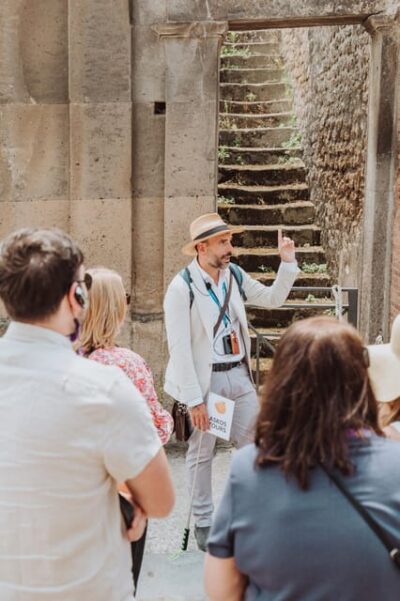
Entry Ticket and Guided Tour with an Archaeologist
Read our review →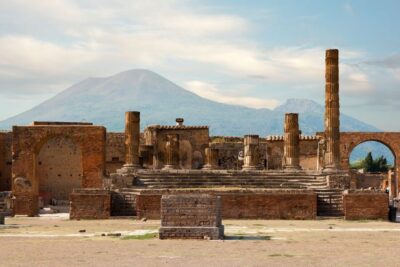
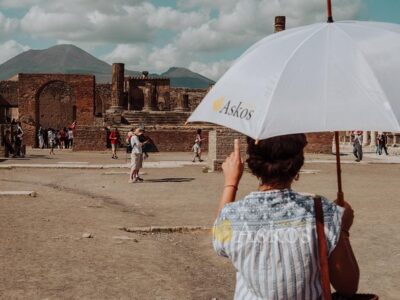

Pompeii Small Group Tour with an Archaeologist
Read our review →
Pompeii, Amalfi Coast and Positano Day Trip from Rome
Read our review →Browse the lists this tour appears in