Reviewed · TICKETS
Florence: Santa Maria Novella Entry Ticket & Audioguide
Look up, and Florence changes. Santa Maria Novella gives you Gothic structure, Renaissance design, quiet cloisters, and major works by Masaccio, Ghirlandaio, Giotto, Botticelli, Brunelleschi, Vasari, and others in one stop. I especially like the skip-the-ticket-line entry and the tablet guide, which adds helpful narration, images, and 3D reconstructions without tying you to a live group.
I also like the setting beside Florence’s main train station, since you can fit this visit into your first or last day in town. The main drawback is value: at $18 per person, this booking may cost more than buying admission and an audio guide directly, and the entry instructions can be confusing.
The visit is listed as about one hour, but you may want longer. The church and cloisters reward a slower pace, and several people have found themselves lingering over the frescoes, chapels, and architectural details. Bring your passport or ID, and remember that the chosen entry time is firm.
In This Review
- Key points to know before you book
- Why Santa Maria Novella deserves your time
- Finding the right entrance near the station
- The basilica: Gothic height and Renaissance order
- Masaccio, Ghirlandaio, and the art inside
- The cloisters and quieter corners
- How long the one-hour visit really takes
- Is the $18 price fair?
- Common problems and how to avoid them
- Who will enjoy this experience most?
- Should you book Santa Maria Novella with the multimedia guide?
- FAQ
- Where do I redeem the Santa Maria Novella ticket?
- Is the entry time flexible?
- What is included in the ticket?
- Which languages are available on the multimedia guide?
- Do I need to bring identification?
- How long does the visit take?
- Can every part of the complex be visited?
Key points to know before you book
- Michelangelo called it his bride: The basilica’s unusual blend of Gothic form and Renaissance decoration explains why it made such a strong impression on him.
- The back entrance matters: Ticket redemption is to the right or rear side of the church, through the tourist office area near the train station, not simply at the obvious front entrance.
- A tablet replaces a traditional audio handset: The seven-inch multimedia guide includes audio, high-definition images, and 3D recreations.
- The art is the main event: Masaccio, Ghirlandaio, Giotto, Filippino Lippi, Paolo Uccello, Brunelleschi, and others are part of the visit.
- Your ID is held temporarily: You must leave a valid passport or identity card at the ticket office to borrow the multimedia guide.
- Some areas may be closed: The accessible portion of the complex can vary, so do not assume every exhibition or room will be open.
Why Santa Maria Novella deserves your time
Santa Maria Novella is not just another pretty church in Florence. It was the city’s first great basilica, and its story reaches back to the early 13th century, when the first Dominican friars settled in Florence. The complex grew in size and importance over the centuries, gathering new chapels, cloisters, paintings, and architectural work along the way.
That long development gives the site its special character. You are not looking at one tidy period piece. Instead, you move through a building where medieval Gothic design meets the clear geometry of the Renaissance. The result can feel busy at first, but the multimedia guide helps explain why the church looks the way it does.
I find the exterior especially useful as an introduction. The famous marble facade prepares you for Florence’s love of pattern, proportion, and strong geometric design. Inside, the mood changes. The scale is grand, but the chapels and fresco cycles pull your attention down to human stories, painted figures, and small details.
Michelangelo’s nickname for Santa Maria Novella, his bride, is easy to understand once you see the union of structure, decoration, and light. You do not need to be an art specialist to enjoy it. The setting works for first-time visitors who want a clear introduction to Florentine art, as well as for returning visitors who want to focus on specific painters.
A few more Florence bookings to compare
- Florence: Skip-The-Line Uffizi Gallery Timed Entry Ticket
★ 4.5 · 27,832 reviews - Tuscany Day Trip from Florence: Siena, San Gimignano, Pisa and Lunch at a Winery
★ 5.0 · 21,634 reviews - Florence: Timed Entrance Ticket to Michelangelo’s David
★ 4.6 · 16,983 reviews
Finding the right entrance near the station
The first challenge is practical, not artistic. The ticket meeting point is not as obvious as it should be. Instructions can point you toward the front of the basilica, while the actual redemption point is on the right or rear side, near the tourist office across from the station.
Give yourself extra time to find it. Several people have had trouble locating the correct gate, and the clearest advice is to look for the pre-booked ticket entrance on the north or back side of the complex. Do not wait until the last minute, especially if you have a train to catch or a timed museum booking afterward.
The selected time slot is binding. You can be refused entry if you arrive outside it, so treat the appointment like a train departure. The ticket is valid for one day, but that does not mean you can arrive whenever you wish. The starting time controls your admission.
Once inside, you collect the multimedia guide. You need to leave a valid passport or ID card at the ticket office as security for the device. This is a useful detail to know before arriving, since some people are uncomfortable handing over a passport, and a driving license may be preferable if accepted by the staff.
The basilica: Gothic height and Renaissance order
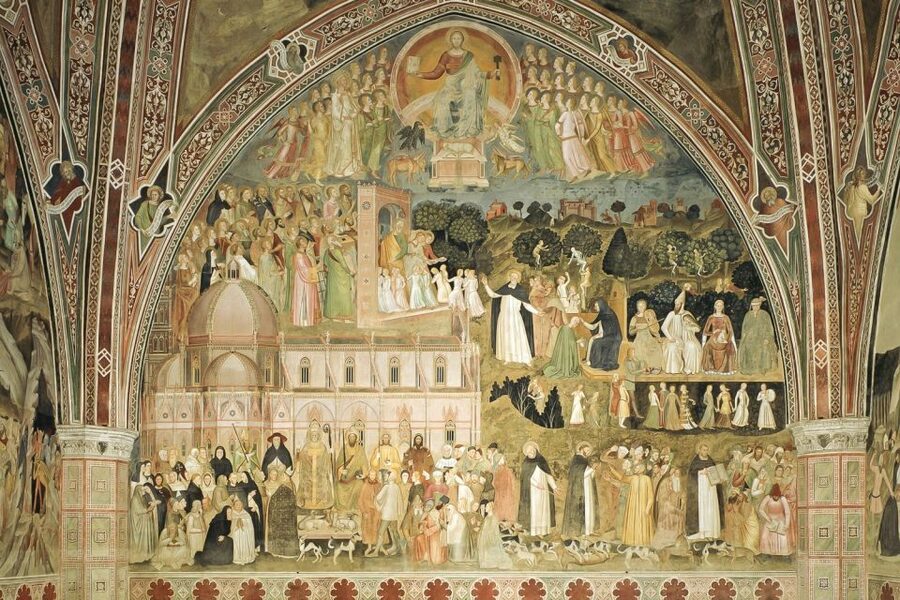
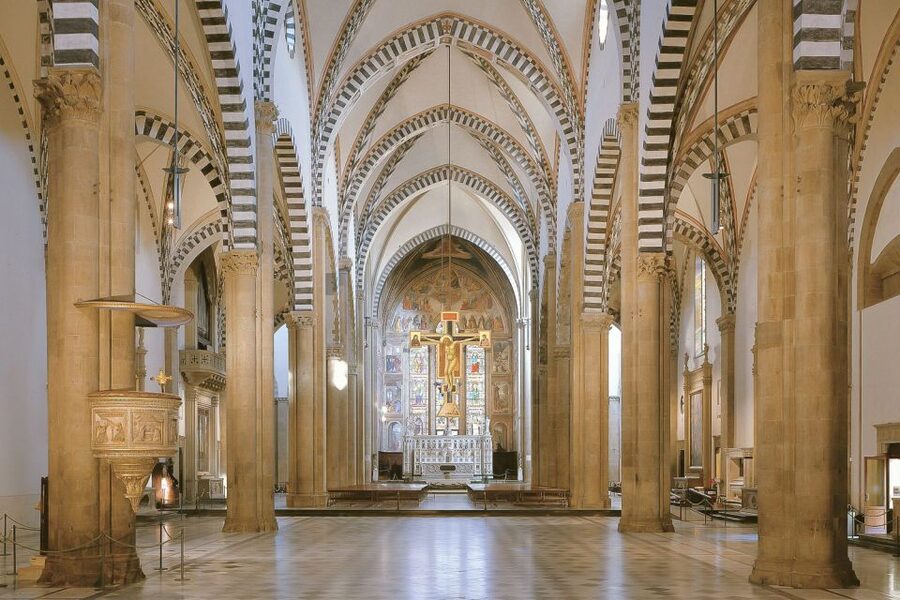
The church interior is the heart of the visit. Its Gothic origins show in the height and sense of upward movement, while later Renaissance additions bring a more measured, orderly feel. The contrast gives the basilica its visual interest.
Your guide provides audio narration in English, Spanish, French, German, or Italian. It also uses high-definition images and 3D recreations, which can help when you are trying to understand how a chapel, artwork, or architectural feature fits into the larger complex.
I like this format because you can stop and start at your own pace. A live guide moves on when the group moves on. With the tablet, you can spend more time with a fresco that catches your eye, or move faster through material that interests you less.
The device is not perfect. Some people have found the controls awkward, and the tablet can lock or time out. Directions on how to operate it could be clearer. If the guide stops responding, ask the staff for help rather than wasting ten minutes pressing the wrong part of the screen.
The content itself is generally more useful than the hardware. It gives you a framework for understanding what you see, rather than leaving you to identify every artist and chapel on your own. If you prefer a printed guidebook, bring your own notes or download background information in advance, since an English-language booklet is not necessarily provided.
Masaccio, Ghirlandaio, and the art inside
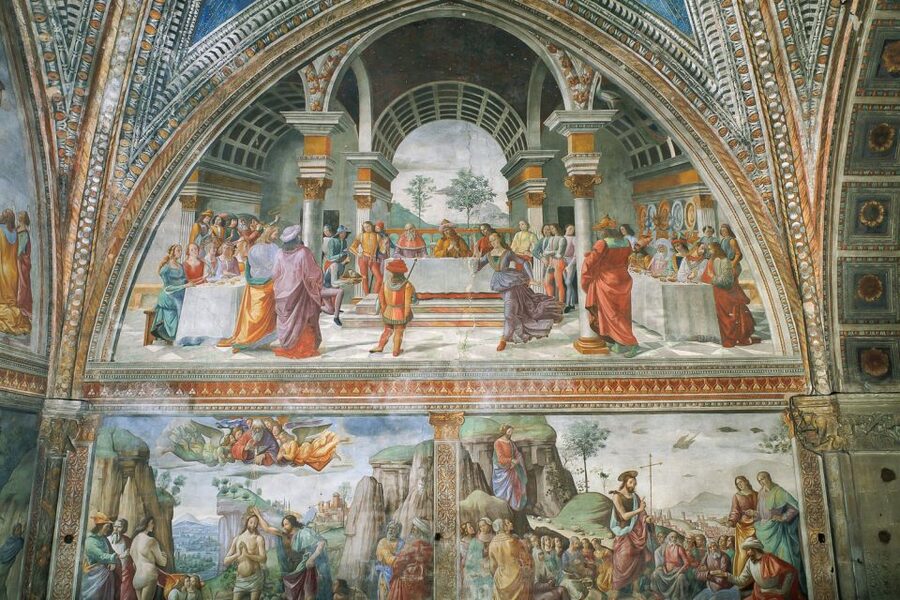
The art collection is the strongest reason to visit. The complex brings together work connected with some of the biggest names in medieval and Renaissance Florence.
Masaccio is one of the key artists to look for. His work is important because of its sense of believable space and human form. The guide helps place his painting in the development of Renaissance art, making it easier to see why it matters rather than simply noting the artist’s name.
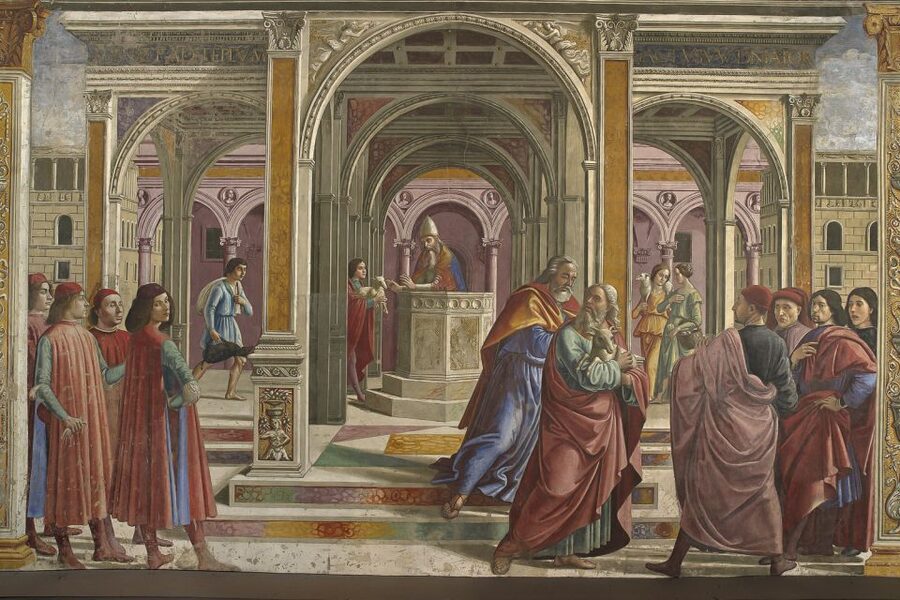
Domenico Ghirlandaio is another major presence. His frescoes offer a different pleasure, with detailed scenes and carefully observed figures. Look beyond the central subject. The surrounding architecture, clothing, gestures, and background details reward patient attention.
You will also encounter connections to Giotto, Paolo Uccello, Filippino Lippi, Filippo Brunelleschi, Botticelli, and Vasari. Not every artist is represented in the same way, and the exact areas available can vary, but the overall range is impressive.
The basilica is particularly good for anyone who wants to see how art served religious and civic purposes in Florence. Paintings were not placed randomly. Chapels, altars, family prestige, devotion, and artistic ambition all came together here. The audio narration gives you enough context to read the building as a historical document, not just a beautiful interior.
Still Florence, but a slower afternoon:
- Florence: Michelangelo’s David Skip-the-Line Entry Ticket
★ 4.5 · 12,764 reviews - The Best tour in Florence: Renaissance & Medici Tales – guided by a STORYTELLER
★ 5.0 · 12,316 reviews - Florence: Leonardo Interactive Museum Entry Ticket
★ 4.5 · 11,763 reviews - The Best Tour in Florence: Renaissance and Medici Tales
★ 5.0 · 10,810 reviews
The cloisters and quieter corners
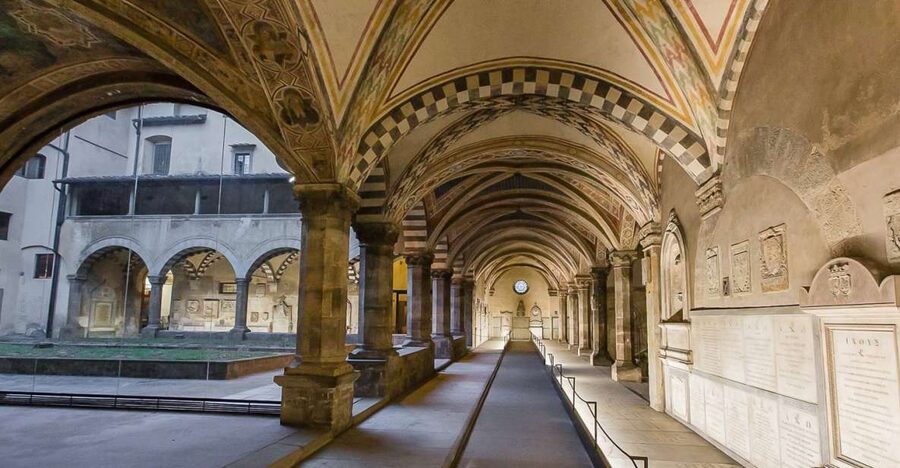
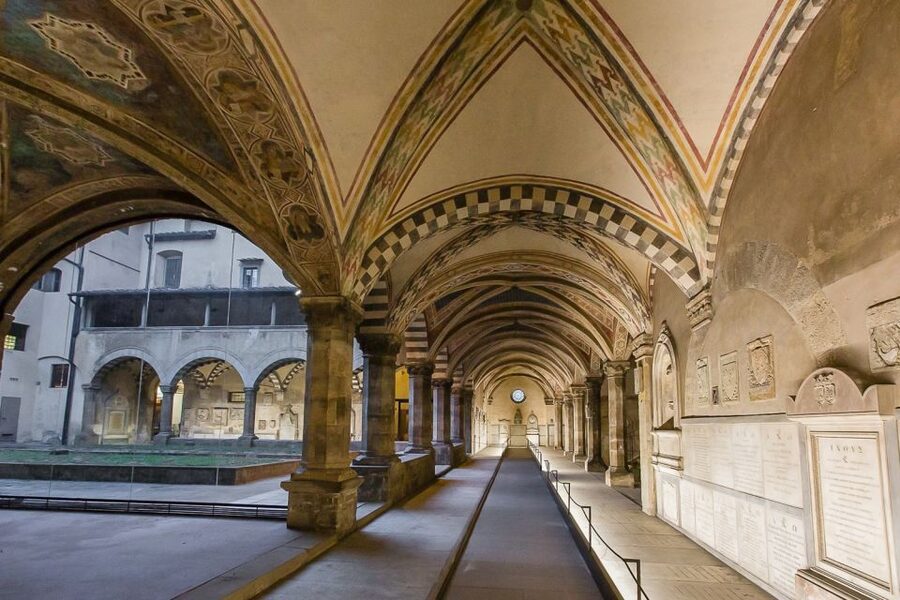
Do not rush out after seeing the main nave. The cloisters add a calmer side to the complex, with covered walkways, painted decoration, and architectural details that are easy to miss if you focus only on the church.
The outdoor corridors are one of the most praised parts of the visit. Their murals and frescoed surfaces create a different rhythm from the large interior. Instead of looking upward at a grand nave, you move along enclosed walkways where repeated arches, wall paintings, and open courtyards shape the experience.
The cloisters also give you a useful pause. Florence’s center can be noisy and crowded, but this part of Santa Maria Novella feels more contained. You can study a section of painted wall, then move on without the pressure of a guided group.
Keep in mind that portions of the museum or complex may be closed on a particular day. This has caused disappointment, especially when people expected access to every listed area. Closures are not always obvious when you book, so ask at the entrance what is currently open.
How long the one-hour visit really takes
The official visit length is about one hour. That is enough for a brisk look at the basilica and cloisters, especially if you listen only to the main sections of the guide.
I would allow more time if you care about art. The church contains enough frescoes, paintings, chapels, and architectural accents to keep you occupied well beyond sixty minutes. One person planned a short visit and ended up staying much longer because there was so much to examine.
Your pace will depend on how you use the tablet. Listening to every track, studying the screen images, and looking back at the artwork takes time. If you are visiting with children, note that the multimedia guides are the same for adults and children, so younger visitors may need help choosing which sections to hear.
The visit works well as a flexible Florence stop. It is close to the train station, so you can schedule it near an arrival or departure. Still, do not cut the timing too close. Finding the correct ticket office, collecting the tablet, and returning it all take a little attention.
Is the $18 price fair?
At $18 per person, this is a reasonable price if the timed entry saves you a long wait and you value the multimedia content. The guide is available in five languages, and the visuals add more than a basic recorded commentary.
The price becomes harder to defend if the line is short or if you are comfortable arranging admission yourself. Direct admission and a self-guided option may cost less, according to the experience of some visitors. That makes the booking fee feel like a premium for convenience rather than a bargain.
You should also consider what is included. You get admission and the multimedia guide, but not a live tour guide. If you want personal interpretation, questions answered on the spot, or a carefully managed route, this is not that kind of experience.
The strongest value comes when you want a set time, dislike waiting, and prefer explanations in your own language. The weakest value comes when you are already near the church, the ticket office has availability, and you can buy a cheaper self-guided ticket directly.
Common problems and how to avoid them
A few small preparations can make this visit much smoother:
- Save the meeting-point instructions before you leave your hotel. Look for the tourist office or rear gate on the side near the station.
- Arrive early enough to find the ticket office without rushing. Your time slot cannot be treated casually.
- Bring a passport or ID card for the multimedia guide. The ticket office keeps it while you use the device.
- Check that the tablet is working before you walk away from the desk. Ask staff to explain the controls if the screen is unclear.
- Confirm which areas are open that day. A closed exhibition can change what you see.
- Keep valuables secure around the piazza and station area. One person reported a wallet being stolen from a bag nearby, so use a zipped purse or front pocket.
These are simple steps, but they matter. The church itself is easy to appreciate. The preventable frustrations come from the meeting point, the timed entry, and the tablet.
Who will enjoy this experience most?
I would recommend it to first-time visitors who want an introduction to Florence’s religious art without joining a live group. The guide gives you structure, while the timed ticket reduces uncertainty during a busy sightseeing day.
It also suits art lovers who want to spend extra time with Masaccio, Ghirlandaio, Giotto, and the other artists connected with the basilica. You can listen closely to the commentary, pause the device, and return to details that deserve a second look.
It is less suitable for someone who wants the lowest possible admission price. In that case, compare the direct ticket cost before booking. It may also disappoint visitors expecting every room to be open or expecting a human guide to lead the way.
Families should know that the audio content is not specially adapted for children. Older children interested in paintings may enjoy the images and 3D sections, but younger ones may need help with the tablet and may not follow every explanation.
Should you book Santa Maria Novella with the multimedia guide?
Book it if you want timed admission, clear art context, and the freedom to explore alone. Santa Maria Novella is beautiful enough to justify a visit, and the cloisters, frescoes, and mixture of Gothic and Renaissance design give you plenty to see.
Think twice if saving money matters more than convenience. Check the direct admission price, and do not pay the $18 fee assuming it includes a live guide. Also plan for the possibility of a closed section and allow time to find the rear ticket office.
My practical verdict: this is a very worthwhile Florence sight, with a useful but sometimes temperamental tablet. The building and artwork carry the experience. The booking is best for visitors who value a reserved time and do not mind paying extra for that convenience.
FAQ
Where do I redeem the Santa Maria Novella ticket?
Go to the right or rear side of the church, near the tourist office area across from Florence’s train station. The pre-booked ticket entrance may be described as the back or north-side gate.
Is the entry time flexible?
No. The date and time slot selected during booking are binding. You may be refused entry if you arrive outside the allotted time.
What is included in the ticket?
The ticket includes admission to Santa Maria Novella and a multimedia guide. A live tour guide is not included.
Which languages are available on the multimedia guide?
The guide is available in English, Spanish, French, German, and Italian.
Do I need to bring identification?
Yes. You must bring a valid passport or ID card, which is held temporarily at the ticket office while you use the multimedia guide.
How long does the visit take?
The planned visit is about one hour, covering the basilica and cloisters. You may choose to stay longer to study the frescoes, paintings, chapels, and architectural details.
Can every part of the complex be visited?
Not always. Some exhibitions or sections may be closed on the day of your visit, so confirm what is open when you collect your ticket.
Recently added around Florence
- Florence Uffizi Gallery monolingual Small Group Tour★ 4.0 · 621 reviews
- Florence Private Walking tour with Skip-the-line to Accademia★ 4.5 · 236 reviews
- Uffizi Gallery Entrance Ticket with Priority Access★ 3.5 · 1,029 reviews
- Florence Skip-the-Line Duomo Tour with Guide & Brunelleschi Dome★ 5.0 · 1,176 reviews
- Skip-the-Line Accademia Guided Visit: David Secrets and Beyond★ 4.0 · 525 reviews
- Priority Entrance : Florence Accademia Gallery Timely Tickets★ 4.0 · 603 reviews
- Skip the line : David Guided Experience★ 4.5 · 1,076 reviews
- Private Tour in Siena, San Gimignano and Chianti Day Trip from Florence★ 5.0 · 405 reviews
Tickets, compared.
Cathedral and Duomo’s Terraces Entrance Ticket
Read our review →
Skip-The-Line Uffizi Gallery Timed Entry Ticket
Read our review →
Naples Underground Entry Ticket and Guided Tour
Read our review →
Pantheon Fast-Track Ticket and Official Audio Guide
Read our review →
Entry Ticket and Guided Tour with an Archaeologist
Read our review →