Reviewed · FLORENCE TOURS
The Best Tour in Florence: Renaissance and Medici Tales
Florence makes more sense when you know the family drama. This two-hour walk links Medici power with the churches, palaces, squares, and works of art that shaped Renaissance Florence. I like the broad route, which runs from San Lorenzo through the Duomo district to Piazza della Signoria, and I like the storytelling, especially when guides such as Aurora, Alberto, Camilla, Deborah, and Manuel turn dates and buildings into human stories. The main drawback is that this is an outdoor walking tour with no included entry tickets, so rain, crowds, and later museum visits can affect your day.
The price is unusual. The advertised rate is $3.62 per person, but the tour works through donations, with the guide’s compensation left to you at the end. That makes it a very low-cost way to get oriented, though you should plan to give a fair tip if the guide earns it. The group can reach 30 people, so do not expect the close attention of a private tour.
In This Review
- Key points to know before you book
- Starting beneath the Medici at San Lorenzo
- Palazzo Medici Riccardi and the family’s first power base
- The Baptistery, Duomo, and the great engineering puzzle
- Dante’s Florence in a five-minute stop
- Piazza della Signoria, the public stage of Florence
- Palazzo Vecchio and the end near the Uffizi
- Why the guides make or break this walk
- The real value of a $3.62 booking price
- Practical limits you should plan around
- Who should book this Florence walk?
- Should you book The Best Tour in Florence?
- FAQ
- How long is The Best Tour in Florence?
- Where does the tour start?
- Where does the tour end?
- What language is the tour offered in?
- Is the Uffizi Gallery admission included?
- Are admissions to the other sights included?
- How does the donation pricing work?
- Can I cancel for a refund?
Key points to know before you book
- Medici-centered storytelling: Learn how Florence’s banking family influenced churches, palaces, politics, art, and the Renaissance.
- A strong first-day route: Walk from San Lorenzo to the Duomo, Dante’s world, Piazza della Signoria, and the Uffizi area.
- Donation-based pricing: The low booking price is only part of the cost. You choose the guide’s compensation afterward.
- English-language tour: A licensed guide leads the experience in English.
- Outside views, not museum visits: Admission is not included at San Lorenzo, Palazzo Medici Riccardi, Giotto’s Campanile, Brunelleschi’s Dome, Palazzo Vecchio, or the Uffizi.
- Well-liked guides: Guides named in the feedback include Aurora, Alberto, Camilla, Deborah, Elisabetta, Elizabeth, Manuel, Marco, and Simona.
Starting beneath the Medici at San Lorenzo
Meet in Piazza di San Lorenzo, beside the statue of Giovanni de’ Medici seated on a throne. This is a practical meeting point in the city center, close to public transportation and easy to pair with a morning in Florence’s main market district.
The Basilica of San Lorenzo is more than a handsome church facade and busy square. It is tied closely to the Medici family and serves as the burial place of principal Medici figures from Cosimo il Vecchio through Cosimo III. That gives your guide a useful opening: Florence’s Renaissance was not just a sudden flowering of beautiful art. It was also shaped by money, family alliances, church patronage, and political control.
You spend about 10 minutes here, and admission is not included. The short stop is enough for orientation and explanation, but not for a full church visit. If the basilica interests you, save it for later and return with a separate ticket.
The tour’s Medici theme is its best organizing idea. Instead of treating Florence as a string of unrelated monuments, the guide connects the city’s buildings to the people who paid for them, lived in them, or used them to gain influence.
A few more Florence bookings to compare
- Florence: Skip-The-Line Uffizi Gallery Timed Entry Ticket
★ 4.5 · 27,832 reviews - Tuscany Day Trip from Florence: Siena, San Gimignano, Pisa and Lunch at a Winery
★ 5.0 · 21,634 reviews - Florence: Timed Entrance Ticket to Michelangelo’s David
★ 4.6 · 16,983 reviews
Palazzo Medici Riccardi and the family’s first power base
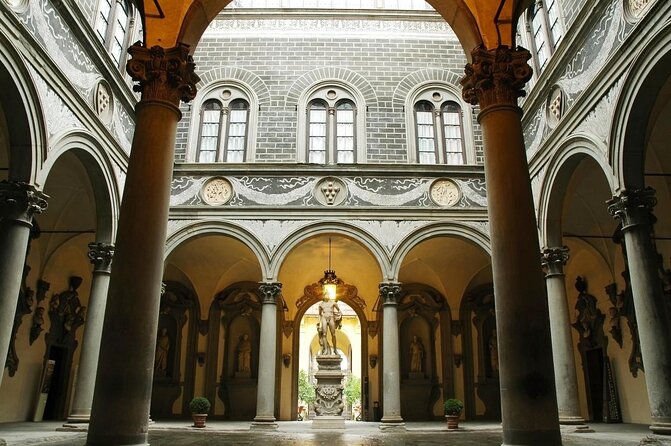
The next stop is Palazzo Medici Riccardi, designed for Cosimo de’ Medici and built between 1444 and 1484. It helps you picture the family before its later grander palaces and political reach.
The guide’s job here is not simply to point at a Renaissance building. It is to explain how a banking family could become the force behind Florence’s cultural life. The palace gives that story a physical setting: a private residence with public consequences.
You have about 10 minutes outside, and entry is not included. That is fair for a first walk, since the route is meant to cover a large part of central Florence. Still, you should note the difference between seeing the exterior and exploring the interior. A visitor interested in Medici art and architecture may want to return on another day.
This is also where a good guide can make the tour more than a standard sightseeing circuit. Alberto is praised for covering the Medici family, food, restaurants, and useful places to visit after the walk. Camilla is described as clear and engaging when explaining how the family helped shape Florence. Those practical recommendations can make the rest of your stay easier.
The Baptistery, Duomo, and the great engineering puzzle
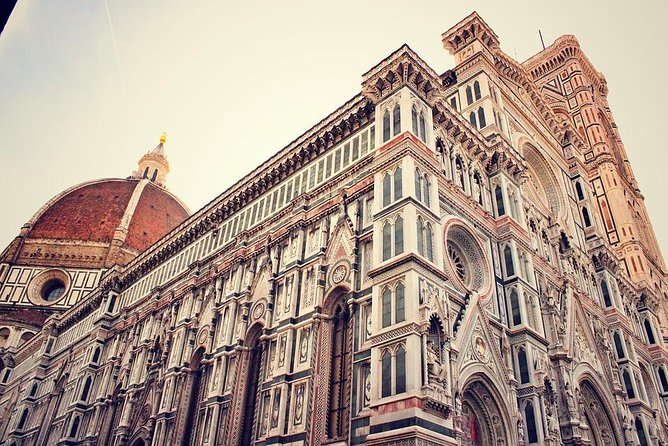
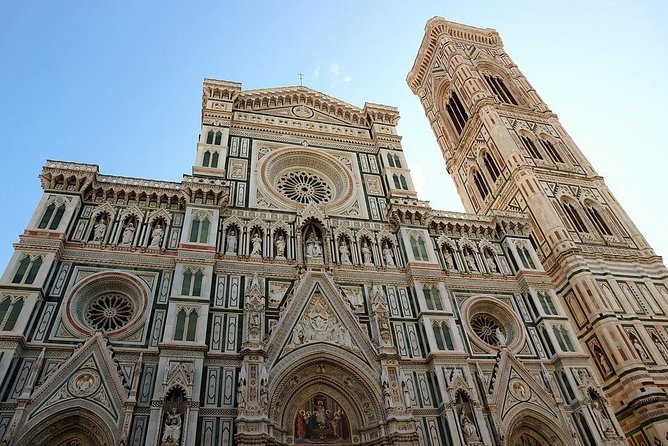
The route then moves into Piazza del Duomo, Florence’s most concentrated display of medieval and Renaissance architecture. You see the Baptistery of Saint John, Florence Cathedral, Giotto’s Campanile, and Brunelleschi’s Dome in close succession.
The Baptistery is one of the oldest buildings in Florence, built between 1059 and 1128 in the Florentine Romanesque style. Its position across from the cathedral makes it easy to understand the Duomo complex as a group rather than a set of separate sights.
You get around 10 minutes here, with no admission included. That is enough for the exterior, but the famous doors, interior details, and museum displays deserve more time if you later choose to enter. The square can also be crowded, so stay close to the guide and listen carefully.
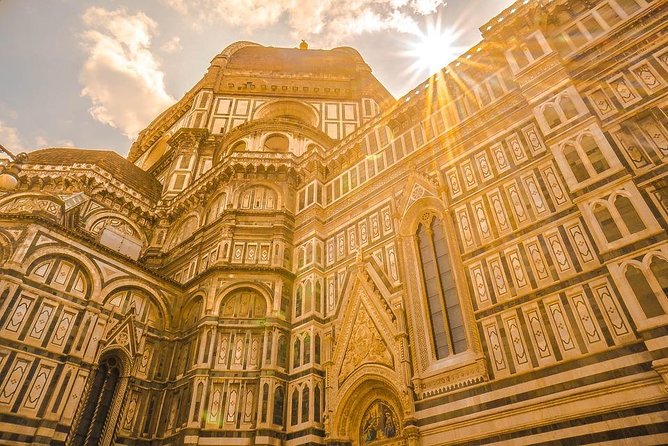
Florence Cathedral began in 1296 in the Gothic style, based on a design by Arnolfo di Cambio. The cathedral complex includes the Baptistery and Giotto’s Campanile, and the whole historic center is protected as a UNESCO World Heritage Site. The cathedral itself is free to enter, according to the tour details, while other parts of the complex require separate admission.
The Campanile gives you another angle on Florentine design. Giotto’s bell tower is known for its colored marble, sculpture, and Gothic form. You stop for about 10 minutes, but the tower is not included as an interior visit. If you want to climb or explore the complex, plan that separately.
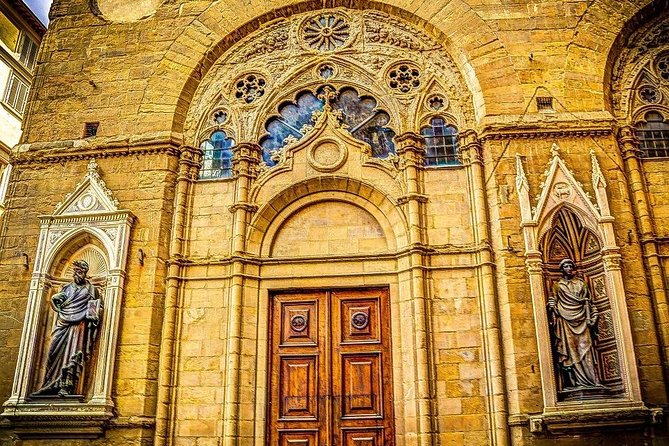
Then comes Brunelleschi’s Dome, the engineering star of the route. It was once the largest dome in the world and remains the largest brick dome ever constructed. A guide can make this stop especially useful by explaining why the structure was so difficult and why its construction mattered to Renaissance architecture.
The dome is also where expectations need careful handling. You see and discuss it from outside on this tour. A climb or interior visit is not part of the experience, and admission is not included. If the dome is a top priority, reserve a separate visit rather than assuming this walk provides access.
Dante’s Florence in a five-minute stop
The route leaves the Duomo area and passes the House of Dante, associated with the Florentine writer who wrote the Divine Comedy. The museum and birthplace connection offers a quick look at the literary side of Florence.
This stop lasts about five minutes and admission is free. It is brief, but it adds useful variety after the architecture-heavy Duomo section. Florence was shaped by writers and political thinkers as well as painters, sculptors, architects, and bankers.
Do not expect a full literary tour here. The value is the context: you learn that the city’s identity reaches beyond Renaissance art. If Dante interests you, the brief stop can help you decide if the museum deserves a longer visit.
Still Florence, but a slower afternoon:
- Florence: Michelangelo’s David Skip-the-Line Entry Ticket
★ 4.5 · 12,764 reviews - The Best tour in Florence: Renaissance & Medici Tales – guided by a STORYTELLER
★ 5.0 · 12,316 reviews - Florence: Leonardo Interactive Museum Entry Ticket
★ 4.5 · 11,763 reviews - Florence: Pasta Cooking Class with Unlimited Wine
★ 4.9 · 10,285 reviews
Piazza della Signoria, the public stage of Florence
Piazza della Signoria is one of the most rewarding places on the route because it brings art and politics together in an open public space. The L-shaped square sits in front of Palazzo Vecchio and serves as a gateway to the Uffizi Gallery.
You spend roughly 10 minutes here, and admission is free. The square is a meeting place for Florentines and a major stop for visitors, so it can feel crowded. That crowd is part of the scene, but it also means you may need to move around the guide to see statues or hear clearly.
The copy of Michelangelo’s David outside Palazzo Vecchio is an important detail. The original is in the Accademia Gallery, but the copy marks the same civic setting where Florence used David as a symbol of strength and independence. A strong guide, such as Deborah, can explain why calling a statue a copy does not make its location meaningless.
Feedback about Deborah also highlights her humor, strong group management, and ability to explain details such as the fake David statue in a memorable way. That kind of explanation is useful because Florence is full of famous works that have been moved, copied, restored, or placed in settings different from their original ones.
Palazzo Vecchio and the end near the Uffizi
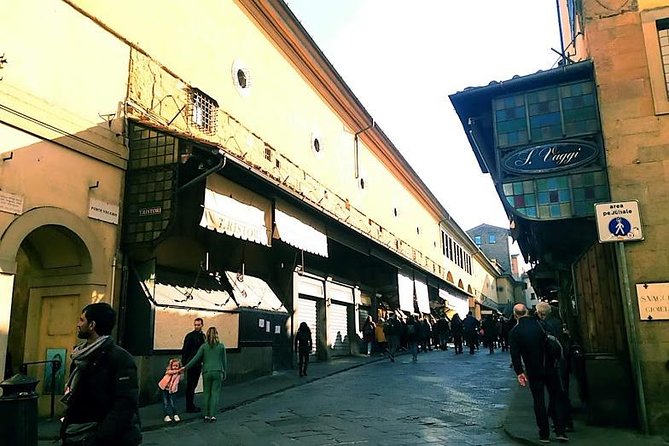
Palazzo Vecchio is Florence’s town hall, a fortress-like palace overlooking Piazza della Signoria. Its location makes the building feel political rather than merely decorative. This is where the Medici story, the city government, public art, and civic power come together.
The stop lasts about 10 minutes, and admission is not included. You see the exterior, the David copy, and the nearby Loggia dei Lanzi with its gallery of statues. If you want the grand rooms and museum collections inside Palazzo Vecchio, arrange a separate visit.
The walk ends in Piazza della Signoria, close to the Uffizi Gallery. The endpoint can vary slightly within the square, but the area is convenient for continuing your day. The Uffizi itself is not included, and you should not treat the final stop as an entry line or guided museum visit.
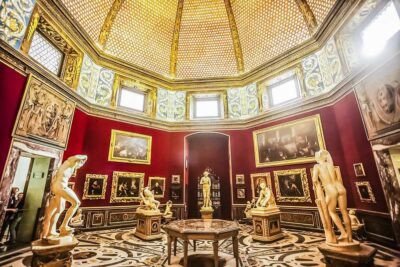
The Uffizi is one of Italy’s major art museums, with an especially important collection of Italian Renaissance works. The building began in 1560 under Giorgio Vasari for Cosimo I de’ Medici, originally to house the offices of Florentine magistrates. The name comes from uffizi, meaning offices.
Ending here makes practical sense. You can go straight to the gallery if you already have a reservation, stop for lunch, or retrace part of the route before choosing which interiors deserve your time and money.
Why the guides make or break this walk
A two-hour route through Florence can easily become a recital of names and dates. The strongest praise for this experience focuses on guides who tell stories, answer questions, use humor, and explain the city in plain English.
Aurora is praised for her insight into lesser-known details and the Medici family. Alberto receives repeated praise for his command of Florence’s history and for restaurant and food suggestions. Camilla is described as lively, clear, and able to bring the Medici story to life.
Other guide names connected with positive feedback include Manuel, Elisabetta, Elizabeth, Marco, Simona, Deborah, and Samona. The comments point to a range of personalities, but the common strengths are clear: strong explanations, enthusiasm, good pacing, and an ability to make the past accessible to people who are not history specialists.
That last point matters. You do not need to arrive knowing the difference between Gothic and Renaissance design, or remembering every Medici family member. A good guide gives you a framework, then helps you notice the city around you.
The group size can reach 30 people. That is manageable in an open square, but less intimate than a small-group or private walk. Arrive early, stay near the guide, and do not hesitate to ask where you should stand to hear better.
The real value of a $3.62 booking price
At $3.62 per person, this looks almost too cheap for a licensed, English-language guide and a two-hour route through central Florence. The reason is the donation model. You pay the small booking amount, then decide how much to give at the end.
That system can be excellent value if you want an introduction before spending money on museum tickets, climbs, or longer tours. You can see the city’s key areas, learn what matters, and then choose which places deserve a return visit.
The low price should not mean a tiny tip. The guide’s only compensation comes from donations, so budget for a fair amount based on the quality of the experience. One piece of advice in the feedback suggested at least €20 per person for an especially strong guide. You should use your own judgment, but carry cash if possible. One person wanted to tip and had none available.
This arrangement also means the final cost is not fully fixed. If you prefer knowing the exact price before booking, a standard paid tour may feel simpler. If you like paying according to the value you receive, this format gives you more control.
Practical limits you should plan around
The tour lasts about two hours and is conducted on foot. That makes it easy to absorb Florence’s streets and squares, but you should wear comfortable shoes and expect to remain outdoors for most of the experience.
The tour requires good weather. If poor weather causes cancellation, you receive a different date or a full refund. The activity also requires a minimum number of participants, so a cancellation for that reason brings the same choice of another date or experience, or a full refund.
You can cancel for a full refund up to 24 hours before the start time. Cancellations or changes inside that 24-hour window are not accepted for a refund.
The tour is offered in English, confirmation arrives at booking, service animals are allowed, and most people can participate. The route is near public transportation, which helps if you are staying outside the historic center.
Because the route covers major sights rather than entering them, think of it as a city introduction. You will learn what you are looking at, then return to the places that interest you most.
Who should book this Florence walk?
I would recommend it most strongly to first-time visitors, people arriving in Florence for a short stay, and anyone who wants the city to make sense before visiting its museums. It is also useful for repeat visitors who have seen the famous buildings but never understood how the Medici family connected them.
Families and mixed-age groups may appreciate the stories and short stops. People who dislike long museum lectures may also prefer the movement and changing scenery.
This is less suitable if you want detailed interior access, a private guide, or a quiet art-history seminar. The group may be large, the stops are brief, and several admissions cost extra. It is also not the right choice for a rainy-day backup unless the weather holds.
Should you book The Best Tour in Florence?
Yes, if you want a lively first look at Florence at very little upfront cost. The route is smart, the Medici theme gives it a clear purpose, and the best guides make the city easier to read. I especially like that the walk ends near the Uffizi, where you can continue with a planned museum visit or use the new context to shape the rest of your trip.
Book it early if your schedule is tight, since it is often reserved about 25 days ahead. Arrive early at the Giovanni de’ Medici statue, wear good shoes, and bring money for a tip. Most important, treat the tour as an orientation rather than a substitute for Florence’s interiors. With that expectation, it offers excellent value and a useful start to the city.
FAQ
How long is The Best Tour in Florence?
The walking tour lasts approximately two hours.
Where does the tour start?
It starts at Piazza di San Lorenzo, 35R, 50123 Firenze FI, Italy, beside the statue of Giovanni de’ Medici seated on a throne.
Where does the tour end?
It ends in Piazza della Signoria near the Uffizi Gallery. The exact endpoint may vary slightly within the indicated area.
What language is the tour offered in?
The tour is offered in English.
Is the Uffizi Gallery admission included?
No. The tour ends near the Uffizi Gallery, but admission is not included.
Are admissions to the other sights included?
No. Admission is not included for San Lorenzo, Palazzo Medici Riccardi, the Baptistery, Giotto’s Campanile, Brunelleschi’s Dome, Palazzo Vecchio, or the Uffizi. The cathedral and House of Dante are listed with free admission.
How does the donation pricing work?
The booking price is listed as $3.62 per person, but the tour is made possible through donations. At the end, you choose the amount that compensates the guide for the experience.
Can I cancel for a refund?
Yes. You can cancel at least 24 hours before the start time for a full refund. Cancellations or changes made less than 24 hours before the start time are not accepted for a refund.
Recently added around Florence
- Florence Uffizi Gallery monolingual Small Group Tour★ 4.0 · 621 reviews
- Florence Private Walking tour with Skip-the-line to Accademia★ 4.5 · 236 reviews
- Uffizi Gallery Entrance Ticket with Priority Access★ 3.5 · 1,029 reviews
- Florence Skip-the-Line Duomo Tour with Guide & Brunelleschi Dome★ 5.0 · 1,176 reviews
- Priority Entrance : Florence Accademia Gallery Timely Tickets★ 4.0 · 603 reviews
- Skip-the-Line Accademia Guided Visit: David Secrets and Beyond★ 4.0 · 525 reviews
- Skip the line : David Guided Experience★ 4.5 · 1,076 reviews
- Private Tour in Siena, San Gimignano and Chianti Day Trip from Florence★ 5.0 · 405 reviews
Florence Tours, compared.
Skip-The-Line Uffizi Gallery Timed Entry Ticket
Read our review →
Tuscany Day Trip from Florence: Siena, San Gimignano, Pisa and Lunch at a Winery
Read our review →
Timed Entrance Ticket to Michelangelo’s David
Read our review →
Michelangelo’s David Skip-the-Line Entry Ticket
Read our review →
The Best tour in Florence: Renaissance & Medici Tales – guided by a STORYTELLER
Read our review →