
Reviewed · WALKING TOURS
Discover Siena: Guided Walking Tour and Cathedral Visit
Siena makes more sense after a little local guidance. I like the way this tour connects the Piazza del Campo and noble palazzos to the city’s rival neighborhoods and Palio tradition, rather than treating the center as a string of pretty buildings. I also like that the cathedral admission is included, with works by Duccio, Donatello, Pinturicchio, Bernini, and Pisano waiting inside. The main drawback is time: the activity is listed as one hour, while the description calls it 90 minutes, so you should confirm the exact schedule and expect a brisk introduction rather than a slow, detailed visit.
For $34, you get a local guide, a walking tour, and entry to Siena Cathedral. I would book it early in your stay, especially if you have only a day or two in town. The guide can give you a useful map of Siena’s rival contrade, historic families, churches, and main squares before you return on your own.
In This Review
- Key points to know before booking
- Starting at San Domenico, with Siena’s story already in view
- Piazza del Campo and the city’s competitive heart
- Palazzo Comunale and Siena’s civic ambition
- Siena Cathedral and its remarkable art collection
- Basilica di San Domenico and Siena’s religious identity
- Noble palazzos, saints, and the people behind the stones
- How long the tour really takes
- Is $34 good value in Siena?
- Who should book this walking tour?
- Should you book Discover Siena?
- FAQ
- Where does the Siena walking tour meet?
- How much does the tour cost?
- How long does the tour last?
- What sights are included?
- Is Siena Cathedral admission included?
- Can I visit the cathedral on a Sunday or bank holiday?
- What languages are available?
- Is the tour suitable for wheelchair users?
Key points to know before booking
- The meeting point is Basilica Cateriniana di San Domenico, a sensible place to begin near one of Siena’s most important churches.
- The Palio is treated as living culture, with stories about the contrade, noble families, pilgrimage, and local saints.
- Cathedral admission is included, but Sunday and bank-holiday bookings visit another museum instead.
- The route covers Siena’s central highlights, including Piazza del Campo, Palazzo Comunale, Siena Cathedral, and Basilica di San Domenico.
- Past guides have included Chiara, Letizia, Claudia, Silvia, and Gemma, with the strongest praise going to guides who added local knowledge and personal stories.
- The tour is short and not suitable for wheelchair users, so it works best as a compact orientation for visitors comfortable walking Siena’s historic center.
Starting at San Domenico, with Siena’s story already in view
Meet your guide in front of Basilica Cateriniana di San Domenico at Piazza San Domenico 1. This is more than a convenient pin on a map. The basilica is tied closely to Siena’s religious life and to Saint Catherine, one of the city’s most important figures.
Beginning here gives the tour a useful tone. Siena is not only a medieval town of striped marble and handsome brick. Its identity grew from religion, banking, noble families, neighborhood loyalties, and competition between the contrade. The guide’s job is to connect those parts before you reach the best-known sights.
The basilica itself is listed as part of the route, though the main focus is the surrounding city and its monuments. You may hear about pilgrimage and saintliness here, subjects that help explain why Siena built such large and richly decorated churches.
A local guide can also help you read the city’s layout. Siena’s streets bend and rise in ways that make the center feel confusing at first. That is part of its charm, but it can be hard to understand how the streets, churches, and civic buildings fit together without some context.
Past guides have included Chiara, Letizia, Claudia, Silvia, and Gemma. The most warmly praised guides were described as friendly, clear, and strongly connected to Siena. Silvia was noted as having been born near the area, while Claudia was singled out for her explanation of the contrade and Palio. Guide assignments can change, so treat those names as examples of the personal style you might encounter, not a guarantee.
More Walking Tours in Siena:
- Siena: Walking Tour and Skip-the-Line Duomo Tickets
★ 4.8 · 1,116 reviews - Siena: 3h Private City Walking Tour with Optional Cathedral
★ 4.7 · 392 reviews - Siena Walking Tour with Cathedral and Crypt & Museum Option
★ 4.9 · 380 reviews
Piazza del Campo and the city’s competitive heart
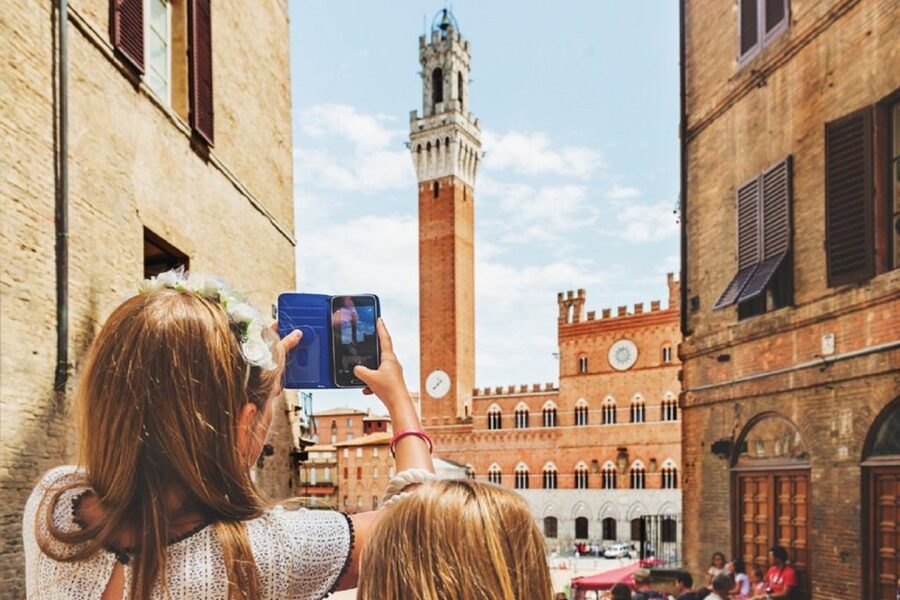
The walk continues toward Piazza del Campo, Siena’s great shell-shaped square. This is the place where the city’s civic life, public celebrations, and famous horse race meet.
Your guide should explain why the square matters beyond its good photographs. The Piazza del Campo is the setting for the Palio, Siena’s dramatic bareback horse race, held around the central area twice each summer. The race lasts only a short time, but its meaning reaches into the city’s neighborhoods, churches, clubs, and family traditions.
The key word is contrada. Siena is divided into historic neighborhood districts, each with its own name, symbols, colors, church, and social life. These districts compete in the Palio, but their identity is not limited to race days. A good explanation helps you see that the flags and emblems around Siena are signs of belonging, not just decoration for tourists.
The tour also introduces the noble families who shaped Siena. The Piccolomini, Tolomei, and Salimbeni families left their mark through palazzos, political influence, banking, and church connections. Their names can blur together when you see them on plaques or hear them in a fast history lesson, so this is where a guide adds real value.
I would pay close attention to the way the guide explains the difference between Siena’s public image and its private loyalties. The Palio is not simply an event to watch. It is tied to neighborhood pride and long-standing relationships. That background makes the city feel more understandable when you explore it later.
The square is also one of the busiest places in Siena. On a Palio day, access and movement can become difficult. One booking took place immediately before the Palio, and the experience was described as good despite the hectic setting. If you visit during Palio preparations, expect crowds, barriers, decorations, and a city running on a different rhythm.
Palazzo Comunale and Siena’s civic ambition
At the lower edge of Piazza del Campo, Palazzo Comunale gives the tour a chance to explain Siena as a self-governing medieval city. The building is the city hall, and its position makes the relationship between public power and the main square easy to understand.
The palace is often called the Palazzo Pubblico, while Palazzo Comunale is also used. The important point for you is its role: this was the seat of civic authority, set directly beside the space where the people gathered.
The guide will likely connect the building to Siena’s noble families and political development. You may hear how different groups influenced the city and how art served public as well as religious purposes. Siena’s major monuments were not built only to impress. They expressed civic pride, faith, wealth, and rivalry.
The tour is focused on outdoor orientation rather than an extended palace visit. That is useful if you want a quick introduction, but it also limits the amount of art and architecture you can examine closely. If Palazzo Comunale interests you most, plan to return independently after the walk.
This is one reason I recommend taking the tour near the start of your stay. It helps you decide where to spend your own time. One person described the experience as a good way to learn what deserved a return visit later in the week. That is exactly the right expectation: use the tour as a guide to Siena, not as a replacement for every museum and church.
Siena Cathedral and its remarkable art collection
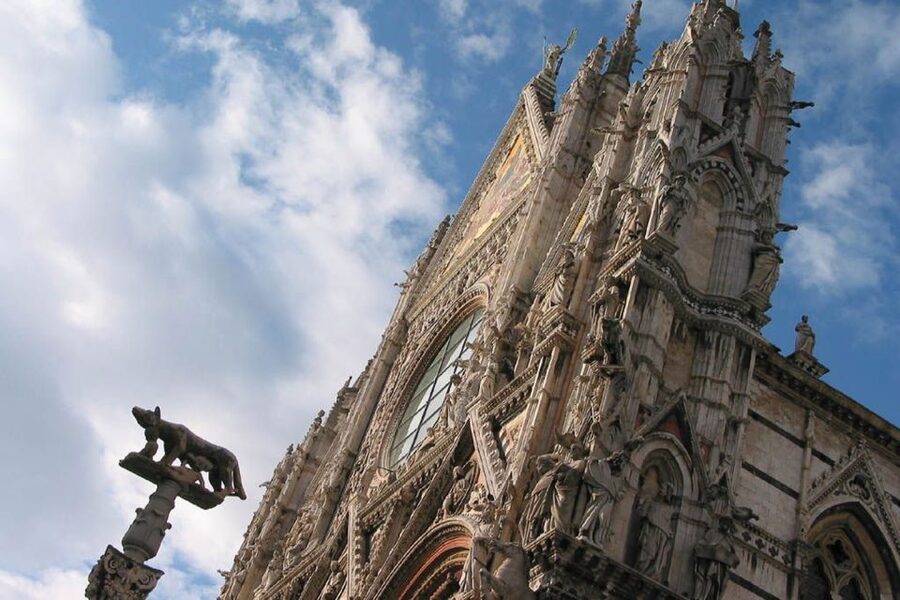
The cathedral is the strongest practical reason to consider this tour. Admission is included, so the $34 price covers an important ticket as well as the guide and walking route.
Inside, the guide introduces a long list of artists and works. You can expect references to Giovanni Pisano, Duccio di Buoninsegna, Donatello, Pinturicchio, and Gianlorenzo Bernini. That range matters because the cathedral is not built around one period or one artistic style. Its decoration developed over centuries, and each artist adds a different layer.
Duccio is especially important to Siena’s artistic identity. Pisano contributed sculpture and architectural detail. Donatello brought his own approach to Renaissance sculpture. Pinturicchio is associated with the Piccolomini Library, where colorful frescoes recount the life of Enea Silvio Piccolomini, who became Pope Pius II. Bernini represents a later Baroque moment, with more theatrical movement and expression.
Without guidance, you can admire the striped marble walls and patterned floors but miss the reason individual works matter. The cathedral is visually busy. A guide can direct your attention to the artists, stories, and details that might otherwise pass unnoticed.
The cathedral floor deserves special planning. During summer, parts of the marble pavement may be uncovered for viewing. It is a major work in the history of European art, made from elaborate marble designs and scenes. This seasonal access is one of the tour’s most appealing details, but the exact floor opening schedule can vary. Check what will be visible on your date.
There is an important limitation. Cathedral admission is not available on Sundays and bank holidays. If you book for one of those dates, the activity visits another museum instead. That does not make the tour useless, but it changes the value of the package. If seeing the cathedral is your main goal, choose a weekday or a date when admission is confirmed.
Also note a practical warning about the ticket. A past participant understood that the cathedral ticket allowed multiple entries over three days, but was permitted only one entry. Assume the ticket is for a single visit unless the guide or operator clearly tells you otherwise. Do not leave and plan on returning later without checking.
A few more Siena bookings to compare
- From Florence: San Gimignano, Siena, and Chianti Wine Tour
★ 4.5 · 3,762 reviews - Siena: Siena Cathedral and Piccolomini Library Entry Ticket
★ 4.5 · 3,462 reviews - Siena: Cathedral Complex Pass with Audio Guide (OPA SI PASS)
★ 4.4 · 2,773 reviews - Small-Group Brunello di Montalcino Wine-Tasting Trip from Siena
★ 5.0 · 952 reviews
Basilica di San Domenico and Siena’s religious identity
The Basilica Cateriniana di San Domenico is both the meeting point and one of the city’s major religious landmarks. Its connection to Saint Catherine makes it especially important in a city where faith and local identity are closely linked.
The tour uses churches to explain more than decoration. Siena’s saints, pilgrims, religious communities, and noble patrons all affected the city’s growth. You will hear stories of pilgrimage and saintliness alongside the political stories of families and civic leaders.
That mixture is one of the better features of the route. You are not simply moving from church to square to palace. You are learning why those buildings were created and why Siena’s people cared about them.
The basilica is also a useful reminder that Siena’s famous center is still a lived-in city. Religious buildings, neighborhood organizations, and local traditions remain part of its identity. The Palio may attract the biggest international attention, but the city’s character was shaped by centuries of ordinary loyalties and religious practice.
The tour does not promise a long, specialized visit inside every church. If you want detailed architectural study, you will need more time on your own. For a first orientation, though, the church adds a strong sense of place.
Noble palazzos, saints, and the people behind the stones
The named families, Piccolomini, Tolomei, and Salimbeni, give the walking route a human thread. Their palazzos are not just old façades. They point to the money, alliances, conflicts, and status that shaped Siena.
A guide can make these names easier to remember by tying them to visible buildings and stories. That is far more useful than memorizing a list of dates. When you later pass a palace or notice a family name, you have a reason to stop and look.
The tour also explains the city’s development over the centuries. Siena’s streets and monuments are the result of many stages, not a single medieval building campaign. Religious influence, civic authority, banking, trade, and local competition all appear in the story.
This is where a live guide beats an audio recording. You can ask questions and follow up on the subjects that interest you most. One past participant particularly appreciated being able to ask questions, while several others praised the clear historical explanations and the sense of local life they gained.
Because the tour is short, you may receive a little about many subjects rather than a long lesson on one family or monument. I see that as a reasonable trade for a first visit. If you want every architectural detail, choose a specialist tour or spend extra time inside the museums afterward.
How long the tour really takes
The timing needs careful attention. The activity information gives a duration of one hour, while the overview describes a 90-minute walking tour. Older descriptions connected with the experience also refer to a two-hour format.
That difference matters because Siena has much to cover. Piazza del Campo, Palazzo Comunale, the cathedral, San Domenico, noble palazzos, the Palio, and several centuries of history cannot all receive equal attention in one hour.
I would plan for a compact walk of roughly one to one and a half hours, then confirm the exact duration when you check available starting times. Do not schedule a train, meal, or museum visit immediately afterward unless you have a comfortable buffer.
The short format is useful for a day trip. You can get a clear introduction early, then explore the cathedral, streets, and museums at your own pace. It is less suitable if you want a detailed art lecture or long stops inside each major building.
Groups of more than 15 people receive earphones. That is helpful in narrow streets and busy squares, where it can be hard to hear a guide. Smaller groups may feel more personal, and one past booking happened with only two people, but group size can vary.
Is $34 good value in Siena?
At $34 per person, the price is fair if you want both a guide and cathedral entry. You are paying for a local explanation of Siena’s history, a route through the central sights, and access to one of Italy’s most important cathedrals.
The value is strongest for first-time visitors and short stays. If you have one day in Siena, an hour with a guide can prevent you from wandering past important buildings without understanding them. It can also help you decide which places deserve a second visit.
The value is weaker if you already know Siena well or plan to spend hours studying the cathedral independently. The tour is an overview, not a private art seminar. Its appeal comes from connection: the guide links the Palio, noble families, saints, palazzos, and monuments into one story.
Food and drinks are not included. That is not a serious issue because the activity is short, but you should plan your own break before or after the walk.
The booking terms are traveler-friendly. You can cancel up to 24 hours in advance for a full refund, and the reserve-now, pay-later option lets you hold a place without paying immediately. Availability and starting times should still be checked for your date.
Who should book this walking tour?
I would choose this tour if you are visiting Siena for one or two days, arriving without much background, or interested in the Palio and local identity. It is also a good first activity for anyone who likes to understand a place before exploring on their own.
Families can benefit from the compact route, since the guide gives the city a clear storyline rather than asking you to absorb every monument at once. One family found that everyone enjoyed the experience, and the format should suit people who prefer a short introduction to a full-day excursion.
I would hesitate if you need step-free access. The activity is specifically not suitable for wheelchair users, and Siena’s historic center can be demanding even apart from the tour’s stated limitation.
You should also think twice if the cathedral is your top priority and you can visit only on Sunday or a bank holiday. The route changes to another museum on those dates, so you will not receive the cathedral visit described here.
Should you book Discover Siena?
Book it if you want a short, useful orientation with a strong focus on Siena’s people and traditions. The best parts are the explanation of the contrade and Palio, the connections to families such as the Piccolomini and Salimbeni, and the included cathedral ticket.
Choose a weekday if possible, especially in summer when the marble floor may be open. Take the tour early in your stay, listen closely to the local stories, and leave time afterward for the cathedral or Palazzo Comunale if one of them catches your interest.
Skip it if you want a long museum visit, guaranteed access to every interior, or a tour designed for wheelchair users. For most first-time visitors who value context and have limited time, $34 is a sensible way to get oriented before Siena’s steep lanes and grand buildings begin to blur together.
FAQ
Where does the Siena walking tour meet?
Meet your guide in front of Basilica Cateriniana di San Domenico at Piazza San Domenico 1, 53100 Siena, Italy.
How much does the tour cost?
The price is $34 per person.
How long does the tour last?
The activity information lists one hour, while the tour description gives 90 minutes. Confirm the exact duration and starting time when checking availability.
What sights are included?
The route includes Piazza del Campo, Palazzo Comunale, Siena Cathedral, and Basilica di San Domenico, along with historic palazzos connected to the Piccolomini, Tolomei, and Salimbeni families.
Is Siena Cathedral admission included?
Yes. The cathedral entrance ticket is included when cathedral admission is available.
Can I visit the cathedral on a Sunday or bank holiday?
No. Cathedral admission is not available on Sundays and bank holidays. A Sunday booking visits another museum instead.
What languages are available?
Live guides are available in English, Spanish, and Italian.
Is the tour suitable for wheelchair users?
No. The activity is listed as not suitable for wheelchair users.
Recently added around Siena
- Total Immersion Wine Tour in Chianti★ 4.9 · 430 reviews
- From Siena: Pienza and Montepulciano Small-Group Tour★ 4.9 · 220 reviews
- Siena: Walking Tour and Skip-the-Line Duomo Tickets★ 4.8 · 1,116 reviews
- Siena Walking Tour with Cathedral and Crypt & Museum Option★ 4.9 · 380 reviews
- Siena: Horseback Riding Tour in the Tuscany Countryside★ 4.8 · 177 reviews
- Siena: Pasta and Tiramisu Cooking Class with Wine★ 4.8 · 274 reviews
- San Gimignano: Lunch or Dinner at a Winery with Wine Tasting★ 4.7 · 177 reviews
- Siena: San Gimignano, Chianti & Montalcino Small-Group Tour★ 4.6 · 195 reviews
Walking Tours, compared.
Guided Walking Tour & Last Supper Visit with Ticket
Read our review →
Rialto Bridge & Offbeat Unusual Venice Walking Tour
Read our review →
Private 3 hrs Venice Tour: St Mark’s, Walking tour & Boat tour
Read our review →
Skip the line: Uffizi and Accademia Small Group Walking Tour
Read our review →Browse the lists this tour appears in