
Reviewed · COLOSSEUM & ROMAN FORUM TOURS
Ultimate Colosseum, Roman Forum & Palatine Hill Small Group Tour
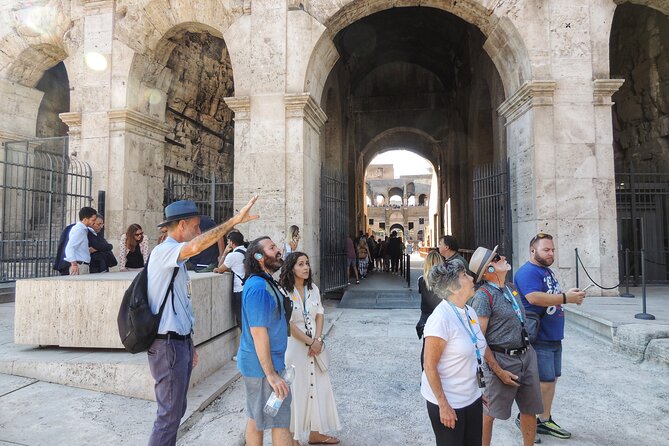
Ancient Rome rewards a good guide. This three-hour walk links the Roman Forum, Palatine Hill, and Colosseum in one well-planned visit, with advance entry and a small group capped at 10 people. I especially like the personal feel and the chance to hear about Julius Caesar, Vestal Virgins, gladiators, and Roman emperors in the places where their stories unfolded. The main drawback is the setting itself: crowds, heat, stairs, and uneven stones can make parts of the visit tiring.
I also like that the tour finishes at the Colosseum, where the story reaches its dramatic peak. Guides such as Donatella Mauceri, Alessandro, Luca, Marco, Francesco, Amanda, and John Tinto have earned praise for clear English, humor, patience, and strong command of Roman history. Still, you should know that this experience does not include the Colosseum’s lower levels, and some parts of the Forum may be closed during restoration.
In This Review
- Key points to know before booking
- Why this three-hour route works in Rome
- Roman Forum: Rome’s old civic center
- The Forum’s temples and basilicas
- Palatine Hill: palaces, gardens, and city views
- Piazza del Colosseo and the Arch of Constantine
- Entering the Colosseum with advance tickets
- The guide can make or break the visit
- Price, pace, and physical demands
- Who should book this ancient Rome tour?
- Should you book it?
- FAQ
- How long does the tour last?
- Which sites are included?
- What language is the tour offered in?
- How large is the group?
- Are Colosseum tickets included?
- Does the tour visit the lower levels of the Colosseum?
- What should I bring or prepare?
Key points to know before booking
- Up to 10 people: A genuinely small group makes it easier to hear the guide and ask questions in crowded ruins.
- Three major ancient sites: You visit the Roman Forum, Palatine Hill, and Colosseum on one walking tour.
- Strong guide element: The best part of the experience is the storytelling, with guides praised for warmth, humor, and detailed explanations.
- Advance entry included: Your Colosseum ticket and reservation fee are covered, helping you avoid the regular ticket line.
- Physical walking required: Expect steps, staircases, cobblestones, and uneven surfaces. Good shoes and water matter.
- No lower Colosseum access: This is a classic Colosseum visit, not an underground or arena-floor tour.
Why this three-hour route works in Rome
Rome’s ancient center is easier to understand when you see the sites together. The Forum was the civic heart, the Palatine was the address of emperors and noble families, and the Colosseum was the great arena for public spectacle.
You meet at Largo Corrado Ricci, near the Forum, then work through the ruins before reaching the Palatine Hill and Colosseum. That order gives you useful context before you enter the amphitheater. Instead of seeing the Colosseum as an isolated stone shell, you begin to understand the city that built and used it.
The tour lasts about three hours. That is long enough to cover the main sights but short enough to fit into a busy Rome schedule. You will be on your feet for most of it, though the exact pace depends on the guide, the group, the heat, and the crowds.
The group size is one of the tour’s strongest features. A group of 10 is small enough for a guide to answer questions and adjust the pace when needed. Headsets are supplied for groups of six or more, which helps when the guide is explaining something from a few steps away or the site is noisy.
More Colosseum and Roman Forum tickets:
- Colosseum, Roman Forum & Palatine Guided Tour
★ 4.7 · 63,148 reviews - Rome: Colosseum, Palatine Hill and Roman Forum Guided Tour
★ 4.8 · 32,814 reviews - Rome: Guided Tour of Colosseum, Roman Forum & Palatine Hill
★ 4.7 · 27,897 reviews
Roman Forum: Rome’s old civic center
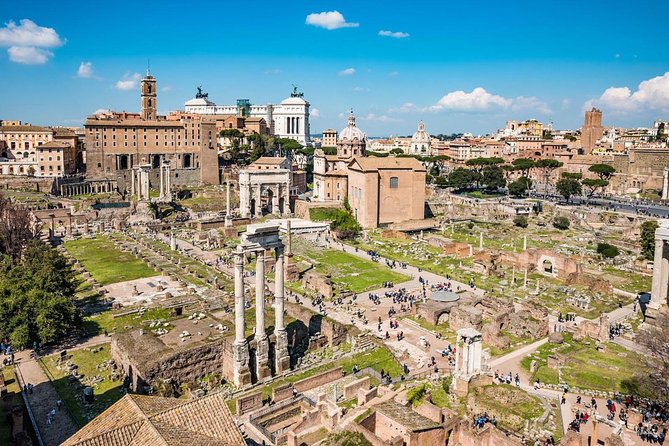
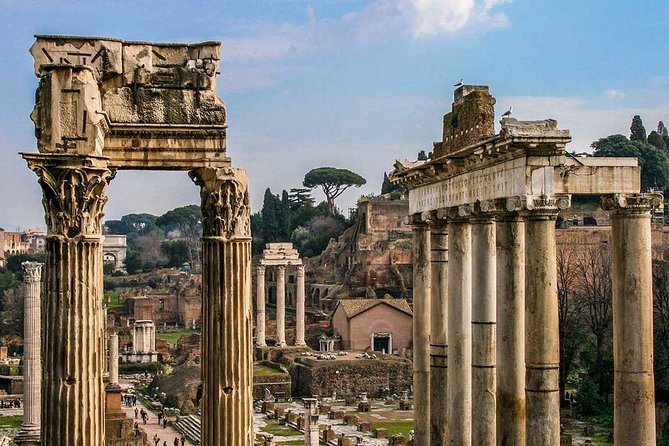
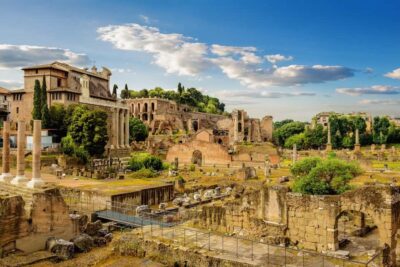
The Roman Forum is where the tour begins in earnest. It was once a marketplace and later became the center of public life, government, religion, law, and politics. Today, it is a broad field of columns, arches, foundations, and broken temples, so a guide is especially useful here.
Without explanation, the Forum can feel like a scattered pile of ruins. With context, the ancient streets begin to make sense. You learn how ordinary Romans lived, worked, worshiped, and moved through this crowded center of public life.
The main Forum visit takes about an hour. That is valuable time because the area contains more than one famous monument. The guide points out the Senate, the Temple of Saturn, the Basilicas of Julia and Maxentius, and the House of the Vestal Virgins.
The Senate is a reminder that Roman politics happened here, not in some distant palace. The Basilica Julia was a large public building used for meetings and official business. The Basilica of Maxentius, one of the largest structures in the Forum, gives you a sense of the scale of Roman engineering even though much of it has disappeared.
The House of the Vestal Virgins is a smaller but more intimate stop. These priestesses cared for the sacred fire of Vesta and lived in a residence near the temple. The surviving ruins help put religious life beside political and commercial life, all within the same compact city center.
You also hear about the funeral of Julius Caesar and the beheading of Cicero, two events tied to the Forum. These stories add human drama to the stones, though the amount of detail can vary by guide. Some guides keep the information moving, while others may spend longer on historical explanation.
One important practical point: parts of the Forum can be closed because of restoration or site work. The tour still covers the main area, but you should be prepared for a route that changes.
The Forum’s temples and basilicas
The brief stops at individual monuments help you read the site as you walk. The Temple of Saturn, at the western end near the Capitoline Hill, recalls the old religious traditions that shaped Roman public life.
The Basilica Julia shows how much of the Forum was devoted to public business. It was not a church in the modern sense, but a large official building where meetings and legal work took place.
The Basilica of Maxentius is especially impressive because of its size. It was the largest building in the Forum and the last Roman basilica built in the city. Even in ruin, its surviving arches give you a good idea of the ambition behind imperial construction.
Another structure on the route is unusually well preserved because it became part of the entrance to the Church of Saints Cosma and Damiano. This is one of the pleasures of Rome: ancient buildings were often reused instead of cleared away, leaving different periods of the city pressed together.
The downside is that these stops are short. Ten minutes at a monument is enough for an explanation and a look, but not for a slow architectural study. If you want extensive time for photographs or detailed examination, you may want to return on your own.
Palatine Hill: palaces, gardens, and city views
From the Forum, the route climbs to Palatine Hill. This is where you will feel the physical side of the tour most clearly. The walk includes stairs and uneven ground, and the open site offers limited relief from the sun.
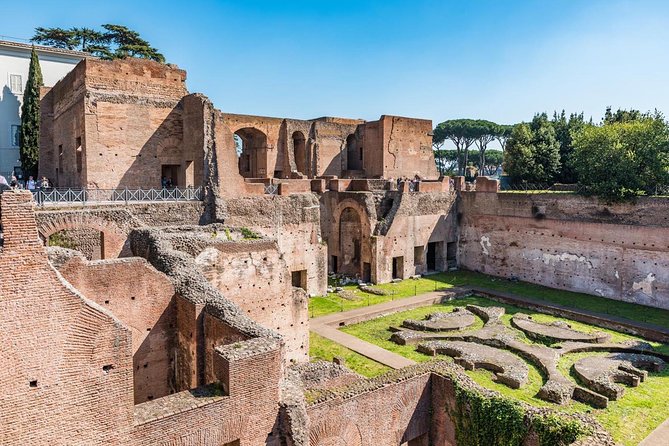
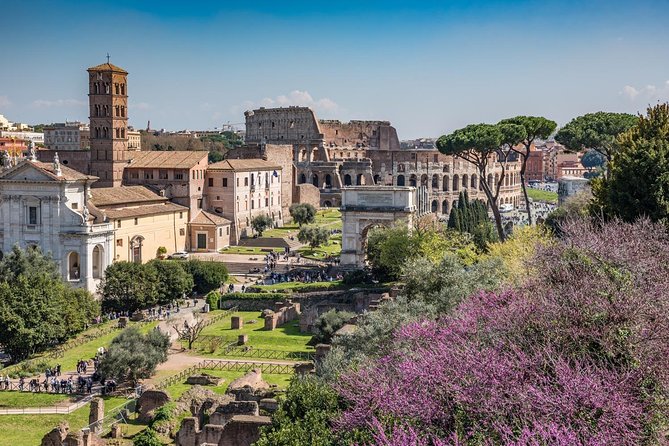
The effort pays off with views over the Forum and Colosseum. The hill was one of the most desirable places to live in ancient Rome, and the view helps explain why emperors and wealthy families wanted their homes here.
The Palatine is linked to the story of Romulus and Remus, the legendary founders of Rome. According to the myth, the twins were raised by a wolf, and the hill became part of Rome’s foundation story. The story is less a simple fact than a window into how Romans explained their own origins and used myth to give the city prestige.
The ruins include former villas and imperial buildings, including the Flavian Palace, the Stadium of Domitian, and the Baths of Septimius Severus. You see fragments of rooms, walls, courtyards, and garden spaces rather than complete residences.
The guide’s job here is to help you picture the vanished palace complex. A good explanation can turn a low wall into part of a reception hall or garden plan. Several guides have been praised for taking the group into shady areas while explaining the site, a useful touch during Rome’s hot months.
The Palatine portion lasts about 30 minutes according to the planned route. That is enough for the major sights and views, but it is not a full archaeological survey. If you are especially interested in imperial architecture, you may wish the visit were longer.
A few more Rome bookings to compare
- Vatican: Museums & Sistine Chapel Entrance Ticket
★ 4.5 · 144,003 reviews - Vatican Museums & Sistine Chapel Tour with Optional Basilica
★ 4.3 · 67,413 reviews - Vatican Museums, Sistine Chapel & St Peter’s Basilica Guided Tour
★ 4.5 · 39,149 reviews - Rome: Colosseum & Forum with Audio Guide App -Optional Arena
★ 4.2 · 24,770 reviews
Piazza del Colosseo and the Arch of Constantine
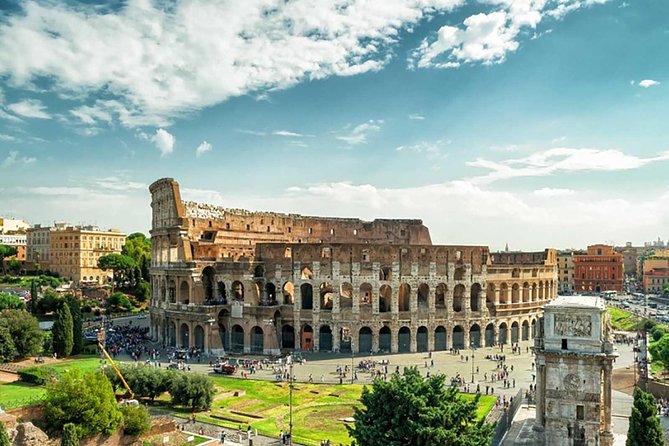
The route passes through Piazza del Colosseo before entering the amphitheater. This short stop gives you a chance to see the Colosseum from outside and orient yourself among the surrounding streets.
Nearby is the Arch of Constantine, built in AD 315 to mark Constantine’s victory over Maxentius. Its three arches and carved decoration make it an important part of the approach to the Colosseum.
This is also where the crowds become most noticeable. The square is a major meeting point, and the Colosseum draws visitors throughout the day. Keep your belongings secure around the Colosseum and on the metro, where pickpocketing can be a concern.
The tour begins at Largo Corrado Ricci and ends at Piazza del Colosseo, 1. That one-way arrangement is convenient because you do not have to walk back to the starting point. The Colosseum metro station is nearby, making it easy to continue to another part of Rome after the tour.
Entering the Colosseum with advance tickets
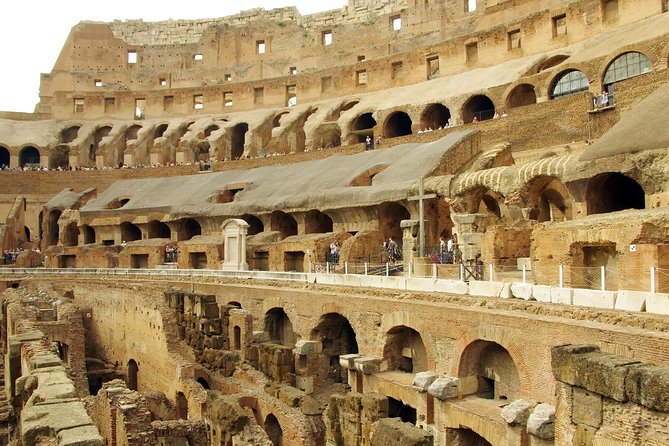
The Colosseum gets its own hour on the route, and this is the moment many people anticipate most. The amphitheater was built to hold more than 50,000 spectators for gladiatorial contests and animal hunts. Its size is still striking, even with the missing outer walls and stripped marble.
The guide explains how the games worked, what happened behind the scenes, and how gladiators and enslaved people were forced into the arena. That human element matters. The building was not simply an engineering achievement. It was also a place designed for public violence, status, and political theater.
Advance entry is included, along with the Colosseum ticket listed at €18 per person and a €2 reservation fee. At a total price of $94.37 per person, the tour is not the cheapest way to enter the site, but the extra cost pays for the guide, group organization, headsets when needed, and the Forum and Palatine visit.
For many people, that is a fair trade. The Colosseum ticket alone does not explain the ruins, and the Forum can be confusing without help. The value depends on how much you want interpretation. If you prefer to wander silently and read at your own pace, the added cost may not suit you.
The standard visit does not include the lower levels of the Colosseum. That is an important distinction when comparing tours. You see the main public areas included in this route, but not every special-access section.
The guide can make or break the visit
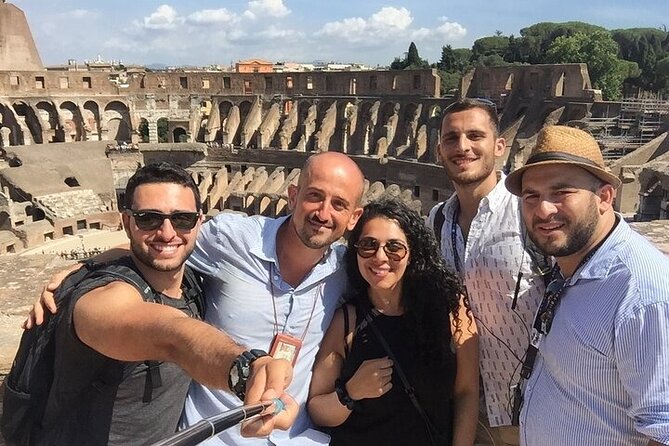
The strongest praise is directed at the guides. Donatella Mauceri is noted for detailed explanations, photographs, and a warm manner. Alessandro is praised for keeping a mixed-age family comfortable without rushing anyone. Luca, described as an archaeologist and historian, received strong marks for his command of Roman history.
Marco is praised for fluent English, well-timed explanations, and effective use of headsets. Amanda is remembered for mixing passion and humor. John Tinto is described as both funny and exceptionally well informed. Francesco, Ricardo, Tom, Frank, and others also receive praise for clear storytelling and care in hot weather.
Of course, a tour is not a machine. Guides have different styles. Some may offer a large amount of information, repeat points, or wander into side topics. One account describes too little explanation early in the tour and a long talk in the sun near the Colosseum. That is useful to know if you prefer a tightly scripted route.
The small group helps reduce this risk because you can ask for clarification or signal when you need a short pause. It also makes it easier to stay together in crowded areas.
Price, pace, and physical demands
At $94.37 per person, this is a mid-to-high priced walking tour. The cost includes admission fees, the reservation fee, and an English-speaking guide, so you are paying for more than a basic ticket.
I see the best value for a first visit to Rome, especially if you want one clear introduction to the ancient center. The tour joins three major sites and saves you from building your own route through a large archaeological area.
The pace is generally described as well managed, but the environment can make it feel fast. Crowds may force the group to keep moving, and the guide may need to stop in whatever patch of shade is available. If you want long photo stops, quiet reflection, or detailed museum time, this may feel too structured.
Wear comfortable walking shoes. Bring water. The ground is uneven, and the route includes steps and staircases. A moderate level of fitness is expected. If anyone in your party has mobility concerns, share that when booking so the operator can assess possible accommodations.
Arrive 10 minutes early at Largo Corrado Ricci. Late arrivals cannot be held for, which matters in Rome’s busy streets. Every person must carry a passport or government-issued photo ID matching the name supplied at booking, and the booking must include the full names of everyone attending. For children, provide their ages by email as requested.
The tour is offered in English only. Free cancellation is available up to 24 hours before the start time. Cancellations or changes made inside that window are not accepted for a refund.
Who should book this ancient Rome tour?
I would choose this tour for a first-time Rome visit, families who want a guide to keep the day moving, and anyone who finds ruins difficult to read without context. It also suits people who value a small group and want to ask questions.
The route can work well for mixed-age groups, though children and older adults need to be comfortable walking on rough ground. Guides have shown care with elderly people and have adjusted the pace for families, but the physical setting cannot be softened completely.
I would look elsewhere if you specifically want underground Colosseum access, the arena floor, a private tour, or a slow archaeological study. I would also think twice if you dislike crowds or find three hours of walking in the sun too demanding.
Should you book it?
Book this tour if you want the major ancient sights explained in plain English, with advance entry and a small group that is easier to manage. The Roman Forum and Palatine Hill are far more rewarding when someone explains what stood where, and the Colosseum gains weight when you learn about the people forced to perform there.
Skip it if you already know ancient Rome well or prefer exploring alone. For most first-time visitors, though, the combination of strong guides, a practical three-hour route, and included entry makes the $94.37 price reasonable, provided you accept the crowds and the missing lower levels.
FAQ
How long does the tour last?
The tour lasts approximately three hours.
Which sites are included?
The tour includes the Roman Forum, Palatine Hill, and Colosseum. It also passes Piazza del Colosseo and the Arch of Constantine.
What language is the tour offered in?
The tour is offered in English.
How large is the group?
The tour has a maximum of 10 participants according to the additional tour information.
Are Colosseum tickets included?
Yes. The Colosseum entrance ticket and reservation fee are included in the price.
Does the tour visit the lower levels of the Colosseum?
No. The tour does not include the lower parts of the Colosseum.
What should I bring or prepare?
Wear comfortable walking shoes and bring a bottle of water. The route includes steps, staircases, cobblestones, and uneven surfaces. Bring a valid passport or government-issued photo ID matching the name used at booking, and arrive 10 minutes early at Largo Corrado Ricci.
Recently added around Rome
- Rome: Pantheon, Trevi Fountain & Roman Squares Guided Tour★ 4.7 · 386 reviews
- Vatican: Pope Francis Tomb and Papal Basilicas Tour★ 4.7 · 340 reviews
- Vatican: St. Peter’s Basilica with Audio Guide and Options★ 3.4 · 269 reviews
- Rome: Vatican Museums Skip-the-line Entry Ticket and Tour★ 4.2 · 400 reviews
- Rome: Vatican Museums & Sistine Chapel Ticket + Tour Options★ 4.7 · 344 reviews
- Vatican: Museums, Raphael & Sistine Chapel + Basilica Option★ 4.7 · 350 reviews
- Vatican Museums & Sistine Chapel Guided Tour★ 4.3 · 832 reviews
- Vatican Museums & Sistine Chapel Entry Ticket★ 4.4 · 245 reviews
Colosseum & Roman Forum Tours, compared.
Colosseum, Roman Forum & Palatine Guided Tour
Read our review →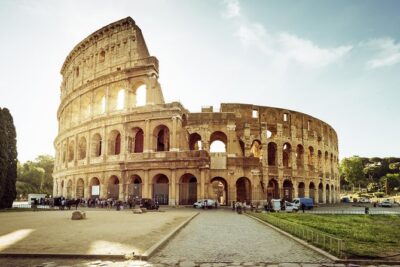
Colosseum, Palatine Hill and Roman Forum Guided Tour
Read our review →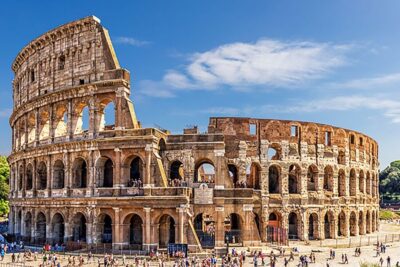
Guided Tour of Colosseum, Roman Forum & Palatine Hill
Read our review →
Colosseum & Forum with Audio Guide App -Optional Arena
Read our review →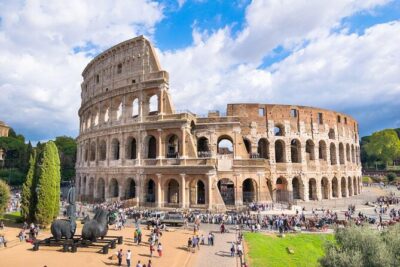
Colosseum, Roman Forum and Palatine Hill Guided Tour
Read our review →
Colosseum, Forum & Palatine Hill Tour & Optional Arena
Read our review →
Colosseum, Roman Forum, Palatine with Multimedia Video
Read our review →
Colosseum, Palatine Hill & Roman Forum Guided Tour
Read our review →Browse the lists this tour appears in